
7 MIMO I Spatial Multiplexing and Channel Modeling

- Slides: 42
7: MIMO I: Spatial Multiplexing and Channel Modeling 7. MIMO: Spatial Multiplexing and Channel Modeling Fundamentals of Wireless Communication, Tse&Viswanath 1
7: MIMO I: Spatial Multiplexing and Channel Modeling Main Story • So far we have only considered single-input multi-output (SIMO) and multi-input single-output (MISO) channels. • They provide diversity and power gains but no degree-offreedom (d. o. f. ) gain. • D. o. f gain is most useful in the high SNR regime. • MIMO channels have a potential to provide d. o. f gain. • We would like to understand how the d. o. f gain depends on the physical environment and come up with statistical models that capture the properties succinctly. • We start with deterministic models and then progress to statistical ones. Fundamentals of Wireless Communication, Tse&Viswanath 2
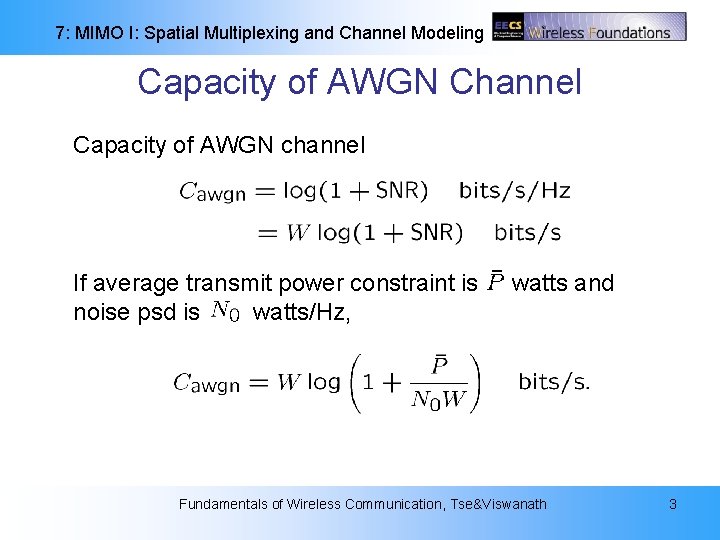
7: MIMO I: Spatial Multiplexing and Channel Modeling Capacity of AWGN Channel Capacity of AWGN channel If average transmit power constraint is noise psd is watts/Hz, watts and Fundamentals of Wireless Communication, Tse&Viswanath 3
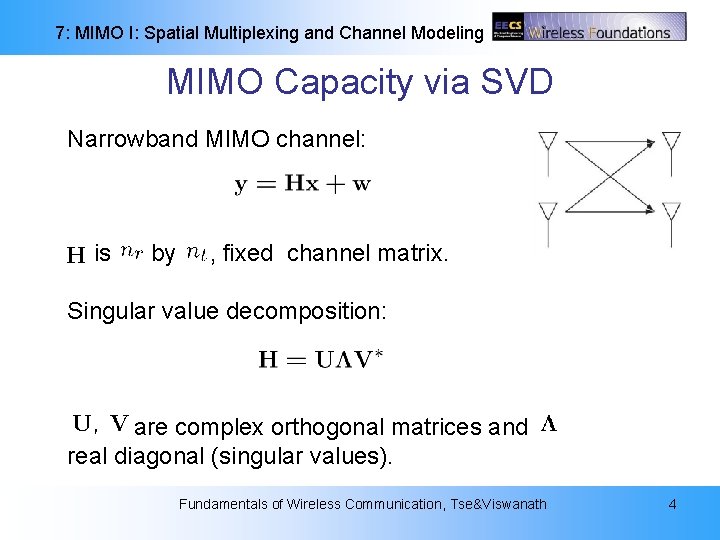
7: MIMO I: Spatial Multiplexing and Channel Modeling MIMO Capacity via SVD Narrowband MIMO channel: is by , fixed channel matrix. Singular value decomposition: are complex orthogonal matrices and real diagonal (singular values). Fundamentals of Wireless Communication, Tse&Viswanath 4
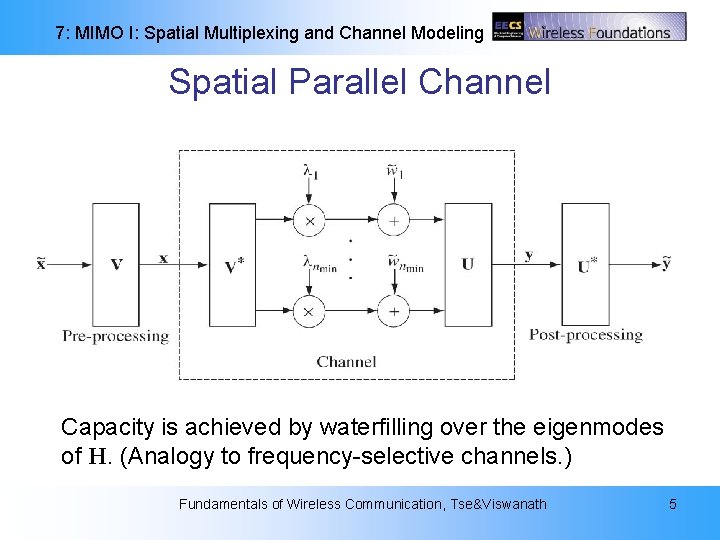
7: MIMO I: Spatial Multiplexing and Channel Modeling Spatial Parallel Channel Capacity is achieved by waterfilling over the eigenmodes of H. (Analogy to frequency-selective channels. ) Fundamentals of Wireless Communication, Tse&Viswanath 5
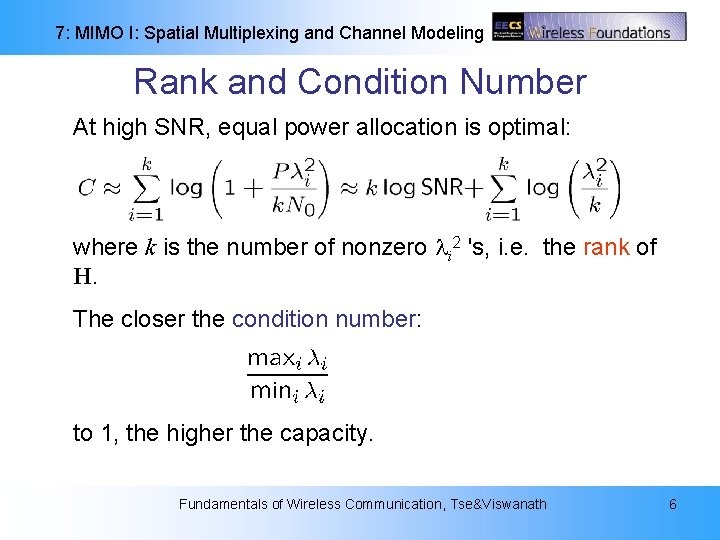
7: MIMO I: Spatial Multiplexing and Channel Modeling Rank and Condition Number At high SNR, equal power allocation is optimal: where k is the number of nonzero i 2 's, i. e. the rank of H. The closer the condition number: to 1, the higher the capacity. Fundamentals of Wireless Communication, Tse&Viswanath 6
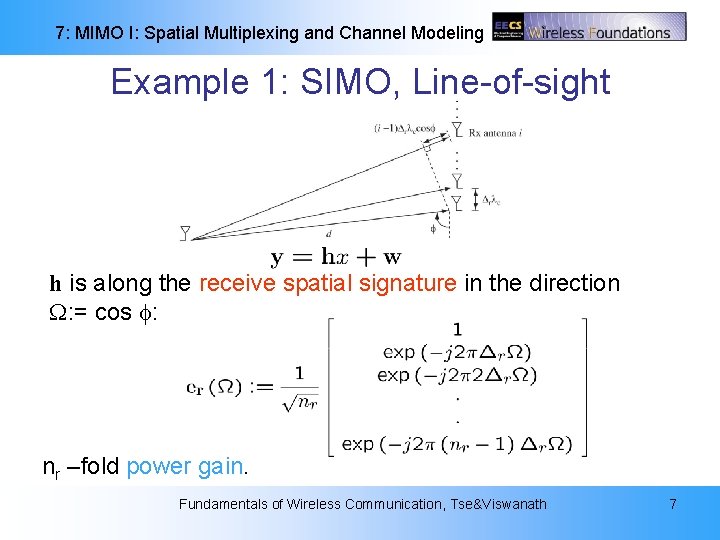
7: MIMO I: Spatial Multiplexing and Channel Modeling Example 1: SIMO, Line-of-sight h is along the receive spatial signature in the direction : = cos : nr –fold power gain. Fundamentals of Wireless Communication, Tse&Viswanath 7
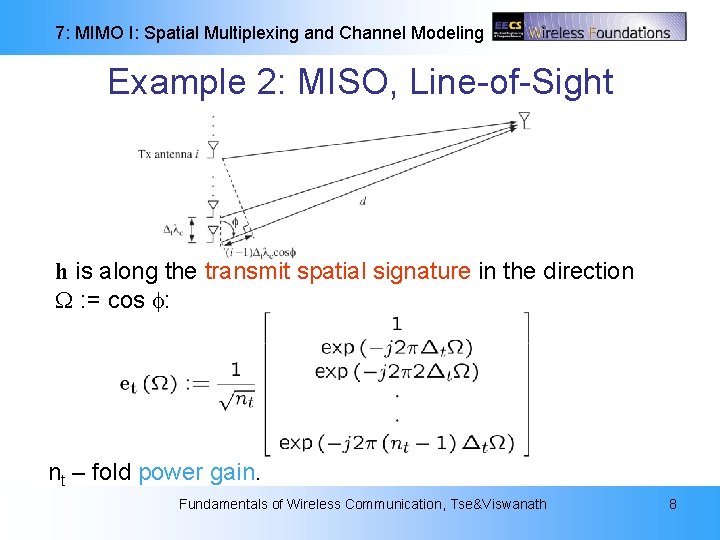
7: MIMO I: Spatial Multiplexing and Channel Modeling Example 2: MISO, Line-of-Sight h is along the transmit spatial signature in the direction : = cos : nt – fold power gain. Fundamentals of Wireless Communication, Tse&Viswanath 8
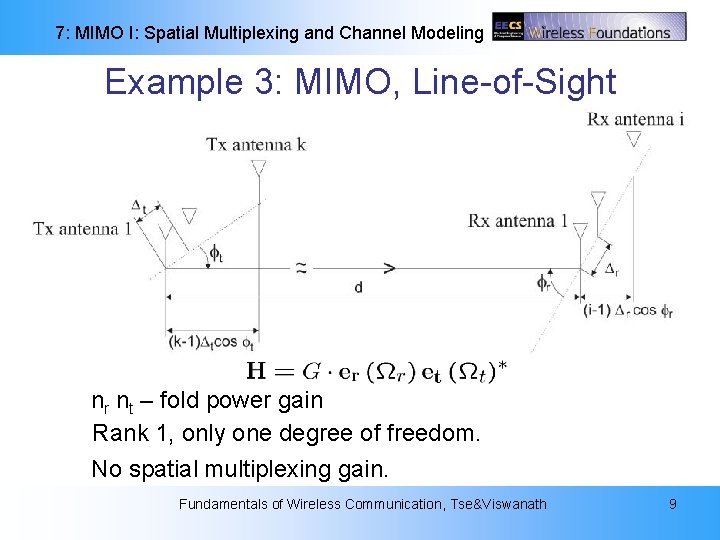
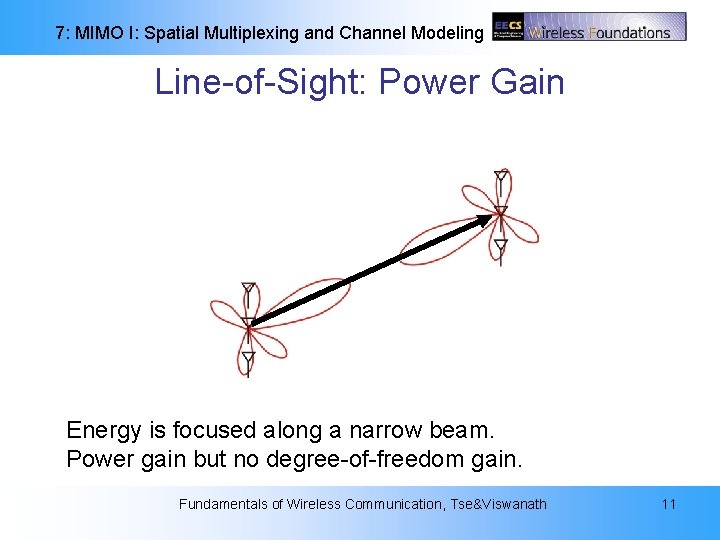
7: MIMO I: Spatial Multiplexing and Channel Modeling Example 3: MIMO, Line-of-Sight nr nt – fold power gain Rank 1, only one degree of freedom. No spatial multiplexing gain. Fundamentals of Wireless Communication, Tse&Viswanath 9
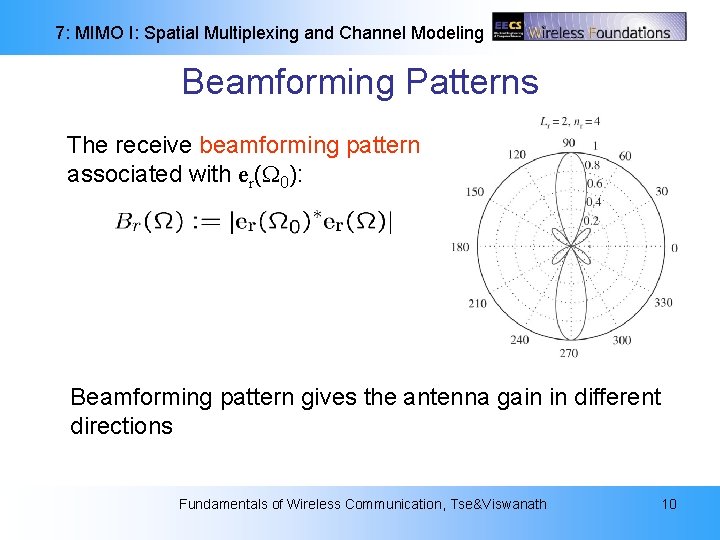
7: MIMO I: Spatial Multiplexing and Channel Modeling Beamforming Patterns The receive beamforming pattern associated with er( 0): Beamforming pattern gives the antenna gain in different directions Fundamentals of Wireless Communication, Tse&Viswanath 10
7: MIMO I: Spatial Multiplexing and Channel Modeling Line-of-Sight: Power Gain Energy is focused along a narrow beam. Power gain but no degree-of-freedom gain. Fundamentals of Wireless Communication, Tse&Viswanath 11
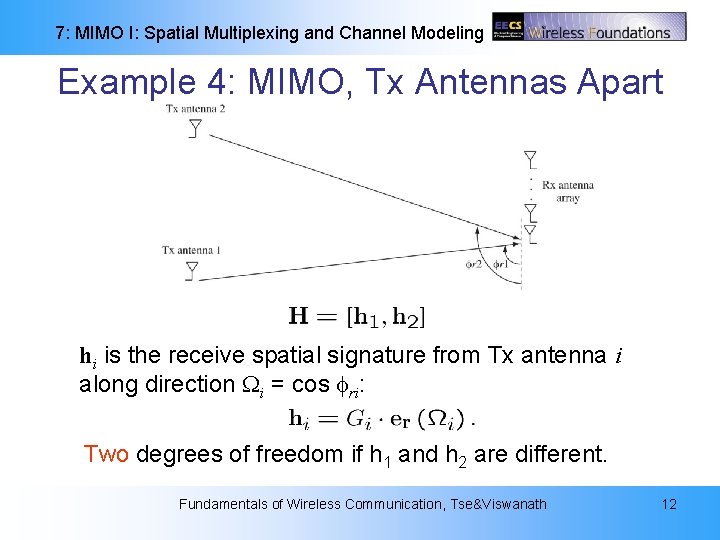
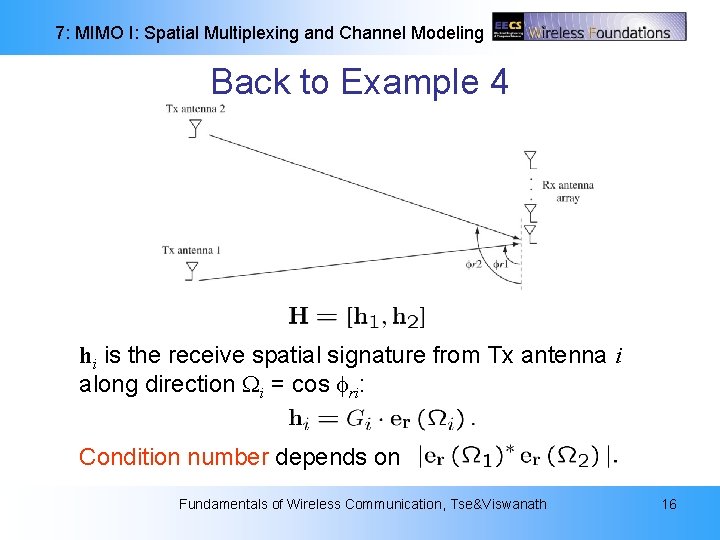
7: MIMO I: Spatial Multiplexing and Channel Modeling Example 4: MIMO, Tx Antennas Apart hi is the receive spatial signature from Tx antenna i along direction i = cos ri: Two degrees of freedom if h 1 and h 2 are different. Fundamentals of Wireless Communication, Tse&Viswanath 12
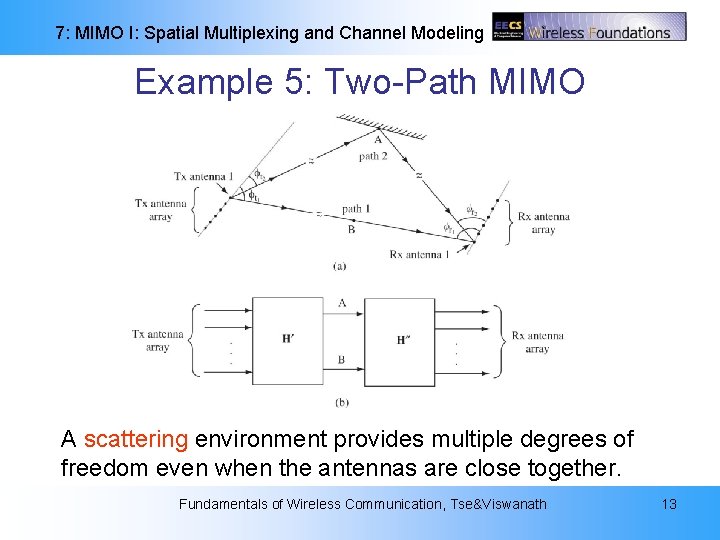
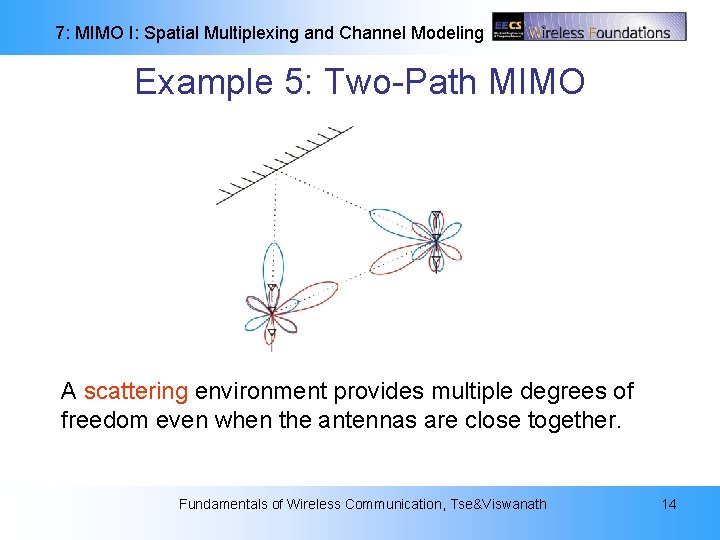
7: MIMO I: Spatial Multiplexing and Channel Modeling Example 5: Two-Path MIMO A scattering environment provides multiple degrees of freedom even when the antennas are close together. Fundamentals of Wireless Communication, Tse&Viswanath 13
7: MIMO I: Spatial Multiplexing and Channel Modeling Example 5: Two-Path MIMO A scattering environment provides multiple degrees of freedom even when the antennas are close together. Fundamentals of Wireless Communication, Tse&Viswanath 14
7: MIMO I: Spatial Multiplexing and Channel Modeling Rank and Conditioning • Question: Does spatial multiplexing gain increase without bound as the number of multipaths increase? • The rank of H increases but looking at the rank by itself is not enough. • The condition number matters. • As the angular separation of the paths decreases, the condition number gets worse. Fundamentals of Wireless Communication, Tse&Viswanath 15
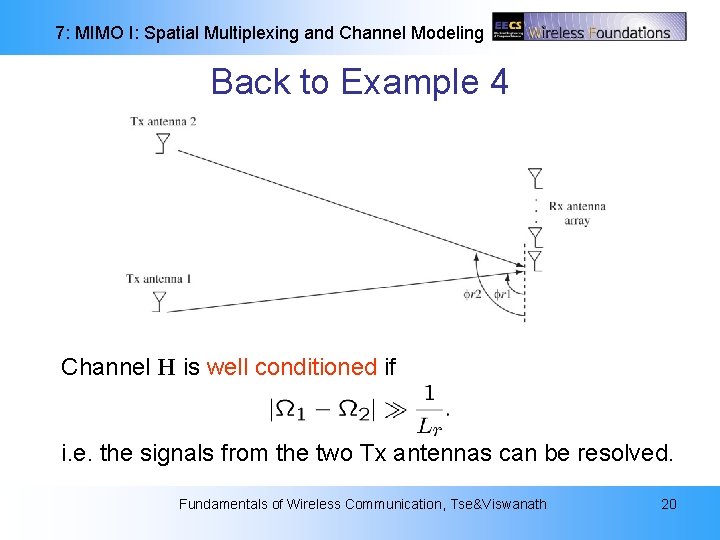
7: MIMO I: Spatial Multiplexing and Channel Modeling Back to Example 4 hi is the receive spatial signature from Tx antenna i along direction i = cos ri: Condition number depends on Fundamentals of Wireless Communication, Tse&Viswanath 16
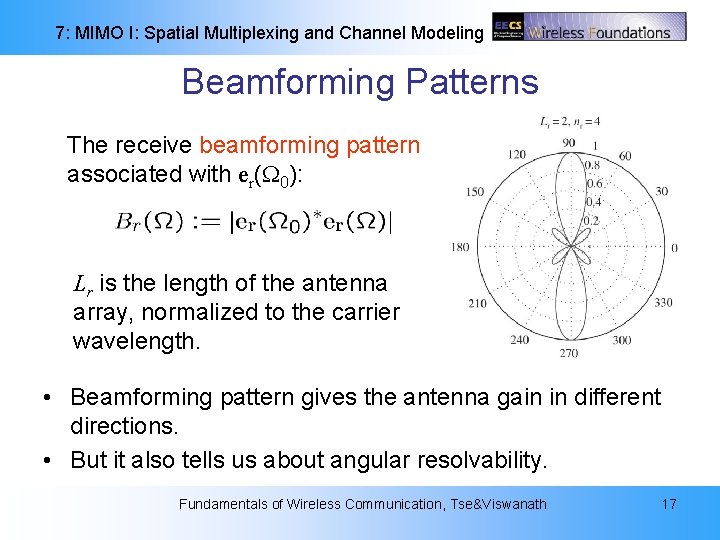
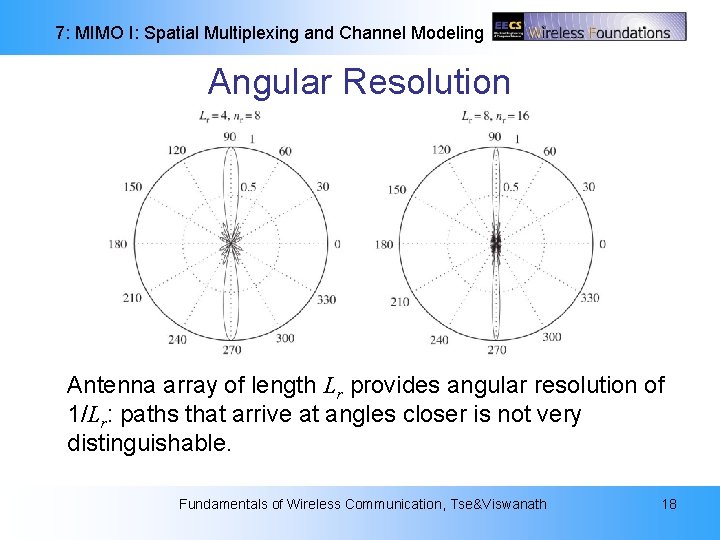
7: MIMO I: Spatial Multiplexing and Channel Modeling Beamforming Patterns The receive beamforming pattern associated with er( 0): Lr is the length of the antenna array, normalized to the carrier wavelength. • Beamforming pattern gives the antenna gain in different directions. • But it also tells us about angular resolvability. Fundamentals of Wireless Communication, Tse&Viswanath 17
7: MIMO I: Spatial Multiplexing and Channel Modeling Angular Resolution Antenna array of length Lr provides angular resolution of 1/Lr: paths that arrive at angles closer is not very distinguishable. Fundamentals of Wireless Communication, Tse&Viswanath 18
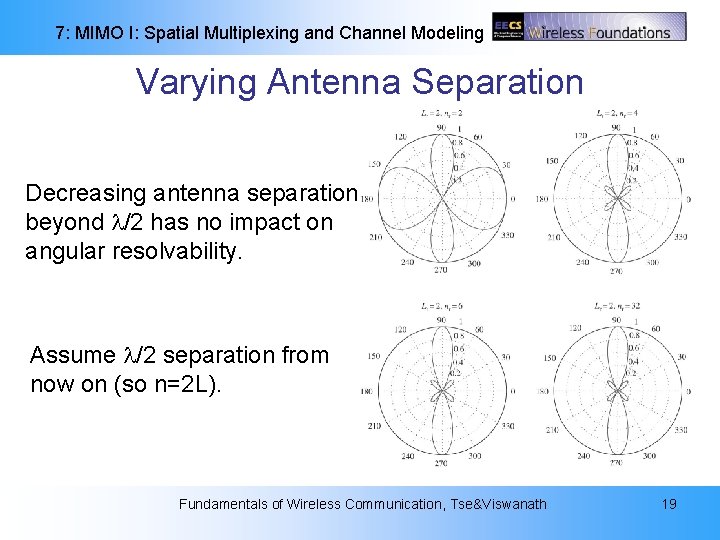
7: MIMO I: Spatial Multiplexing and Channel Modeling Varying Antenna Separation Decreasing antenna separation beyond /2 has no impact on angular resolvability. Assume /2 separation from now on (so n=2 L). Fundamentals of Wireless Communication, Tse&Viswanath 19
7: MIMO I: Spatial Multiplexing and Channel Modeling Back to Example 4 Channel H is well conditioned if i. e. the signals from the two Tx antennas can be resolved. Fundamentals of Wireless Communication, Tse&Viswanath 20
7: MIMO I: Spatial Multiplexing and Channel Modeling MIMO Channel Modeling • • Recall how we modeled multipath channels in Chapter 2. Start with a deterministic continuous-time model. Sample to get a discrete-time tap delay line model. The physical paths are grouped into delay bins of width 1/W seconds, one for each tap. • Each tap gain hl is an aggregation of several physical paths and can be modeled as Gaussian. • We can follow the same approach for MIMO channels. Fundamentals of Wireless Communication, Tse&Viswanath 21
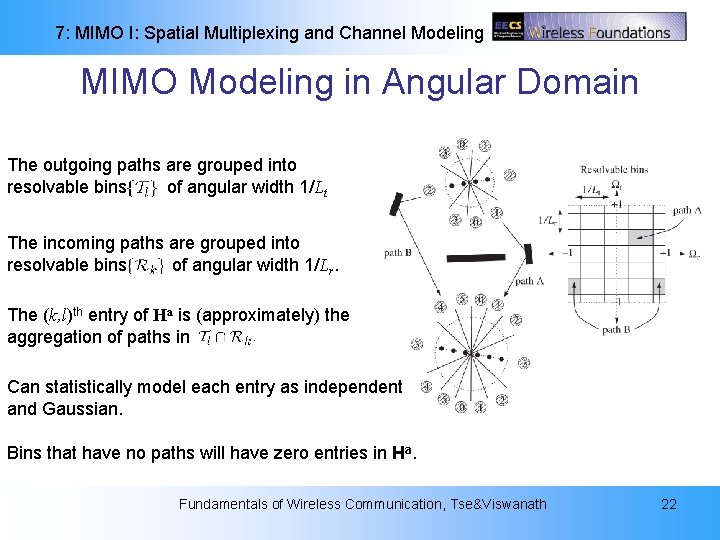
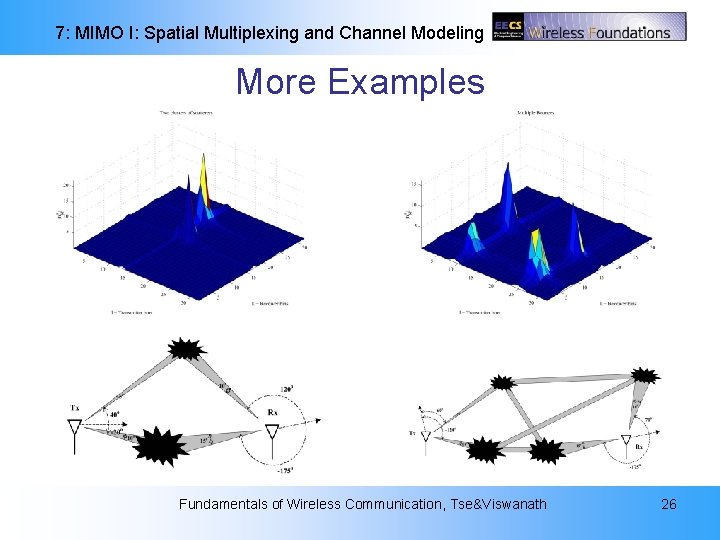
7: MIMO I: Spatial Multiplexing and Channel Modeling MIMO Modeling in Angular Domain The outgoing paths are grouped into resolvable bins of angular width 1/Lt The incoming paths are grouped into resolvable bins of angular width 1/Lr. The (k, l)th entry of Ha is (approximately) the aggregation of paths in Can statistically model each entry as independent and Gaussian. Bins that have no paths will have zero entries in Ha. Fundamentals of Wireless Communication, Tse&Viswanath 22
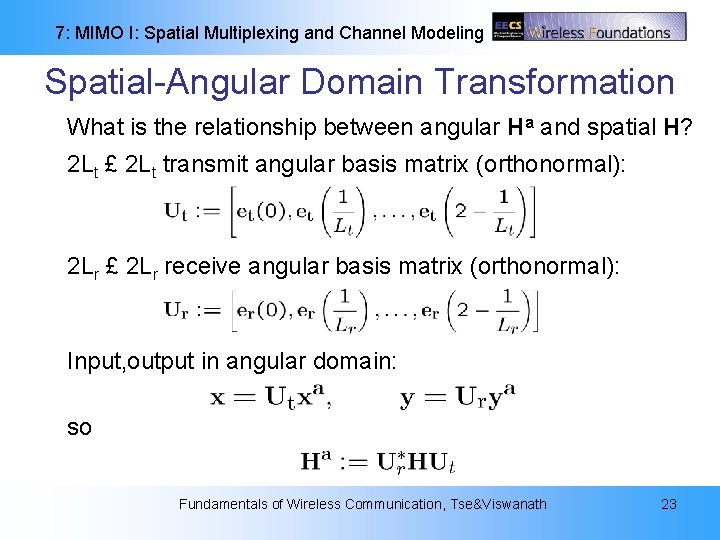
7: MIMO I: Spatial Multiplexing and Channel Modeling Spatial-Angular Domain Transformation What is the relationship between angular Ha and spatial H? 2 Lt £ 2 Lt transmit angular basis matrix (orthonormal): 2 Lr £ 2 Lr receive angular basis matrix (orthonormal): Input, output in angular domain: so Fundamentals of Wireless Communication, Tse&Viswanath 23
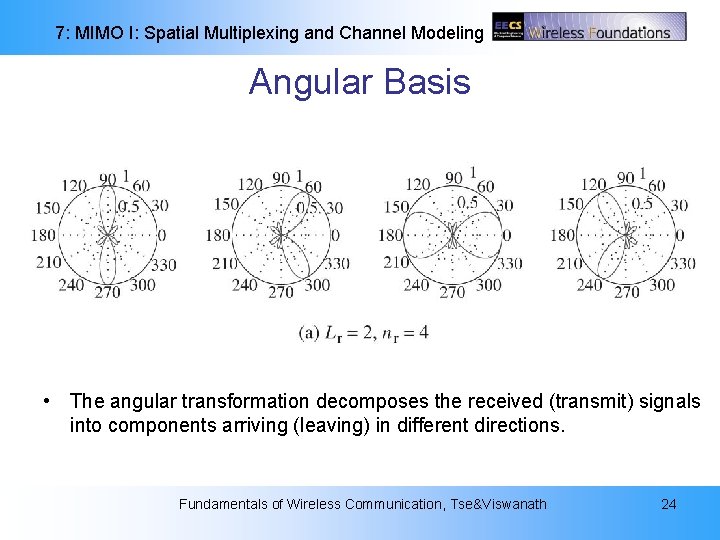
7: MIMO I: Spatial Multiplexing and Channel Modeling Angular Basis • The angular transformation decomposes the received (transmit) signals into components arriving (leaving) in different directions. Fundamentals of Wireless Communication, Tse&Viswanath 24
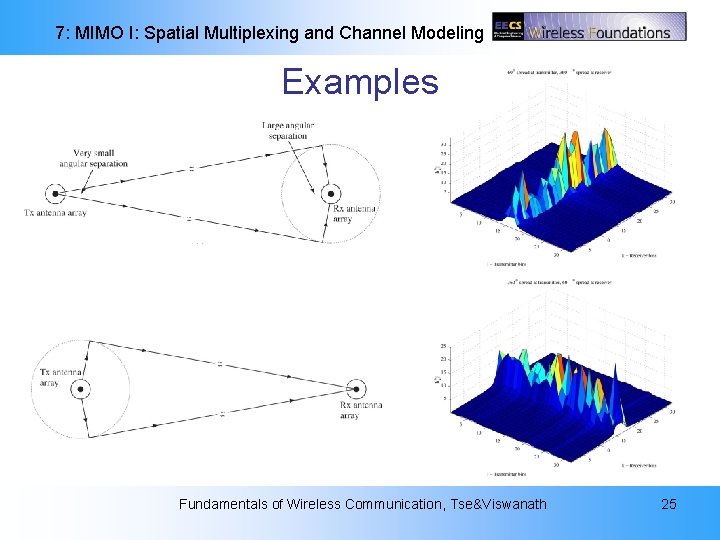
7: MIMO I: Spatial Multiplexing and Channel Modeling Examples Fundamentals of Wireless Communication, Tse&Viswanath 25
7: MIMO I: Spatial Multiplexing and Channel Modeling More Examples Fundamentals of Wireless Communication, Tse&Viswanath 26
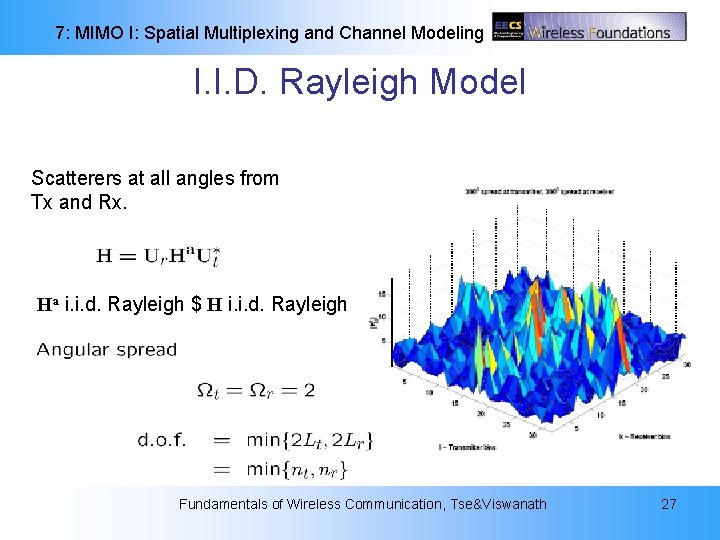
7: MIMO I: Spatial Multiplexing and Channel Modeling I. I. D. Rayleigh Model Scatterers at all angles from Tx and Rx. Ha i. i. d. Rayleigh $ H i. i. d. Rayleigh Fundamentals of Wireless Communication, Tse&Viswanath 27
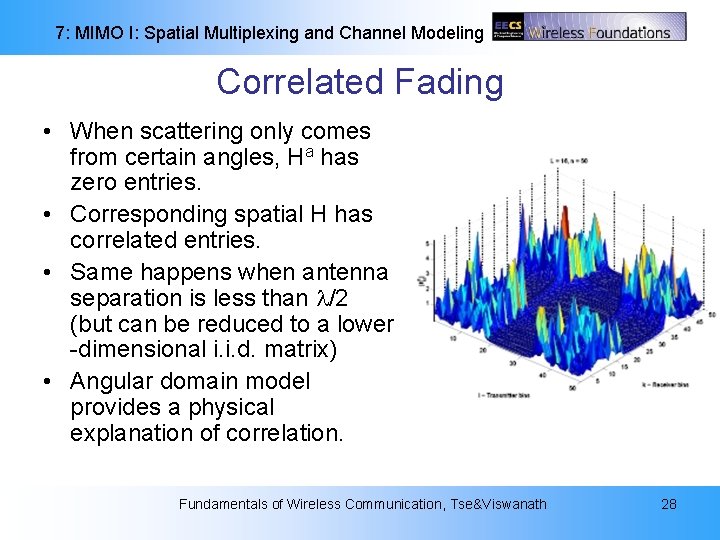
7: MIMO I: Spatial Multiplexing and Channel Modeling Correlated Fading • When scattering only comes from certain angles, Ha has zero entries. • Corresponding spatial H has correlated entries. • Same happens when antenna separation is less than /2 (but can be reduced to a lower -dimensional i. i. d. matrix) • Angular domain model provides a physical explanation of correlation. Fundamentals of Wireless Communication, Tse&Viswanath 28
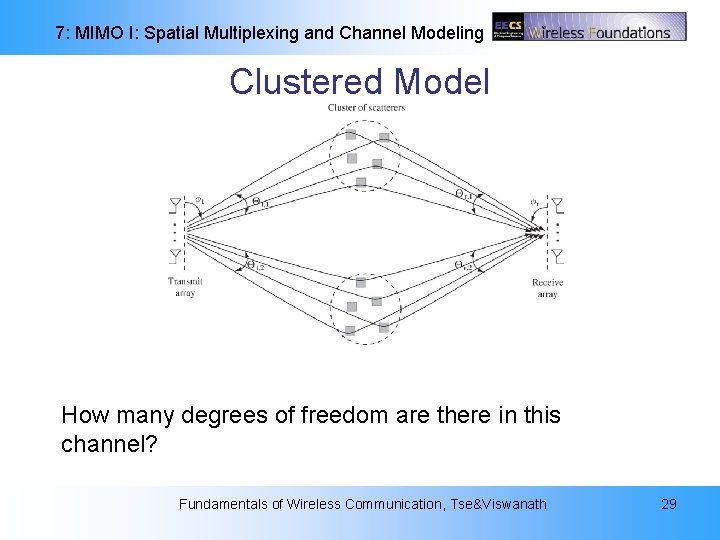
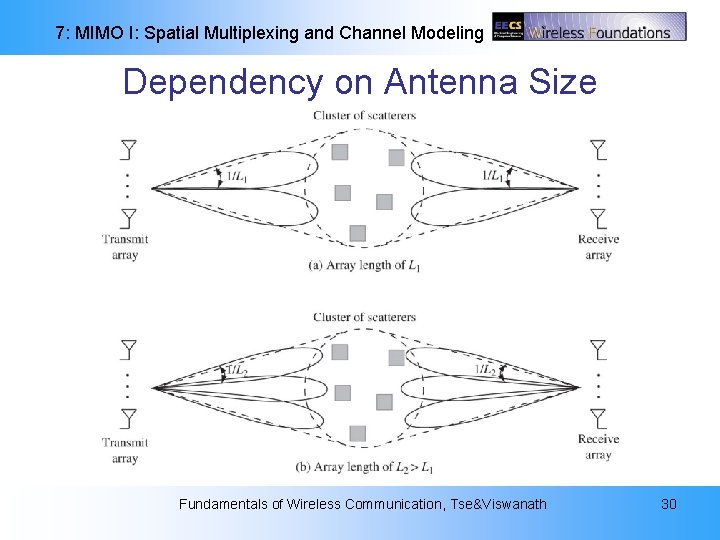
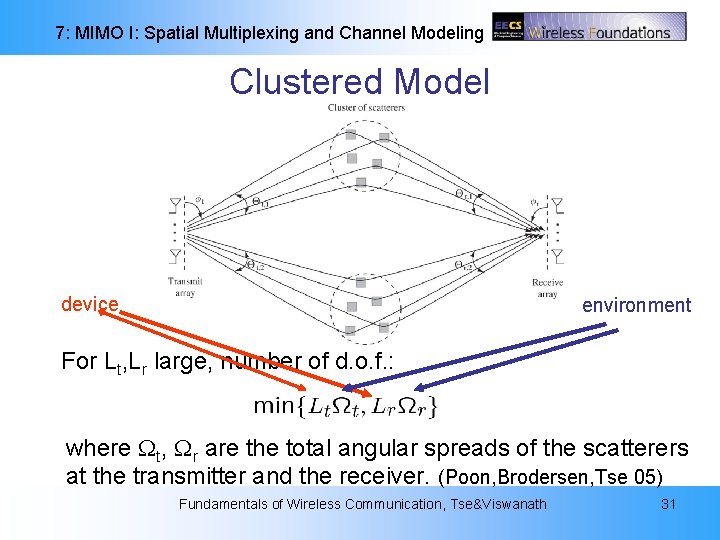
7: MIMO I: Spatial Multiplexing and Channel Modeling Clustered Model How many degrees of freedom are there in this channel? Fundamentals of Wireless Communication, Tse&Viswanath 29
7: MIMO I: Spatial Multiplexing and Channel Modeling Dependency on Antenna Size Fundamentals of Wireless Communication, Tse&Viswanath 30
7: MIMO I: Spatial Multiplexing and Channel Modeling Clustered Model device environment For Lt, Lr large, number of d. o. f. : where t, r are the total angular spreads of the scatterers at the transmitter and the receiver. (Poon, Brodersen, Tse 05) Fundamentals of Wireless Communication, Tse&Viswanath 31
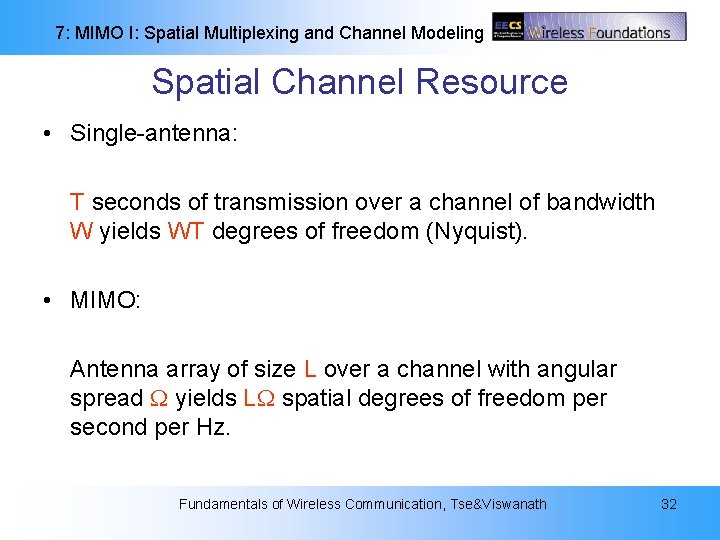
7: MIMO I: Spatial Multiplexing and Channel Modeling Spatial Channel Resource • Single-antenna: T seconds of transmission over a channel of bandwidth W yields WT degrees of freedom (Nyquist). • MIMO: Antenna array of size L over a channel with angular spread yields L spatial degrees of freedom per second per Hz. Fundamentals of Wireless Communication, Tse&Viswanath 32
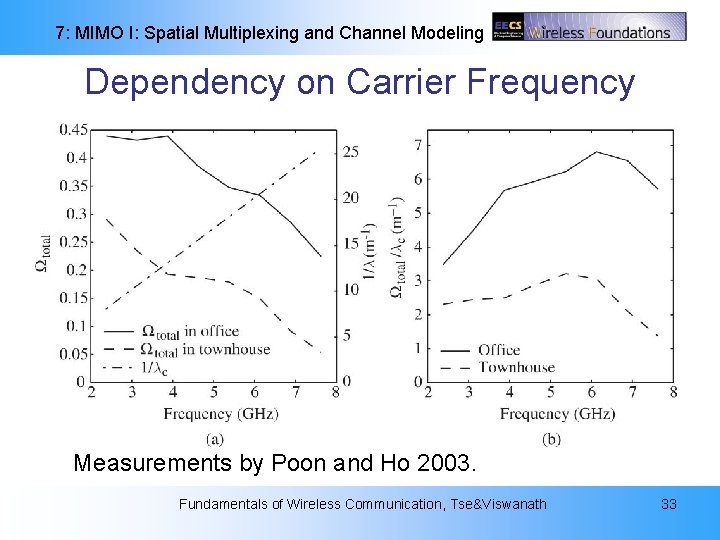
7: MIMO I: Spatial Multiplexing and Channel Modeling Dependency on Carrier Frequency Measurements by Poon and Ho 2003. Fundamentals of Wireless Communication, Tse&Viswanath 33
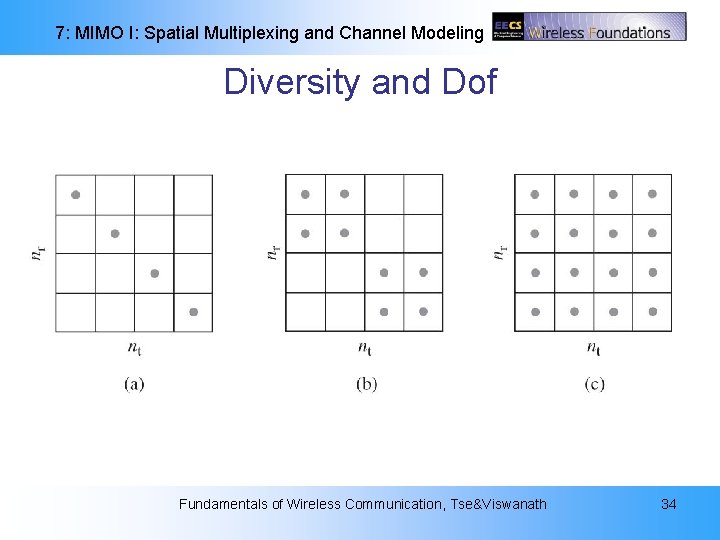
7: MIMO I: Spatial Multiplexing and Channel Modeling Diversity and Dof Fundamentals of Wireless Communication, Tse&Viswanath 34
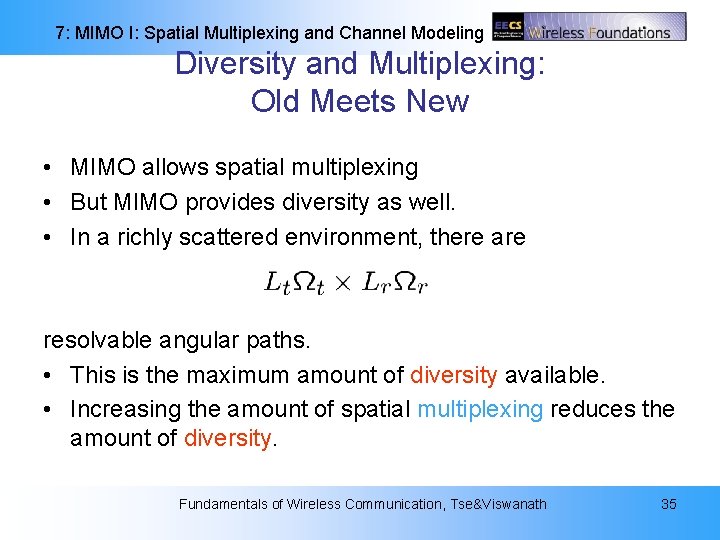
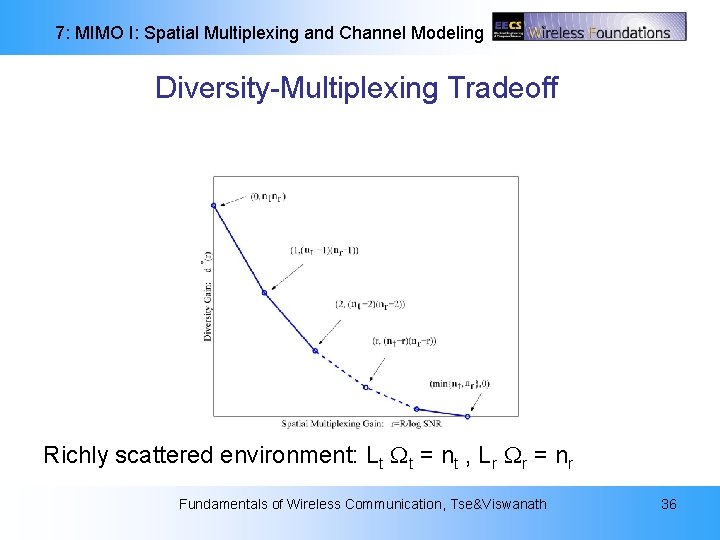
7: MIMO I: Spatial Multiplexing and Channel Modeling Diversity and Multiplexing: Old Meets New • MIMO allows spatial multiplexing • But MIMO provides diversity as well. • In a richly scattered environment, there are resolvable angular paths. • This is the maximum amount of diversity available. • Increasing the amount of spatial multiplexing reduces the amount of diversity. Fundamentals of Wireless Communication, Tse&Viswanath 35
7: MIMO I: Spatial Multiplexing and Channel Modeling Diversity-Multiplexing Tradeoff Richly scattered environment: Lt t = nt , Lr r = nr Fundamentals of Wireless Communication, Tse&Viswanath 36
7: MIMO I: Spatial Multiplexing and Channel Modeling System Considerations • MIMO makes sense in indoor environments with high SNR and rich scattering. • MIMO-based products have started to appear in the Wi. Fi space. (emerging 802. 11 n standard) • In wide-area cellular networks, users have wide ranges of SNR’s and angular spreads, so system design becomes more challenging. • How to get spatial degrees of freedom gain even when there is limited angular spread? Fundamentals of Wireless Communication, Tse&Viswanath 37
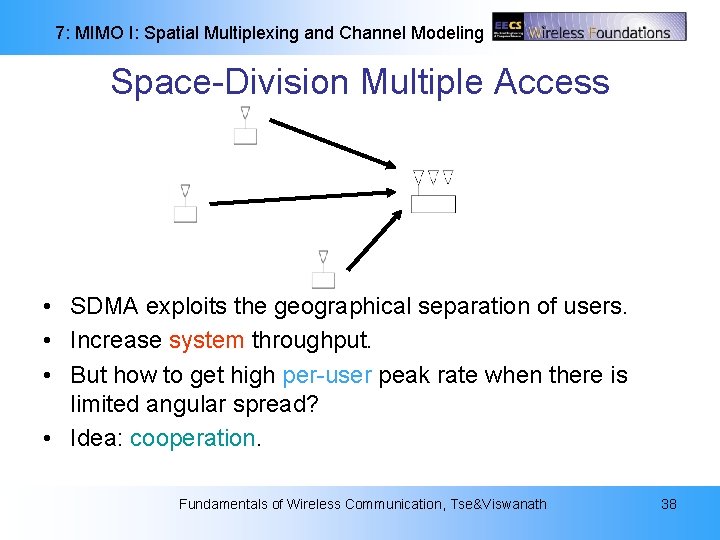
7: MIMO I: Spatial Multiplexing and Channel Modeling Space-Division Multiple Access • SDMA exploits the geographical separation of users. • Increase system throughput. • But how to get high per-user peak rate when there is limited angular spread? • Idea: cooperation. Fundamentals of Wireless Communication, Tse&Viswanath 38
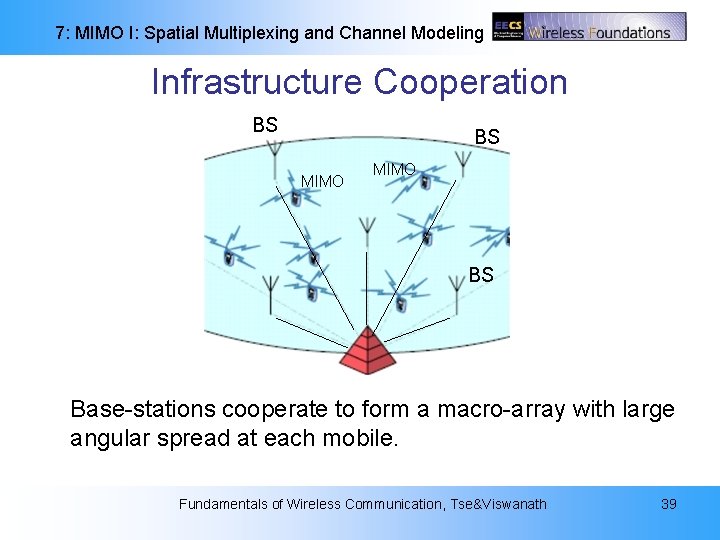
7: MIMO I: Spatial Multiplexing and Channel Modeling Infrastructure Cooperation BS BS MIMO BS Base-stations cooperate to form a macro-array with large angular spread at each mobile. Fundamentals of Wireless Communication, Tse&Viswanath 39
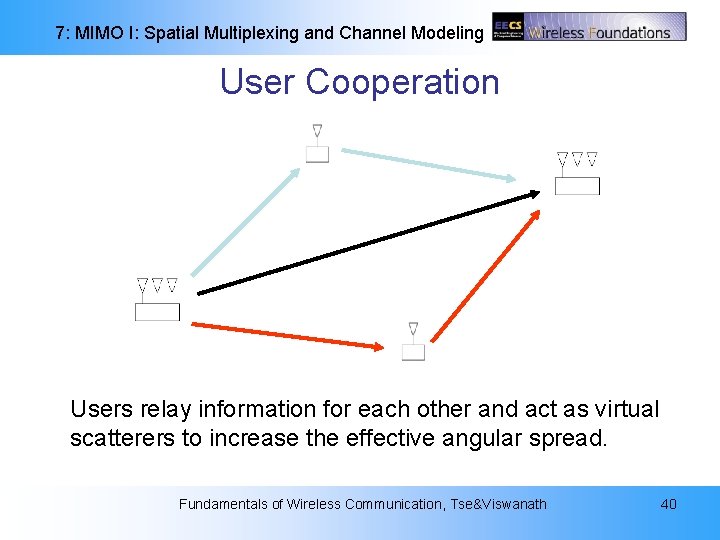
7: MIMO I: Spatial Multiplexing and Channel Modeling User Cooperation Users relay information for each other and act as virtual scatterers to increase the effective angular spread. Fundamentals of Wireless Communication, Tse&Viswanath 40
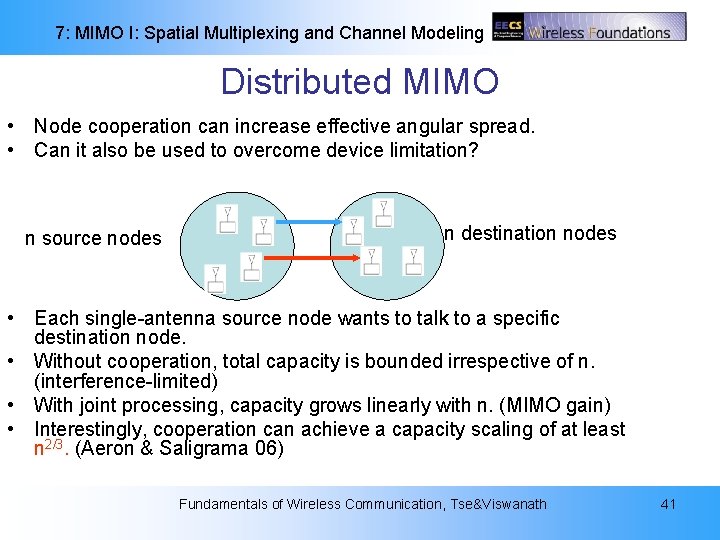
7: MIMO I: Spatial Multiplexing and Channel Modeling Distributed MIMO • Node cooperation can increase effective angular spread. • Can it also be used to overcome device limitation? n source nodes n destination nodes • Each single-antenna source node wants to talk to a specific destination node. • Without cooperation, total capacity is bounded irrespective of n. (interference-limited) • With joint processing, capacity grows linearly with n. (MIMO gain) • Interestingly, cooperation can achieve a capacity scaling of at least n 2/3. (Aeron & Saligrama 06) Fundamentals of Wireless Communication, Tse&Viswanath 41
7: MIMO I: Spatial Multiplexing and Channel Modeling Conclusions • Modern wireless communication theory exploits fading to increase spectral efficiency. • Real advances require marriage of theory with understanding of system issues. • The new point of view even suggests that fading can be induced by appropriate system design. Fundamentals of Wireless Communication, Tse&Viswanath 42