
7 Lakoff Connect the Learning Improve this explanation

- Slides: 9
7 Lakoff
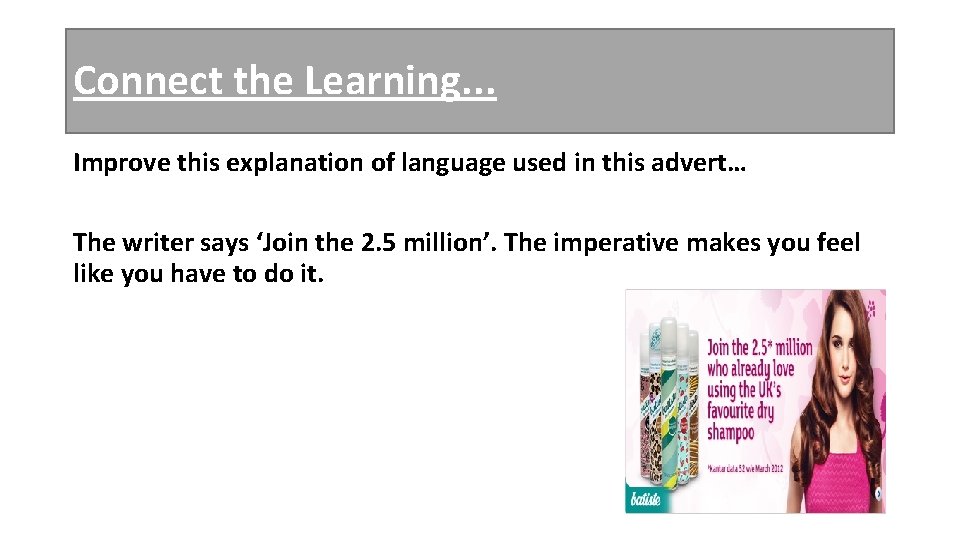
Connect the Learning. . . Improve this explanation of language used in this advert… The writer says ‘Join the 2. 5 million’. The imperative makes you feel like you have to do it.
Learning Intention Good Progress Outstanding Progress To recognise the key component of Robin Lakoff’s theory regarding Language and Gender To speculate about how language used by women has changed over time
Did you? Analyse the effect of the imperative (more than just ’it makes you feel like you have to do it’). 10 points Comment on the intended audience. 5 points Explain the purpose (to persuade). 5 points Analyse the genre and where it was likely to be found. 10 points Comment on words like ‘love’ and ‘favourite’ and their effects. 7 points
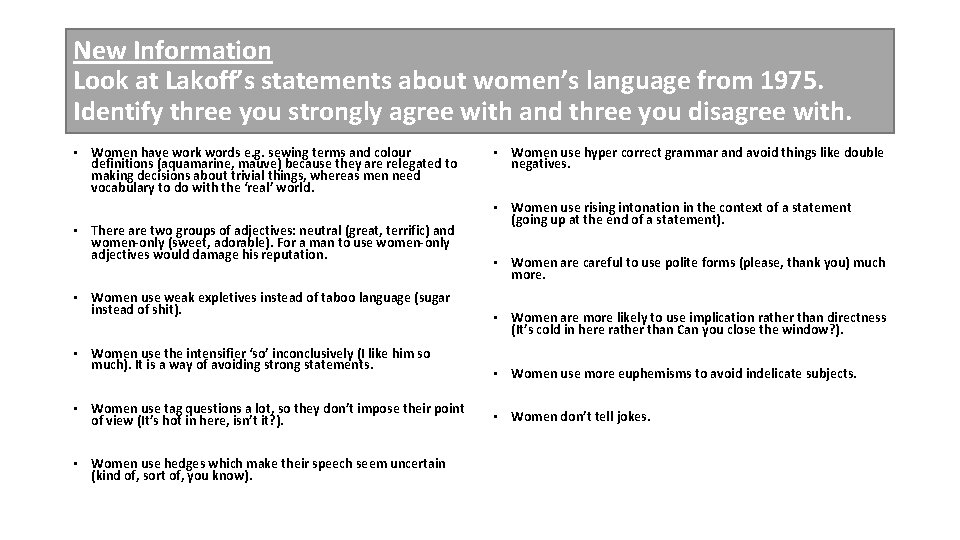
New Information Look at Lakoff’s statements about women’s language from 1975. Identify three you strongly agree with and three you disagree with. • Women have work words e. g. sewing terms and colour definitions (aquamarine, mauve) because they are relegated to making decisions about trivial things, whereas men need vocabulary to do with the ‘real’ world. • There are two groups of adjectives: neutral (great, terrific) and women-only (sweet, adorable). For a man to use women-only adjectives would damage his reputation. • Women use weak expletives instead of taboo language (sugar instead of shit). • Women use the intensifier ‘so’ inconclusively (I like him so much). It is a way of avoiding strong statements. • Women use tag questions a lot, so they don’t impose their point of view (It’s hot in here, isn’t it? ). • Women use hedges which make their speech seem uncertain (kind of, sort of, you know). • Women use hyper correct grammar and avoid things like double negatives. • Women use rising intonation in the context of a statement (going up at the end of a statement). • Women are careful to use polite forms (please, thank you) much more. • Women are more likely to use implication rather than directness (It’s cold in here rather than Can you close the window? ). • Women use more euphemisms to avoid indelicate subjects. • Women don’t tell jokes.
Lakoff as viable theory… Arguments to support Lakoff Arguments to refute Lakoff
Challenge Watch the clip from Friends. Discussion Does it demonstrate any of the features of women’s language that Lakoff identifies? If so, why? If not, why not? Make notes as you watch the clip. http: //www. youtube. com/watch? v=fsvs. RZh. NVp 4
Demonstrate your Understanding Write your own transcript between two women or a man and a woman in which you use at least three of the features of women’s language that Lakoff identifies. Swap your transcript with another student and annotate it to show the features of Lakoff’s theories.
Review and Reflect How many of Lakoff’s features of women’s language can you remember? How can you remember them? Home learning Research the Bechdel Test. What is it? What does it apply to? Does it support or refute Robin Lakoff? What is the best way for you to learn them?