
7 Ladder Diagrams 1 An example of a
- Slides: 19
(7) Ladder Diagrams 1
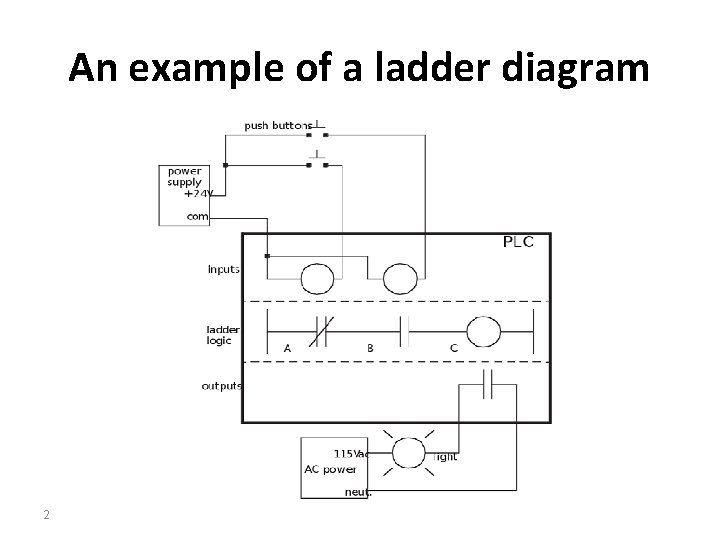
An example of a ladder diagram 2
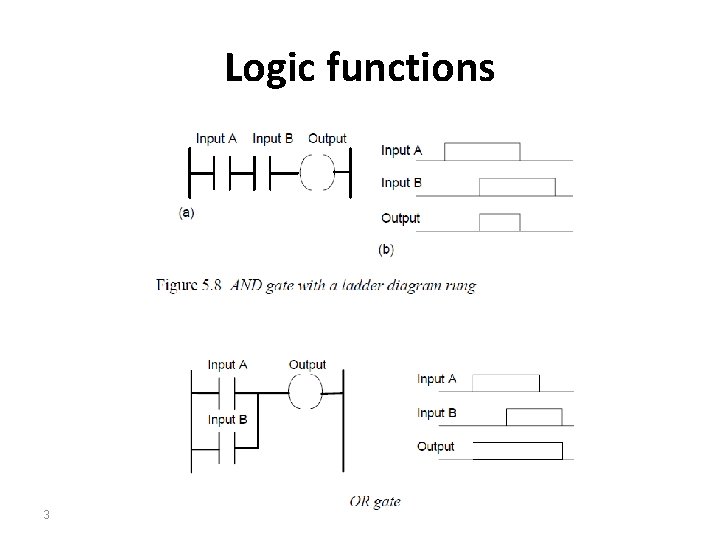
Logic functions 3
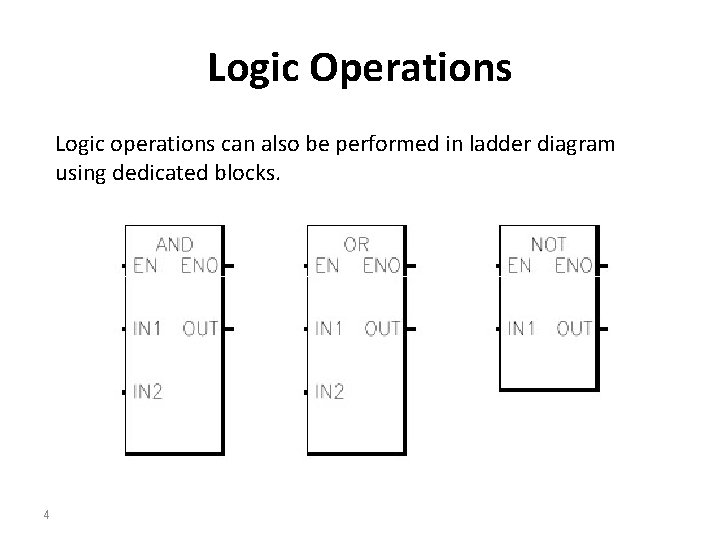
Logic Operations Logic operations can also be performed in ladder diagram using dedicated blocks. 4
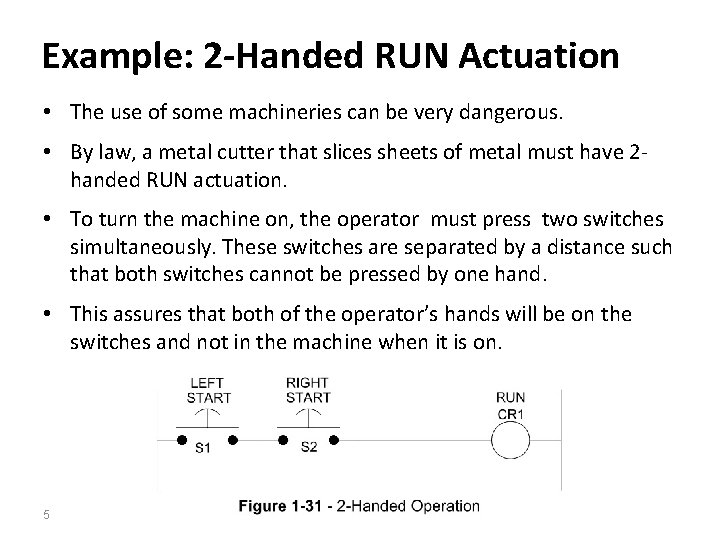
Example: 2 -Handed RUN Actuation • The use of some machineries can be very dangerous. • By law, a metal cutter that slices sheets of metal must have 2 handed RUN actuation. • To turn the machine on, the operator must press two switches simultaneously. These switches are separated by a distance such that both switches cannot be pressed by one hand. • This assures that both of the operator’s hands will be on the switches and not in the machine when it is on. 5
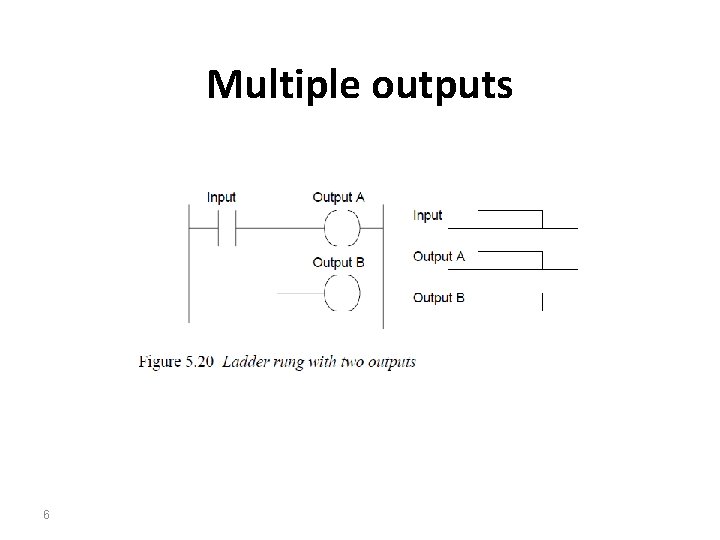
Multiple outputs 6
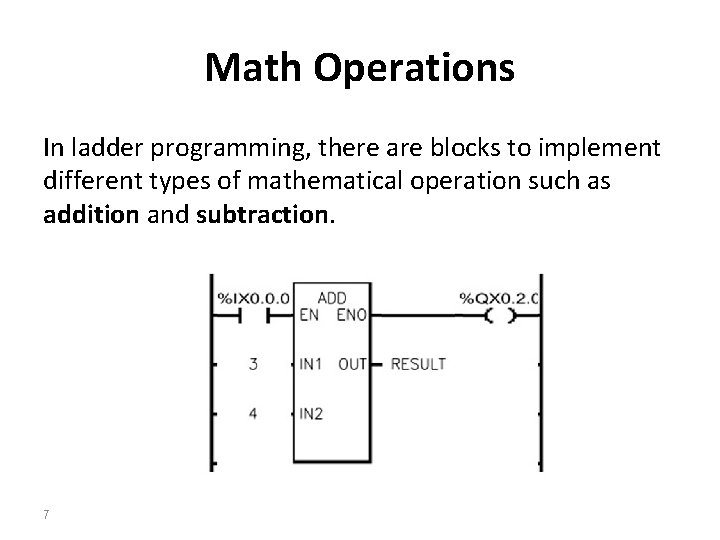
Math Operations In ladder programming, there are blocks to implement different types of mathematical operation such as addition and subtraction. 7
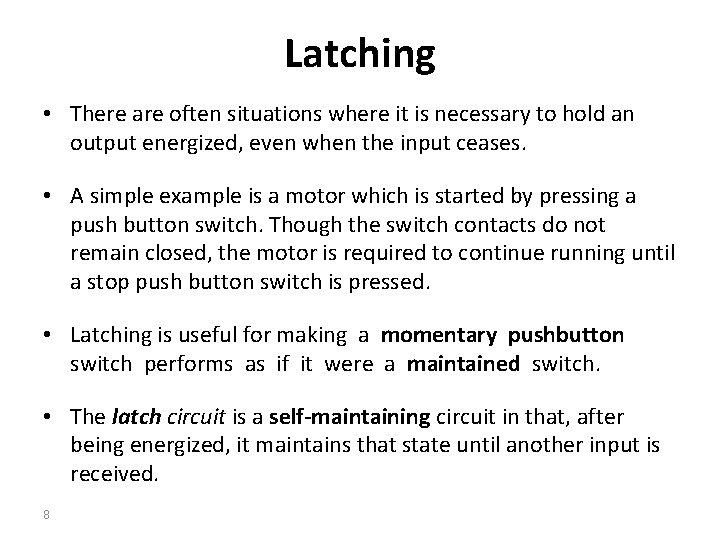
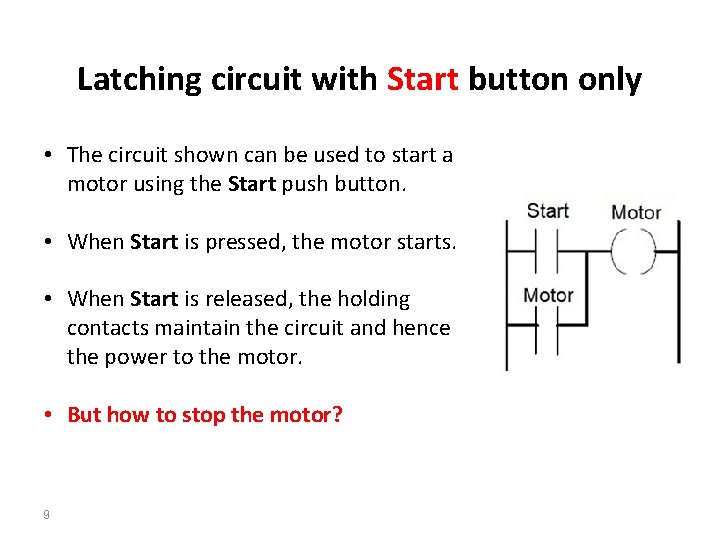
Latching • There are often situations where it is necessary to hold an output energized, even when the input ceases. • A simple example is a motor which is started by pressing a push button switch. Though the switch contacts do not remain closed, the motor is required to continue running until a stop push button switch is pressed. • Latching is useful for making a momentary pushbutton switch performs as if it were a maintained switch. • The latch circuit is a self-maintaining circuit in that, after being energized, it maintains that state until another input is received. 8
Latching circuit with Start button only • The circuit shown can be used to start a motor using the Start push button. • When Start is pressed, the motor starts. • When Start is released, the holding contacts maintain the circuit and hence the power to the motor. • But how to stop the motor? 9
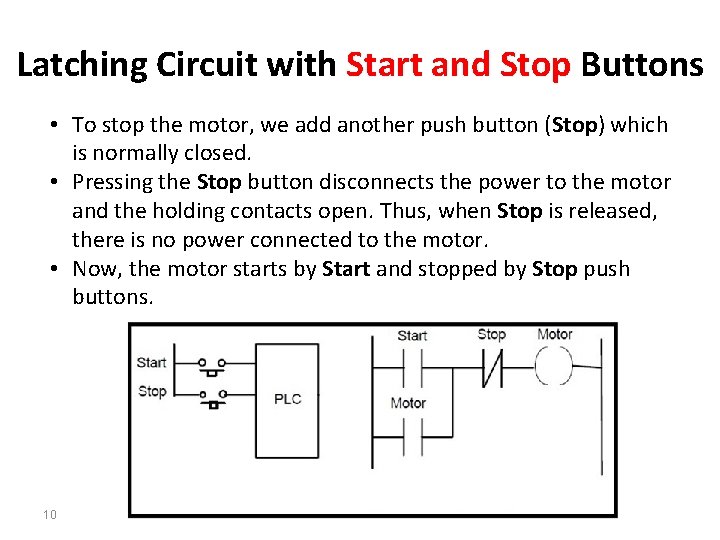
Latching Circuit with Start and Stop Buttons • To stop the motor, we add another push button (Stop) which is normally closed. • Pressing the Stop button disconnects the power to the motor and the holding contacts open. Thus, when Stop is released, there is no power connected to the motor. • Now, the motor starts by Start and stopped by Stop push buttons. 10
Safe and Unsafe Stop Switches • In electric circuits, "open" failures (open switch contacts, broken wire connections, open relay coils, blown fuses, etc. ) are statistically more likely to occur than other types of failure. • In the previous circuit, if the stop switch fails and becomes open permanently, the system cannot be stopped. We say that the Stop switch is unsafe. 11
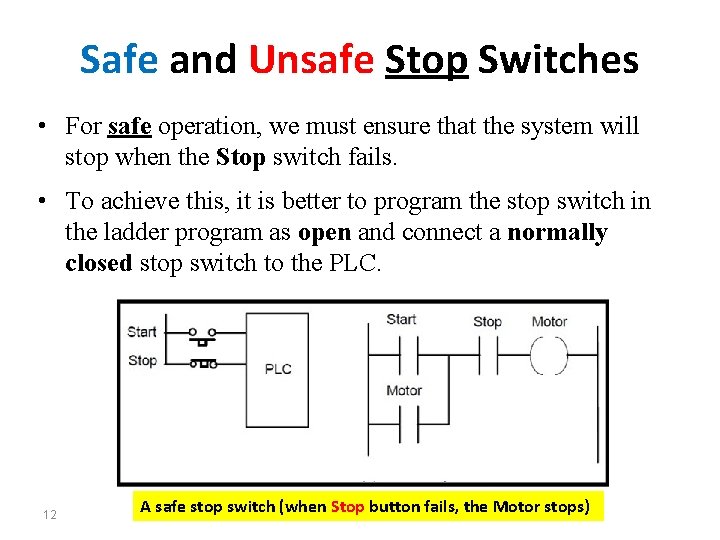
Safe and Unsafe Stop Switches • For safe operation, we must ensure that the system will stop when the Stop switch fails. • To achieve this, it is better to program the stop switch in the ladder program as open and connect a normally closed stop switch to the PLC. 12 A safe stop switch (when Stop button fails, the Motor stops)
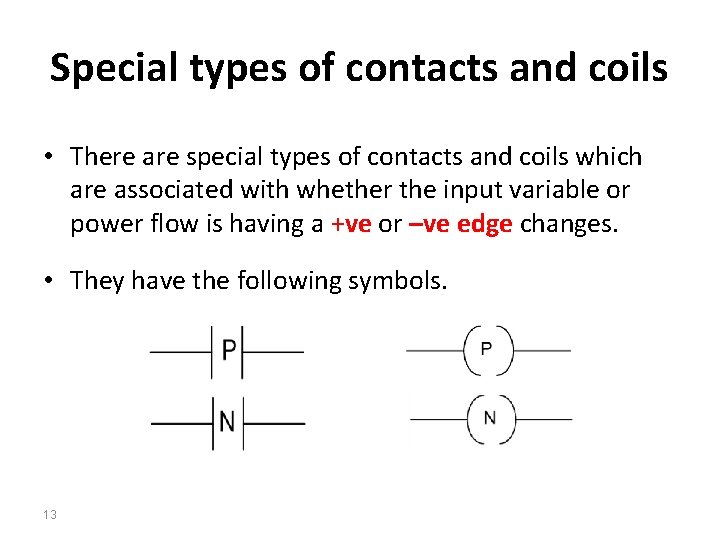
Special types of contacts and coils • There are special types of contacts and coils which are associated with whether the input variable or power flow is having a +ve or –ve edge changes. • They have the following symbols. 13
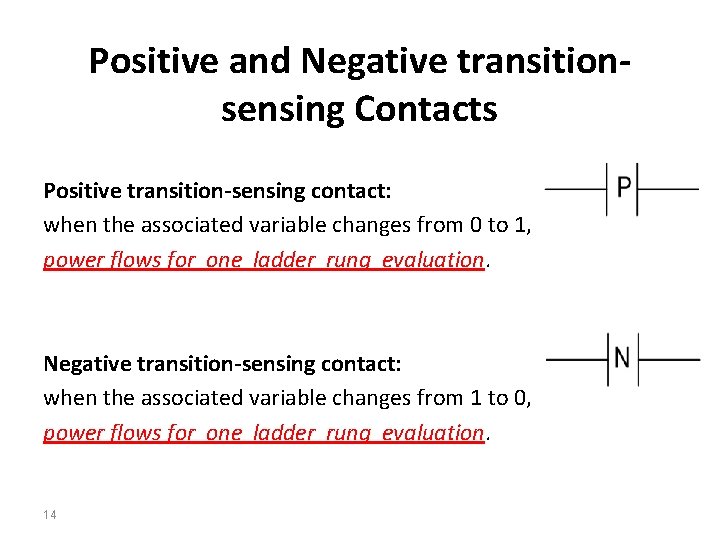
Positive and Negative transitionsensing Contacts Positive transition-sensing contact: when the associated variable changes from 0 to 1, power flows for one ladder rung evaluation. Negative transition-sensing contact: when the associated variable changes from 1 to 0, power flows for one ladder rung evaluation. 14
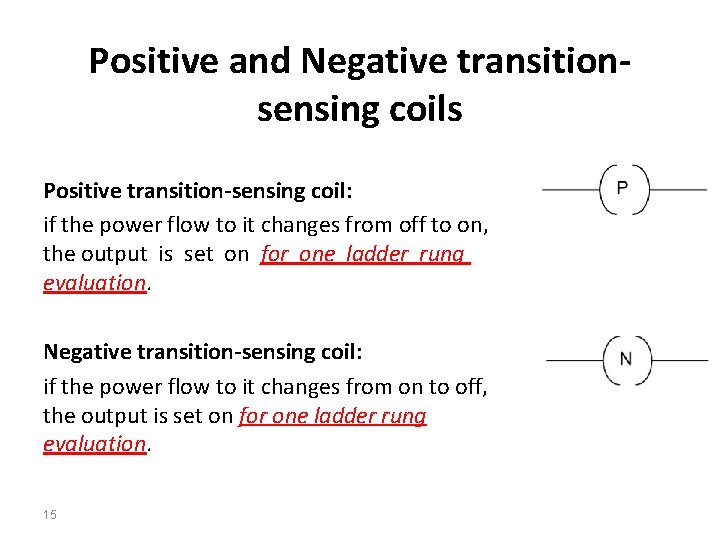
Positive and Negative transitionsensing coils Positive transition-sensing coil: if the power flow to it changes from off to on, the output is set on for one ladder rung evaluation. Negative transition-sensing coil: if the power flow to it changes from on to off, the output is set on for one ladder rung evaluation. 15
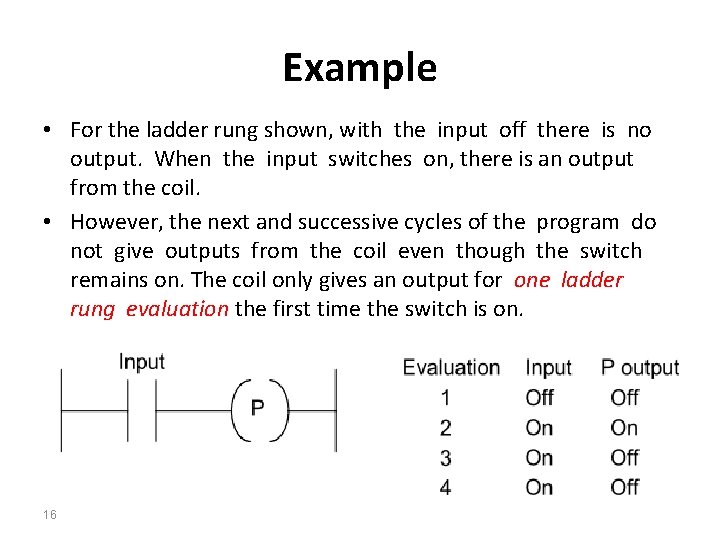
Example • For the ladder rung shown, with the input off there is no output. When the input switches on, there is an output from the coil. • However, the next and successive cycles of the program do not give outputs from the coil even though the switch remains on. The coil only gives an output for one ladder rung evaluation the first time the switch is on. 16
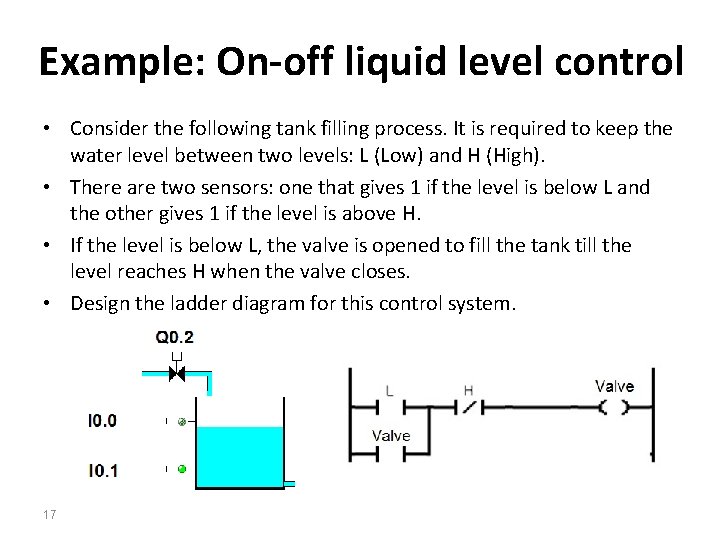
Example: On-off liquid level control • Consider the following tank filling process. It is required to keep the water level between two levels: L (Low) and H (High). • There are two sensors: one that gives 1 if the level is below L and the other gives 1 if the level is above H. • If the level is below L, the valve is opened to fill the tank till the level reaches H when the valve closes. • Design the ladder diagram for this control system. 17
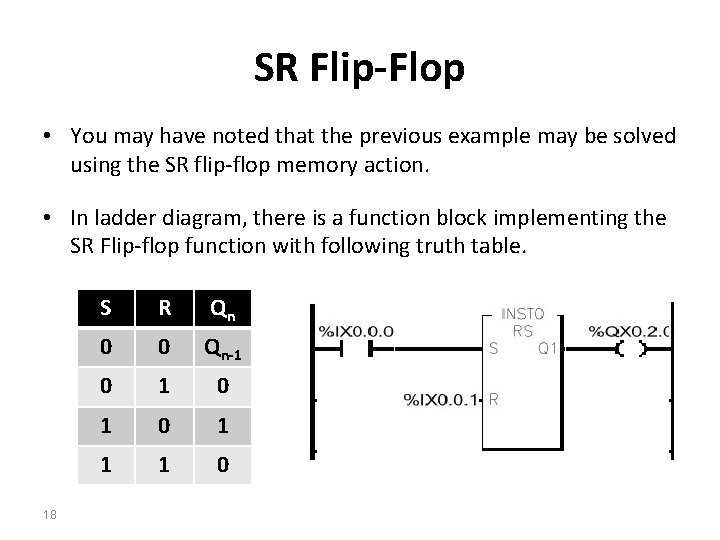
SR Flip-Flop • You may have noted that the previous example may be solved using the SR flip-flop memory action. • In ladder diagram, there is a function block implementing the SR Flip-flop function with following truth table. 18 S R Qn 0 0 Qn-1 0 1 0 1 1 1 0
Notes • The software we are using is GMWIN (from LG). You can download it at: http: //www. lsis. com/support/download/detail. aspx? c=945 (the file we need is GMWIN 417(ENG)_080605. zip, 23. 24 MB) • You can watch a nice tutorial on ladder diagram at: http: //www. wisc-online. com/objects/View. Object. aspx? ID=IAU 3106 19