
7 Introduction to DCDC Converters Marc T Thompson
- Slides: 46
7. Introduction to DC/DC Converters Marc T. Thompson, Ph. D. Adjunct Associate Professor of Electrical Engineering Worcester Polytechnic Institute Thompson Consulting, Inc. 9 Jacob Gates Road Harvard, MA 01451 Phone: (978) 456 -7722 Email: marctt@aol. com Website: http: //members. aol. com/marctt/index. htm Portions of these notes excerpted from the CD ROM accompanying Mohan, Undeland Robbins, Power Electronics Converters, Applications and Design, 3 d edition, John Wiley 2003 Power Electronics Chapter 7 Introduction to DC/DC Converters 7 -1
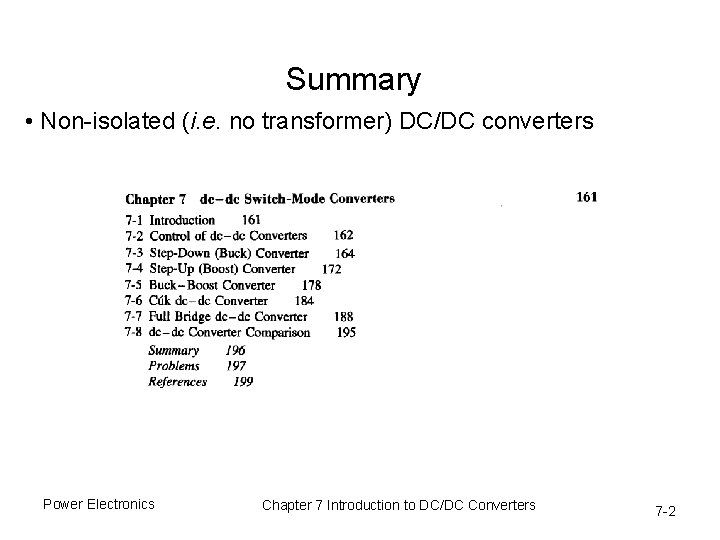
Summary • Non-isolated (i. e. no transformer) DC/DC converters Power Electronics Chapter 7 Introduction to DC/DC Converters 7 -2
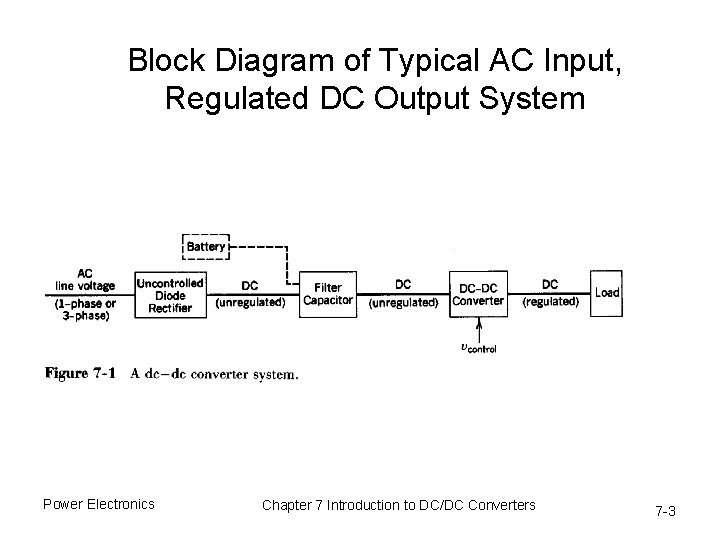
Block Diagram of Typical AC Input, Regulated DC Output System Power Electronics Chapter 7 Introduction to DC/DC Converters 7 -3
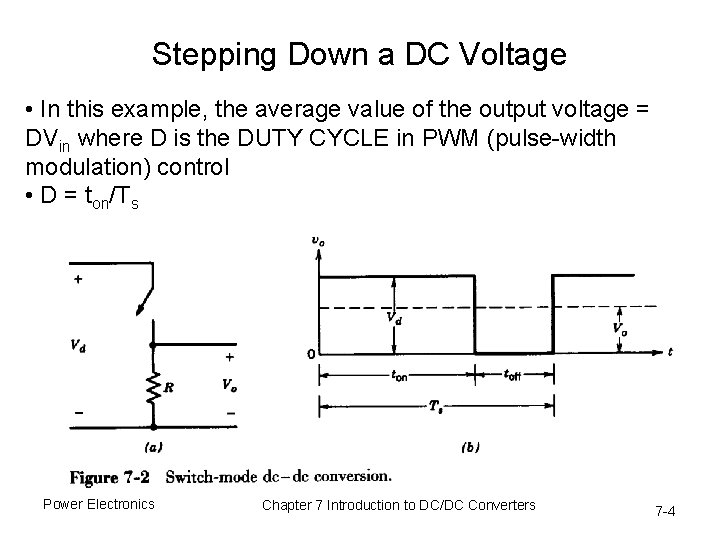
Stepping Down a DC Voltage • In this example, the average value of the output voltage = DVin where D is the DUTY CYCLE in PWM (pulse-width modulation) control • D = ton/Ts Power Electronics Chapter 7 Introduction to DC/DC Converters 7 -4
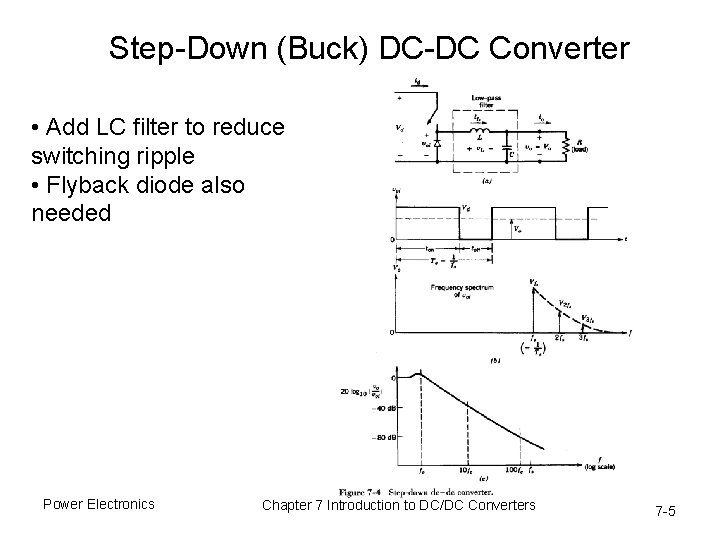
Step-Down (Buck) DC-DC Converter • Add LC filter to reduce switching ripple • Flyback diode also needed Power Electronics Chapter 7 Introduction to DC/DC Converters 7 -5
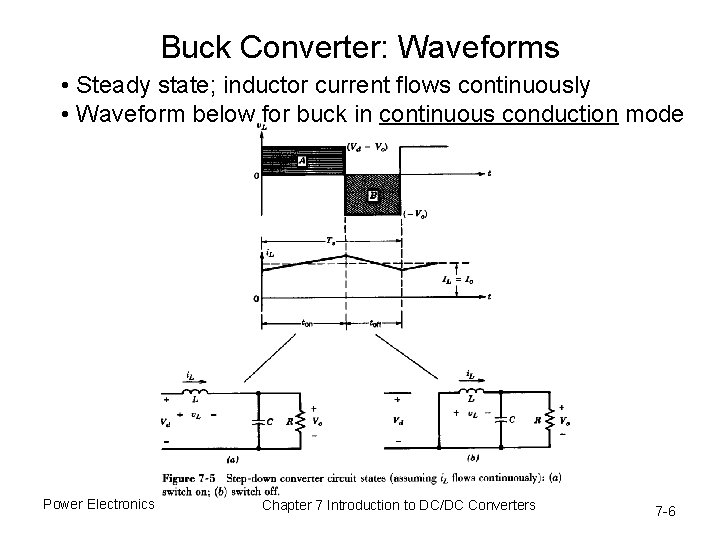
Buck Converter: Waveforms • Steady state; inductor current flows continuously • Waveform below for buck in continuous conduction mode Power Electronics Chapter 7 Introduction to DC/DC Converters 7 -6
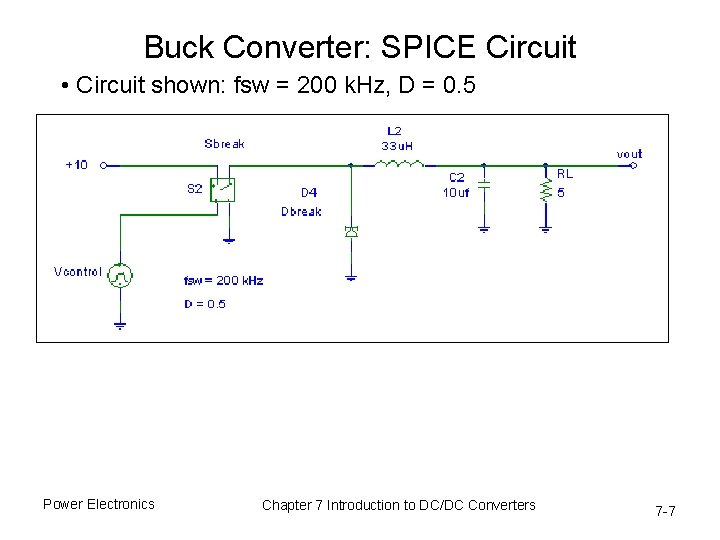
Buck Converter: SPICE Circuit • Circuit shown: fsw = 200 k. Hz, D = 0. 5 Power Electronics Chapter 7 Introduction to DC/DC Converters 7 -7
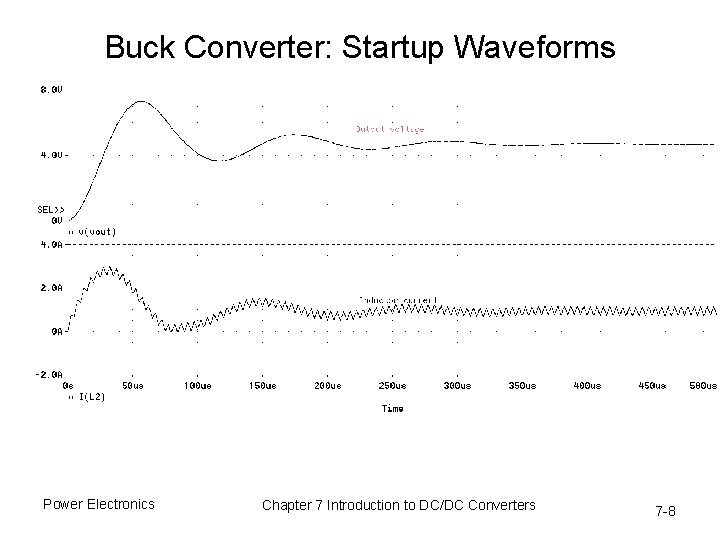
Buck Converter: Startup Waveforms Power Electronics Chapter 7 Introduction to DC/DC Converters 7 -8
Analysis for DC/DC Converter in Continuous Conduction and Steady State • In steady state, the inductor current returns to the same value every switching cycle, or every T seconds • Therefore, the inductor ripple current UP equals ripple DOWN • Several assumptions to simplify analysis: • Periodic steady state --- all startup transients have died out • Small ripple --- ripple is small compared to average values Power Electronics Chapter 7 Introduction to DC/DC Converters 7 -9
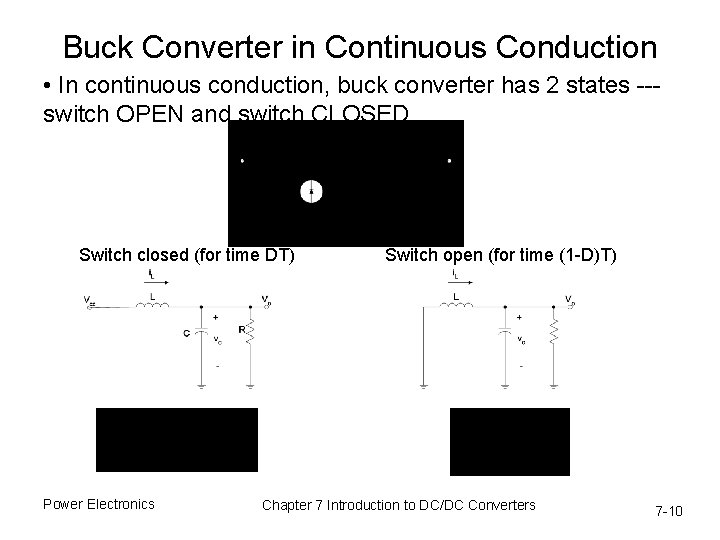
Buck Converter in Continuous Conduction • In continuous conduction, buck converter has 2 states --switch OPEN and switch CLOSED Switch closed (for time DT) Power Electronics Switch open (for time (1 -D)T) Chapter 7 Introduction to DC/DC Converters 7 -10
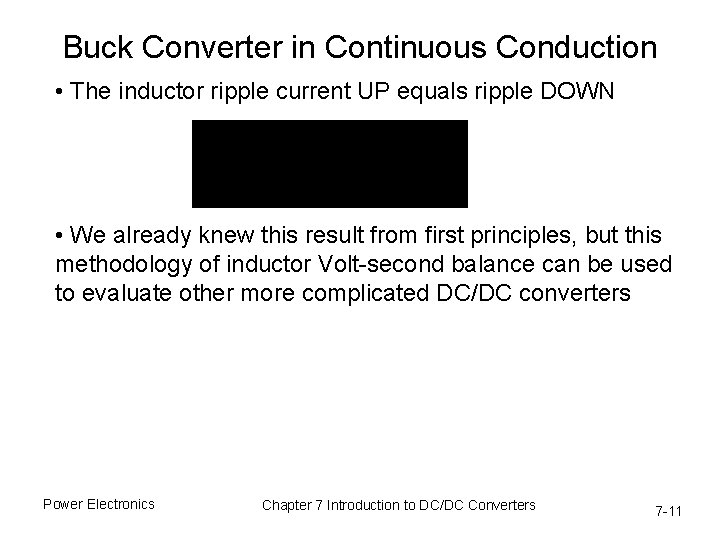
Buck Converter in Continuous Conduction • The inductor ripple current UP equals ripple DOWN • We already knew this result from first principles, but this methodology of inductor Volt-second balance can be used to evaluate other more complicated DC/DC converters Power Electronics Chapter 7 Introduction to DC/DC Converters 7 -11
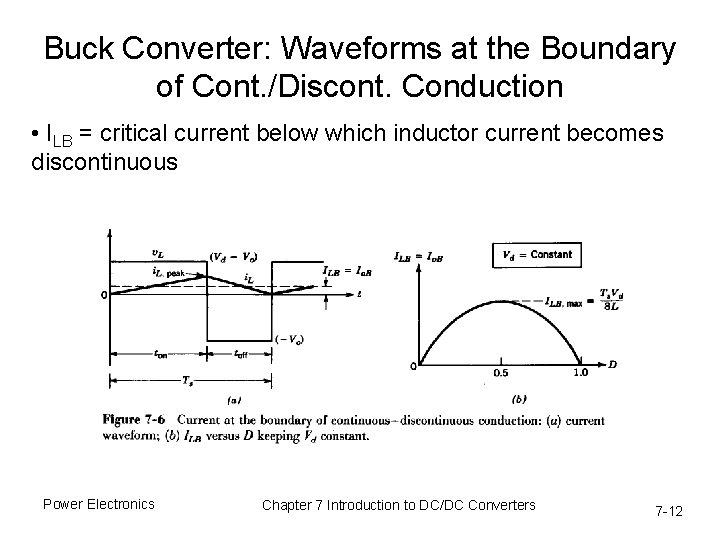
Buck Converter: Waveforms at the Boundary of Cont. /Discont. Conduction • ILB = critical current below which inductor current becomes discontinuous Power Electronics Chapter 7 Introduction to DC/DC Converters 7 -12
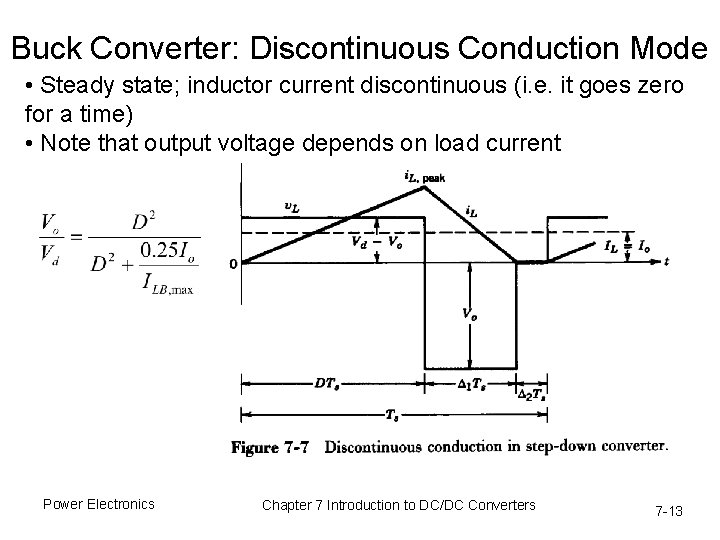
Buck Converter: Discontinuous Conduction Mode • Steady state; inductor current discontinuous (i. e. it goes zero for a time) • Note that output voltage depends on load current Power Electronics Chapter 7 Introduction to DC/DC Converters 7 -13
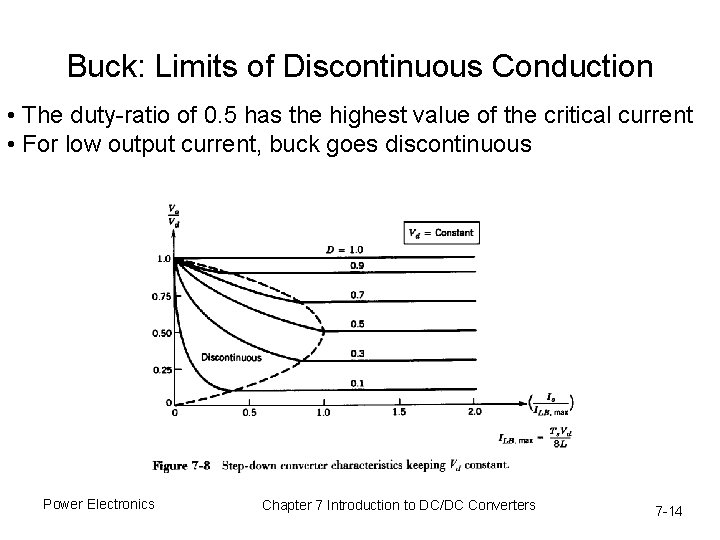
Buck: Limits of Discontinuous Conduction • The duty-ratio of 0. 5 has the highest value of the critical current • For low output current, buck goes discontinuous Power Electronics Chapter 7 Introduction to DC/DC Converters 7 -14
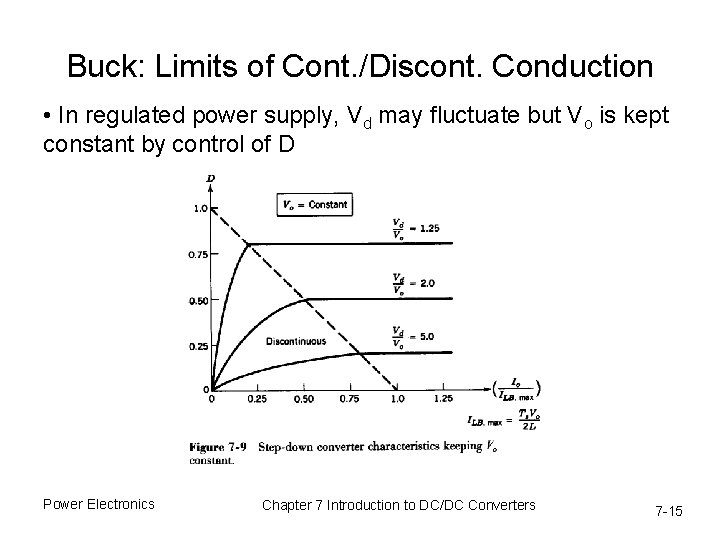
Buck: Limits of Cont. /Discont. Conduction • In regulated power supply, Vd may fluctuate but Vo is kept constant by control of D Power Electronics Chapter 7 Introduction to DC/DC Converters 7 -15
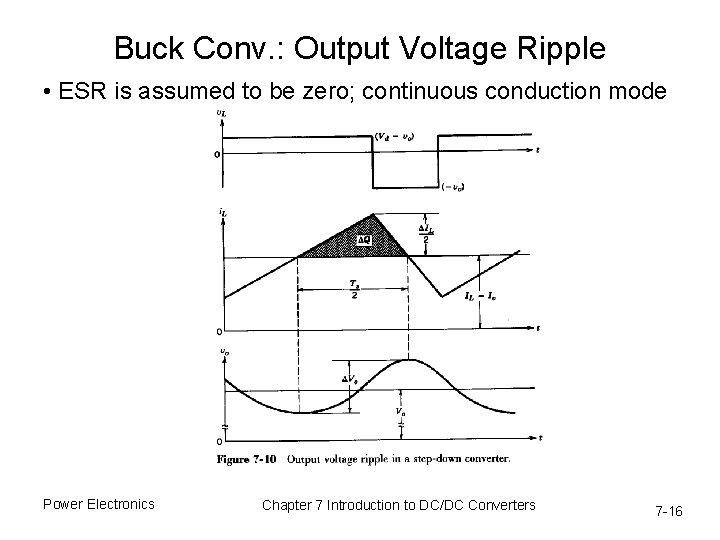
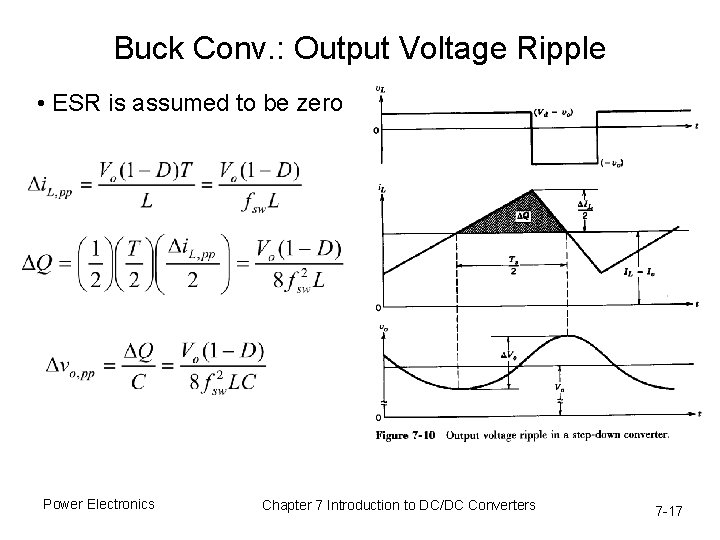
Buck Conv. : Output Voltage Ripple • ESR is assumed to be zero; continuous conduction mode Power Electronics Chapter 7 Introduction to DC/DC Converters 7 -16
Buck Conv. : Output Voltage Ripple • ESR is assumed to be zero Power Electronics Chapter 7 Introduction to DC/DC Converters 7 -17
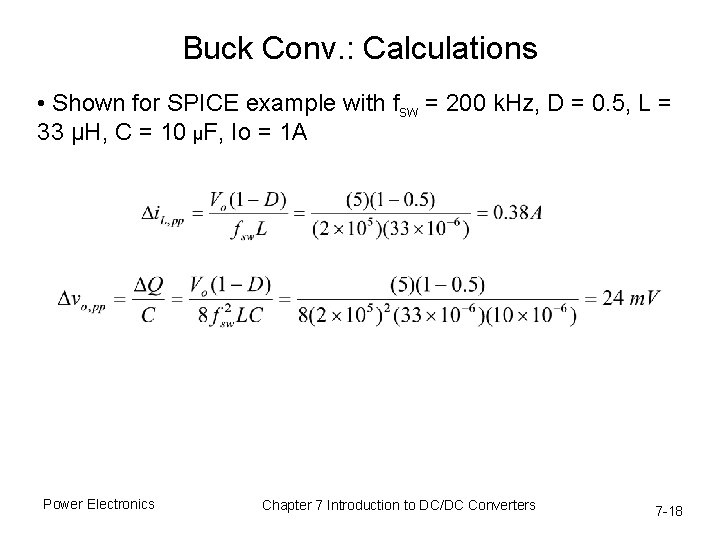
Buck Conv. : Calculations • Shown for SPICE example with fsw = 200 k. Hz, D = 0. 5, L = 33 µH, C = 10 µF, Io = 1 A Power Electronics Chapter 7 Introduction to DC/DC Converters 7 -18
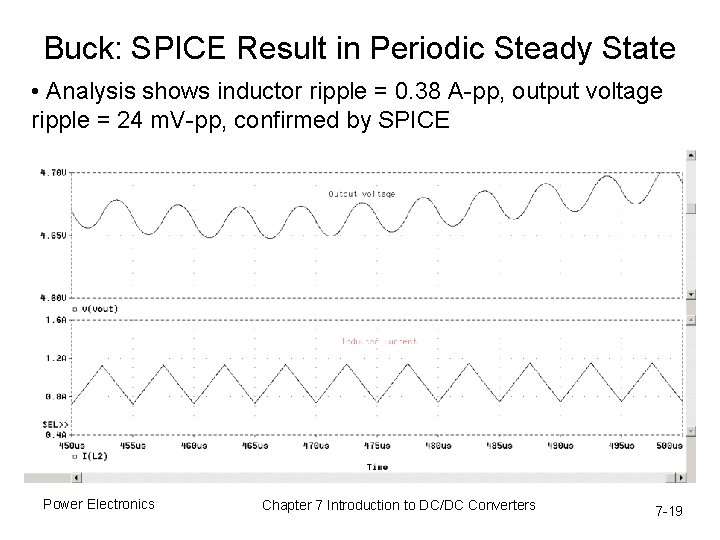
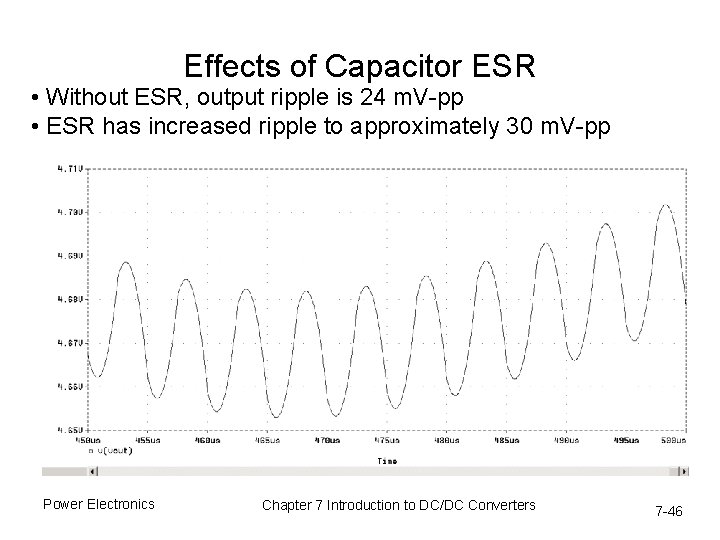
Buck: SPICE Result in Periodic Steady State • Analysis shows inductor ripple = 0. 38 A-pp, output voltage ripple = 24 m. V-pp, confirmed by SPICE Power Electronics Chapter 7 Introduction to DC/DC Converters 7 -19
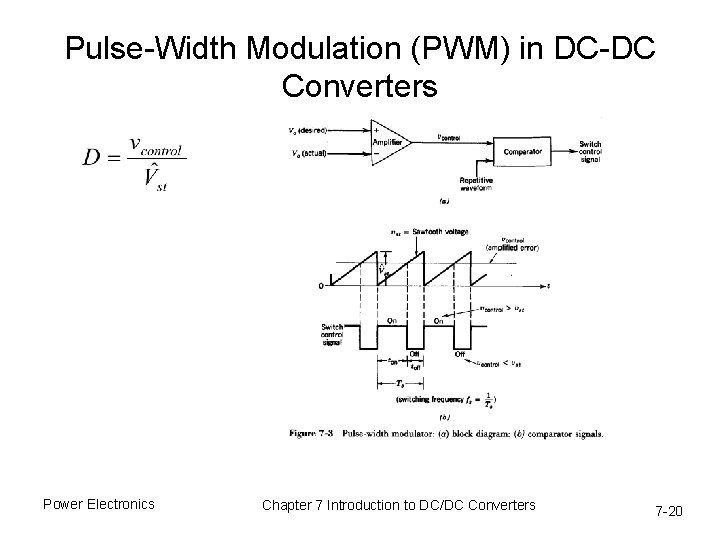
Pulse-Width Modulation (PWM) in DC-DC Converters Power Electronics Chapter 7 Introduction to DC/DC Converters 7 -20
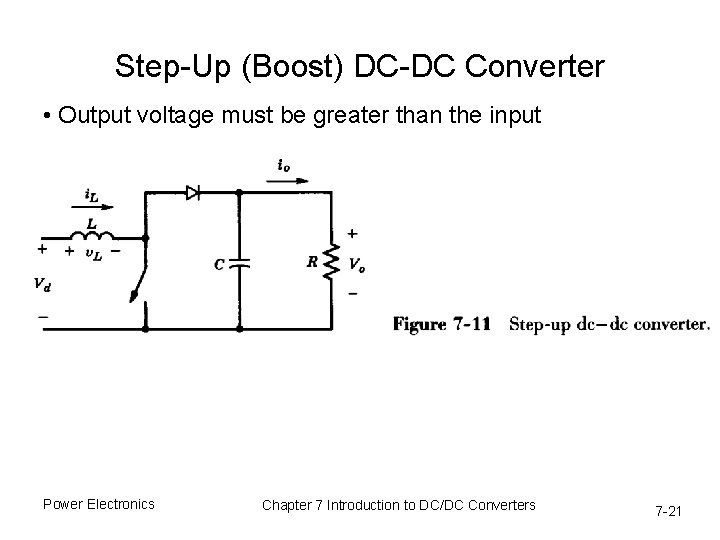
Step-Up (Boost) DC-DC Converter • Output voltage must be greater than the input Power Electronics Chapter 7 Introduction to DC/DC Converters 7 -21
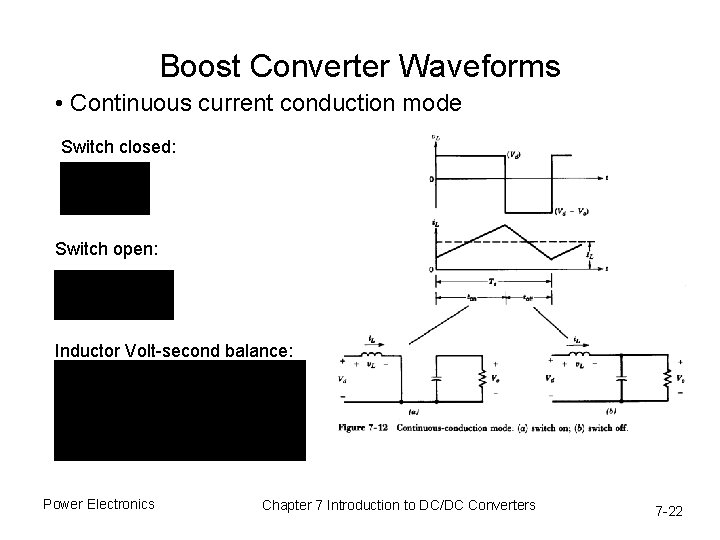
Boost Converter Waveforms • Continuous current conduction mode Switch closed: Switch open: Inductor Volt-second balance: Power Electronics Chapter 7 Introduction to DC/DC Converters 7 -22
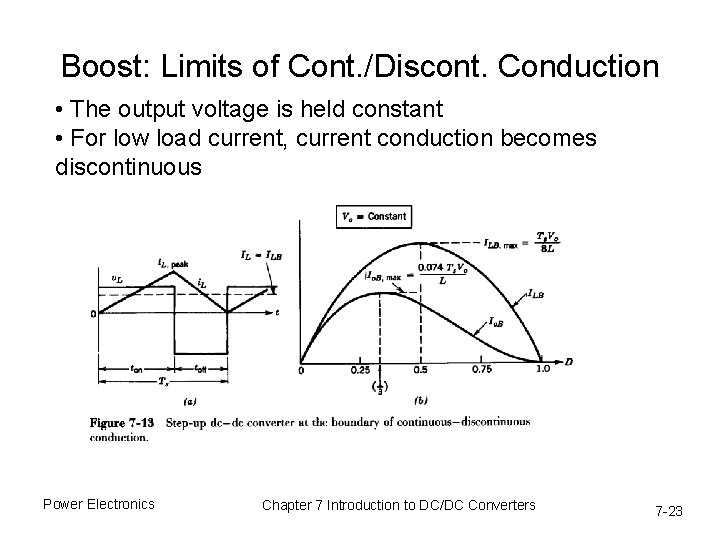
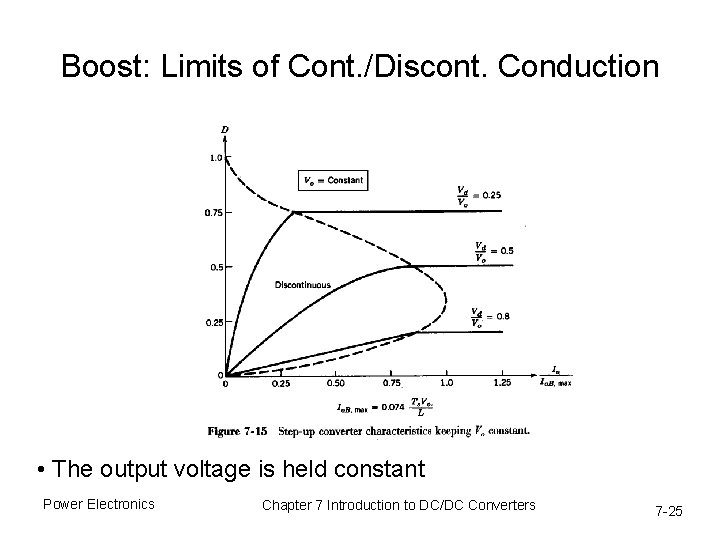
Boost: Limits of Cont. /Discont. Conduction • The output voltage is held constant • For low load current, current conduction becomes discontinuous Power Electronics Chapter 7 Introduction to DC/DC Converters 7 -23
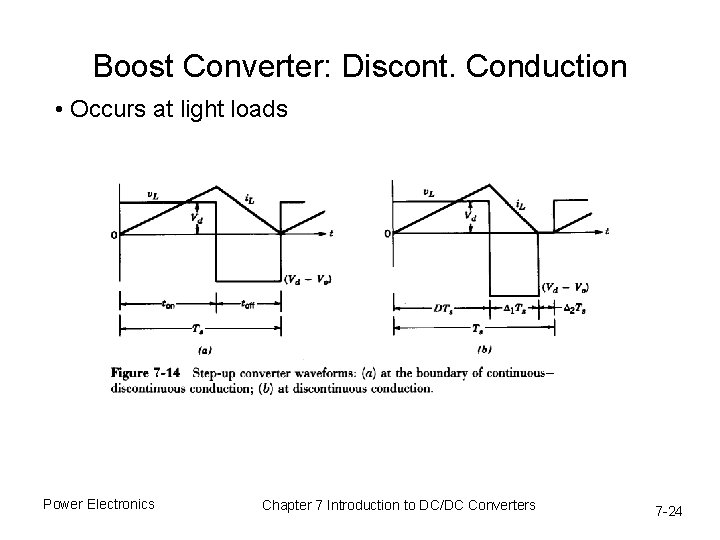
Boost Converter: Discont. Conduction • Occurs at light loads Power Electronics Chapter 7 Introduction to DC/DC Converters 7 -24
Boost: Limits of Cont. /Discont. Conduction • The output voltage is held constant Power Electronics Chapter 7 Introduction to DC/DC Converters 7 -25
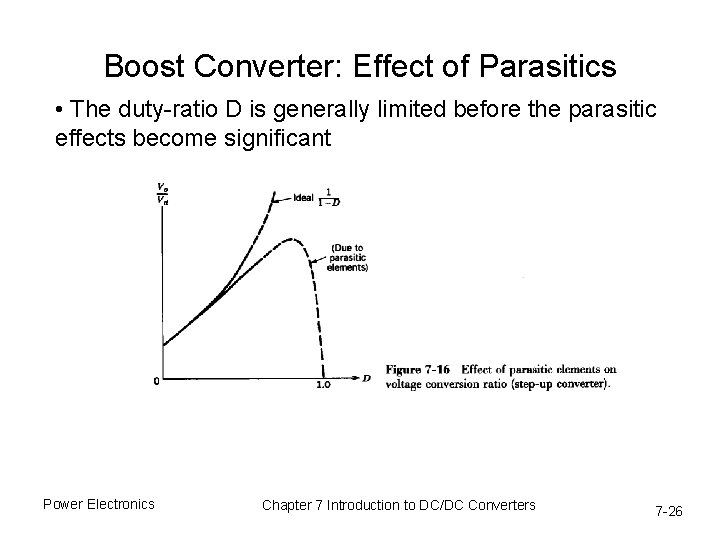
Boost Converter: Effect of Parasitics • The duty-ratio D is generally limited before the parasitic effects become significant Power Electronics Chapter 7 Introduction to DC/DC Converters 7 -26
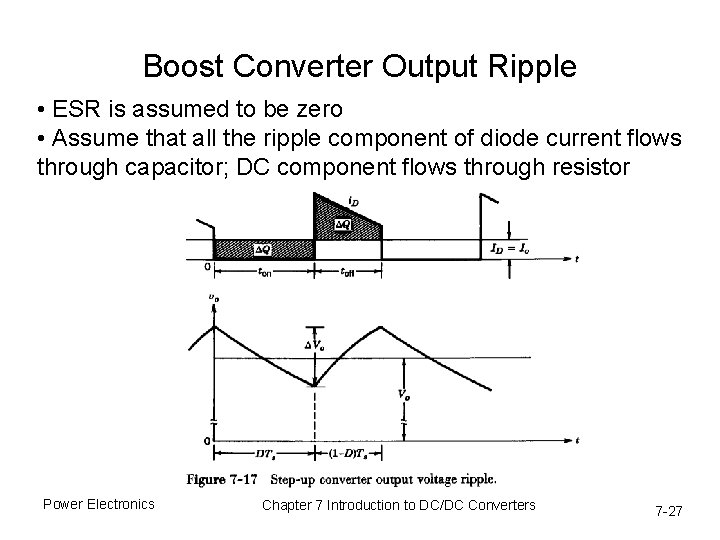
Boost Converter Output Ripple • ESR is assumed to be zero • Assume that all the ripple component of diode current flows through capacitor; DC component flows through resistor Power Electronics Chapter 7 Introduction to DC/DC Converters 7 -27
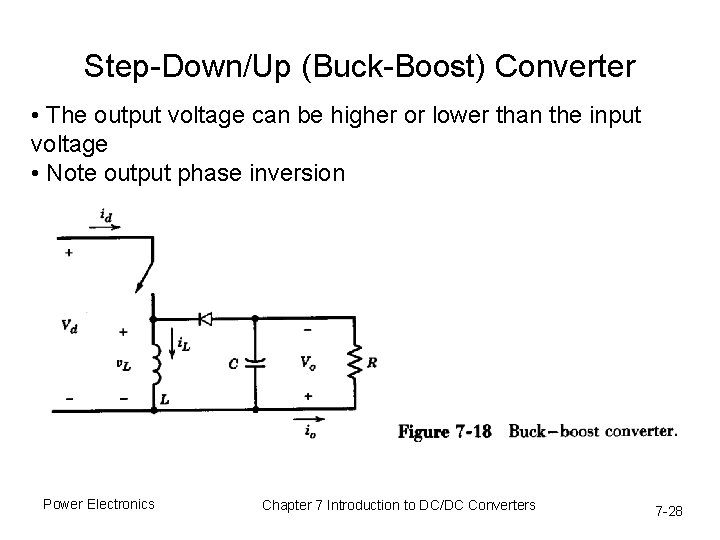
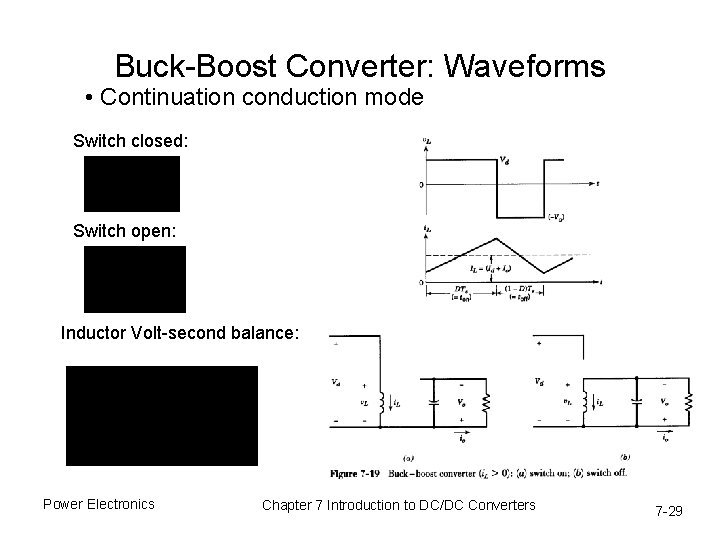
Step-Down/Up (Buck-Boost) Converter • The output voltage can be higher or lower than the input voltage • Note output phase inversion Power Electronics Chapter 7 Introduction to DC/DC Converters 7 -28
Buck-Boost Converter: Waveforms • Continuation conduction mode Switch closed: Switch open: Inductor Volt-second balance: Power Electronics Chapter 7 Introduction to DC/DC Converters 7 -29
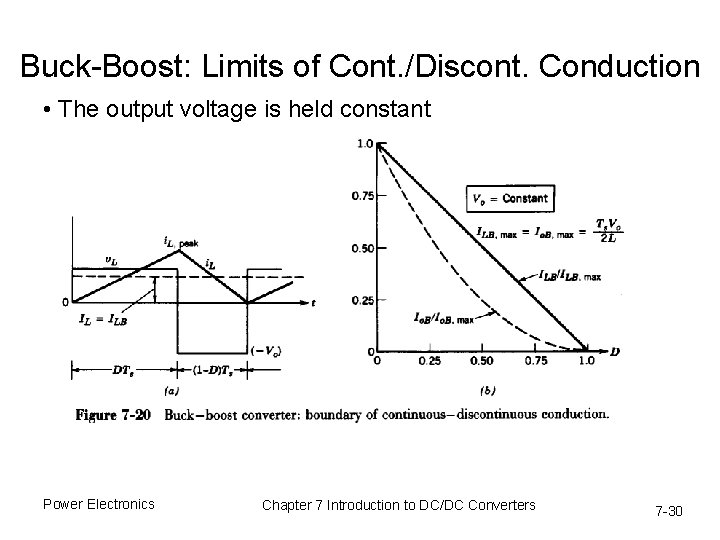
Buck-Boost: Limits of Cont. /Discont. Conduction • The output voltage is held constant Power Electronics Chapter 7 Introduction to DC/DC Converters 7 -30
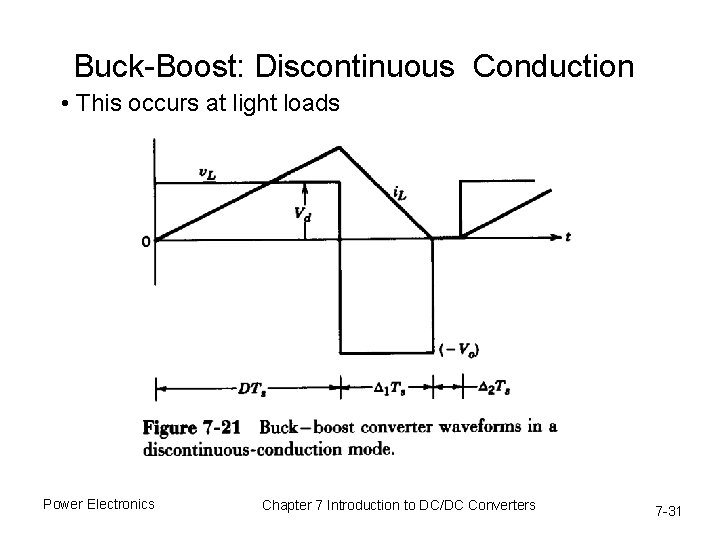
Buck-Boost: Discontinuous Conduction • This occurs at light loads Power Electronics Chapter 7 Introduction to DC/DC Converters 7 -31
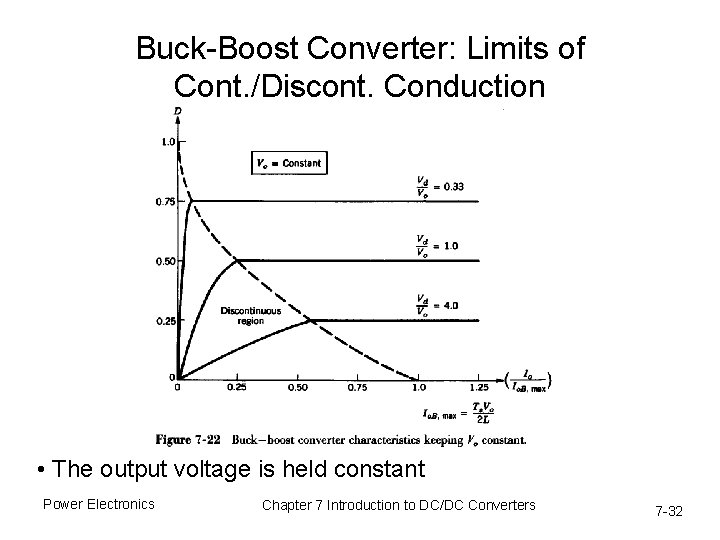
Buck-Boost Converter: Limits of Cont. /Discont. Conduction • The output voltage is held constant Power Electronics Chapter 7 Introduction to DC/DC Converters 7 -32
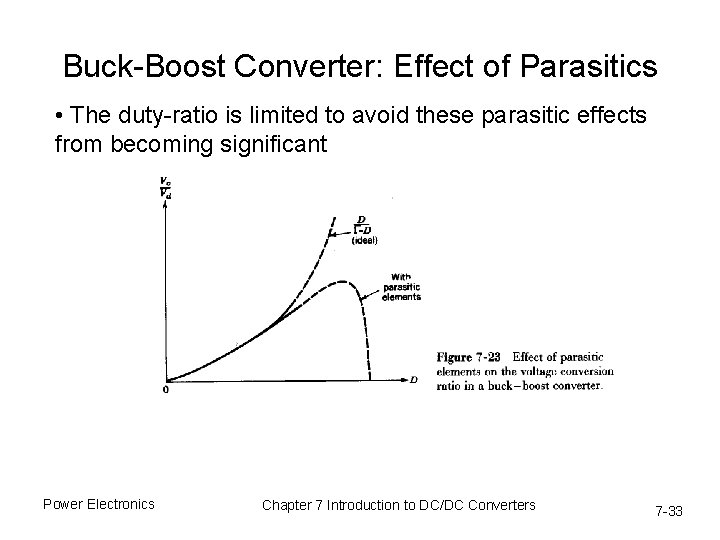
Buck-Boost Converter: Effect of Parasitics • The duty-ratio is limited to avoid these parasitic effects from becoming significant Power Electronics Chapter 7 Introduction to DC/DC Converters 7 -33
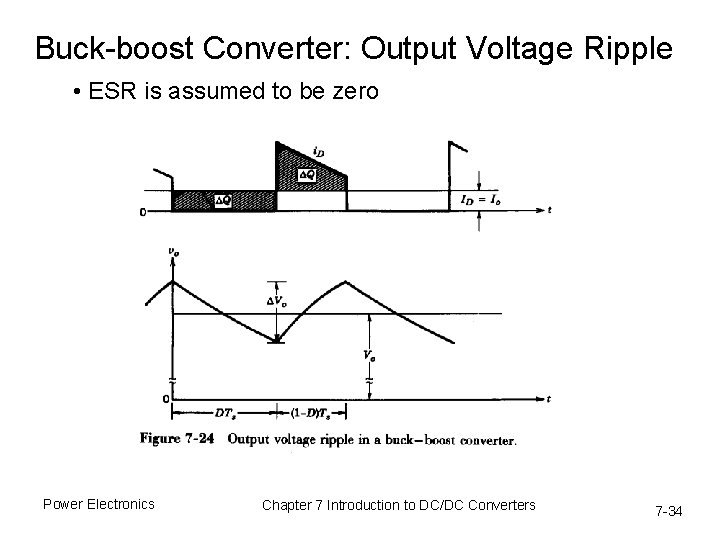
Buck-boost Converter: Output Voltage Ripple • ESR is assumed to be zero Power Electronics Chapter 7 Introduction to DC/DC Converters 7 -34
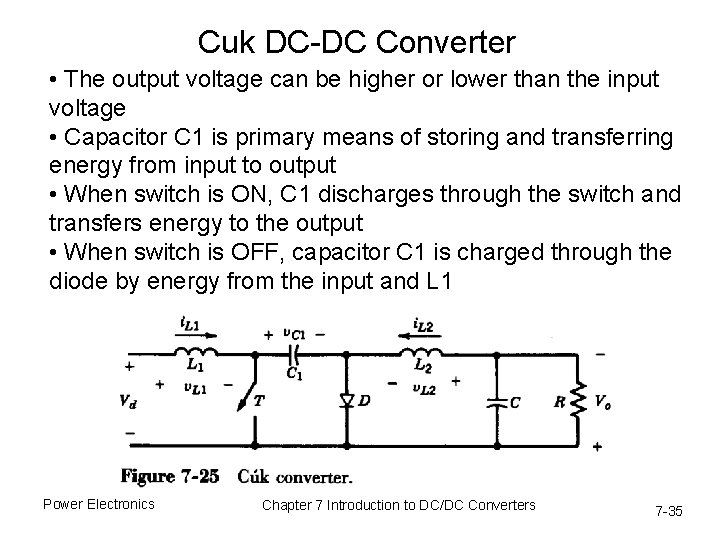
Cuk DC-DC Converter • The output voltage can be higher or lower than the input voltage • Capacitor C 1 is primary means of storing and transferring energy from input to output • When switch is ON, C 1 discharges through the switch and transfers energy to the output • When switch is OFF, capacitor C 1 is charged through the diode by energy from the input and L 1 Power Electronics Chapter 7 Introduction to DC/DC Converters 7 -35
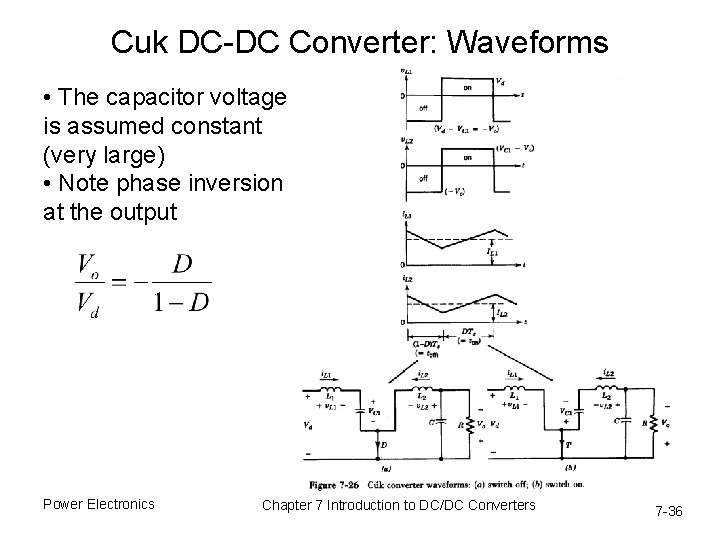
Cuk DC-DC Converter: Waveforms • The capacitor voltage is assumed constant (very large) • Note phase inversion at the output Power Electronics Chapter 7 Introduction to DC/DC Converters 7 -36
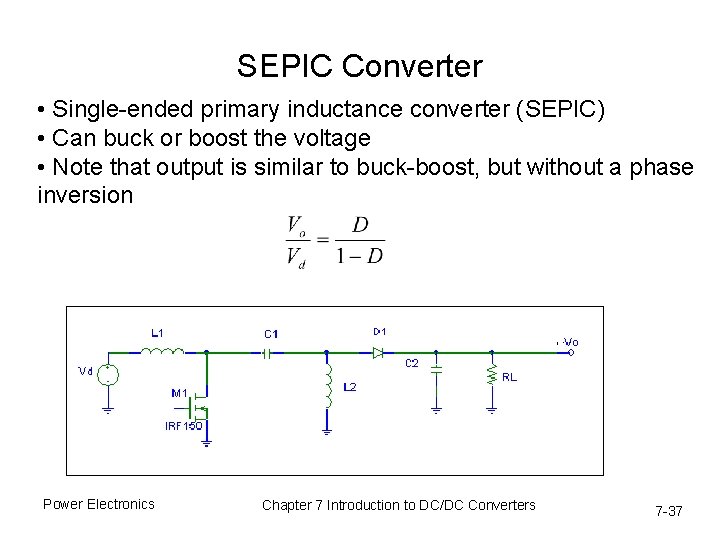
SEPIC Converter • Single-ended primary inductance converter (SEPIC) • Can buck or boost the voltage • Note that output is similar to buck-boost, but without a phase inversion Power Electronics Chapter 7 Introduction to DC/DC Converters 7 -37
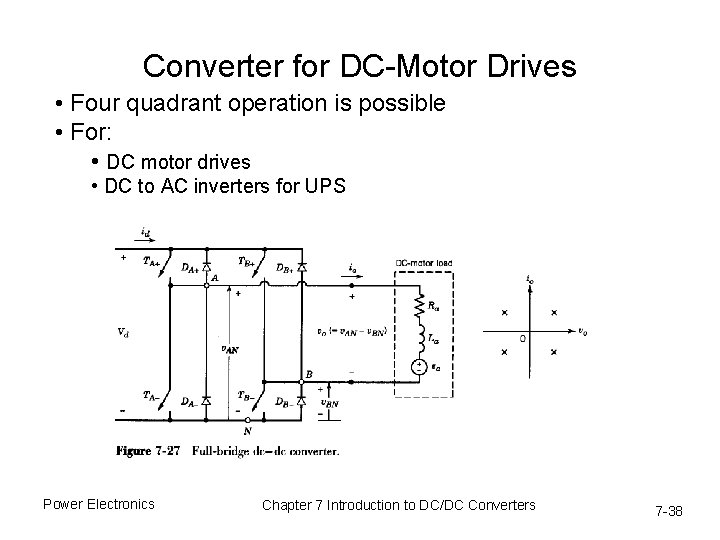
Converter for DC-Motor Drives • Four quadrant operation is possible • For: • DC motor drives • DC to AC inverters for UPS Power Electronics Chapter 7 Introduction to DC/DC Converters 7 -38
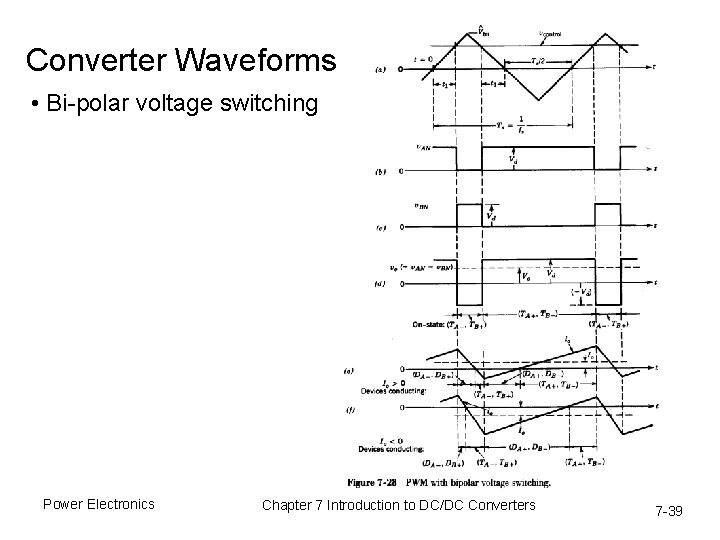
Converter Waveforms • Bi-polar voltage switching Power Electronics Chapter 7 Introduction to DC/DC Converters 7 -39
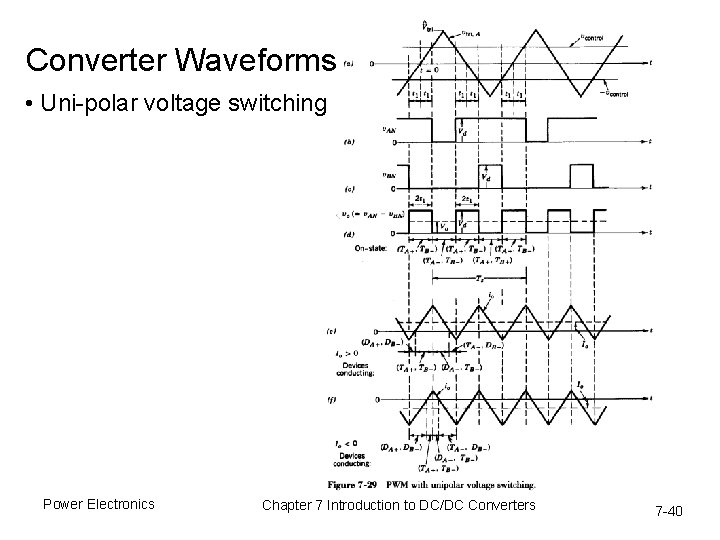
Converter Waveforms • Uni-polar voltage switching Power Electronics Chapter 7 Introduction to DC/DC Converters 7 -40
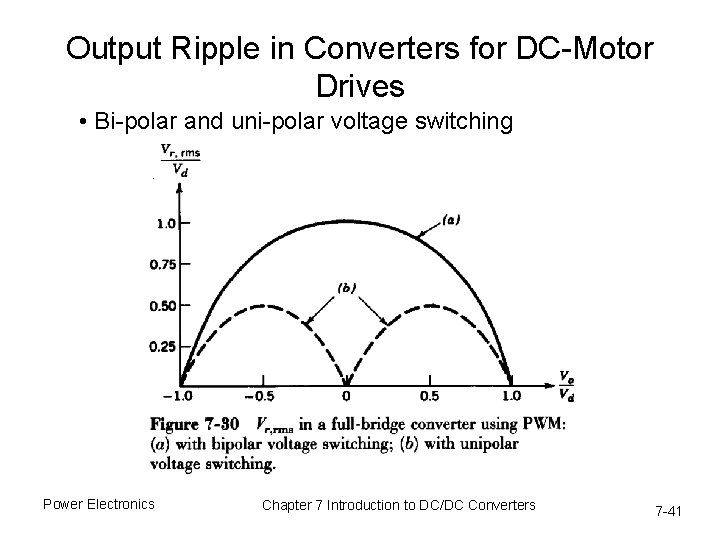
Output Ripple in Converters for DC-Motor Drives • Bi-polar and uni-polar voltage switching Power Electronics Chapter 7 Introduction to DC/DC Converters 7 -41
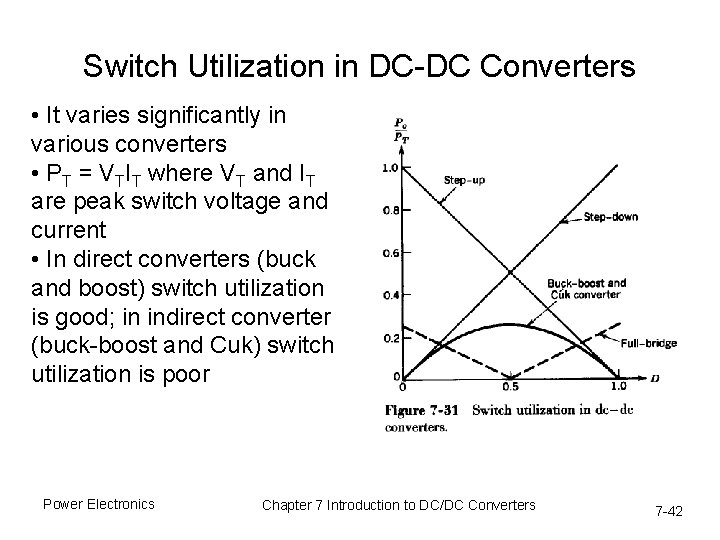
Switch Utilization in DC-DC Converters • It varies significantly in various converters • PT = VTIT where VT and IT are peak switch voltage and current • In direct converters (buck and boost) switch utilization is good; in indirect converter (buck-boost and Cuk) switch utilization is poor Power Electronics Chapter 7 Introduction to DC/DC Converters 7 -42
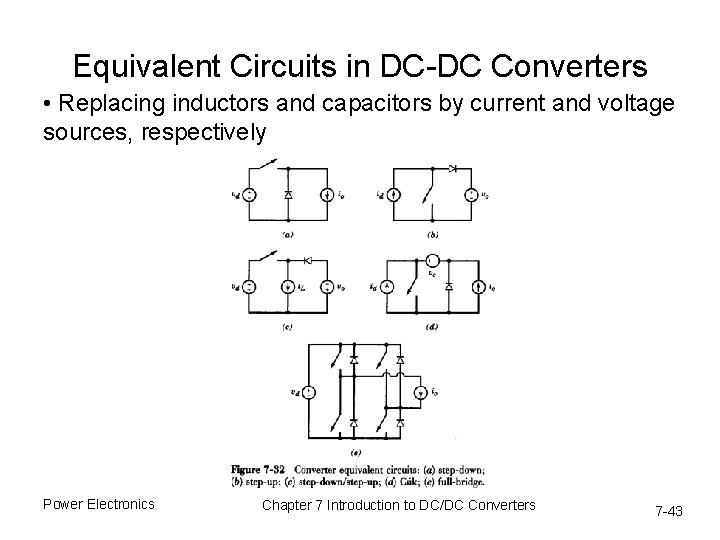
Equivalent Circuits in DC-DC Converters • Replacing inductors and capacitors by current and voltage sources, respectively Power Electronics Chapter 7 Introduction to DC/DC Converters 7 -43
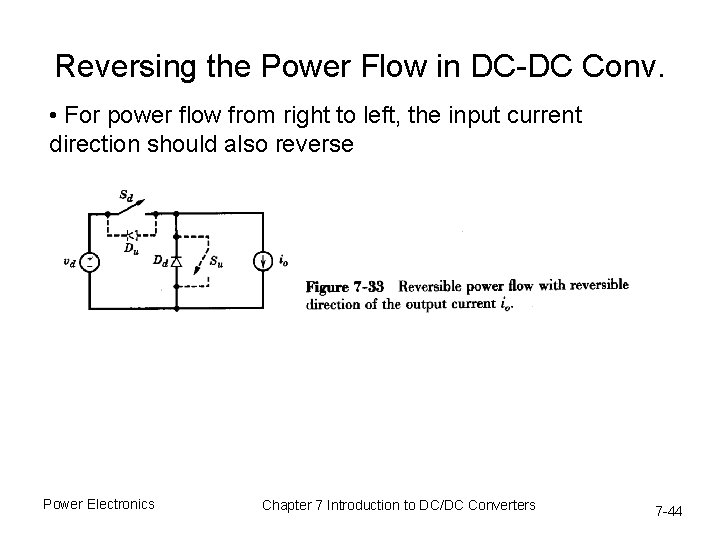
Reversing the Power Flow in DC-DC Conv. • For power flow from right to left, the input current direction should also reverse Power Electronics Chapter 7 Introduction to DC/DC Converters 7 -44
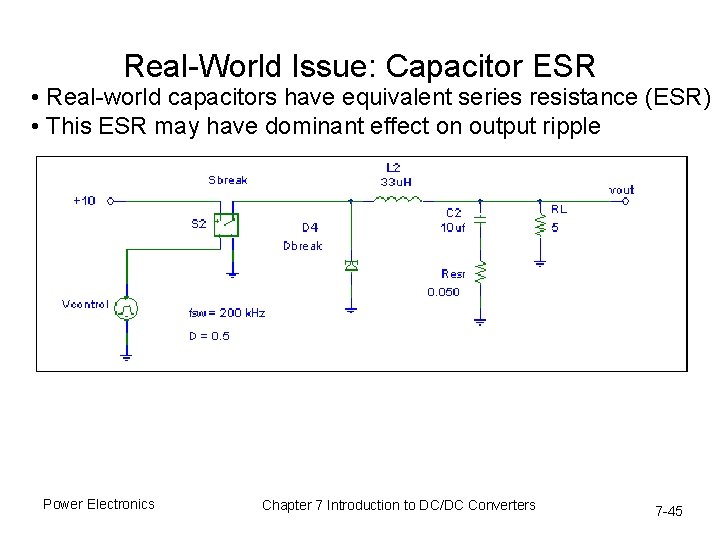
Real-World Issue: Capacitor ESR • Real-world capacitors have equivalent series resistance (ESR) • This ESR may have dominant effect on output ripple Power Electronics Chapter 7 Introduction to DC/DC Converters 7 -45
Effects of Capacitor ESR • Without ESR, output ripple is 24 m. V-pp • ESR has increased ripple to approximately 30 m. V-pp Power Electronics Chapter 7 Introduction to DC/DC Converters 7 -46