
7 Interdependent Global Economy The role multinationals play
7 Interdependent Global Economy The role multinationals play in Irish and global trade The global environmental issues of global warming, deforestation and desertification Asylum seeker and refugee issues in Europe
Chapter 7: Interdependent Global Economy Multinationals § Directly invest in many countries by building factories and by employing workers § 78, 000 world wide § Account for over 10% of global GDP § Responsible for approximately one third of global exports
Chapter 7: Interdependent Global Economy Multinationals (continued) § Employ an estimated 3% of the global workforce § Important source of employment, export trade and economic growth in many countries § Economic difficulties can result if decide to move elsewhere § Positive and negative economic impact
Chapter 7: Interdependent Global Economy Irish trade and Multinationals § Irish government encouraged foreign-owned companies to establish operations in Ireland § Major source of employment § Accounts for the majority of Irish exports § Industrial Development Agency (IDA) responsible for the attraction and development of foreign investment in Ireland § Crucial role in Irish economy
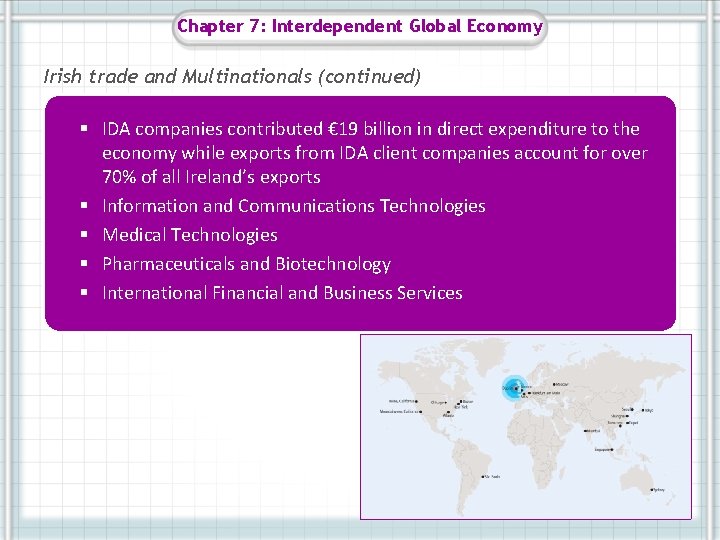
Chapter 7: Interdependent Global Economy Irish trade and Multinationals (continued) § IDA companies contributed € 19 billion in direct expenditure to the economy while exports from IDA client companies account for over 70% of all Ireland’s exports § Information and Communications Technologies § Medical Technologies § Pharmaceuticals and Biotechnology § International Financial and Business Services
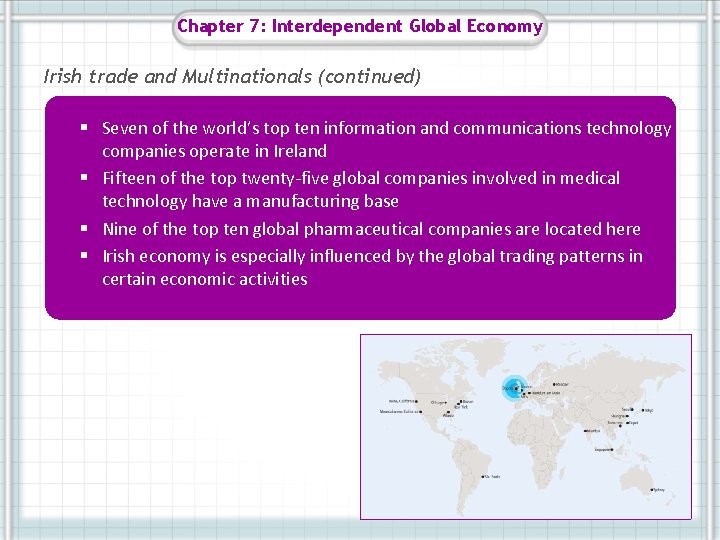
Chapter 7: Interdependent Global Economy Irish trade and Multinationals (continued) § Seven of the world’s top ten information and communications technology companies operate in Ireland § Fifteen of the top twenty-five global companies involved in medical technology have a manufacturing base § Nine of the top ten global pharmaceutical companies are located here § Irish economy is especially influenced by the global trading patterns in certain economic activities
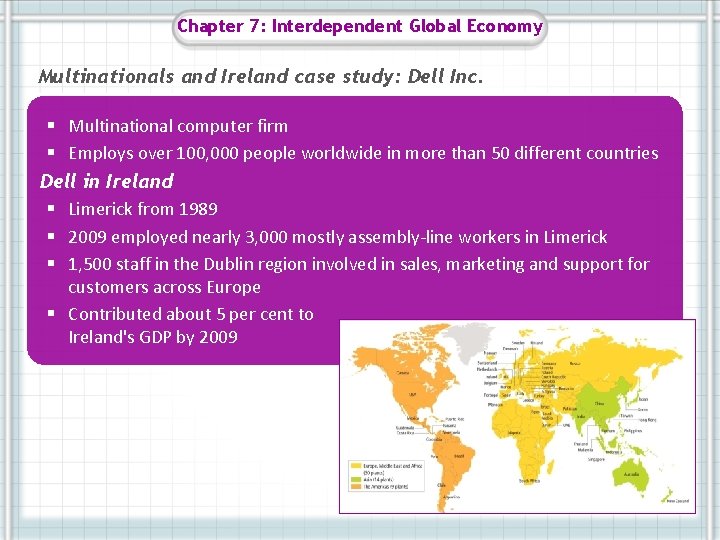
Chapter 7: Interdependent Global Economy Multinationals and Ireland case study: Dell Inc. § Multinational computer firm § Employs over 100, 000 people worldwide in more than 50 different countries Dell in Ireland § Limerick from 1989 § 2009 employed nearly 3, 000 mostly assembly-line workers in Limerick § 1, 500 staff in the Dublin region involved in sales, marketing and support for customers across Europe § Contributed about 5 per cent to Ireland's GDP by 2009
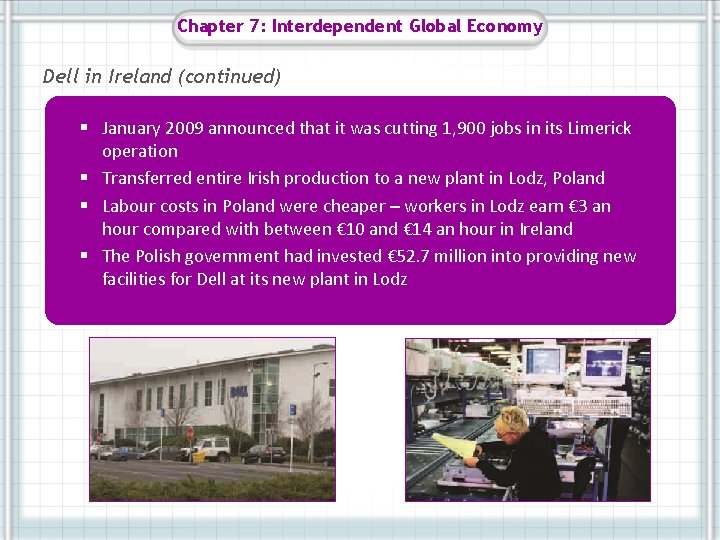
Chapter 7: Interdependent Global Economy Dell in Ireland (continued) § January 2009 announced that it was cutting 1, 900 jobs in its Limerick operation § Transferred entire Irish production to a new plant in Lodz, Poland § Labour costs in Poland were cheaper – workers in Lodz earn € 3 an hour compared with between € 10 and € 14 an hour in Ireland § The Polish government had invested € 52. 7 million into providing new facilities for Dell at its new plant in Lodz
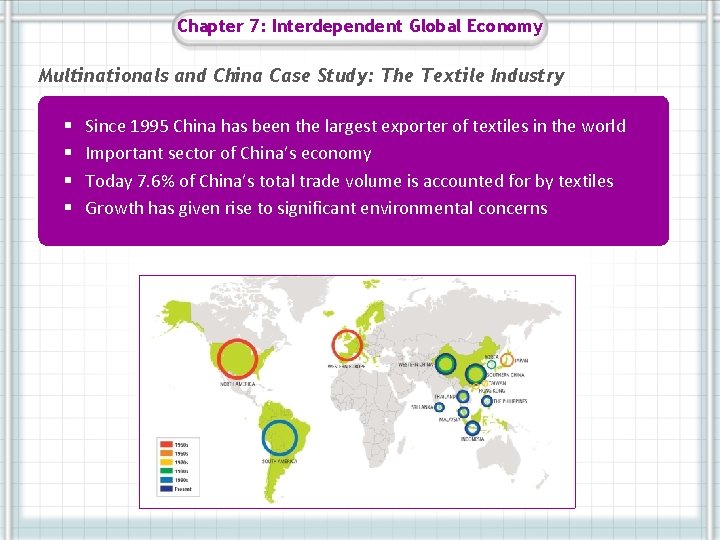
Chapter 7: Interdependent Global Economy Multinationals and China Case Study: The Textile Industry § § Since 1995 China has been the largest exporter of textiles in the world Important sector of China’s economy Today 7. 6% of China’s total trade volume is accounted for by textiles Growth has given rise to significant environmental concerns
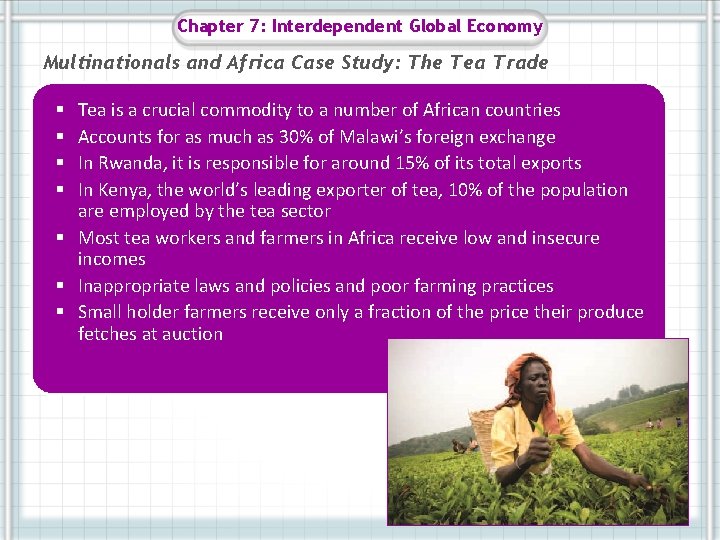
Chapter 7: Interdependent Global Economy Multinationals and Africa Case Study: The Tea Trade Tea is a crucial commodity to a number of African countries Accounts for as much as 30% of Malawi’s foreign exchange In Rwanda, it is responsible for around 15% of its total exports In Kenya, the world’s leading exporter of tea, 10% of the population are employed by the tea sector § Most tea workers and farmers in Africa receive low and insecure incomes § Inappropriate laws and policies and poor farming practices § Small holder farmers receive only a fraction of the price their produce fetches at auction § §
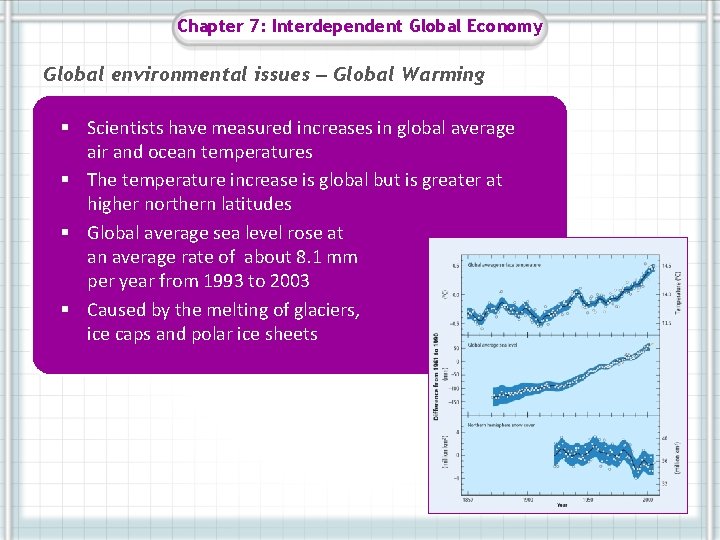
Chapter 7: Interdependent Global Economy Global environmental issues – Global Warming § Scientists have measured increases in global average air and ocean temperatures § The temperature increase is global but is greater at higher northern latitudes § Global average sea level rose at an average rate of about 8. 1 mm per year from 1993 to 2003 § Caused by the melting of glaciers, ice caps and polar ice sheets
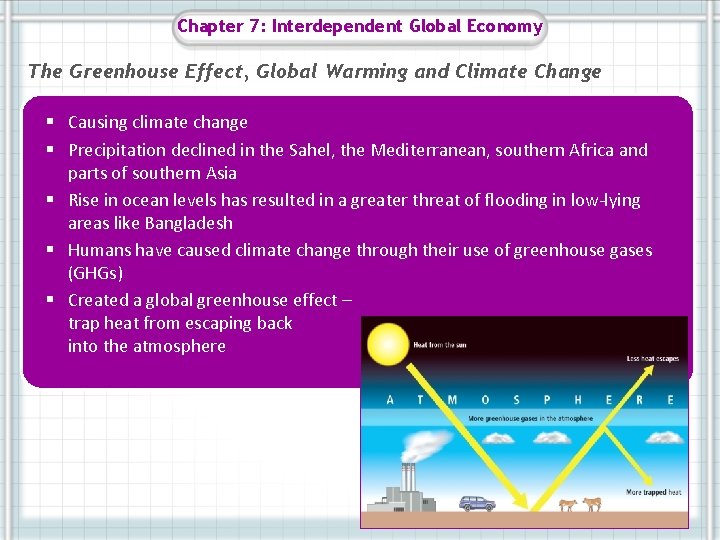
Chapter 7: Interdependent Global Economy The Greenhouse Effect, Global Warming and Climate Change § Causing climate change § Precipitation declined in the Sahel, the Mediterranean, southern Africa and parts of southern Asia § Rise in ocean levels has resulted in a greater threat of flooding in low-lying areas like Bangladesh § Humans have caused climate change through their use of greenhouse gases (GHGs) § Created a global greenhouse effect – trap heat from escaping back into the atmosphere
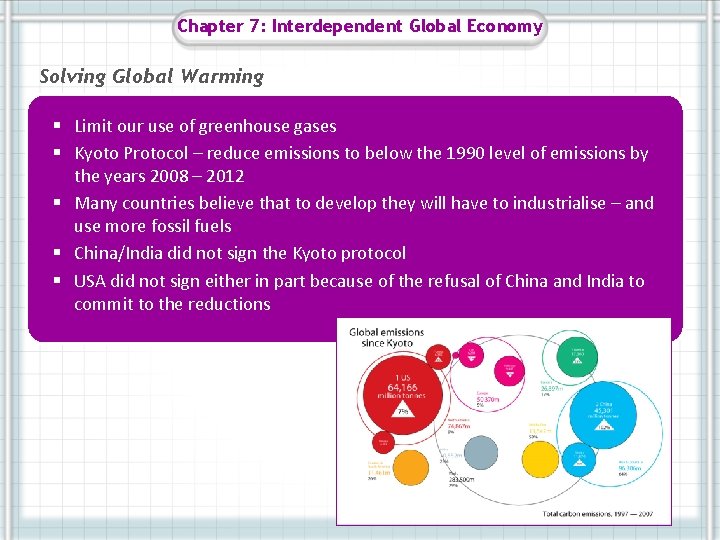
Chapter 7: Interdependent Global Economy Solving Global Warming § Limit our use of greenhouse gases § Kyoto Protocol – reduce emissions to below the 1990 level of emissions by the years 2008 – 2012 § Many countries believe that to develop they will have to industrialise – and use more fossil fuels § China/India did not sign the Kyoto protocol § USA did not sign either in part because of the refusal of China and India to commit to the reductions
Chapter 7: Interdependent Global Economy Global environmental issues – Deforestation § Removal of the tree cover below a certain limit and converting the land to another use § Forests sustain the livelihoods of hundreds of millions of people globally § Store more than one trillion tonnes of carbon and support a rich biodiversity § About 13 million hectares of forests are converted to other land uses every year § Result of the interdependent nature of the global economy
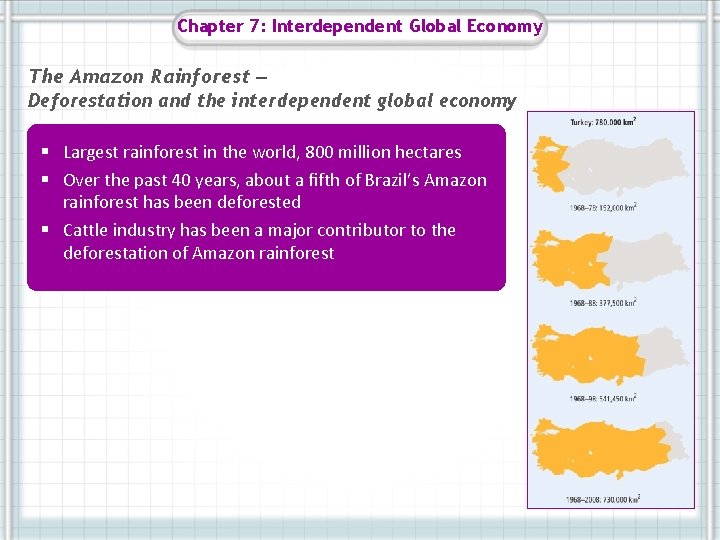
Chapter 7: Interdependent Global Economy The Amazon Rainforest – Deforestation and the interdependent global economy § Largest rainforest in the world, 800 million hectares § Over the past 40 years, about a fifth of Brazil’s Amazon rainforest has been deforested § Cattle industry has been a major contributor to the deforestation of Amazon rainforest
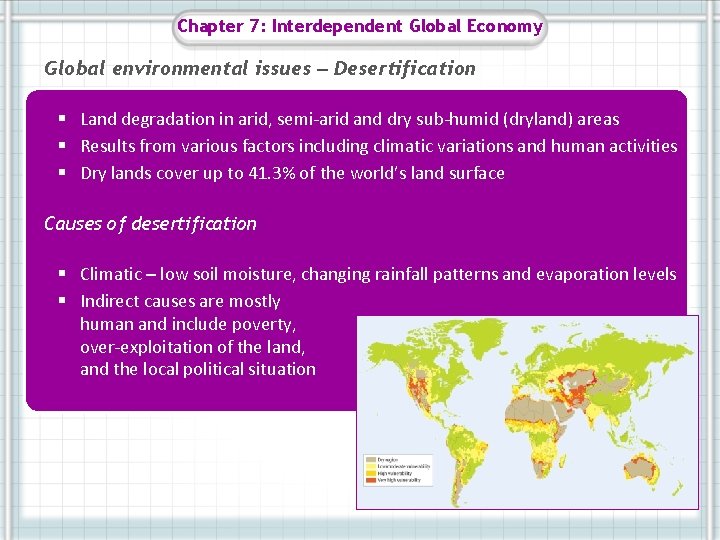
Chapter 7: Interdependent Global Economy Global environmental issues – Desertification § Land degradation in arid, semi-arid and dry sub-humid (dryland) areas § Results from various factors including climatic variations and human activities § Dry lands cover up to 41. 3% of the world’s land surface Causes of desertification § Climatic – low soil moisture, changing rainfall patterns and evaporation levels § Indirect causes are mostly human and include poverty, over-exploitation of the land, and the local political situation
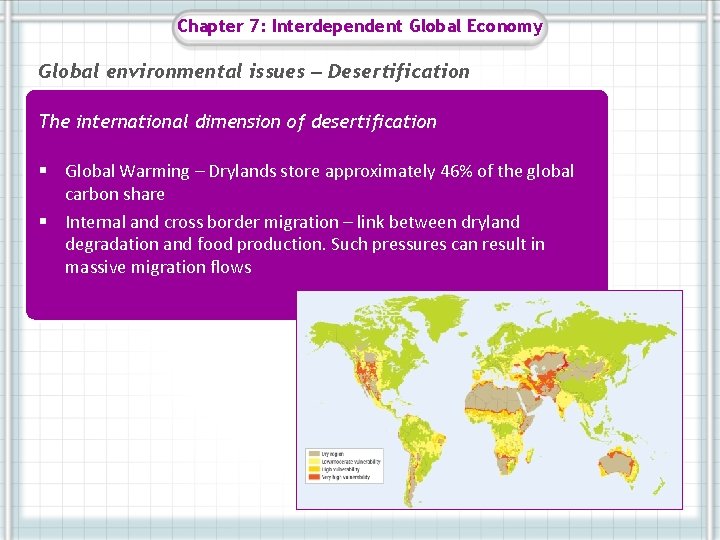
Chapter 7: Interdependent Global Economy Global environmental issues – Desertification The international dimension of desertification § Global Warming – Drylands store approximately 46% of the global carbon share § Internal and cross border migration – link between dryland degradation and food production. Such pressures can result in massive migration flows
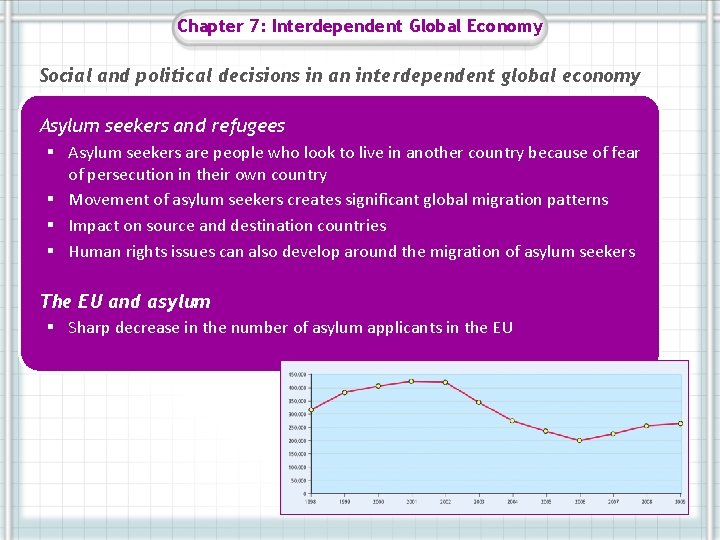
Chapter 7: Interdependent Global Economy Social and political decisions in an interdependent global economy Asylum seekers and refugees § Asylum seekers are people who look to live in another country because of fear of persecution in their own country § Movement of asylum seekers creates significant global migration patterns § Impact on source and destination countries § Human rights issues can also develop around the migration of asylum seekers The EU and asylum § Sharp decrease in the number of asylum applicants in the EU
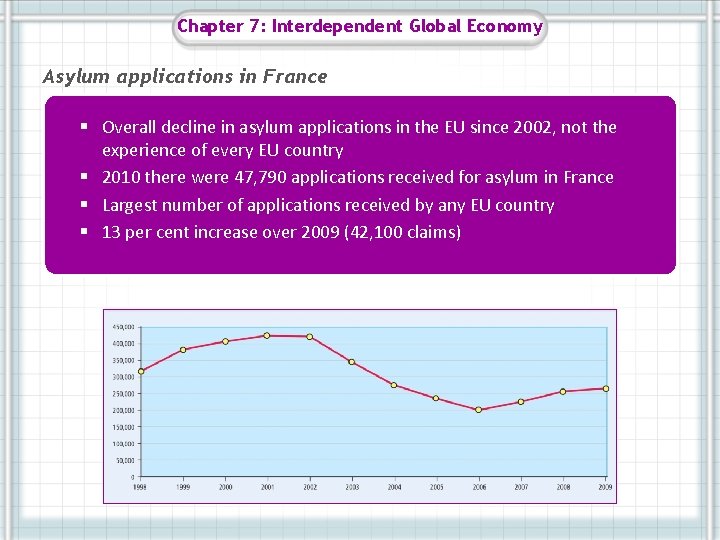
Chapter 7: Interdependent Global Economy Asylum applications in France § Overall decline in asylum applications in the EU since 2002, not the experience of every EU country § 2010 there were 47, 790 applications received for asylum in France § Largest number of applications received by any EU country § 13 per cent increase over 2009 (42, 100 claims)
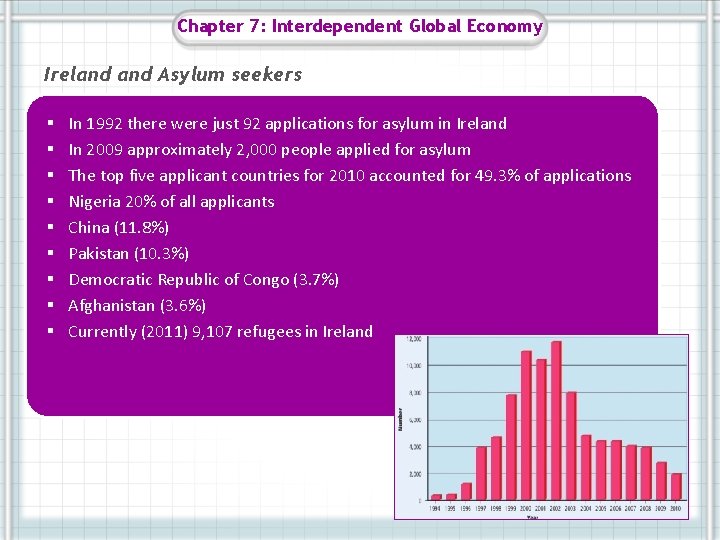
Chapter 7: Interdependent Global Economy Ireland Asylum seekers § § § § § In 1992 there were just 92 applications for asylum in Ireland In 2009 approximately 2, 000 people applied for asylum The top five applicant countries for 2010 accounted for 49. 3% of applications Nigeria 20% of all applicants China (11. 8%) Pakistan (10. 3%) Democratic Republic of Congo (3. 7%) Afghanistan (3. 6%) Currently (2011) 9, 107 refugees in Ireland
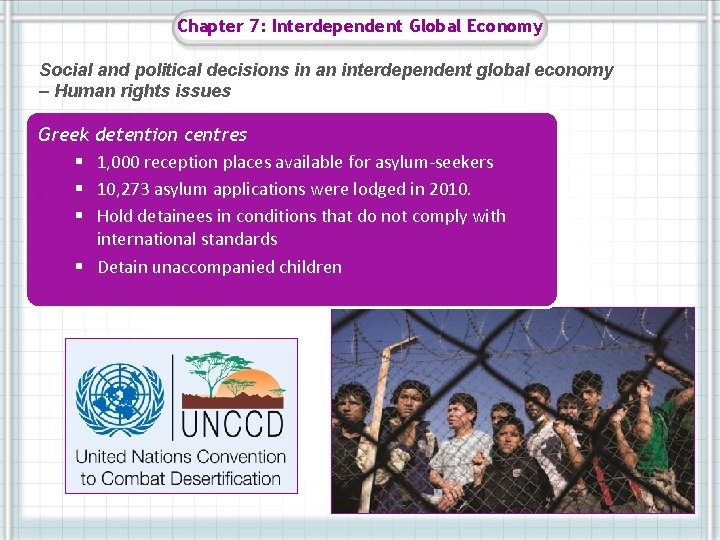
Chapter 7: Interdependent Global Economy Social and political decisions in an interdependent global economy – Human rights issues Greek § § § detention centres 1, 000 reception places available for asylum-seekers 10, 273 asylum applications were lodged in 2010. Hold detainees in conditions that do not comply with international standards § Detain unaccompanied children
- Slides: 21