
7 Innovation and Change Copyright 2017 Cengage Learning

- Slides: 25
7 Innovation and Change Copyright © 2017 Cengage Learning. All Rights Reserved. May not be scanned, copied or duplicated, or posted to a publicly accessible website, in whole or in part.
LEARNING OUTCOMES 1. Explain why innovation matters to companies 2. Discuss the different methods that managers can use to effectively manage innovation in their organizations 3. Discuss why not changing can lead to organizational decline 4. Discuss the different methods that managers can use to better manage change as it occurs Copyright © 2017 Cengage Learning. All Rights Reserved. May not be scanned, copied or duplicated, or posted to a publicly accessible website, in whole or in part. MGMT 10 | CH 7 2
Why Innovation Matters LO 1 • Organizational innovation: Successful implementation of creative ideas in organizations • Technology cycle: Begins with the birth of a new technology • Ends when the technology reaches its limits and is replaced by a newer and better technology Copyright © 2017 Cengage Learning. All Rights Reserved. May not be scanned, copied or duplicated, or posted to a publicly accessible website, in whole or in part. MGMT 10 | CH 7 3
LO 1 S-Curve Pattern of Innovation • Characterized by slow initial progress, followed by rapid progress, and then slow progress again • Slow progress results when a technology matures and reaches its limits • Slope of the curve • Steep slope - Little effort increases performance • Flat slope - Further developmental efforts lead to small increases in performance Copyright © 2017 Cengage Learning. All Rights Reserved. May not be scanned, copied or duplicated, or posted to a publicly accessible website, in whole or in part. MGMT 10 | CH 7 4
LO 1 Innovation Streams • Patterns of innovation over time that can create sustainable competitive advantage • Phases • Technological discontinuity: Unique combination of existing technologies creates a significant breakthrough in performance • Discontinuous change: Characterized by design competition and technological substitution Copyright © 2017 Cengage Learning. All Rights Reserved. May not be scanned, copied or duplicated, or posted to a publicly accessible website, in whole or in part. MGMT 10 | CH 7 5
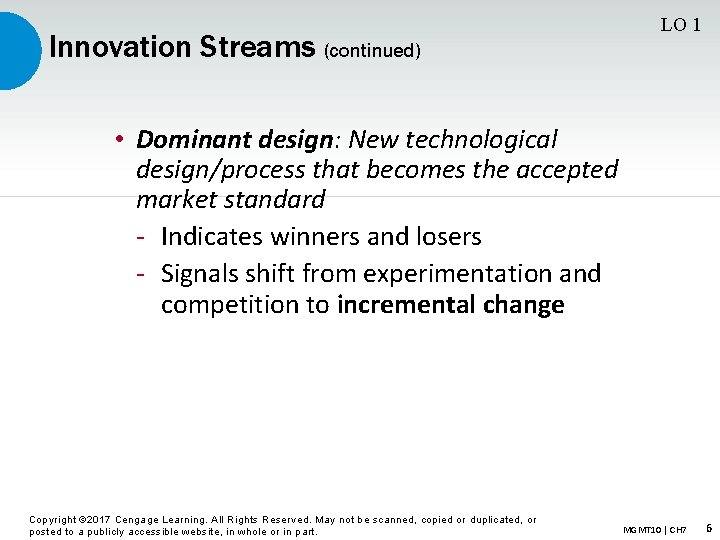
Innovation Streams (continued) LO 1 • Dominant design: New technological design/process that becomes the accepted market standard - Indicates winners and losers - Signals shift from experimentation and competition to incremental change Copyright © 2017 Cengage Learning. All Rights Reserved. May not be scanned, copied or duplicated, or posted to a publicly accessible website, in whole or in part. MGMT 10 | CH 7 6
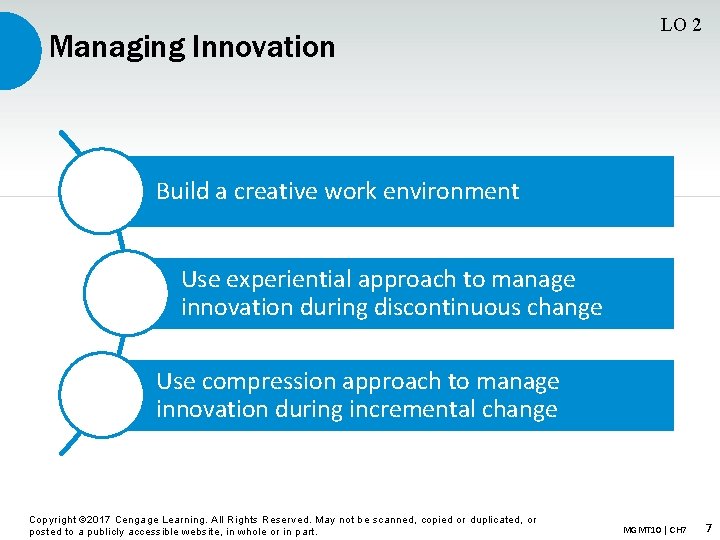
Managing Innovation LO 2 Build a creative work environment Use experiential approach to manage innovation during discontinuous change Use compression approach to manage innovation during incremental change Copyright © 2017 Cengage Learning. All Rights Reserved. May not be scanned, copied or duplicated, or posted to a publicly accessible website, in whole or in part. MGMT 10 | CH 7 7
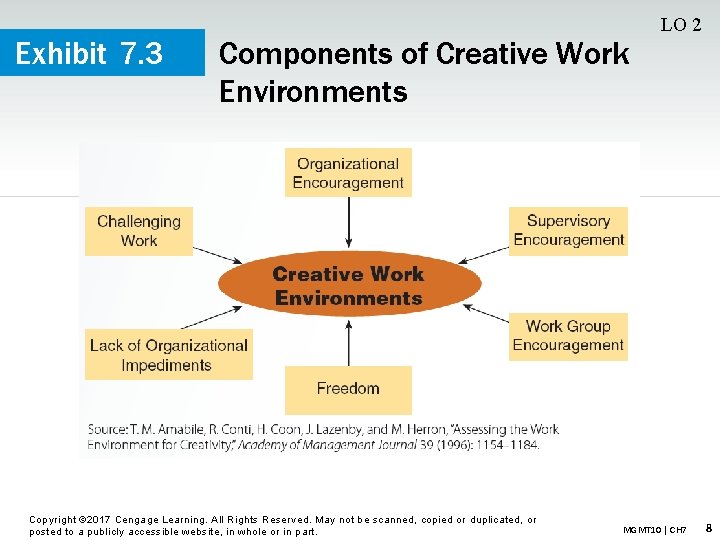
Exhibit 7. 3 Components of Creative Work Environments Copyright © 2017 Cengage Learning. All Rights Reserved. May not be scanned, copied or duplicated, or posted to a publicly accessible website, in whole or in part. LO 2 MGMT 10 | CH 7 8
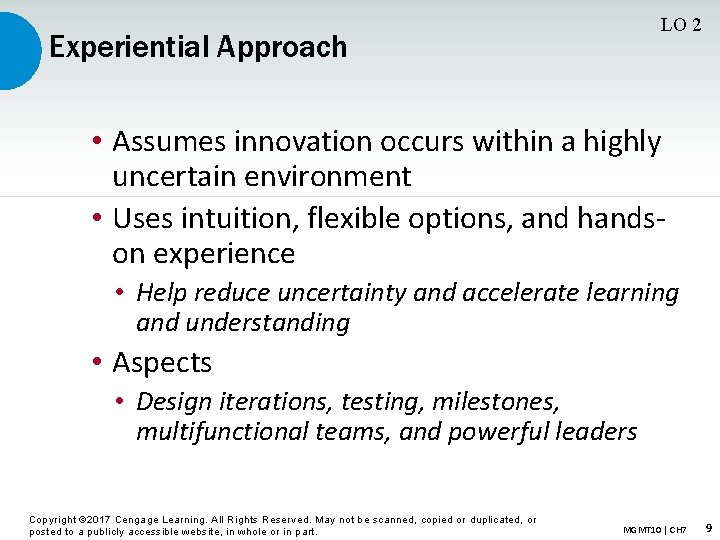
LO 2 Experiential Approach • Assumes innovation occurs within a highly uncertain environment • Uses intuition, flexible options, and handson experience • Help reduce uncertainty and accelerate learning and understanding • Aspects • Design iterations, testing, milestones, multifunctional teams, and powerful leaders Copyright © 2017 Cengage Learning. All Rights Reserved. May not be scanned, copied or duplicated, or posted to a publicly accessible website, in whole or in part. MGMT 10 | CH 7 9
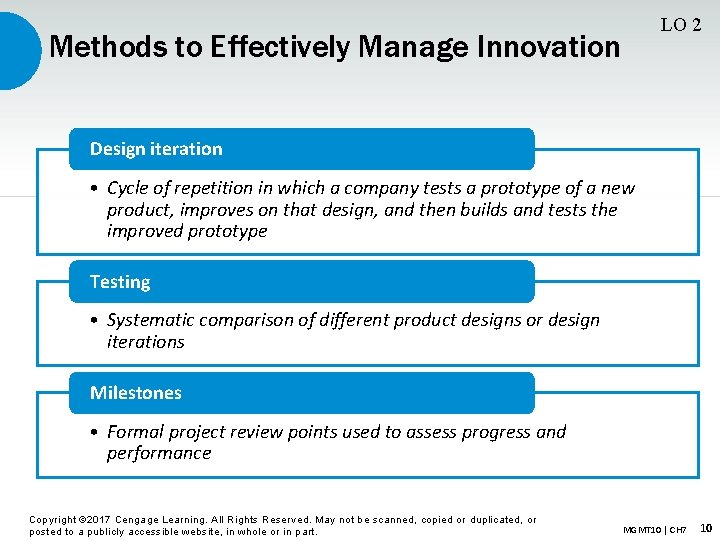
LO 2 Methods to Effectively Manage Innovation Design iteration • Cycle of repetition in which a company tests a prototype of a new product, improves on that design, and then builds and tests the improved prototype Testing • Systematic comparison of different product designs or design iterations Milestones • Formal project review points used to assess progress and performance Copyright © 2017 Cengage Learning. All Rights Reserved. May not be scanned, copied or duplicated, or posted to a publicly accessible website, in whole or in part. MGMT 10 | CH 7 10
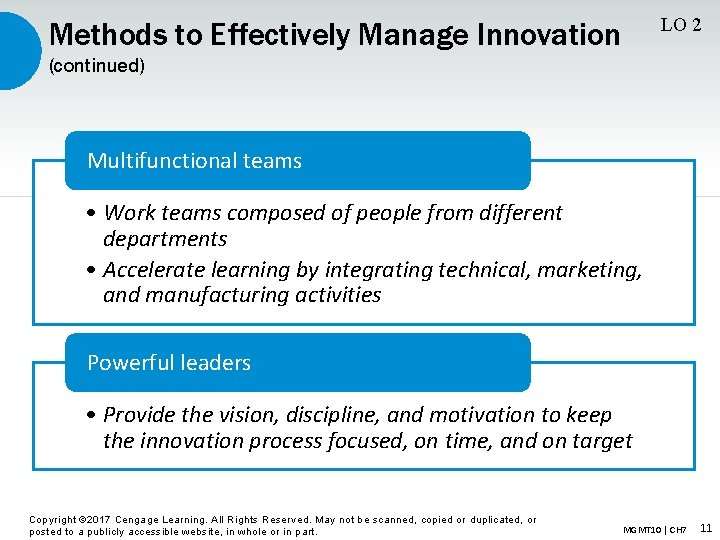
LO 2 Methods to Effectively Manage Innovation (continued) Multifunctional teams • Work teams composed of people from different departments • Accelerate learning by integrating technical, marketing, and manufacturing activities Powerful leaders • Provide the vision, discipline, and motivation to keep the innovation process focused, on time, and on target Copyright © 2017 Cengage Learning. All Rights Reserved. May not be scanned, copied or duplicated, or posted to a publicly accessible website, in whole or in part. MGMT 10 | CH 7 11
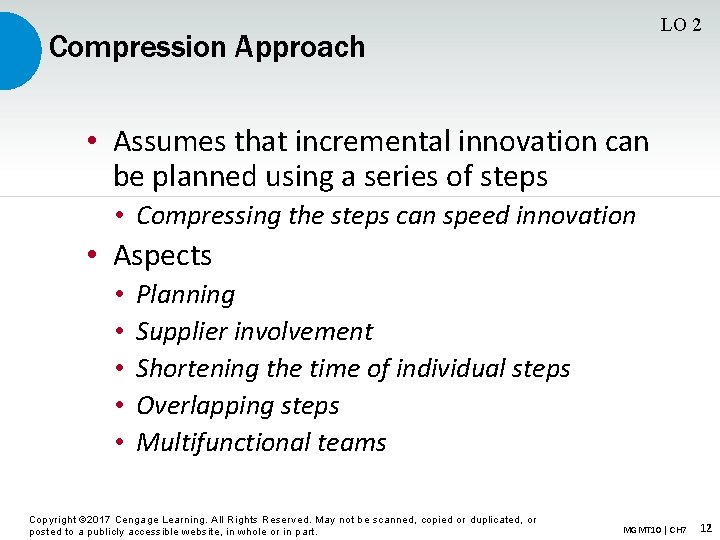
LO 2 Compression Approach • Assumes that incremental innovation can be planned using a series of steps • Compressing the steps can speed innovation • Aspects • • • Planning Supplier involvement Shortening the time of individual steps Overlapping steps Multifunctional teams Copyright © 2017 Cengage Learning. All Rights Reserved. May not be scanned, copied or duplicated, or posted to a publicly accessible website, in whole or in part. MGMT 10 | CH 7 12
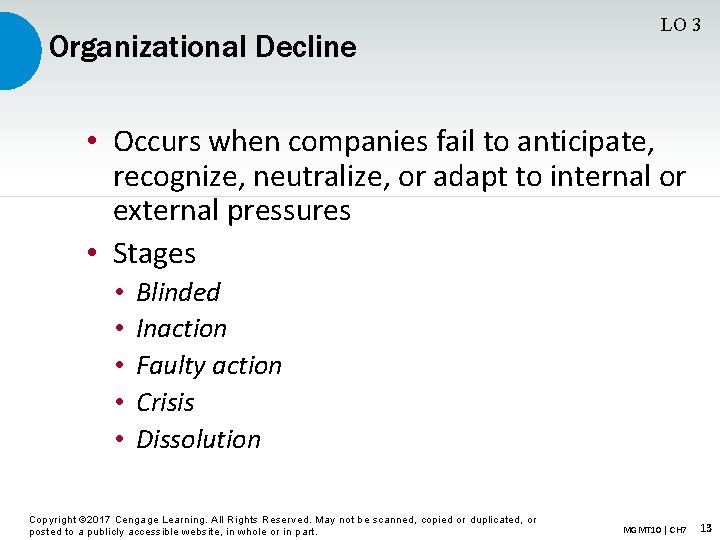
Organizational Decline LO 3 • Occurs when companies fail to anticipate, recognize, neutralize, or adapt to internal or external pressures • Stages • • • Blinded Inaction Faulty action Crisis Dissolution Copyright © 2017 Cengage Learning. All Rights Reserved. May not be scanned, copied or duplicated, or posted to a publicly accessible website, in whole or in part. MGMT 10 | CH 7 13
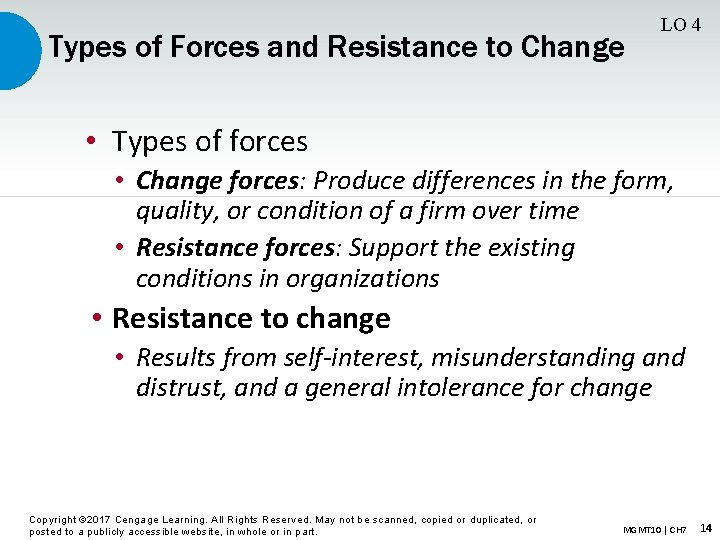
Types of Forces and Resistance to Change LO 4 • Types of forces • Change forces: Produce differences in the form, quality, or condition of a firm over time • Resistance forces: Support the existing conditions in organizations • Resistance to change • Results from self-interest, misunderstanding and distrust, and a general intolerance for change Copyright © 2017 Cengage Learning. All Rights Reserved. May not be scanned, copied or duplicated, or posted to a publicly accessible website, in whole or in part. MGMT 10 | CH 7 14
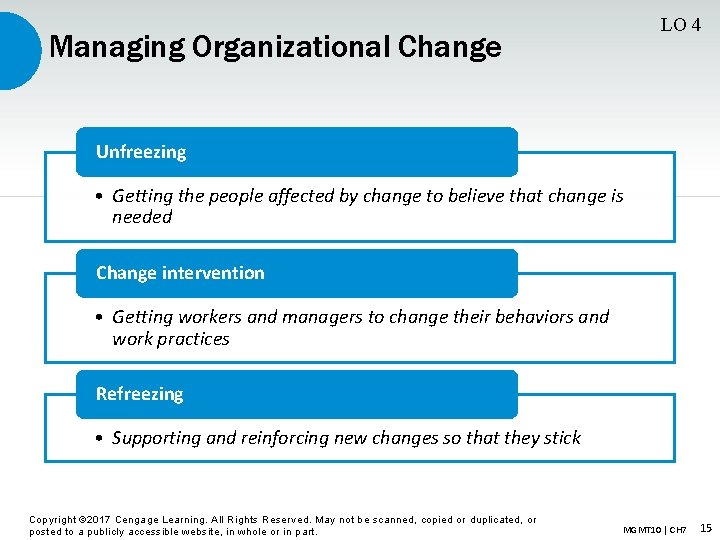
LO 4 Managing Organizational Change Unfreezing • Getting the people affected by change to believe that change is needed Change intervention • Getting workers and managers to change their behaviors and work practices Refreezing • Supporting and reinforcing new changes so that they stick Copyright © 2017 Cengage Learning. All Rights Reserved. May not be scanned, copied or duplicated, or posted to a publicly accessible website, in whole or in part. MGMT 10 | CH 7 15
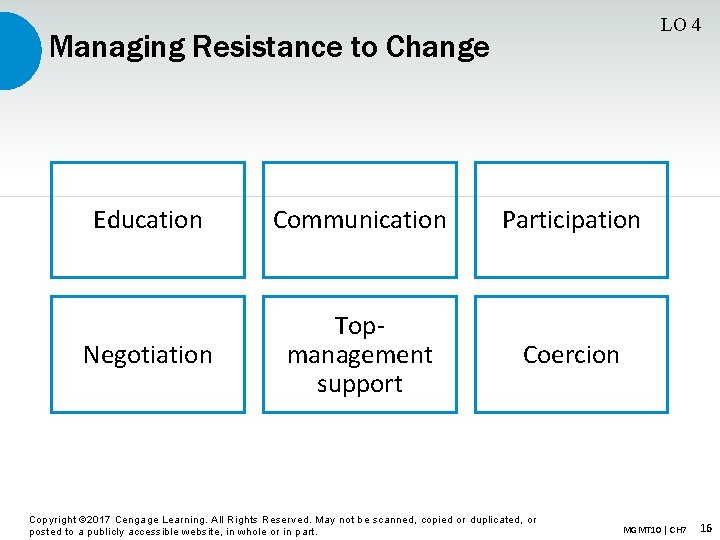
LO 4 Managing Resistance to Change Education Communication Participation Negotiation Topmanagement support Coercion Copyright © 2017 Cengage Learning. All Rights Reserved. May not be scanned, copied or duplicated, or posted to a publicly accessible website, in whole or in part. MGMT 10 | CH 7 16
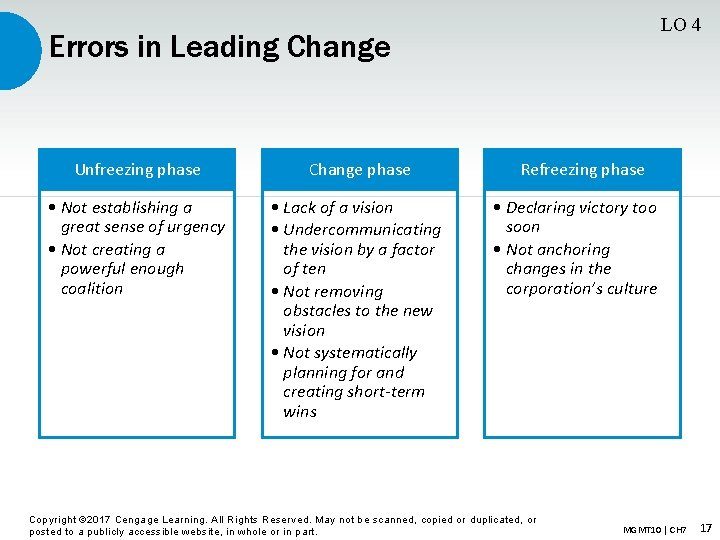
LO 4 Errors in Leading Change Unfreezing phase Change phase • Not establishing a great sense of urgency • Not creating a powerful enough coalition • Lack of a vision • Undercommunicating the vision by a factor of ten • Not removing obstacles to the new vision • Not systematically planning for and creating short-term wins Refreezing phase • Declaring victory too soon • Not anchoring changes in the corporation’s culture Copyright © 2017 Cengage Learning. All Rights Reserved. May not be scanned, copied or duplicated, or posted to a publicly accessible website, in whole or in part. MGMT 10 | CH 7 17
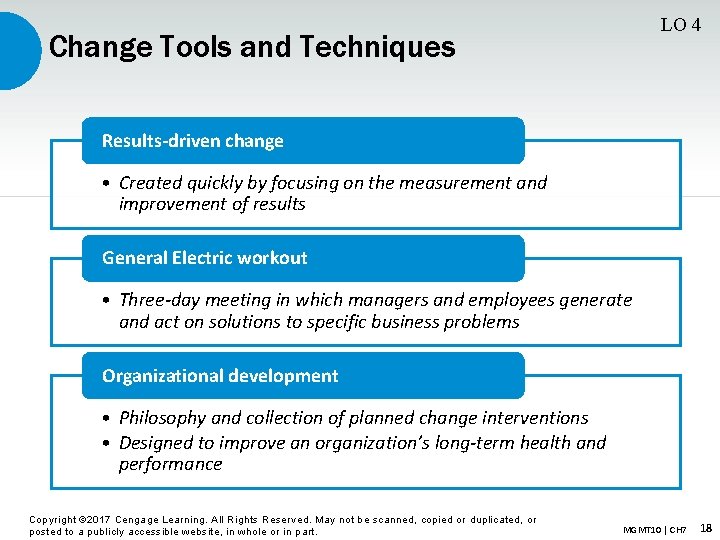
LO 4 Change Tools and Techniques Results-driven change • Created quickly by focusing on the measurement and improvement of results General Electric workout • Three-day meeting in which managers and employees generate and act on solutions to specific business problems Organizational development • Philosophy and collection of planned change interventions • Designed to improve an organization’s long-term health and performance Copyright © 2017 Cengage Learning. All Rights Reserved. May not be scanned, copied or duplicated, or posted to a publicly accessible website, in whole or in part. MGMT 10 | CH 7 18
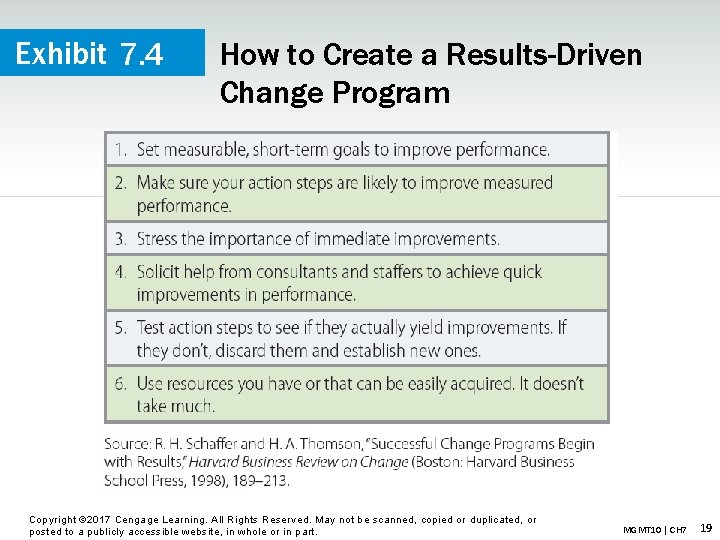
Exhibit 7. 4 How to Create a Results-Driven Change Program Copyright © 2017 Cengage Learning. All Rights Reserved. May not be scanned, copied or duplicated, or posted to a publicly accessible website, in whole or in part. MGMT 10 | CH 7 19
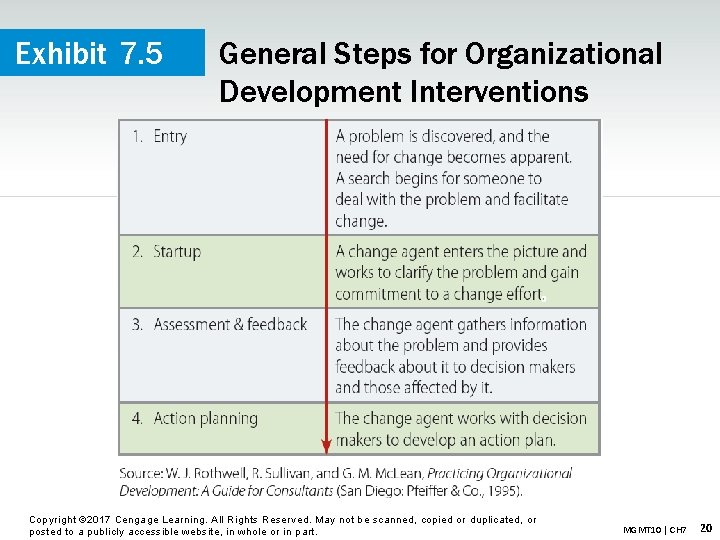
Exhibit 7. 5 General Steps for Organizational Development Interventions Copyright © 2017 Cengage Learning. All Rights Reserved. May not be scanned, copied or duplicated, or posted to a publicly accessible website, in whole or in part. MGMT 10 | CH 7 20
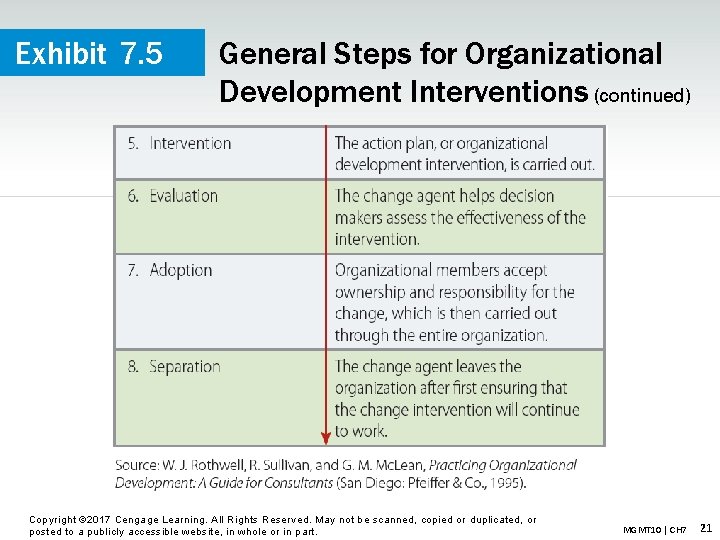
Exhibit 7. 5 General Steps for Organizational Development Interventions (continued) Copyright © 2017 Cengage Learning. All Rights Reserved. May not be scanned, copied or duplicated, or posted to a publicly accessible website, in whole or in part. MGMT 10 | CH 7 21
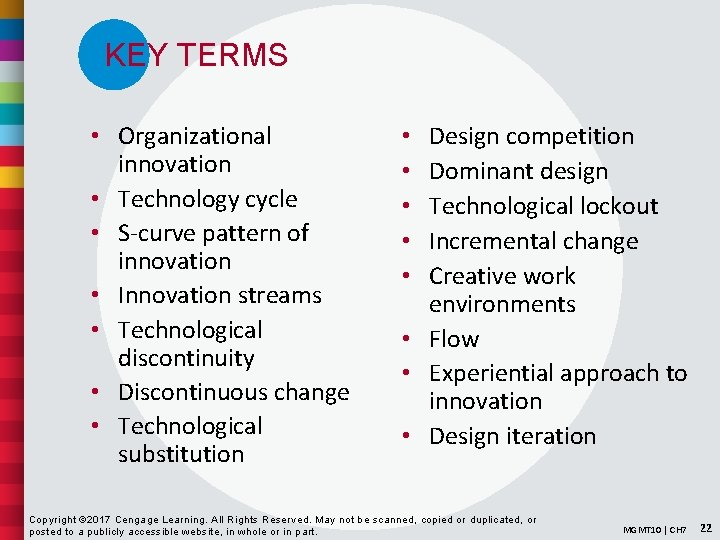
KEY TERMS • Organizational innovation • Technology cycle • S-curve pattern of innovation • Innovation streams • Technological discontinuity • Discontinuous change • Technological substitution Design competition Dominant design Technological lockout Incremental change Creative work environments • Flow • Experiential approach to innovation • Design iteration • • • Copyright © 2017 Cengage Learning. All Rights Reserved. May not be scanned, copied or duplicated, or posted to a publicly accessible website, in whole or in part. MGMT 10 | CH 7 22
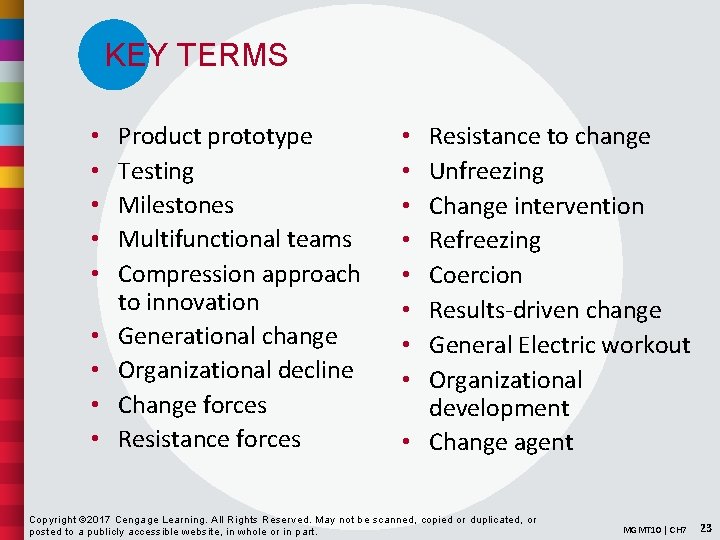
KEY TERMS • • • Product prototype Testing Milestones Multifunctional teams Compression approach to innovation Generational change Organizational decline Change forces Resistance to change Unfreezing Change intervention Refreezing Coercion Results-driven change General Electric workout Organizational development • Change agent • • Copyright © 2017 Cengage Learning. All Rights Reserved. May not be scanned, copied or duplicated, or posted to a publicly accessible website, in whole or in part. MGMT 10 | CH 7 23
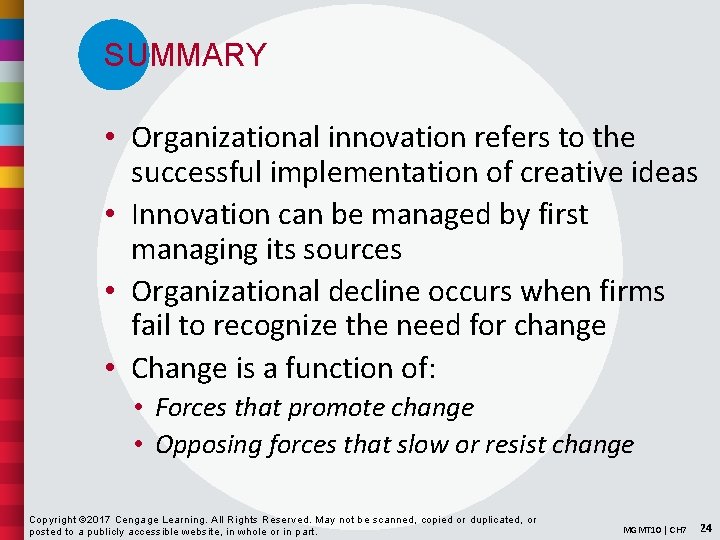
SUMMARY • Organizational innovation refers to the successful implementation of creative ideas • Innovation can be managed by first managing its sources • Organizational decline occurs when firms fail to recognize the need for change • Change is a function of: • Forces that promote change • Opposing forces that slow or resist change Copyright © 2017 Cengage Learning. All Rights Reserved. May not be scanned, copied or duplicated, or posted to a publicly accessible website, in whole or in part. MGMT 10 | CH 7 24
Copyright © 2017 Cengage Learning. All Rights Reserved. May not be scanned, copied or duplicated, or posted to a publicly accessible website, in whole or in part. MGMT 10 | CH 7 25