
7 d AUSTRALIAN AIRLETTERS 1944 1952 PRESENTED BY
7 d AUSTRALIAN AIRLETTERS 1944 1952 PRESENTED BY FRANK PAUER FRPSV
Background The Australian “Air Letter” and later “Aerogramme” evolved from the “Air Mail Letter Card” used by military authorities and some members of the armed forces during World War II. All airletters and aerogrammes were printed letterpress at the Note Printing Branch, Melbourne except for the 1962 Commonwealth Games which was printed photogravure on the new Chambon press. There were four basic two flap layouts used for aerogramme in the period up to 1965.
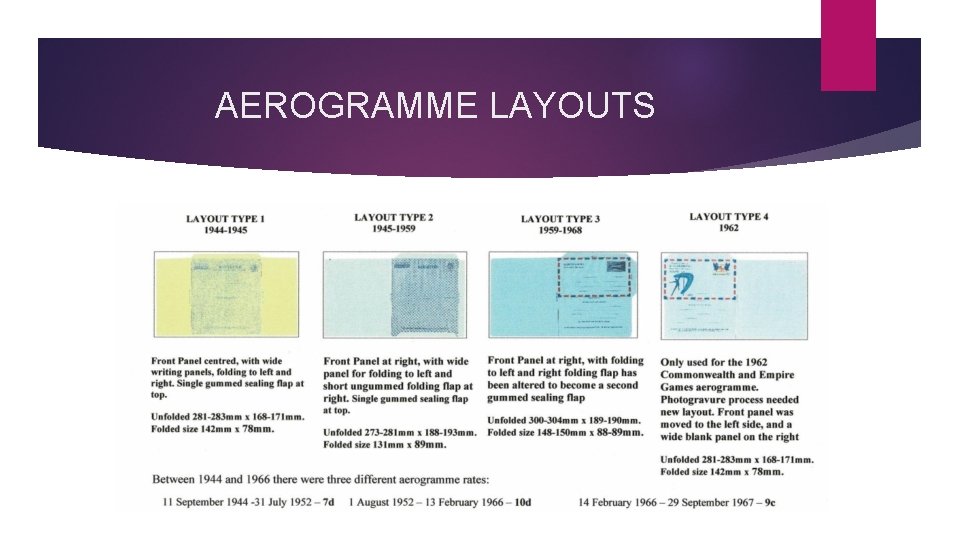
AEROGRAMME LAYOUTS
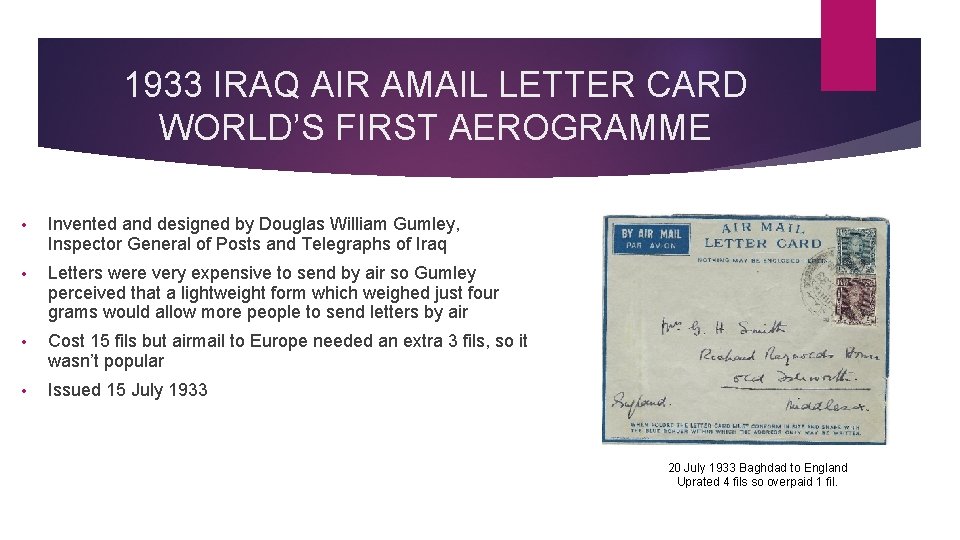
1933 IRAQ AIR AMAIL LETTER CARD WORLD’S FIRST AEROGRAMME • Invented and designed by Douglas William Gumley, Inspector General of Posts and Telegraphs of Iraq • Letters were very expensive to send by air so Gumley perceived that a lightweight form which weighed just four grams would allow more people to send letters by air • Cost 15 fils but airmail to Europe needed an extra 3 fils, so it wasn’t popular • Issued 15 July 1933 20 July 1933 Baghdad to England Uprated 4 fils so overpaid 1 fil.
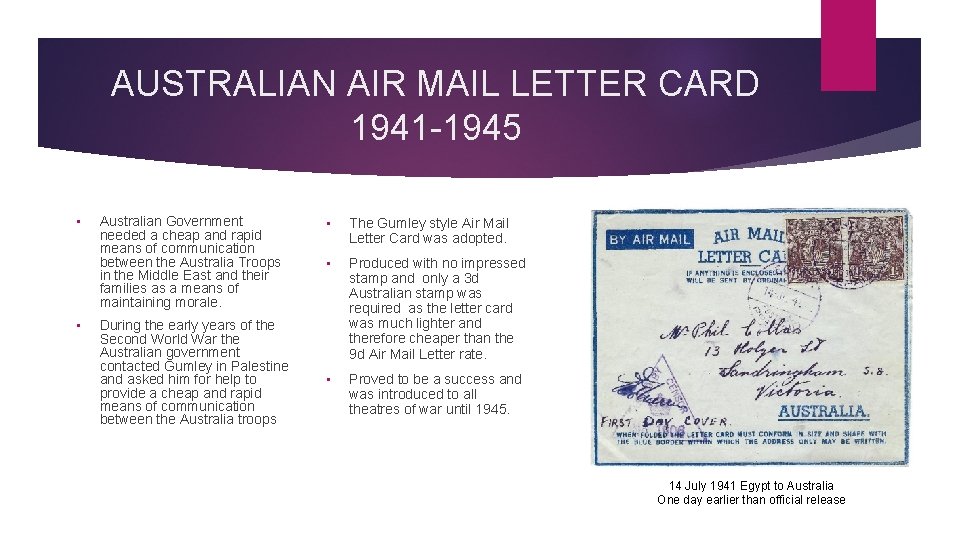
AUSTRALIAN AIR MAIL LETTER CARD 1941 -1945 • • Australian Government needed a cheap and rapid means of communication between the Australia Troops in the Middle East and their families as a means of maintaining morale. During the early years of the Second World War the Australian government contacted Gumley in Palestine and asked him for help to provide a cheap and rapid means of communication between the Australia troops • The Gumley style Air Mail Letter Card was adopted. • Produced with no impressed stamp and only a 3 d Australian stamp was required as the letter card was much lighter and therefore cheaper than the 9 d Air Mail Letter rate. • Proved to be a success and was introduced to all theatres of war until 1945. 14 July 1941 Egypt to Australia One day earlier than official release
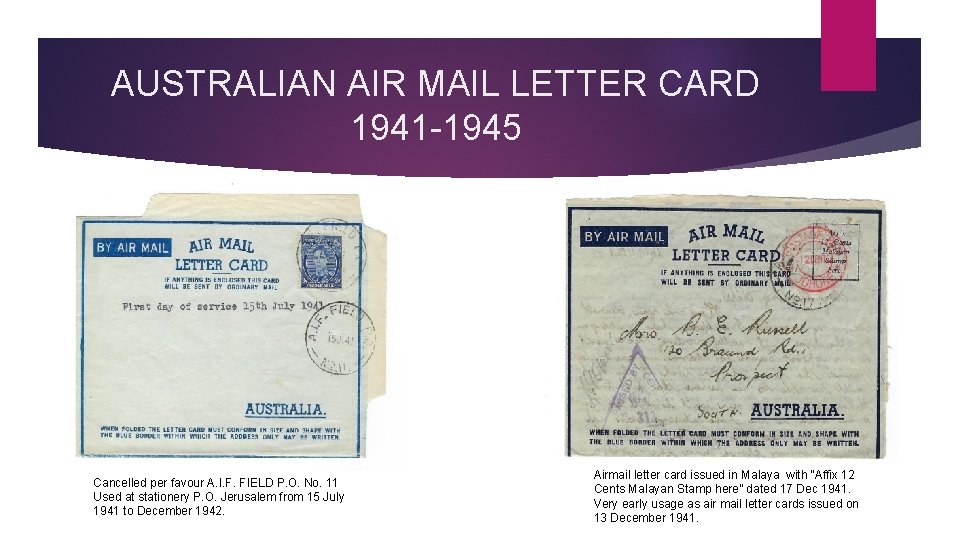
AUSTRALIAN AIR MAIL LETTER CARD 1941 -1945 Cancelled per favour A. I. F. FIELD P. O. No. 11 Used at stationery P. O. Jerusalem from 15 July 1941 to December 1942. Airmail letter card issued in Malaya with “Affix 12 Cents Malayan Stamp here” dated 17 Dec 1941. Very early usage as air mail letter cards issued on 13 December 1941.
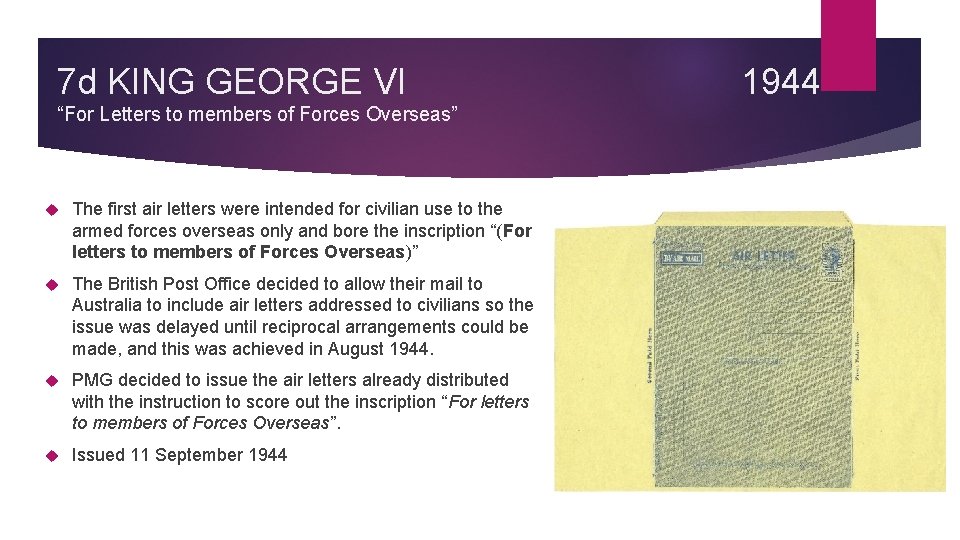
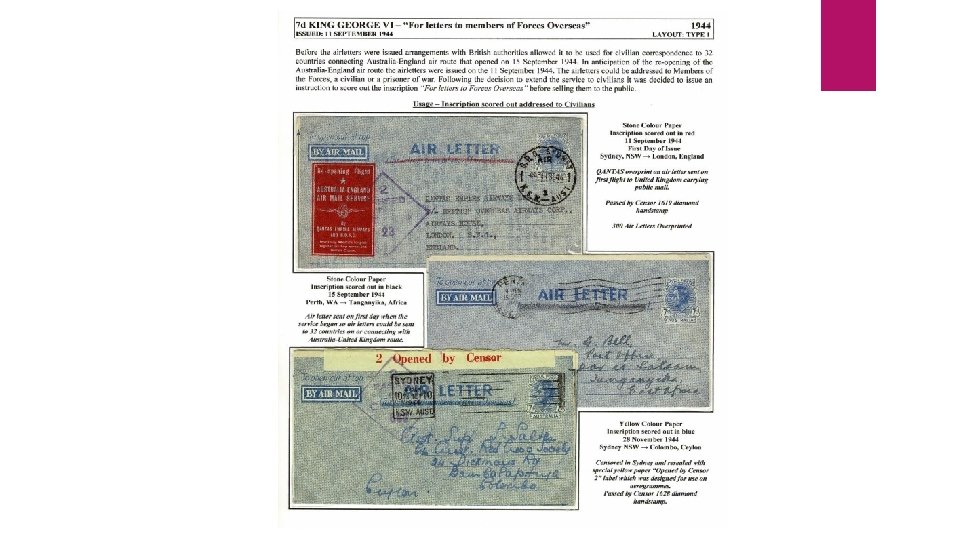
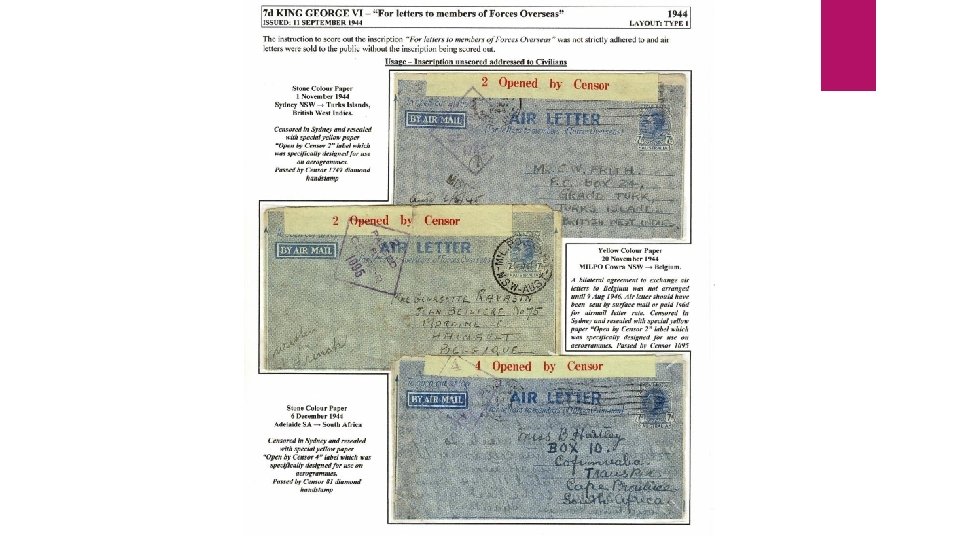
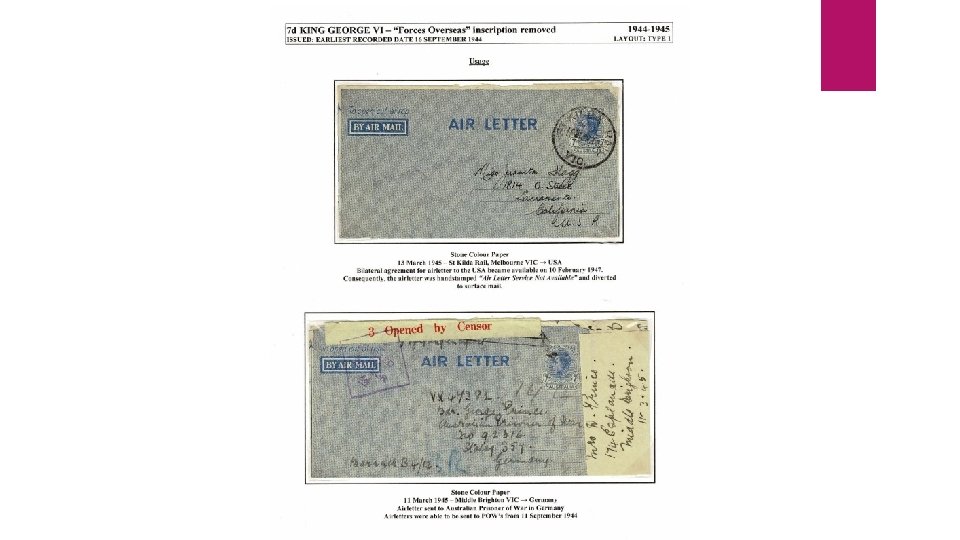
7 d KING GEORGE VI “For Letters to members of Forces Overseas” The first air letters were intended for civilian use to the armed forces overseas only and bore the inscription “(For letters to members of Forces Overseas)” The British Post Office decided to allow their mail to Australia to include air letters addressed to civilians so the issue was delayed until reciprocal arrangements could be made, and this was achieved in August 1944. PMG decided to issue the air letters already distributed with the instruction to score out the inscription “For letters to members of Forces Overseas”. Issued 11 September 1944
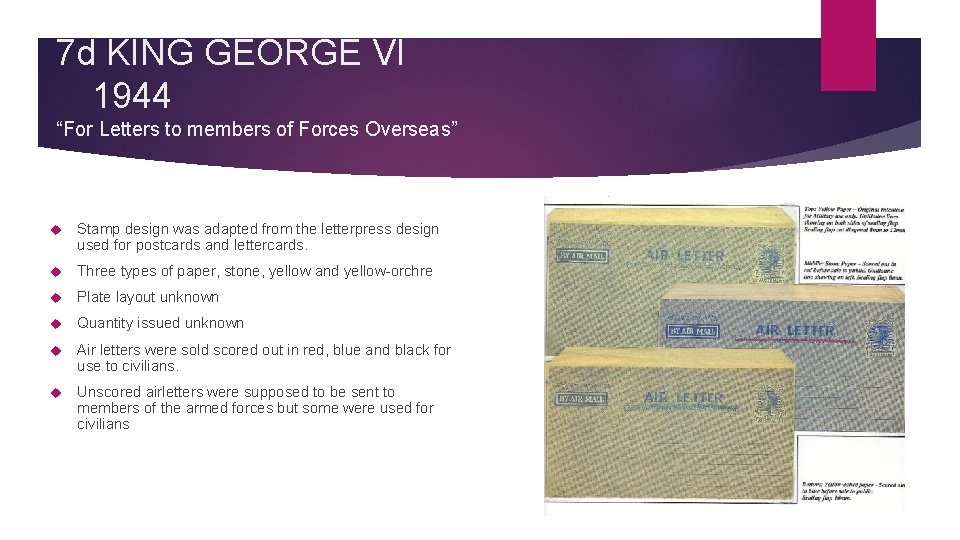
7 d KING GEORGE VI 1944 “For Letters to members of Forces Overseas” Stamp design was adapted from the letterpress design used for postcards and lettercards. Three types of paper, stone, yellow and yellow-orchre Plate layout unknown Quantity issued unknown Air letters were sold scored out in red, blue and black for use to civilians. Unscored airletters were supposed to be sent to members of the armed forces but some were used for civilians

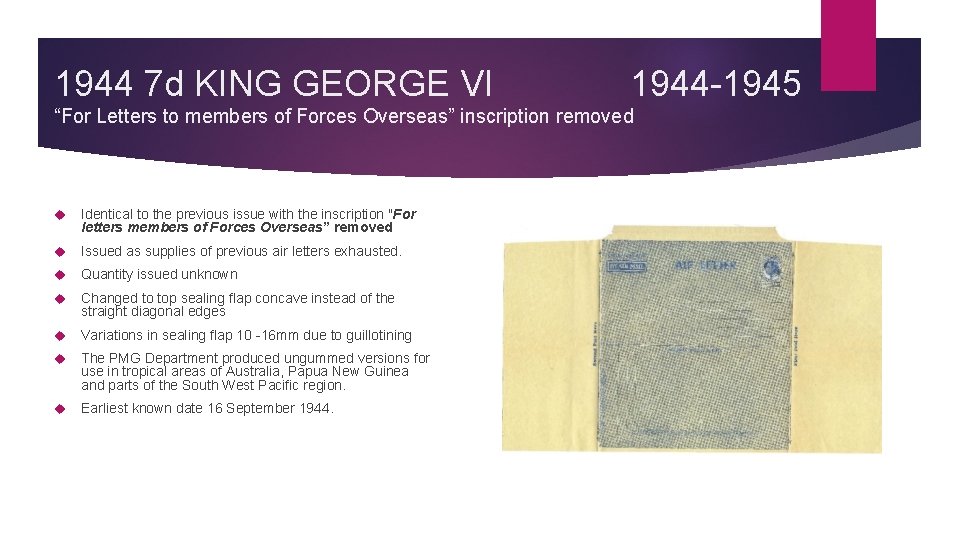
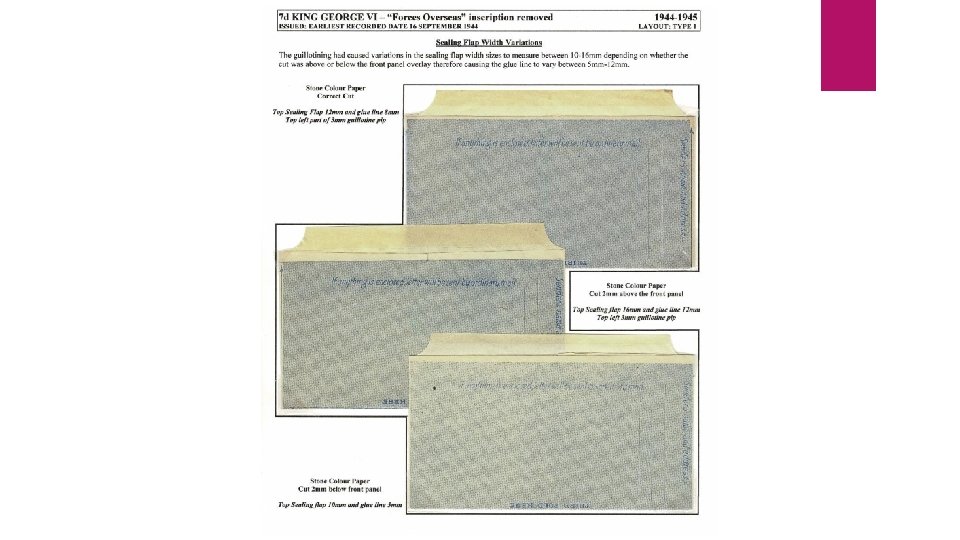
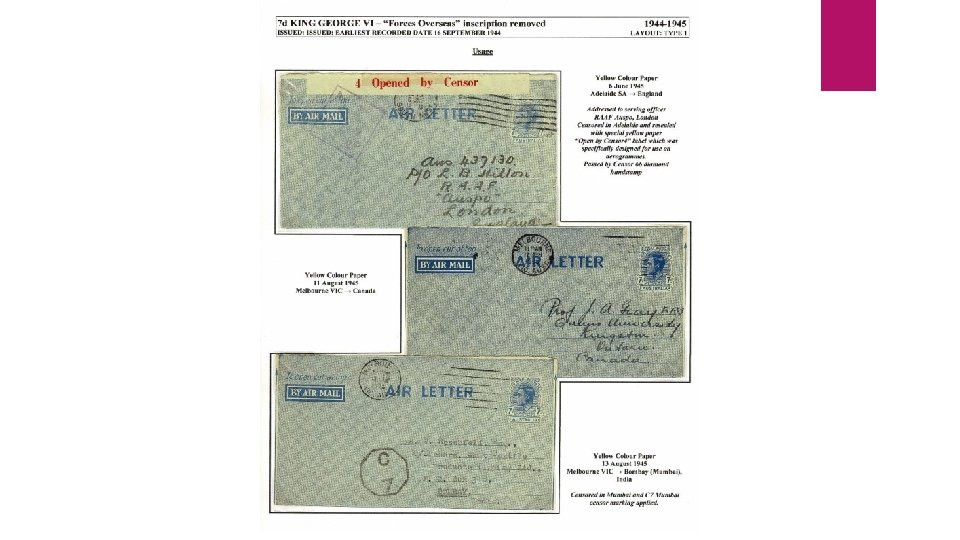
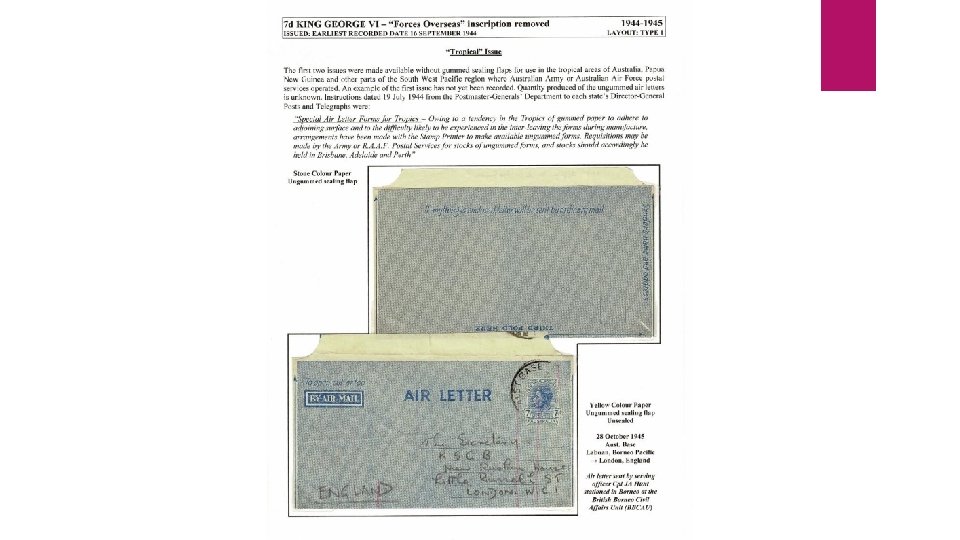
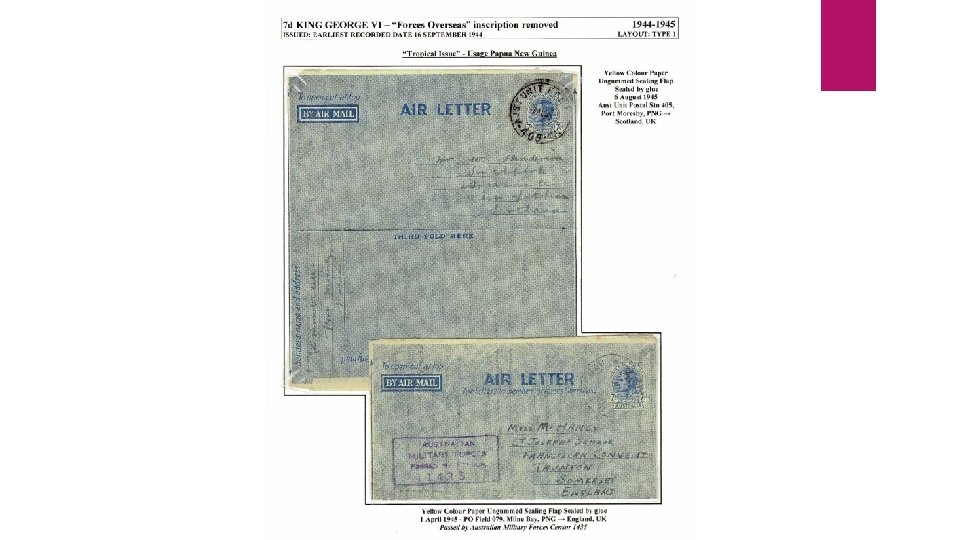
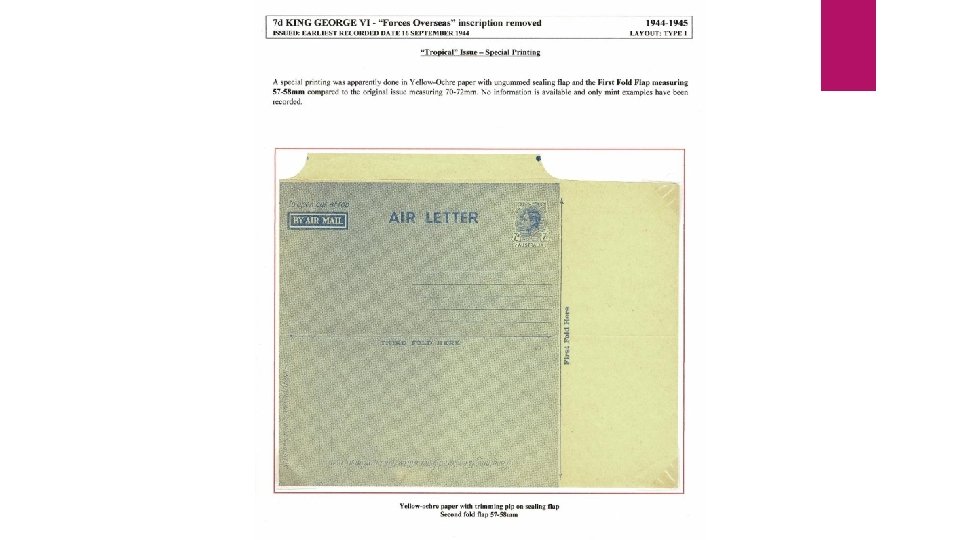
1944 7 d KING GEORGE VI 1944 -1945 “For Letters to members of Forces Overseas” inscription removed Identical to the previous issue with the inscription "For letters members of Forces Overseas” removed Issued as supplies of previous air letters exhausted. Quantity issued unknown Changed to top sealing flap concave instead of the straight diagonal edges Variations in sealing flap 10 -16 mm due to guillotining The PMG Department produced ungummed versions for use in tropical areas of Australia, Papua New Guinea and parts of the South West Pacific region. Earliest known date 16 September 1944.
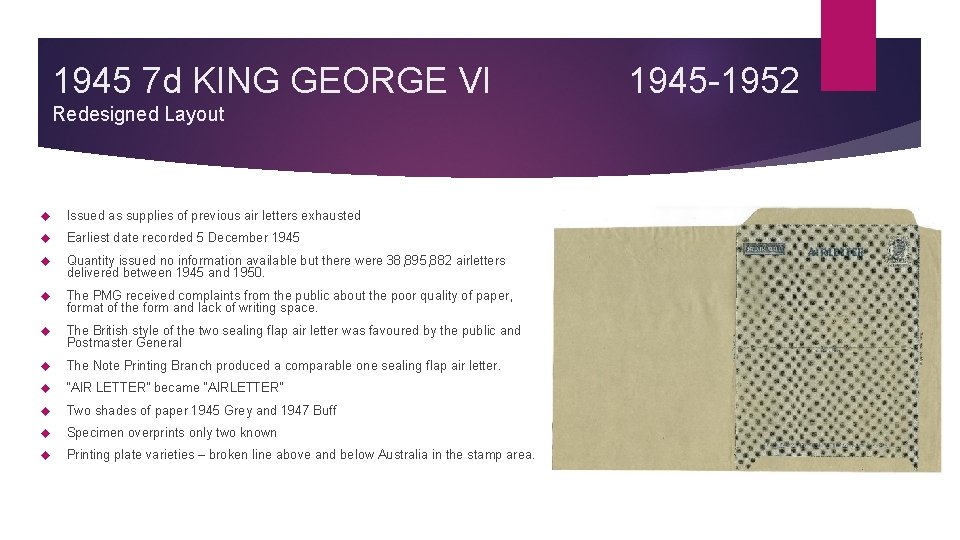
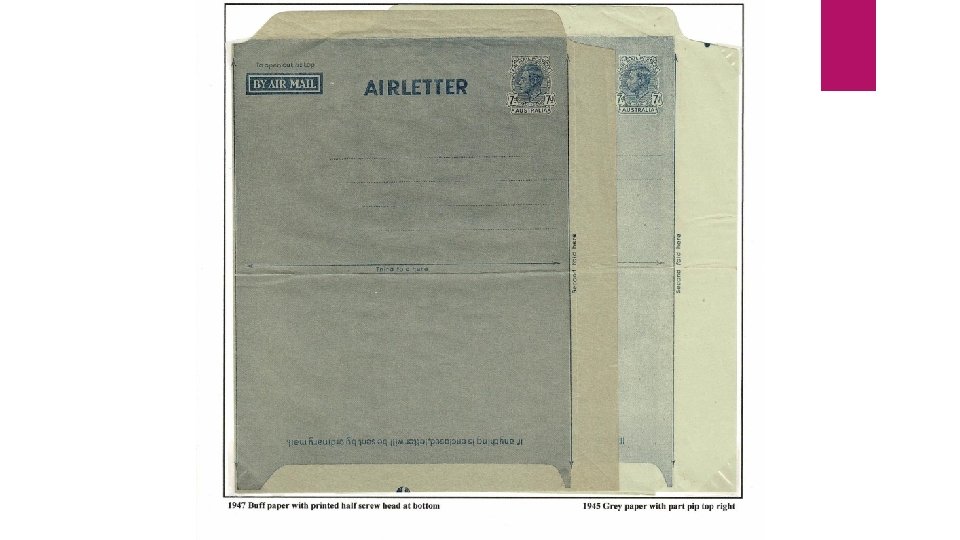
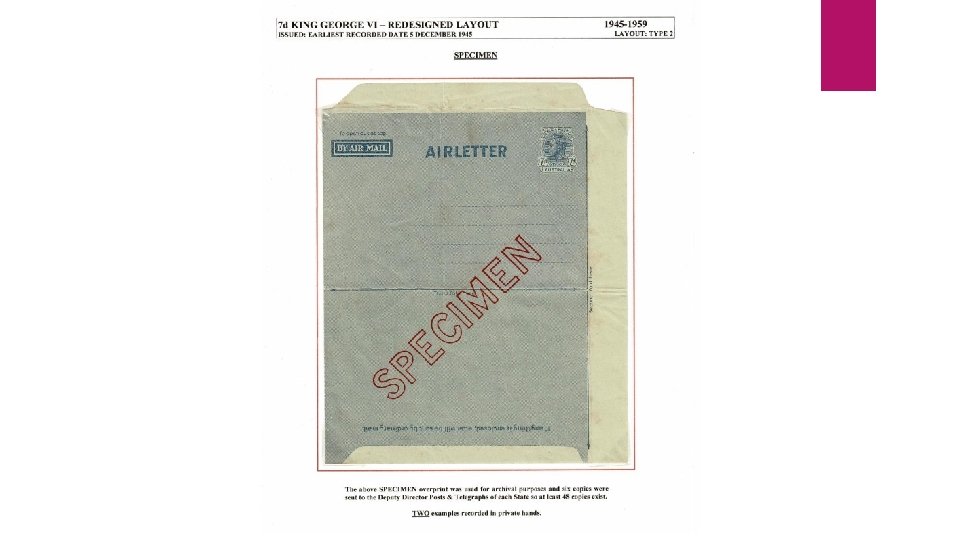
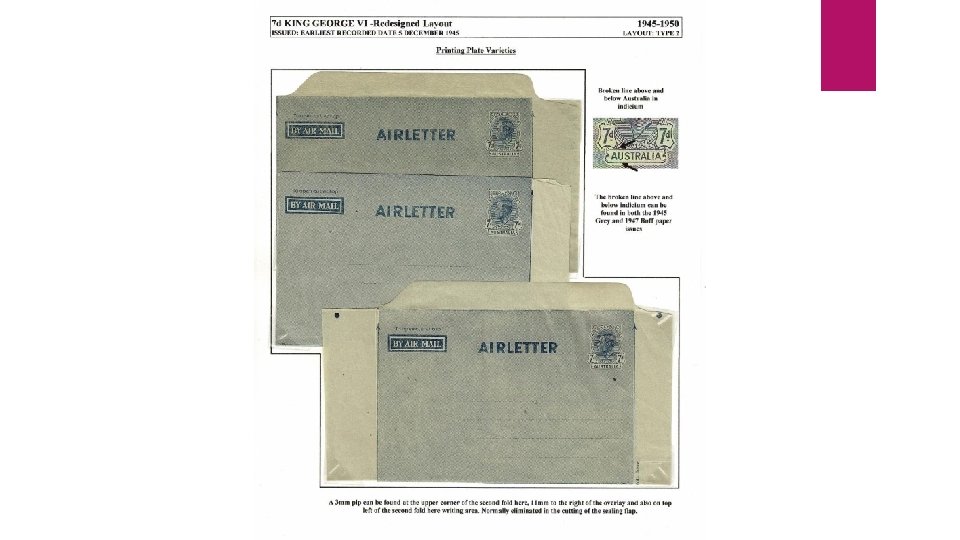
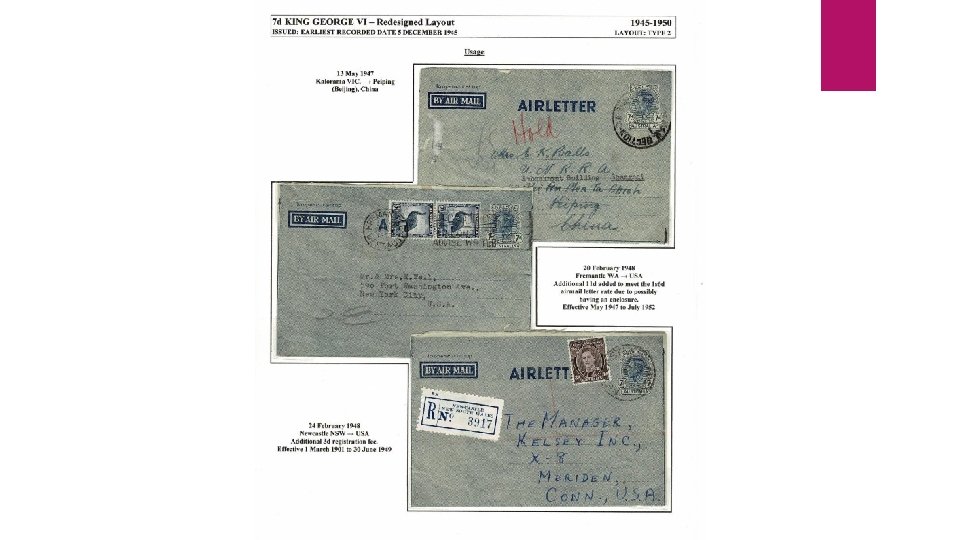
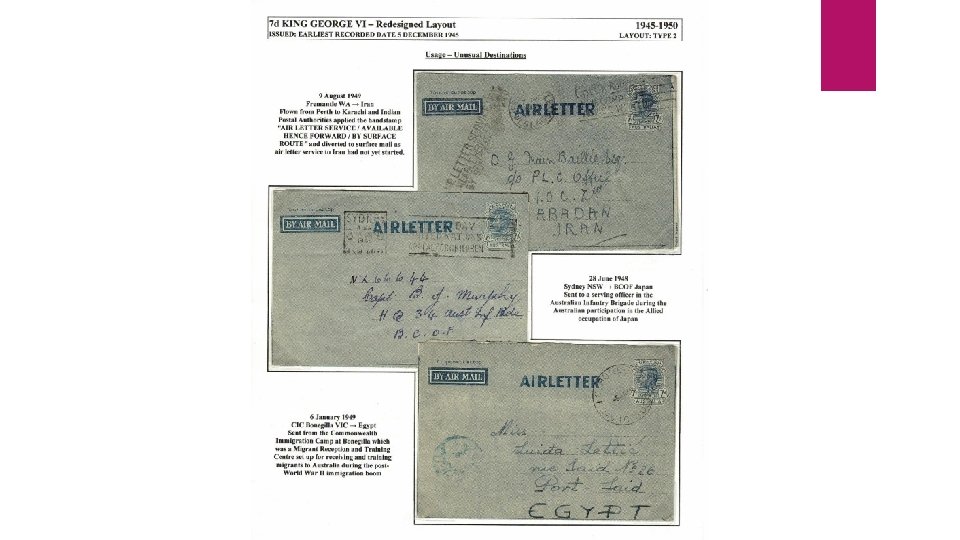
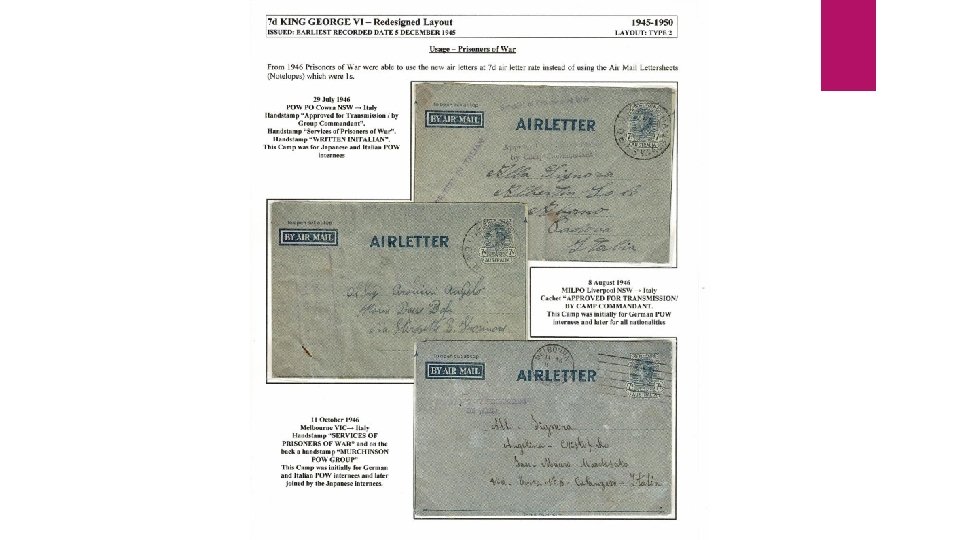
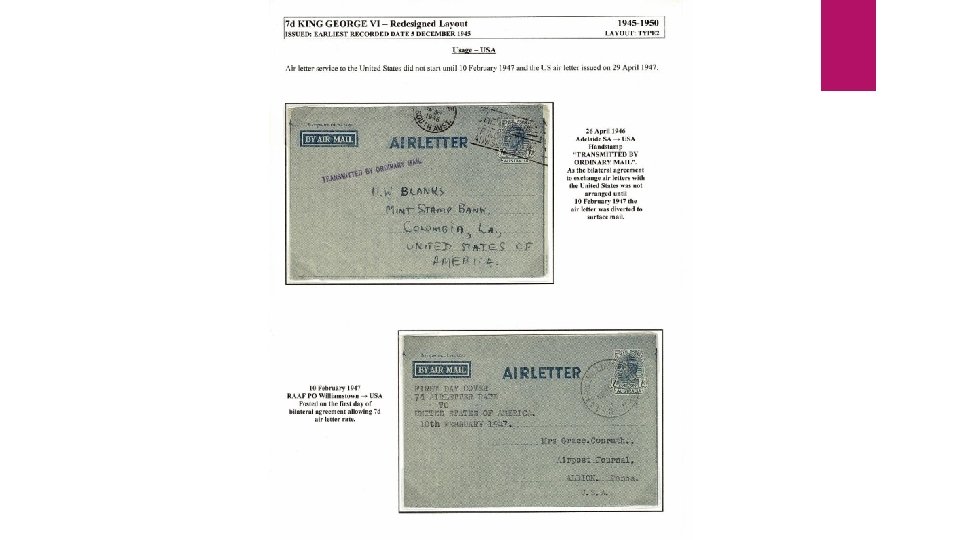
1945 7 d KING GEORGE VI Redesigned Layout Issued as supplies of previous air letters exhausted Earliest date recorded 5 December 1945 Quantity issued no information available but there were 38, 895, 882 airletters delivered between 1945 and 1950. The PMG received complaints from the public about the poor quality of paper, format of the form and lack of writing space. The British style of the two sealing flap air letter was favoured by the public and Postmaster General The Note Printing Branch produced a comparable one sealing flap air letter. “AIR LETTER” became “AIRLETTER” Two shades of paper 1945 Grey and 1947 Buff Specimen overprints only two known Printing plate varieties – broken line above and below Australia in the stamp area. 1945 -1952
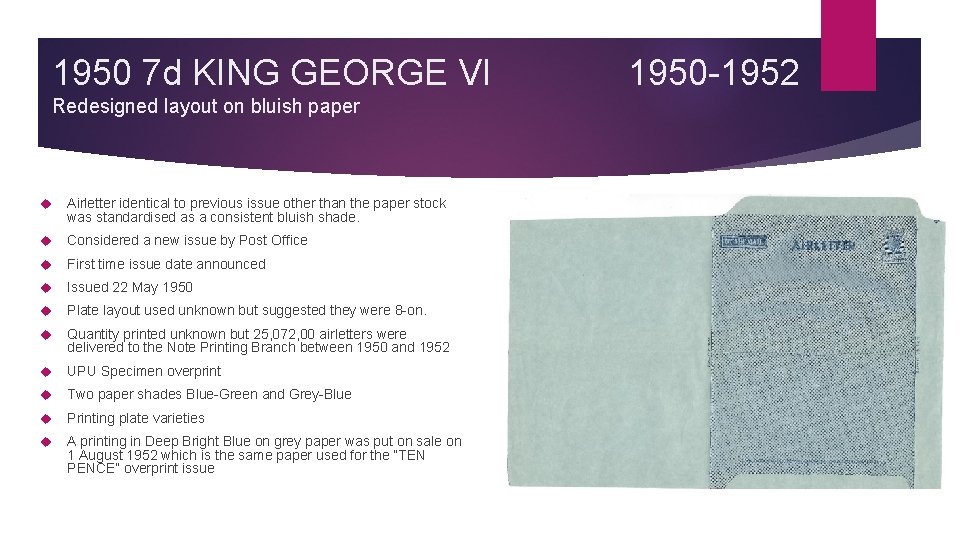
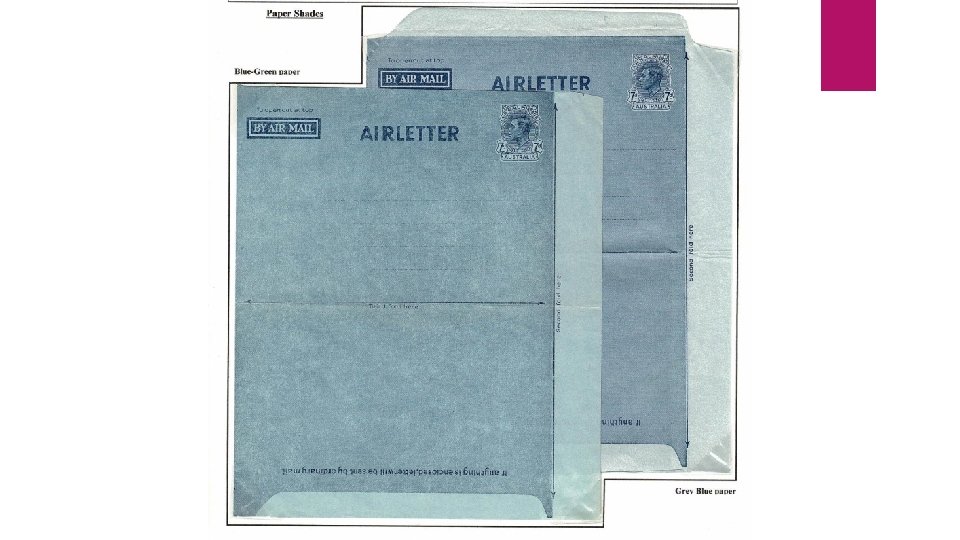
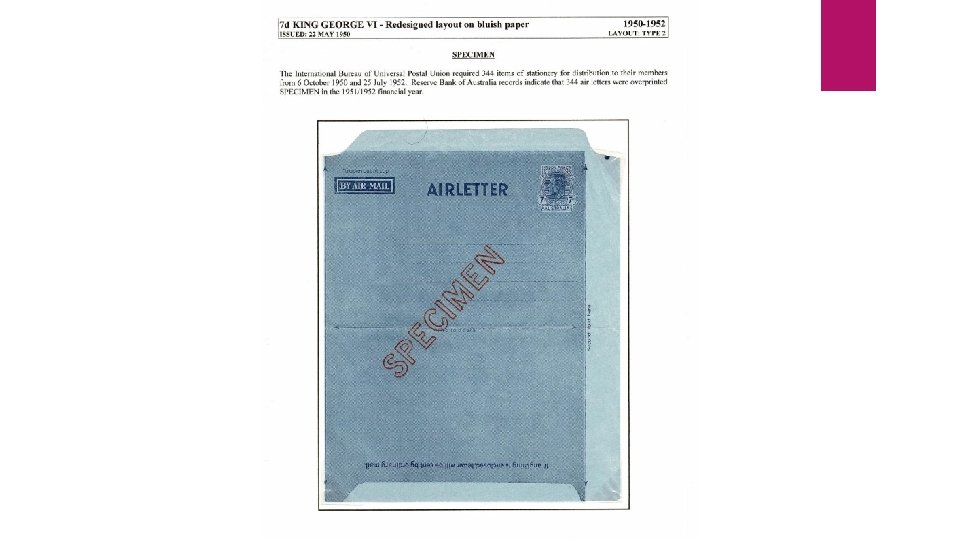
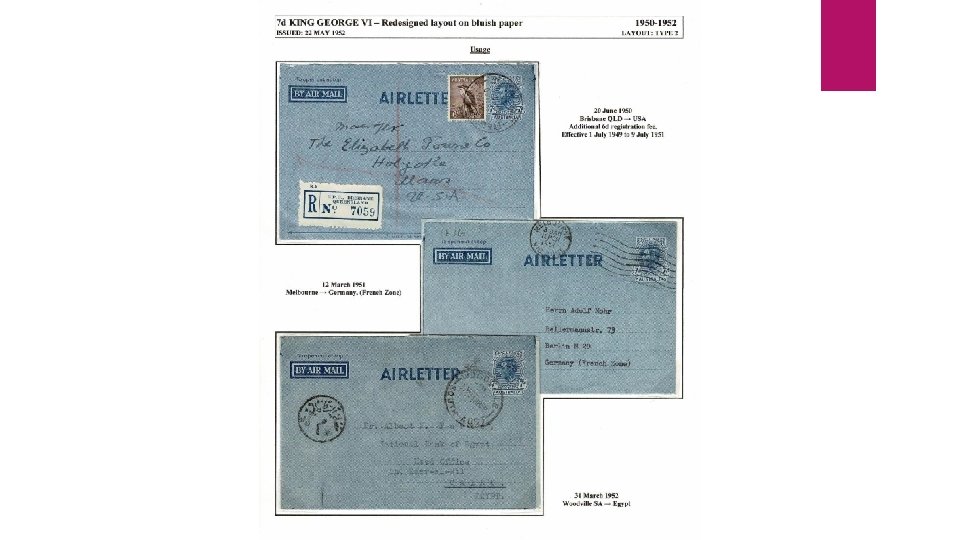
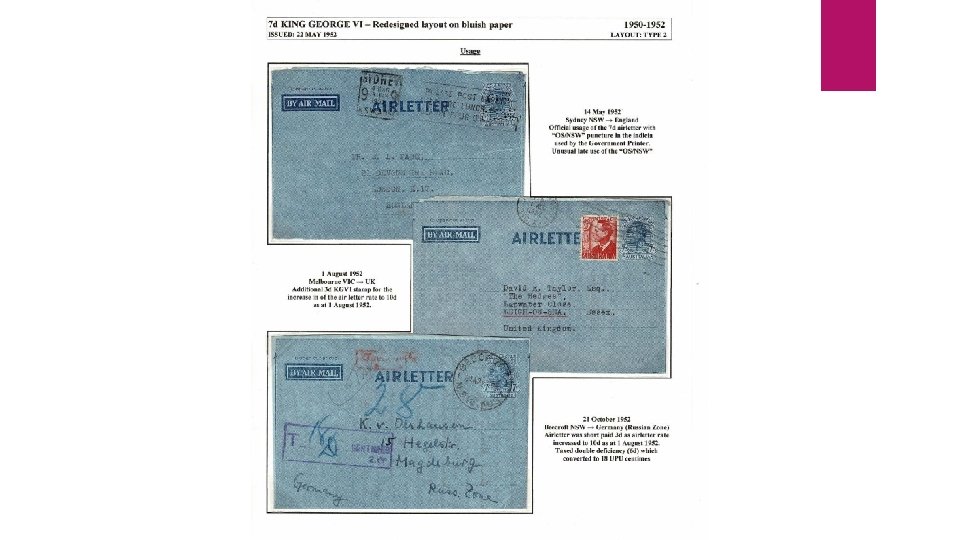
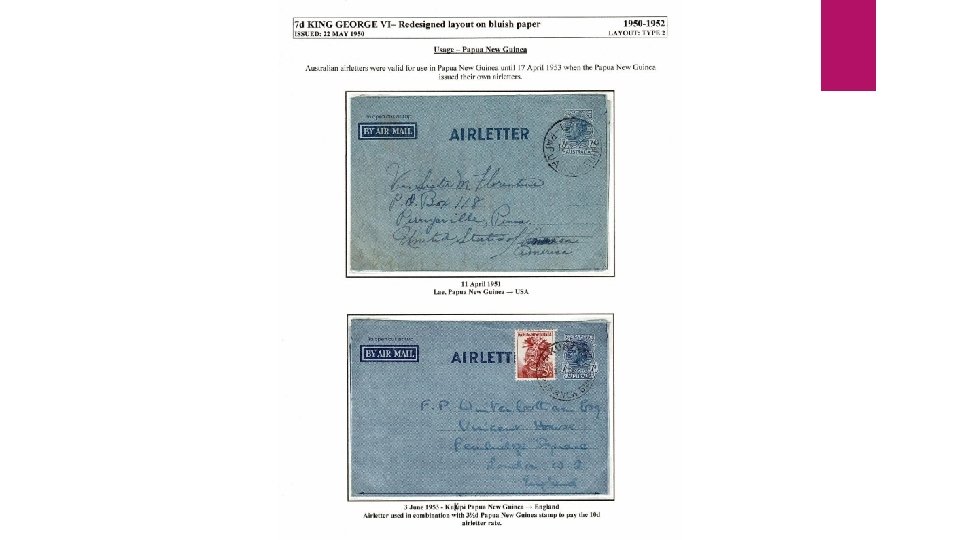
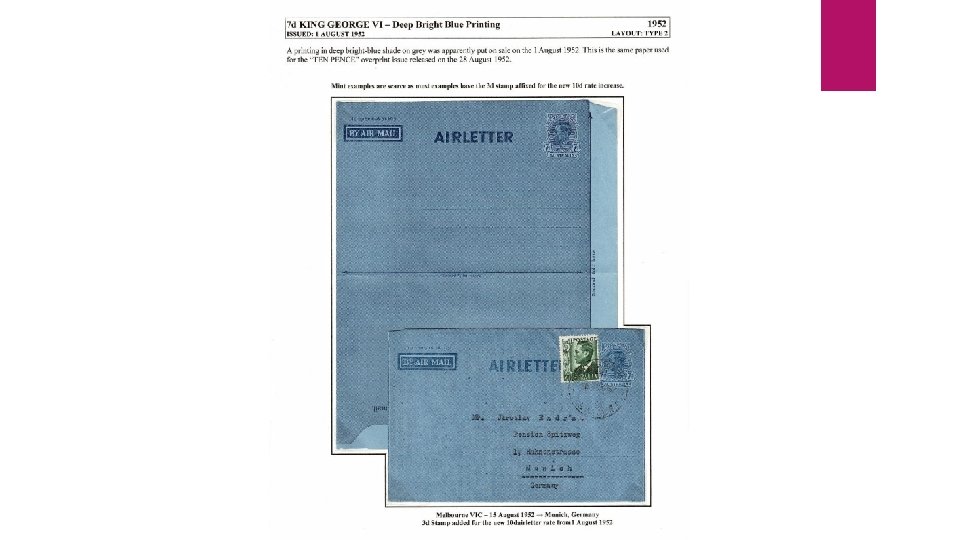
1950 7 d KING GEORGE VI Redesigned layout on bluish paper Airletter identical to previous issue other than the paper stock was standardised as a consistent bluish shade. Considered a new issue by Post Office First time issue date announced Issued 22 May 1950 Plate layout used unknown but suggested they were 8 -on. Quantity printed unknown but 25, 072, 00 airletters were delivered to the Note Printing Branch between 1950 and 1952 UPU Specimen overprint Two paper shades Blue-Green and Grey-Blue Printing plate varieties A printing in Deep Bright Blue on grey paper was put on sale on 1 August 1952 which is the same paper used for the “TEN PENCE” overprint issue 1950 -1952

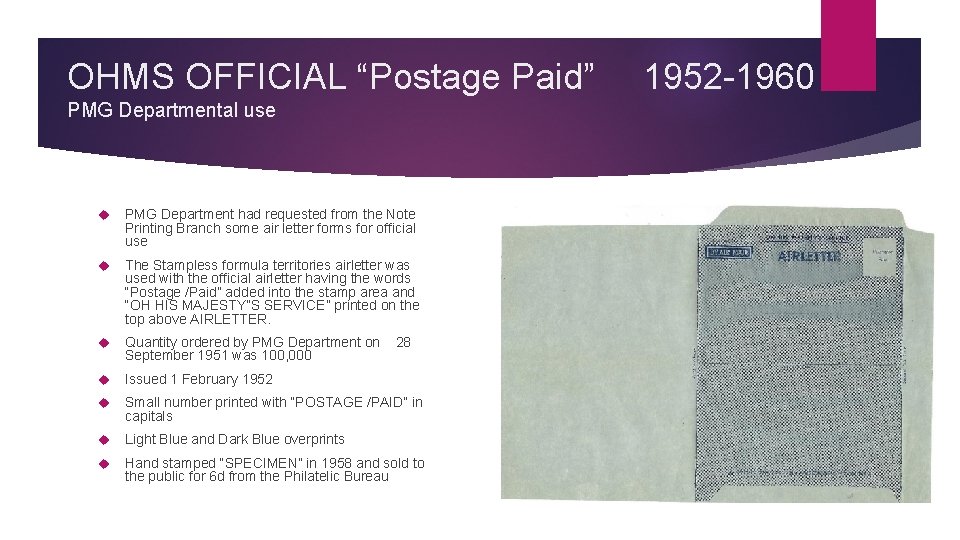
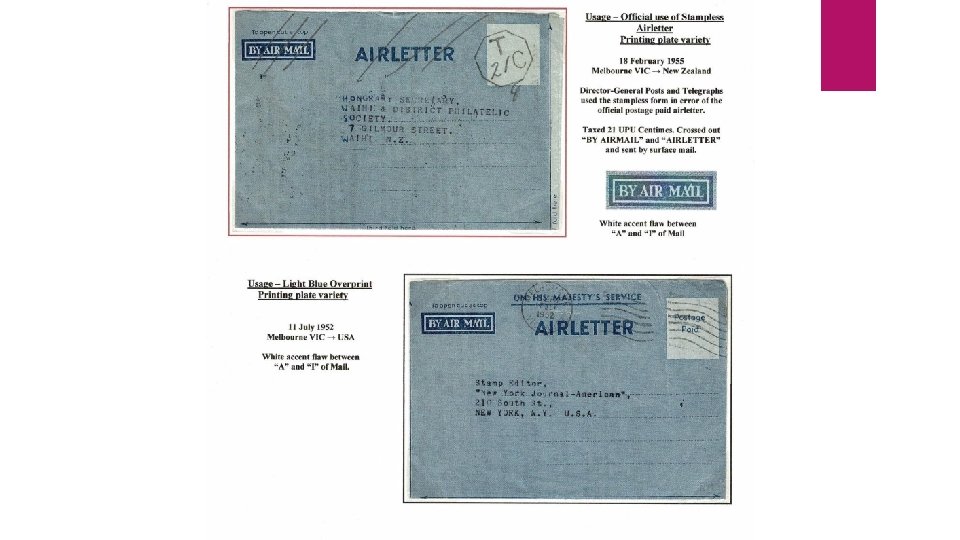
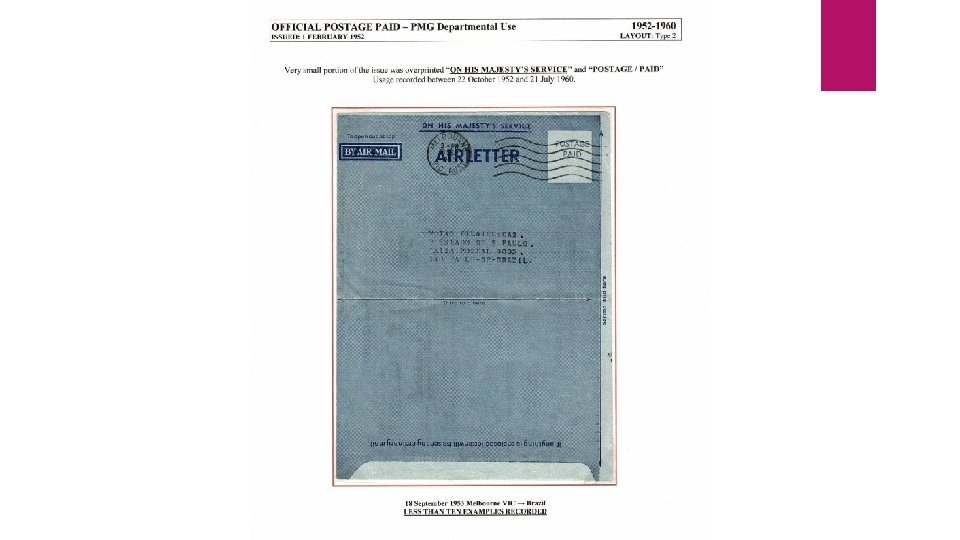
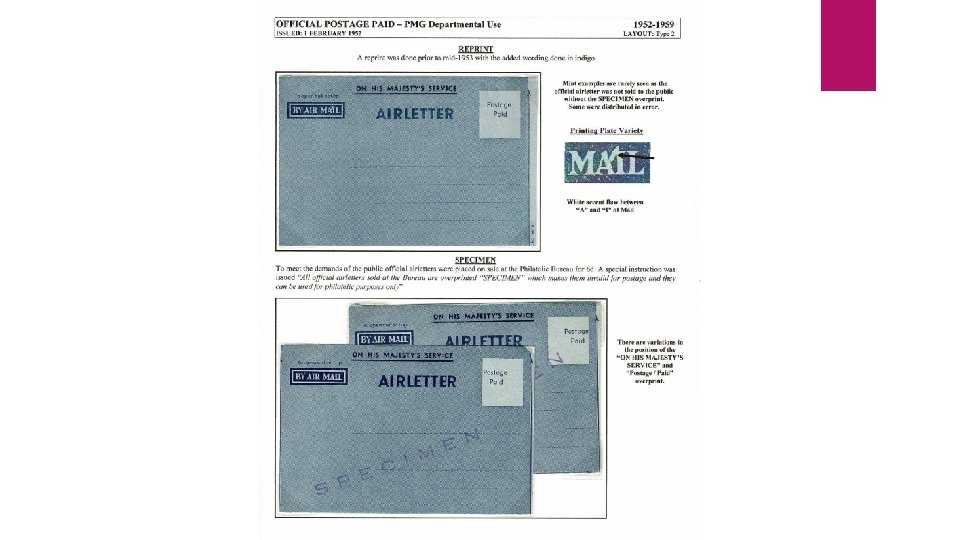
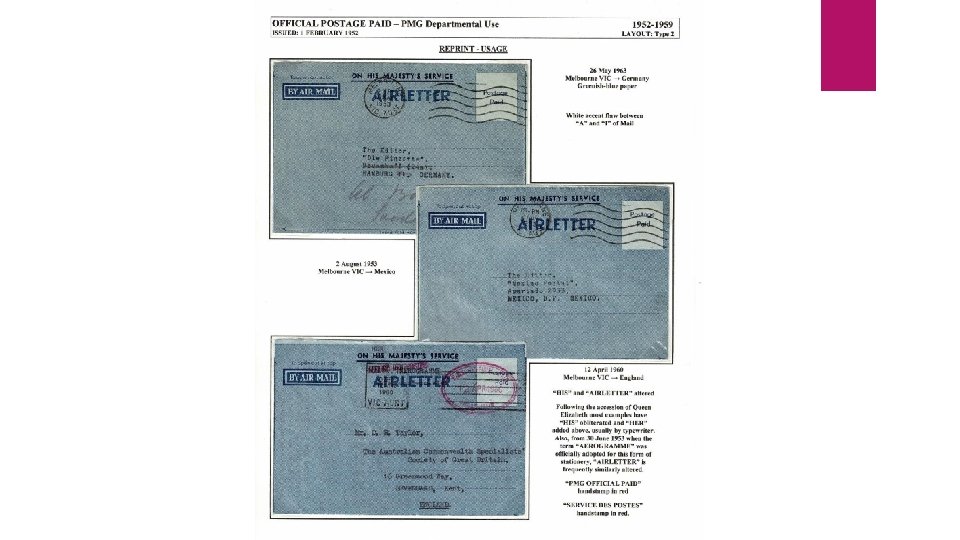
OHMS OFFICIAL “Postage Paid” PMG Departmental use PMG Department had requested from the Note Printing Branch some air letter forms for official use The Stampless formula territories airletter was used with the official airletter having the words “Postage /Paid” added into the stamp area and “OH HIS MAJESTY”S SERVICE” printed on the top above AIRLETTER. Quantity ordered by PMG Department on September 1951 was 100, 000 Issued 1 February 1952 Small number printed with “POSTAGE /PAID” in capitals Light Blue and Dark Blue overprints Hand stamped “SPECIMEN” in 1958 and sold to the public for 6 d from the Philatelic Bureau 28 1952 -1960
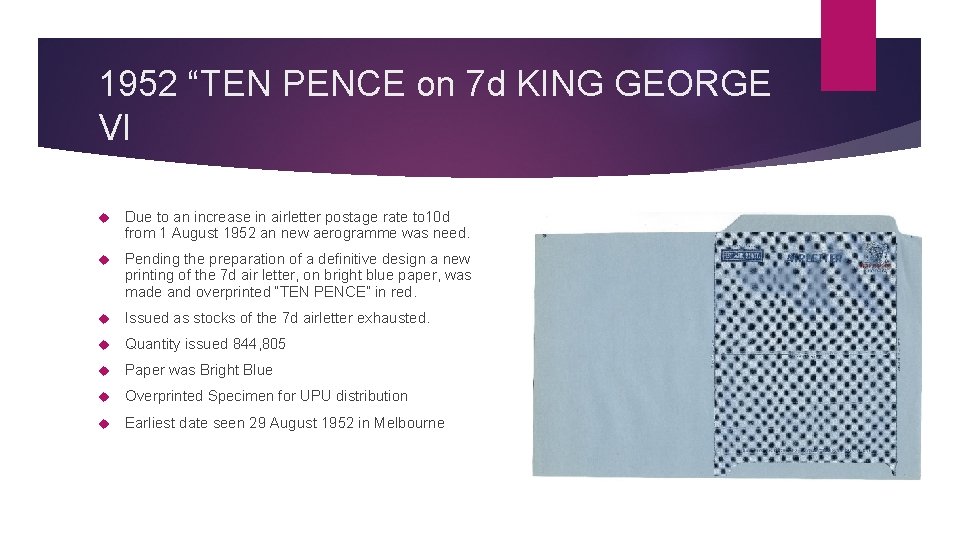
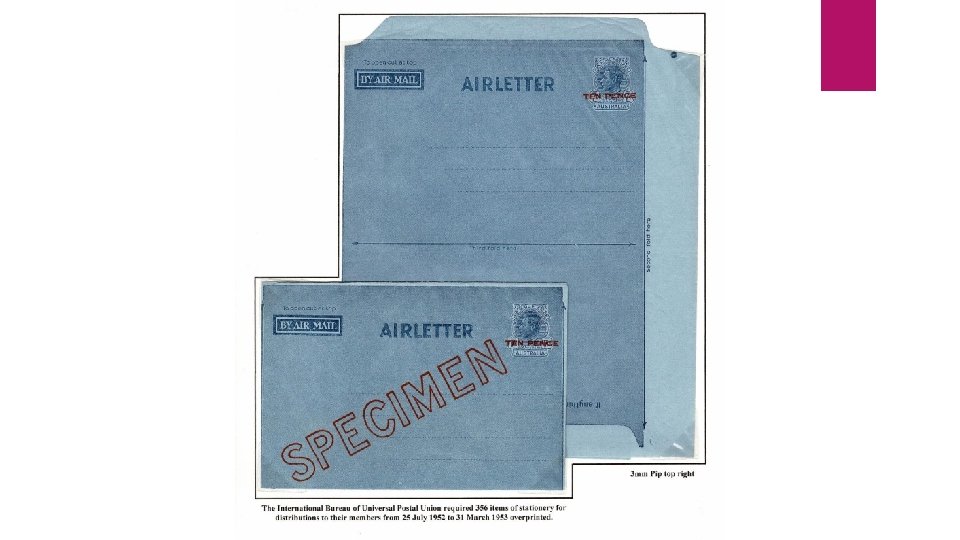
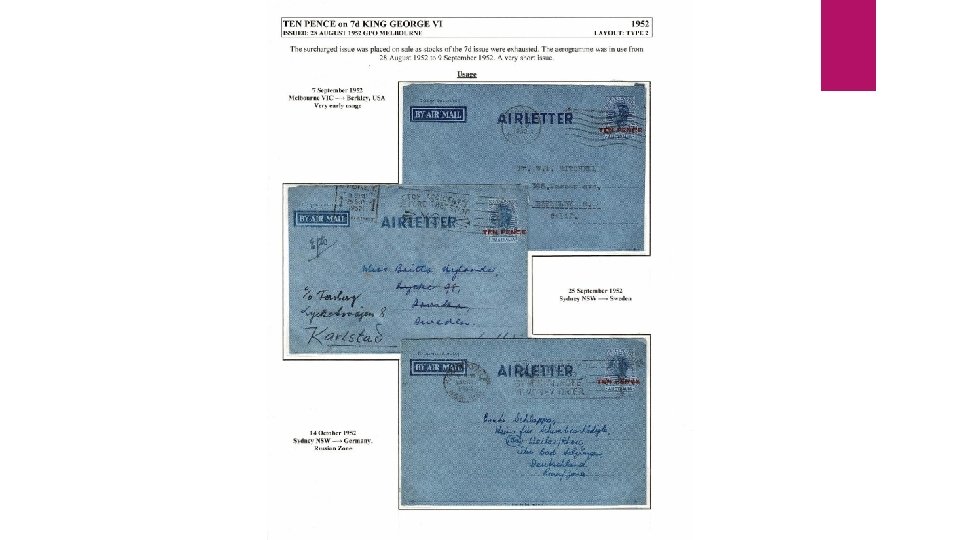
1952 “TEN PENCE on 7 d KING GEORGE VI Due to an increase in airletter postage rate to 10 d from 1 August 1952 an new aerogramme was need. Pending the preparation of a definitive design a new printing of the 7 d air letter, on bright blue paper, was made and overprinted “TEN PENCE” in red. Issued as stocks of the 7 d airletter exhausted. Quantity issued 844, 805 Paper was Bright Blue Overprinted Specimen for UPU distribution Earliest date seen 29 August 1952 in Melbourne

THANK YOU QUESTIONS
- Slides: 43