
7 Chemical bonding 7 5 Strengths of ionic
7. Chemical bonding 7. 5: Strengths of ionic & covalent bonding • Describe the energetics of covalent & ionic bond formation & breakage. • Use average covalent bond energies to estimate enthalpies of reaction • Use the Born-Haber cycle to compute lattice energies to estimate enthalpies of reaction Before this section, please check for a Flip exercise! (Posted on the Module 7 page)
Strength of covalent bonds An input of energy is needed to break covalent bonds, thus this process is said to be endothermic (+ ΔH). H 2(g) 2 H(g) H | H – C – H (g) C(g) + 4 H(g) | H ΔH = 436 k. J ΔH = 1660 k. J/4 mol = 415 k. J/mol of C – H Trends in covalent bond strength: • Increases with increasing number of shared pairs (# of bonds) • Decreases down columns or groups

Covalent bonds energies Examples of bond energies or strengths. bond k. J/mol H-H 436 C-S 260 F-Cl 255 H-C 415 C-Cl 330 F-Br 235 H-N 390 C-Br 275 Si-Si 230 H-O 464 C-I 240 Si-P 215 H-F 569 N-N 160 Si-S 225 H-Si 395 418 Si-Cl 359 H-F 320 N=N = N=N 946 Si-Br 290

Covalent bonds energies vs. lengths Bond length is inversely related to bond strength (or energy). • Length: single > double > triple • Strength: triple > double > single bond length (Å) energy (k. J/mol C-C 1. 54 345 C=C = C=C 1. 34 611 1. 20 837 C-N 1. 43 290 C=N = C=N 1. 38 615 1. 16 891 C-O 1. 43 350 C=O = C=O 1. 23 741 1. 13 1080

Using bond energies Bond energies can be used to calculate the overall energy change of chemical reactions: the enthalpy of reaction (ΔH) = ΣDbonds broken – ΣDbonds made where D = bond energies (k. J/mol) Calculate the enthalpy of the reaction that forms hydrochloric acid: H 2(g) + Cl 2(g) 2 HCl(g) (ΔH) = ΣDbonds broken – ΣDbonds made = [H-H + Cl-Cl] – [2 x H-Cl] = [436 + 243] – [2(432)] = - 185 k. J The – indicates that energy is released, so the products are more stable than the reactants.
Try this Calculate the enthalpy change (ΔH) of this reaction: CO(g) + 2 H 2(g) CH 3 OH(g) (ΔH) = ΣDbonds broken – ΣDbonds made = [C-O + (2)(H-H)] – [(3)(C-H) + C-O + O-H] = [1080 + (2)(436)] – [(3)(415) + 350 + 464] = - 107 k. J The – indicates that energy is released, so the products are more stable than the reactants. 26
Try this Ethyl alcohol (ethanol) was one of the first chemicals made by man. Calculate the overall enthalpy change for the reaction shown here H 2 CCH 2 + H 2 O CH 3 CH 2 OH 27 (ΔH) = ΣDbonds broken – ΣDbonds made = [C=C + O-H] – [C-H + C-C + C-O] = [611 + 464] – [415 + 345 + 350] = 1075 – 1110 = - 35 k. J The – indicates that energy is released, so the products are more stable than the reactants.
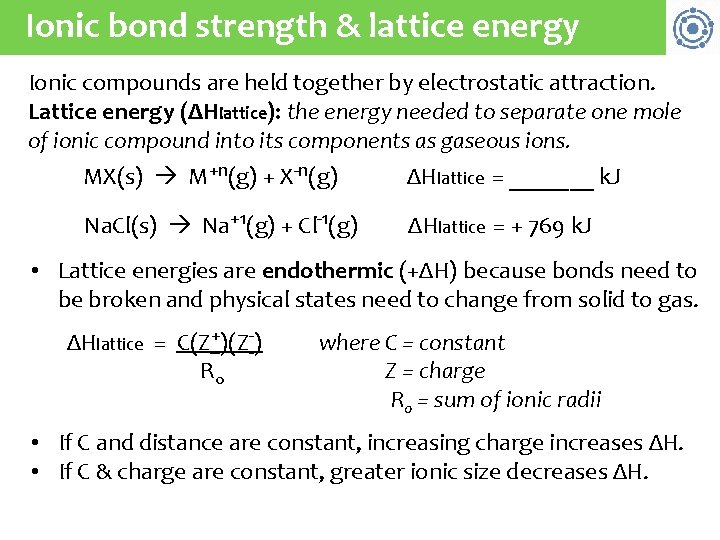
Ionic bond strength & lattice energy Ionic compounds are held together by electrostatic attraction. Lattice energy (ΔHlattice): the energy needed to separate one mole of ionic compound into its components as gaseous ions. MX(s) M+n(g) + X-n(g) ΔHlattice = _______ k. J Na. Cl(s) Na+1(g) + Cl-1(g) ΔHlattice = + 769 k. J • Lattice energies are endothermic (+ΔH) because bonds need to be broken and physical states need to change from solid to gas. ΔHlattice = C(Z+)(Z-) R 0 where C = constant Z = charge R 0 = sum of ionic radii • If C and distance are constant, increasing charge increases ΔH. • If C & charge are constant, greater ionic size decreases ΔH.
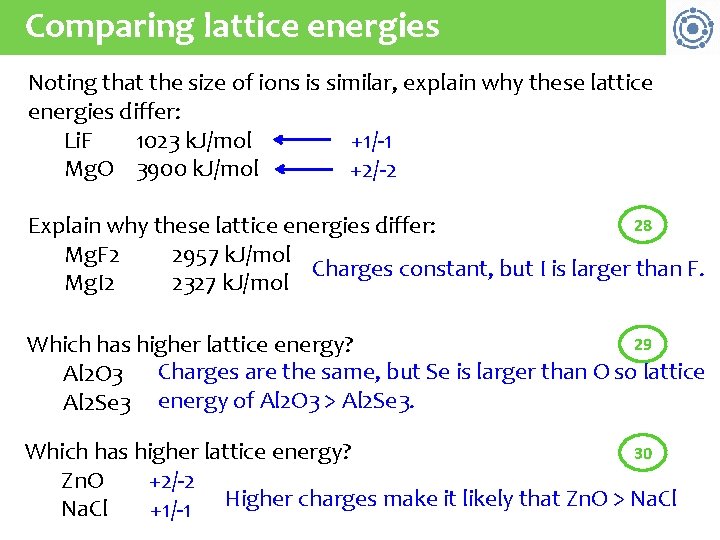
Comparing lattice energies Noting that the size of ions is similar, explain why these lattice energies differ: Li. F 1023 k. J/mol +1/-1 Mg. O 3900 k. J/mol +2/-2 28 Explain why these lattice energies differ: Mg. F 2 2957 k. J/mol Charges constant, but I is larger than F. Mg. I 2 2327 k. J/mol 29 Which has higher lattice energy? Al 2 O 3 Charges are the same, but Se is larger than O so lattice Al 2 Se 3 energy of Al 2 O 3 > Al 2 Se 3. 30 Which has higher lattice energy? Zn. O +2/-2 Na. Cl +1/-1 Higher charges make it likely that Zn. O > Na. Cl
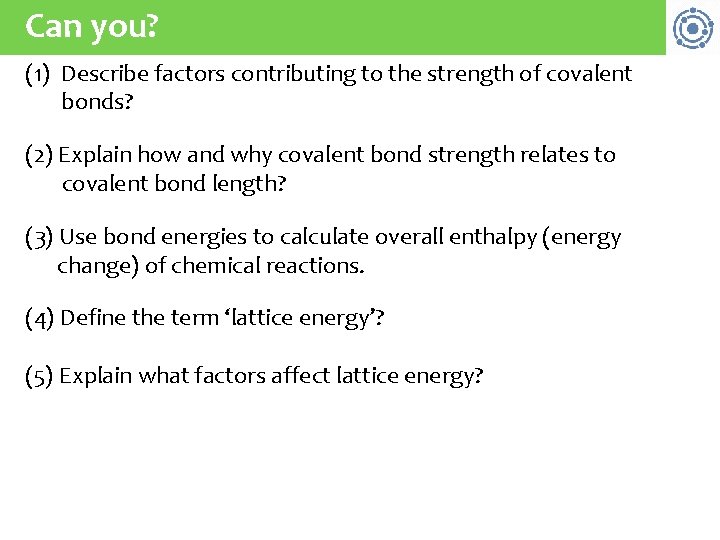
Can you? (1) Describe factors contributing to the strength of covalent bonds? (2) Explain how and why covalent bond strength relates to covalent bond length? (3) Use bond energies to calculate overall enthalpy (energy change) of chemical reactions. (4) Define the term ‘lattice energy’? (5) Explain what factors affect lattice energy?
- Slides: 10