
7 Case studies in Solid Waste Management Introduction
- Slides: 44
7 – Case studies in Solid Waste Management Introduction to Climate Change Wim Maaskant BGP Engineers – The Netherlands www. bgpengineers. com
7 – Case studies in Solid Waste Management Financial assessment of Emission Reduction investments Wim Maaskant BGP Engineers – The Netherlands www. bgpengineers. com
7 – Case studies in Solid Waste Management Carbon Credits enhance the finances of your project: Carbon credits: • It is new since approx. 7 years when some European Governments have started to buy with purpose of meeting their Kyoto targets • The start of the European Emissions Trading Scheme in 2005 has accelerated the carbon market • Clean Development Mechanism (CDM) combines financial support with sustainable development and technology transfer • Reducing Emissions from Deforestation and Degradation (REDD) is new mechanism, but still under development, with particular interest for countries with tropical forests (Indonesia, Cameroun, Brazil etc. ) and with possibilities for generating income Financing instruments
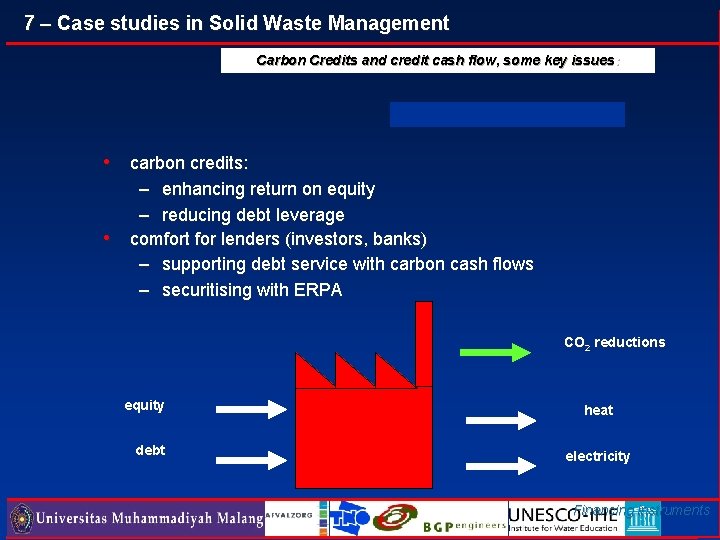
7 – Case studies in Solid Waste Management Carbon Credits and credit cash flow, some key issues: • carbon credits: – enhancing return on equity – reducing debt leverage • comfort for lenders (investors, banks) – supporting debt service with carbon cash flows – securitising with ERPA CO 2 reductions equity debt heat electricity Financing instruments
7 – Case studies in Solid Waste Management Financial assessment: the basics (1) The purpose of financial assessment is to obtain 1) insight and understanding about your budget; 2) Information about the profitability of your investment; 3) Insight into the financial risks of the project Key parameter is the Internal Rate of Return (IRR). We need to understand the time-value of money = a Rupia today is not the same as a Rupia after 10 years Financing instruments
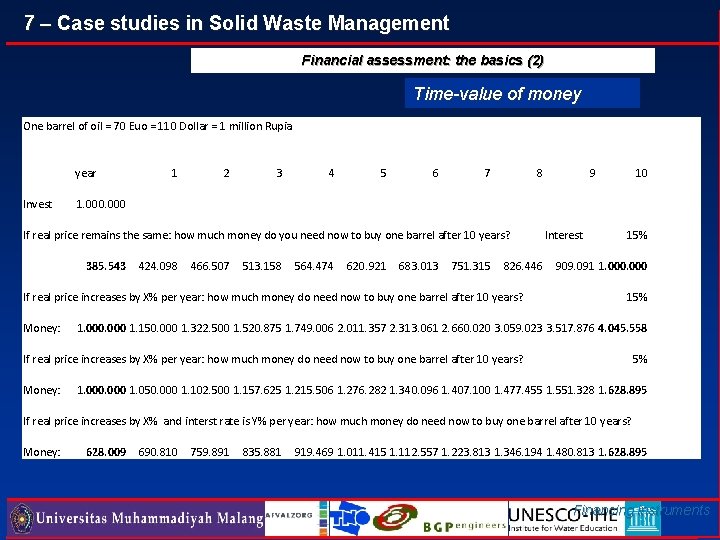
7 – Case studies in Solid Waste Management Financial assessment: the basics (2) Time-value of money One barrel of oil = 70 Euo = 110 Dollar = 1 million Rupia year Invest 1 2 3 4 5 6 7 8 10 1. 000 If real price remains the same: how much money do you need now to buy one barrel after 10 years? 385. 543 424. 098 466. 507 513. 158 564. 474 620. 921 683. 013 751. 315 826. 446 If real price increases by X% per year: how much money do need now to buy one barrel after 10 years? Money: 9 Interest 15% 909. 091 1. 000 15% 1. 000 1. 150. 000 1. 322. 500 1. 520. 875 1. 749. 006 2. 011. 357 2. 313. 061 2. 660. 020 3. 059. 023 3. 517. 876 4. 045. 558 If real price increases by X% per year: how much money do need now to buy one barrel after 10 years? Money: 5% 1. 000 1. 050. 000 1. 102. 500 1. 157. 625 1. 215. 506 1. 276. 282 1. 340. 096 1. 407. 100 1. 477. 455 1. 551. 328 1. 628. 895 If real price increases by X% and interst rate is Y% per year: how much money do need now to buy one barrel after 10 years? Money: 628. 009 690. 810 759. 891 835. 881 919. 469 1. 011. 415 1. 112. 557 1. 223. 813 1. 346. 194 1. 480. 813 1. 628. 895 Financing instruments
7 – Case studies in Solid Waste Management Case studies Case study 1: Renewable energy in agricultural company (Cyprus) Case study 2: Energy efficiency in Textile industry (Macedonia) Case study 3: Landfill Gas Capture and Energy Generation (Indonesia) Financing instruments
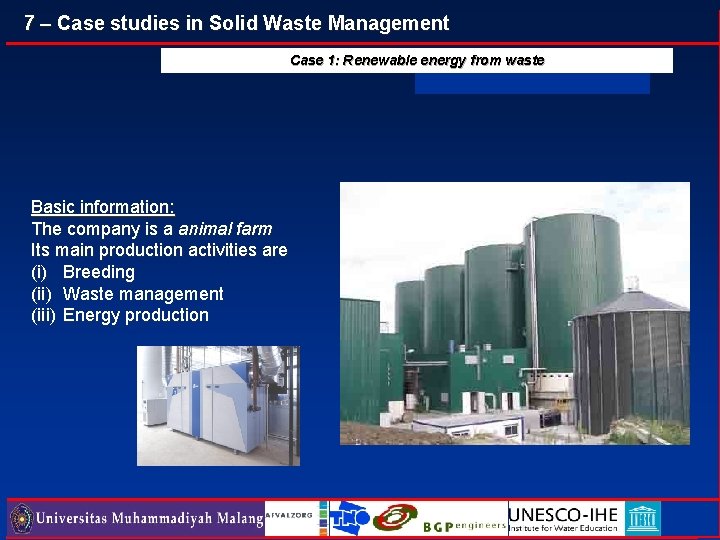
7 – Case studies in Solid Waste Management Case 1: Renewable energy from waste Basic information: The company is a animal farm Its main production activities are (i) Breeding (ii) Waste management (iii) Energy production
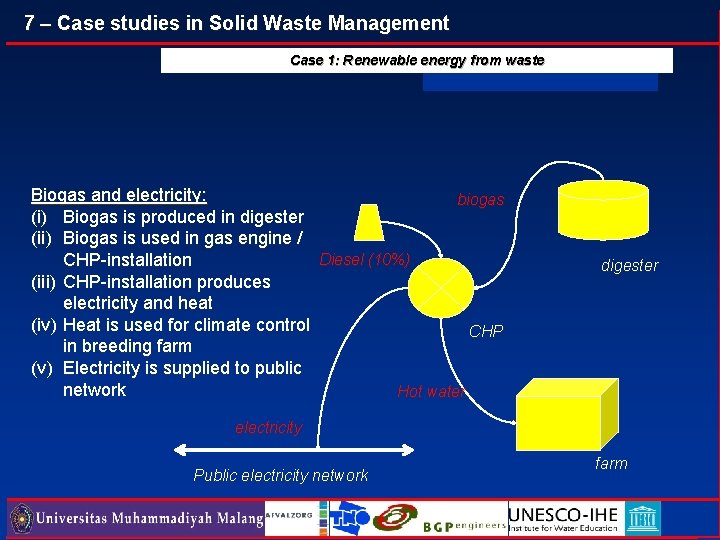
7 – Case studies in Solid Waste Management Case 1: Renewable energy from waste Biogas and electricity: biogas (i) Biogas is produced in digester (ii) Biogas is used in gas engine / Diesel (10%) CHP-installation (iii) CHP-installation produces electricity and heat (iv) Heat is used for climate control CHP in breeding farm (v) Electricity is supplied to public network Hot water digester electricity Public electricity network farm
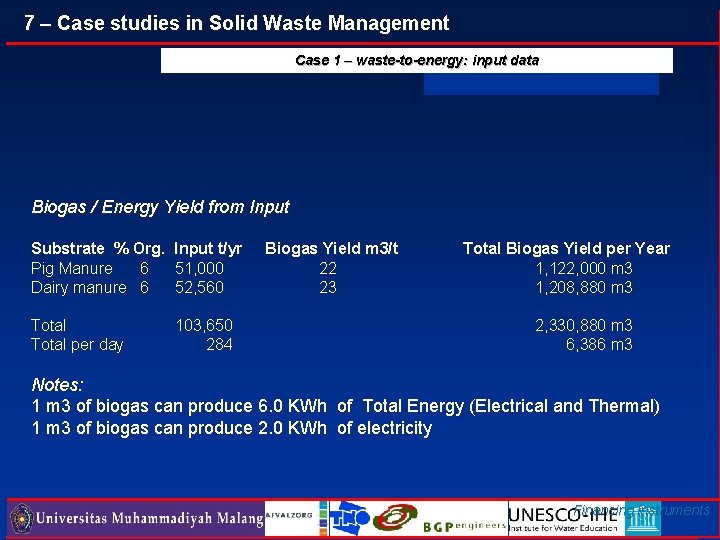
7 – Case studies in Solid Waste Management Case 1 – waste-to-energy: input data Biogas / Energy Yield from Input Substrate % Org. Input t/yr Pig Manure 6 51, 000 Dairy manure 6 52, 560 Total per day 103, 650 284 Biogas Yield m 3/t 22 23 Total Biogas Yield per Year 1, 122, 000 m 3 1, 208, 880 m 3 2, 330, 880 m 3 6, 386 m 3 Notes: 1 m 3 of biogas can produce 6. 0 KWh of Total Energy (Electrical and Thermal) 1 m 3 of biogas can produce 2. 0 KWh of electricity Financing instruments
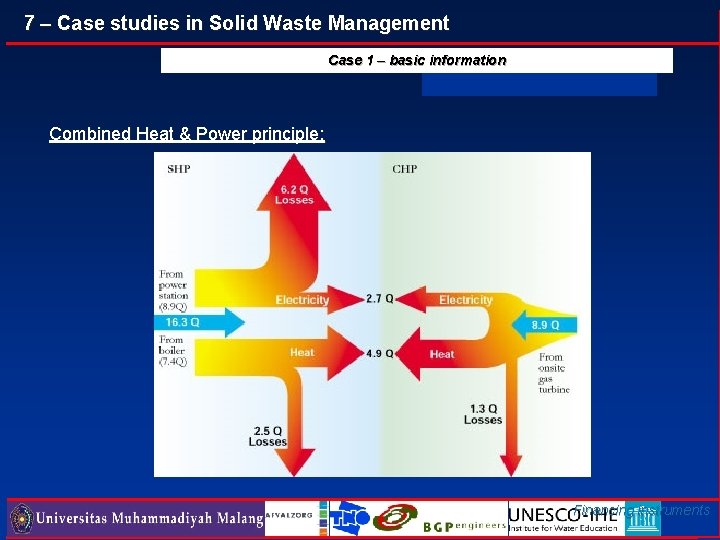
7 – Case studies in Solid Waste Management Case 1 – basic information Combined Heat & Power principle: Financing instruments
7 – Case studies in Solid Waste Management Case 1 – basics of financial assessment Financial assessment: 1) Must comprise all financial parameters relevant to the project 2) Cost information on: equipment and civil structures, utilities (gas, water, electricity etc. ) 3) Must include financing parameters (“how will you pay for the investments? ”) 4) Objective is to assess the revenues and the financial risks of the investment Financing instruments
7 – Case studies in Solid Waste Management Case 1 – basics of financial assessment Financial assessment: We make EXCEL sheet for financial analysis (EXERCISE) Financing instruments
7 – Case studies in Solid Waste Management Case 1 – approach of financial assessment Approach: 1) Collect prices of equipment, works and services relevant to the project; validity of prices; payment terms 2) Collect price information on input flows and output flows; make price prognosis 3) Set-up EXCEL sheet 4) Make analysis of risks and price effects Financing instruments
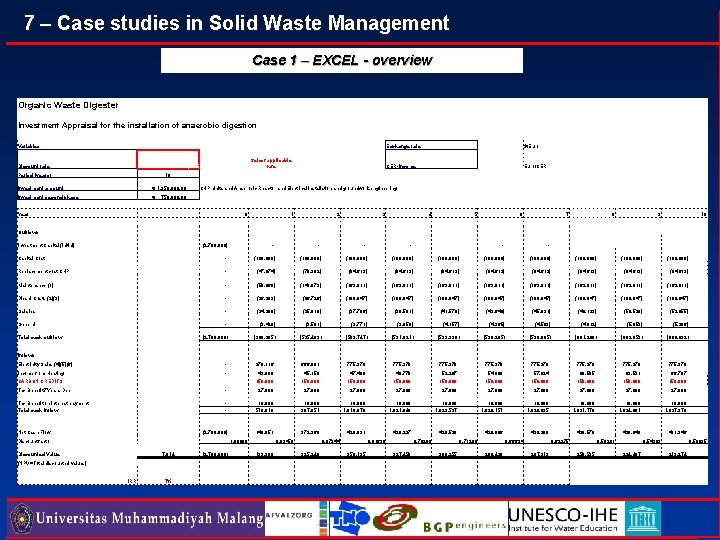
7 – Case studies in Solid Waste Management Case 1 – EXCEL - overview Organic Waste Digester Investment Appraisal for the installation of anaerobic digestion Variables Exchange rate Discount rate Select applicable rate 7, 00% Period (years) 1, 60 $/Euro CER-income 10 Euro/CER 10 Investment amount € 1. 950. 000, 00 Investment second phase € CHP Units and Anaerobic Reactor and Electrical installation and groundwork, engineering 750. 000, 00 Year 0 1 2 3 4 5 6 7 8 9 10 Outflows Investment Capital (initial) (2. 700. 000) - - - Capital Cost - (189. 000) (189. 000) Replacement cost CHP - (47. 074) (79. 382) (94. 613) (94. 613) Maintenance (1) - (58. 968) (140. 873) (163. 811) (163. 811) Diesel Costs (2)(3) - (36. 303) (86. 726) (100. 847) (100. 847) Salaries - (34. 200) (35. 910) (37. 706) (39. 591) (41. 570) (43. 649) (45. 831) (48. 123) (50. 529) (53. 055) General - (3. 420) (3. 591) (3. 771) (3. 959) (4. 157) (4. 365) (4. 583) (4. 812) (5. 053) (5. 306) (368. 965) (535. 483) (589. 747) (591. 821) (593. 998) (596. 285) (598. 685) (601. 206) (603. 853) (606. 632) 775. 370 Total cash outflow (2. 700. 000) (189. 000) Inflows Electricity Sales (4)(5)(6) - 279. 116 666. 801 775. 370 775. 370 Income from Heating - 43. 000 45. 150 47. 408 49. 778 52. 267 54. 880 57. 624 60. 505 63. 531 66. 707 150. 000 150. 000 CARBON CREDITS Tax Benefit 7 Years Depr - 27. 000 27. 000 Tax Benefit on interest payment Total cash inflow - 18. 900 518. 016 18. 900 907. 851 18. 900 1. 018. 678 18. 900 1. 021. 048 18. 900 1. 023. 537 18. 900 1. 026. 151 18. 900 1. 028. 895 18. 900 1. 031. 776 18. 900 1. 034. 801 18. 900 1. 037. 978 Net Cash Flow (2. 700. 000) Discount factor 149. 051 1, 00000 Discounted Value 7. 014 (NPV=Total discounted values) IRR 7% (2. 700. 000) 372. 368 0, 93458 139. 300 428. 931 0, 87344 325. 240 429. 227 0, 81630 350. 135 429. 539 0, 76290 327. 456 429. 866 0, 71299 306. 255 430. 209 0, 66634 286. 438 430. 570 0, 62275 267. 913 430. 948 0, 58201 250. 595 431. 346 0, 54393 234. 407 0, 50835 219. 274
7 – Case studies in Solid Waste Management Case 1 – EXCEL – input data 1) Biogas production data 2) Performance data from CHP-installation (IN: gas, OUT: heat, electricity) 3) Life time of project 4) Cost of money (interest rate, non-islamic banking) 5) Currency (import or domestic equipment) 6) Prices of utilities (water, electricity, carbon credits etc. ) Financing instruments
7 – Case studies in Solid Waste Management Case 1 – exercise Analysis of optimization of investment (GROUP WORK + PRESENTATION): 1) Which are the key factors to increase the profitability of the investment project? - on input side - on operational side - on output side 2) Which (additional) risks can you identify if: - the project life time is 6 years instead of 10 years? - the project life time is 15 years instead of 10 years? (please look for internal risks (= inside of project) and external risks (= cannot be influenced by project) Financing instruments
7 – Case studies in Solid Waste Management Case 2: Energy Efficiency in industry Basic information: Project Title: Energy Conservation Program at Tetex Textile Mill in Tetovo Teteks (est. 1951) is a large, vertically integrated, wool textile manufacturer in Tetovo, Macedonia. It employs 3, 200 employees Its main production processes are 1, 030 tons of yarn, 800, 000 meters of fabric, 700, 000 pieces for ready-made garments and 330, 000 pieces for knitted apparel. The plant has two steam boilers and generates large quantities of steam for both process and heating purposes (approximately 83, 000 tons/year). The Company paid approximately $1. 37 million for heat and approximately $390, 000 for electricity (approximately 9, 300 MWh)
7 – Case studies in Solid Waste Management Case 2: continued… Energy case: Purpose: to reduce costs Main object: two operating boilers that generate steam EE option: the coal-fired boiler has the capacity to generate 40 tons of steam per hour (25 -bar). The heavy oil-fired boiler has the capacity to generate 10 -15 tons of steam per hour (7 -bar). According to a past survey, however, both boilers were operating at a much lower capacity and generated only 18 tons of steam per hour (7 -bar) in total. Heat consumption was 2. 5 times higher in the winter than during the rest of the year. Financing instruments
7 – Case studies in Solid Waste Management Case 2: continued… Approach: 1) Feasibility study with assessment of options 2) “Quick fix” measures (short pay-back period) 3) More advanced measures (medium or long pay-back period) Financing instruments
7 – Case studies in Solid Waste Management Case 2: continued… Collect real data: • Boiler combustion measurements were taken using a combustion analyzer. • A thorough survey of the arrangement, sizing and insulation of the steam distribution system was conducted to identify potential improvements. • A steam trap survey was conducted to identify and quantify failures and leaks and explore how condensation recovery and heat transfer efficiency could be optimized. • Hot water systems were inspected to evaluate heat recovery opportunities and identify physical requirements for making improvements. • Plant equipment was inspected to assess energy efficiency. Opportunities for consolidation to improve efficiency were identified and discussed with production managers. Financing instruments
7 – Case studies in Solid Waste Management Case 2: continued… • The condition and thickness of building insulation and weatherproofing were • • inspected. A general lack of building insulation was noted. Numerous openings in doors and windows were also observed. Steam, air and water leak detection and maintenance practices were assessed. The tracking and management system by which Teteks monitors and controls energy use was assessed. Financing instruments
7 – Case studies in Solid Waste Management Case 2: continued… Key information from study: Teteks consumes 83, 143 tons of steam per year and 9, 271 MWh of electricity in 2001. Steam represented approximately 60% of the total energy consumption per year while electricity consumption amounted to 35%. Compressed air made up the remaining five percent. (-> set priorities!) Based on the results, it were recommended several low and medium cost measures, as well as a few high cost measures. These measures required a total investment outlay of $1, 587, 000 with a simple payback period of approximately 24 months generating an annual cost savings of $772, 683. Financing instruments
7 – Case studies in Solid Waste Management Case 2: continued… Results: see paper • • Awareness increased All management levels involved Reduction of operational room Management strategy is required Financing instruments
7 – Case studies in Solid Waste Management Case 2: continued… CO 2 -reduction: In addition to these cost savings, environmental benefits were also generated. Implementation of the improvement measures reduce carbon dioxide emissions by 20, 000 tons per year • Kyoto-period (2008 -2012) allows trading of Carbon Credits • If all measures are implemented in 2008, 4 years of Carbon Credits can be • produced, approx. 80, 000 credits Price of Carbon Credits is approx. 12 -15 euros Therefore, the value of the emissions reduction equals to approx. 1 million euro Financing instruments
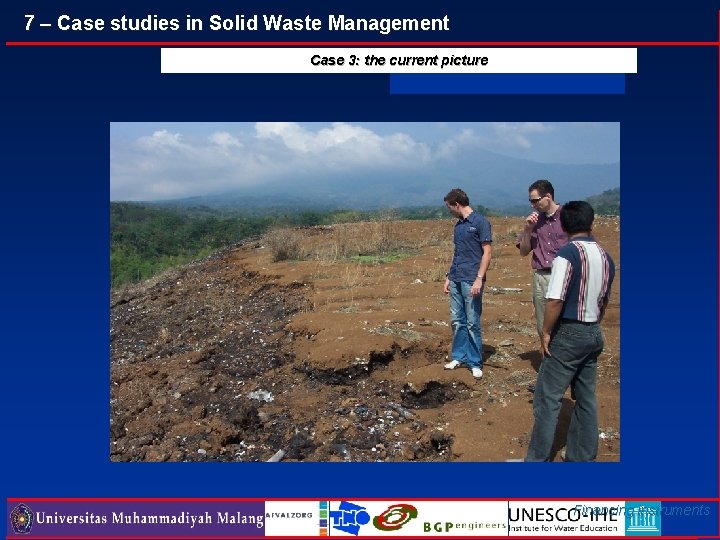
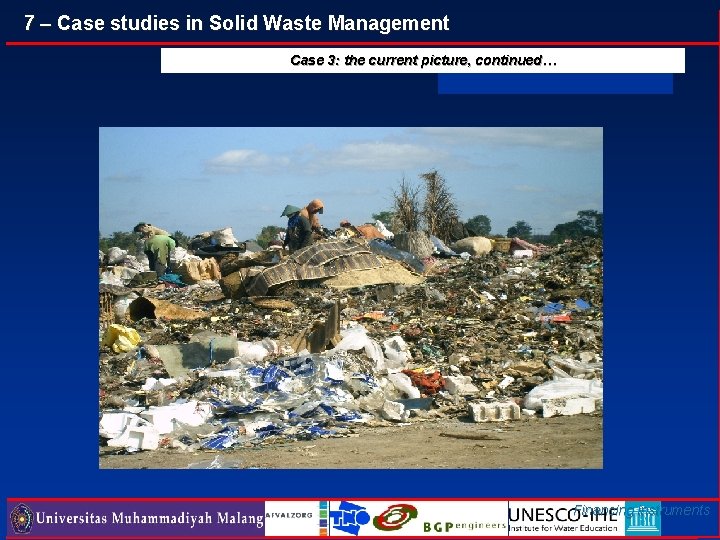
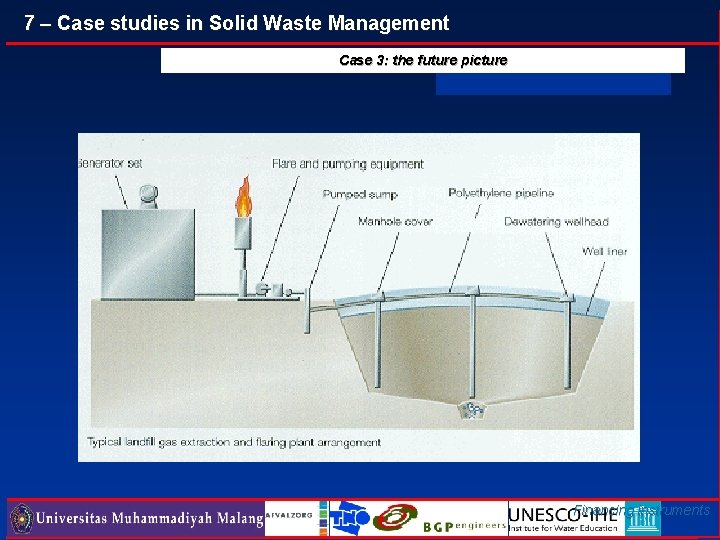
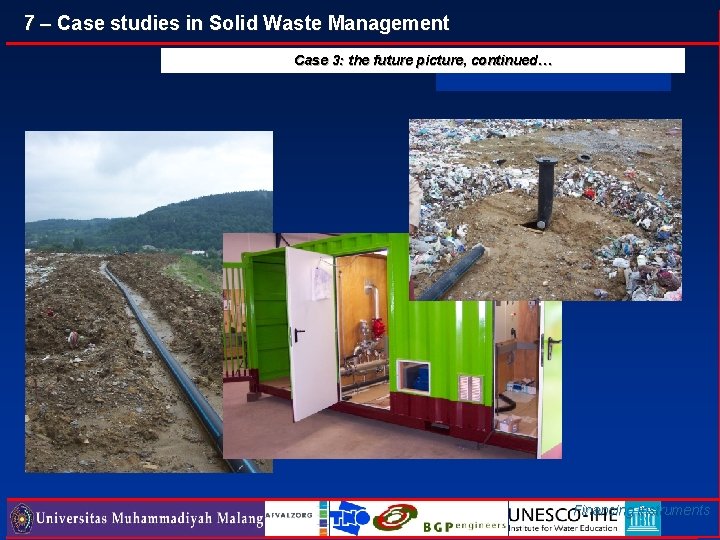
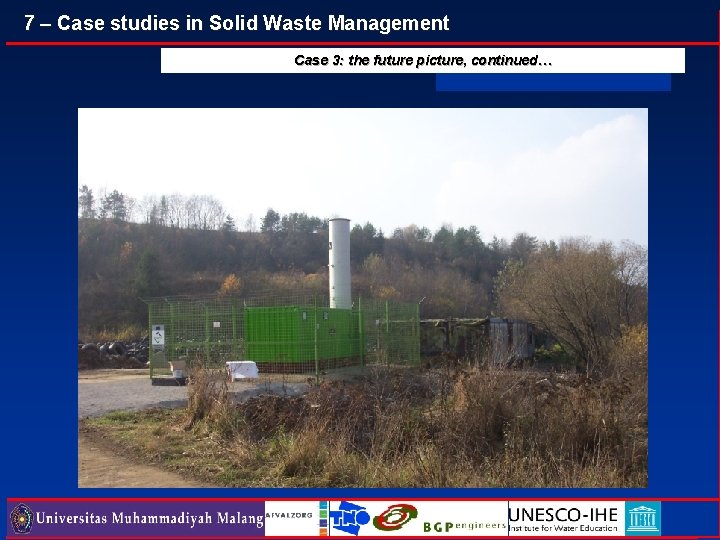
7 – Case studies in Solid Waste Management Case 3: Landfill gas capture and energy generation Basic information: The landfill is an existing one with some parts not in operation and some parts where waste is disposed • • The landfill was started 8 years ago The landfill needs re-structuring (by shape and by organisation) Waste amounts are expected to increase during 2008 -2012 The upgrading plan foresees the construction of gas wells, flare, processing unit and generation of electricity Case study will define, calculate and assess the costs and benefits of the envisaged investment and the operations Financing instruments
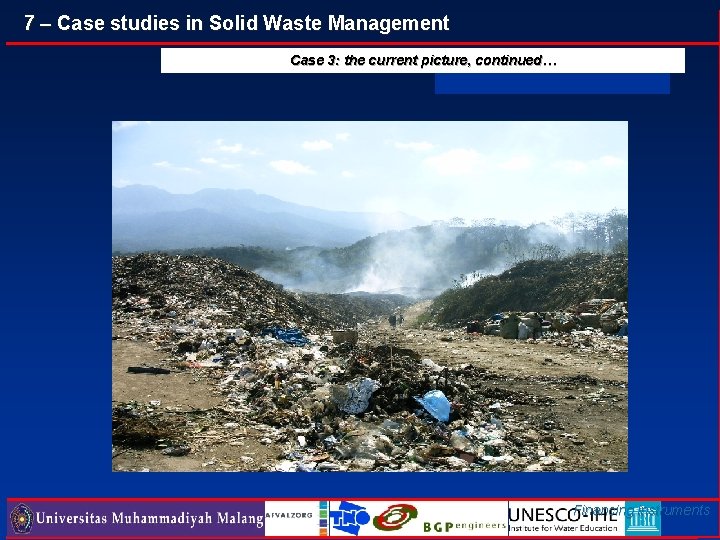
7 – Case studies in Solid Waste Management Case 3: the current picture Financing instruments
7 – Case studies in Solid Waste Management Case 3: the current picture, continued… Financing instruments
7 – Case studies in Solid Waste Management Case 3: the current picture, continued… Financing instruments
7 – Case studies in Solid Waste Management Case 3: the future picture Financing instruments
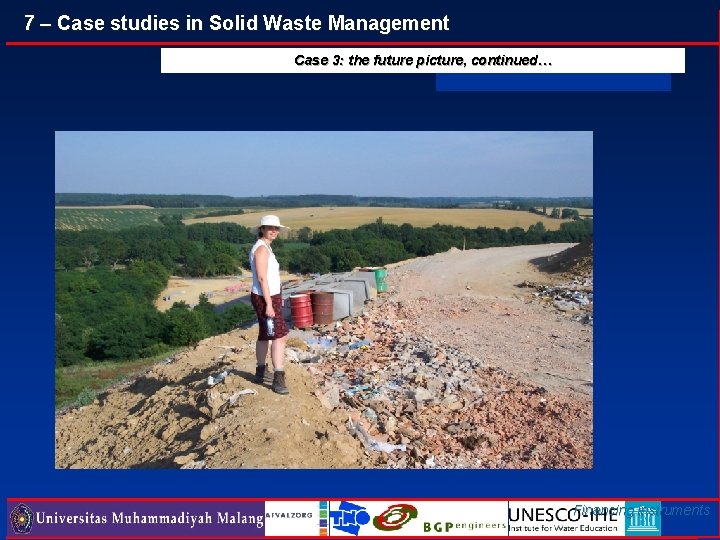
7 – Case studies in Solid Waste Management Case 3: the future picture, continued… Financing instruments
7 – Case studies in Solid Waste Management Case 3: the future picture, continued…
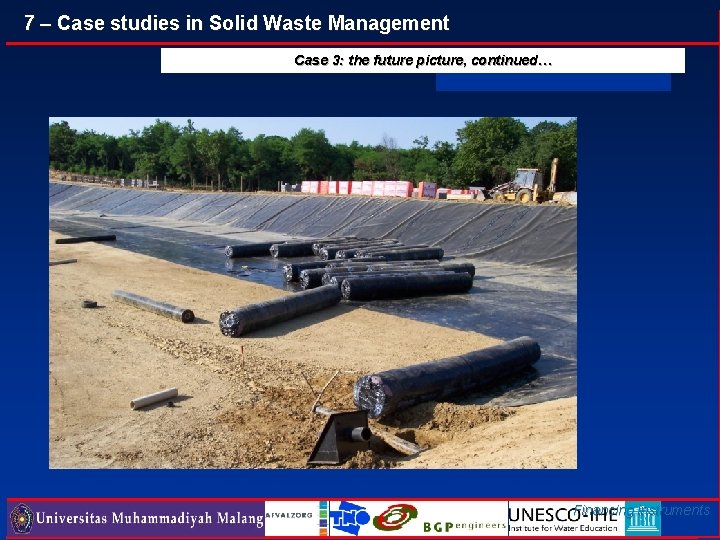
7 – Case studies in Solid Waste Management Case 3: the future picture, continued… Financing instruments
7 – Case studies in Solid Waste Management Case 3: the future picture, continued… Financing instruments
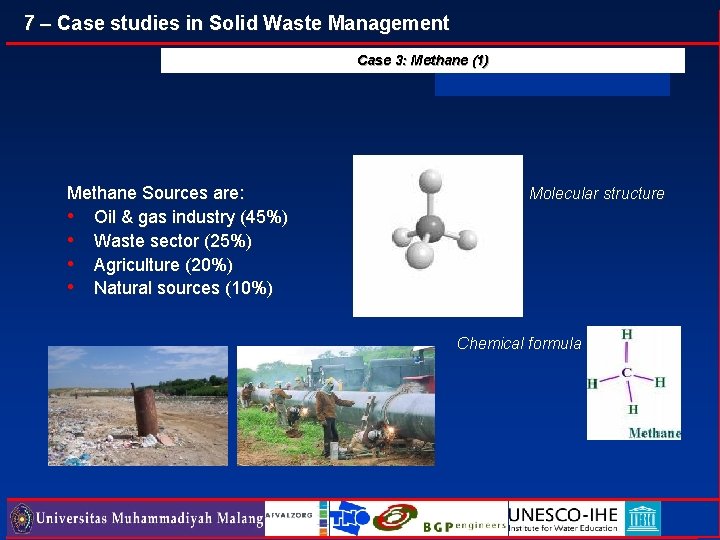
7 – Case studies in Solid Waste Management Case 3: Methane (1) Methane Sources are: • Oil & gas industry (45%) • Waste sector (25%) • Agriculture (20%) • Natural sources (10%) Molecular structure Chemical formula
7 – Case studies in Solid Waste Management Case 3: Methane (2) Methane characteristics: • Odourless gas • Invisible gas • Very explosive (@ 5 -15 vol% with air) • High energy content (38 MJ/Nm 3) • Non toxic • Pure, no contaminants • Global warming potential = 21 • • Nm 3 = one cubic meter at standard conditions of 0 o. C (273 o. K)and 1 atmosphere pressure (105 Pa) Energy content is defined as higher or lower thermal value Question: why is possible that we are able to smell landfill gas?
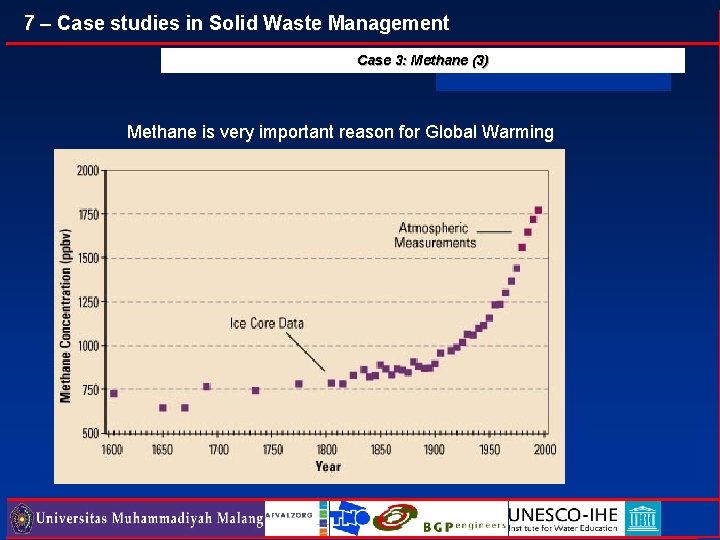
7 – Case studies in Solid Waste Management Case 3: Methane (3) Methane is very important reason for Global Warming
7 – Case studies in Solid Waste Management Case 3: Global Warming Potential Global warming potential (GWP) is a measure of how much a given mass of greenhouse gas is estimated to contribute to global warming. It is a relative scale which compares the gas in question to that of the same mass of carbon dioxide (whose GWP is by definition 1). A GWP is calculated over a specific time interval and the value of this must be stated whenever a GWP is quoted or else the value is meaningless. Carbon dioxide has a GWP of exactly 1 (since it is the baseline unit to which all other greenhouse gases are compared). Methane has a GWP of 21 Financing instruments
7 – Case studies in Solid Waste Management Case 3: Landfill gas characteristics: • Smelly gas • Invisible gas • Very explosive (@ 10 -30 vol% with air) • High energy content (18 -20 MJ/Nm 3) • Main components are CH 4, CO 2, N 2, H 2 S and organic compounds • Toxic • It contains contaminants Financing instruments
7 – Case studies in Solid Waste Management Case 3: Landfill gas capture and energy generation, continued… Basic calculation: The landfill is an existing one with some parts not in operation and some parts where waste is disposed • • The landfill was started 8 years ago The landfill needs re-structuring (by shape and by organisation) Waste amounts are expected to increase during 2008 -2012 The upgrading plan foresees the construction of gas wells, flare, processing unit and generation of electricity Case study will define, calculate and assess the costs and benefits of the envisaged investment and the operations Financing instruments
7 – Case studies in Solid Waste Management Case 3: Landfill gas capture and energy generation Basic information, more facts: • Release of methane (landfill gas) has been observed • There is insufficient structure in landfill activities • Approx. 50 people live near or on top of the landfill Define the immediate problems which you have and present approach to preparing landfill gas extraction project (SHORT GROUP WORK) Make 3 -4 bullet point for each question Financing instruments
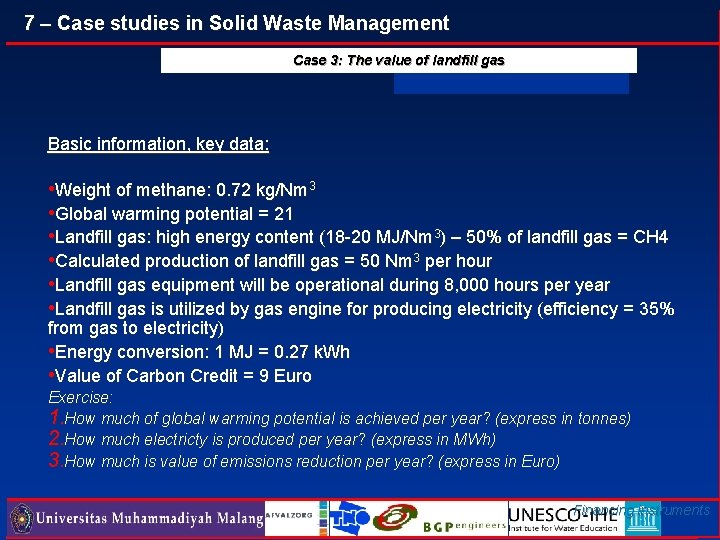
7 – Case studies in Solid Waste Management Case 3: The value of landfill gas Basic information, key data: • Weight of methane: 0. 72 kg/Nm 3 • Global warming potential = 21 • Landfill gas: high energy content (18 -20 MJ/Nm 3) – 50% of landfill gas = CH 4 • Calculated production of landfill gas = 50 Nm 3 per hour • Landfill gas equipment will be operational during 8, 000 hours per year • Landfill gas is utilized by gas engine for producing electricity (efficiency = 35% from gas to electricity) • Energy conversion: 1 MJ = 0. 27 k. Wh • Value of Carbon Credit = 9 Euro Exercise: 1. How much of global warming potential is achieved per year? (express in tonnes) 2. How much electricty is produced per year? (express in MWh) 3. How much is value of emissions reduction per year? (express in Euro) Financing instruments
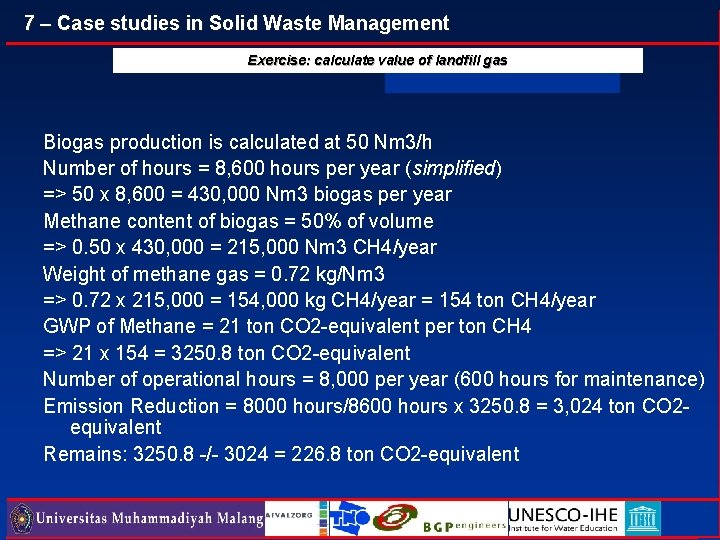
7 – Case studies in Solid Waste Management Exercise: calculate value of landfill gas Biogas production is calculated at 50 Nm 3/h Number of hours = 8, 600 hours per year (simplified) => 50 x 8, 600 = 430, 000 Nm 3 biogas per year Methane content of biogas = 50% of volume => 0. 50 x 430, 000 = 215, 000 Nm 3 CH 4/year Weight of methane gas = 0. 72 kg/Nm 3 => 0. 72 x 215, 000 = 154, 000 kg CH 4/year = 154 ton CH 4/year GWP of Methane = 21 ton CO 2 -equivalent per ton CH 4 => 21 x 154 = 3250. 8 ton CO 2 -equivalent Number of operational hours = 8, 000 per year (600 hours for maintenance) Emission Reduction = 8000 hours/8600 hours x 3250. 8 = 3, 024 ton CO 2 equivalent Remains: 3250. 8 -/- 3024 = 226. 8 ton CO 2 -equivalent
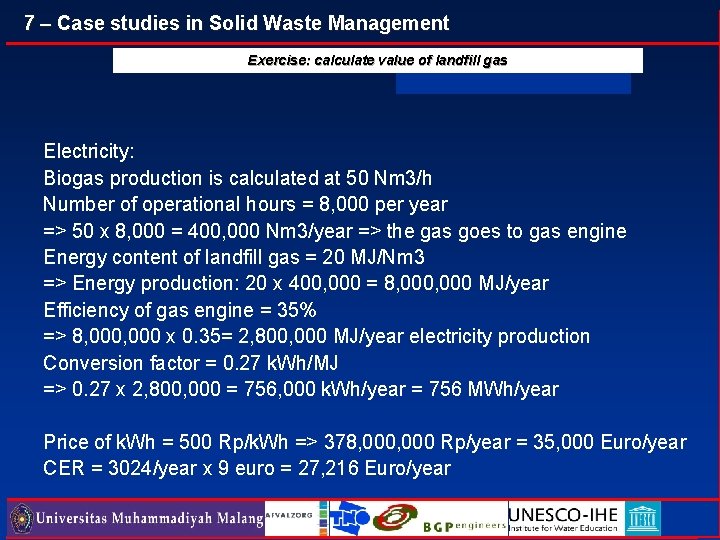
7 – Case studies in Solid Waste Management Exercise: calculate value of landfill gas Electricity: Biogas production is calculated at 50 Nm 3/h Number of operational hours = 8, 000 per year => 50 x 8, 000 = 400, 000 Nm 3/year => the gas goes to gas engine Energy content of landfill gas = 20 MJ/Nm 3 => Energy production: 20 x 400, 000 = 8, 000 MJ/year Efficiency of gas engine = 35% => 8, 000 x 0. 35= 2, 800, 000 MJ/year electricity production Conversion factor = 0. 27 k. Wh/MJ => 0. 27 x 2, 800, 000 = 756, 000 k. Wh/year = 756 MWh/year Price of k. Wh = 500 Rp/k. Wh => 378, 000 Rp/year = 35, 000 Euro/year CER = 3024/year x 9 euro = 27, 216 Euro/year