
7 B Radioactivity and Particles Lessons 6 9
7 B Radioactivity and Particles Lessons 6 -9 1 Forces and Motion 5 Solid Liquids Gases 2 Electricity 6 Magnetism 3 Waves 7 Radioactivity i. GCSE Edexcel 1 -9 – Mr Powell 4 Energy 8 Astrophysics Animated Science 2020

7 Radioactivity and Particles – Syllabus…. 7. 2 describe the structure of an atom in terms of protons, neutrons and electrons and use symbols such as C 14 to describe particular nuclei 7. 3 know the terms atomic (proton) number, mass (nucleon) number and isotope 7. 4 know that alpha ( ) particles, beta ( -) particles and gamma ( ) rays are ionising radiations emitted from unstable nuclei in a random process 7. 5 describe the nature of alpha ( ) particles, beta ( -) particles and gamma ( ) rays and recall that they may be distinguished in terms of penetrating power and ability to ionise 7. 6 practical: investigate the penetration powers of different types of radiation using either radioactive sources or simulations. 7. 7 describe the effects on the atomic and mass numbers of a nucleus of the emission of each of the four main types of radiation (alpha, beta, gamma and neutron radiation) 7. 8 understand how to complete balanced nuclear equations in terms of mass and charge 7. 9 know that photographic film or a Geiger–Müller detector can detect ionising radiations. 7. 10 explain the sources of background (ionising) radiation from Earth and space. 7. 11 know that the activity of a radioactive source decreases over a period of time and is measured in becquerels 7. 12 know the term ‘half-life’ and understand that it is different for different radioactive isotopes 7. 13 use the concept of the half-life to carry out simple calculations on activity, including graphical methods. 7. 14 describe the uses of radioactivity in industry and medicine 7. 15 describe the difference between contamination and irradiation 7. 16 describe the dangers of ionising radiations including • that radiation cause mutations in living organisms • that radiation can damage cells and tissue • the problems arising in the disposal of radioactive waste and how the associated risks can be reduced. R A G Animated Science 2020
Animated Science 2020 Mr D Powell 2020 Lesson 6 Hazards and Uses of Radiation (1 or 2 hours) I can compare sources and why they can or cannot be used as tracers and give specific examples of hazards of radiation. 7/8 ++I can explain how radioisotopes can be used as tracers in detail with an example such as a kidney or knee 5/6 +explain how contaminated waste can be disposed of and contained in places such as Chernobyl AND people protected. 4 I can define radioactive contamination listing methods of contamination such as polonium 210 Animated Science 2020
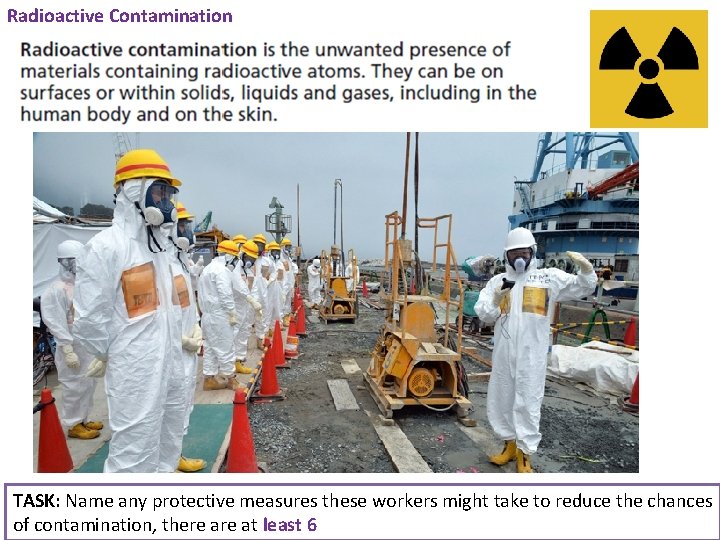
Radioactive Contamination TASK: Name any protective measures these workers might take to reduce the chances Animated Science of contamination, there at least 6 2020
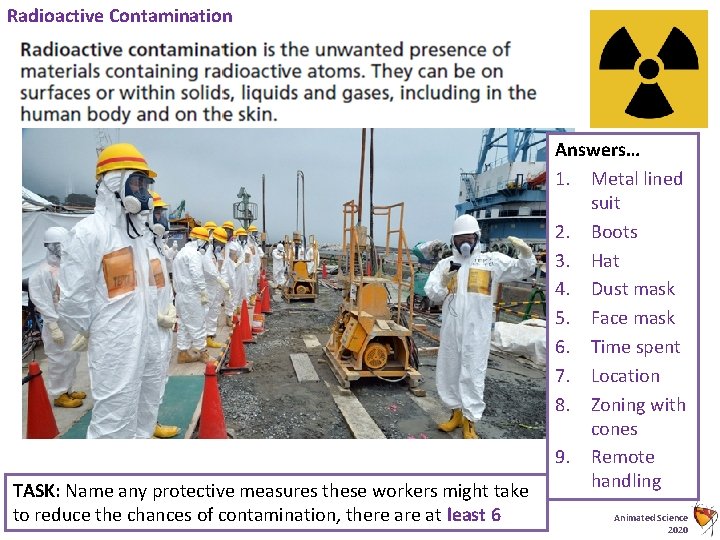
Radioactive Contamination TASK: Name any protective measures these workers might take to reduce the chances of contamination, there at least 6 Answers… 1. Metal lined suit 2. Boots 3. Hat 4. Dust mask 5. Face mask 6. Time spent 7. Location 8. Zoning with cones 9. Remote handling Animated Science 2020
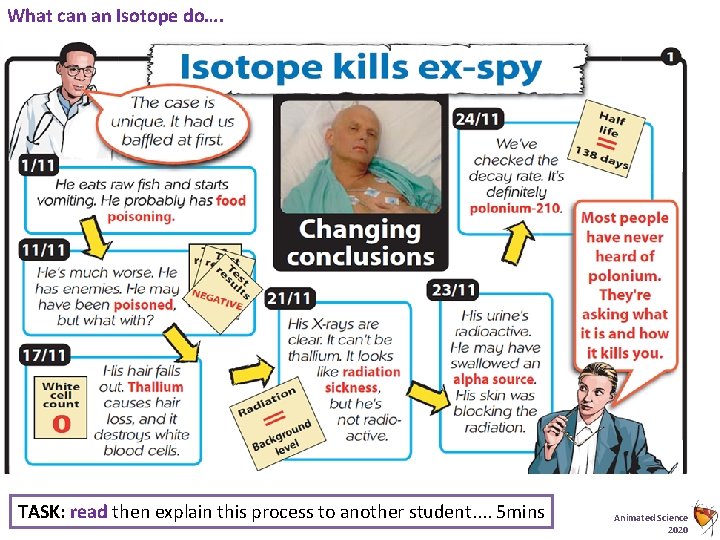
What can an Isotope do…. TASK: read then explain this process to another student. . 5 mins Animated Science 2020
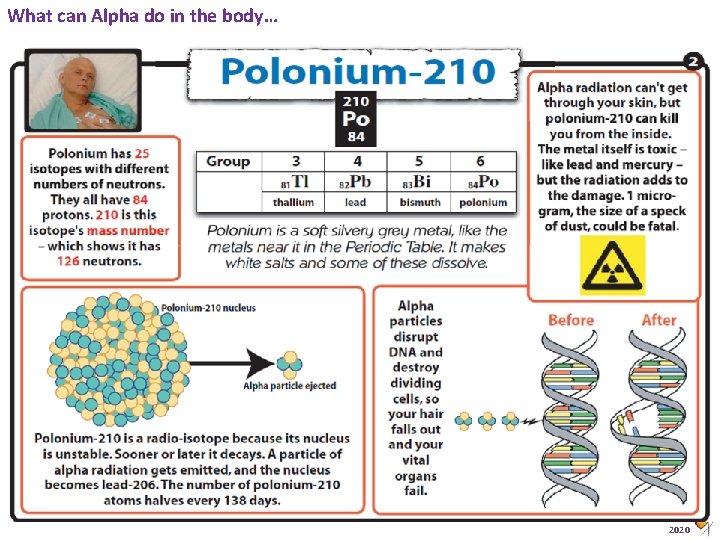
What can Alpha do in the body… Animated Science 2020
More Information on Polonium 210…. In nature, it takes about 138 days for half of a given quantity of polonium-210 to decay. But because biological processes also work to eliminate the substance, it takes about 138 days for half of it to disappear while inside the body, Polonium-210, a dangerous dose can be a matter of micrograms: smaller than a single speck of pepper. If you ingest polonium-210, about 50% to 90% of the substance will exit the body through faeces and what is left will enter the bloodstream. About 45% of polonium ingested gets into the spleen, kidneys and liver, and 10% is deposited in the bone marrow. Radiation poisoning from polonium-210 looks like the end stage of cancer. Liver and kidney damage ensue, along with extreme nausea and severe headaches. Victims often experience vomiting, diarrhoea and hair loss. The alpha particles emitted from the decaying substance get absorbed in the body, which is what causes harm. Death may come in a matter of days, sometimes weeks. There is no cure for severe radiation poisoning, Animated Science 2020
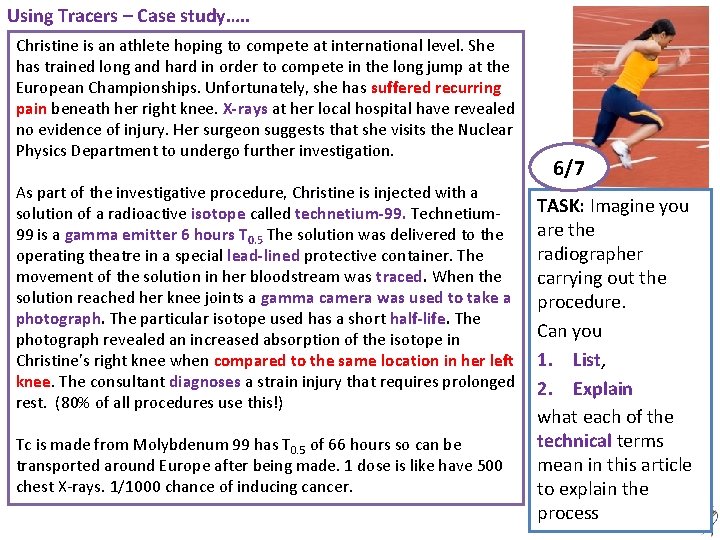
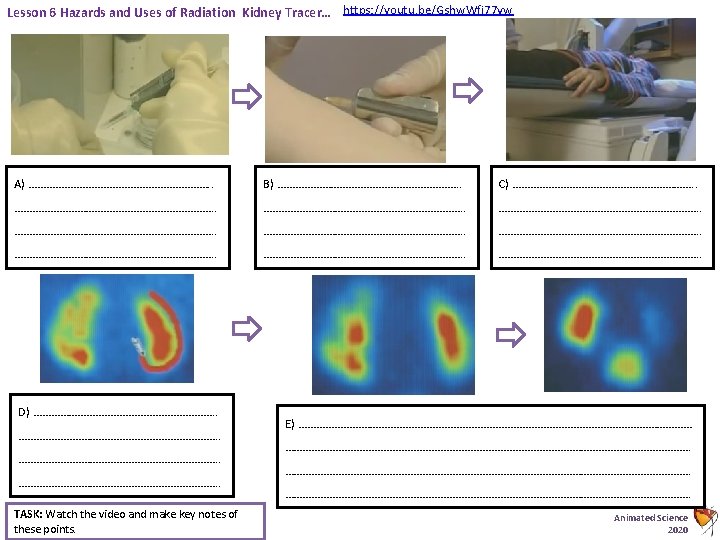
Using Tracers – Case study…. . Christine is an athlete hoping to compete at international level. She has trained long and hard in order to compete in the long jump at the European Championships. Unfortunately, she has suffered recurring pain beneath her right knee. X-rays at her local hospital have revealed no evidence of injury. Her surgeon suggests that she visits the Nuclear Physics Department to undergo further investigation. As part of the investigative procedure, Christine is injected with a solution of a radioactive isotope called technetium-99. Technetium 99 is a gamma emitter 6 hours T 0. 5 The solution was delivered to the operating theatre in a special lead-lined protective container. The movement of the solution in her bloodstream was traced. When the solution reached her knee joints a gamma camera was used to take a photograph. The particular isotope used has a short half-life. The photograph revealed an increased absorption of the isotope in Christine’s right knee when compared to the same location in her left knee. The consultant diagnoses a strain injury that requires prolonged rest. (80% of all procedures use this!) Tc is made from Molybdenum 99 has T 0. 5 of 66 hours so can be transported around Europe after being made. 1 dose is like have 500 chest X-rays. 1/1000 chance of inducing cancer. 6/7 TASK: Imagine you are the radiographer carrying out the procedure. Can you 1. List, 2. Explain what each of the technical terms mean in this article to explain the process Animated Science 2020

Lesson 6 Hazards and Uses of Radiation Mini Menu Tasks…. Use the printed resources too… 1 Name any protective measures these workers might take to reduce the chances of contamination, there at least 6…. . A. ………………. . B. ………………. . C. ………………. . D. ……………………………. . E. ………………. . 2) Explain what happened to this man, and what has it got to do with Polonium 210… F. ……………………………. . ……………… G. ……………………………. . ……………… 3) Explain/ List the ideas of how you use a tracer to diagnose a knee injury? ……………………………. . ………………………………………………………………………………………. . ……………………………………………………. Animated Science 2020
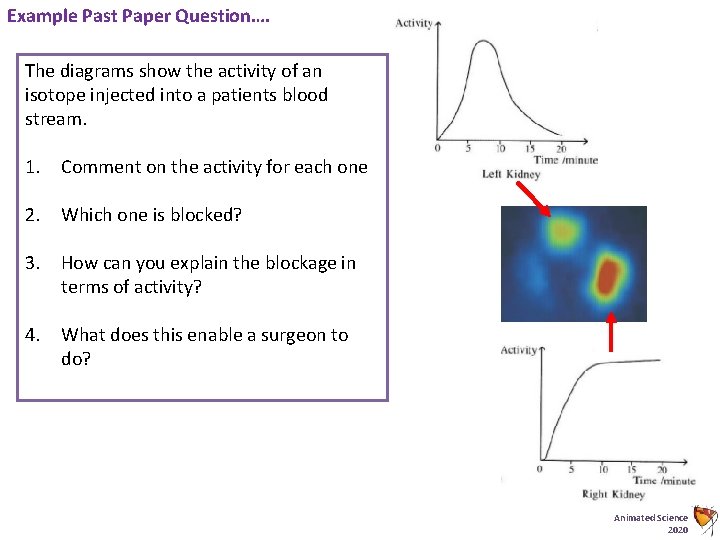
Example Past Paper Question…. The diagrams show the activity of an isotope injected into a patients blood stream. 1. Comment on the activity for each one 2. Which one is blocked? 3. How can you explain the blockage in terms of activity? 4. What does this enable a surgeon to do? Animated Science 2020
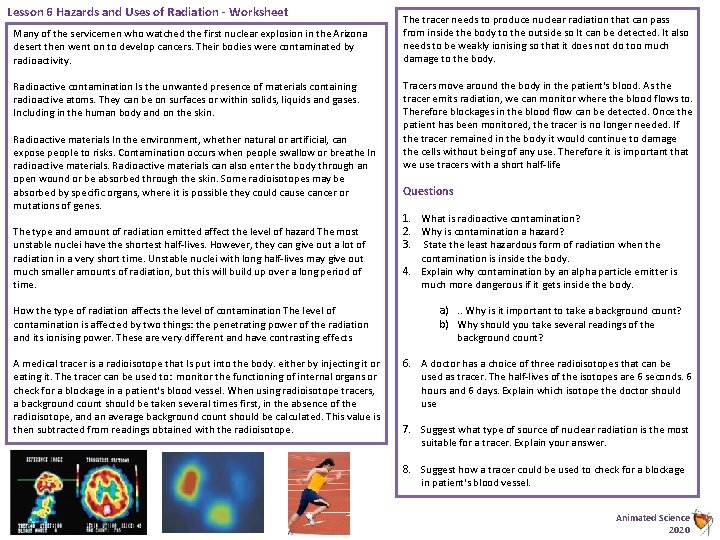
Lesson 6 Hazards and Uses of Radiation - Worksheet Many of the servicemen who watched the first nuclear explosion in the Arizona desert then went on to develop cancers. Their bodies were contaminated by radioactivity. Radioactive contamination Is the unwanted presence of materials containing radioactive atoms. They can be on surfaces or within solids, liquids and gases. Including in the human body and on the skin. Radioactive materials In the environment, whether natural or artificial, can expose people to risks. Contamination occurs when people swallow or breathe In radioactive materials. Radioactive materials can also enter the body through an open wound or be absorbed through the skin. Some radioisotopes may be absorbed by specific organs, where it is possible they could cause cancer or mutations of genes. The type and amount of radiation emitted affect the level of hazard The most unstable nuclei have the shortest half-lives. However, they can give out a lot of radiation in a very short time. Unstable nuclei with long half-lives may give out much smaller amounts of radiation, but this will build up over a long period of time. How the type of radiation affects the level of contamination The level of contamination is affected by two things: the penetrating power of the radiation and its ionising power. These are very different and have contrasting effects A medical tracer is a radioisotope that Is put into the body. either by injecting it or eating it. The tracer can be used to: monitor the functioning of internal organs or check for a blockage in a patient's blood vessel. When using radioisotope tracers, a background count should be taken several times first, in the absence of the radioisotope, and an average background count should be calculated. This value is then subtracted from readings obtained with the radioisotope. The tracer needs to produce nuclear radiation that can pass from inside the body to the outside so It can be detected. It also needs to be weakly ionising so that it does not do too much damage to the body. Tracers move around the body in the patient's blood. As the tracer emits radiation, we can monitor where the blood flows to. Therefore blockages in the blood flow can be detected. Once the patient has been monitored, the tracer is no longer needed. If the tracer remained in the body it would continue to damage the cells without being of any use. Therefore it is important that we use tracers with a short half-life Questions 1. What is radioactive contamination? 2. Why is contamination a hazard? 3. State the least hazardous form of radiation when the contamination is inside the body. 4. Explain why contamination by an alpha particle emitter is much more dangerous if it gets inside the body. a). . Why is it important to take a background count? b) Why should you take several readings of the background count? 6. A doctor has a choice of three radioisotopes that can be used as tracer. The half-lives of the isotopes are 6 seconds. 6 hours and 6 days. Explain which isotope the doctor should use 7. Suggest what type of source of nuclear radiation is the most suitable for a tracer. Explain your answer. 8. Suggest how a tracer could be used to check for a blockage in patient's blood vessel. Animated Science 2020
Lesson 6 Hazards and Uses of Radiation - Worksheet 1 When a radioactive material is somewhere it isn’t wanted. 2 Radioactive materials produce ionising radiation which is harmful to health. Ionising radiation can kill cells and can cause cancer. 3 Gamma (since it has the weakest ionising power) 4 Alpha particles are very ionising which means that they are more likely to kill cells or cause cancer. However, they are not very penetrating so if they are outside the body they can’t get in and cause the damage. 5 a You need to make sure that your measurements are a true measure of the activity of the tracer rather than that of the background radiation. 6 The isotope with the half-life of 6 hours. 6 seconds would mean that the isotope has decayed to unmeasurable levels before the tracer can be monitored and 6 days would mean the patient would remain radioactive long after the procedure had taken place which would add unnecessary risk. 7 A gamma emitter. Gamma radiation has the weakest ionising power so it does the least harm to the body. It is also the most penetrating so it can pass from the inside of the body where the tracer is, to the outside where it can be detected. 8 Inject the tracer into the blood. Leave enough time for the tracer to be carried by the blood through the body. Examine the patient with a gamma camera. If there is a large signal at a particular place in the vessel then it is likely that there is a blockage in that place. 5 b Background radiation is random and its activity can be higher at some times than at others. You need to use an accurate average. Animated Science 2020
Animated Science 2020 Mr D Powell 2020 Lesson 7 Irradiation OR Contamination – p 325 to 355 I can discuss in context all the key terms surrounding radiation and the dangers /uses (from my worksheet Lesson 6) & How Cancer occurs as part of the life cycle. Chernobyl Video 7/8 I can compare and contrast irradiation and contamination (PC’s/ Textbook independent work) 5/6 I can explain the possible effects of irradiation on body cells & link to cancer 4 I can define the terms irradiation and contamination Animated Science 2020
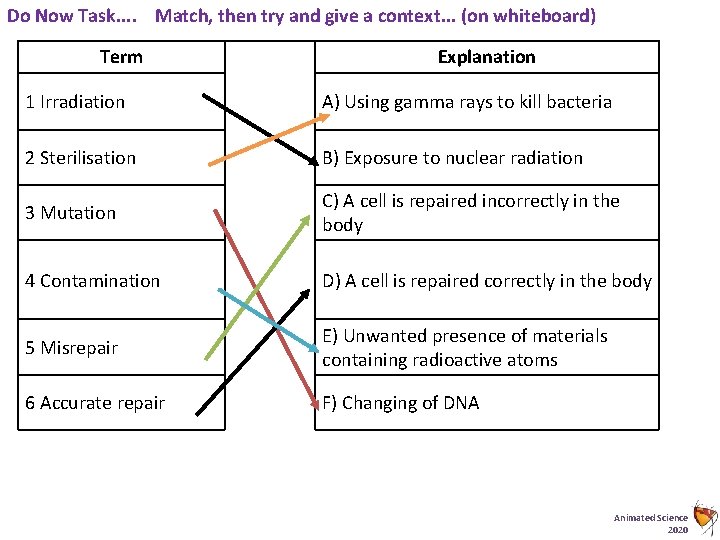
Do Now Task. . Match, then try and give a context. . . (on whiteboard) Term Explanation 1 Irradiation A) Using gamma rays to kill bacteria 2 Sterilisation B) Exposure to nuclear radiation 3 Mutation C) A cell is repaired incorrectly in the body 4 Contamination D) A cell is repaired correctly in the body 5 Misrepair E) Unwanted presence of materials containing radioactive atoms 6 Accurate repair F) Changing of DNA Animated Science 2020
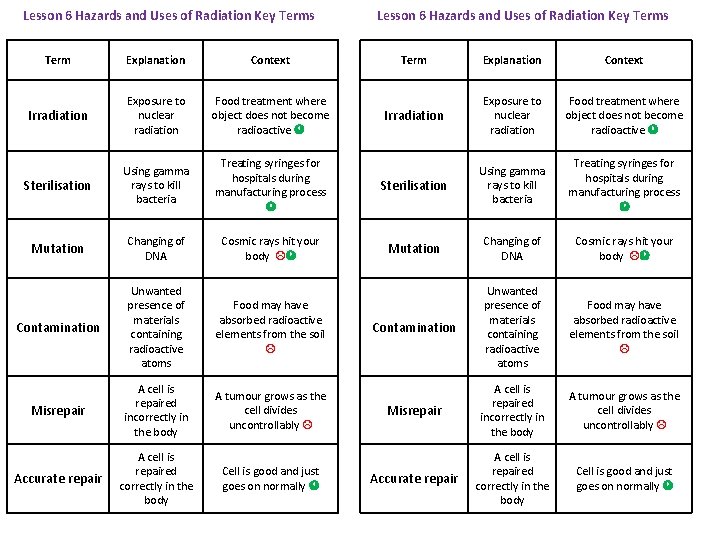
Lesson 6 Hazards and Uses of Radiation Key Terms Term Explanation Context Irradiation Exposure to nuclear radiation Food treatment where object does not become radioactive Sterilisation Using gamma rays to kill bacteria Mutation Changing of DNA Contamination Unwanted presence of materials containing radioactive atoms Food may have absorbed radioactive elements from the soil Misrepair A cell is repaired incorrectly in the body A tumour grows as the cell divides uncontrollably Accurate repair A cell is repaired correctly in the body Cell is good and just goes on normally Lesson 6 Hazards and Uses of Radiation Key Terms Term Explanation Context Irradiation Exposure to nuclear radiation Food treatment where object does not become radioactive Treating syringes for hospitals during manufacturing process Sterilisation Using gamma rays to kill bacteria Treating syringes for hospitals during manufacturing process Cosmic rays hit your body Mutation Changing of DNA Cosmic rays hit your body Contamination Unwanted presence of materials containing radioactive atoms Food may have absorbed radioactive elements from the soil Misrepair A cell is repaired incorrectly in the body A tumour grows as the cell divides uncontrollably Accurate repair A cell is repaired correctly in the body Cell is good and just goes on normally
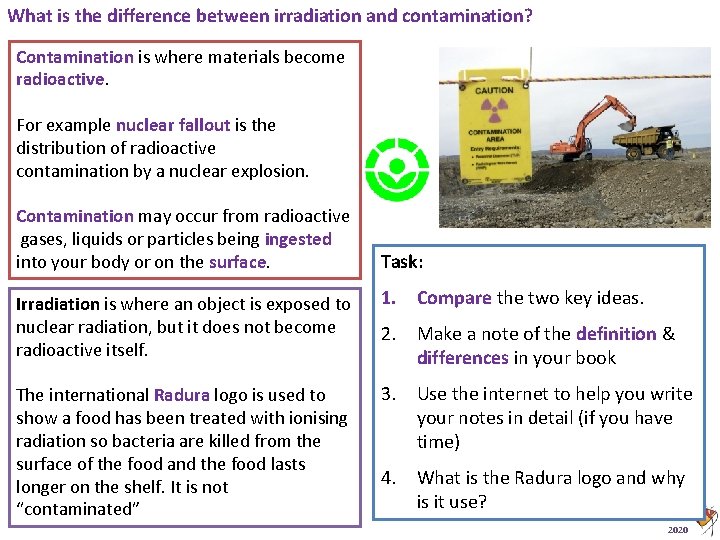
What is the difference between irradiation and contamination? Contamination is where materials become radioactive. For example nuclear fallout is the distribution of radioactive contamination by a nuclear explosion. Contamination may occur from radioactive gases, liquids or particles being ingested into your body or on the surface. Task: Irradiation is where an object is exposed to nuclear radiation, but it does not become radioactive itself. 1. Compare the two key ideas. The international Radura logo is used to show a food has been treated with ionising radiation so bacteria are killed from the surface of the food and the food lasts longer on the shelf. It is not “contaminated” 3. Use the internet to help you write your notes in detail (if you have time) 2. Make a note of the definition & differences in your book 4. What is the Radura logo and why is it use? Animated Science 2020
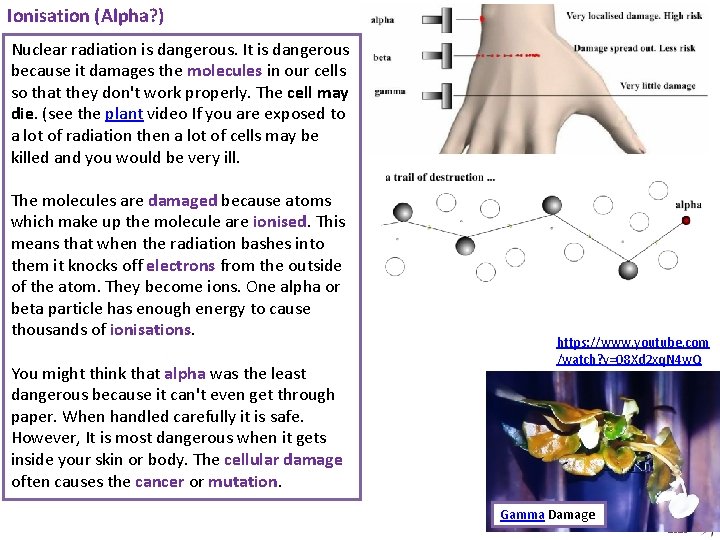
Ionisation (Alpha? ) Nuclear radiation is dangerous. It is dangerous because it damages the molecules in our cells so that they don't work properly. The cell may die. (see the plant video If you are exposed to a lot of radiation then a lot of cells may be killed and you would be very ill. The molecules are damaged because atoms which make up the molecule are ionised. This means that when the radiation bashes into them it knocks off electrons from the outside of the atom. They become ions. One alpha or beta particle has enough energy to cause thousands of ionisations. You might think that alpha was the least dangerous because it can't even get through paper. When handled carefully it is safe. However, It is most dangerous when it gets inside your skin or body. The cellular damage often causes the cancer or mutation. https: //www. youtube. com /watch? v=08 Xd 2 xq. N 4 w. Q Gamma Damage Animated Science 2020
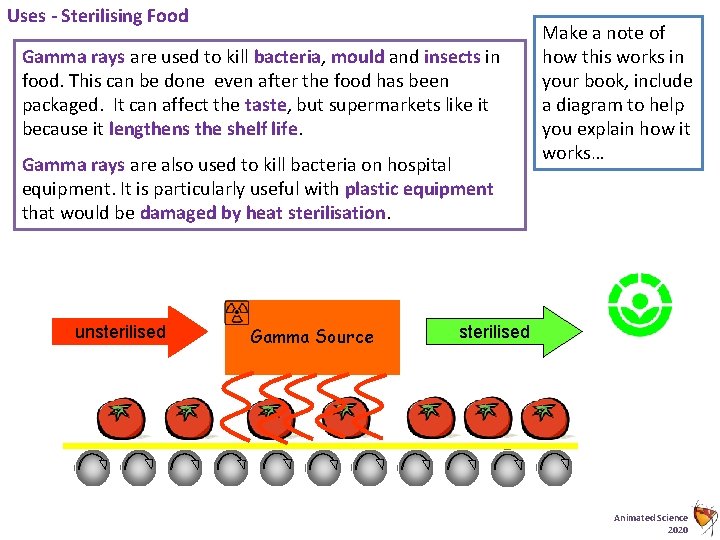
Uses - Sterilising Food Gamma rays are used to kill bacteria, mould and insects in food. This can be done even after the food has been packaged. It can affect the taste, but supermarkets like it because it lengthens the shelf life. Gamma rays are also used to kill bacteria on hospital equipment. It is particularly useful with plastic equipment that would be damaged by heat sterilisation. unsterilised Gamma Source Make a note of how this works in your book, include a diagram to help you explain how it works… sterilised Animated Science 2020
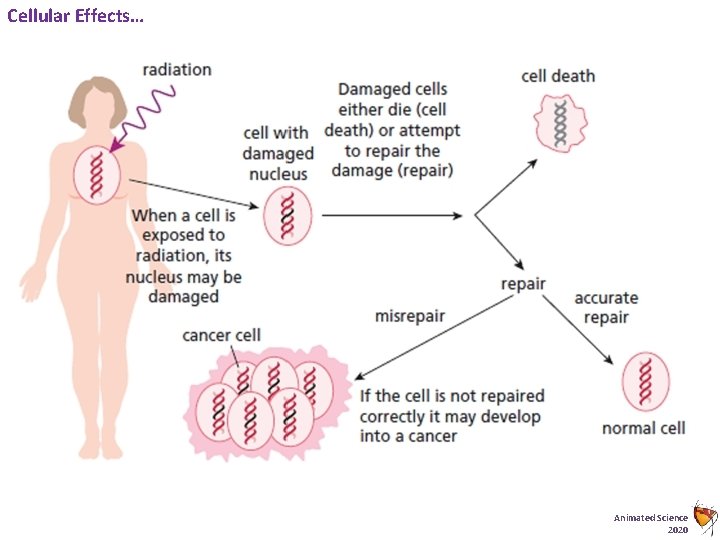
Cellular Effects… Animated Science 2020
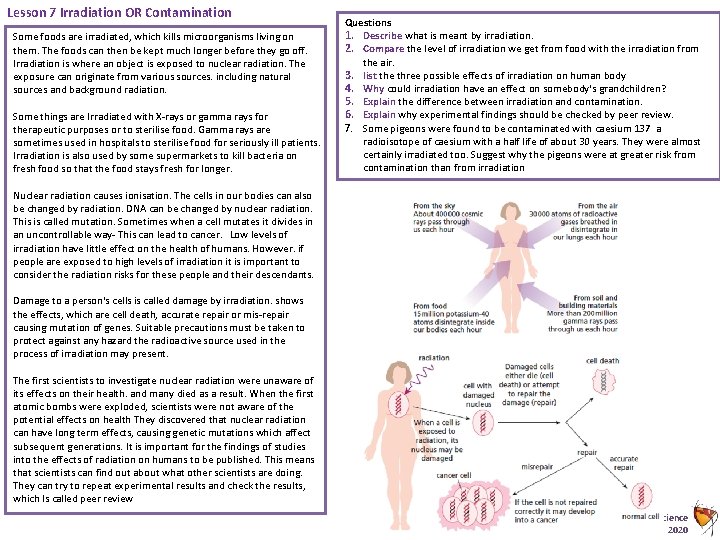
Lesson 7 Irradiation OR Contamination Some foods are irradiated, which kills microorganisms living on them. The foods can then be kept much longer before they go off. Irradiation is where an object is exposed to nuclear radiation. The exposure can originate from various sources. including natural sources and background radiation. Some things are Irradiated with X-rays or gamma rays for therapeutic purposes or to sterilise food. Gamma rays are sometimes used in hospitals to sterilise food for seriously ill patients. Irradiation is also used by some supermarkets to kill bacteria on fresh food so that the food stays fresh for longer. Questions 1. Describe what is meant by irradiation. 2. Compare the level of irradiation we get from food with the irradiation from the air. 3. list the three possible effects of irradiation on human body 4. Why could irradiation have an effect on somebody's grandchildren? 5. Explain the difference between irradiation and contamination. 6. Explain why experimental findings should be checked by peer review. 7. Some pigeons were found to be contaminated with caesium 137 a radioisotope of caesium with a half life of about 30 years. They were almost certainly irradiated too. Suggest why the pigeons were at greater risk from contamination than from irradiation Nuclear radiation causes ionisation. The cells in our bodies can also be changed by radiation. DNA can be changed by nuclear radiation. This is called mutation. Sometimes when a cell mutates it divides in an uncontrollable way- This can lead to cancer. Low levels of irradiation have little effect on the health of humans. However. if people are exposed to high levels of irradiation it is important to consider the radiation risks for these people and their descendants. Damage to a person's cells is called damage by irradiation. shows the effects, which are cell death, accurate repair or mis-repair causing mutation of genes. Suitable precautions must be taken to protect against any hazard the radioactive source used in the process of irradiation may present. The first scientists to investigate nuclear radiation were unaware of its effects on their health. and many died as a result. When the first atomic bombs were exploded, scientists were not aware of the potential effects on health They discovered that nuclear radiation can have long term effects, causing genetic mutations which affect subsequent generations. It is important for the findings of studies into the effects of radiation on humans to be published. This means that scientists can find out about what other scientists are doing. They can try to repeat experimental results and check the results, which Is called peer review Animated Science 2020
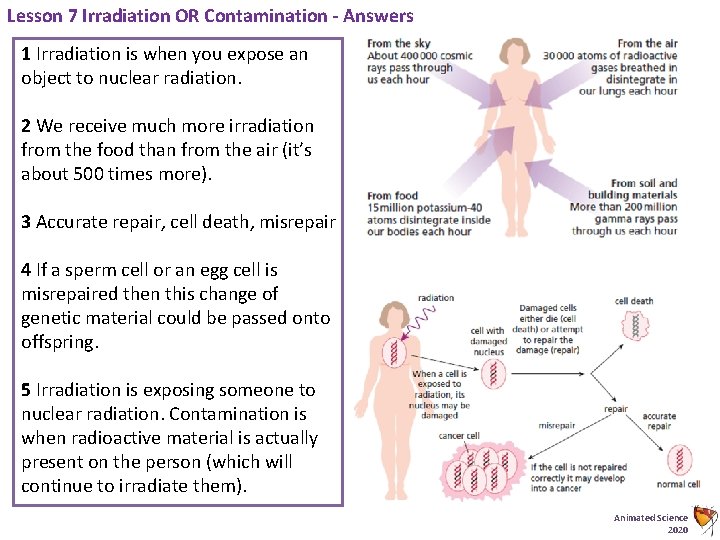
Lesson 7 Irradiation OR Contamination - Answers 1 Irradiation is when you expose an object to nuclear radiation. 2 We receive much more irradiation from the food than from the air (it’s about 500 times more). 3 Accurate repair, cell death, misrepair 4 If a sperm cell or an egg cell is misrepaired then this change of genetic material could be passed onto offspring. 5 Irradiation is exposing someone to nuclear radiation. Contamination is when radioactive material is actually present on the person (which will continue to irradiate them). Animated Science 2020
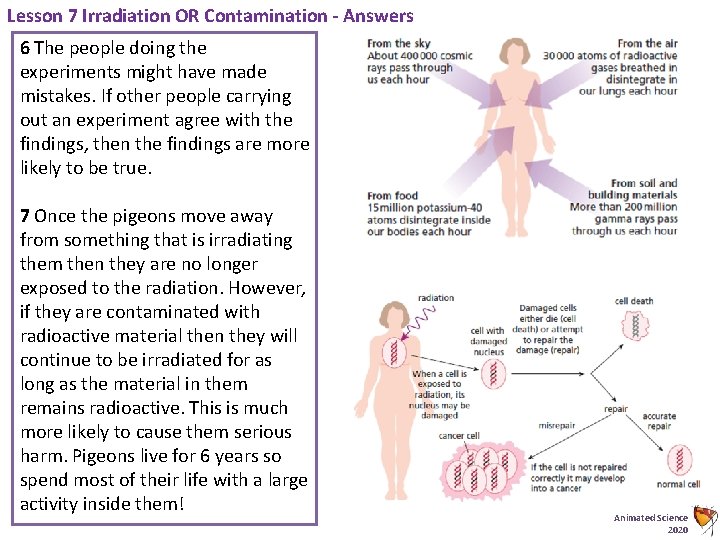
Lesson 7 Irradiation OR Contamination - Answers 6 The people doing the experiments might have made mistakes. If other people carrying out an experiment agree with the findings, then the findings are more likely to be true. 7 Once the pigeons move away from something that is irradiating them then they are no longer exposed to the radiation. However, if they are contaminated with radioactive material then they will continue to be irradiated for as long as the material in them remains radioactive. This is much more likely to cause them serious harm. Pigeons live for 6 years so spend most of their life with a large activity inside them! Animated Science 2020
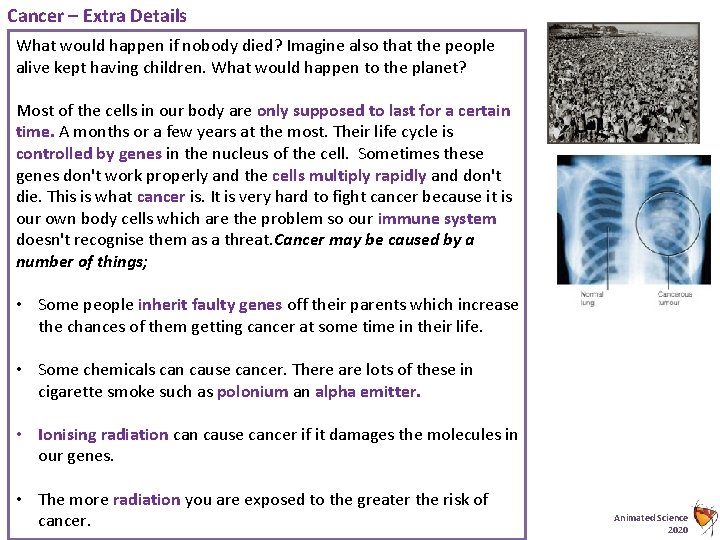
Cancer – Extra Details What would happen if nobody died? Imagine also that the people alive kept having children. What would happen to the planet? Most of the cells in our body are only supposed to last for a certain time. A months or a few years at the most. Their life cycle is controlled by genes in the nucleus of the cell. Sometimes these genes don't work properly and the cells multiply rapidly and don't die. This is what cancer is. It is very hard to fight cancer because it is our own body cells which are the problem so our immune system doesn't recognise them as a threat. Cancer may be caused by a number of things; • Some people inherit faulty genes off their parents which increase the chances of them getting cancer at some time in their life. • Some chemicals can cause cancer. There are lots of these in cigarette smoke such as polonium an alpha emitter. • Ionising radiation cause cancer if it damages the molecules in our genes. • The more radiation you are exposed to the greater the risk of cancer. Animated Science 2020
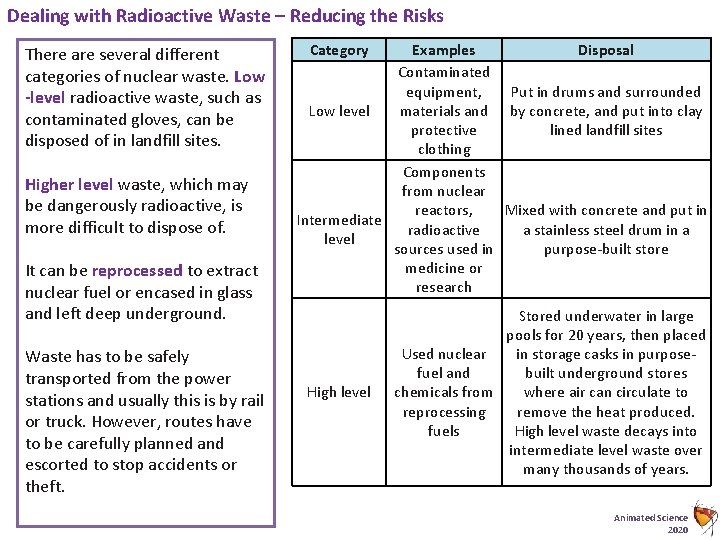
Dealing with Radioactive Waste – Reducing the Risks There are several different categories of nuclear waste. Low -level radioactive waste, such as contaminated gloves, can be disposed of in landfill sites. Higher level waste, which may be dangerously radioactive, is more difficult to dispose of. It can be reprocessed to extract nuclear fuel or encased in glass and left deep underground. Waste has to be safely transported from the power stations and usually this is by rail or truck. However, routes have to be carefully planned and escorted to stop accidents or theft. Category Examples Disposal Contaminated Put in drums and surrounded equipment, Low level materials and by concrete, and put into clay protective lined landfill sites clothing Components from nuclear Mixed with concrete and put in reactors, Intermediate a stainless steel drum in a radioactive level sources used in purpose-built store medicine or research High level Stored underwater in large pools for 20 years, then placed Used nuclear in storage casks in purposefuel and built underground stores chemicals from where air can circulate to reprocessing remove the heat produced. fuels High level waste decays into intermediate level waste over many thousands of years. Animated Science 2020
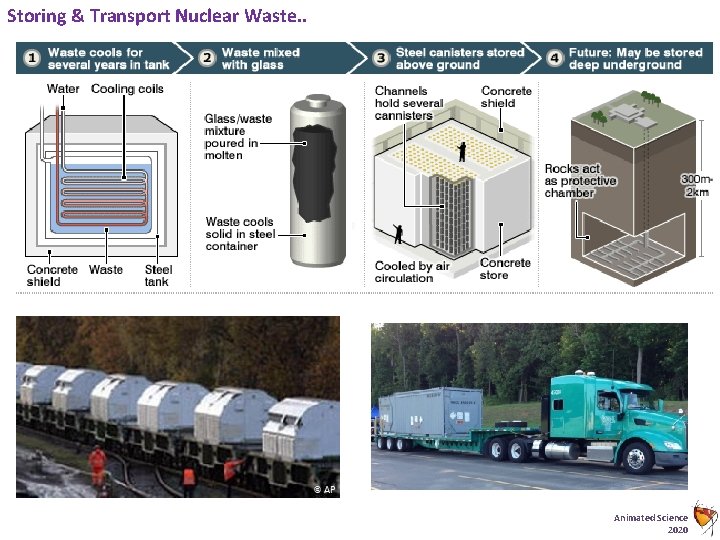
Storing & Transport Nuclear Waste. . Animated Science 2020
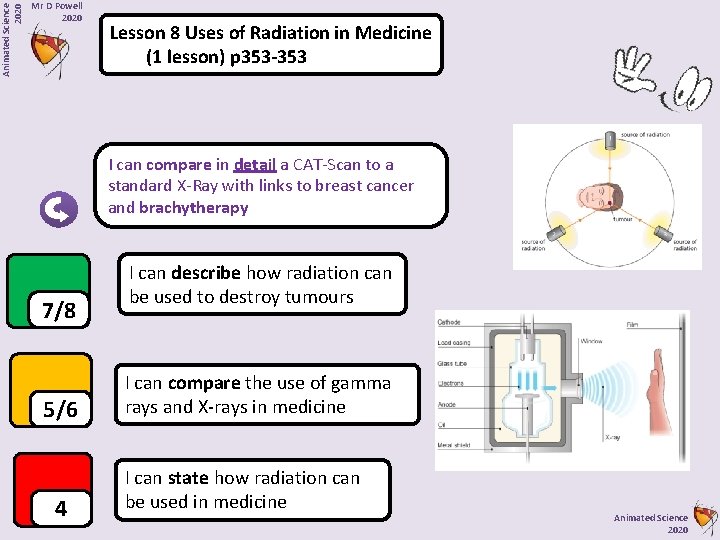
Animated Science 2020 Mr D Powell 2020 Lesson 8 Uses of Radiation in Medicine (1 lesson) p 353 -353 I can compare in detail a CAT-Scan to a standard X-Ray with links to breast cancer and brachytherapy 7/8 5/6 4 I can describe how radiation can be used to destroy tumours I can compare the use of gamma rays and X-rays in medicine I can state how radiation can be used in medicine Animated Science 2020
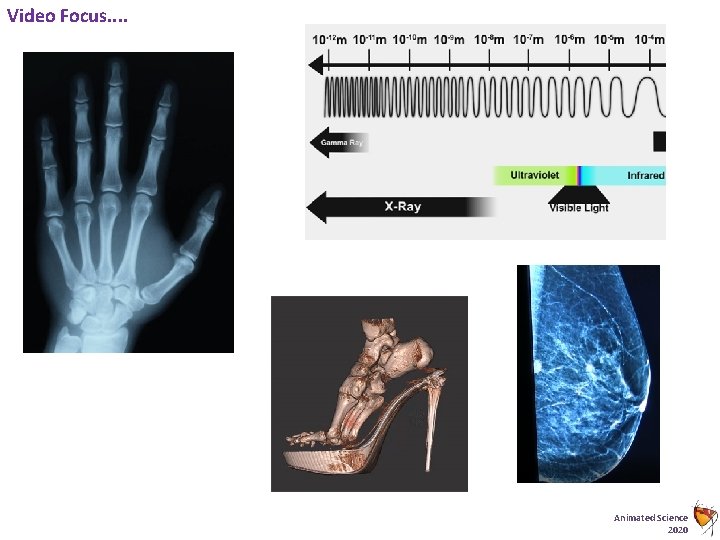
Video Focus. . Animated Science 2020
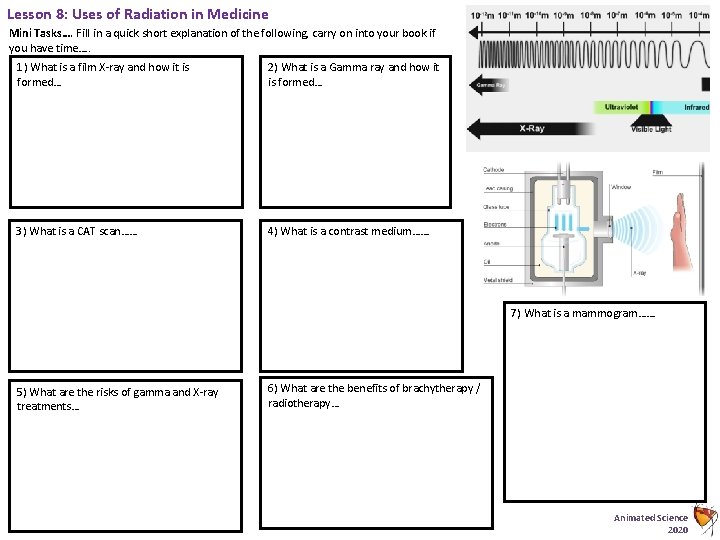
Lesson 8: Uses of Radiation in Medicine Mini Tasks…. Fill in a quick short explanation of the following, carry on into your book if you have time…. . 1) What is a film X-ray and how it is formed… 2) What is a Gamma ray and how it is formed… 3) What is a CAT scan…… 4) What is a contrast medium……. 7) What is a mammogram……. 5) What are the risks of gamma and X-ray treatments… 6) What are the benefits of brachytherapy / radiotherapy… Animated Science 2020
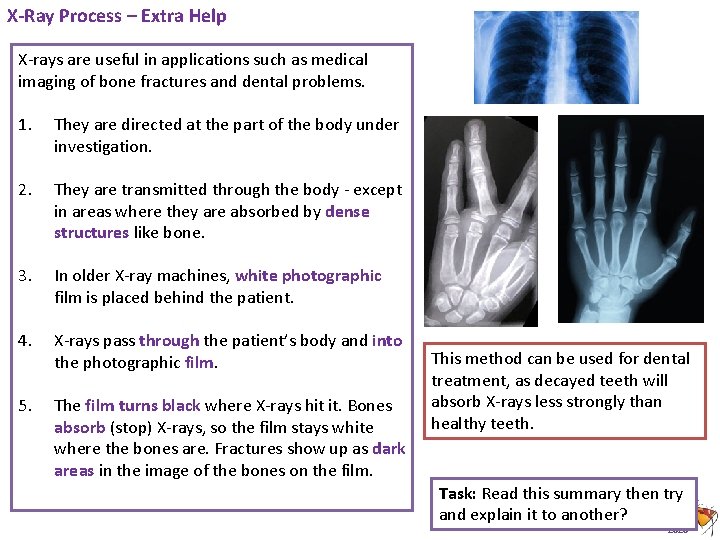
X-Ray Process – Extra Help X-rays are useful in applications such as medical imaging of bone fractures and dental problems. 1. They are directed at the part of the body under investigation. 2. They are transmitted through the body - except in areas where they are absorbed by dense structures like bone. 3. In older X-ray machines, white photographic film is placed behind the patient. 4. X-rays pass through the patient’s body and into the photographic film. 5. The film turns black where X-rays hit it. Bones absorb (stop) X-rays, so the film stays white where the bones are. Fractures show up as dark areas in the image of the bones on the film. This method can be used for dental treatment, as decayed teeth will absorb X-rays less strongly than healthy teeth. Task: Read this summary then try and explain it to another? Animated Science 2020
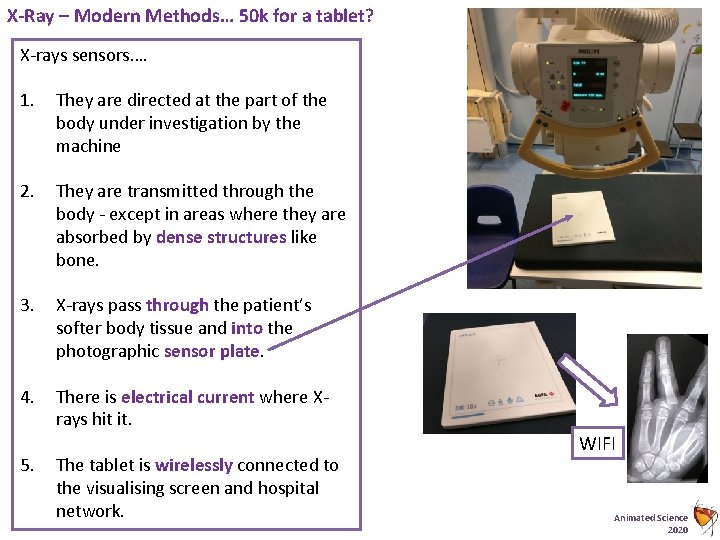
X-Ray – Modern Methods… 50 k for a tablet? X-rays sensors…. 1. They are directed at the part of the body under investigation by the machine 2. They are transmitted through the body - except in areas where they are absorbed by dense structures like bone. 3. X-rays pass through the patient’s softer body tissue and into the photographic sensor plate. 4. There is electrical current where Xrays hit it. 5. The tablet is wirelessly connected to the visualising screen and hospital network. WIFI Animated Science 2020
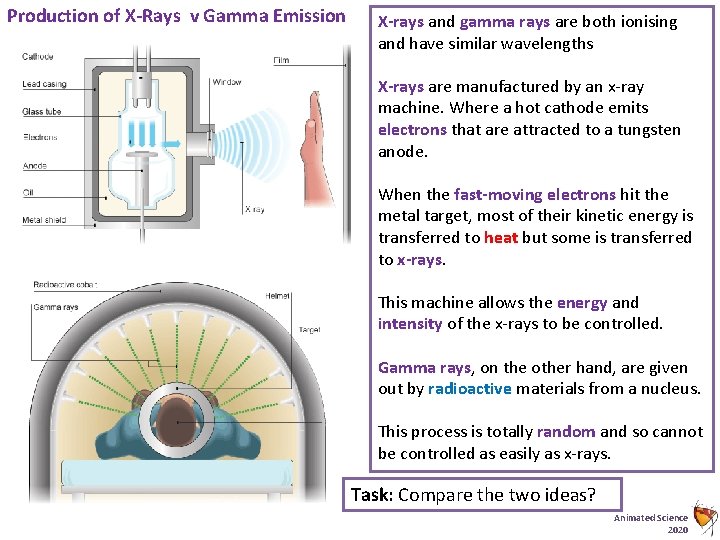
Production of X-Rays v Gamma Emission X-rays and gamma rays are both ionising and have similar wavelengths X-rays are manufactured by an x-ray machine. Where a hot cathode emits electrons that are attracted to a tungsten anode. When the fast-moving electrons hit the metal target, most of their kinetic energy is transferred to heat but some is transferred to x-rays. This machine allows the energy and intensity of the x-rays to be controlled. Gamma rays, on the other hand, are given out by radioactive materials from a nucleus. This process is totally random and so cannot be controlled as easily as x-rays. Task: Compare the two ideas? Animated Science 2020
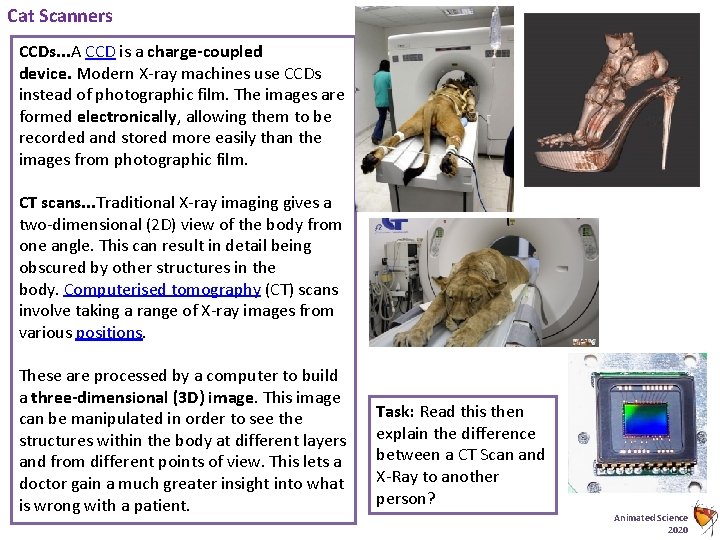
Cat Scanners CCDs. . . A CCD is a charge-coupled device. Modern X-ray machines use CCDs instead of photographic film. The images are formed electronically, allowing them to be recorded and stored more easily than the images from photographic film. CT scans. . . Traditional X-ray imaging gives a two-dimensional (2 D) view of the body from one angle. This can result in detail being obscured by other structures in the body. Computerised tomography (CT) scans involve taking a range of X-ray images from various positions. These are processed by a computer to build a three-dimensional (3 D) image. This image can be manipulated in order to see the structures within the body at different layers and from different points of view. This lets a doctor gain a much greater insight into what is wrong with a patient. Task: Read this then explain the difference between a CT Scan and X-Ray to another person? Animated Science 2020
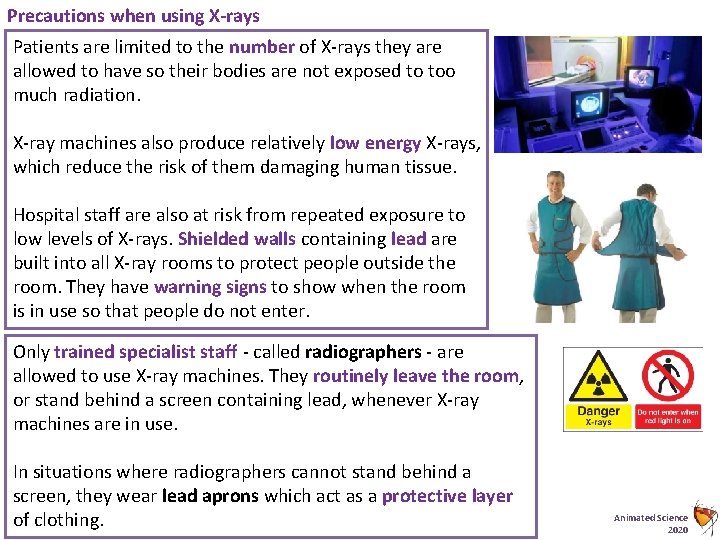
Precautions when using X-rays Patients are limited to the number of X-rays they are allowed to have so their bodies are not exposed to too much radiation. X-ray machines also produce relatively low energy X-rays, which reduce the risk of them damaging human tissue. Hospital staff are also at risk from repeated exposure to low levels of X-rays. Shielded walls containing lead are built into all X-ray rooms to protect people outside the room. They have warning signs to show when the room is in use so that people do not enter. Only trained specialist staff - called radiographers - are allowed to use X-ray machines. They routinely leave the room, or stand behind a screen containing lead, whenever X-ray machines are in use. In situations where radiographers cannot stand behind a screen, they wear lead aprons which act as a protective layer of clothing. Animated Science 2020
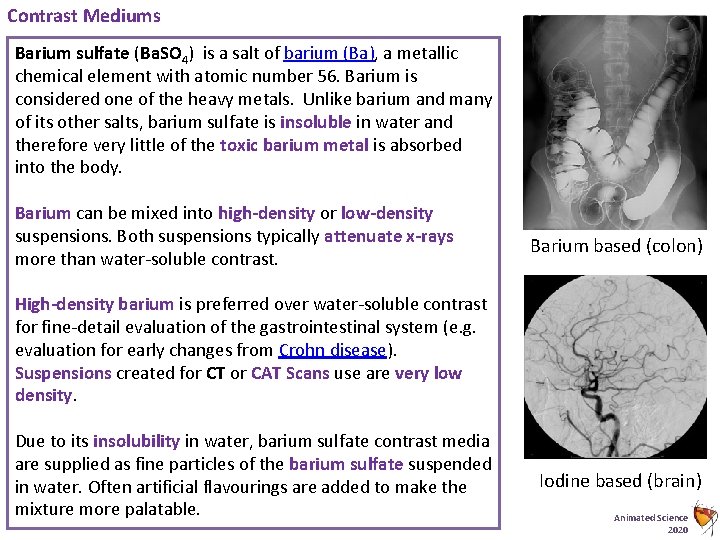
Contrast Mediums Barium sulfate (Ba. SO 4) is a salt of barium (Ba), a metallic chemical element with atomic number 56. Barium is considered one of the heavy metals. Unlike barium and many of its other salts, barium sulfate is insoluble in water and therefore very little of the toxic barium metal is absorbed into the body. Barium can be mixed into high-density or low-density suspensions. Both suspensions typically attenuate x-rays more than water-soluble contrast. Barium based (colon) High-density barium is preferred over water-soluble contrast for fine-detail evaluation of the gastrointestinal system (e. g. evaluation for early changes from Crohn disease). Suspensions created for CT or CAT Scans use are very low density. Due to its insolubility in water, barium sulfate contrast media are supplied as fine particles of the barium sulfate suspended in water. Often artificial flavourings are added to make the mixture more palatable. Iodine based (brain) Animated Science 2020
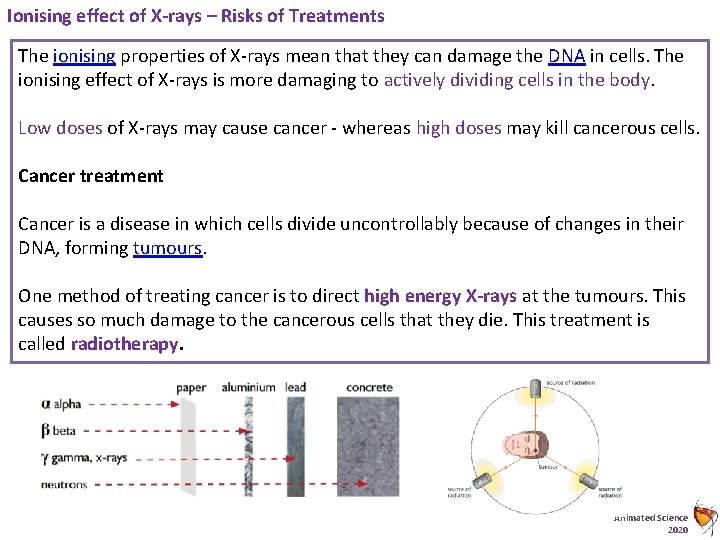
Ionising effect of X-rays – Risks of Treatments The ionising properties of X-rays mean that they can damage the DNA in cells. The ionising effect of X-rays is more damaging to actively dividing cells in the body. Low doses of X-rays may cause cancer - whereas high doses may kill cancerous cells. Cancer treatment Cancer is a disease in which cells divide uncontrollably because of changes in their DNA, forming tumours. One method of treating cancer is to direct high energy X-rays at the tumours. This causes so much damage to the cancerous cells that they die. This treatment is called radiotherapy. Animated Science 2020
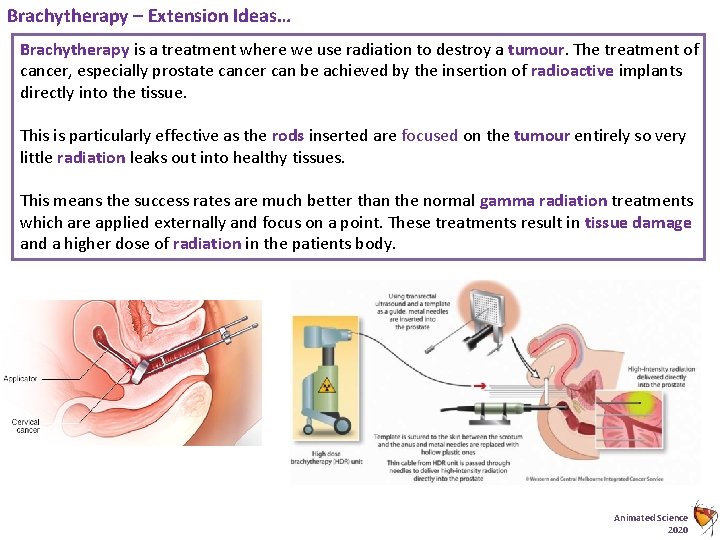
Brachytherapy – Extension Ideas… Brachytherapy is a treatment where we use radiation to destroy a tumour. The treatment of cancer, especially prostate cancer can be achieved by the insertion of radioactive implants directly into the tissue. This is particularly effective as the rods inserted are focused on the tumour entirely so very little radiation leaks out into healthy tissues. This means the success rates are much better than the normal gamma radiation treatments which are applied externally and focus on a point. These treatments result in tissue damage and a higher dose of radiation in the patients body. Animated Science 2020
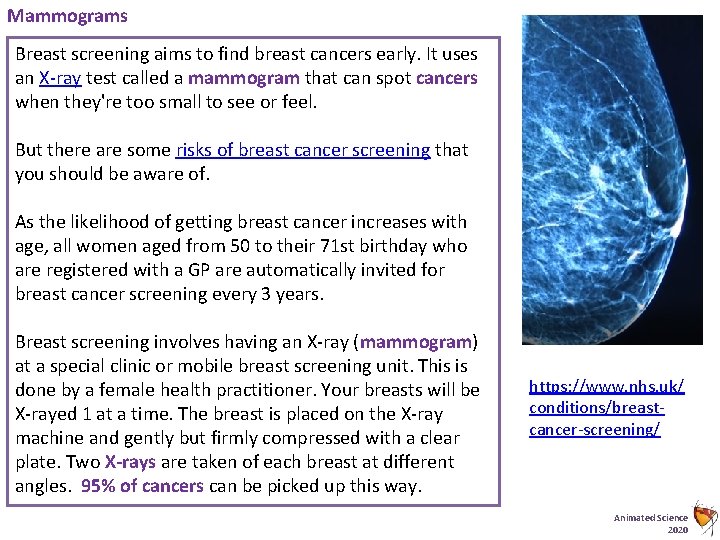
Mammograms Breast screening aims to find breast cancers early. It uses an X-ray test called a mammogram that can spot cancers when they're too small to see or feel. But there are some risks of breast cancer screening that you should be aware of. As the likelihood of getting breast cancer increases with age, all women aged from 50 to their 71 st birthday who are registered with a GP are automatically invited for breast cancer screening every 3 years. Breast screening involves having an X-ray (mammogram) at a special clinic or mobile breast screening unit. This is done by a female health practitioner. Your breasts will be X-rayed 1 at a time. The breast is placed on the X-ray machine and gently but firmly compressed with a clear plate. Two X-rays are taken of each breast at different angles. 95% of cancers can be picked up this way. https: //www. nhs. uk/ conditions/breastcancer-screening/ Animated Science 2020
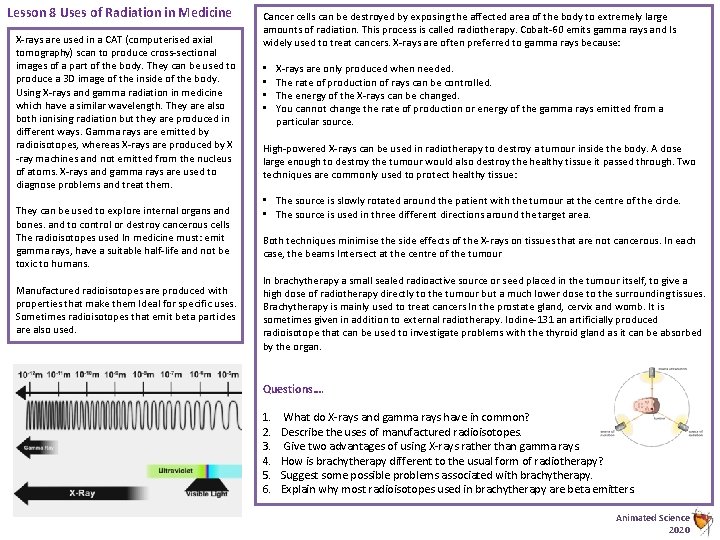
Lesson 8 Uses of Radiation in Medicine X-rays are used in a CAT (computerised axial tomography) scan to produce cross-sectional images of a part of the body. They can be used to produce a 3 D image of the inside of the body. Using X-rays and gamma radiation in medicine which have a similar wavelength. They are also both ionising radiation but they are produced in different ways. Gamma rays are emitted by radioisotopes, whereas X-rays are produced by X -ray machines and not emitted from the nucleus of atoms. X-rays and gamma rays are used to diagnose problems and treat them. They can be used to explore internal organs and bones. and to control or destroy cancerous cells The radioisotopes used In medicine must: emit gamma rays, have a suitable half-life and not be toxic to humans. Manufactured radioisotopes are produced with properties that make them Ideal for specific uses. Sometimes radioisotopes that emit beta particles are also used. Cancer cells can be destroyed by exposing the affected area of the body to extremely large amounts of radiation. This process is called radiotherapy. Cobalt-60 emits gamma rays and Is widely used to treat cancers. X-rays are often preferred to gamma rays because: • • X-rays are only produced when needed. The rate of production of rays can be controlled. The energy of the X-rays can be changed. You cannot change the rate of production or energy of the gamma rays emitted from a particular source. High-powered X-rays can be used in radiotherapy to destroy a tumour inside the body. A dose large enough to destroy the tumour would also destroy the healthy tissue it passed through. Two techniques are commonly used to protect healthy tissue: • The source is slowly rotated around the patient with the tumour at the centre of the circle. • The source is used in three different directions around the target area. Both techniques minimise the side effects of the X-rays on tissues that are not cancerous. In each case, the beams Intersect at the centre of the tumour In brachytherapy a small sealed radioactive source or seed placed in the tumour itself, to give a high dose of radiotherapy directly to the tumour but a much lower dose to the surrounding tissues. Brachytherapy is mainly used to treat cancers In the prostate gland, cervix and womb. It is sometimes given in addition to external radiotherapy. Iodine-131 an artificially produced radioisotope that can be used to investigate problems with the thyroid gland as it can be absorbed by the organ. Questions…. 1. 2. 3. 4. 5. 6. What do X-rays and gamma rays have in common? Describe the uses of manufactured radioisotopes. Give two advantages of using X-rays rather than gamma rays. How is brachytherapy different to the usual form of radiotherapy? Suggest some possible problems associated with brachytherapy. Explain why most radioisotopes used in brachytherapy are beta emitters. Animated Science 2020

Lesson 8 Uses of Radiation in Medicine – Answers…. . 1 They are both types of electromagnetic waves. 2 Many manufactured radioisotopes are used in medicine. Some of these are used to destroy cancerous cells from the radiation they produce; others are used as tracers to help diagnose problems with a patient in order to treat them. 3 X-rays are only produced when needed. You can control the energy of the x-rays that you produce. 4 Bracytherapy uses the radioactive source right next to (or inside) the tumour rather than the radiation coming from outside the body. 5 You need to make sure that you can extract all of the radioactive source so you don’t contaminate the patient. Placing the radioactive source near the tumour might need invasive surgery which can lead to problems with infection. 6 Alpha particles wouldn’t penetrate very far into the tumour (and probably wouldn’t even be able to leave the protective casing). Many gamma rays would pass through the tumour so there would be a large dose applied to tissue outside of the tumour. Beta particles would penetrate into the tumour and deposit most of their energy within the tumour. Therefore, the tumour would get the biggest dose with a beta emitter. Animated Science 2020
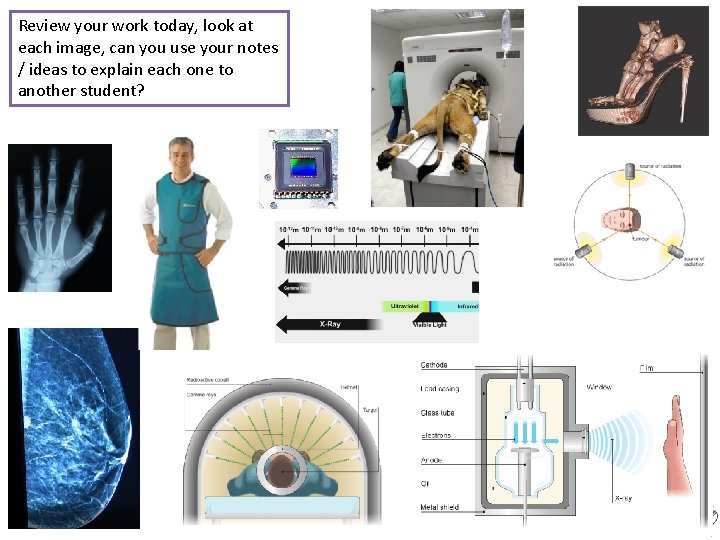
Review your work today, look at each image, can you use your notes / ideas to explain each one to another student? Animated Science 2020
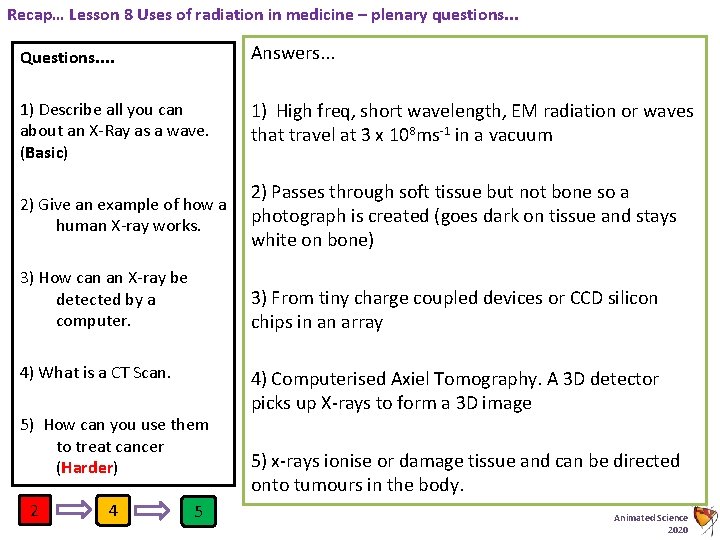
Recap… Lesson 8 Uses of radiation in medicine – plenary questions. . . Questions. . Answers. . . 1) Describe all you can about an X-Ray as a wave. (Basic) 1) High freq, short wavelength, EM radiation or waves that travel at 3 x 10⁸ ms-1 in a vacuum 2) Give an example of how a human X-ray works. 2) Passes through soft tissue but not bone so a photograph is created (goes dark on tissue and stays white on bone) 3) How can an X-ray be detected by a computer. 3) From tiny charge coupled devices or CCD silicon chips in an array 4) What is a CT Scan. 5) How can you use them to treat cancer (Harder) 2 4 5 4) Computerised Axiel Tomography. A 3 D detector picks up X-rays to form a 3 D image 5) x-rays ionise or damage tissue and can be directed onto tumours in the body. Animated Science 2020
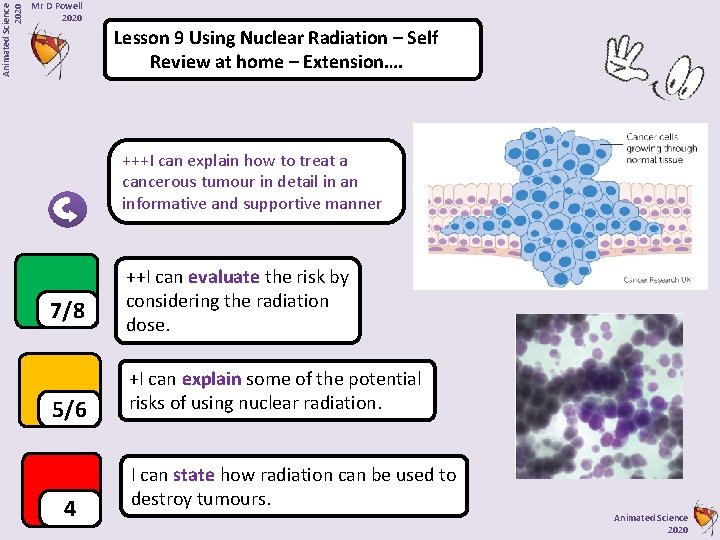
Animated Science 2020 Mr D Powell 2020 Lesson 9 Using Nuclear Radiation – Self Review at home – Extension…. +++I can explain how to treat a cancerous tumour in detail in an informative and supportive manner 7/8 5/6 4 ++I can evaluate the risk by considering the radiation dose. +I can explain some of the potential risks of using nuclear radiation. I can state how radiation can be used to destroy tumours. Animated Science 2020
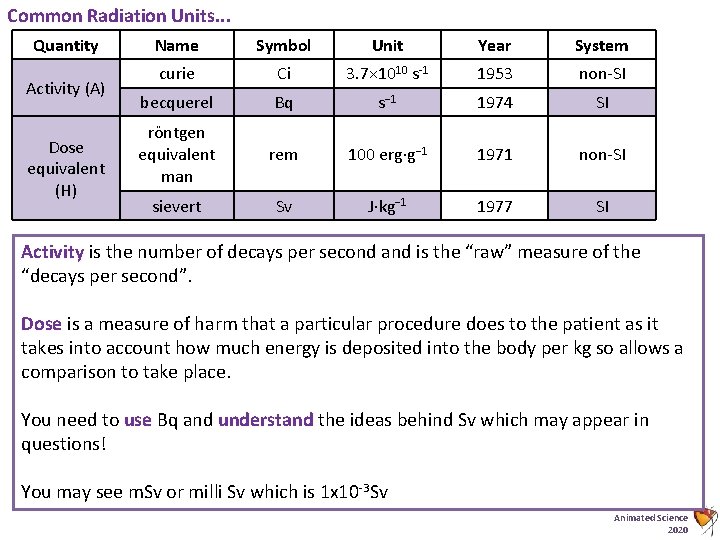
Common Radiation Units. . . Quantity Activity (A) Dose equivalent (H) Name Symbol Unit Year System curie Ci 3. 7× 10¹⁰ s-1 1953 non-SI becquerel Bq s− 1 1974 SI röntgen equivalent man rem 100 erg·g− 1 1971 non-SI sievert Sv J·kg− 1 1977 SI Activity is the number of decays per second and is the “raw” measure of the “decays per second”. Dose is a measure of harm that a particular procedure does to the patient as it takes into account how much energy is deposited into the body per kg so allows a comparison to take place. You need to use Bq and understand the ideas behind Sv which may appear in questions! You may see m. Sv or milli Sv which is 1 x 10 -3 Sv Animated Science 2020
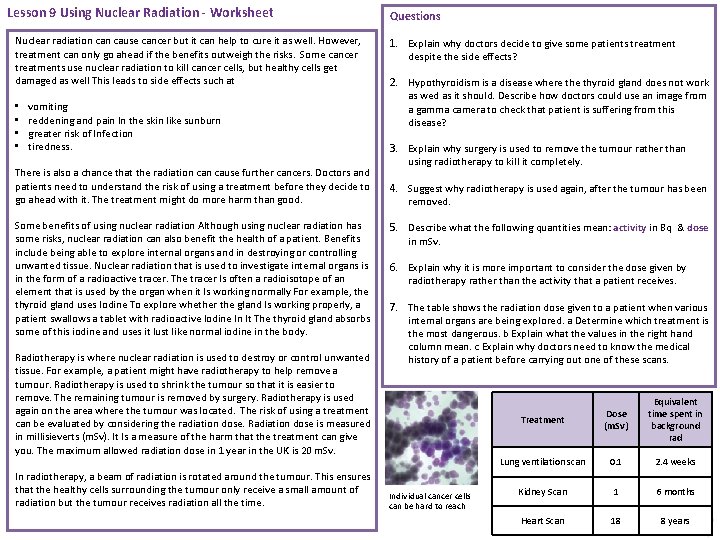
Lesson 9 Using Nuclear Radiation - Worksheet Nuclear radiation cause cancer but it can help to cure it as well. However, treatment can only go ahead if the benefits outweigh the risks. Some cancer treatments use nuclear radiation to kill cancer cells, but healthy cells get damaged as well This leads to side effects such at • • vomiting reddening and pain In the skin like sunburn greater risk of Infection tiredness. There is also a chance that the radiation cause further cancers. Doctors and patients need to understand the risk of using a treatment before they decide to go ahead with it. The treatment might do more harm than good. Some benefits of using nuclear radiation Although using nuclear radiation has some risks, nuclear radiation can also benefit the health of a patient. Benefits include being able to explore internal organs and in destroying or controlling unwanted tissue. Nuclear radiation that is used to investigate internal organs is in the form of a radioactive tracer. The tracer Is often a radioisotope of an element that is used by the organ when it Is working normally For example, the thyroid gland uses Iodine To explore whether the gland Is working properly, a patient swallows a tablet with radioactive Iodine In It The thyroid gland absorbs some of this iodine and uses it lust like normal iodine in the body. Radiotherapy is where nuclear radiation is used to destroy or control unwanted tissue. For example, a patient might have radiotherapy to help remove a tumour. Radiotherapy is used to shrink the tumour so that it is easier to remove. The remaining tumour is removed by surgery. Radiotherapy is used again on the area where the tumour was located. The risk of using a treatment can be evaluated by considering the radiation dose. Radiation dose is measured in millisieverts (m. Sv). It Is a measure of the harm that the treatment can give you. The maximum allowed radiation dose in 1 year in the UK is 20 m. Sv. In radiotherapy, a beam of radiation is rotated around the tumour. This ensures that the healthy cells surrounding the tumour only receive a small amount of radiation but the tumour receives radiation all the time. Questions 1. Explain why doctors decide to give some patients treatment despite the side effects? 2. Hypothyroidism is a disease where thyroid gland does not work as wed as it should. Describe how doctors could use an image from a gamma camera to check that patient is suffering from this disease? 3. Explain why surgery is used to remove the tumour rather than using radiotherapy to kill it completely. 4. Suggest why radiotherapy is used again, after the tumour has been removed. 5. Describe what the following quantities mean: activity in Bq & dose in m. Sv. 6. Explain why it is more important to consider the dose given by radiotherapy rather than the activity that a patient receives. 7. The table shows the radiation dose given to a patient when various internal organs are being explored. a Determine which treatment is the most dangerous. b Explain what the values in the right hand column mean. c Explain why doctors need to know the medical history of a patient before carrying out one of these scans. Individual cancer cells can be hard to reach Treatment Dose (m. Sv) Equivalent time spent in background rad Lung ventilation scan 0. 1 2. 4 weeks Kidney Scan 1 6 months Heart Scan Animated Science 18 8 years 2020
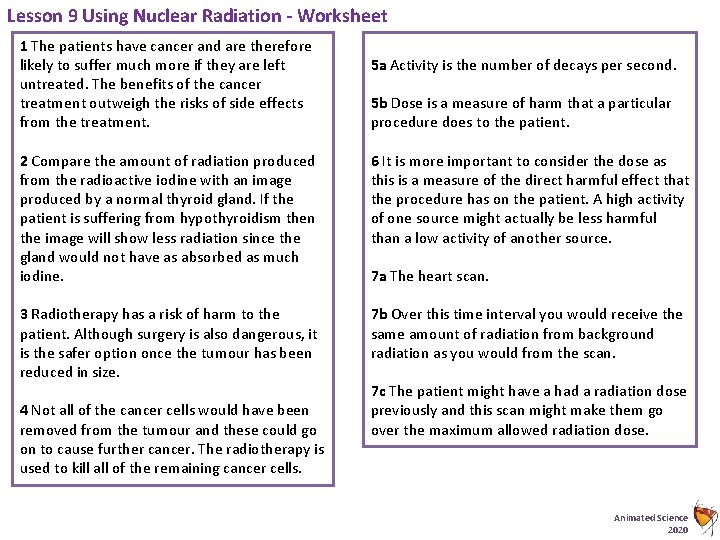
Lesson 9 Using Nuclear Radiation - Worksheet 1 The patients have cancer and are therefore likely to suffer much more if they are left untreated. The benefits of the cancer treatment outweigh the risks of side effects from the treatment. 5 a Activity is the number of decays per second. 5 b Dose is a measure of harm that a particular procedure does to the patient. 2 Compare the amount of radiation produced from the radioactive iodine with an image produced by a normal thyroid gland. If the patient is suffering from hypothyroidism then the image will show less radiation since the gland would not have as absorbed as much iodine. 6 It is more important to consider the dose as this is a measure of the direct harmful effect that the procedure has on the patient. A high activity of one source might actually be less harmful than a low activity of another source. 3 Radiotherapy has a risk of harm to the patient. Although surgery is also dangerous, it is the safer option once the tumour has been reduced in size. 7 b Over this time interval you would receive the same amount of radiation from background radiation as you would from the scan. 4 Not all of the cancer cells would have been removed from the tumour and these could go on to cause further cancer. The radiotherapy is used to kill all of the remaining cancer cells. 7 a The heart scan. 7 c The patient might have a had a radiation dose previously and this scan might make them go over the maximum allowed radiation dose. Animated Science 2020
- Slides: 47