
7 A and 7 B Events Involving Not
§ 7. A and § 7. B – Events Involving “Not” and “Or” and Odds
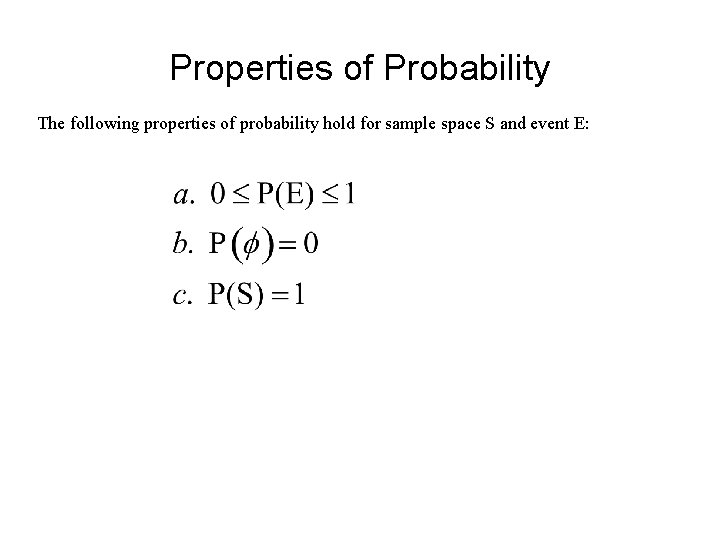
Properties of Probability The following properties of probability hold for sample space S and event E:
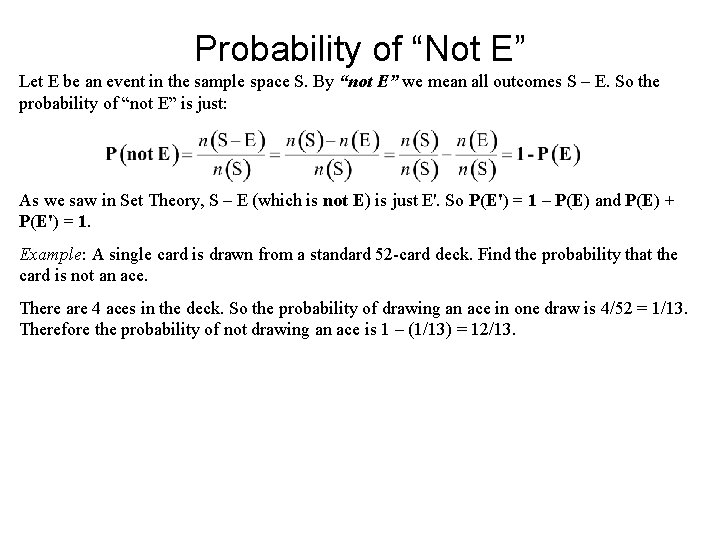
Probability of “Not E” Let E be an event in the sample space S. By “not E” we mean all outcomes S – E. So the probability of “not E” is just: As we saw in Set Theory, S – E (which is not E) is just E'. So P(E') = 1 – P(E) and P(E) + P(E') = 1. Example: A single card is drawn from a standard 52 -card deck. Find the probability that the card is not an ace. There are 4 aces in the deck. So the probability of drawing an ace in one draw is 4/52 = 1/13. Therefore the probability of not drawing an ace is 1 – (1/13) = 12/13.
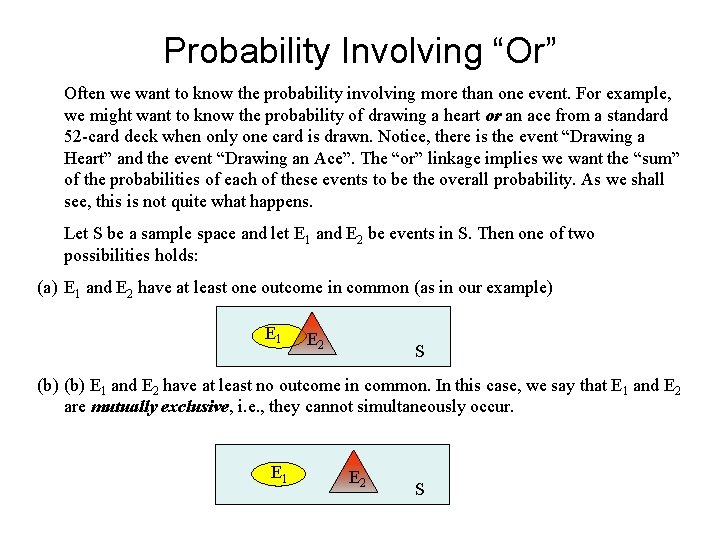
Probability Involving “Or” Often we want to know the probability involving more than one event. For example, we might want to know the probability of drawing a heart or an ace from a standard 52 -card deck when only one card is drawn. Notice, there is the event “Drawing a Heart” and the event “Drawing an Ace”. The “or” linkage implies we want the “sum” of the probabilities of each of these events to be the overall probability. As we shall see, this is not quite what happens. Let S be a sample space and let E 1 and E 2 be events in S. Then one of two possibilities holds: (a) E 1 and E 2 have at least one outcome in common (as in our example) E 1 E 2 S (b) E 1 and E 2 have at least no outcome in common. In this case, we say that E 1 and E 2 are mutually exclusive, i. e. , they cannot simultaneously occur. E 1 E 2 S
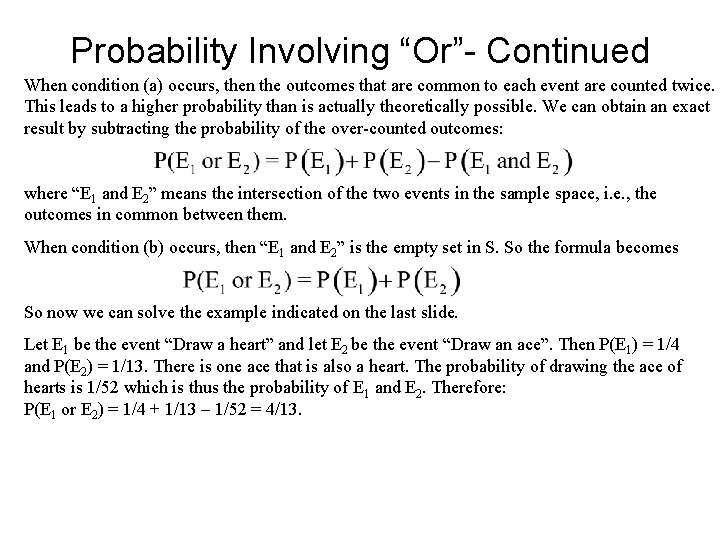
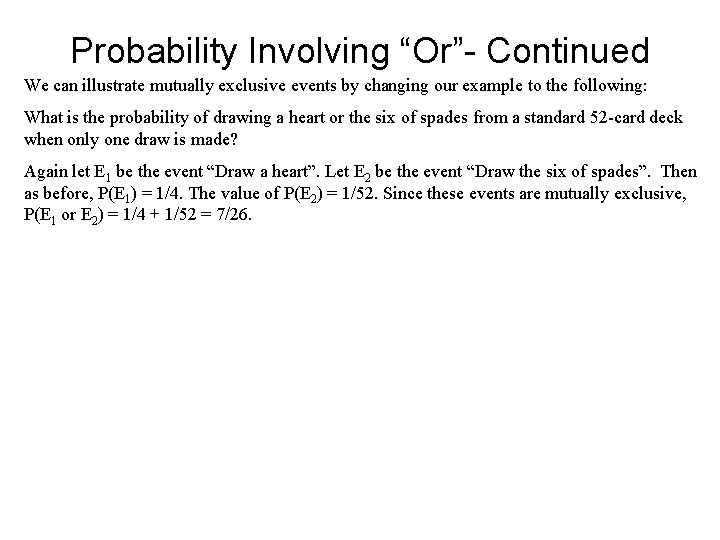
Probability Involving “Or”- Continued When condition (a) occurs, then the outcomes that are common to each event are counted twice. This leads to a higher probability than is actually theoretically possible. We can obtain an exact result by subtracting the probability of the over-counted outcomes: where “E 1 and E 2” means the intersection of the two events in the sample space, i. e. , the outcomes in common between them. When condition (b) occurs, then “E 1 and E 2” is the empty set in S. So the formula becomes So now we can solve the example indicated on the last slide. Let E 1 be the event “Draw a heart” and let E 2 be the event “Draw an ace”. Then P(E 1) = 1/4 and P(E 2) = 1/13. There is one ace that is also a heart. The probability of drawing the ace of hearts is 1/52 which is thus the probability of E 1 and E 2. Therefore: P(E 1 or E 2) = 1/4 + 1/13 – 1/52 = 4/13.
Probability Involving “Or”- Continued We can illustrate mutually exclusive events by changing our example to the following: What is the probability of drawing a heart or the six of spades from a standard 52 -card deck when only one draw is made? Again let E 1 be the event “Draw a heart”. Let E 2 be the event “Draw the six of spades”. Then as before, P(E 1) = 1/4. The value of P(E 2) = 1/52. Since these events are mutually exclusive, P(E 1 or E 2) = 1/4 + 1/52 = 7/26.
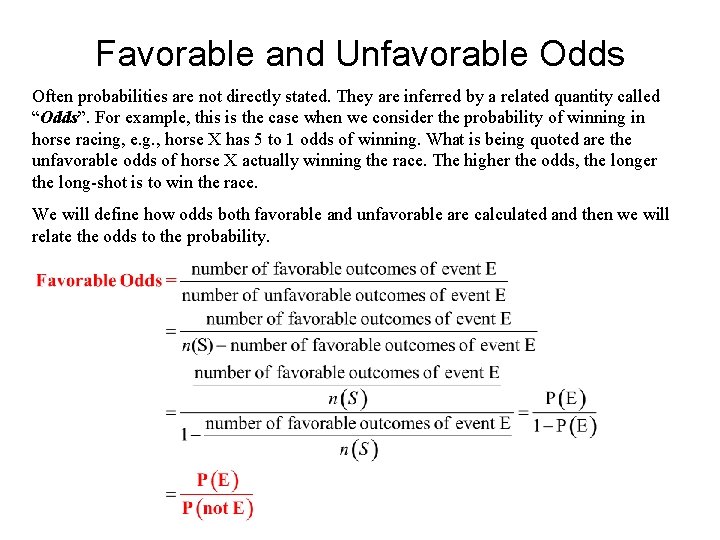
Favorable and Unfavorable Odds Often probabilities are not directly stated. They are inferred by a related quantity called “Odds”. For example, this is the case when we consider the probability of winning in horse racing, e. g. , horse X has 5 to 1 odds of winning. What is being quoted are the unfavorable odds of horse X actually winning the race. The higher the odds, the longer the long-shot is to win the race. We will define how odds both favorable and unfavorable are calculated and then we will relate the odds to the probability.
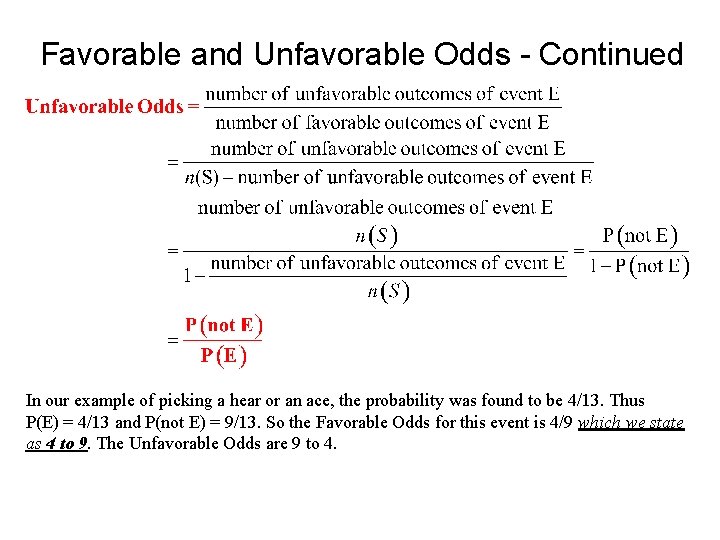
Favorable and Unfavorable Odds - Continued In our example of picking a hear or an ace, the probability was found to be 4/13. Thus P(E) = 4/13 and P(not E) = 9/13. So the Favorable Odds for this event is 4/9 which we state as 4 to 9. The Unfavorable Odds are 9 to 4.
- Slides: 8