
7 5 Solutions of Linear Systems Existence Uniqueness
- Slides: 15
7. 5 Solutions of Linear Systems: Existence, Uniqueness Section 7. 5 p 1
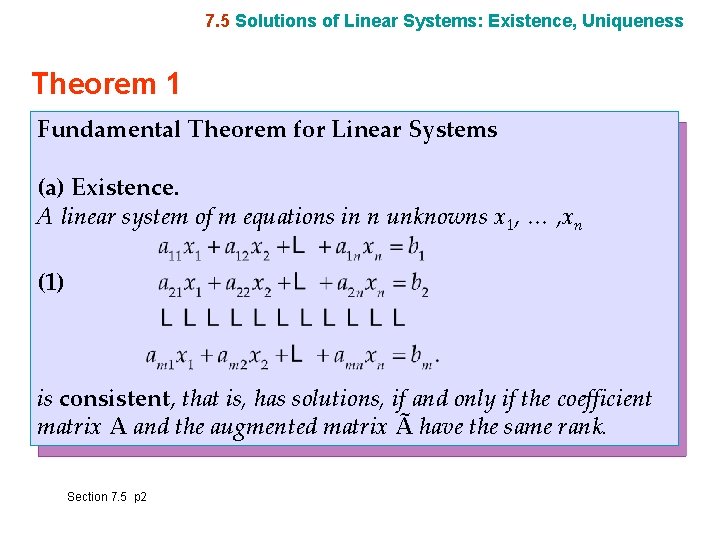
7. 5 Solutions of Linear Systems: Existence, Uniqueness Theorem 1 Fundamental Theorem for Linear Systems (a) Existence. A linear system of m equations in n unknowns x 1, … , xn (1) is consistent, that is, has solutions, if and only if the coefficient matrix A and the augmented matrix à have the same rank. Section 7. 5 p 2
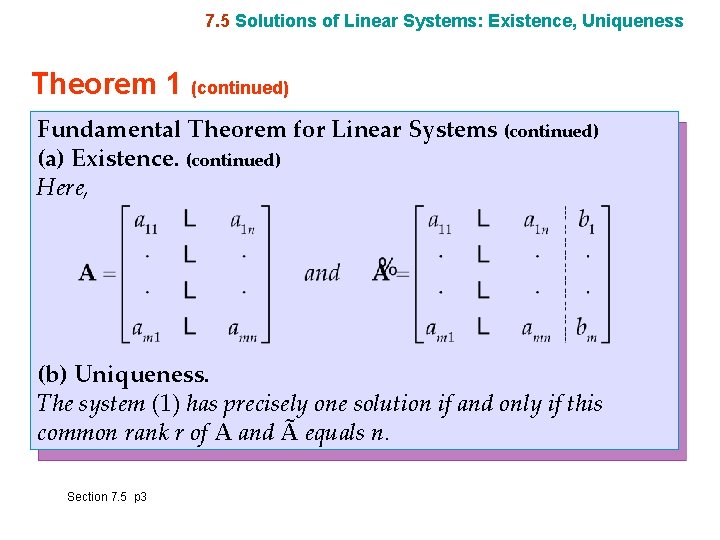
7. 5 Solutions of Linear Systems: Existence, Uniqueness Theorem 1 (continued) Fundamental Theorem for Linear Systems (continued) (a) Existence. (continued) Here, (b) Uniqueness. The system (1) has precisely one solution if and only if this common rank r of A and à equals n. Section 7. 5 p 3
7. 5 Solutions of Linear Systems: Existence, Uniqueness Theorem 1 (continued) Fundamental Theorem for Linear Systems (continued) (c) Infinitely many solutions. If this common rank r is less than n, the system (1) has infinitely many solutions. All of these solutions are obtained by determining r suitable unknowns (whose submatrix of coefficients must have rank r) in terms of the remaining n − r unknowns, to which arbitrary values can be assigned. (See Example 3 in Sec. 7. 3. ) (d) Gauss elimination (Sec. 7. 3). If solutions exist, they can all be obtained by the Gauss elimination. (This method will automatically reveal whether or not solutions exist; see Sec. 7. 3. ) Section 7. 5 p 4
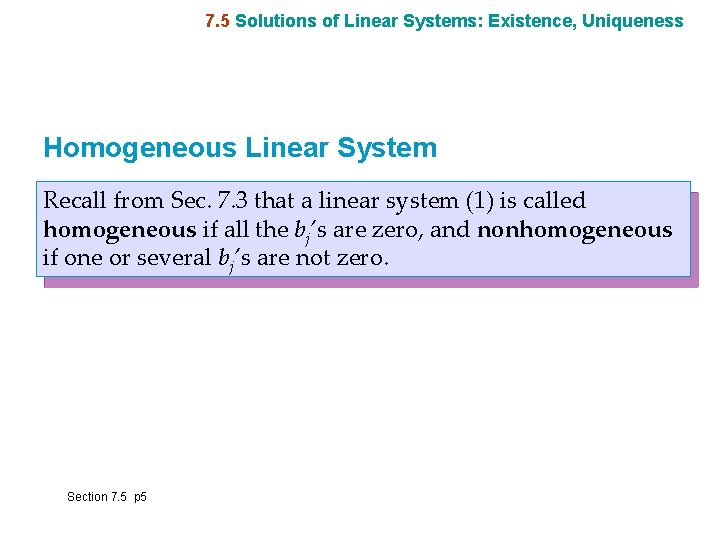
7. 5 Solutions of Linear Systems: Existence, Uniqueness Homogeneous Linear System Recall from Sec. 7. 3 that a linear system (1) is called homogeneous if all the bj’s are zero, and nonhomogeneous if one or several bj’s are not zero. Section 7. 5 p 5
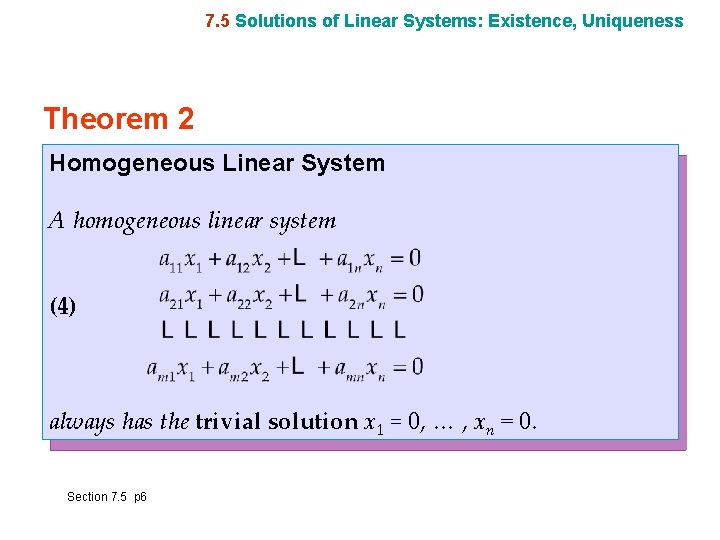
7. 5 Solutions of Linear Systems: Existence, Uniqueness Theorem 2 Homogeneous Linear System A homogeneous linear system (4) always has the trivial solution x 1 = 0, … , xn = 0. Section 7. 5 p 6
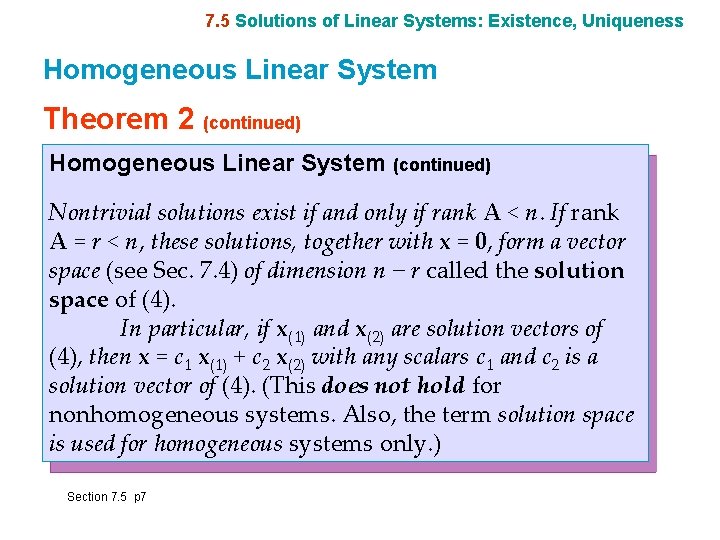
7. 5 Solutions of Linear Systems: Existence, Uniqueness Homogeneous Linear System Theorem 2 (continued) Homogeneous Linear System (continued) Nontrivial solutions exist if and only if rank A < n. If rank A = r < n, these solutions, together with x = 0, form a vector space (see Sec. 7. 4) of dimension n − r called the solution space of (4). In particular, if x(1) and x(2) are solution vectors of (4), then x = c 1 x(1) + c 2 x(2) with any scalars c 1 and c 2 is a solution vector of (4). (This does not hold for nonhomogeneous systems. Also, the term solution space is used for homogeneous systems only. ) Section 7. 5 p 7
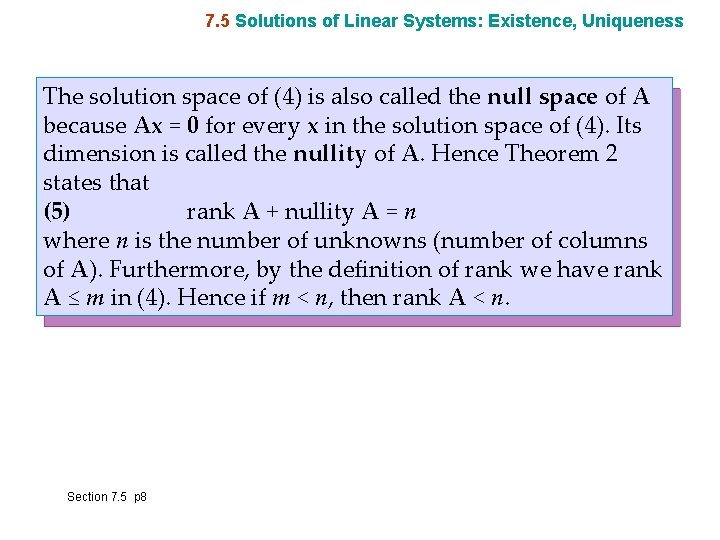
7. 5 Solutions of Linear Systems: Existence, Uniqueness The solution space of (4) is also called the null space of A because Ax = 0 for every x in the solution space of (4). Its dimension is called the nullity of A. Hence Theorem 2 states that (5) rank A + nullity A = n where n is the number of unknowns (number of columns of A). Furthermore, by the definition of rank we have rank A ≤ m in (4). Hence if m < n, then rank A < n. Section 7. 5 p 8
7. 5 Solutions of Linear Systems: Existence, Uniqueness Theorem 3 Homogeneous Linear System with Fewer Equations Than Unknowns A homogeneous linear system with fewer equations than unknowns always has nontrivial solutions. Section 7. 5 p 9
7. 5 Solutions of Linear Systems: Existence, Uniqueness Nonhomogeneous Linear System Theorem 4 Nonhomogeneous Linear System If a nonhomogeneous linear system (1) is consistent, then all of its solutions are obtained as (6) x = x 0 + xh where x 0 is any (fixed) solution of (1) and xh runs through all the solutions of the corresponding homogeneous system (4). Section 7. 5 p 10
7. 6 For Reference: Second- and Third-Order Determinants Section 7. 6 p 11
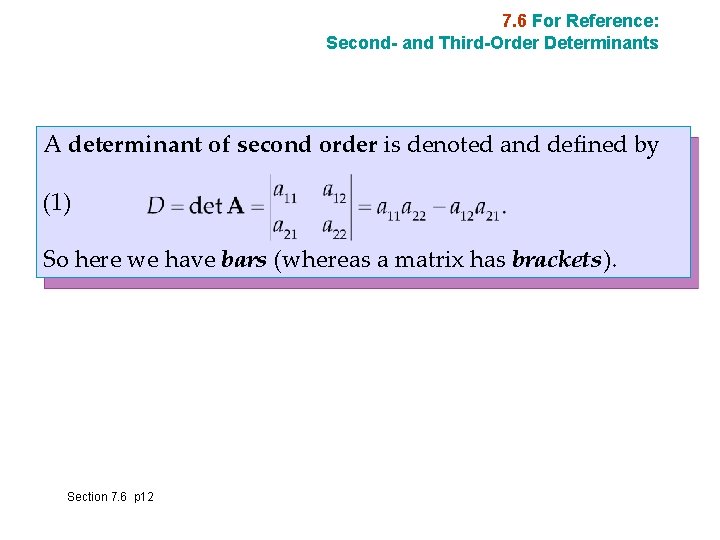
7. 6 For Reference: Second- and Third-Order Determinants A determinant of second order is denoted and defined by (1) So here we have bars (whereas a matrix has brackets). Section 7. 6 p 12
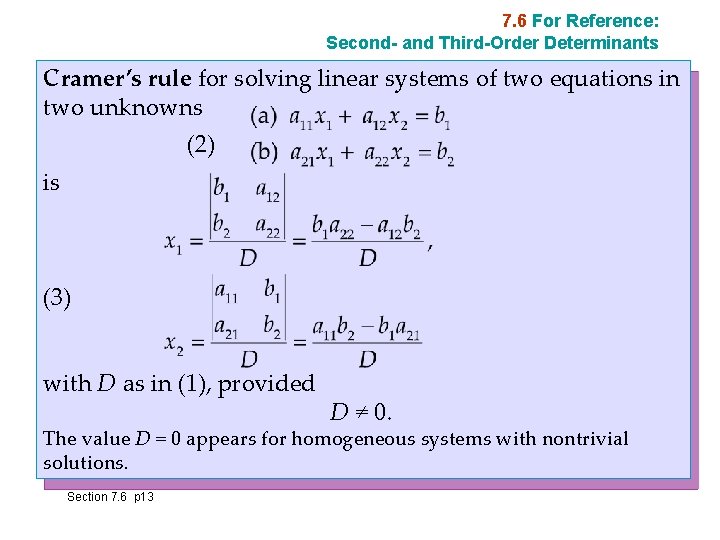
7. 6 For Reference: Second- and Third-Order Determinants Cramer’s rule for solving linear systems of two equations in two unknowns (2) is (3) with D as in (1), provided D ≠ 0. The value D = 0 appears for homogeneous systems with nontrivial solutions. Section 7. 6 p 13
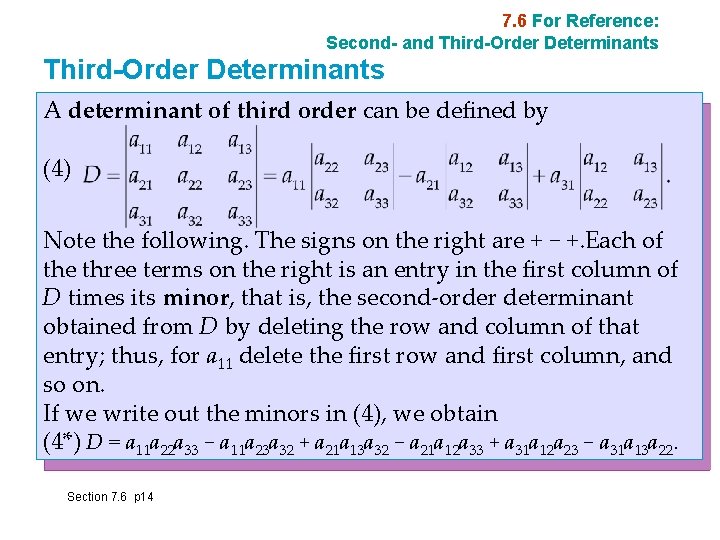
7. 6 For Reference: Second- and Third-Order Determinants A determinant of third order can be defined by (4) Note the following. The signs on the right are + − +. Each of the three terms on the right is an entry in the first column of D times its minor, that is, the second-order determinant obtained from D by deleting the row and column of that entry; thus, for a 11 delete the first row and first column, and so on. If we write out the minors in (4), we obtain (4*) D = a 11 a 22 a 33 − a 11 a 23 a 32 + a 21 a 13 a 32 − a 21 a 12 a 33 + a 31 a 12 a 23 − a 31 a 13 a 22. Section 7. 6 p 14
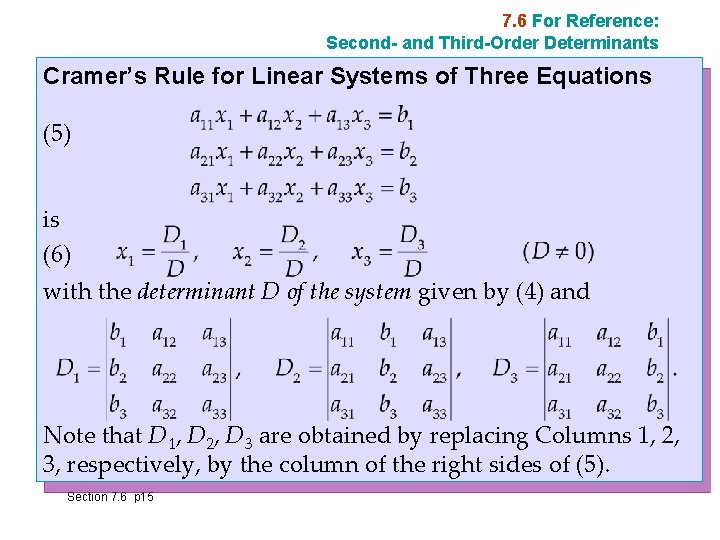
7. 6 For Reference: Second- and Third-Order Determinants Cramer’s Rule for Linear Systems of Three Equations (5) is (6) with the determinant D of the system given by (4) and Note that D 1, D 2, D 3 are obtained by replacing Columns 1, 2, 3, respectively, by the column of the right sides of (5). Section 7. 6 p 15