
7 5 Other Objects in the Solar System
7. 5 Other Objects in the Solar System • Comets, dwarf planets, meteoroids and asteroids are other important objects in the solar system • Objects that circle the Sun beyond the orbit of Neptune are called trans-Neptunian objects • They are located in the Kuiper Belt, which is a disc shaped group of millions of small objects orbiting the Sun • It is believed that the Kuiper Belt is composed of fragments of material left over from the formation of the solar system
Pluto • The Kuiper Belt contains the former planet Pluto • Pluto is composed of rock and ice, and has 3 moons • Pluto and similar objects are referred to as dwarf planets • The largest Kuiper Belt object is Eris, has a moon • In 2006, Pluto was demoted to dwarf planet status because its orbit sometimes crosses Neptune’s orbit
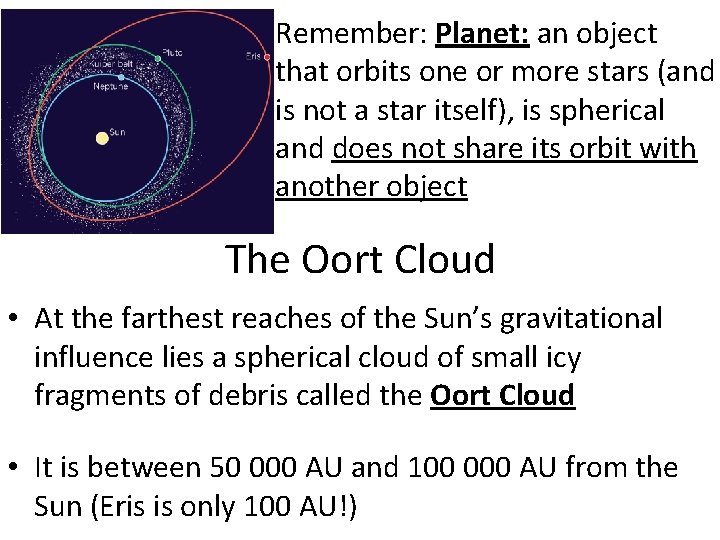
Remember: Planet: an object that orbits one or more stars (and is not a star itself), is spherical and does not share its orbit with another object The Oort Cloud • At the farthest reaches of the Sun’s gravitational influence lies a spherical cloud of small icy fragments of debris called the Oort Cloud • It is between 50 000 AU and 100 000 AU from the Sun (Eris is only 100 AU!)
Comets • Comets are composed of dust, ice and rock • Most comets originate in the Kuiper Belt and the Oort Cloud • Ever so often a comet gets close to Jupiter and Jupiter’s gravitations force will either capture the comet, or nudge the comet to change its orbit and enter the inner solar system
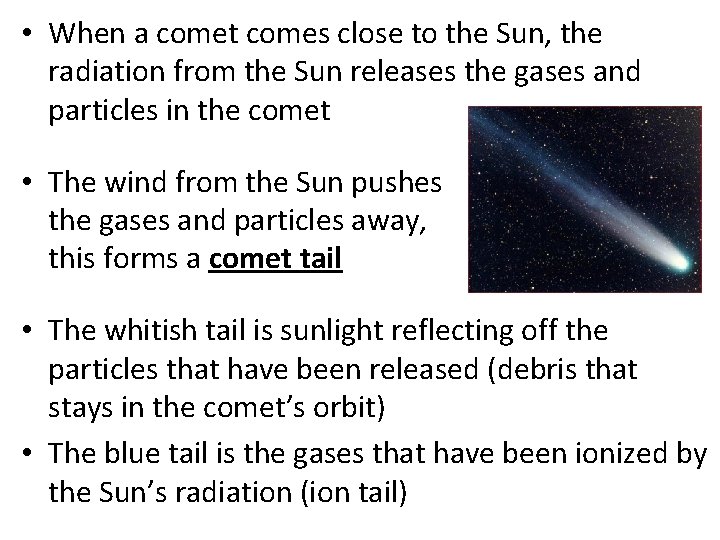
• When a comet comes close to the Sun, the radiation from the Sun releases the gases and particles in the comet • The wind from the Sun pushes the gases and particles away, this forms a comet tail • The whitish tail is sunlight reflecting off the particles that have been released (debris that stays in the comet’s orbit) • The blue tail is the gases that have been ionized by the Sun’s radiation (ion tail)
Asteroids • Asteroids are small, non-spherical objects that are believed to be debris left over from the formation of the solar system • Most asteroids orbit the Sun in a band (asteroid belt) between Mars and Jupiter • Asteroids range in size from a tiny speck to 500 km wide • Some asteroids have been promoted to dwarf planet status -one was 1000 km wide and had its own moon
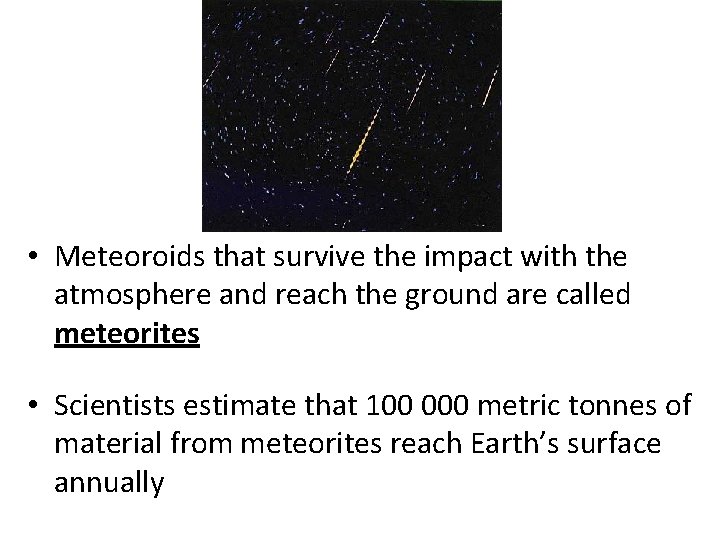
Other Objects • Meteoroids are pieces of rock moving though space - Believed to be pieces of asteroids and planets • When meteoroids collide with Earth’s atmosphere they burn up due to atmospheric friction forming meteors • When Earth passes through an area where there is a lot of excess material (such as debris from a comet) a meteor shower results - AKA “shooting stars”
• Meteoroids that survive the impact with the atmosphere and reach the ground are called meteorites • Scientists estimate that 100 000 metric tonnes of material from meteorites reach Earth’s surface annually
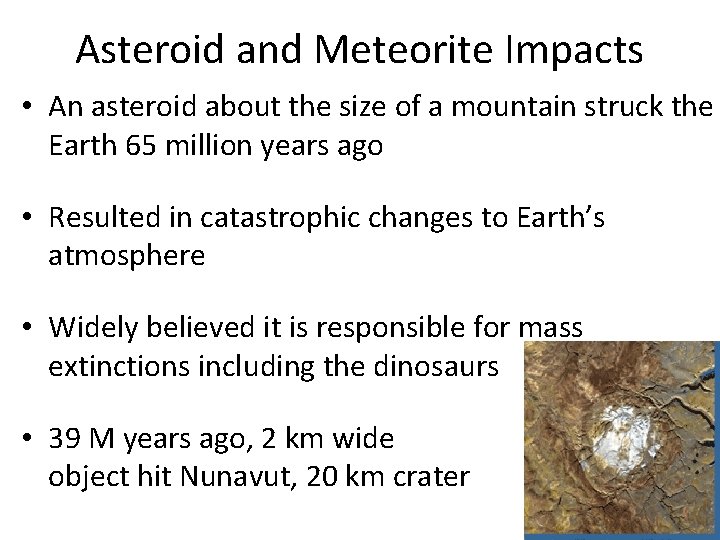
Asteroid and Meteorite Impacts • An asteroid about the size of a mountain struck the Earth 65 million years ago • Resulted in catastrophic changes to Earth’s atmosphere • Widely believed it is responsible for mass extinctions including the dinosaurs • 39 M years ago, 2 km wide object hit Nunavut, 20 km crater
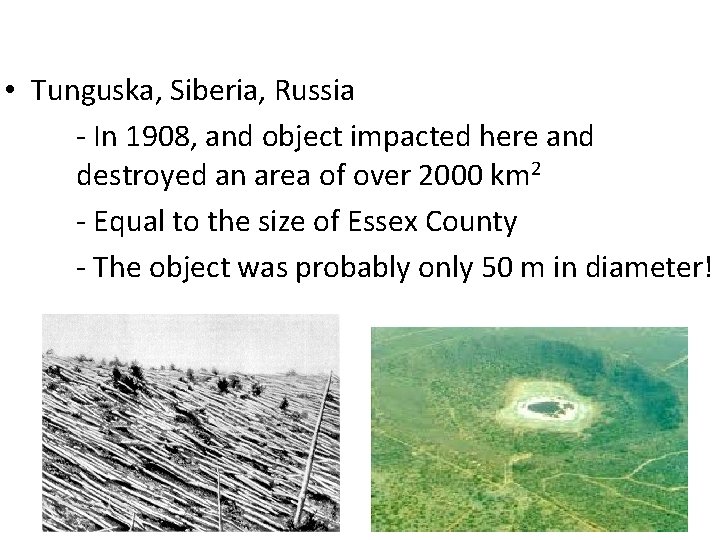
• Tunguska, Siberia, Russia - In 1908, and object impacted here and destroyed an area of over 2000 km 2 - Equal to the size of Essex County - The object was probably only 50 m in diameter!
- Slides: 10