
7 4 Meet Your Solar System The ancient
- Slides: 12
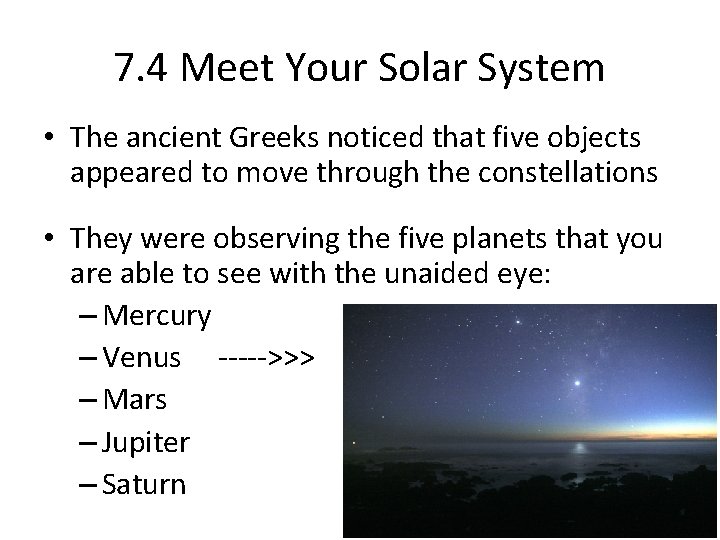
7. 4 Meet Your Solar System • The ancient Greeks noticed that five objects appeared to move through the constellations • They were observing the five planets that you are able to see with the unaided eye: – Mercury – Venus ----->>> – Mars – Jupiter – Saturn
The Planets • Planet: an object that orbits one or more stars (and is not a star itself), is spherical and does not share its orbit with another object • The planets, the Sun and other smaller objects make up the solar system • The Sun’s gravitational pull keeps the objects in the solar system in orbit around the Sun
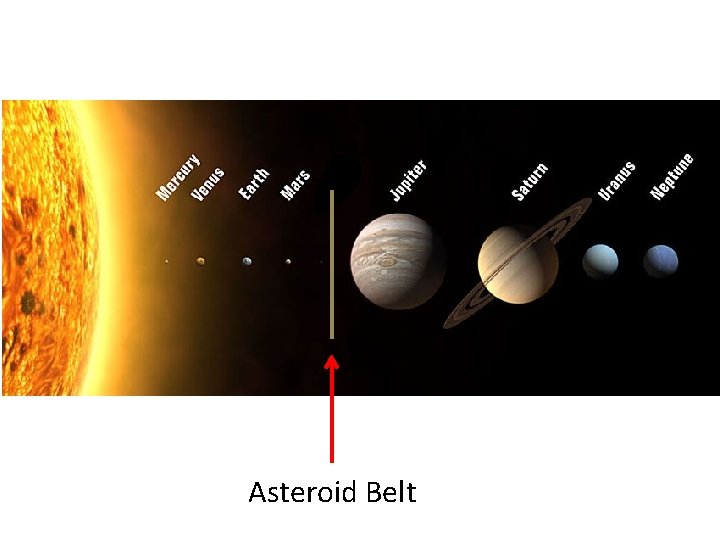
Asteroid Belt
Models of the Solar System • Geocentric Model: Earth is the centre of all planetary motion, with the planets and the Sun travelling in perfect circles around Earth • Heliocentric Model: The Sun is the centre of the solar system, and the planets orbit the Sun in perfect circles – Revision made to Heliocentric Model: The orbits of the planets are ellipses
Classification of the Planets • The planets Mercury, Venus, Earth and Mars are called the inner planets • Sometimes they are called terrestrial planets = Earth-like • They are relatively small and have solid cores and rocky crusts
• Farther away, Jupiter, Saturn, Uranus and Neptune are located and they are the outer planets • These planets are known for their large gaseous bands and cold temperatures • They are also called the gas giants
Planetary Motion • Mercury and Venus stay near the Sun • They can be see only in the early evening or morning • In comparison, on any given night, Mars, Jupiter and Saturn move westward along with the fixed stars due to Earth’s rotation
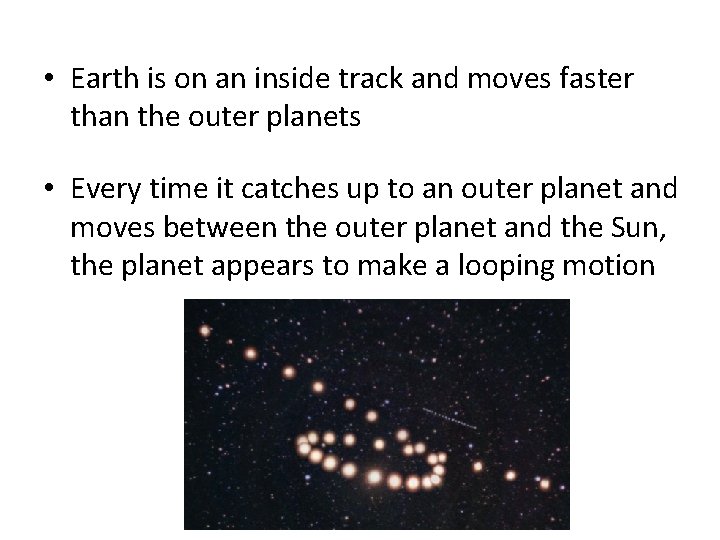
• However, at certain times these three planets “wander” against the backdrop of stars in a slow, looping motion that lasts several weeks • This apparent change in direction is called retrograde motion • Retrograde motion is produced when Earth catches up with and passes an outer planet in its orbit
• Earth is on an inside track and moves faster than the outer planets • Every time it catches up to an outer planet and moves between the outer planet and the Sun, the planet appears to make a looping motion
Distance Between The Planets • Large distances keep the planets well separated from each other • The planets lie so far apart that measuring them in kilometres would result in values that are too large to comprehend • For this reason, astronomers created a unit for measuring distances in the solar system: astronomical unit (AU)
• The AU is equal to the average distance between Earth and the Sun - about 150 million kilometres! • Therefore, the Earth is 1 AU from the Sun • The average distance between the Sun and an object orbiting the Sun is called the orbital radius - measured in AU • The planets share many similarities with one another, but also have many differences
• Mercury: No atmosphere = huge differences between day and night temperatures, freezing and thawing results in immense cracks on surface • Venus: Earth’s sister planet = similar composition and size, has atmosphere with lots of S = acid rain, also has CO 2 and N 2 • Earth: LIFE, H 2 O in three states of matter, atmosphere • Mars: Red = Fe rocks oxidizing (rust), thin atmosphere, has a canyon 8 km deep and as wide as the distance from Vancouver to Toronto • Jupiter: Largest planet, Great Red Spot is the size of three Earths = storm in atmosphere, very thin rings • Saturn: Lots of rings made of ice particles, atmosphere • Uranus: Rings, blue-green atmosphere = CH 4, rotates on 90 o angle • Neptune: Blue atmosphere, very thin rings