
7 3 USING CHEMICAL FORMULAS 7 3 Learning
- Slides: 18
7 -3 USING CHEMICAL FORMULAS
7 -3 Learning Targets • • • Calculate formula/molar mass of a compound Use molar mass as a conversion factor Calculate percent composition Explain what a hydrate is Determine the formulas for a hydrate form lab data
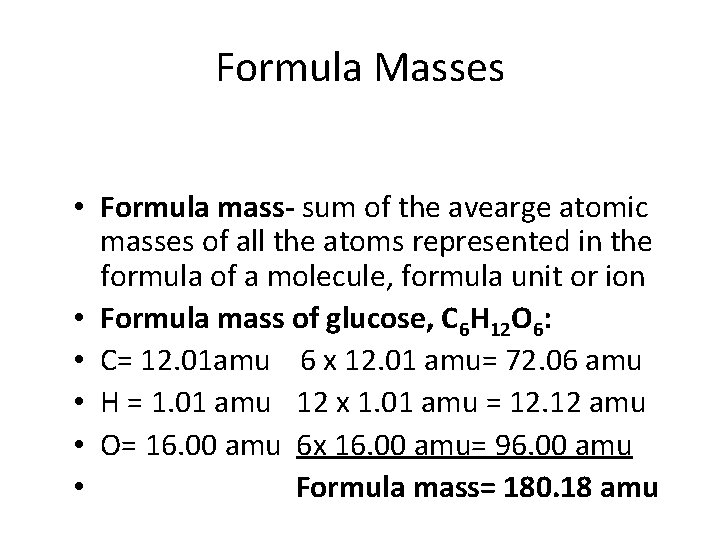
Formula Masses • Formula mass- sum of the avearge atomic masses of all the atoms represented in the formula of a molecule, formula unit or ion • Formula mass of glucose, C 6 H 12 O 6: • C= 12. 01 amu 6 x 12. 01 amu= 72. 06 amu • H = 1. 01 amu 12 x 1. 01 amu = 12. 12 amu • O= 16. 00 amu 6 x 16. 00 amu= 96. 00 amu • Formula mass= 180. 18 amu
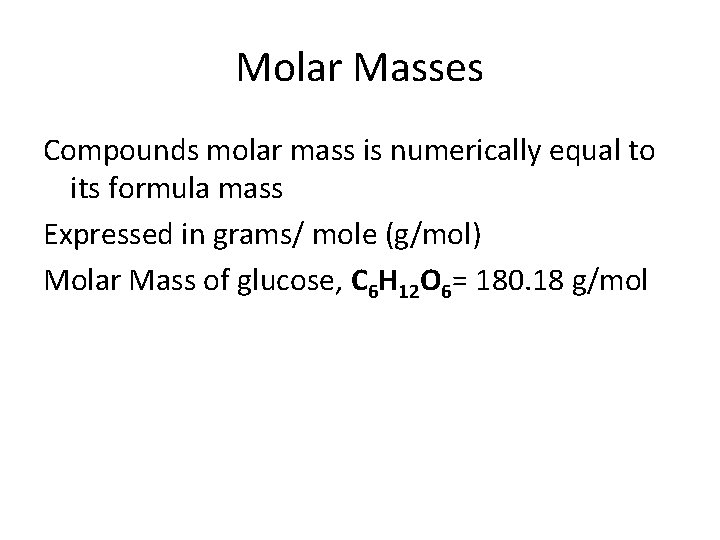
Molar Masses Compounds molar mass is numerically equal to its formula mass Expressed in grams/ mole (g/mol) Molar Mass of glucose, C 6 H 12 O 6= 180. 18 g/mol
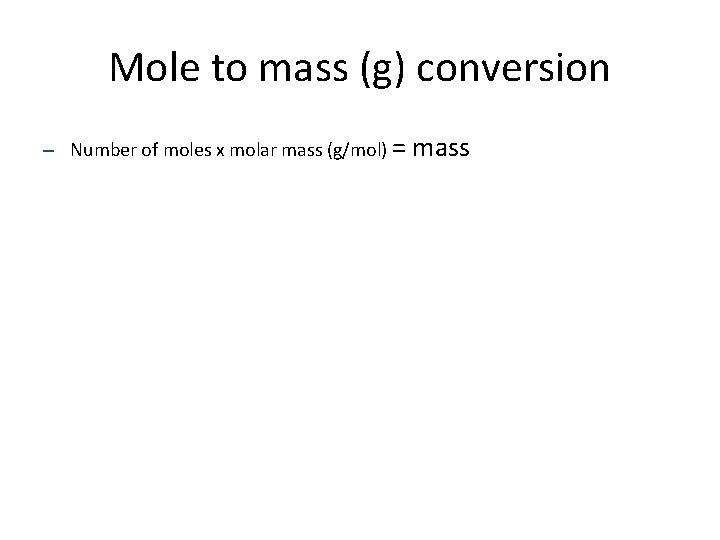
Mole to mass (g) conversion – Number of moles x molar mass (g/mol) = mass
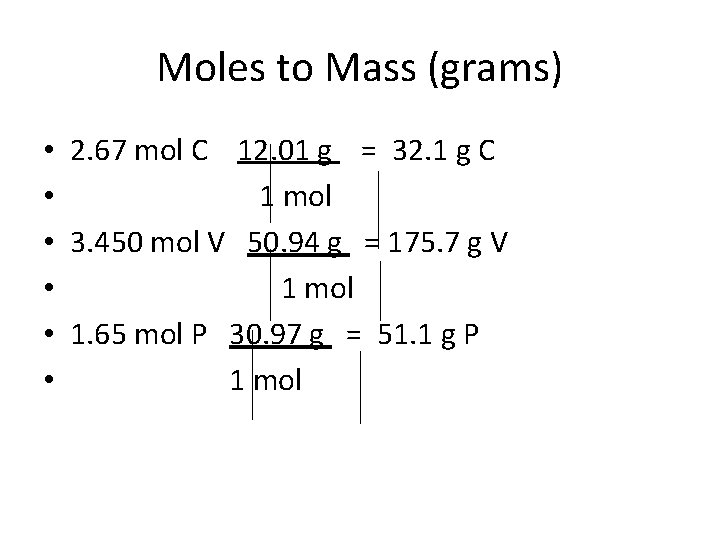
Moles to Mass (grams) • 2. 67 mol C 12. 01 g = 32. 1 g C • 1 mol • 3. 450 mol V 50. 94 g = 175. 7 g V • 1 mol • 1. 65 mol P 30. 97 g = 51. 1 g P • 1 mol
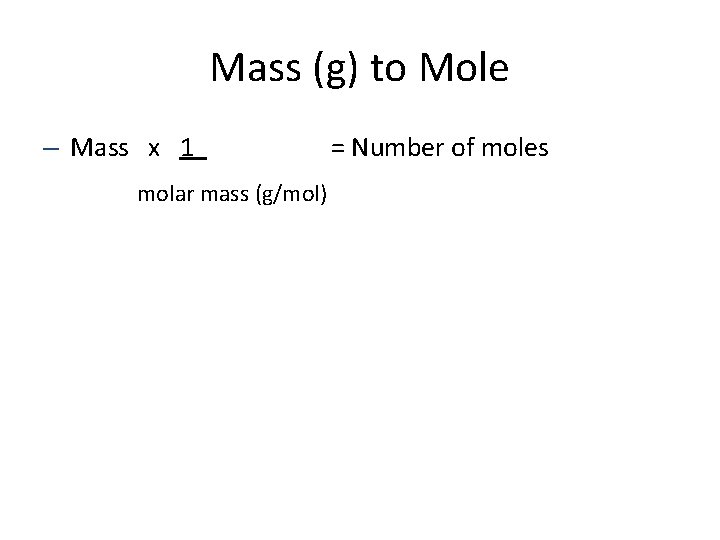
Mass (g) to Mole – Mass x 1 molar mass (g/mol) = Number of moles
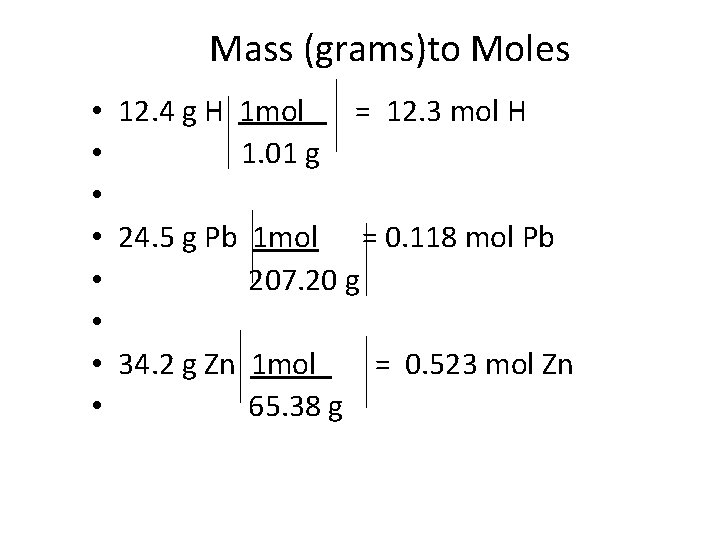
Mass (grams)to Moles • 12. 4 g H 1 mol = 12. 3 mol H • 1. 01 g • • 24. 5 g Pb 1 mol = 0. 118 mol Pb • 207. 20 g • • 34. 2 g Zn 1 mol = 0. 523 mol Zn • 65. 38 g
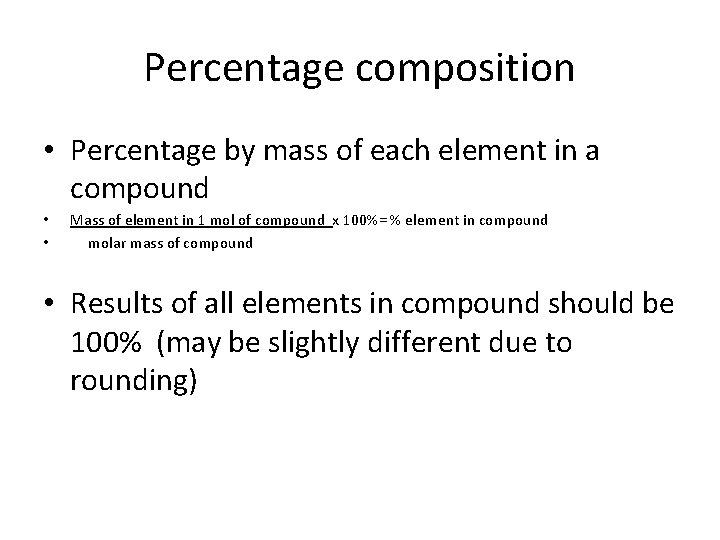
Percentage composition • Percentage by mass of each element in a compound • • Mass of element in 1 mol of compound x 100%= % element in compound molar mass of compound • Results of all elements in compound should be 100% (may be slightly different due to rounding)
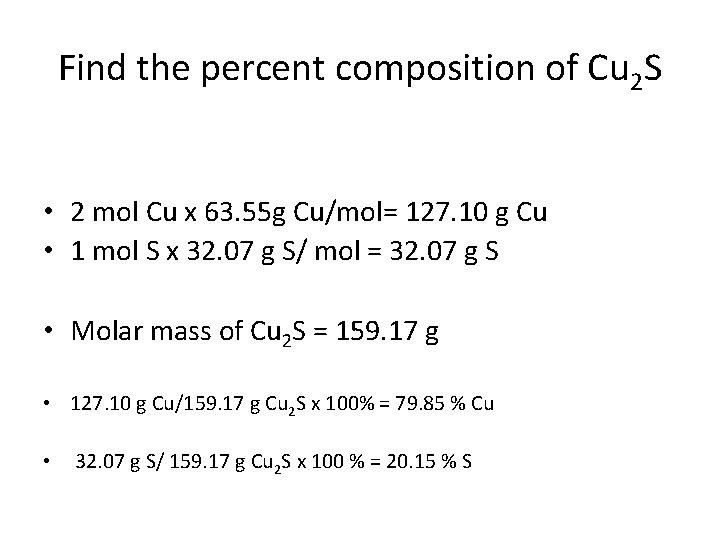
Find the percent composition of Cu 2 S • 2 mol Cu x 63. 55 g Cu/mol= 127. 10 g Cu • 1 mol S x 32. 07 g S/ mol = 32. 07 g S • Molar mass of Cu 2 S = 159. 17 g • 127. 10 g Cu/159. 17 g Cu 2 S x 100% = 79. 85 % Cu • 32. 07 g S/ 159. 17 g Cu 2 S x 100 % = 20. 15 % S
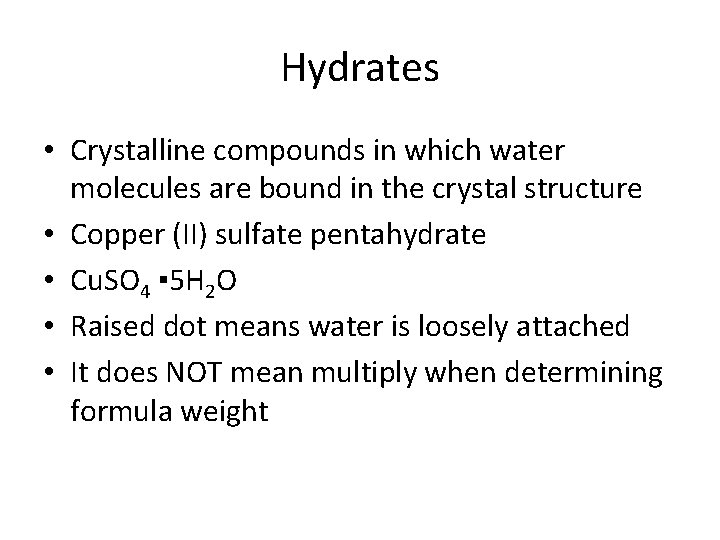
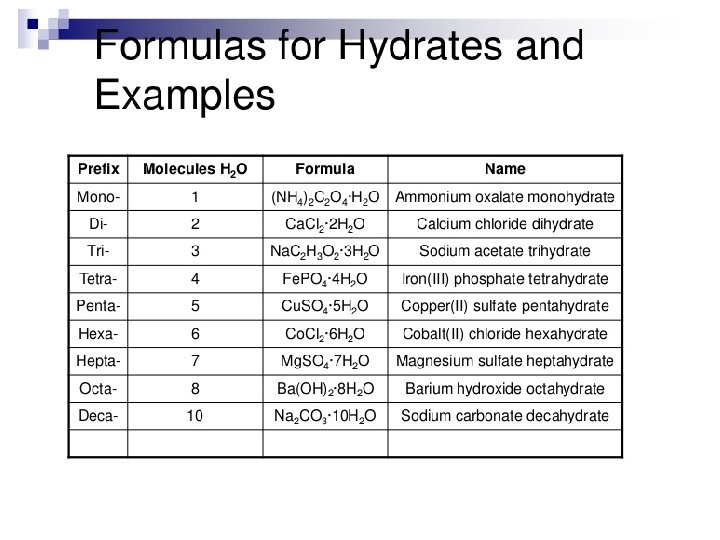
Hydrates • Crystalline compounds in which water molecules are bound in the crystal structure • Copper (II) sulfate pentahydrate • Cu. SO 4 ▪ 5 H 2 O • Raised dot means water is loosely attached • It does NOT mean multiply when determining formula weight
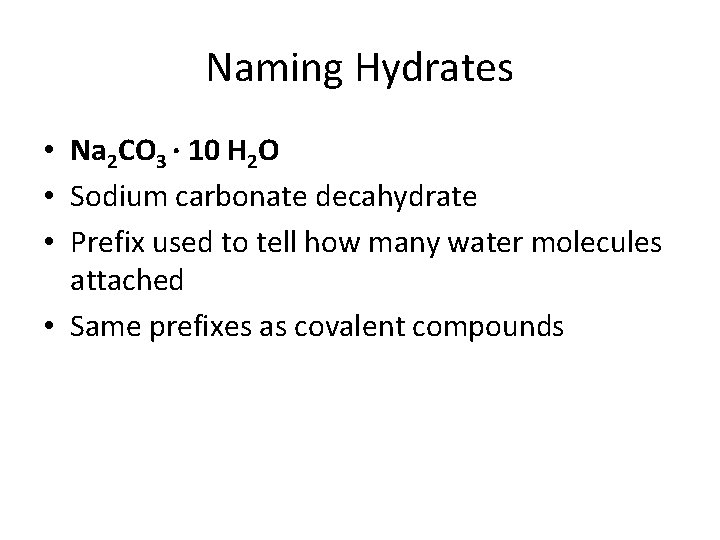
Naming Hydrates • Na 2 CO 3 · 10 H 2 O • Sodium carbonate decahydrate • Prefix used to tell how many water molecules attached • Same prefixes as covalent compounds
Uses of hydrates • Use anhydrous forms of hydrates (no water attached yet) • Used as desiccants- absorb moisture – In packing of electronics – Keep chemicals dry (in desiccator)
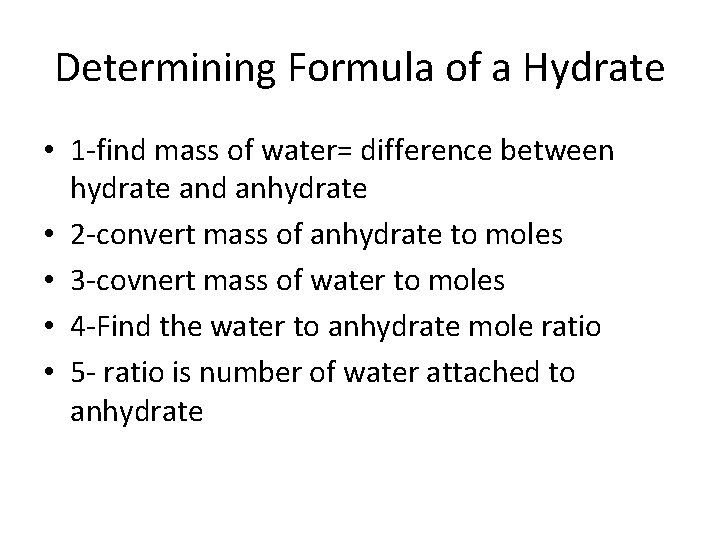
Determining Formula of a Hydrate • 1 -find mass of water= difference between hydrate and anhydrate • 2 -convert mass of anhydrate to moles • 3 -covnert mass of water to moles • 4 -Find the water to anhydrate mole ratio • 5 - ratio is number of water attached to anhydrate
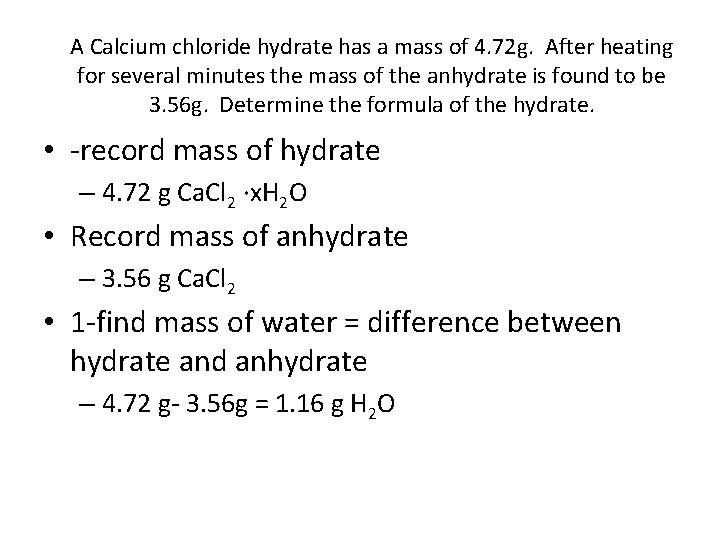
A Calcium chloride hydrate has a mass of 4. 72 g. After heating for several minutes the mass of the anhydrate is found to be 3. 56 g. Determine the formula of the hydrate. • -record mass of hydrate – 4. 72 g Ca. Cl 2 ·x. H 2 O • Record mass of anhydrate – 3. 56 g Ca. Cl 2 • 1 -find mass of water = difference between hydrate and anhydrate – 4. 72 g- 3. 56 g = 1. 16 g H 2 O
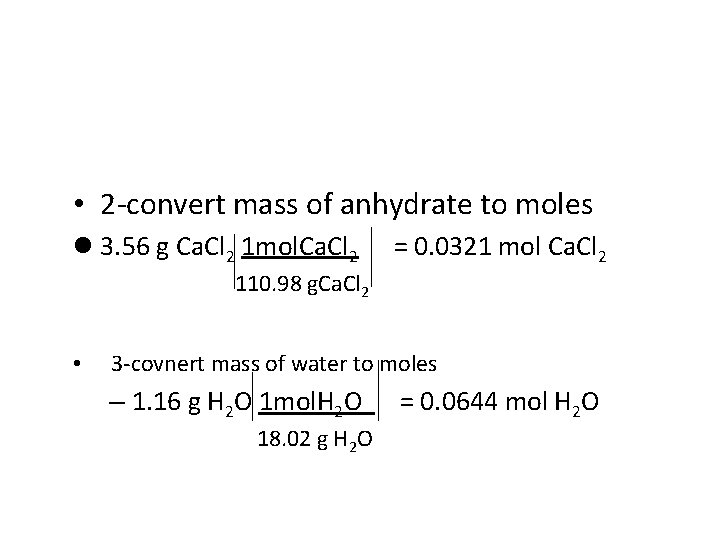
• 2 -convert mass of anhydrate to moles l 3. 56 g Ca. Cl 2 1 mol. Ca. Cl 2 = 0. 0321 mol Ca. Cl 2 110. 98 g. Ca. Cl 2 • 3 -covnert mass of water to moles – 1. 16 g H 2 O 1 mol. H 2 O 18. 02 g H 2 O = 0. 0644 mol H 2 O
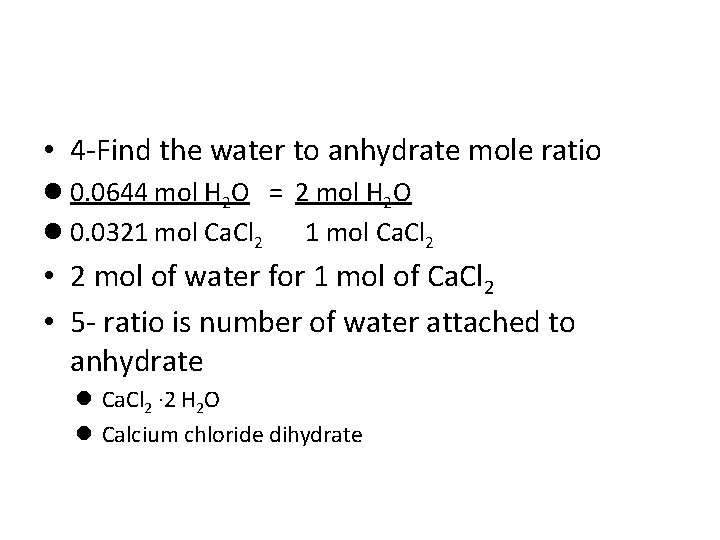
• 4 -Find the water to anhydrate mole ratio l 0. 0644 mol H 2 O = 2 mol H 2 O l 0. 0321 mol Ca. Cl 2 • 2 mol of water for 1 mol of Ca. Cl 2 • 5 - ratio is number of water attached to anhydrate l Ca. Cl 2 · 2 H 2 O l Calcium chloride dihydrate