
7 3 The Natural Base e The Natural
7. 3 The Natural Base e
The Natural Base e A famous constant (similar to π) is the natural base, e (also known as Euler’s number). e ≈ 2. 71828459 e is irrational (non-repeating, not-terminating). A function in the form f(x) = Cebx is a natural base exponential function. if b>0…growth if b<0…decay Let’s take a look at the graph of a natural base exponential function…
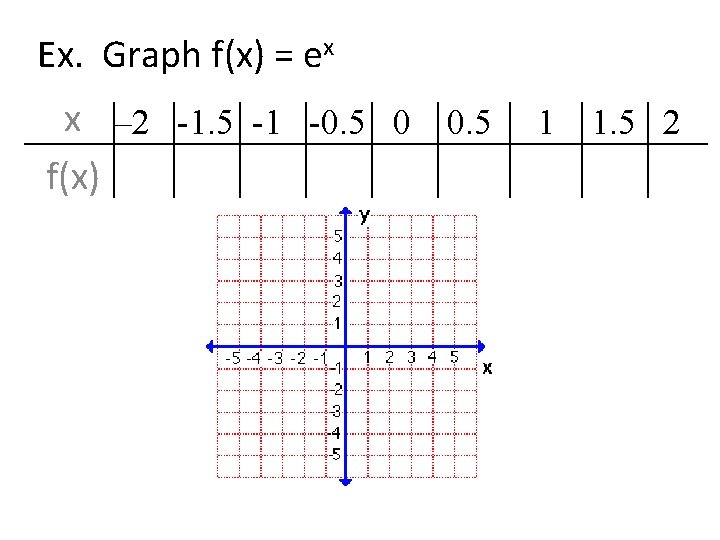
Ex. Graph f(x) = ex x – 2 -1. 5 -1 -0. 5 0 0. 5 f(x) 1 1. 5 2
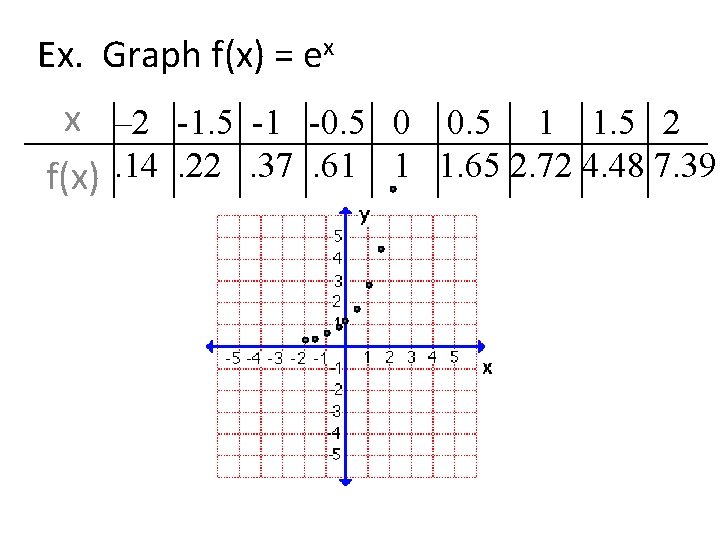
Ex. Graph f(x) = ex x – 2 -1. 5 -1 -0. 5 0 0. 5 1 1. 5 2 f(x). 14. 22. 37. 61 1 1. 65 2. 72 4. 48 7. 39

To simplify natural base expressions, follow the Properties of Exponents: Simplify. 8 3 5 = e a. e • e b. c. 8 e 6 = 4 e 4 2 e 2 (2 e– 3 x)– 2 = 2– 2 e 6 x = e 6 x 4
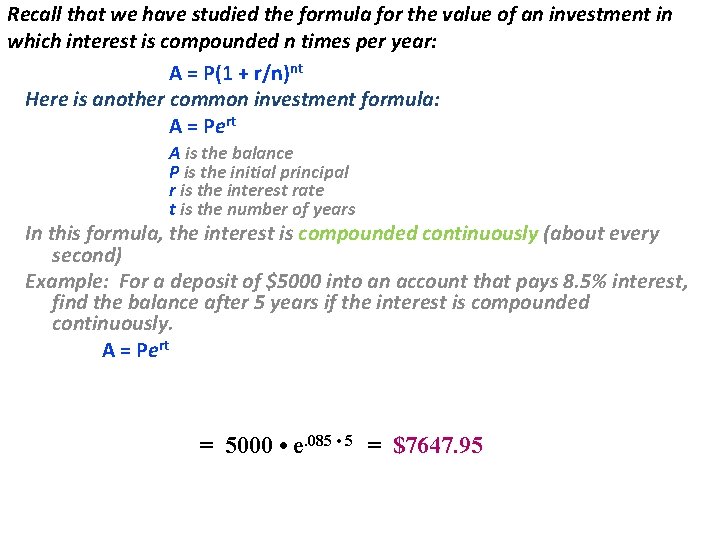
Recall that we have studied the formula for the value of an investment in which interest is compounded n times per year: A = P(1 + r/n)nt Here is another common investment formula: A = Pert A is the balance P is the initial principal r is the interest rate t is the number of years In this formula, the interest is compounded continuously (about every second) Example: For a deposit of $5000 into an account that pays 8. 5% interest, find the balance after 5 years if the interest is compounded continuously. A = Pert = 5000 • e. 085 • 5 = $7647. 95
Homework: p. 495 -497 #3 -39 multiples of 3, #56 and #57
- Slides: 7