
7 3 Sine and Cosine and Tangent Functions
- Slides: 20
7 -3 Sine and Cosine (and Tangent) Functions 7 -4 Evaluating Sine and Cosine sin is an abbreviation for sine cos is an abbreviation for cosine tan is an abbreviation for tangent
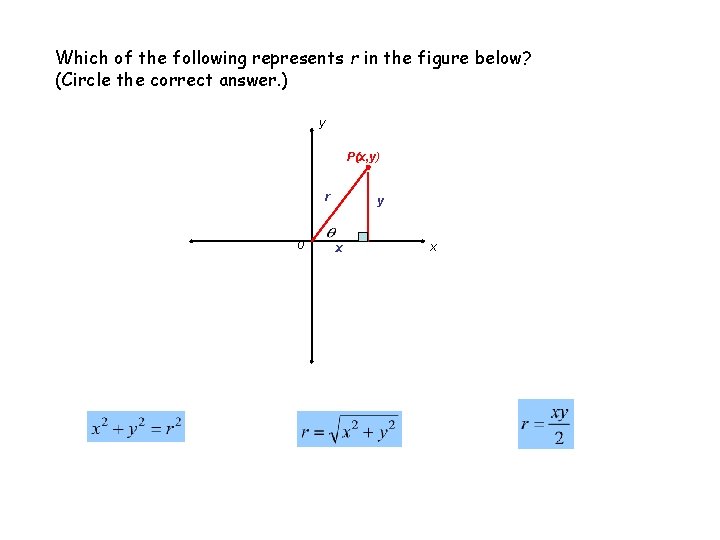
Which of the following represents r in the figure below? (Circle the correct answer. ) y P(x, y) r 0 y x x
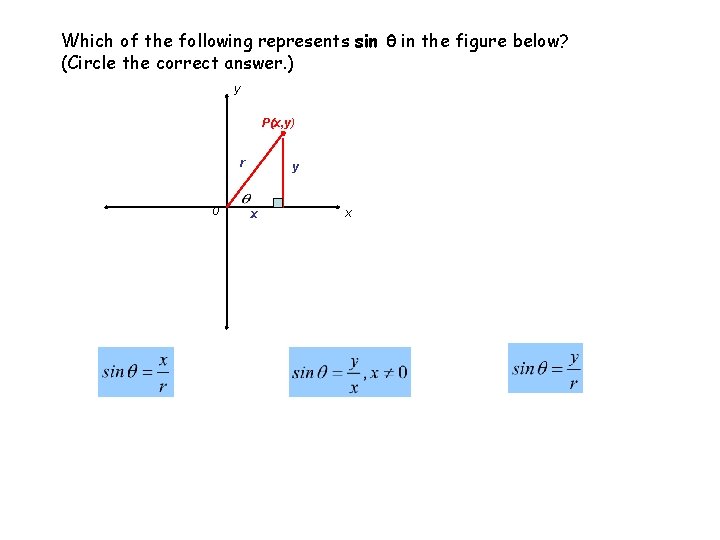
Which of the following represents sin in the figure below? (Circle the correct answer. ) y P(x, y) r 0 y x x
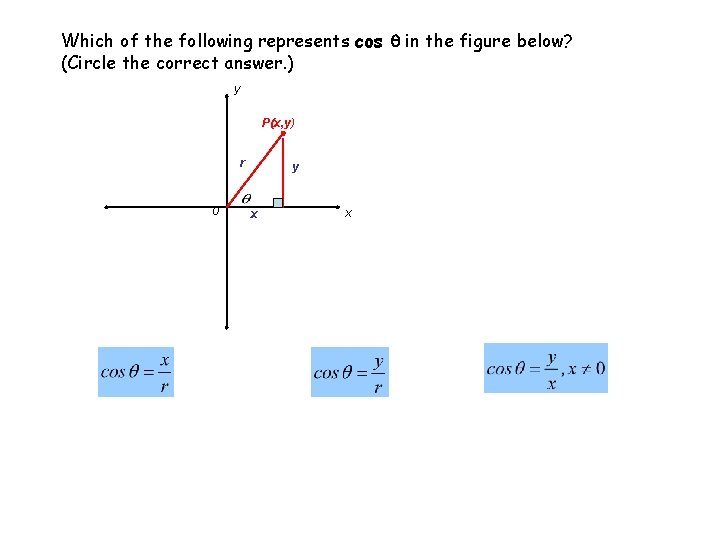
Which of the following represents cos in the figure below? (Circle the correct answer. ) y P(x, y) r 0 y x x
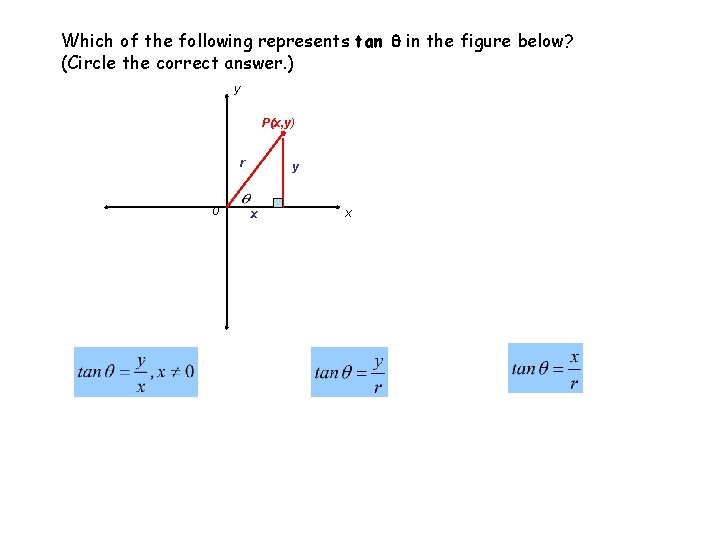
Which of the following represents tan in the figure below? (Circle the correct answer. ) y P(x, y) r 0 y x x
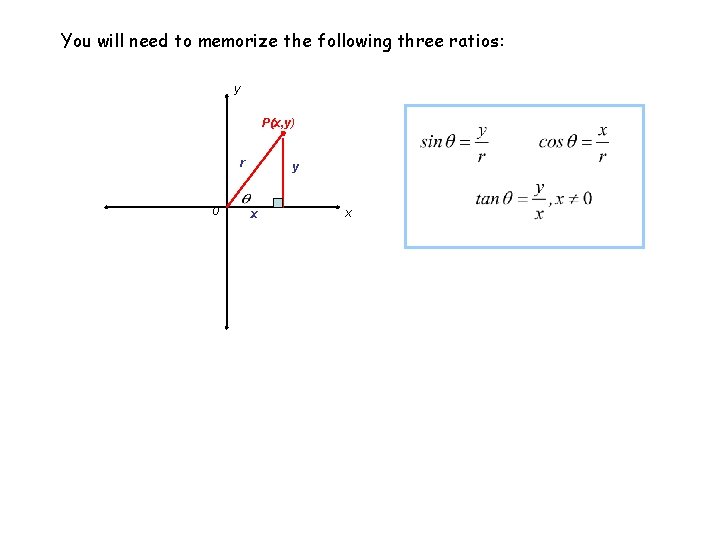
You will need to memorize the following three ratios: y P(x, y) r 0 y x x
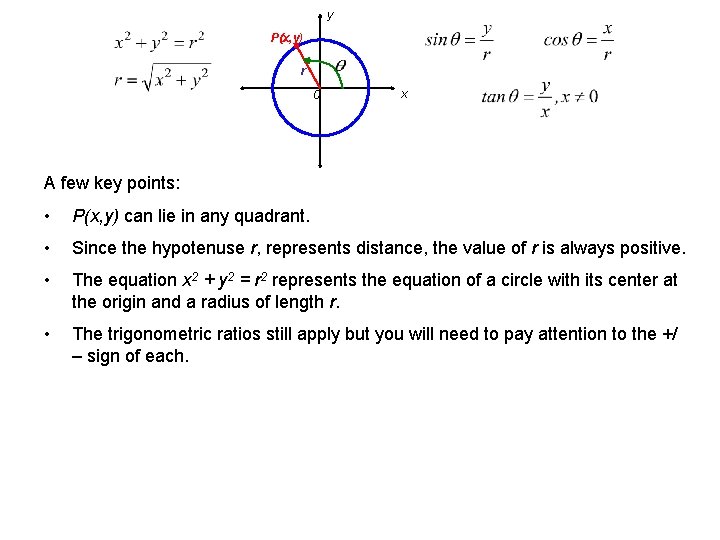
y P(x, y) r 0 x A few key points: • P(x, y) can lie in any quadrant. • Since the hypotenuse r, represents distance, the value of r is always positive. • The equation x 2 + y 2 = r 2 represents the equation of a circle with its center at the origin and a radius of length r. • The trigonometric ratios still apply but you will need to pay attention to the +/ – sign of each.
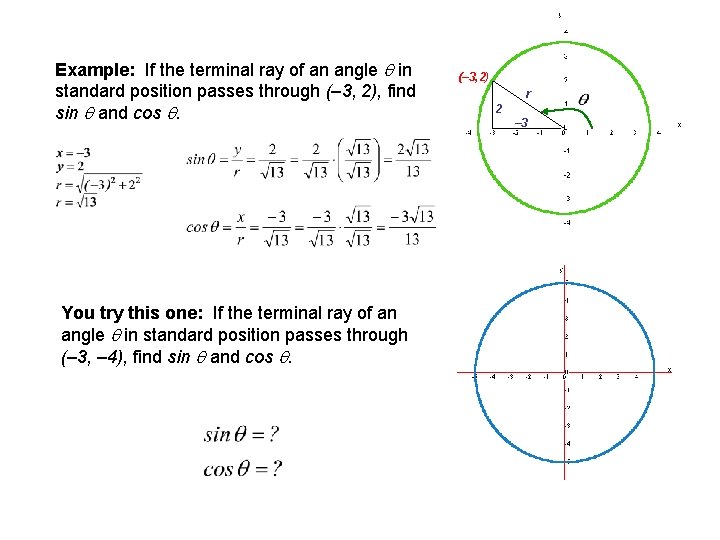
Example: If the terminal ray of an angle in standard position passes through (– 3, 2), find sin and cos . You try this one: If the terminal ray of an angle in standard position passes through (– 3, – 4), find sin and cos . (– 3, 2) r 2 – 3
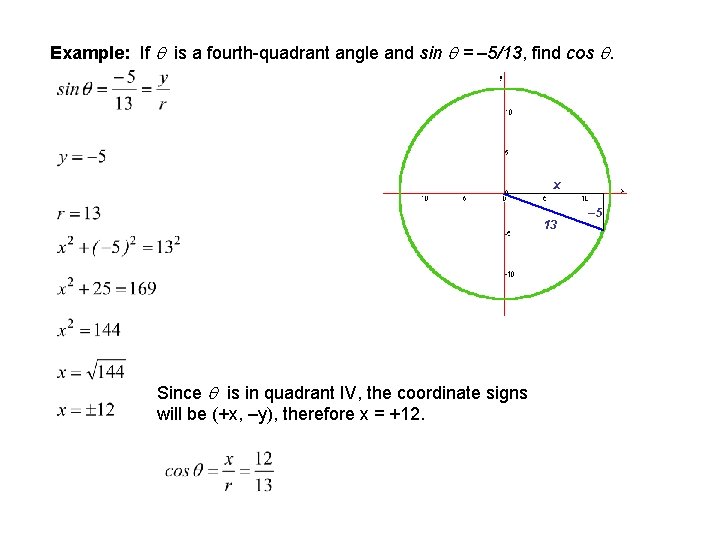
Example: If is a fourth-quadrant angle and sin = – 5/13, find cos . x 13 Since is in quadrant IV, the coordinate signs will be (+x, –y), therefore x = +12. – 5
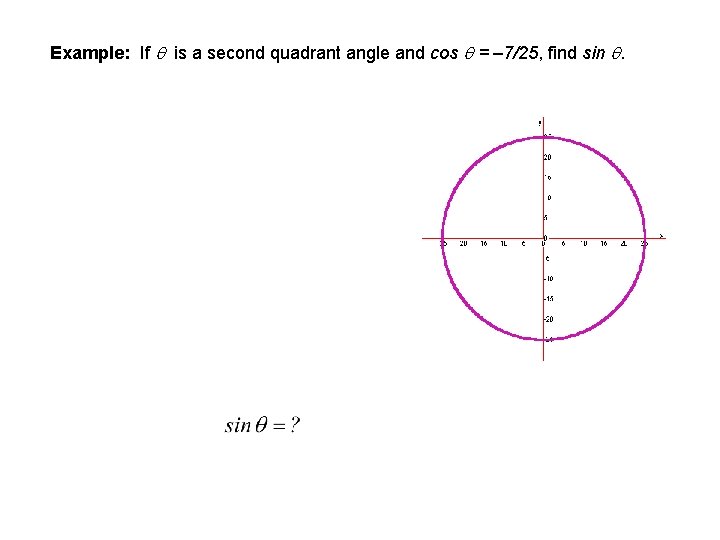
Example: If is a second quadrant angle and cos = – 7/25, find sin .
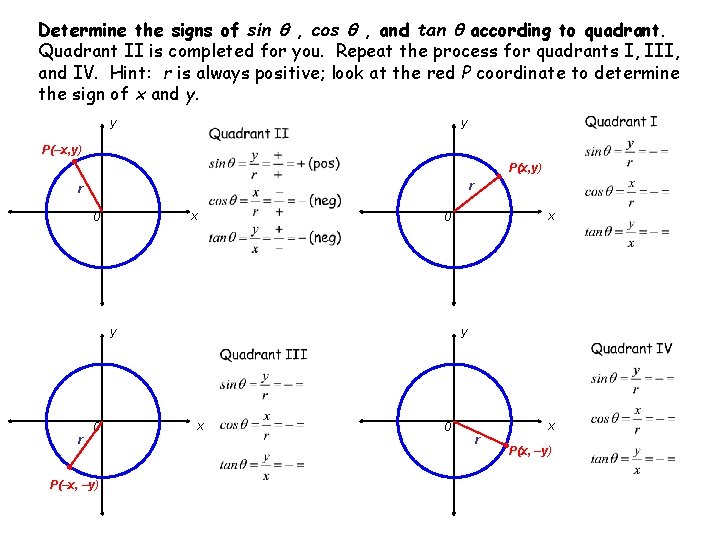
Determine the signs of sin , cos , and tan according to quadrant. Quadrant II is completed for you. Repeat the process for quadrants I, III, and IV. Hint: r is always positive; look at the red P coordinate to determine the sign of x and y. y y P(–x, y) P(x, y) r r x 0 y r 0 P(–x, –y) x 0 y x 0 x r P(x, –y)
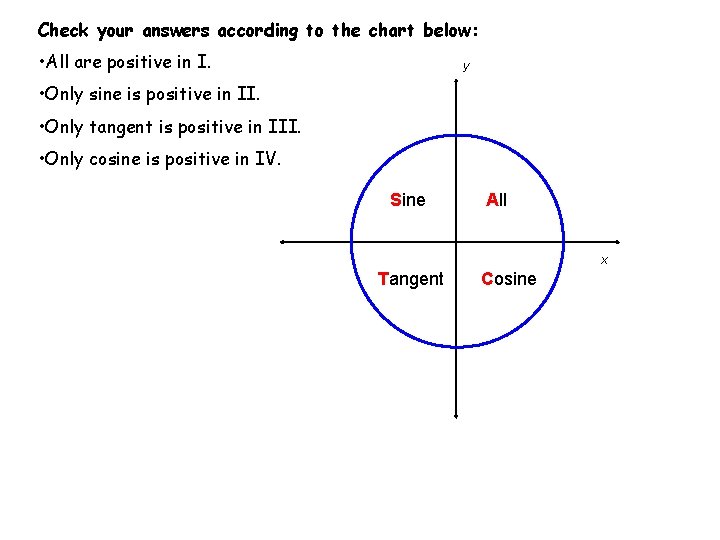
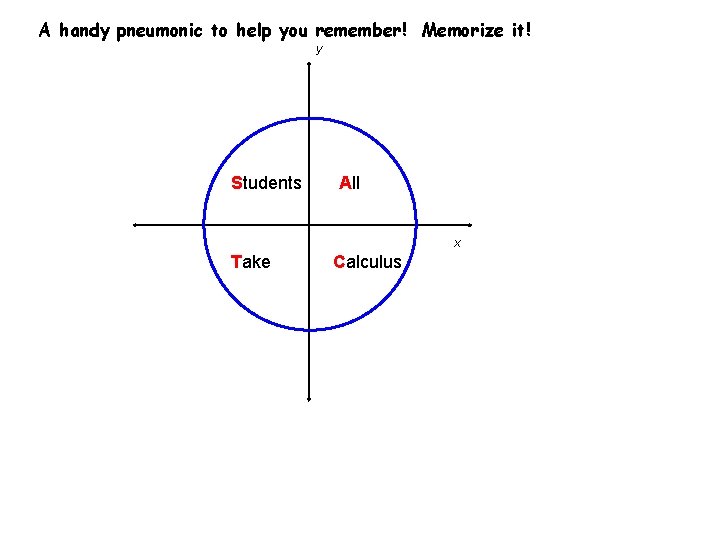
Check your answers according to the chart below: • All are positive in I. y • Only sine is positive in II. • Only tangent is positive in III. • Only cosine is positive in IV. Sine All x Tangent Cosine
A handy pneumonic to help you remember! Memorize it! y Students All x Take Calculus
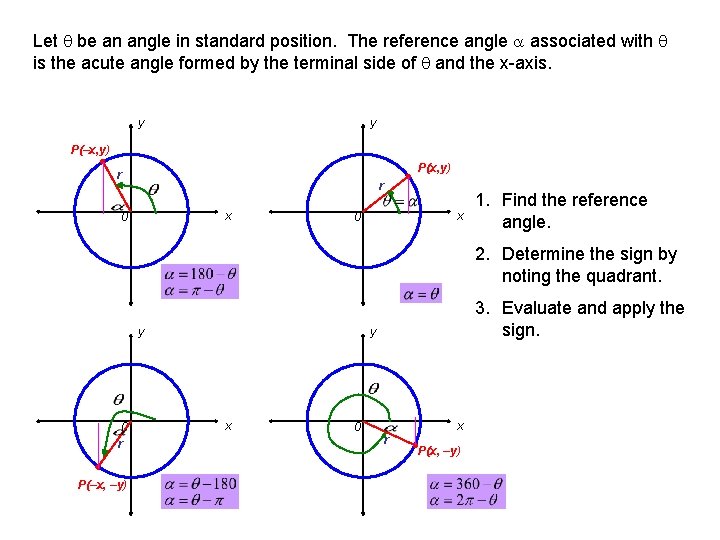
Let be an angle in standard position. The reference angle associated with is the acute angle formed by the terminal side of and the x-axis. y y P(–x, y) P(x, y) r r x 0 1. Find the reference angle. 2. Determine the sign by noting the quadrant. y 0 r P(–x, –y) 3. Evaluate and apply the sign. y x 0 x r P(x, –y)
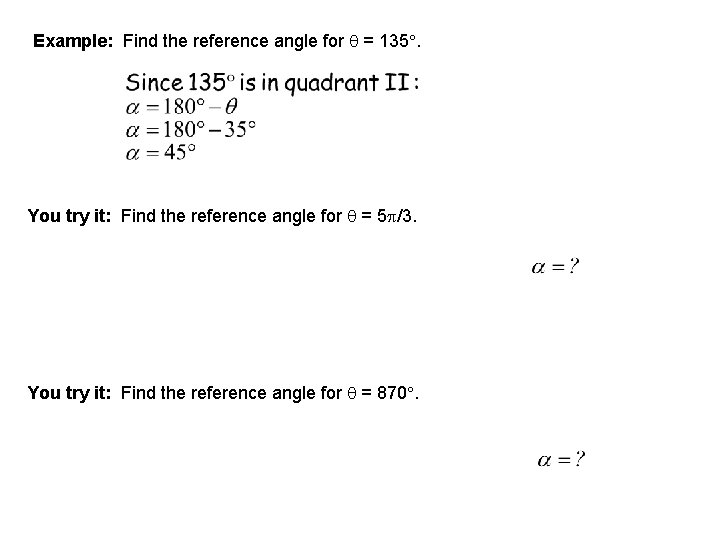
Example: Find the reference angle for = 135. You try it: Find the reference angle for = 5 /3. You try it: Find the reference angle for = 870.
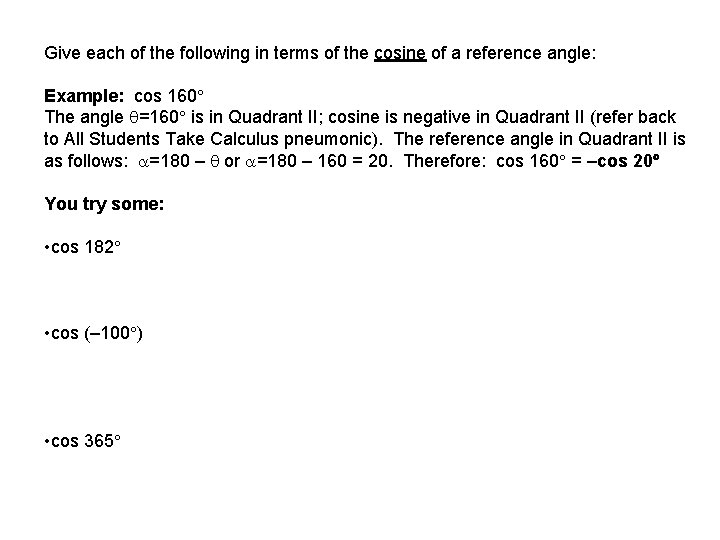
Give each of the following in terms of the cosine of a reference angle: Example: cos 160 The angle =160 is in Quadrant II; cosine is negative in Quadrant II (refer back to All Students Take Calculus pneumonic). The reference angle in Quadrant II is as follows: =180 – or =180 – 160 = 20. Therefore: cos 160 = –cos 20 You try some: • cos 182 • cos (– 100 ) • cos 365
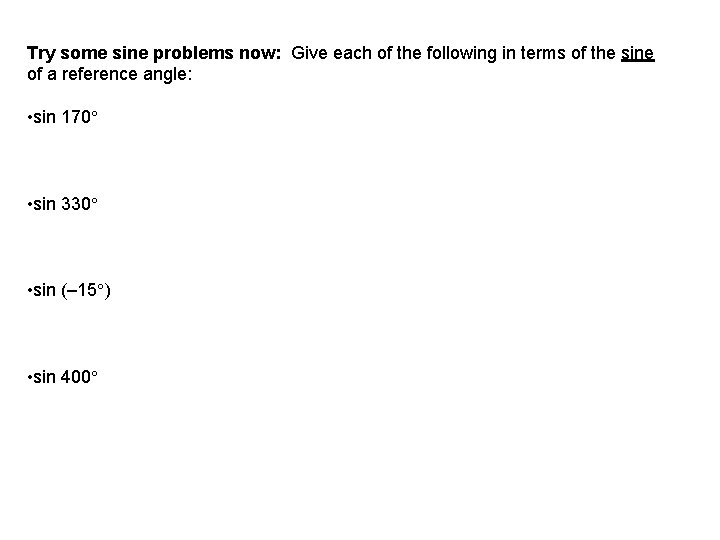
Try some sine problems now: Give each of the following in terms of the sine of a reference angle: • sin 170 • sin 330 • sin (– 15 ) • sin 400
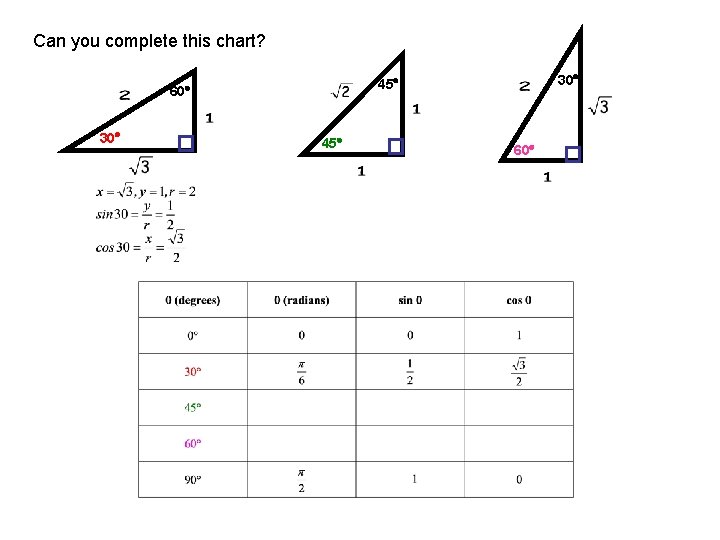
Can you complete this chart? 30 45 60
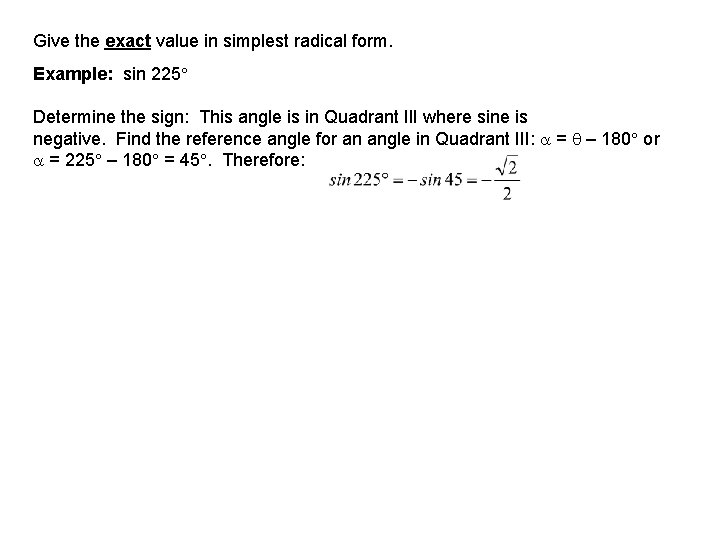
Give the exact value in simplest radical form. Example: sin 225 Determine the sign: This angle is in Quadrant III where sine is negative. Find the reference angle for an angle in Quadrant III: = – 180 or = 225 – 180 = 45. Therefore:
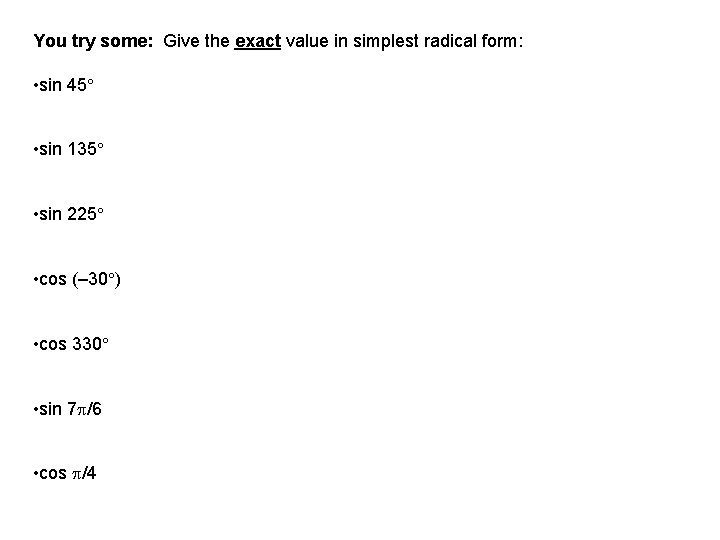
You try some: Give the exact value in simplest radical form: • sin 45 • sin 135 • sin 225 • cos (– 30 ) • cos 330 • sin 7 /6 • cos /4