
7 3 Jordan form Canonical form for matrices
![• [Ti]B_i = • There are some gaps of 1 s here. •](https://slidetodoc.com/presentation_image_h2/1d8a759d278655048cde77d2225c334a/image-7.jpg "• [Ti]B_i = • There are some gaps of 1 s here. •")
- Slides: 11
7. 3. Jordan form Canonical form for matrices and transformations.
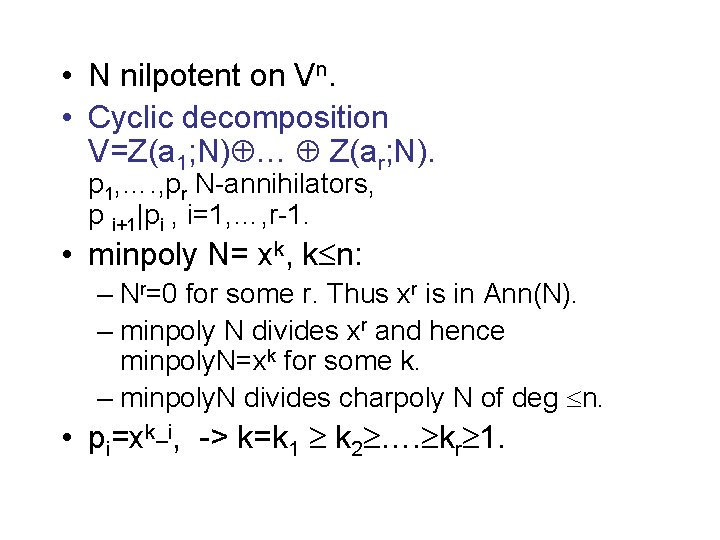
• N nilpotent on Vn. • Cyclic decomposition V=Z(a 1; N) … Z(ar; N). p 1, …. , pr N-annihilators, p i+1|pi , i=1, …, r-1. • minpoly N= xk, k n: – Nr=0 for some r. Thus xr is in Ann(N). – minpoly N divides xr and hence minpoly. N=xk for some k. – minpoly. N divides charpoly N of deg n. • pi=xk_i, -> k=k 1 k 2 …. kr 1.
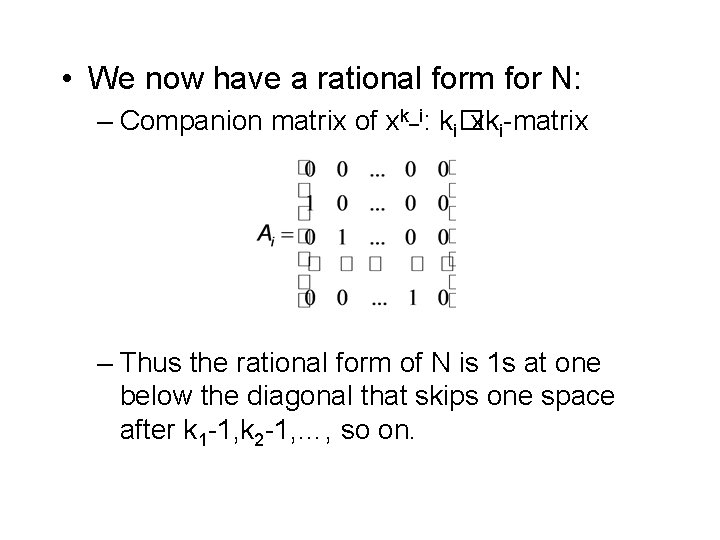
• We now have a rational form for N: – Companion matrix of xk_i: ki�xki-matrix – Thus the rational form of N is 1 s at one below the diagonal that skips one space after k 1 -1, k 2 -1, …, so on.
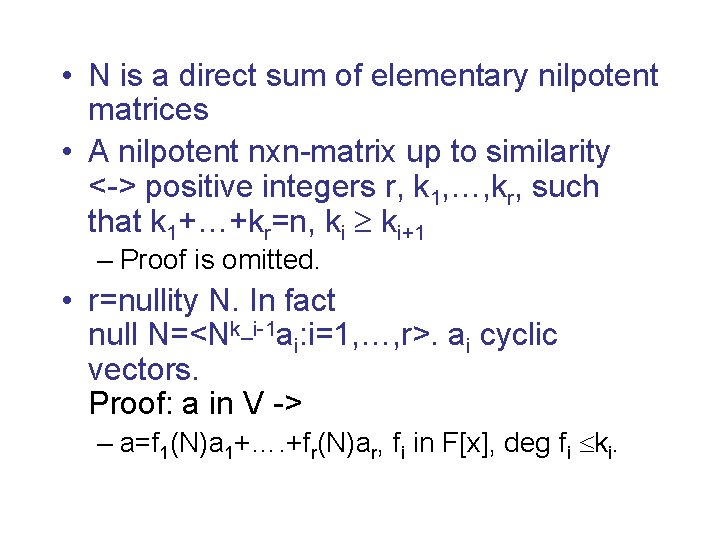
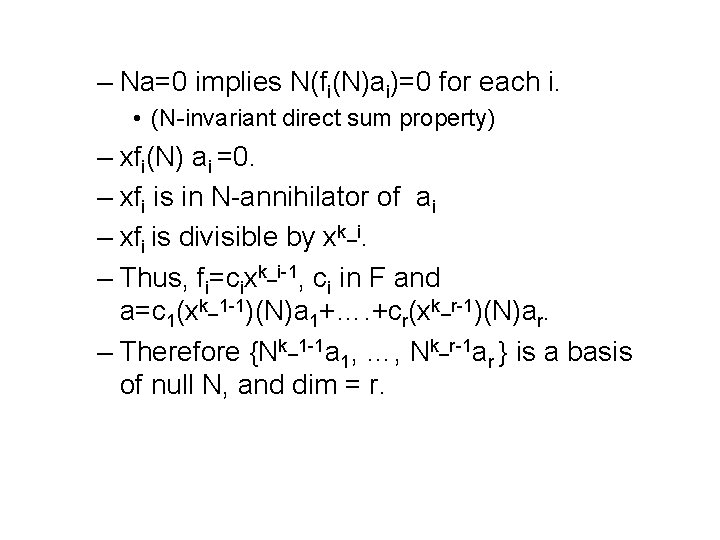
• N is a direct sum of elementary nilpotent matrices • A nilpotent nxn-matrix up to similarity <-> positive integers r, k 1, …, kr, such that k 1+…+kr=n, ki ki+1 – Proof is omitted. • r=nullity N. In fact null N=<Nk_i-1 ai: i=1, …, r>. ai cyclic vectors. Proof: a in V -> – a=f 1(N)a 1+…. +fr(N)ar, fi in F[x], deg fi ki.
– Na=0 implies N(fi(N)ai)=0 for each i. • (N-invariant direct sum property) – xfi(N) ai =0. – xfi is in N-annihilator of ai – xfi is divisible by xk_i. – Thus, fi=cixk_i-1, ci in F and a=c 1(xk_1 -1)(N)a 1+…. +cr(xk_r-1)(N)ar. – Therefore {Nk_1 -1 a 1, …, Nk_r-1 ar } is a basis of null N, and dim = r.
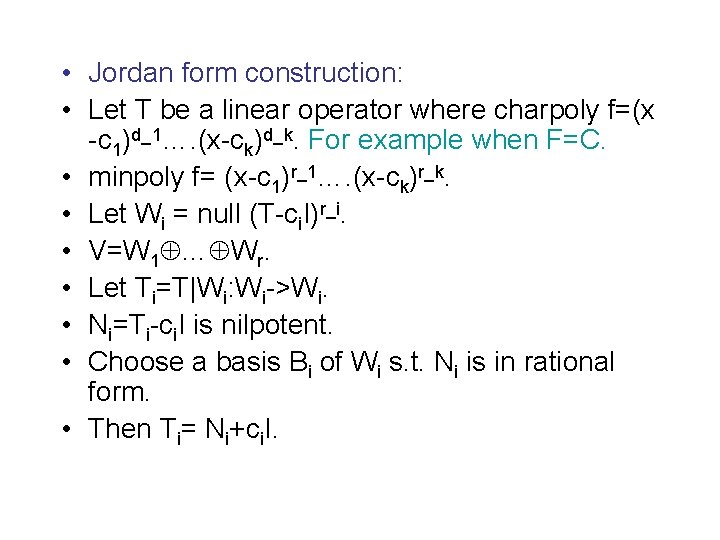
• Jordan form construction: • Let T be a linear operator where charpoly f=(x -c 1)d_1…. (x-ck)d_k. For example when F=C. • minpoly f= (x-c 1)r_1…. (x-ck)r_k. • Let Wi = null (T-ci. I)r_i. • V=W 1 … Wr. • Let Ti=T|Wi: Wi->Wi. • Ni=Ti-ci. I is nilpotent. • Choose a basis Bi of Wi s. t. Ni is in rational form. • Then Ti= Ni+ci. I.
• [Ti]B_i = • There are some gaps of 1 s here. • If there are no gaps, then it is called the elementary Jordan matrix with char value ci.
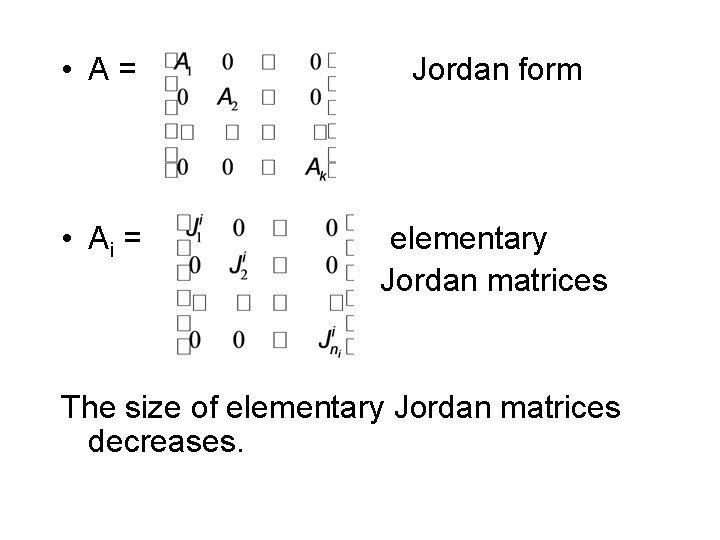
• A= Jordan form • Ai = elementary Jordan matrices The size of elementary Jordan matrices decreases.
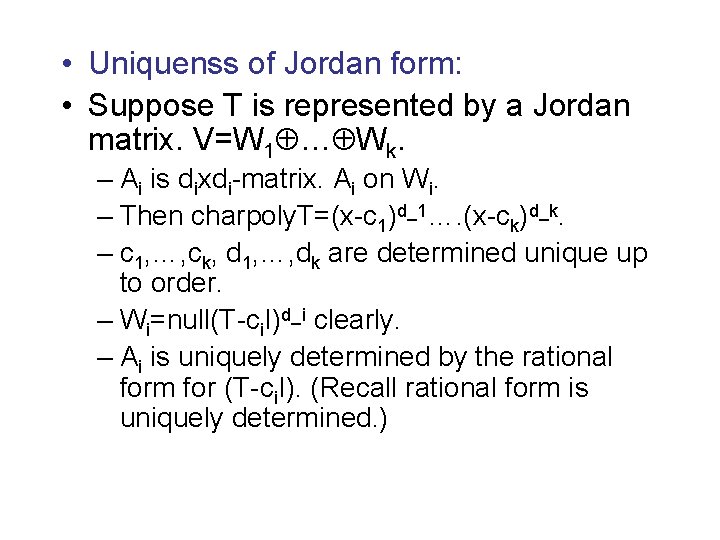
• Uniquenss of Jordan form: • Suppose T is represented by a Jordan matrix. V=W 1 … Wk. – Ai is dixdi-matrix. Ai on Wi. – Then charpoly. T=(x-c 1)d_1…. (x-ck)d_k. – c 1, …, ck, d 1, …, dk are determined unique up to order. – Wi=null(T-ci. I)d_i clearly. – Ai is uniquely determined by the rational form for (T-ci. I). (Recall rational form is uniquely determined. )
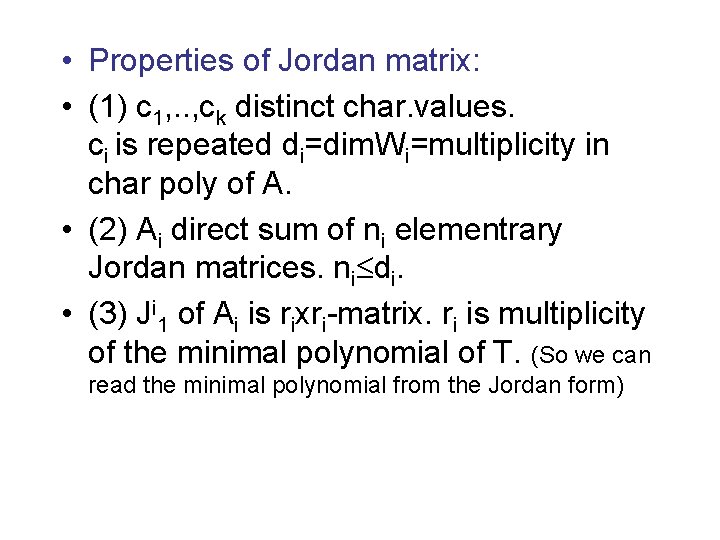
• Properties of Jordan matrix: • (1) c 1, . . , ck distinct char. values. ci is repeated di=dim. Wi=multiplicity in char poly of A. • (2) Ai direct sum of ni elementrary Jordan matrices. ni di. • (3) Ji 1 of Ai is rixri-matrix. ri is multiplicity of the minimal polynomial of T. (So we can read the minimal polynomial from the Jordan form)
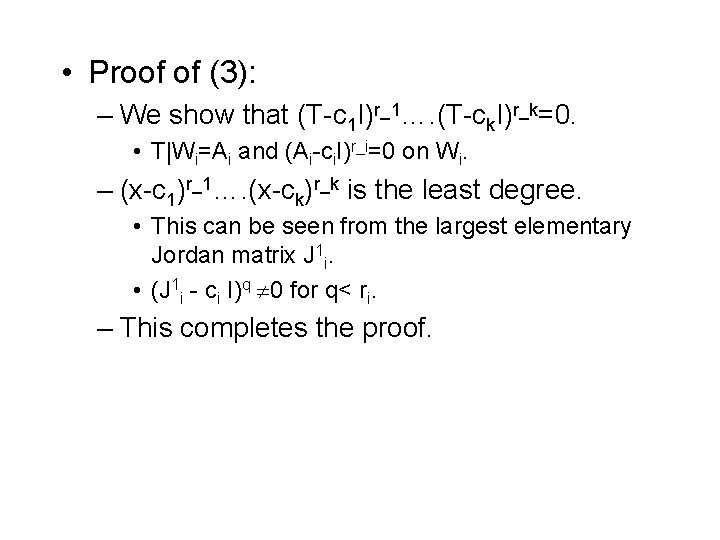
• Proof of (3): – We show that (T-c 1 I)r_1…. (T-ck. I)r_k=0. • T|Wi=Ai and (Ai-ci. I)r_i=0 on Wi. – (x-c 1)r_1…. (x-ck)r_k is the least degree. • This can be seen from the largest elementary Jordan matrix J 1 i. • (J 1 i - ci I)q 0 for q< ri. – This completes the proof.