
7 3 Energy Changes in Reactions A propane




- Slides: 45
7. 3 Energy Changes in Reactions
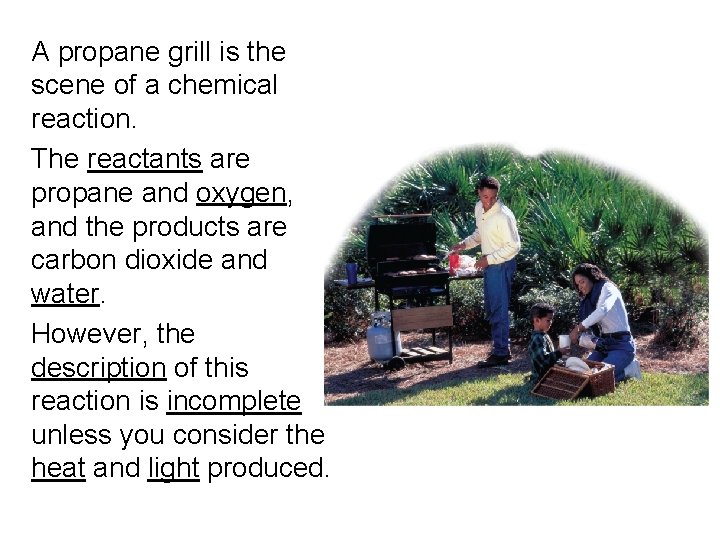
A propane grill is the scene of a chemical reaction. The reactants are propane and oxygen, and the products are carbon dioxide and water. However, the description of this reaction is incomplete unless you consider the heat and light produced.
Chemical Bonds and Energy What happens to chemical bonds during a chemical reaction? Bonds in the reactants break and new chemical bonds form in the products.
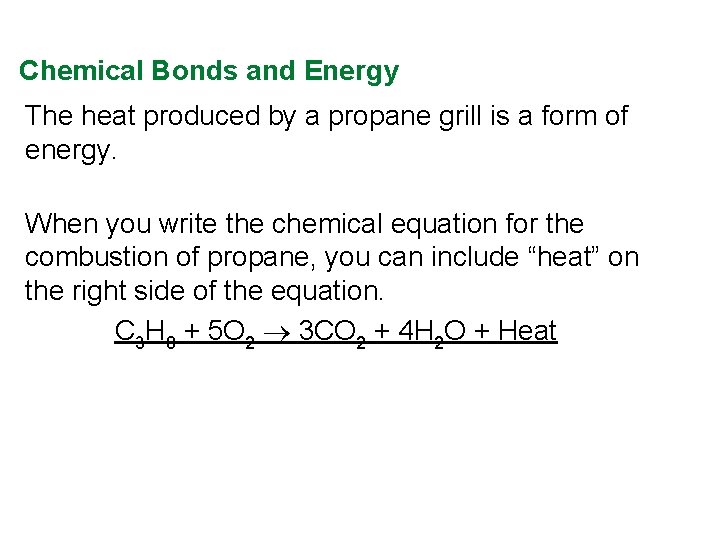
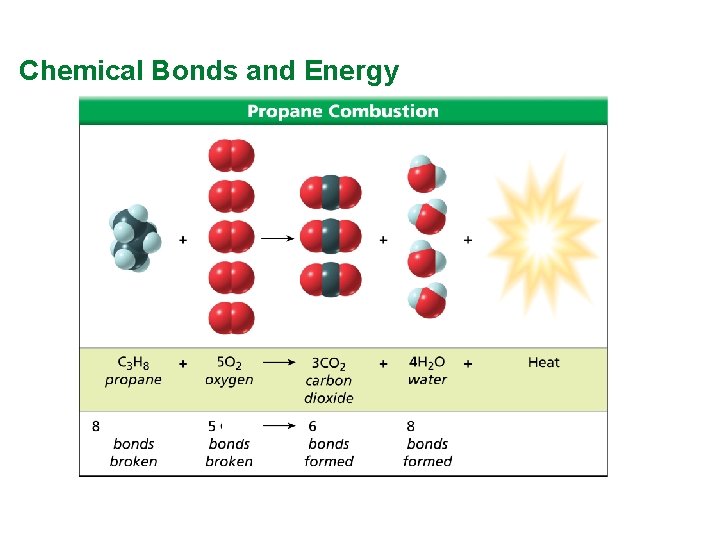
Chemical Bonds and Energy The heat produced by a propane grill is a form of energy. When you write the chemical equation for the combustion of propane, you can include “heat” on the right side of the equation. C 3 H 8 + 5 O 2 3 CO 2 + 4 H 2 O + Heat
Chemical Bonds and Energy The chemical energy of a propane molecule is the energy stored in its bonds. Oxygen, carbon dioxide, and water molecules also have energy stored in their chemical bonds.
Chemical Bonds and Energy changes in chemical reactions are determined by changes that occur in chemical bonding. In the combustion of propane, the bonds in propane and oxygen molecules are broken, while the bonds in carbon dioxide and water molecules are formed.
Chemical Bonds and Energy Breaking Bonds In order for the combustion of propane to occur, all the chemical bonds in the reactants (propane and oxygen) must be broken. The formation of the chemical bonds in the products then completes the reaction. Breaking chemical bonds requires energy. A spark provides enough energy to break the bonds of reacting molecules and get the reaction started.
Chemical Bonds and Energy
Chemical Bonds and Energy Forming Bonds For each molecule of propane burned, three molecules of carbon dioxide and four molecules of water are formed. • Six C=O double bonds and eight O—H single bonds are formed. • The formation of chemical bonds releases energy. • The heat and light given off result from the formation of new chemical bonds.
Exothermic and Endothermic Reactions What happens to energy during a chemical reaction? During a chemical reaction, energy is either released or absorbed.
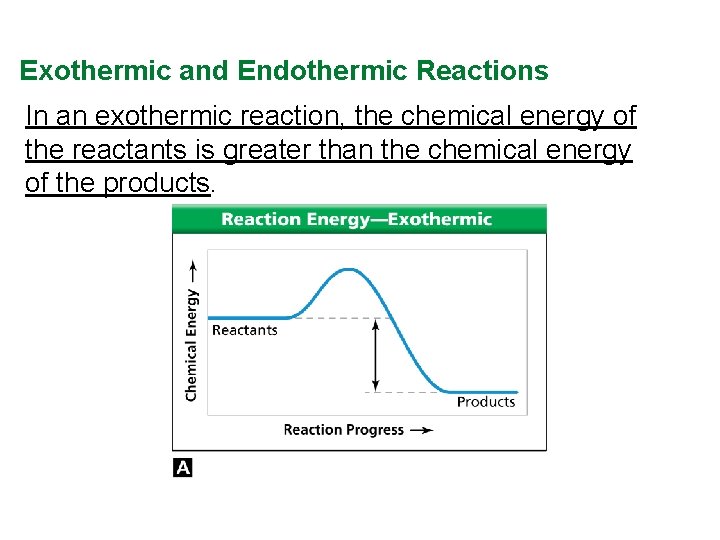
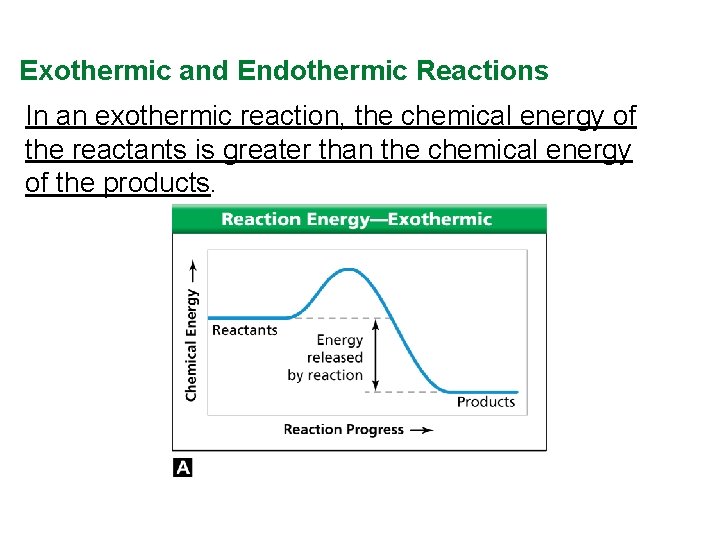
Exothermic and Endothermic Reactions Exothermic Reactions A chemical reaction that releases energy to its surroundings is called an exothermic reaction. In exothermic reactions, the energy released as the products form is greater than the energy required to break the bonds in the reactants.
Exothermic and Endothermic Reactions Combustion is an extremely exothermic reaction. When 1 mole of propane reacts with 5 moles of oxygen, 2220 k. J (kilojoules) of heat is released. C 3 H 8 + 5 O 2 3 CO 2 + 4 H 2 O + 2220 k. J A k. J is a unit of energy. It equals 1, 000 Joules
Exothermic and Endothermic Reactions In an exothermic reaction, the chemical energy of the reactants is greater than the chemical energy of the products.
Exothermic and Endothermic Reactions In an exothermic reaction, the chemical energy of the reactants is greater than the chemical energy of the products.
Exothermic and Endothermic Reactions In a chemical reaction, the chemical energy reaches a peak before the reactants change into products. • This peak represents the amount of energy required to break the chemical bonds of the reactants. • Particles must collide with enough energy to break these bonds, or the reaction will not occur.
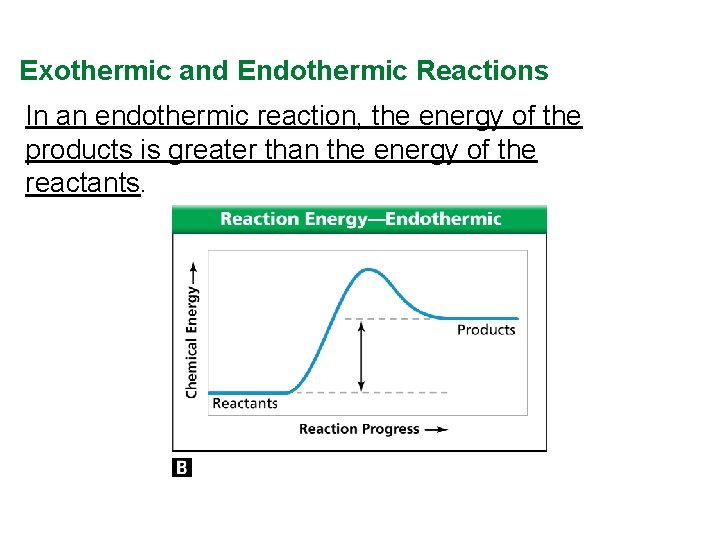
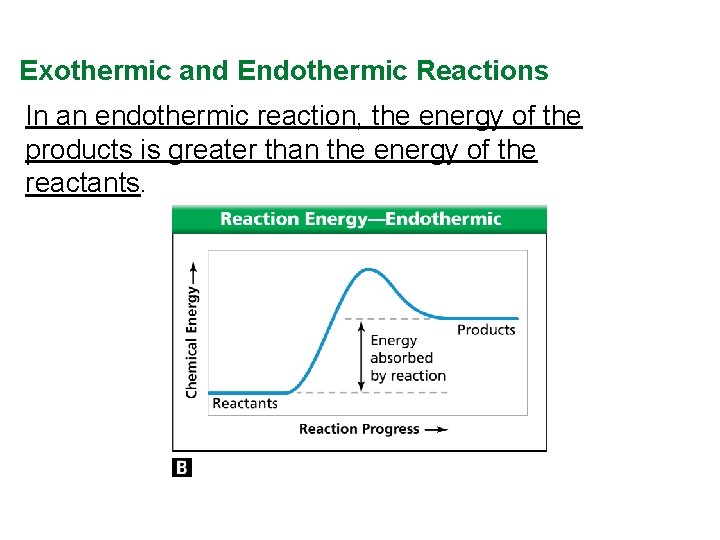
Exothermic and Endothermic Reactions A chemical reaction that absorbs energy from its surroundings is called an endothermic reaction. In an endothermic reaction, more energy is required to break the bonds in the reactants than is released by the formation of the products.
Exothermic and Endothermic Reactions In an endothermic reaction, the energy of the products is greater than the energy of the reactants.
Exothermic and Endothermic Reactions In an endothermic reaction, the energy of the products is greater than the energy of the reactants.
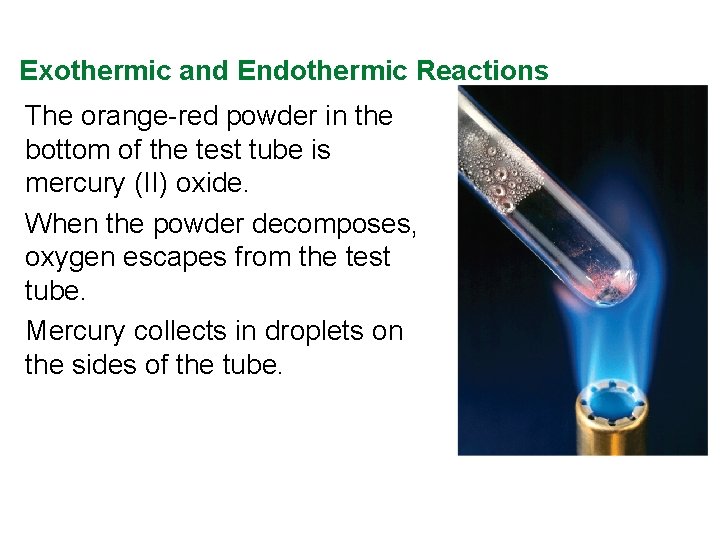
Exothermic and Endothermic Reactions At about 450°C, mercury(II) oxide decomposes into oxygen gas and liquid mercury. The decomposition of mercury(II) oxide is an endothermic reaction. 2 Hg. O + 181. 7 k. J 2 Hg + O 2
Exothermic and Endothermic Reactions The orange-red powder in the bottom of the test tube is mercury (II) oxide. When the powder decomposes, oxygen escapes from the test tube. Mercury collects in droplets on the sides of the tube.
Conservation of Energy In an exothermic reaction, the chemical energy of the reactants is converted into heat plus the chemical energy of the products. Heat is a product In an endothermic reaction, heat plus the chemical energy of the reactants is converted into the chemical energy of the products. Heat is a reactant
Conservation of Energy In both cases, the total energy before and after the reaction is the same. This principle is known as the law of conservation of energy.
Assessment Questions 1. During a chemical reaction, an input of energy is always required to a. b. c. d. break chemical bonds in a molecule. build chemical bonds as a molecule forms. separate products from reactants. change reactants to the liquid phase so they can react.
Assessment Questions 2. In an exothermic reaction, the total chemical energy of the products added to the energy released by the reactions is a. b. c. d. less than the energy of the reactants. equal to the chemical energy of the reactants. greater than the chemical energy of the reactants. not related to the chemical energy of the reactants.
Assessment Questions 3. Combustion is always an exothermic reaction. True False
7. 4 Reaction Rates
If you eat a banana, you provide your body with about 100 Calories of energy to burn. This energy is slowly released in a series of reactions that take place inside your body. A much faster way of releasing the energy contained in a banana is to burn it—outside the body—in a combustion reaction. The total amount of energy released is the same in both cases.
Reactions Over Time What does a reaction rate tell you? how fast a reaction is taking place. A reaction rate is the rate at which reactants change into products over time.
Reactions Over Time The reaction rate is how fast the reactants are being consumed, how fast the products are being formed, or how fast energy is being absorbed or released.
Factors Affecting Reaction Rates What factors cause reaction rates to change? Factors that affect reaction rates include: temperature, surface area, concentration, stirring, and catalysts.
Factors Affecting Reaction Rates The reaction rate of a chemical reaction depends on how often reactant particles collide. • If the collisions occur more frequently, then the reaction rate increases. • If the collisions occur less frequently, then the reaction rate decreases. • Reaction rates can be changed by varying conditions.
Factors Affecting Reaction Rates Temperature Generally, an increase in temperature will increase the reaction rate, while a decrease in temperature will decrease the reaction rate. You store milk in a refrigerator to slow down the reactions that cause the milk to spoil. The rate of spoiling decreases if the milk is kept cold.
Factors Affecting Reaction Rates Increasing the temperature of a substance causes its particles to move faster. Particles that move faster are both more likely to collide and more likely to react. If the number of collisions that produce reactions increases, then the reaction rate increases.
Factors Affecting Reaction Rates Surface Area The smaller the particle size of a given mass, the larger is its surface area. • Increased surface area increases collisions that involve reacting particles. • With more collisions, more particles will react.
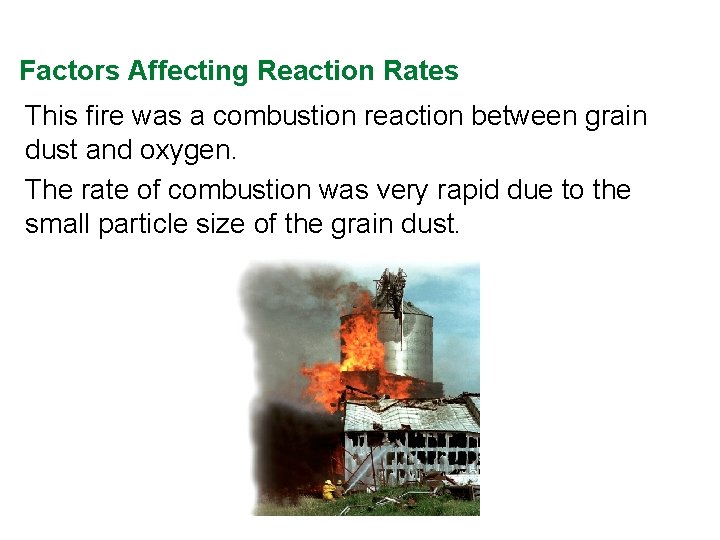
Factors Affecting Reaction Rates This fire was a combustion reaction between grain dust and oxygen. The rate of combustion was very rapid due to the small particle size of the grain dust.
Factors Affecting Reaction Rates Stirring reactants increases their exposure to each other. In a washing machine, particles of detergent react with particles of the stains on clothes. A washing machine speeds up the reaction by stirring the contents back and forth.
Factors Affecting Reaction Rates Concentration refers to the number of particles in a given volume. You can change the reaction rate by changing the concentration of the reactants. The more reacting particles that are present in a given volume, the more opportunities there are for collisions involving those particles. The reaction rate is faster.
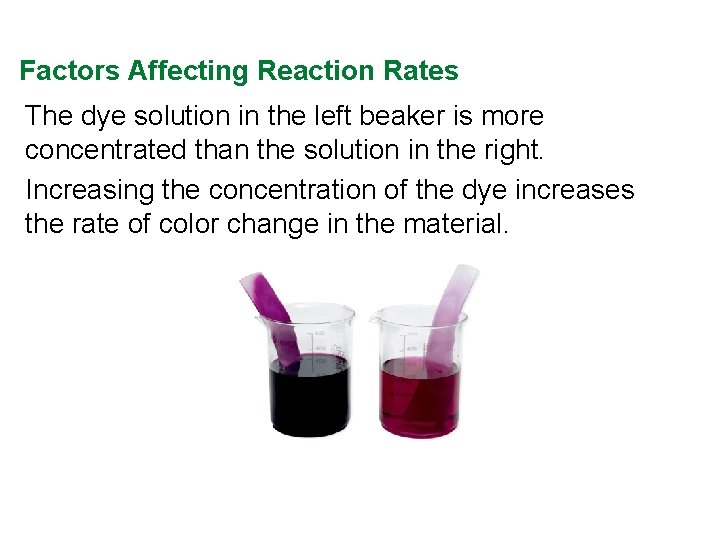
Factors Affecting Reaction Rates The dye solution in the left beaker is more concentrated than the solution in the right. Increasing the concentration of the dye increases the rate of color change in the material.
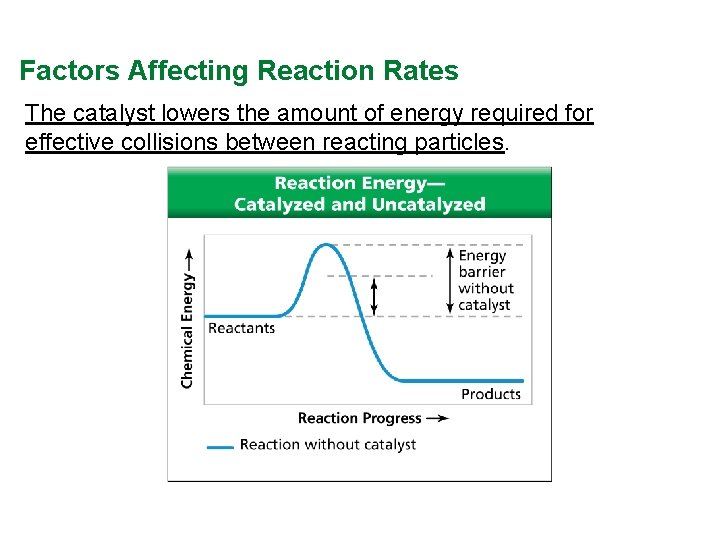
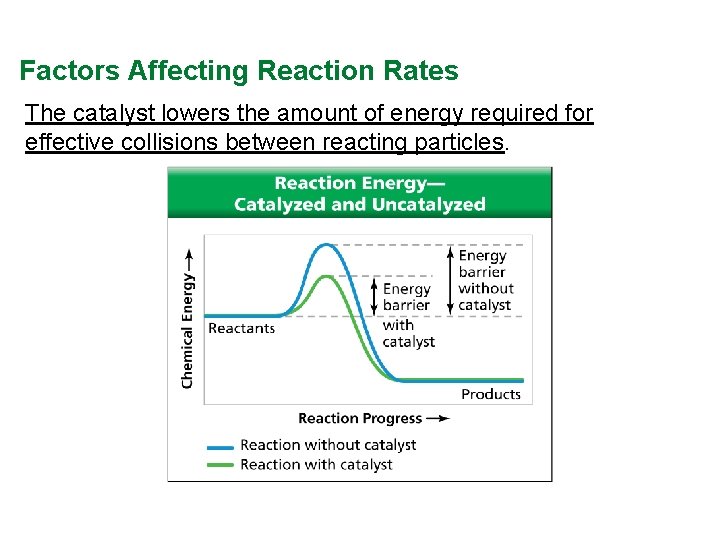
Factors Affecting Reaction Rates Catalysts A catalyst is a substance that affects the reaction rate without being used up in the reaction. Chemists often use catalysts to speed up a reaction or enable a reaction to occur at a lower temperature.
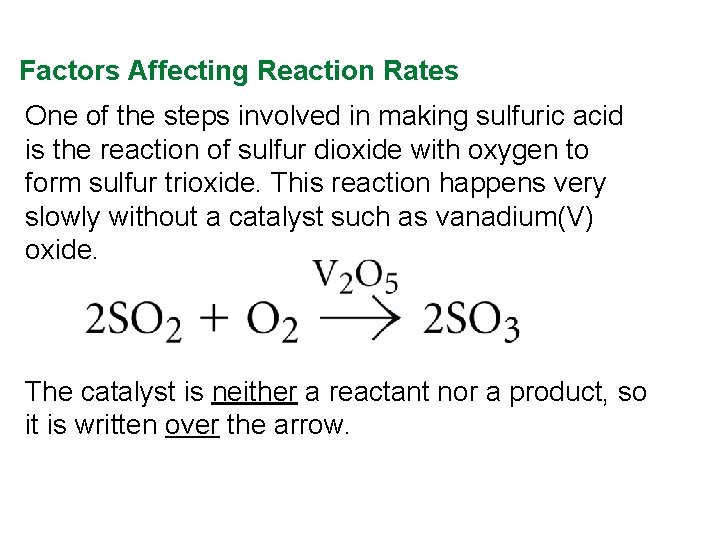
Factors Affecting Reaction Rates One of the steps involved in making sulfuric acid is the reaction of sulfur dioxide with oxygen to form sulfur trioxide. This reaction happens very slowly without a catalyst such as vanadium(V) oxide. The catalyst is neither a reactant nor a product, so it is written over the arrow.
Factors Affecting Reaction Rates The catalyst lowers the amount of energy required for effective collisions between reacting particles.
Factors Affecting Reaction Rates The catalyst lowers the amount of energy required for effective collisions between reacting particles.
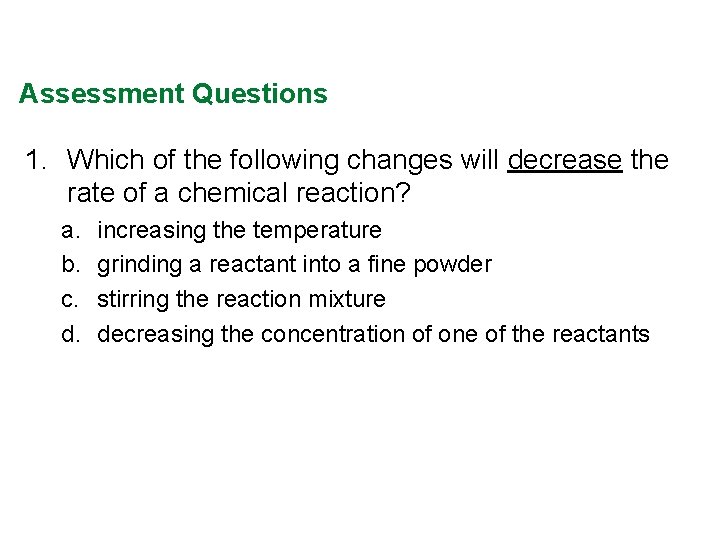
Assessment Questions 1. Which of the following changes will decrease the rate of a chemical reaction? a. b. c. d. increasing the temperature grinding a reactant into a fine powder stirring the reaction mixture decreasing the concentration of one of the reactants
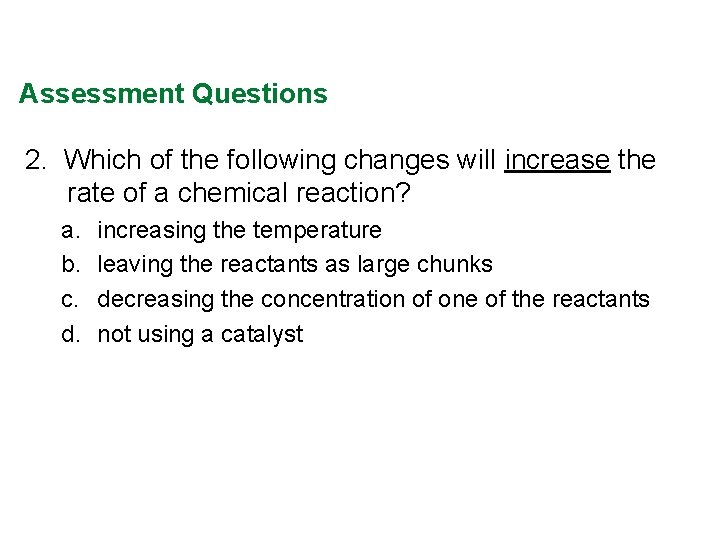
Assessment Questions 2. Which of the following changes will increase the rate of a chemical reaction? a. b. c. d. increasing the temperature leaving the reactants as large chunks decreasing the concentration of one of the reactants not using a catalyst
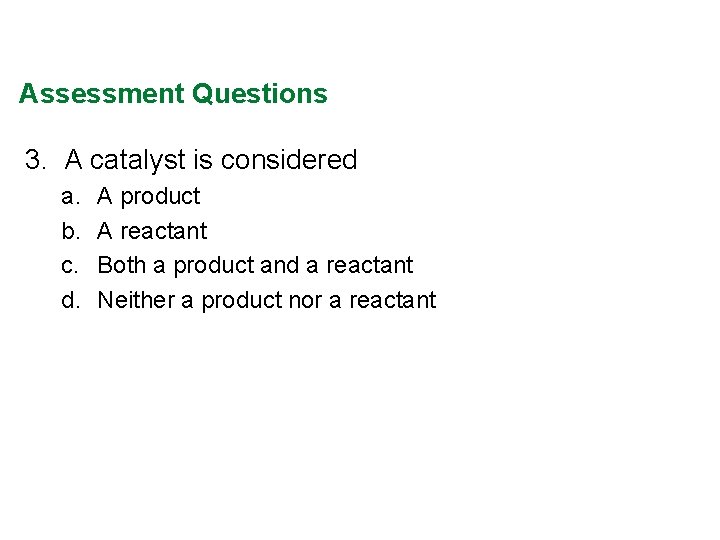
Assessment Questions 3. A catalyst is considered a. b. c. d. A product A reactant Both a product and a reactant Neither a product nor a reactant