
7 2 The Pythagorean Theorem and its Converse

- Slides: 11
7 -2 The Pythagorean Theorem and its Converse M 11. C. 1 2. 9. 11. G 2) Objectives: 1) To use the Pythagorean Theorem. To use the converse of the Pythagorean Theorem.
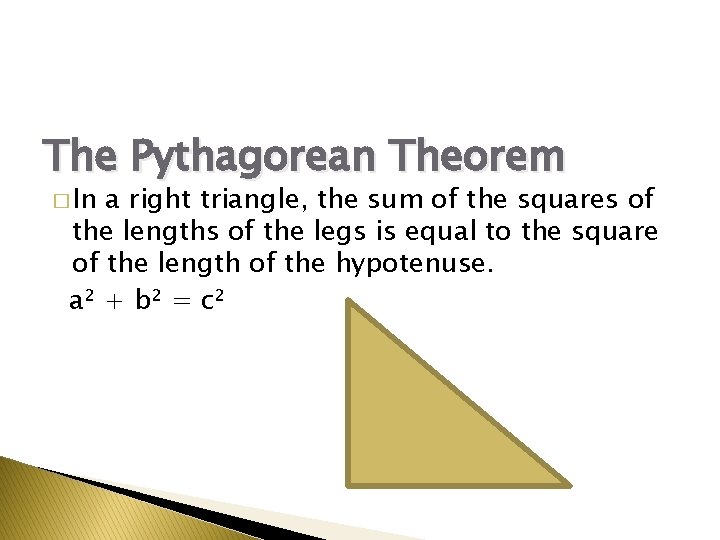
The Pythagorean Theorem � In a right triangle, the sum of the squares of the lengths of the legs is equal to the square of the length of the hypotenuse. a² + b² = c²
Pythagorean Triple � Is a set of nonzero whole numbers a, b, c that satisfy the equation a² + b² = c² � Examples: (most common) 3, 4, 5 5, 12, 13 8, 15, 17 7, 24, 25 **If you multiply each number in a Pythagorean triple by the same whole number, the three numbers is a new triple.
Examples: Pythagorean Triples �A right triangle has legs of length 16 and 30. Find the hypotenuse. Do the lengths form a Pythagorean triple?
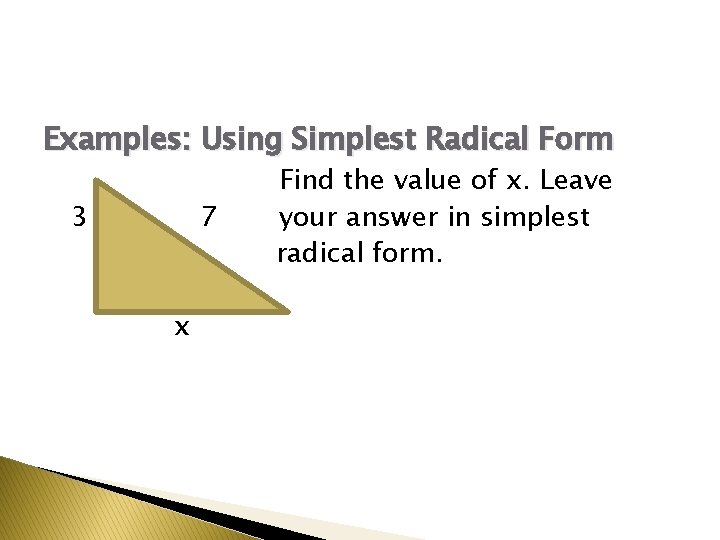
Examples: Using Simplest Radical Form 3 7 x Find the value of x. Leave your answer in simplest radical form.
Example � The hypotenuse if a right triangle has length 12. One leg has length 6. Find the length of the other leg. Leave your answer in simplest radical form.
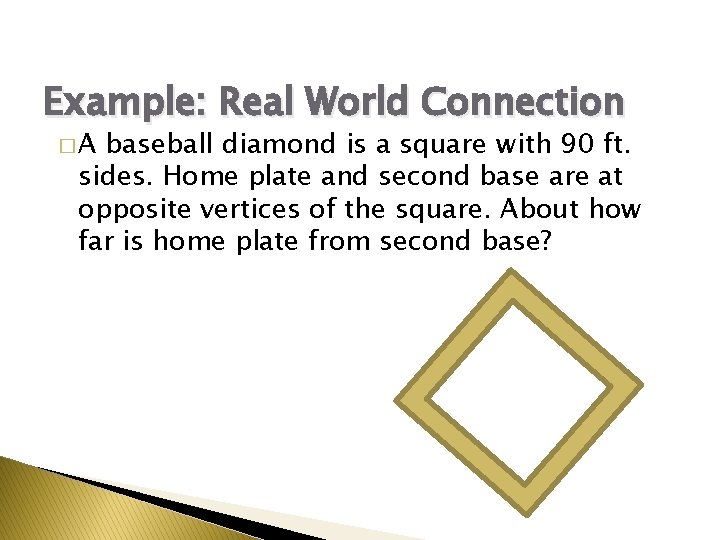
Example: Real World Connection �A baseball diamond is a square with 90 ft. sides. Home plate and second base are at opposite vertices of the square. About how far is home plate from second base?
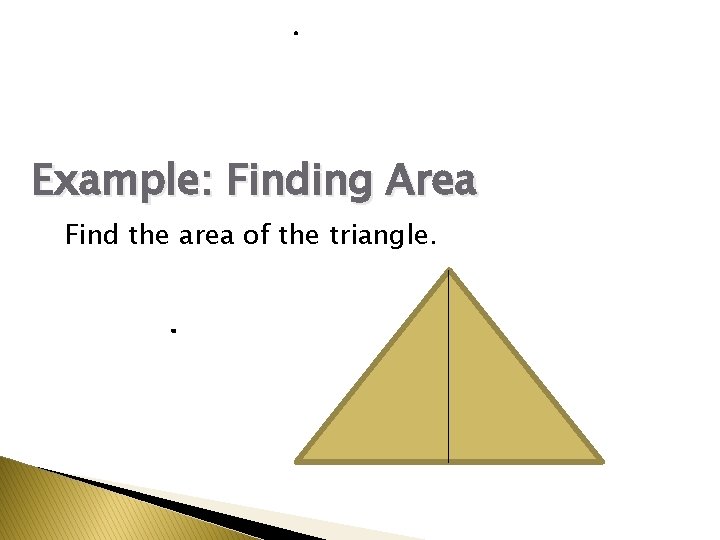
Example: Finding Area Find the area of the triangle.
Converse of the Pythagorean Theorem � If the square of the length of one side of a triangle is equal to the sum of the squares of the lengths of the other two sides, then the triangle is a right triangle.
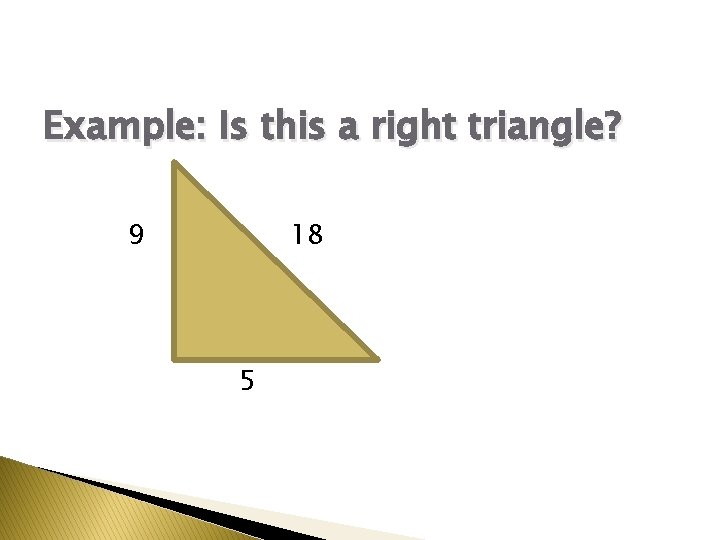
Example: Is this a right triangle? 9 18 5
Classwork Handed-In Page 360 #1 -12, 16, 18 -23