
7 1 Substitution reactions One group of atoms
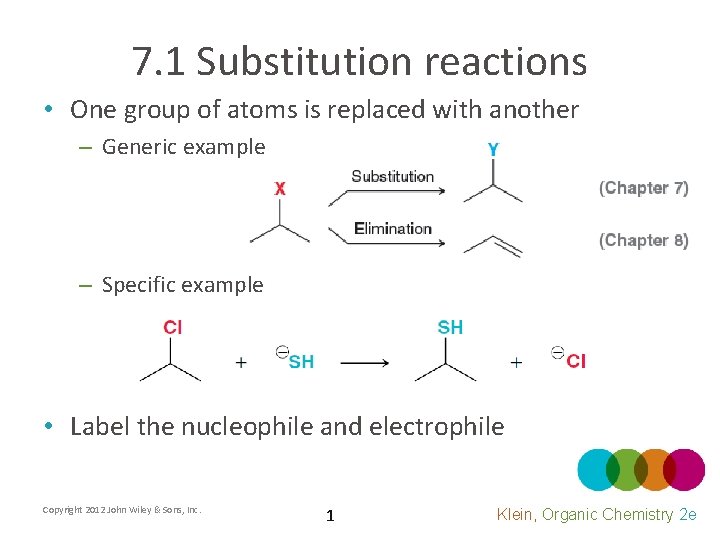
7. 1 Substitution reactions • One group of atoms is replaced with another – Generic example – Specific example • Label the nucleophile and electrophile Copyright 2012 John Wiley & Sons, Inc. 1 Klein, Organic Chemistry 2 e
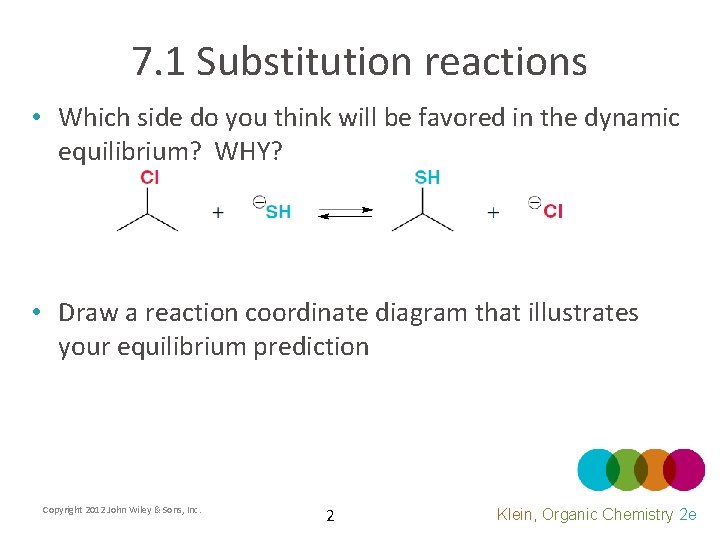
7. 1 Substitution reactions • Which side do you think will be favored in the dynamic equilibrium? WHY? • Draw a reaction coordinate diagram that illustrates your equilibrium prediction Copyright 2012 John Wiley & Sons, Inc. 2 Klein, Organic Chemistry 2 e
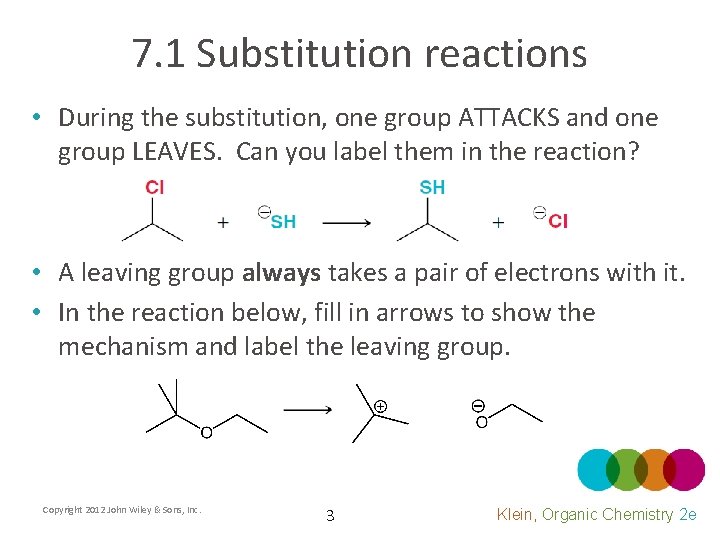
7. 1 Substitution reactions • During the substitution, one group ATTACKS and one group LEAVES. Can you label them in the reaction? • A leaving group always takes a pair of electrons with it. • In the reaction below, fill in arrows to show the mechanism and label the leaving group. Copyright 2012 John Wiley & Sons, Inc. 3 Klein, Organic Chemistry 2 e
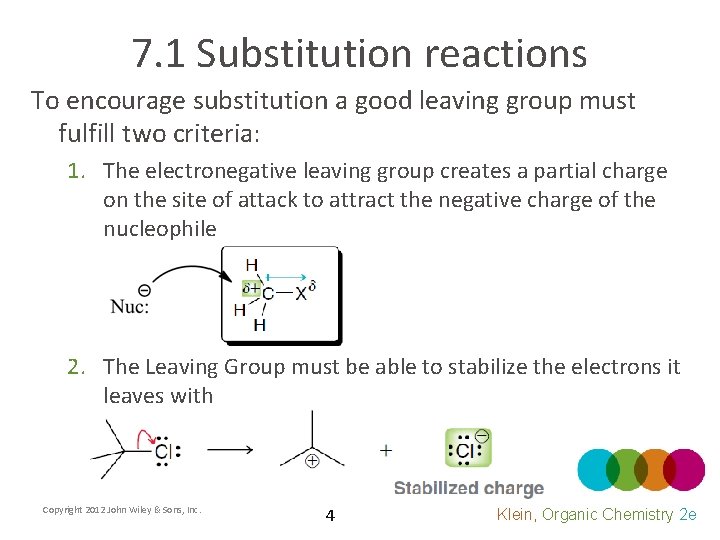
7. 1 Substitution reactions To encourage substitution a good leaving group must fulfill two criteria: 1. The electronegative leaving group creates a partial charge on the site of attack to attract the negative charge of the nucleophile 2. The Leaving Group must be able to stabilize the electrons it leaves with Copyright 2012 John Wiley & Sons, Inc. 4 Klein, Organic Chemistry 2 e
7. 1 Substitution reactions Can you give some examples of groups of atoms that qualify as good leaving groups according to the two key criteria? 1. Create a positive charge to attract the nucleophile. 2. Be able to stabilize the electrons it leaves with Copyright 2012 John Wiley & Sons, Inc. 5 Klein, Organic Chemistry 2 e
7. 2 Alkyl Halides • Alkyl halides are compounds where a carbon group (alkyl) is bonded to a halide (F, Cl, Br, or I) • Recall from section 4. 2 the steps we use to name a molecule 1. 2. 3. 4. • Identify and name the parent chain Identify the name of the substituents Assign a locant (number) to each substituents Assemble the name alphabetically The halide group is the key substituent we will name and locate Copyright 2012 John Wiley & Sons, Inc. 6 Klein, Organic Chemistry 2 e
7. 2 Alkyl Halide Nomenclature • For each of these examples, convince yourself that they are numbered in the most appropriate way. Copyright 2012 John Wiley & Sons, Inc. 7 Klein, Organic Chemistry 2 e
7. 2 Alkyl Halide Nomenclature • Some simple molecules are also recognized by their common names. – the alkyl group is named as the substituent, and the halide is treated as the parent name Methylene chloride is a commonly used organic solvent Copyright 2012 John Wiley & Sons, Inc. 8 Klein, Organic Chemistry 2 e
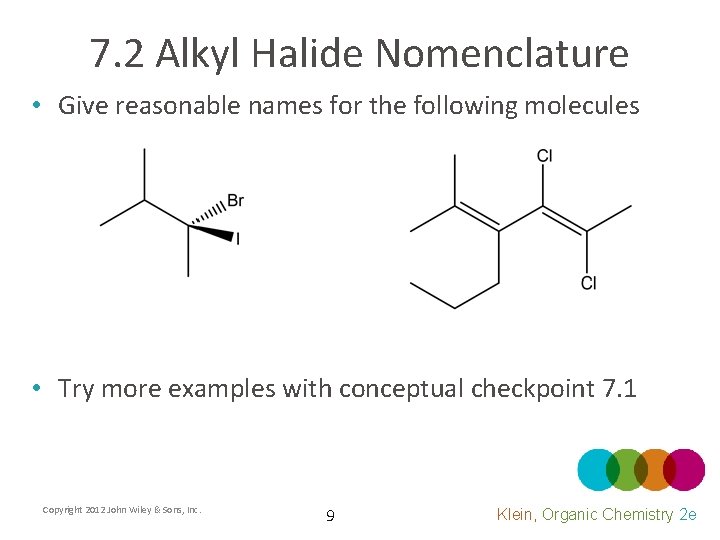
7. 2 Alkyl Halide Nomenclature • Give reasonable names for the following molecules • Try more examples with conceptual checkpoint 7. 1 Copyright 2012 John Wiley & Sons, Inc. 9 Klein, Organic Chemistry 2 e
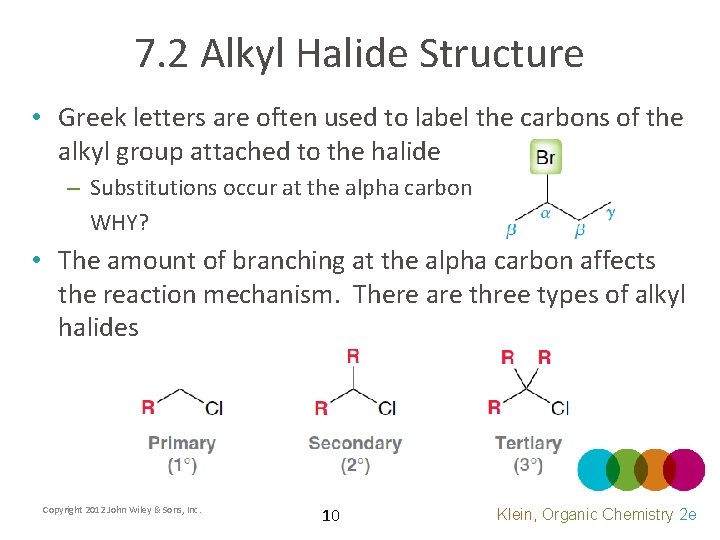
7. 2 Alkyl Halide Structure • Greek letters are often used to label the carbons of the alkyl group attached to the halide – Substitutions occur at the alpha carbon WHY? • The amount of branching at the alpha carbon affects the reaction mechanism. There are three types of alkyl halides Copyright 2012 John Wiley & Sons, Inc. 10 Klein, Organic Chemistry 2 e
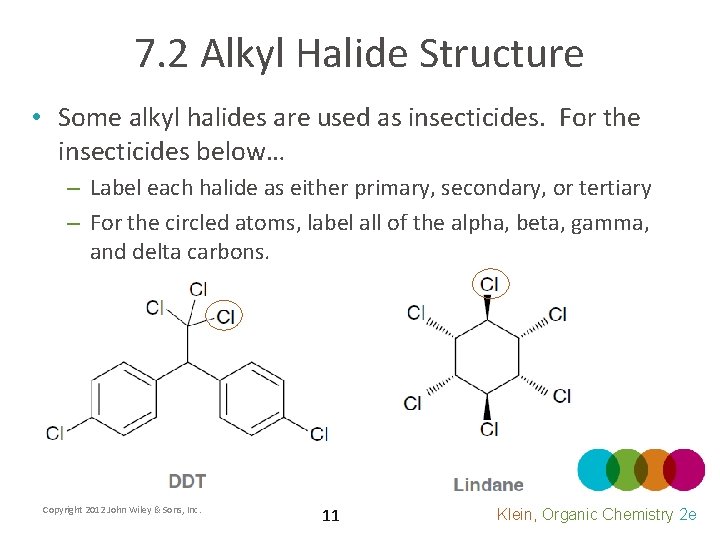
7. 2 Alkyl Halide Structure • Some alkyl halides are used as insecticides. For the insecticides below… – Label each halide as either primary, secondary, or tertiary – For the circled atoms, label all of the alpha, beta, gamma, and delta carbons. Copyright 2012 John Wiley & Sons, Inc. 11 Klein, Organic Chemistry 2 e
7. 2 Alkyl Halide Structure • Halides appear in a wide variety of natural products and synthetic compounds • The structure of the molecule determines its function, and functions include… – – – Insecticides (DDT, etc. ) Dyes (tyrian purple, etc. ) Drugs (anticancer, antidepressants, antimicrobial, etc. ) Food additives (Splenda, etc. ) Many more Copyright 2012 John Wiley & Sons, Inc. 12 Klein, Organic Chemistry 2 e
7. 2 Alkyl Halide Structure HOW does a molecule’s structure affect its function and properties? Copyright 2012 John Wiley & Sons, Inc. 13 Klein, Organic Chemistry 2 e
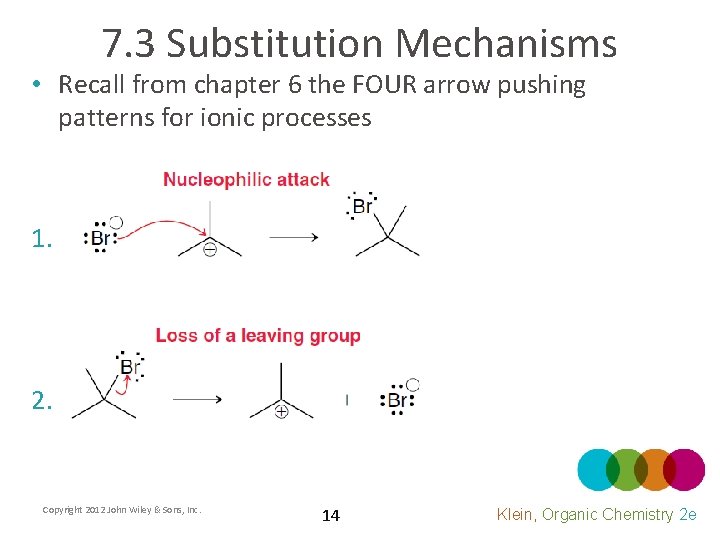
7. 3 Substitution Mechanisms • Recall from chapter 6 the FOUR arrow pushing patterns for ionic processes 1. 2. Copyright 2012 John Wiley & Sons, Inc. 14 Klein, Organic Chemistry 2 e
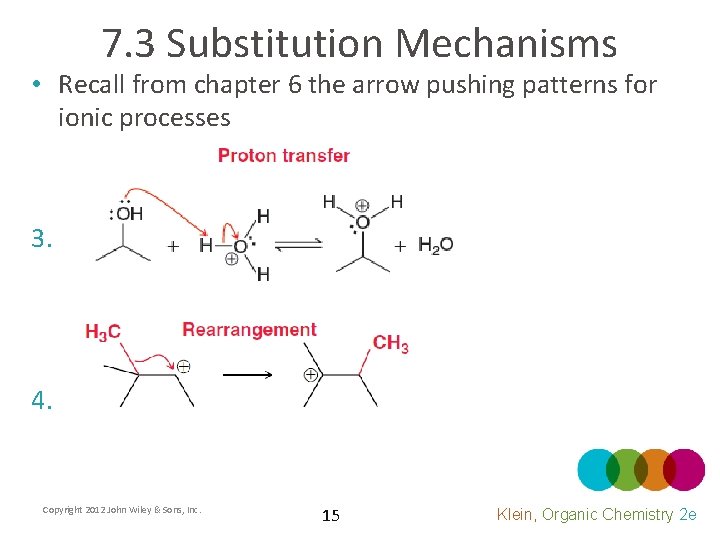
7. 3 Substitution Mechanisms • Recall from chapter 6 the arrow pushing patterns for ionic processes 3. 4. Copyright 2012 John Wiley & Sons, Inc. 15 Klein, Organic Chemistry 2 e
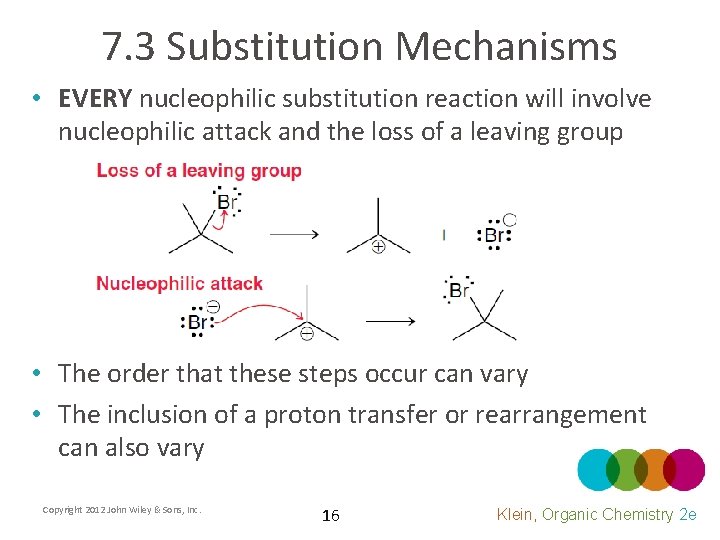
7. 3 Substitution Mechanisms • EVERY nucleophilic substitution reaction will involve nucleophilic attack and the loss of a leaving group • The order that these steps occur can vary • The inclusion of a proton transfer or rearrangement can also vary Copyright 2012 John Wiley & Sons, Inc. 16 Klein, Organic Chemistry 2 e
7. 3 Substitution Mechanisms • Draw mechanisms for each possibility and critique their likelihood 1. Nucleophilic attack first then loss of leaving group. 2. Loss of leaving group first then nucleophilic attack 3. Both happen simultaneously • Practice arrow pushing with Skill. Builder 7. 1 Copyright 2012 John Wiley & Sons, Inc. 17 Klein, Organic Chemistry 2 e
7. 4 SN 2 – a concerted mechanism • How might you write a rate law for this reaction? • How would you design a laboratory experiment to test this mechanism? • Test yourself with conceptual checkpoint 7. 6 Copyright 2012 John Wiley & Sons, Inc. 18 Klein, Organic Chemistry 2 e
7. 4 SN 2 – stereochemistry • What do S, N, and 2 stand for in the SN 2 name? • How might we use stereochemistry to support the SN 2 mechanism for the following reaction? • Practice drawing SN 2 reactions with Skill. Builder 7. 2 Copyright 2012 John Wiley & Sons, Inc. 19 Klein, Organic Chemistry 2 e
7. 4 SN 2 – backside attack • The nucleophile attacks from the back-side – Electron density repels the attacking nucleophile from the front-side – The nucleophile must approach the back-side to allow electrons to flow from the HOMO of the nucleophile to the LUMO of the electrophile. – Proper orbital overlap cannot occur with front-side attack because there is a node on the front-side of the LUMO Copyright 2012 John Wiley & Sons, Inc. 20 Klein, Organic Chemistry 2 e
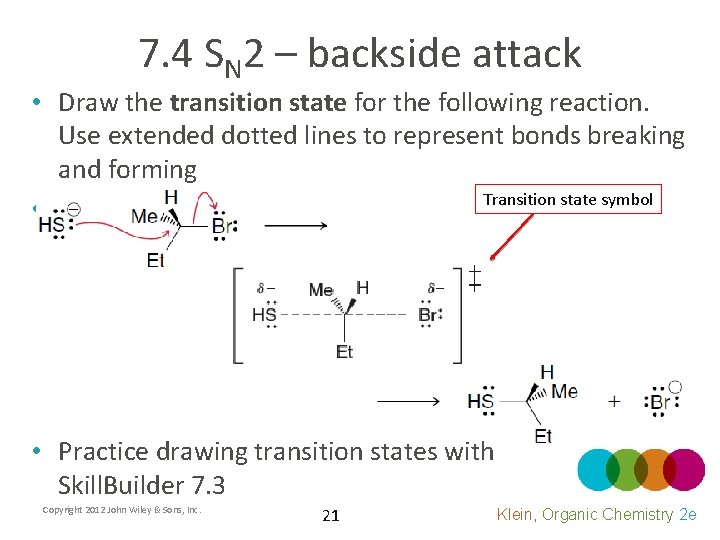
7. 4 SN 2 – backside attack • Draw the transition state for the following reaction. Use extended dotted lines to represent bonds breaking and forming Transition state symbol • sy • Practice drawing transition states with Skill. Builder 7. 3 Copyright 2012 John Wiley & Sons, Inc. 21 Klein, Organic Chemistry 2 e
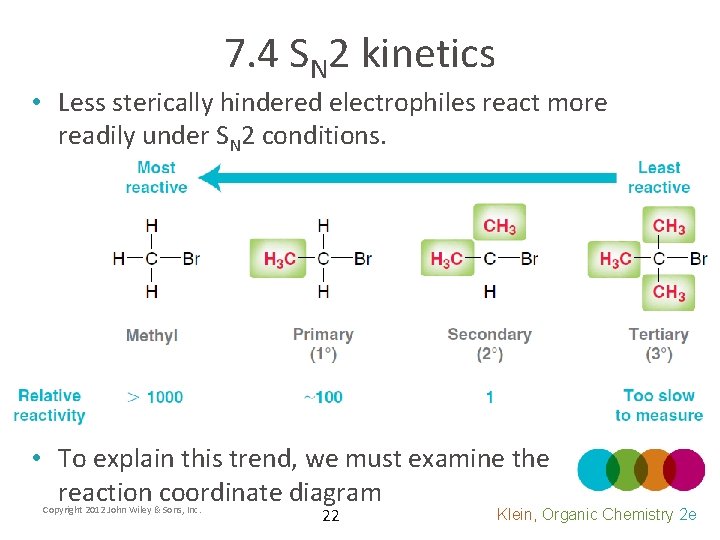
7. 4 SN 2 kinetics • Less sterically hindered electrophiles react more readily under SN 2 conditions. • To explain this trend, we must examine the reaction coordinate diagram Copyright 2012 John Wiley & Sons, Inc. 22 Klein, Organic Chemistry 2 e
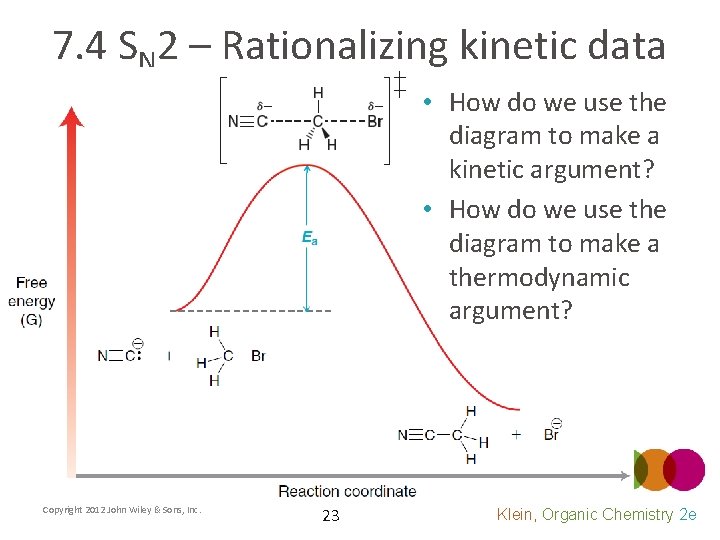
7. 4 SN 2 – Rationalizing kinetic data • How do we use the diagram to make a kinetic argument? • How do we use the diagram to make a thermodynamic argument? Copyright 2012 John Wiley & Sons, Inc. 23 Klein, Organic Chemistry 2 e
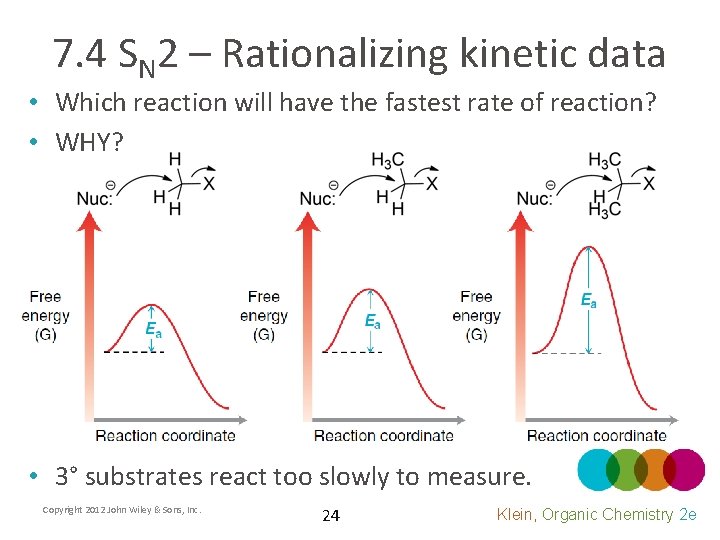
7. 4 SN 2 – Rationalizing kinetic data • Which reaction will have the fastest rate of reaction? • WHY? • 3° substrates react too slowly to measure. Copyright 2012 John Wiley & Sons, Inc. 24 Klein, Organic Chemistry 2 e
7. 4 SN 2 – Rationalizing kinetic data • An example to consider: neopentyl bromide • Draw the structure of neopentyl bromide • Is neopentyl bromide a primary, secondary, or tertiary alkyl bromide? • Should neopentyl bromide react by an SN 2 reaction relatively quickly or relatively slowly? WHY? Copyright 2012 John Wiley & Sons, Inc. 25 Klein, Organic Chemistry 2 e
7. 4 SN 2 – Rationalizing kinetic data • If you memorize rules, you will probably miss questions about exceptions to rules • It is better to understand the concepts than to memorize rules Copyright 2012 John Wiley & Sons, Inc. 26 Klein, Organic Chemistry 2 e
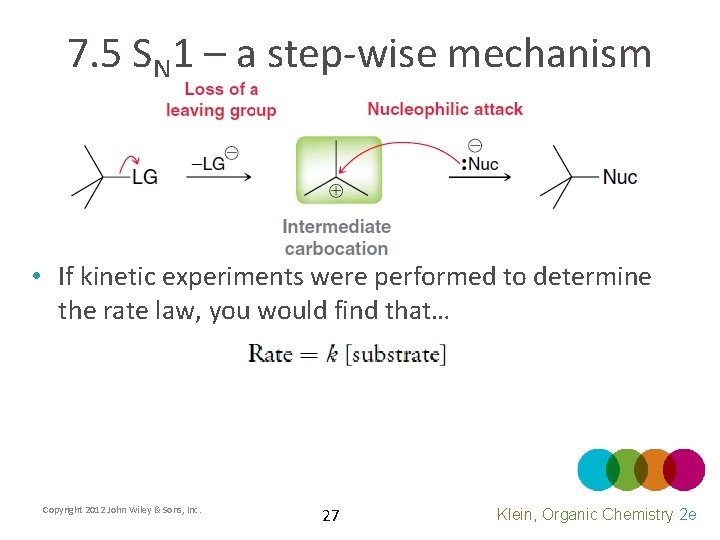
7. 5 SN 1 – a step-wise mechanism • If kinetic experiments were performed to determine the rate law, you would find that… Copyright 2012 John Wiley & Sons, Inc. 27 Klein, Organic Chemistry 2 e

7. 5 SN 1 – reaction coordinate • A two-step mechanism gives a diagram with two transitions states. Where on the diagram is the intermediate? Copyright 2012 John Wiley & Sons, Inc. 28 Klein, Organic Chemistry 2 e

7. 5 SN 1 – reaction coordinate • What is happening to the molecule in each transition state? Copyright 2012 John Wiley & Sons, Inc. 29 Klein, Organic Chemistry 2 e
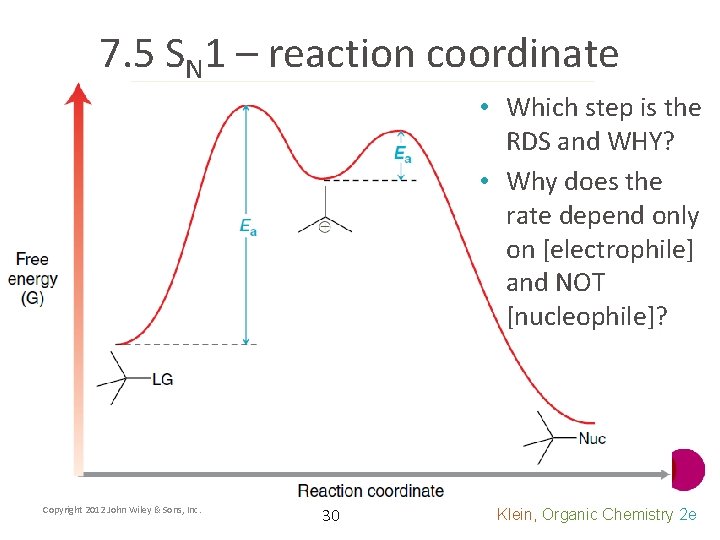
7. 5 SN 1 – reaction coordinate • Which step is the RDS and WHY? • Why does the rate depend only on [electrophile] and NOT [nucleophile]? Copyright 2012 John Wiley & Sons, Inc. 30 Klein, Organic Chemistry 2 e
7. 5 SN 1 – a step-wise mechanism • What do the S, N, and 1 stand for in the SN 1 name? Copyright 2012 John Wiley & Sons, Inc. 31 Klein, Organic Chemistry 2 e
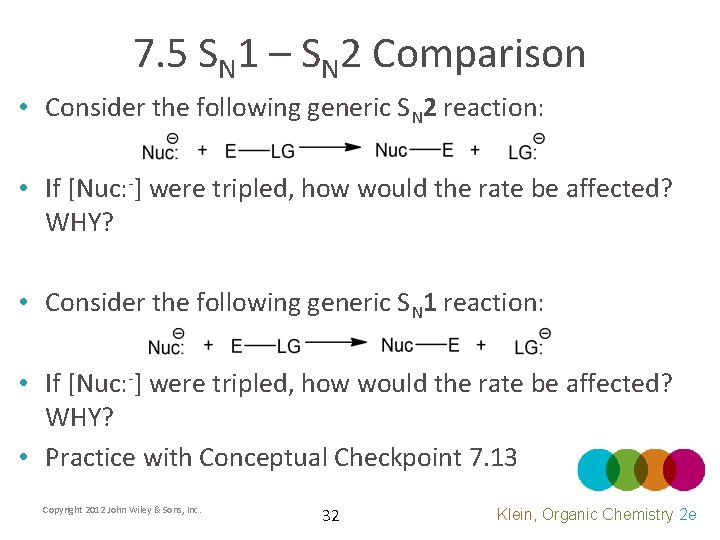
7. 5 SN 1 – SN 2 Comparison • Consider the following generic SN 2 reaction: • If [Nuc: -] were tripled, how would the rate be affected? WHY? • Consider the following generic SN 1 reaction: • If [Nuc: -] were tripled, how would the rate be affected? WHY? • Practice with Conceptual Checkpoint 7. 13 Copyright 2012 John Wiley & Sons, Inc. 32 Klein, Organic Chemistry 2 e
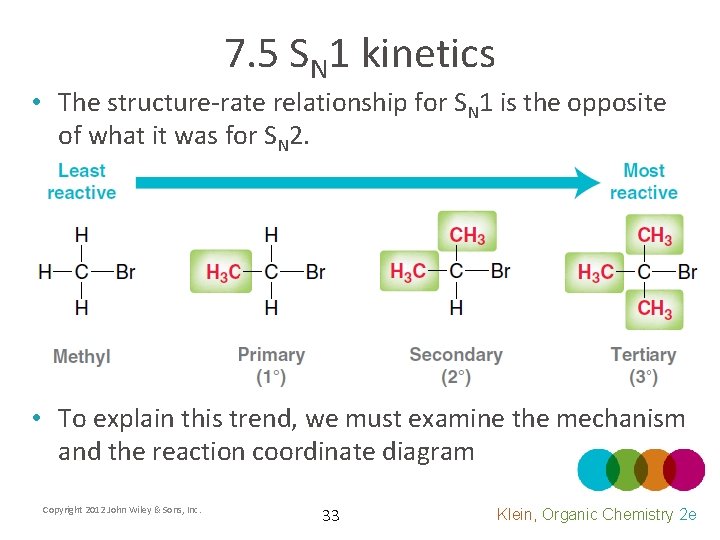
7. 5 SN 1 kinetics • The structure-rate relationship for SN 1 is the opposite of what it was for SN 2. • To explain this trend, we must examine the mechanism and the reaction coordinate diagram Copyright 2012 John Wiley & Sons, Inc. 33 Klein, Organic Chemistry 2 e
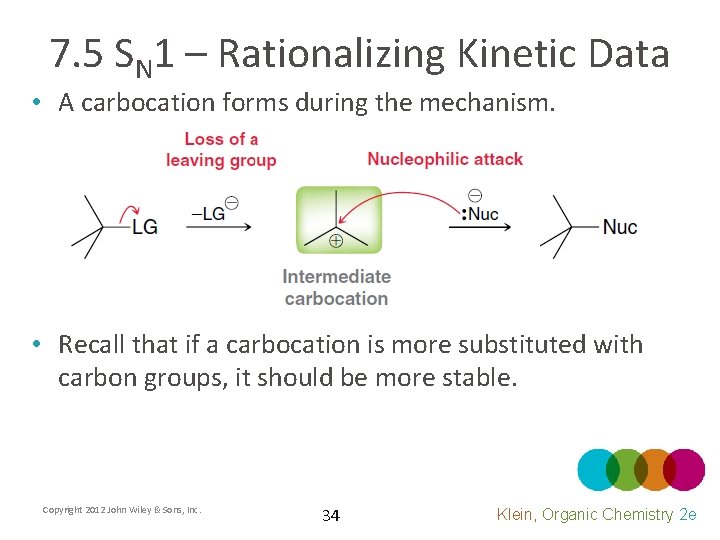
7. 5 SN 1 – Rationalizing Kinetic Data • A carbocation forms during the mechanism. • Recall that if a carbocation is more substituted with carbon groups, it should be more stable. Copyright 2012 John Wiley & Sons, Inc. 34 Klein, Organic Chemistry 2 e
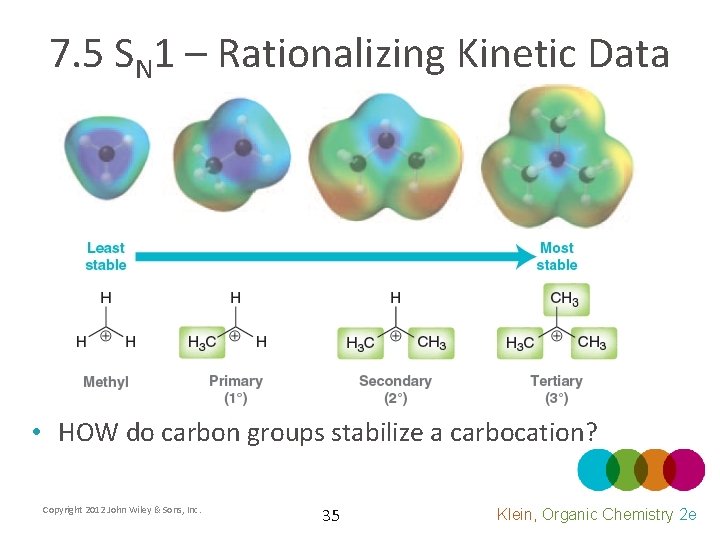
7. 5 SN 1 – Rationalizing Kinetic Data • HOW do carbon groups stabilize a carbocation? Copyright 2012 John Wiley & Sons, Inc. 35 Klein, Organic Chemistry 2 e
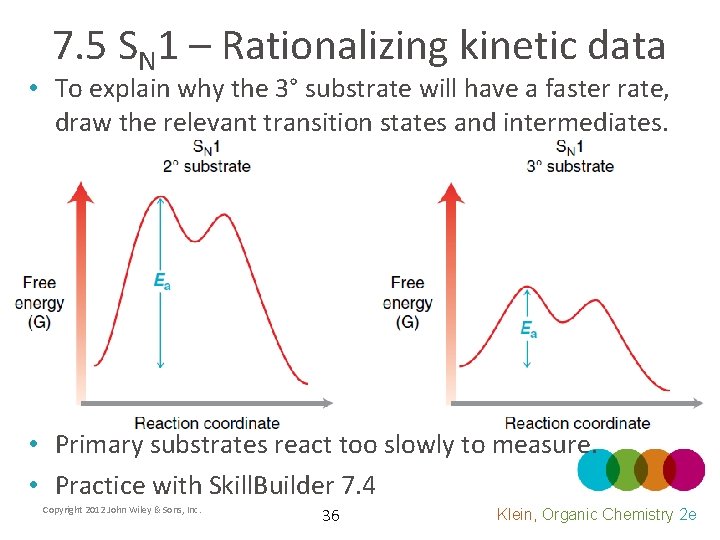
7. 5 SN 1 – Rationalizing kinetic data • To explain why the 3° substrate will have a faster rate, draw the relevant transition states and intermediates. • Primary substrates react too slowly to measure. • Practice with Skill. Builder 7. 4 Copyright 2012 John Wiley & Sons, Inc. 36 Klein, Organic Chemistry 2 e
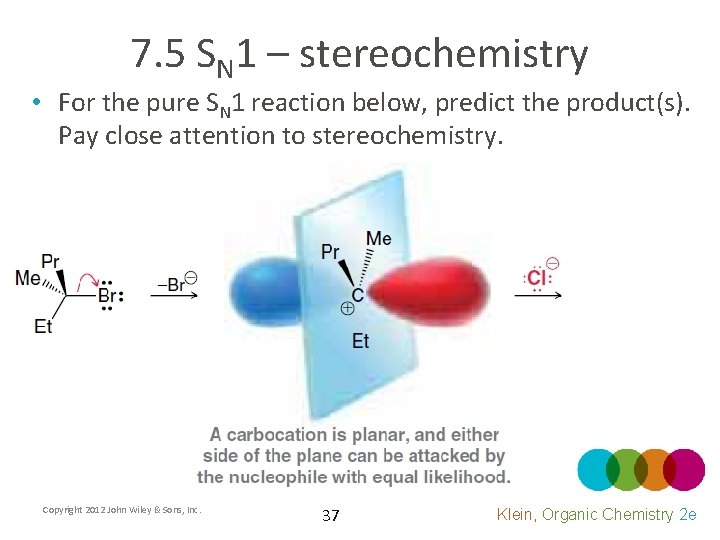
7. 5 SN 1 – stereochemistry • For the pure SN 1 reaction below, predict the product(s). Pay close attention to stereochemistry. Copyright 2012 John Wiley & Sons, Inc. 37 Klein, Organic Chemistry 2 e
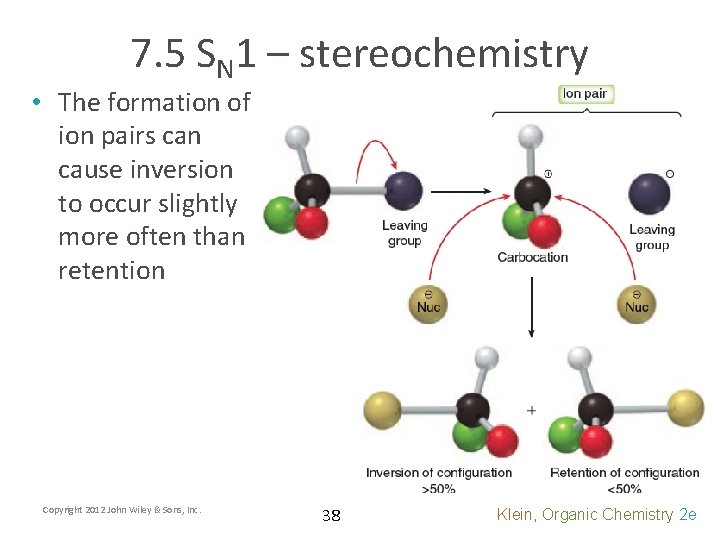
7. 5 SN 1 – stereochemistry • The formation of ion pairs can cause inversion to occur slightly more often than retention Copyright 2012 John Wiley & Sons, Inc. 38 Klein, Organic Chemistry 2 e
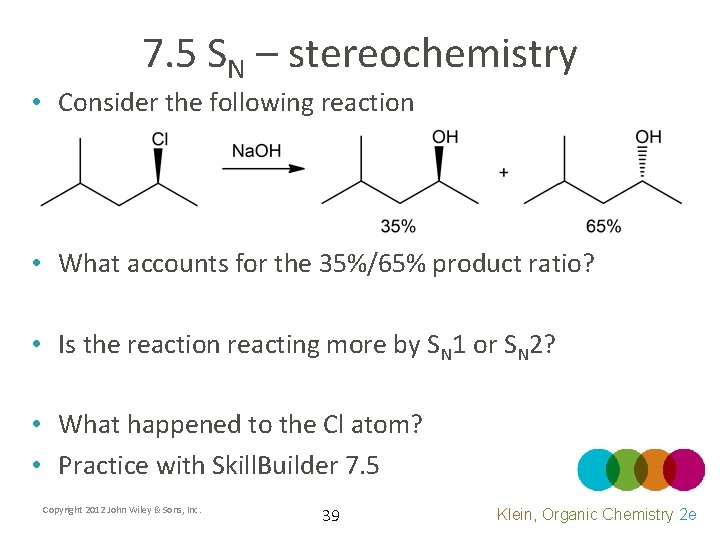
7. 5 SN – stereochemistry • Consider the following reaction • What accounts for the 35%/65% product ratio? • Is the reaction reacting more by SN 1 or SN 2? • What happened to the Cl atom? • Practice with Skill. Builder 7. 5 Copyright 2012 John Wiley & Sons, Inc. 39 Klein, Organic Chemistry 2 e
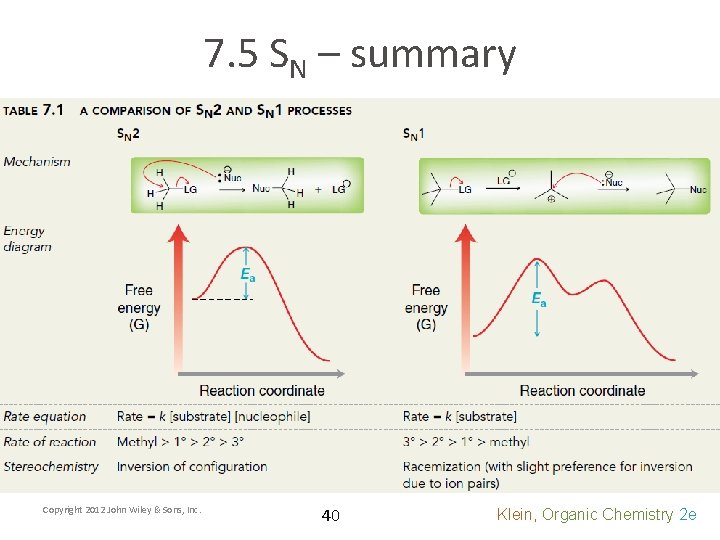
7. 5 SN – summary Copyright 2012 John Wiley & Sons, Inc. 40 Klein, Organic Chemistry 2 e
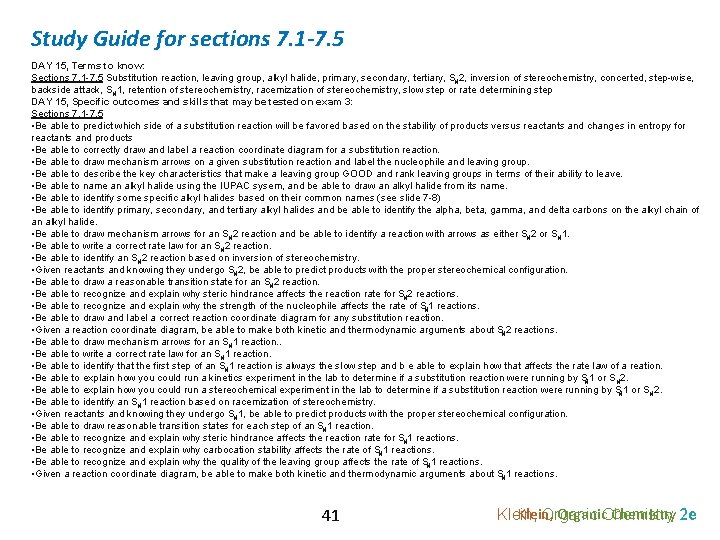
Study Guide for sections 7. 1 -7. 5 DAY 15, Terms to know: Sections 7. 1 -7. 5 Substitution reaction, leaving group, alkyl halide, primary, secondary, tertiary, SN 2, inversion of stereochemistry, concerted, step-wise, backside attack, SN 1, retention of stereochemistry, racemization of stereochemistry, slow step or rate determining step DAY 15, Specific outcomes and skills that may be tested on exam 3: Sections 7. 1 -7. 5 • Be able to predict which side of a substitution reaction will be favored based on the stability of products versus reactants and changes in entropy for reactants and products • Be able to correctly draw and label a reaction coordinate diagram for a substitution reaction. • Be able to draw mechanism arrows on a given substitution reaction and label the nucleophile and leaving group. • Be able to describe the key characteristics that make a leaving group GOOD and rank leaving groups in terms of their ability to leave. • Be able to name an alkyl halide using the IUPAC sysem, and be able to draw an alkyl halide from its name. • Be able to identify some specific alkyl halides based on their common names (see slide 7 -8) • Be able to identify primary, secondary, and tertiary alkyl halides and be able to identify the alpha, beta, gamma, and delta carbons on the alkyl chain of an alkyl halide. • Be able to draw mechanism arrows for an SN 2 reaction and be able to identify a reaction with arrows as either SN 2 or SN 1. • Be able to write a correct rate law for an SN 2 reaction. • Be able to identify an SN 2 reaction based on inversion of stereochemistry. • Given reactants and knowing they undergo SN 2, be able to predict products with the proper stereochemical configuration. • Be able to draw a reasonable transition state for an SN 2 reaction. • Be able to recognize and explain why steric hindrance affects the reaction rate for SN 2 reactions. • Be able to recognize and explain why the strength of the nucleophile affects the rate of SN 1 reactions. • Be able to draw and label a correct reaction coordinate diagram for any substitution reaction. • Given a reaction coordinate diagram, be able to make both kinetic and thermodynamic arguments about SN 2 reactions. • Be able to draw mechanism arrows for an SN 1 reaction. . • Be able to write a correct rate law for an SN 1 reaction. • Be able to identify that the first step of an SN 1 reaction is always the slow step and b e able to explain how that affects the rate law of a reation. • Be able to explain how you could run a kinetics experiment in the lab to determine if a substitution reaction were running by SN 1 or SN 2. • Be able to explain how you could run a stereochemical experiment in the lab to determine if a substitution reaction were running by SN 1 or SN 2. • Be able to identify an SN 1 reaction based on racemization of stereochemistry. • Given reactants and knowing they undergo SN 1, be able to predict products with the proper stereochemical configuration. • Be able to draw reasonable transition states for each step of an SN 1 reaction. • Be able to recognize and explain why steric hindrance affects the reaction rate for SN 1 reactions. • Be able to recognize and explain why carbocation stability affects the rate of SN 1 reactions. • Be able to recognize and explain why the quality of the leaving group affects the rate of SN 1 reactions. • Given a reaction coordinate diagram, be able to make both kinetic and thermodynamic arguments about SN 1 reactions. 41 Klein, Organic. Chemistry 2 e 2 e Klein, Organic
Practice Problems for sections 7. 1 -7. 5 Complete these problems outside of class until you are confident you have learned the SKILLS in this section outlined on the study guide and we will review some of them next class period. 7. 1 7. 2 7. 3 7. 4 7. 5 7. 6 7. 7 7. 9 7. 10 7. 13 7. 14 7. 15 7. 16 7. 17 7. 36 7. 37 42 Klein, Organic. Chemistry 2 e 2 e Klein, Organic
Prep for Day 16 Must Watch videos: https: //www. youtube. com/watch? v=4 it. AWx. AV 9 e 8, https: //www. youtube. com/watch? v=n. Xia. KLEJl 2 o (choosing between SN 2 and SN 1 ) https: //www. youtube. com/watch? v=g. C 4 Fz. WT 4 g. Os (substitution in synthesis) Other helpful videos: https: //www. youtube. com/watch? v=ZRMSHG 18 a. MY (SN 2 versus SN 1 solvent effects) http: //ps. uci. edu/content/chem-51 a-organic-chemistry (lecture 24) Read sections 7. 6 -7. 9 43 Klein, Organic. Chemistry 2 e 2 e Klein, Organic
- Slides: 43