
7 1 Rigid Motion in a Plane Preimage

- Slides: 54
7. 1 – Rigid Motion in a Plane
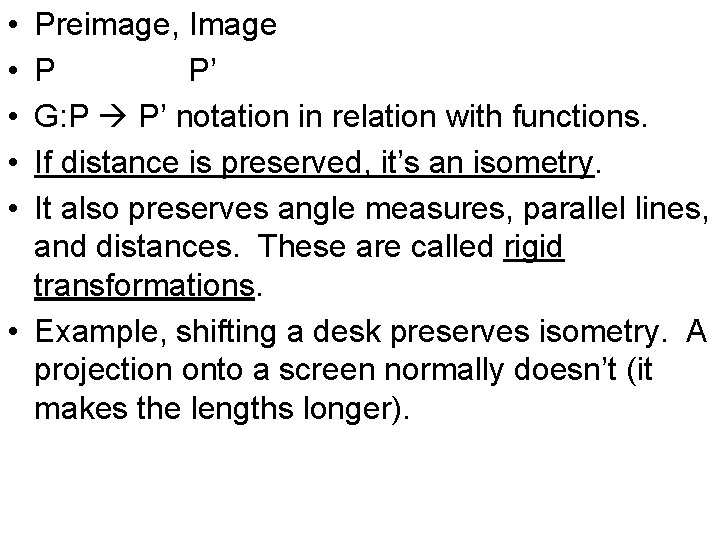
• • • Preimage, Image P P’ G: P P’ notation in relation with functions. If distance is preserved, it’s an isometry. It also preserves angle measures, parallel lines, and distances. These are called rigid transformations. • Example, shifting a desk preserves isometry. A projection onto a screen normally doesn’t (it makes the lengths longer).
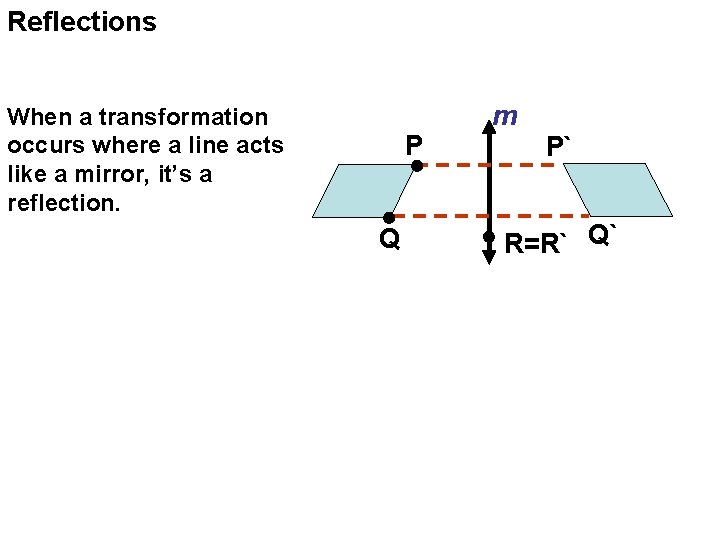
Reflections When a transformation occurs where a line acts like a mirror, it’s a reflection. P Q m P` R=R` Q`
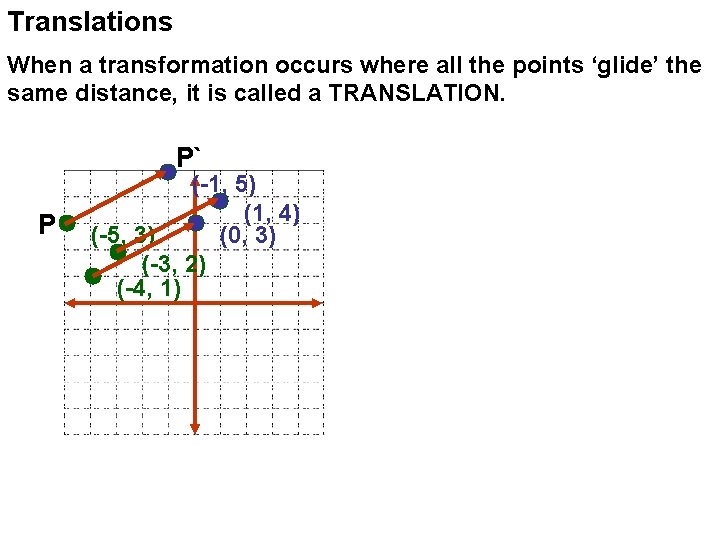
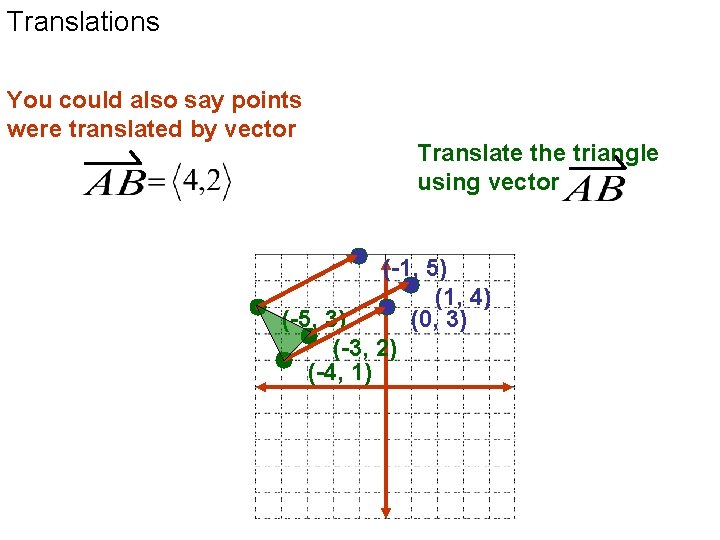
Translations When a transformation occurs where all the points ‘glide’ the same distance, it is called a TRANSLATION. P` P (-1, 5) (1, 4) (-5, 3) (0, 3) (-3, 2) (-4, 1)
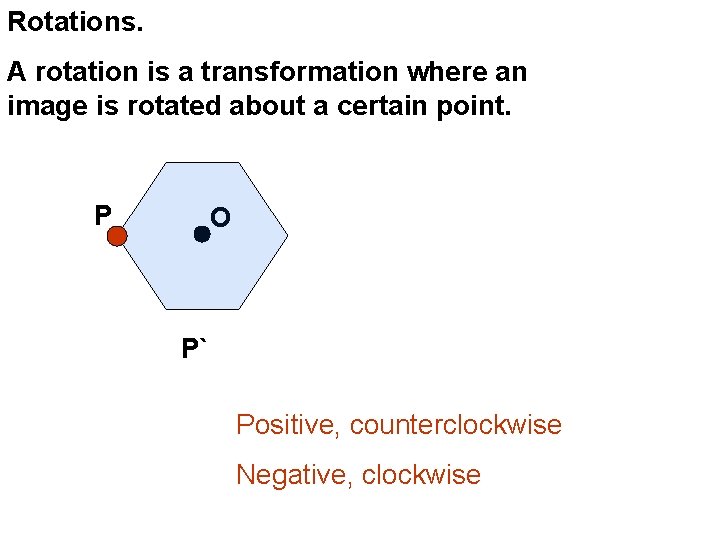
Rotations. A rotation is a transformation where an image is rotated about a certain point. P O P` Positive, counterclockwise Negative, clockwise
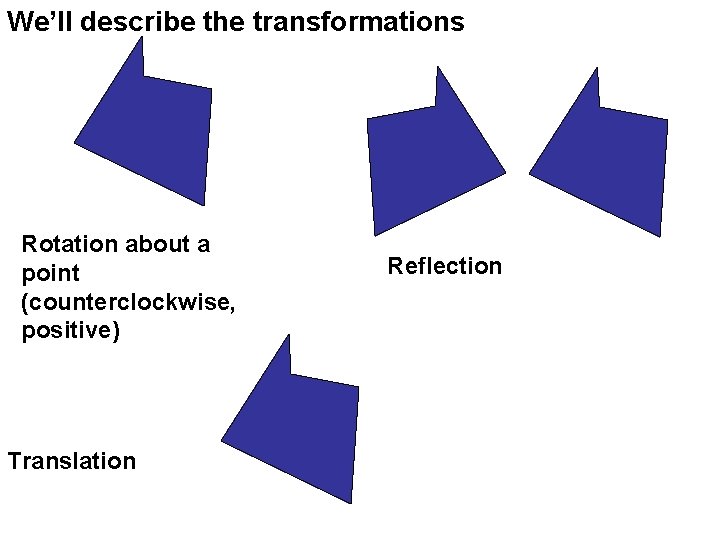
We’ll describe the transformations Rotation about a point (counterclockwise, positive) Translation Reflection
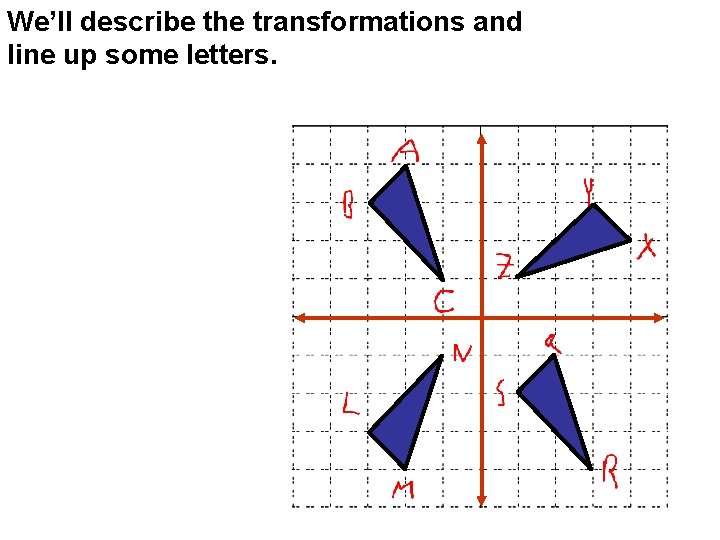
We’ll describe the transformations and line up some letters.
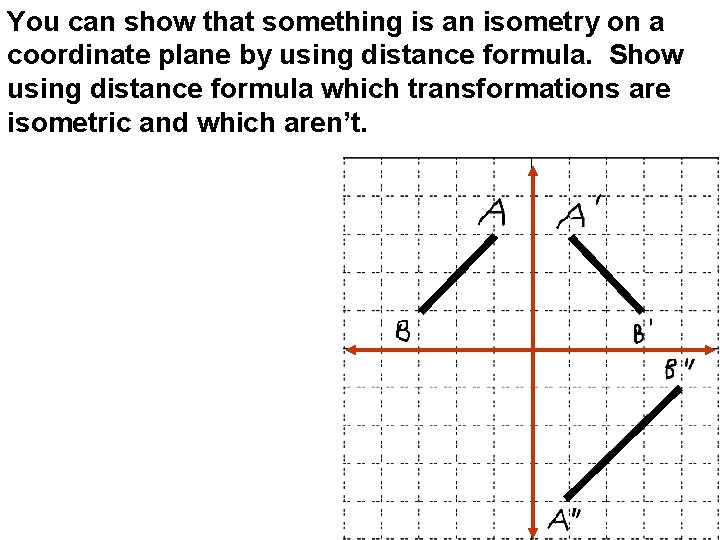
You can show that something is an isometry on a coordinate plane by using distance formula. Show using distance formula which transformations are isometric and which aren’t.
7. 2 – Reflections
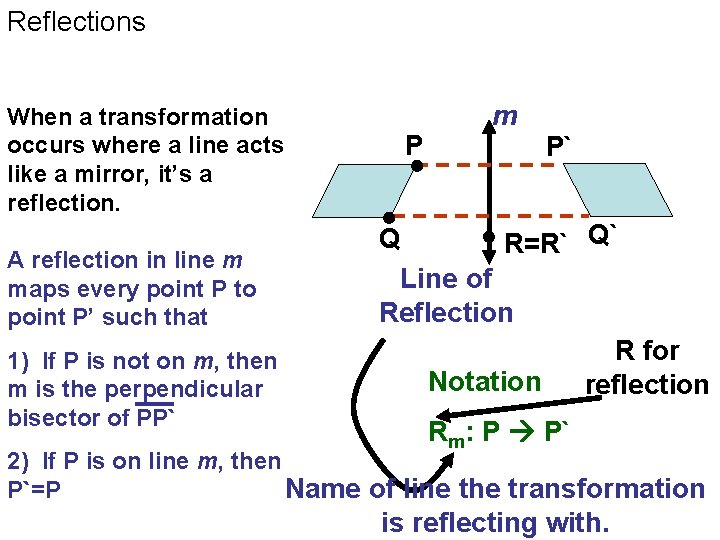
Reflections When a transformation occurs where a line acts like a mirror, it’s a reflection. A reflection in line m maps every point P to point P’ such that 1) If P is not on m, then m is the perpendicular bisector of PP` P m P` Q R=R` Q` Line of Reflection R for Notation reflection Rm: P P` 2) If P is on line m, then Name of line the transformation P`=P is reflecting with.
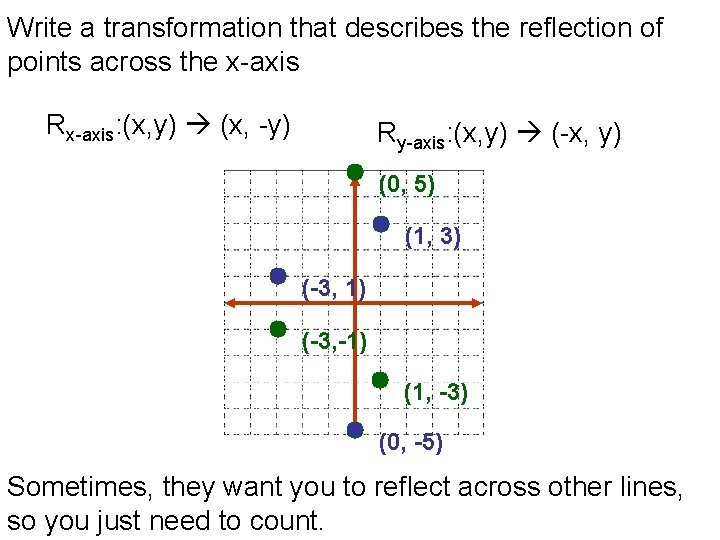
Write a transformation that describes the reflection of points across the x-axis Rx-axis: (x, y) (x, -y) Ry-axis: (x, y) (-x, y) (0, 5) (1, 3) (-3, 1) (-3, -1) (1, -3) (0, -5) Sometimes, they want you to reflect across other lines, so you just need to count.
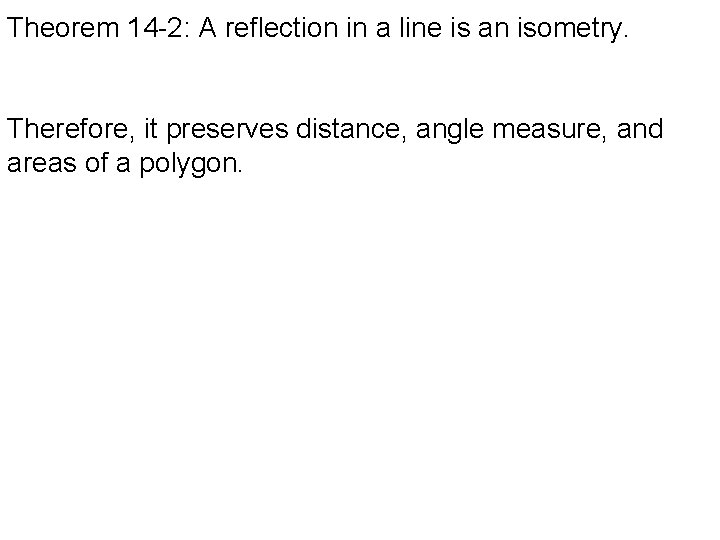
Theorem 14 -2: A reflection in a line is an isometry. Therefore, it preserves distance, angle measure, and areas of a polygon.
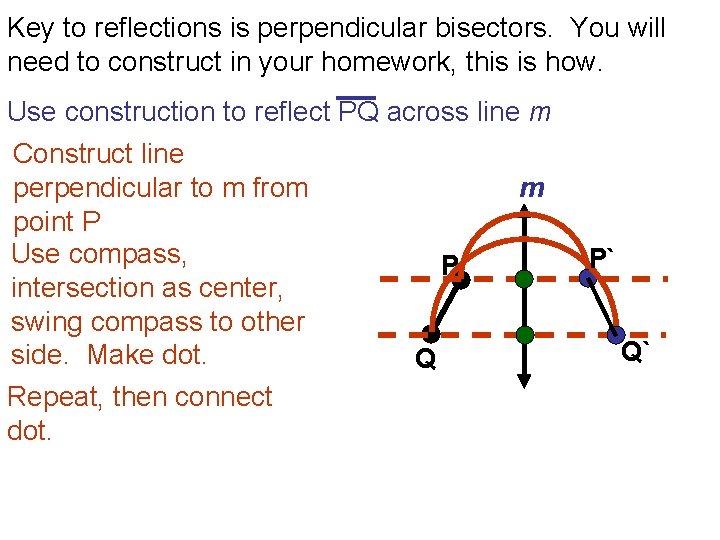
Key to reflections is perpendicular bisectors. You will need to construct in your homework, this is how. Use construction to reflect PQ across line m Construct line m perpendicular to m from point P Use compass, P intersection as center, swing compass to other side. Make dot. Q Repeat, then connect dot. P` Q`
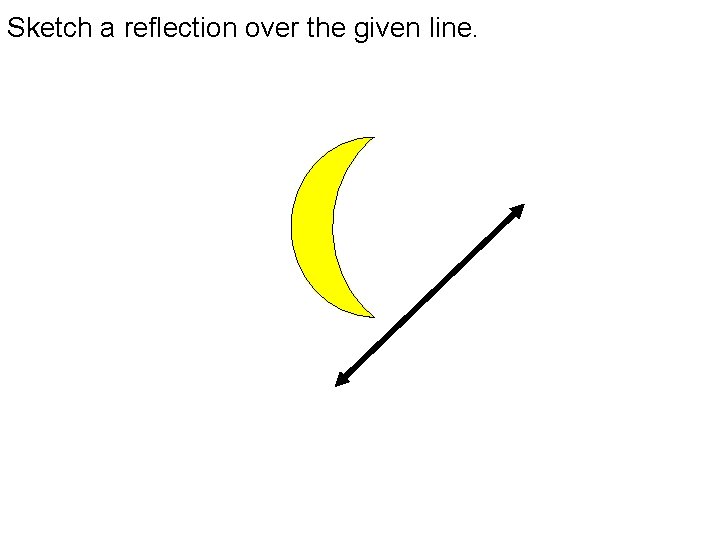
Sketch a reflection over the given line.
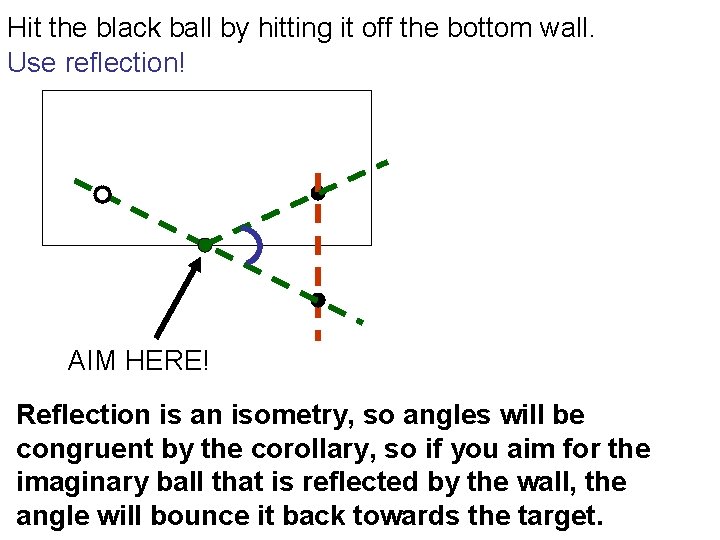
Hit the black ball by hitting it off the bottom wall. Use reflection! AIM HERE! Reflection is an isometry, so angles will be congruent by the corollary, so if you aim for the imaginary ball that is reflected by the wall, the angle will bounce it back towards the target.
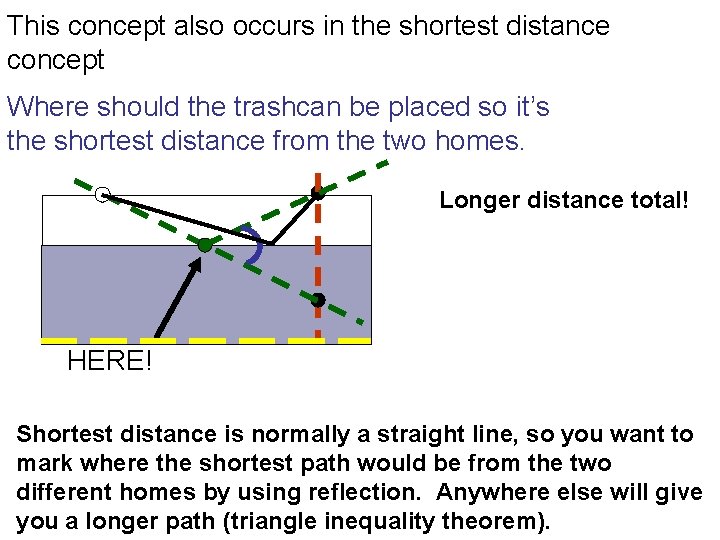
This concept also occurs in the shortest distance concept Where should the trashcan be placed so it’s the shortest distance from the two homes. Longer distance total! HERE! Shortest distance is normally a straight line, so you want to mark where the shortest path would be from the two different homes by using reflection. Anywhere else will give you a longer path (triangle inequality theorem).
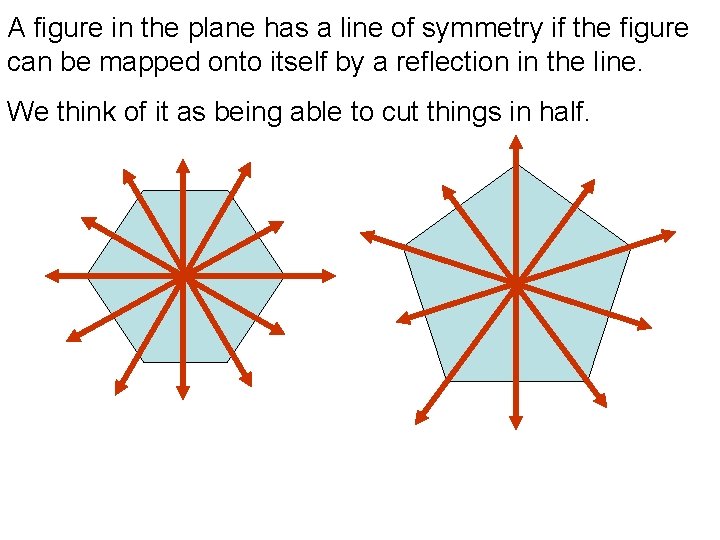
A figure in the plane has a line of symmetry if the figure can be mapped onto itself by a reflection in the line. We think of it as being able to cut things in half.
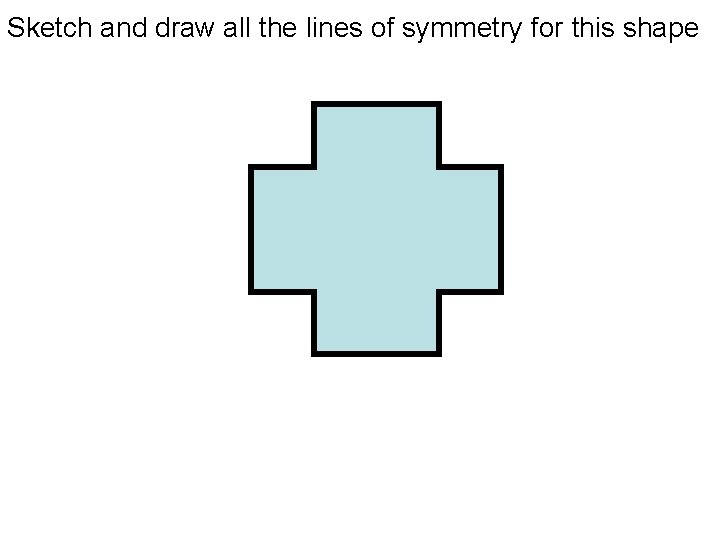
Sketch and draw all the lines of symmetry for this shape
7. 3 – Rotations
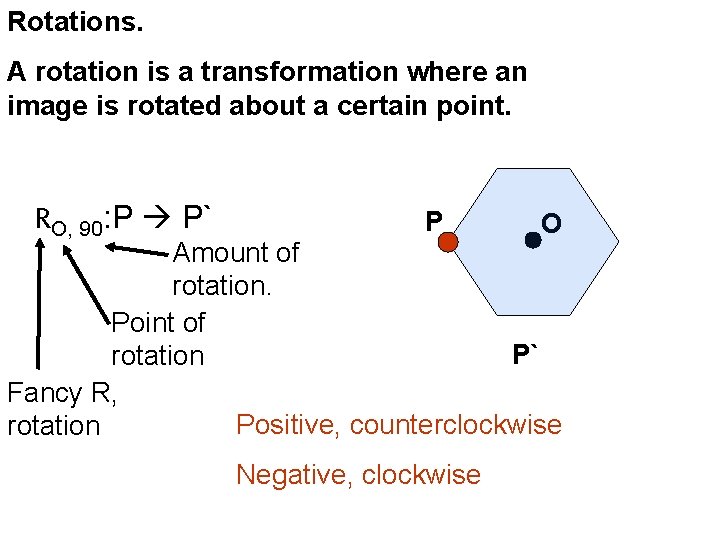
Rotations. A rotation is a transformation where an image is rotated about a certain point. RO, 90: P P` P O Amount of rotation. Point of P` rotation Fancy R, Positive, counterclockwise rotation Negative, clockwise
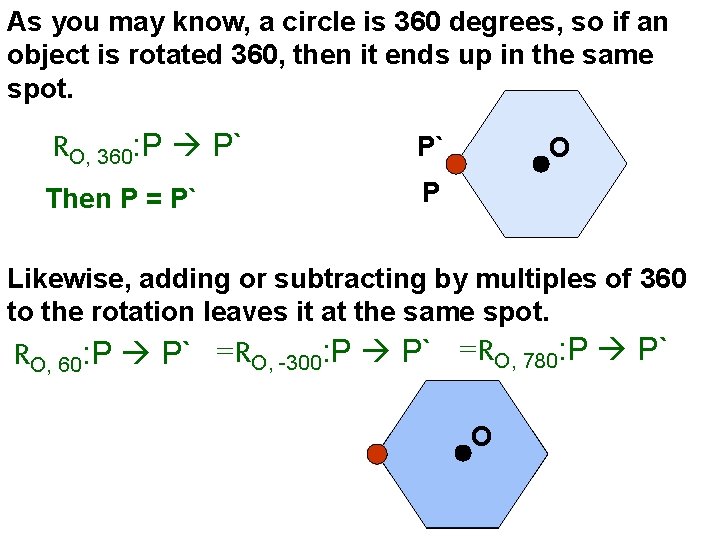
As you may know, a circle is 360 degrees, so if an object is rotated 360, then it ends up in the same spot. RO, 360: P P` P` Then P = P` P O Likewise, adding or subtracting by multiples of 360 to the rotation leaves it at the same spot. RO, 60: P P` =RO, -300: P P` =RO, 780: P P` O
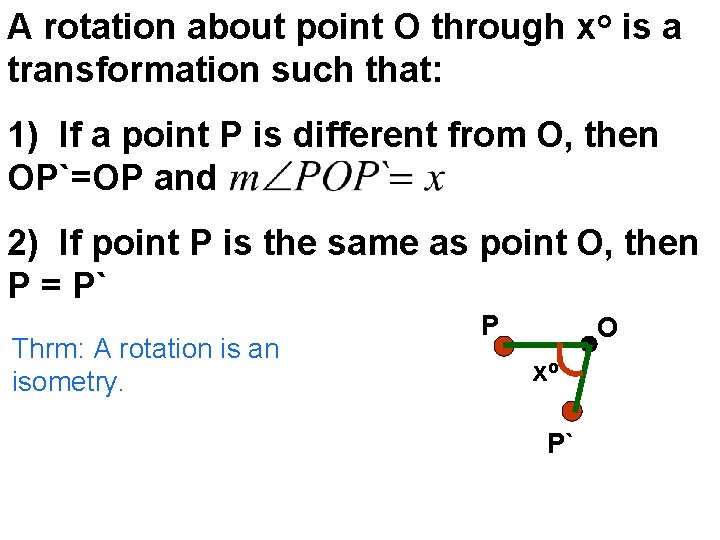
A rotation about point O through xo is a transformation such that: 1) If a point P is different from O, then OP`=OP and 2) If point P is the same as point O, then P = P` Thrm: A rotation is an isometry. P O xo P`
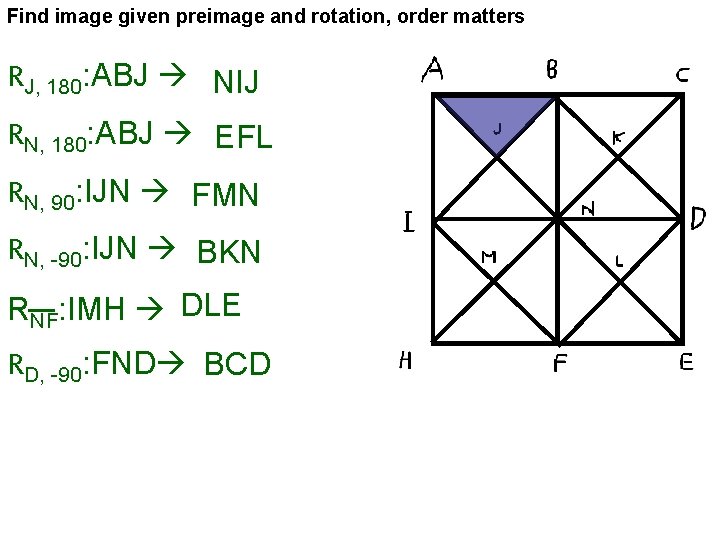
Find image given preimage and rotation, order matters RJ, 180: ABJ NIJ RN, 180: ABJ EFL RN, 90: IJN FMN RN, -90: IJN BKN RNF: IMH DLE RD, -90: FND BCD
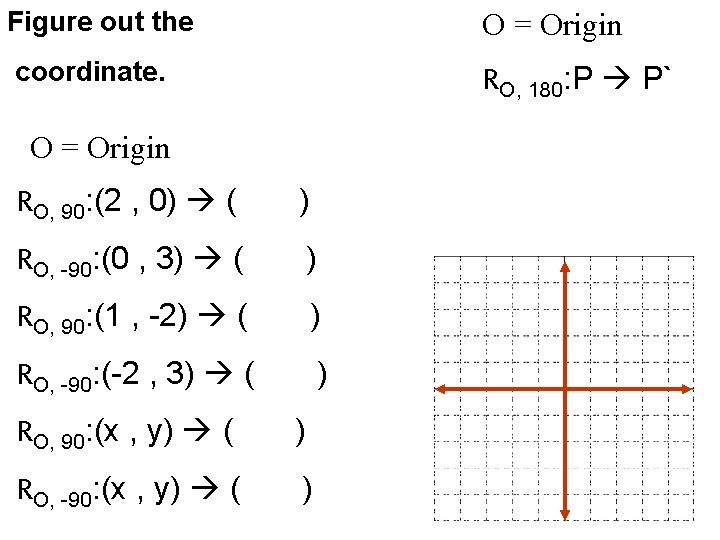
Figure out the O = Origin coordinate. RO, 180: P P` O = Origin RO, 90: (2 , 0) ( ) RO, -90: (0 , 3) ( ) RO, 90: (1 , -2) ( ) RO, -90: (-2 , 3) ( ) RO, 90: (x , y) ( ) RO, -90: (x , y) ( )
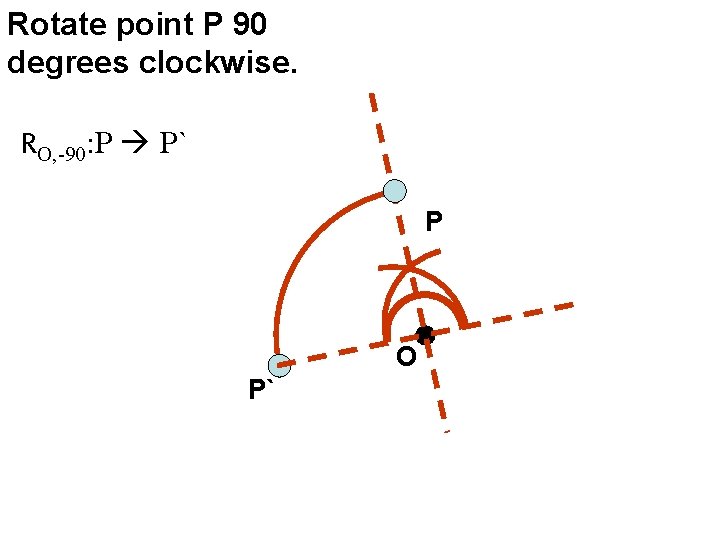
Rotate point P 90 degrees clockwise. RO, -90: P P` P O P`
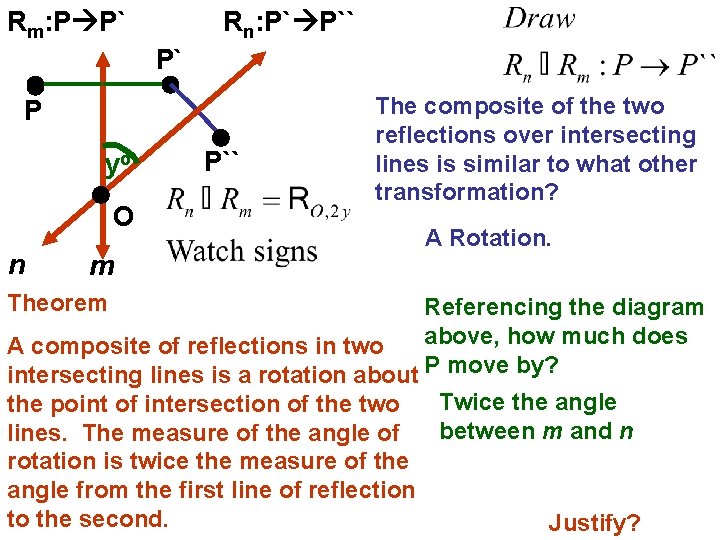
Rm: P P` Rn: P` P` P yo O n m P`` The composite of the two reflections over intersecting lines is similar to what other transformation? A Rotation. Theorem Referencing the diagram above, how much does A composite of reflections in two intersecting lines is a rotation about P move by? Twice the angle the point of intersection of the two between m and n lines. The measure of the angle of rotation is twice the measure of the angle from the first line of reflection to the second. Justify?
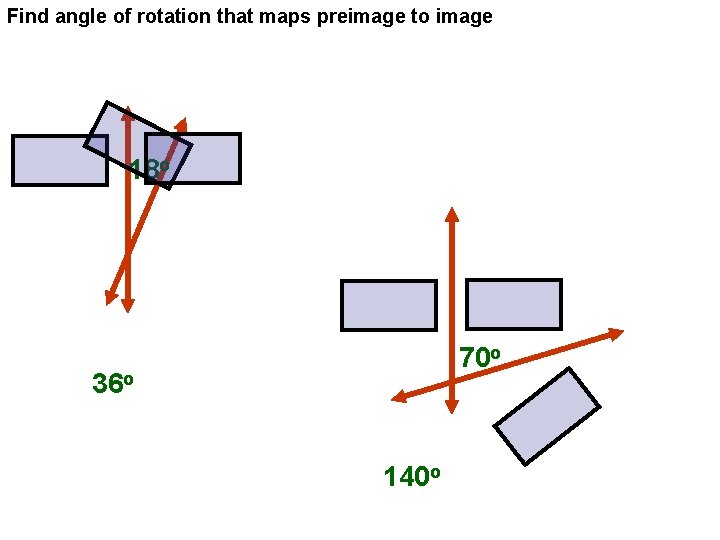
Find angle of rotation that maps preimage to image 18 o 70 o 36 o 140 o
7. 4 – Translations and Vectors
Translations When a transformation occurs where all the points ‘glide’ the same distance, it is called a TRANSLATION. Notation T: P P` T for translation Generally, you will see this in a coordinate plane, and noted as such: T: (x, y) (x + h, y + k) where h and k tell how much the figure shifted. Theorem: A translation is an isometry.
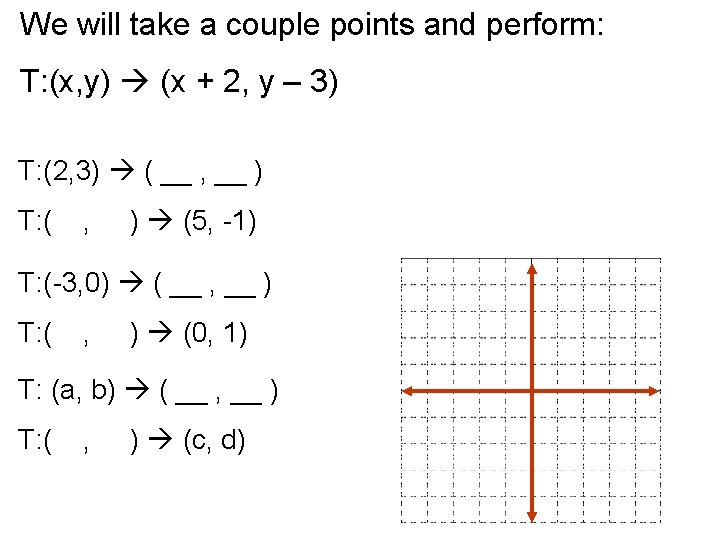
We will take a couple points and perform: T: (x, y) (x + 2, y – 3) T: (2, 3) ( __ , __ ) T: ( , ) (5, -1) T: (-3, 0) ( __ , __ ) T: ( , ) (0, 1) T: (a, b) ( __ , __ ) T: ( , ) (c, d)
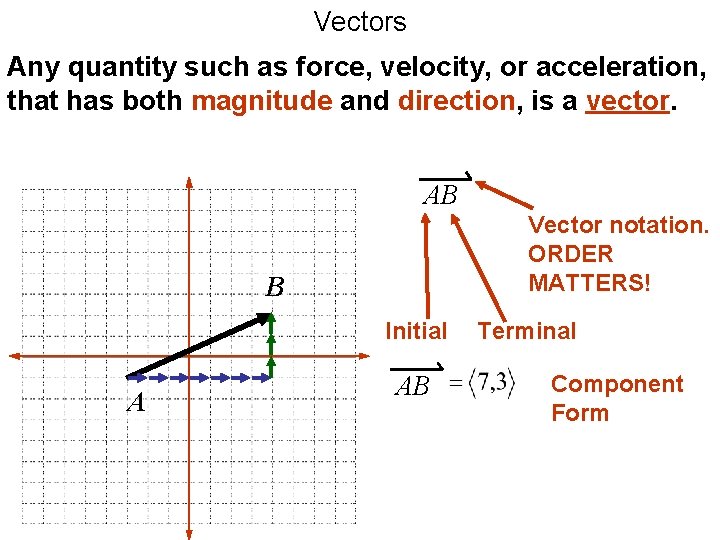
Vectors Any quantity such as force, velocity, or acceleration, that has both magnitude and direction, is a vector. AB Vector notation. ORDER MATTERS! B Initial A AB Terminal Component Form
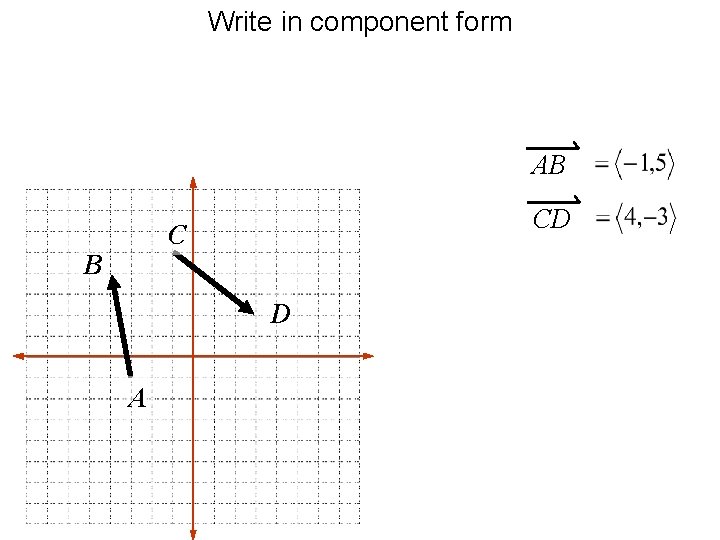
Write in component form AB CD C B D A
Translations You could also say points were translated by vector Translate the triangle using vector (-1, 5) (1, 4) (-5, 3) (0, 3) (-3, 2) (-4, 1)
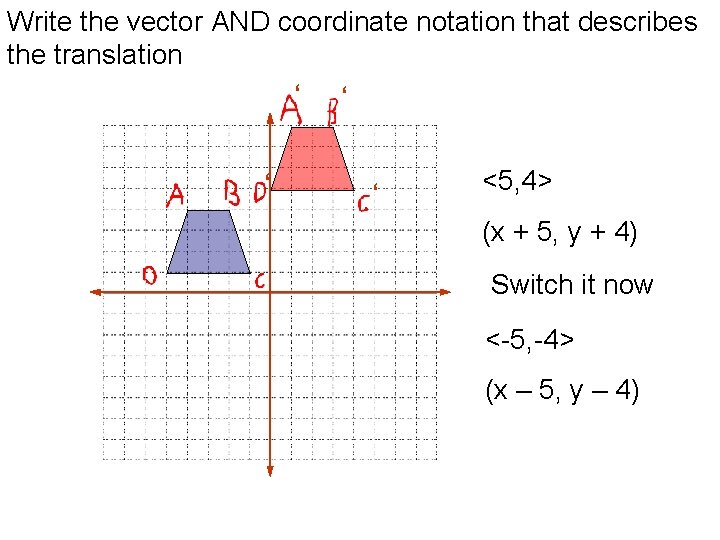
Write the vector AND coordinate notation that describes the translation ‘ ‘ <5, 4> (x + 5, y + 4) Switch it now <-5, -4> (x – 5, y – 4)
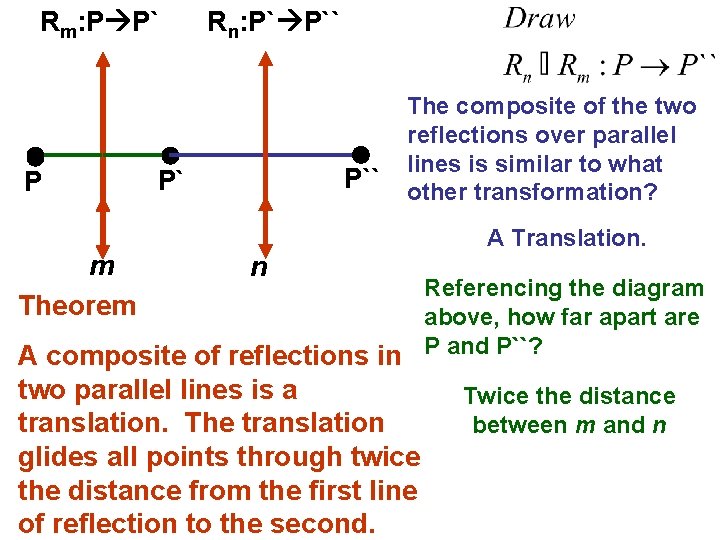
Rm: P P` P m Theorem Rn: P` P`` P` The composite of the two reflections over parallel lines is similar to what other transformation? n A Translation. Referencing the diagram above, how far apart are A composite of reflections in P and P``? two parallel lines is a translation. The translation glides all points through twice the distance from the first line of reflection to the second. Twice the distance between m and n
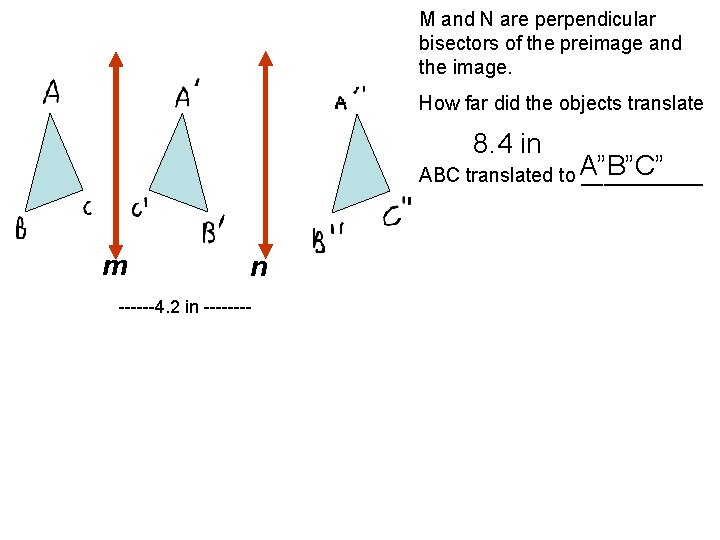
M and N are perpendicular bisectors of the preimage and the image. How far did the objects translate 8. 4 in ABC translated to A”B”C” ______ m n ------4. 2 in ----
7. 5 – Glide Reflections and Compositions
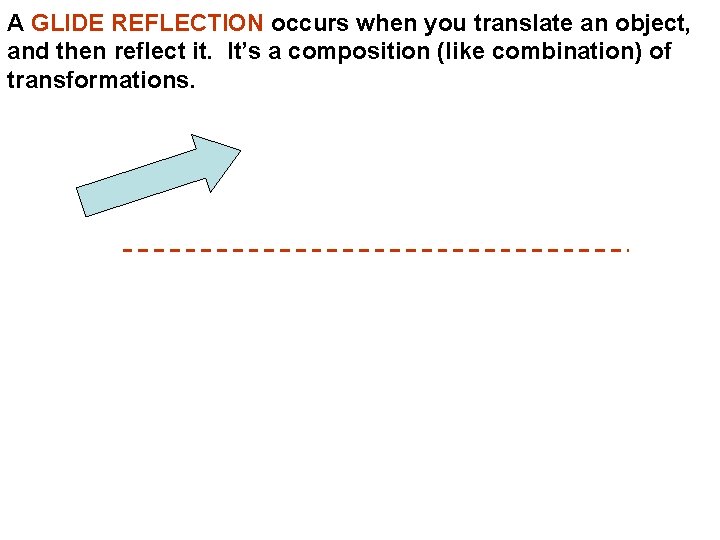
A GLIDE REFLECTION occurs when you translate an object, and then reflect it. It’s a composition (like combination) of transformations.
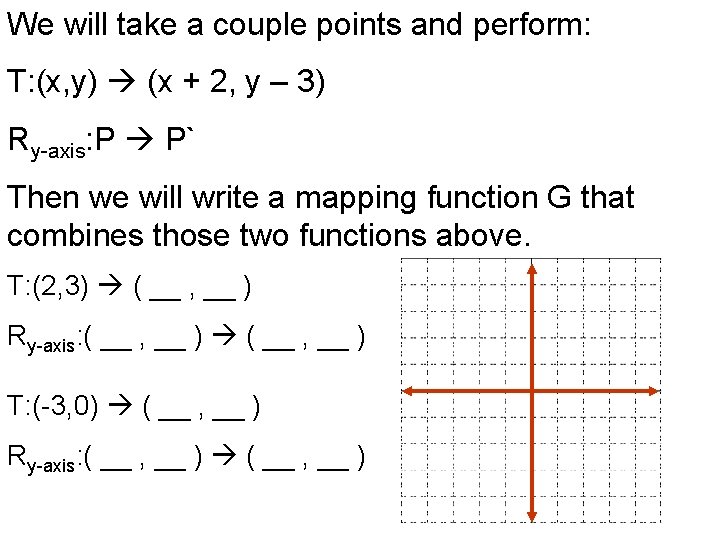
We will take a couple points and perform: T: (x, y) (x + 2, y – 3) Ry-axis: P P` Then we will write a mapping function G that combines those two functions above. T: (2, 3) ( __ , __ ) Ry-axis: ( __ , __ ) T: (-3, 0) ( __ , __ ) Ry-axis: ( __ , __ )
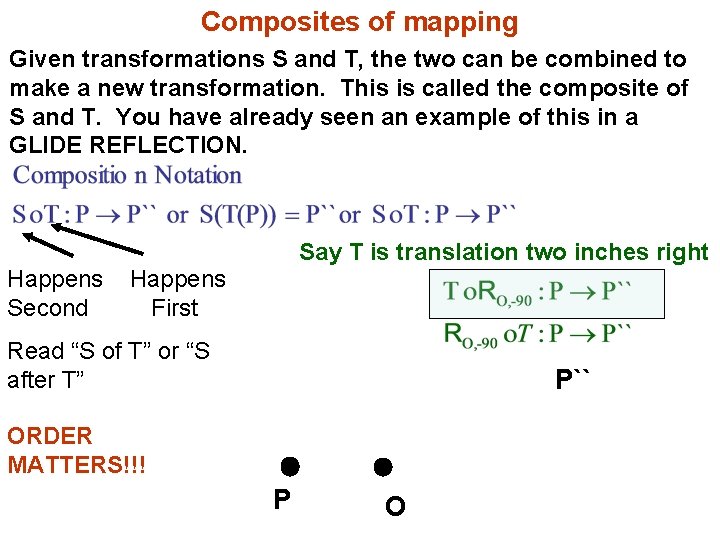
Composites of mapping Given transformations S and T, the two can be combined to make a new transformation. This is called the composite of S and T. You have already seen an example of this in a GLIDE REFLECTION. Say T is translation two inches right Happens Second Happens First Read “S of T” or “S after T” P`` ORDER MATTERS!!! P O
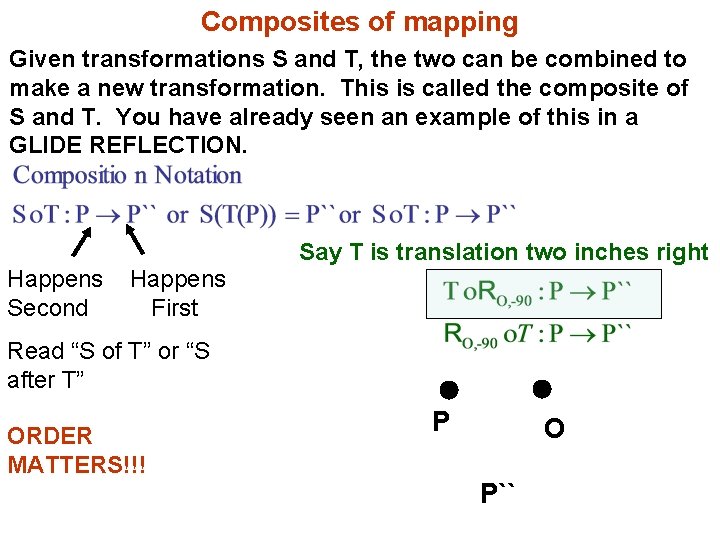
Composites of mapping Given transformations S and T, the two can be combined to make a new transformation. This is called the composite of S and T. You have already seen an example of this in a GLIDE REFLECTION. Say T is translation two inches right Happens Second Happens First Read “S of T” or “S after T” ORDER MATTERS!!! P O P``
Order matters in a composition of functions. The composite of two isometries is an isometry. There are times on a coordinate grid where you’ll be asked to combine a composition into one function, like you did for glide reflections. There also times when two compositions may look like a type of one transformation.
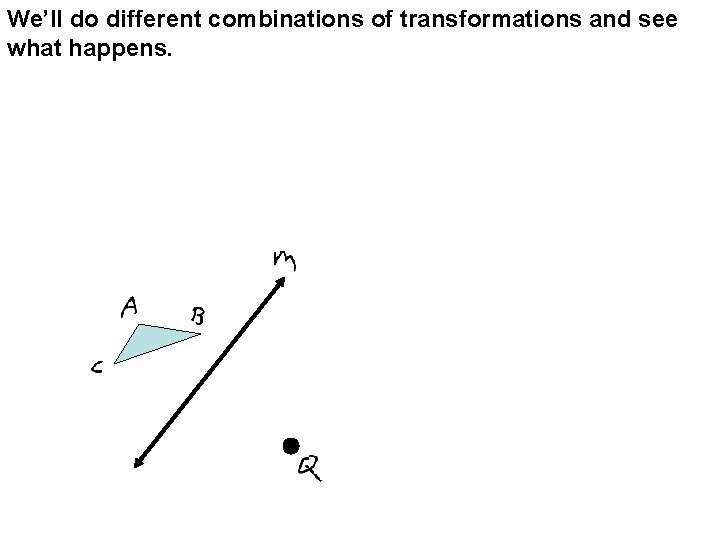
We’ll do different combinations of transformations and see what happens.
We’ll do different combinations of transformations and see what happens. Points and Shapes. Also draw some transformations and describe compositions.
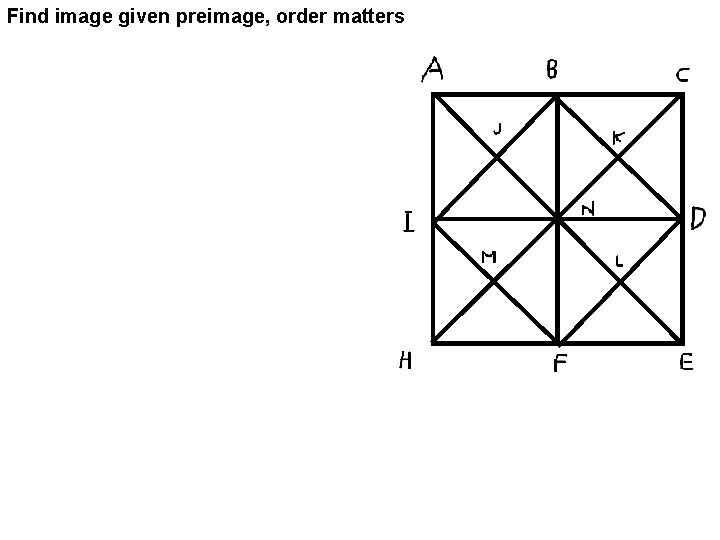
Find image given preimage, order matters
8. 7 – Dilations
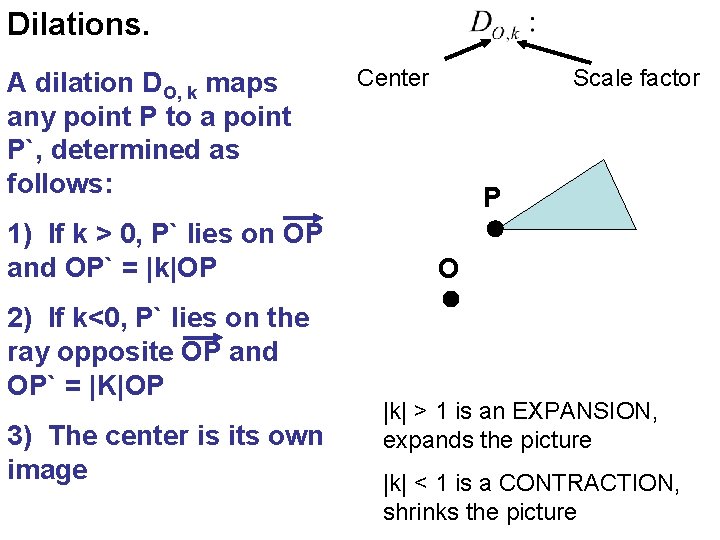
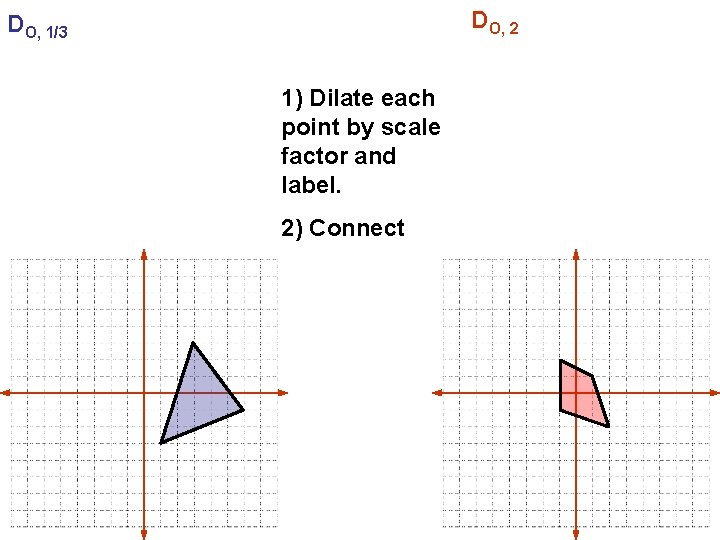
Dilations. A dilation DO, k maps any point P to a point P`, determined as follows: 1) If k > 0, P` lies on OP and OP` = |k|OP 2) If k<0, P` lies on the ray opposite OP and OP` = |K|OP 3) The center is its own image Center Scale factor P O |k| > 1 is an EXPANSION, expands the picture |k| < 1 is a CONTRACTION, shrinks the picture
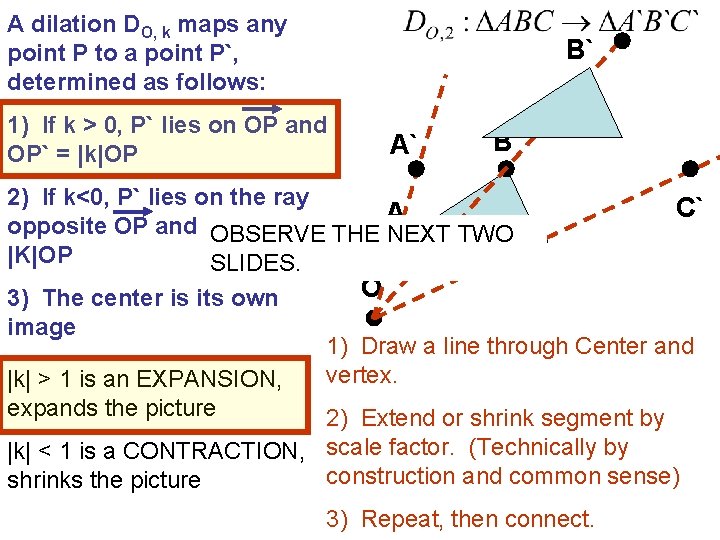
A dilation DO, k maps any point P to a point P`, determined as follows: B` 1) If k > 0, P` lies on OP and OP` = |k|OP A` B 2) If k<0, P` lies on the ray A opposite OP and OP` = OBSERVE THE NEXT TWO |K|OP SLIDES. 3) The center is its own image |k| > 1 is an EXPANSION, expands the picture O C` C 1) Draw a line through Center and vertex. 2) Extend or shrink segment by |k| < 1 is a CONTRACTION, scale factor. (Technically by construction and common sense) shrinks the picture 3) Repeat, then connect.
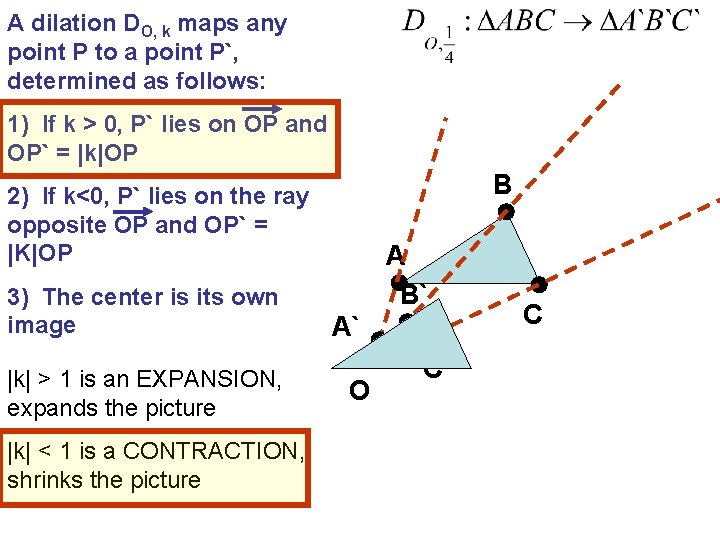
A dilation DO, k maps any point P to a point P`, determined as follows: 1) If k > 0, P` lies on OP and OP` = |k|OP B 2) If k<0, P` lies on the ray opposite OP and OP` = |K|OP 3) The center is its own image |k| > 1 is an EXPANSION, expands the picture |k| < 1 is a CONTRACTION, shrinks the picture A B` A` O C` C
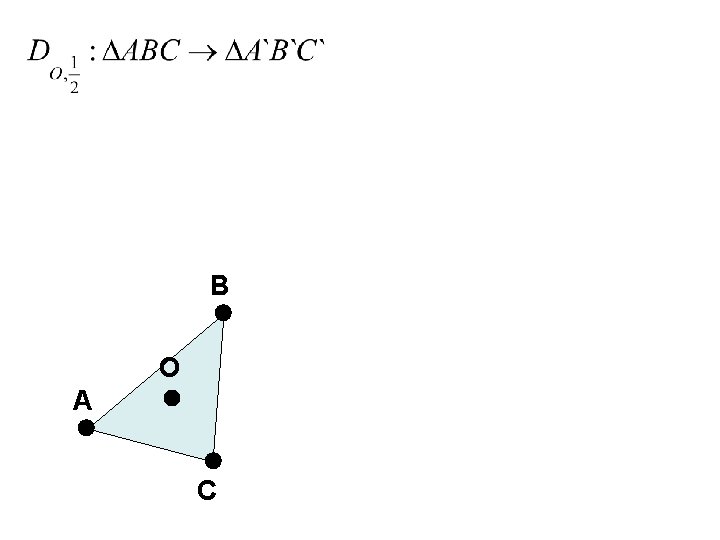
B O A C
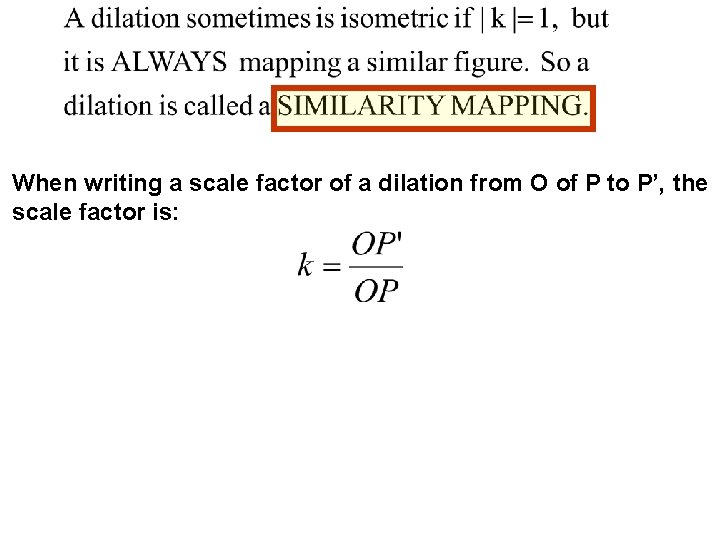
When writing a scale factor of a dilation from O of P to P’, the scale factor is:
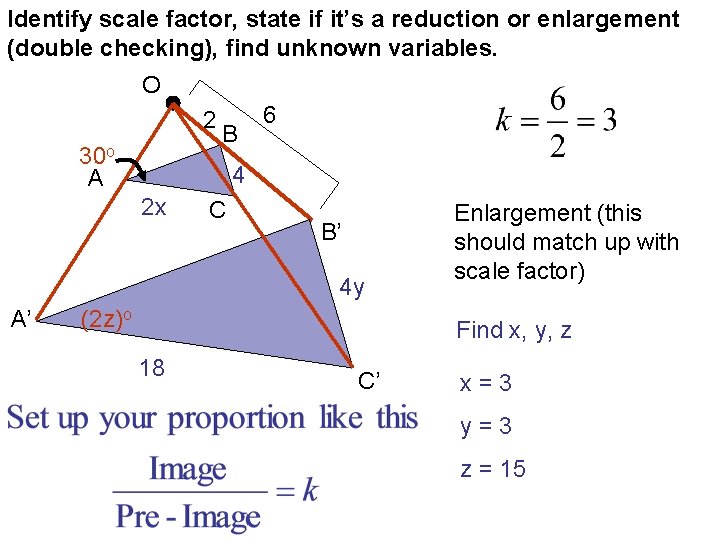
Identify scale factor, state if it’s a reduction or enlargement (double checking), find unknown variables. O 2 30 o A B 6 4 2 x C B’ 4 y A’ (2 z)o Enlargement (this should match up with scale factor) Find x, y, z 18 C’ x=3 y=3 z = 15
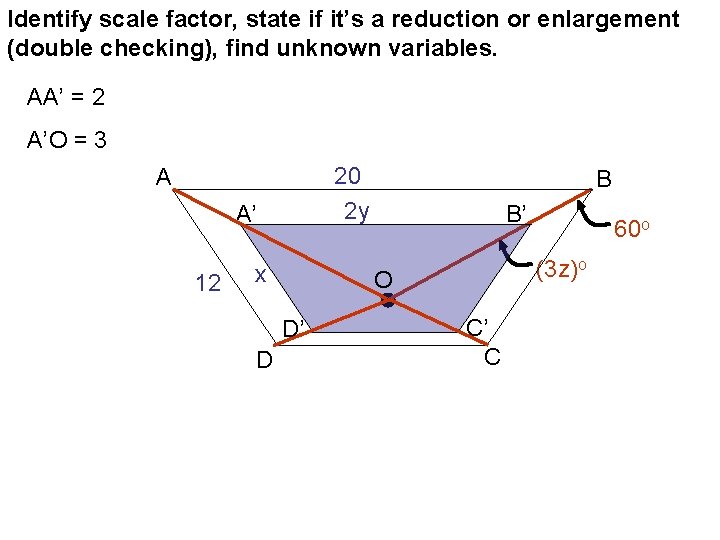
Identify scale factor, state if it’s a reduction or enlargement (double checking), find unknown variables. AA’ = 2 A’O = 3 20 2 y A A’ 12 x B’ 60 o (3 z)o O D’ D B C’ C
DO, 2 DO, 1/3 1) Dilate each point by scale factor and label. 2) Connect