
7 1 Describing Reactions Burning is a chemical
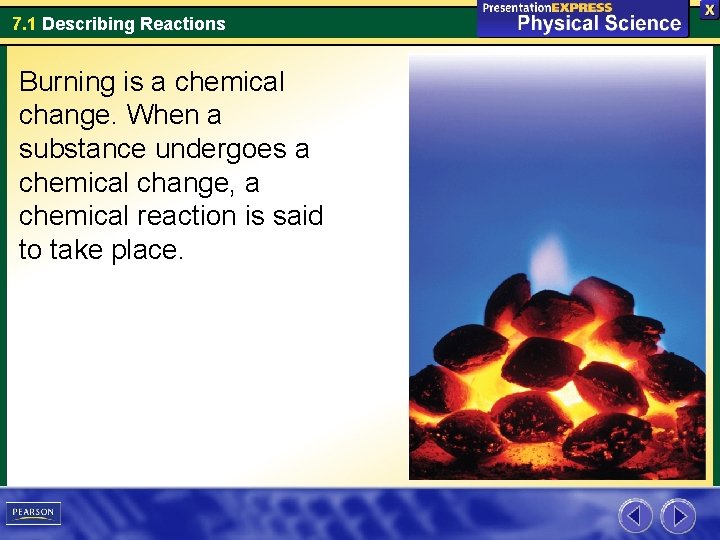
7. 1 Describing Reactions Burning is a chemical change. When a substance undergoes a chemical change, a chemical reaction is said to take place.
7. 1 Describing Reactions Chemical Equations What is the law of conservation of mass? The law of conservation of mass states that mass is neither created nor destroyed in a chemical reaction.
7. 1 Describing Reactions Chemical Equations A useful description of a chemical reaction tells you the substances present before and after the reaction. • The substances that undergo change are called reactants. • The new substances formed as a result of that change are called products.
7. 1 Describing Reactions Chemical Equations Using Equations to Represent Reactions During a chemical reaction, the reactants change into products. You can summarize this process with a word equation. Reactants Products
7. 1 Describing Reactions Describe Charcoal Burning To describe the burning of charcoal, you can write reactants and products of the reaction in the following word equation. Carbon + Oxygen Carbon dioxide Write the reactants and products as chemical formulas. C + O 2 CO 2
7. 1 Describing Reactions Chemical Equations A chemical equation is a representation of a chemical reaction in which the reactants and products are expressed as formulas. You can read the equation C + O 2 CO 2 as • “ Carbon and oxygen react and form carbon dioxide, ” or, • “The reaction of carbon and oxygen yields carbon dioxide. ”
7. 1 Describing Reactions Chemical Equations Conservation of Mass During chemical reactions, the mass of the products is always equal to the mass of the reactants. This principle is the law of conservation of mass. When charcoal burns, the mass of the carbon dioxide produced is equal to the mass of the charcoal and oxygen that reacted.
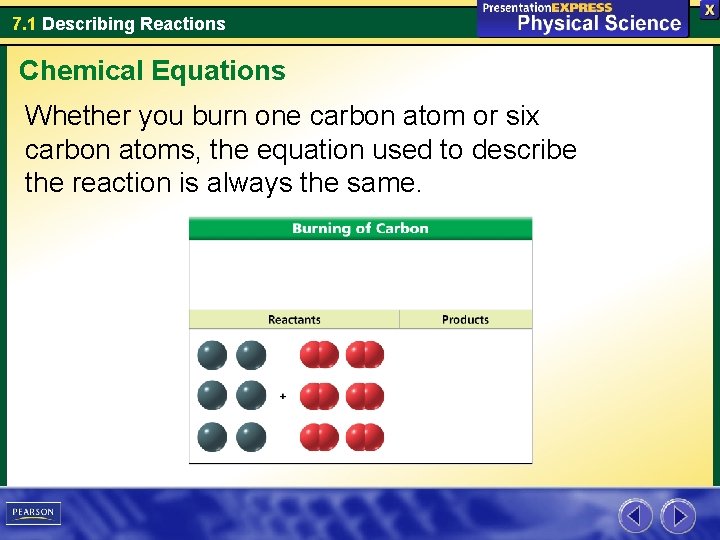
7. 1 Describing Reactions Chemical Equations Whether you burn one carbon atom or six carbon atoms, the equation used to describe the reaction is always the same.
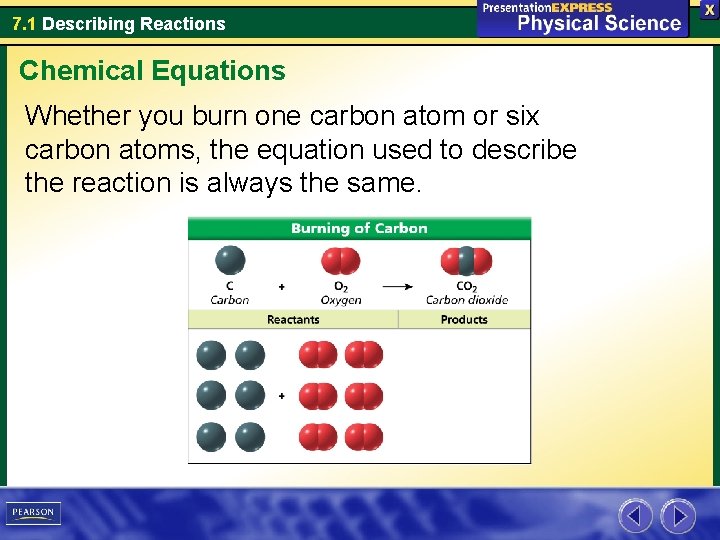
7. 1 Describing Reactions Chemical Equations Whether you burn one carbon atom or six carbon atoms, the equation used to describe the reaction is always the same.
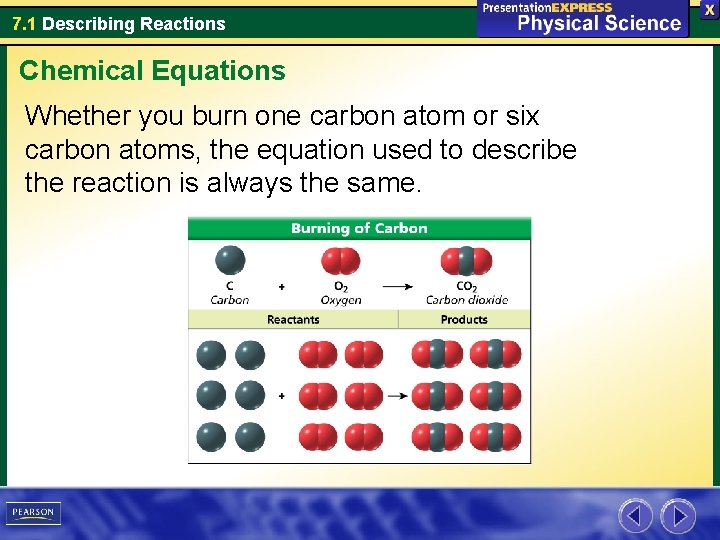
7. 1 Describing Reactions Chemical Equations Whether you burn one carbon atom or six carbon atoms, the equation used to describe the reaction is always the same.
7. 1 Describing Reactions Balancing Equations Why must chemical equations be balanced? In order to show that mass is conserved during a reaction, a chemical equation must be balanced.
7. 1 Describing Reactions Balancing Equations You can balance a chemical equation by changing the coefficients, the numbers that appear before the formulas. When you change a coefficient, you change the amount of that reactant or product represented in the chemical equation.
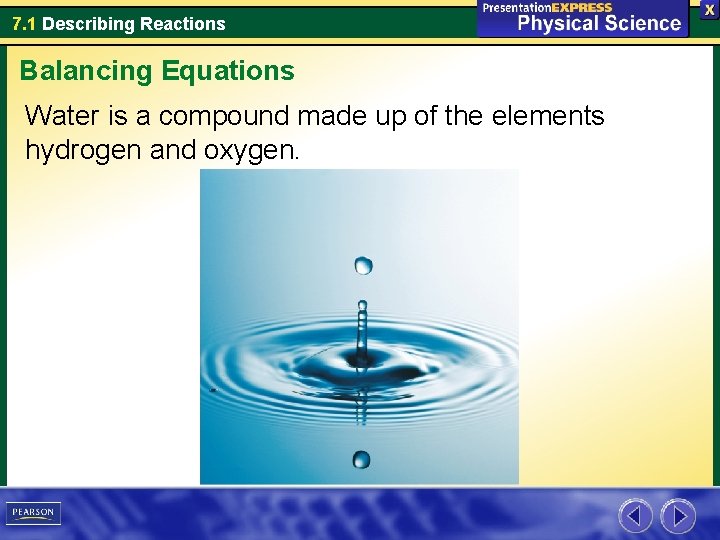
7. 1 Describing Reactions Balancing Equations Water is a compound made up of the elements hydrogen and oxygen.
7. 1 Describing Reactions Balancing Equations You can balance a chemical equation by changing the coefficients, the numbers that appear before the formulas. When you change a coefficient, you change the amount of that reactant or product represented in the chemical equation.
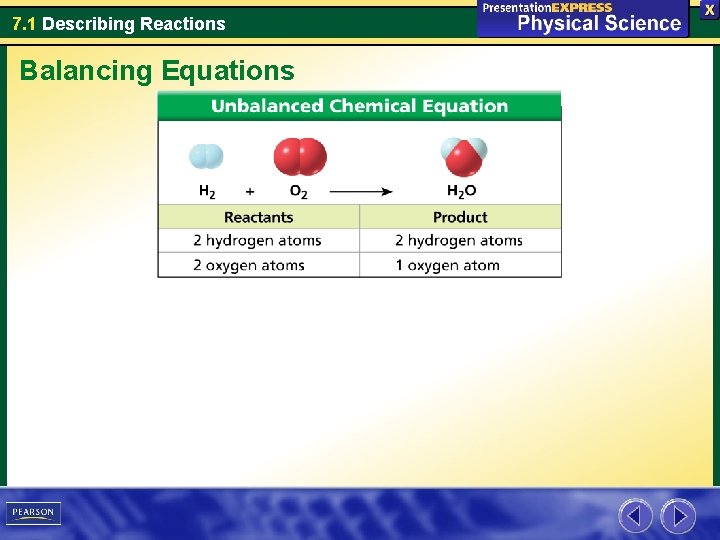
7. 1 Describing Reactions Balancing Equations
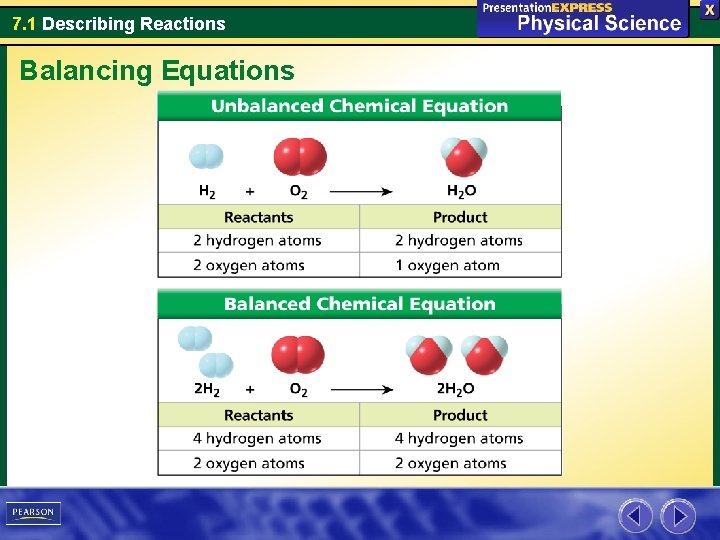
7. 1 Describing Reactions Balancing Equations
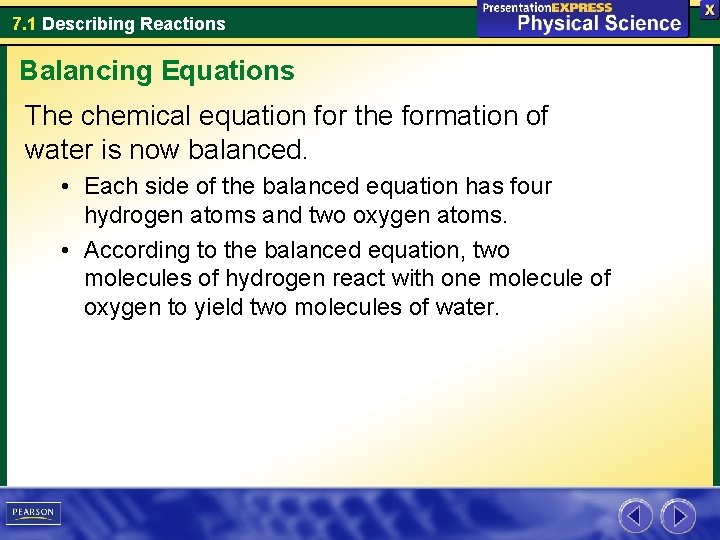
7. 1 Describing Reactions Balancing Equations The chemical equation for the formation of water is now balanced. • Each side of the balanced equation has four hydrogen atoms and two oxygen atoms. • According to the balanced equation, two molecules of hydrogen react with one molecule of oxygen to yield two molecules of water.
7. 1 Describing Reactions Balancing Equations Balancing Chemical Equations Write a balanced equation for the reaction between copper and oxygen to produce copper(II) oxide, Cu. O.
7. 1 Describing Reactions Balancing Equations Read and Understand What information are you given?
7. 1 Describing Reactions Balancing Equations Read and Understand What information are you given? Reactants: Cu, O 2 Product: Cu. O
7. 1 Describing Reactions Balancing Equations Plan and Solve Write a chemical equation with the reactants on the left side and the product on the right.
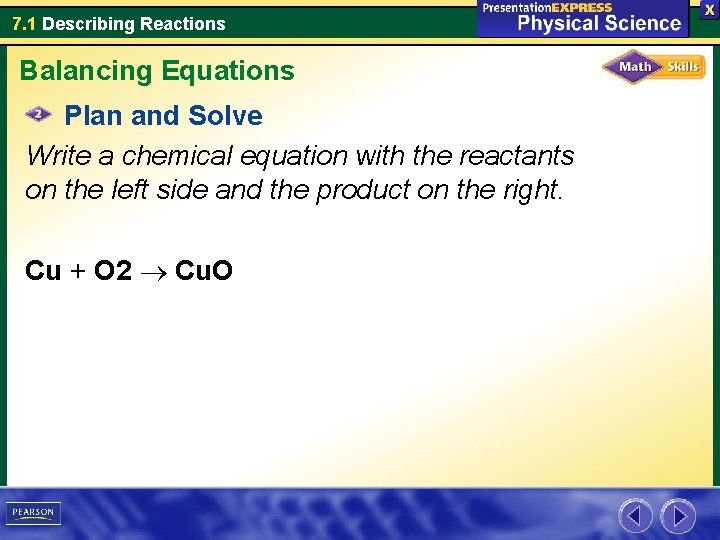
7. 1 Describing Reactions Balancing Equations Plan and Solve Write a chemical equation with the reactants on the left side and the product on the right. Cu + O 2 Cu. O
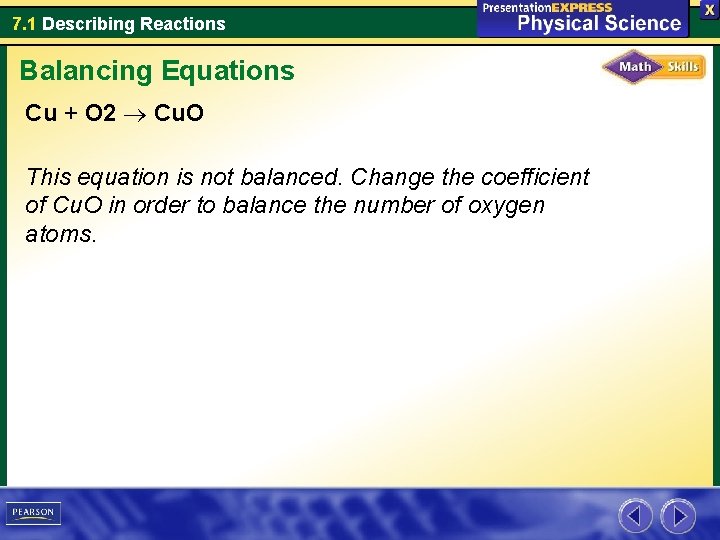
7. 1 Describing Reactions Balancing Equations Cu + O 2 Cu. O This equation is not balanced. Change the coefficient of Cu. O in order to balance the number of oxygen atoms.
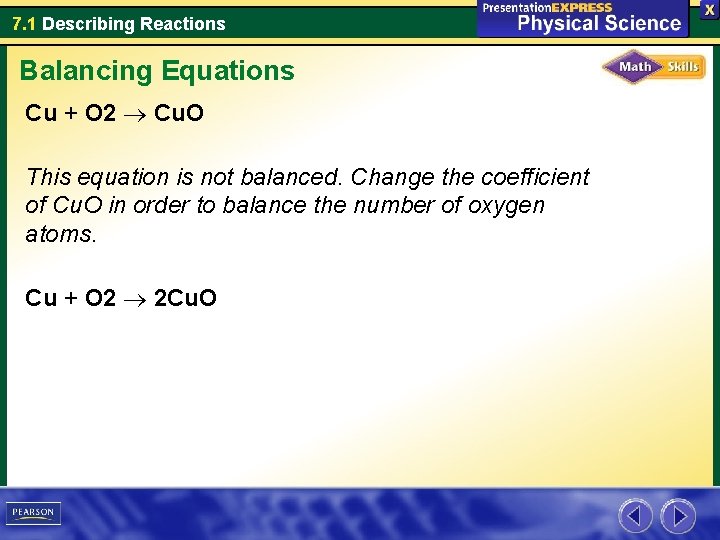
7. 1 Describing Reactions Balancing Equations Cu + O 2 Cu. O This equation is not balanced. Change the coefficient of Cu. O in order to balance the number of oxygen atoms. Cu + O 2 2 Cu. O
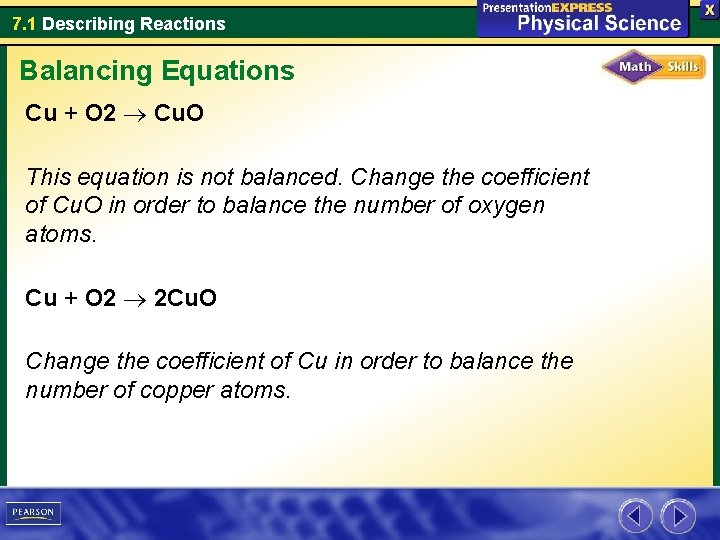
7. 1 Describing Reactions Balancing Equations Cu + O 2 Cu. O This equation is not balanced. Change the coefficient of Cu. O in order to balance the number of oxygen atoms. Cu + O 2 2 Cu. O Change the coefficient of Cu in order to balance the number of copper atoms.
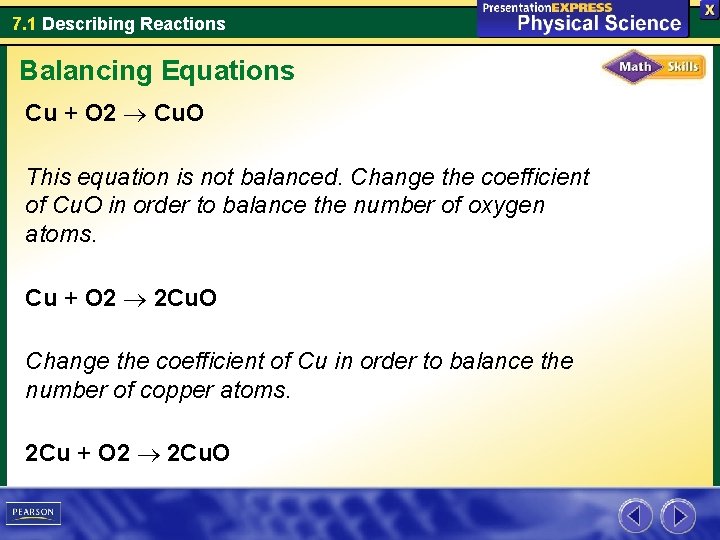
7. 1 Describing Reactions Balancing Equations Cu + O 2 Cu. O This equation is not balanced. Change the coefficient of Cu. O in order to balance the number of oxygen atoms. Cu + O 2 2 Cu. O Change the coefficient of Cu in order to balance the number of copper atoms. 2 Cu + O 2 2 Cu. O
7. 1 Describing Reactions Balancing Equations Look Back and Check Is your answer reasonable?
7. 1 Describing Reactions Balancing Equations Look Back and Check Is your answer reasonable? The number of atoms on the left equals the number of atoms on the right.
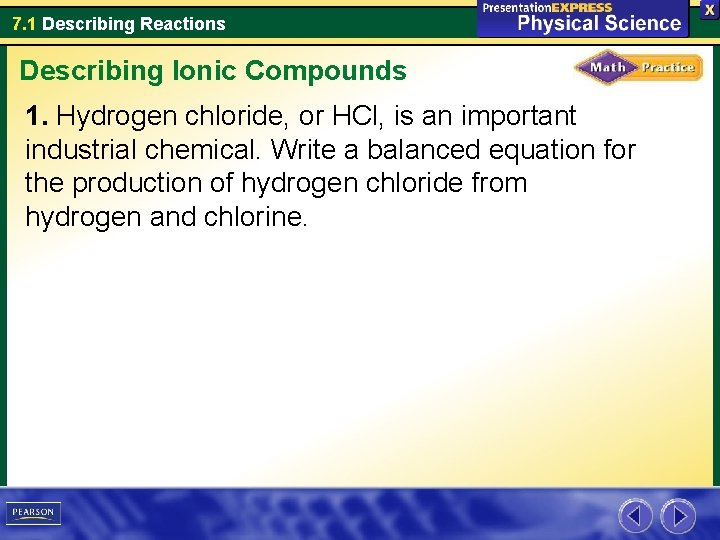
7. 1 Describing Reactions Describing Ionic Compounds 1. Hydrogen chloride, or HCl, is an important industrial chemical. Write a balanced equation for the production of hydrogen chloride from hydrogen and chlorine.
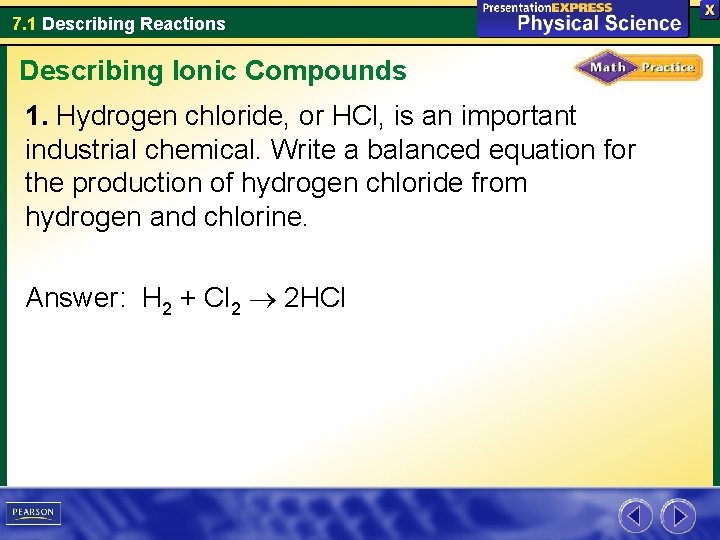
7. 1 Describing Reactions Describing Ionic Compounds 1. Hydrogen chloride, or HCl, is an important industrial chemical. Write a balanced equation for the production of hydrogen chloride from hydrogen and chlorine. Answer: H 2 + Cl 2 2 HCl
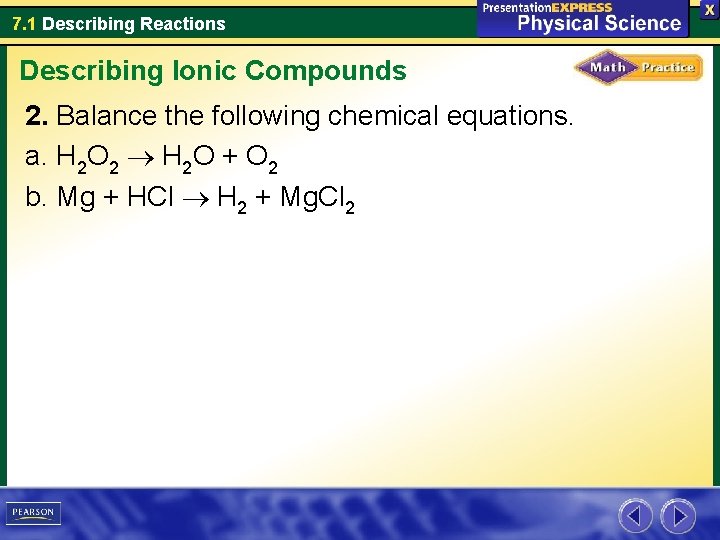
7. 1 Describing Reactions Describing Ionic Compounds 2. Balance the following chemical equations. a. H 2 O 2 H 2 O + O 2 b. Mg + HCl H 2 + Mg. Cl 2
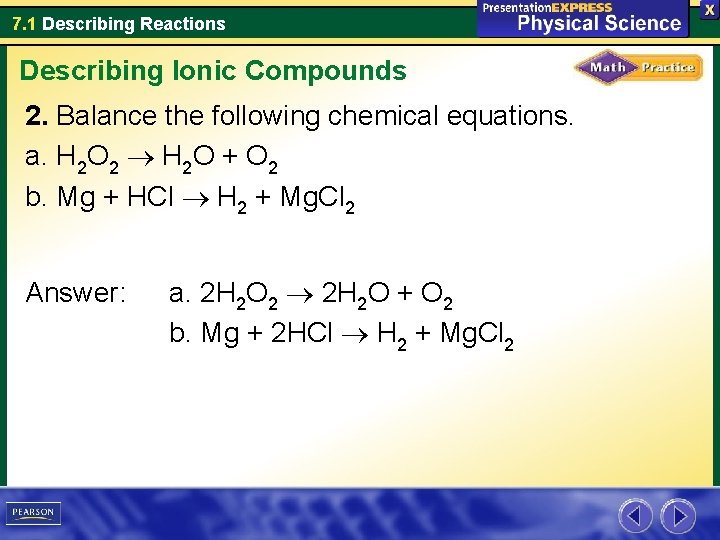
7. 1 Describing Reactions Describing Ionic Compounds 2. Balance the following chemical equations. a. H 2 O 2 H 2 O + O 2 b. Mg + HCl H 2 + Mg. Cl 2 Answer: a. 2 H 2 O 2 2 H 2 O + O 2 b. Mg + 2 HCl H 2 + Mg. Cl 2
7. 1 Describing Reactions Describing Ionic Compounds 3. Ethylene, C 2 H 4, burns in the presence of oxygen to produce carbon dioxide and water vapor. Write a balanced equation for this reaction.
7. 1 Describing Reactions Describing Ionic Compounds 3. Ethylene, C 2 H 4, burns in the presence of oxygen to produce carbon dioxide and water vapor. Write a balanced equation for this reaction. Answer: C 2 H 4 + 3 O 2 2 CO 2 + 2 H 2 O
7. 1 Describing Reactions Counting With Moles Why do chemists use the mole? Because chemical reactions often involve large numbers of small particles, chemists use a counting unit called the mole to measure amounts of a substance. A mole (mol) is an amount of a substance that contains approximately 6. 02 × 1023 particles. For instance, a mole of iron is 6. 02 × 1023 atoms of iron. This number is known as Avogadro’s number.
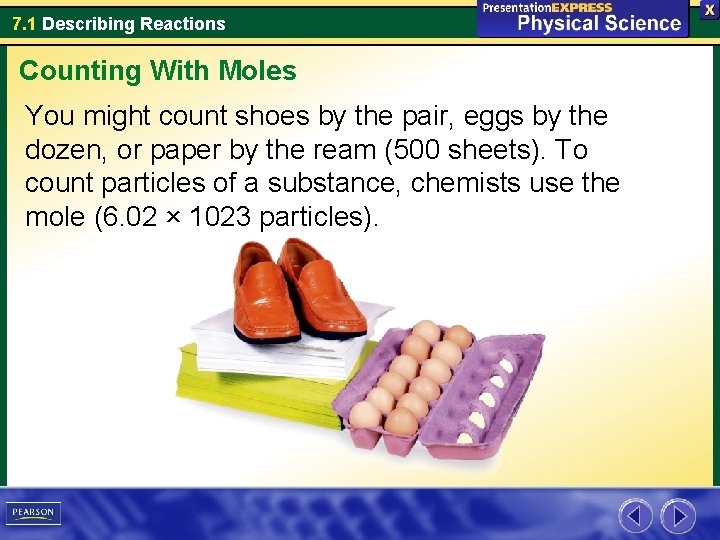
7. 1 Describing Reactions Counting With Moles You might count shoes by the pair, eggs by the dozen, or paper by the ream (500 sheets). To count particles of a substance, chemists use the mole (6. 02 × 1023 particles).
- Slides: 36