
7 03 2010 Status of the LHC Rencontres
- Slides: 48
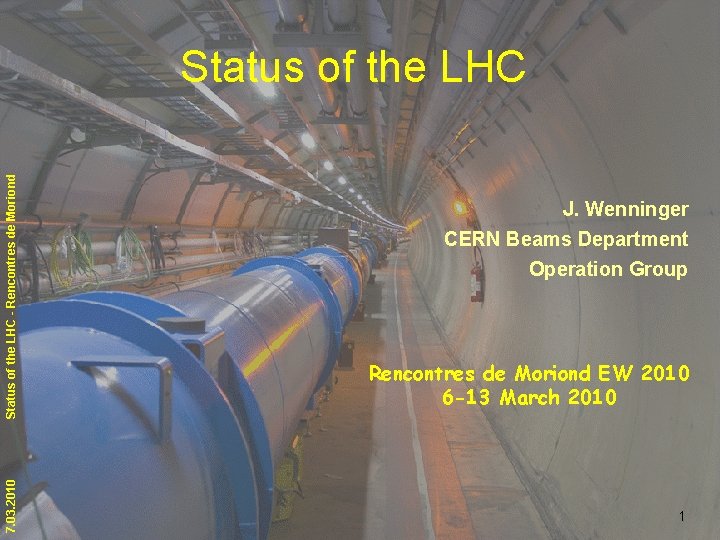
7. 03. 2010 Status of the LHC - Rencontres de Moriond Status of the LHC J. Wenninger CERN Beams Department Operation Group Rencontres de Moriond EW 2010 6 -13 March 2010 1
Outline 7. 03. 2010 Status of the LHC - Rencontres de Moriond Introduction Installation and preparation for beam Incident in sector 34 and repair LHC beam operation Conclusions 2
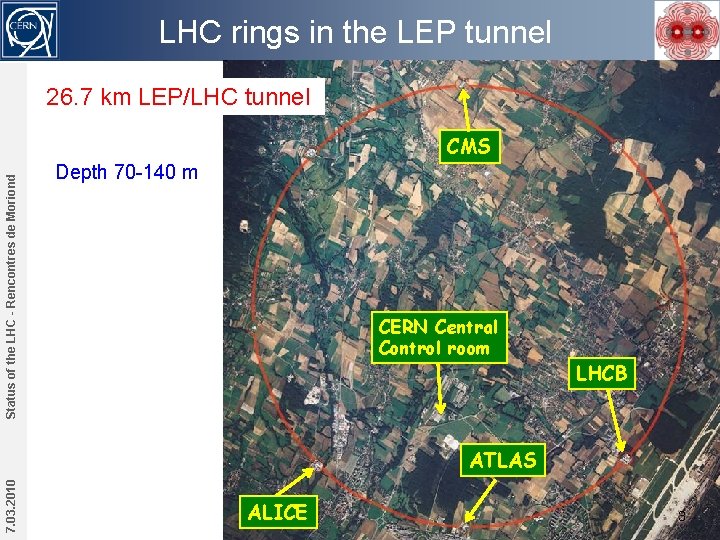
LHC rings in the LEP tunnel 26. 7 km LEP/LHC tunnel Status of the LHC - Rencontres de Moriond CMS Depth 70 -140 m CERN Central Control room LHCB 7. 03. 2010 ATLAS ALICE 3
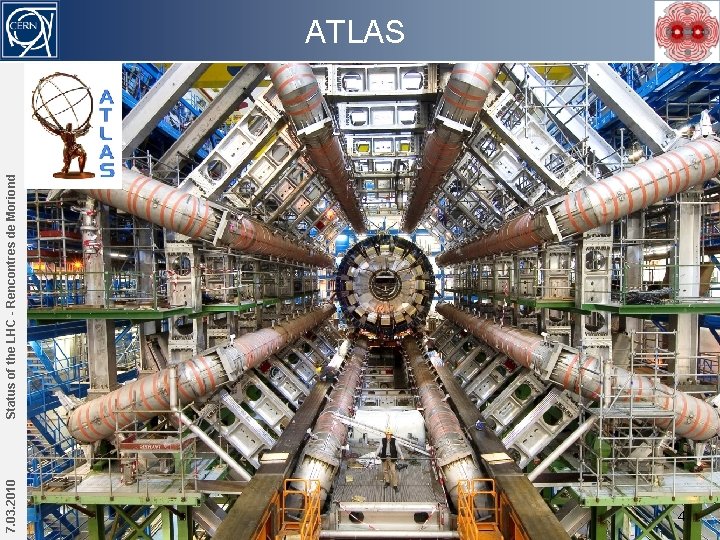
7. 03. 2010 Status of the LHC - Rencontres de Moriond ATLAS 4
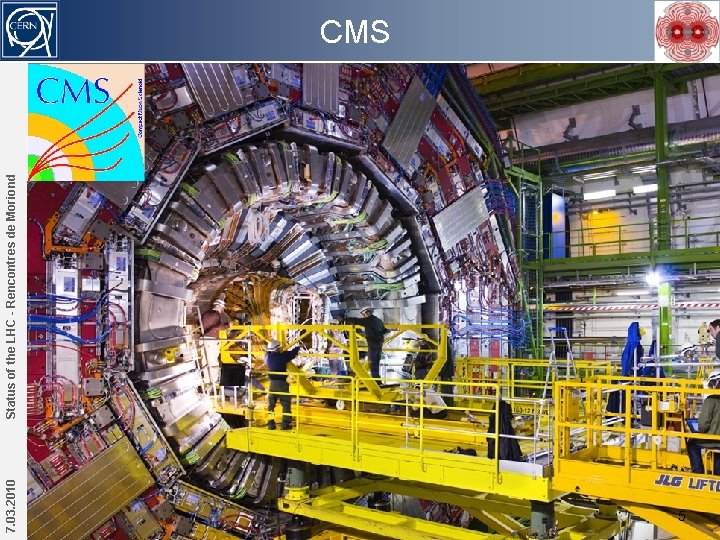
7. 03. 2010 Status of the LHC - Rencontres de Moriond CMS 5
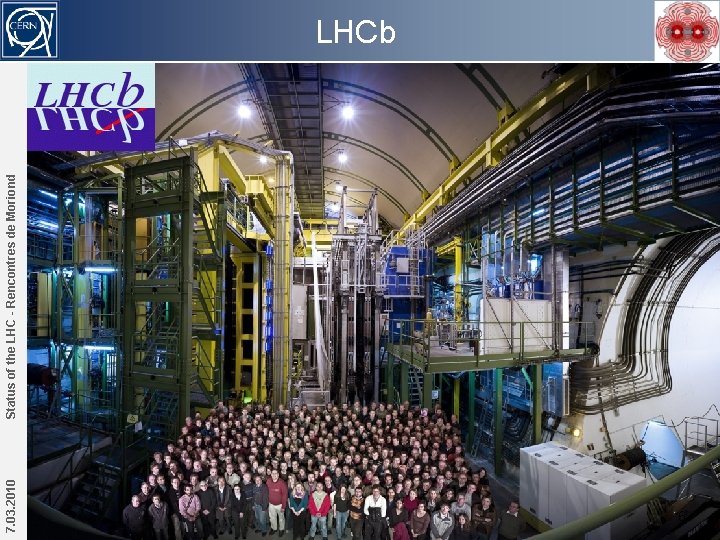
7. 03. 2010 Status of the LHC - Rencontres de Moriond LHCb 6
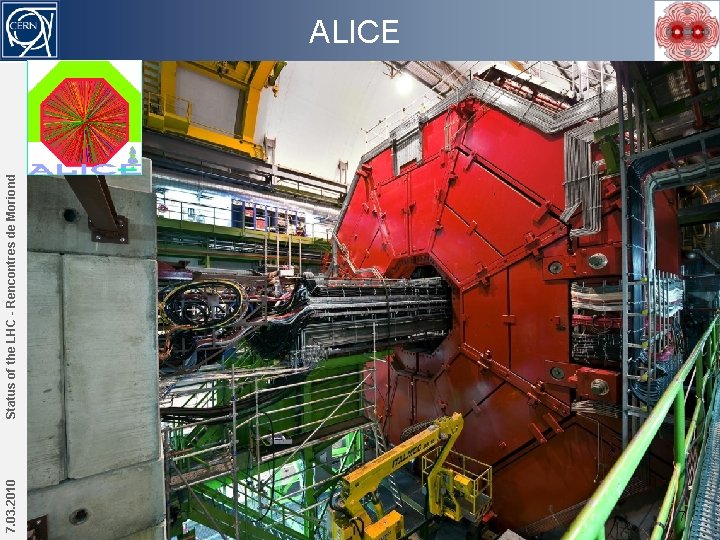
7. 03. 2010 Status of the LHC - Rencontres de Moriond ALICE 7
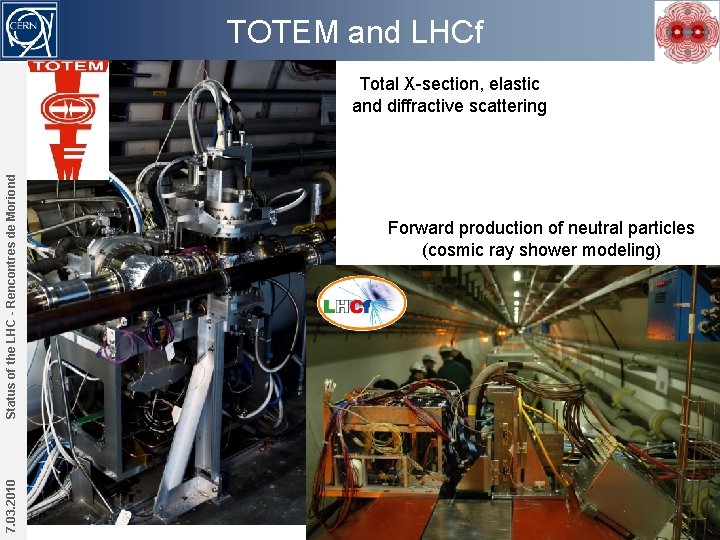
TOTEM and LHCf 7. 03. 2010 Status of the LHC - Rencontres de Moriond Total X-section, elastic and diffractive scattering Forward production of neutral particles (cosmic ray shower modeling) 8
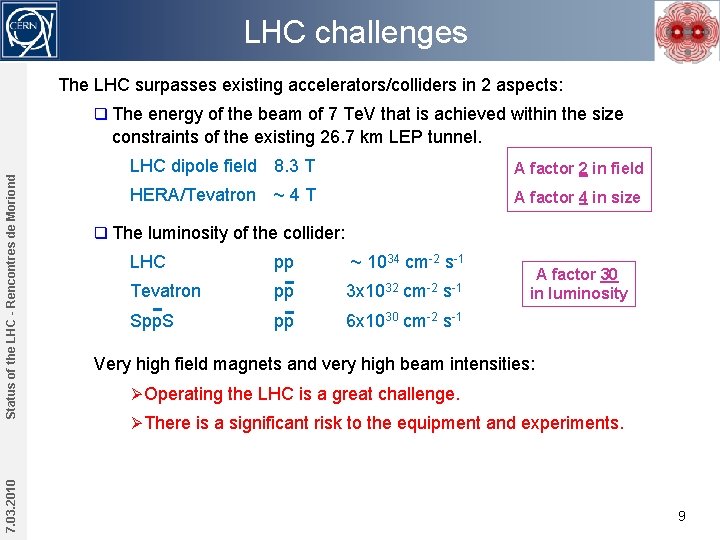
LHC challenges The LHC surpasses existing accelerators/colliders in 2 aspects: q The energy of the beam of 7 Te. V that is achieved within the size 7. 03. 2010 Status of the LHC - Rencontres de Moriond constraints of the existing 26. 7 km LEP tunnel. LHC dipole field 8. 3 T A factor 2 in field HERA/Tevatron A factor 4 in size ~4 T q The luminosity of the collider: LHC pp ~ 1034 cm-2 s-1 Tevatron pp 3 x 1032 Spp. S pp 6 x 1030 cm-2 s-1 A factor 30 in luminosity Very high field magnets and very high beam intensities: Ø Operating the LHC is a great challenge. Ø There is a significant risk to the equipment and experiments. 9
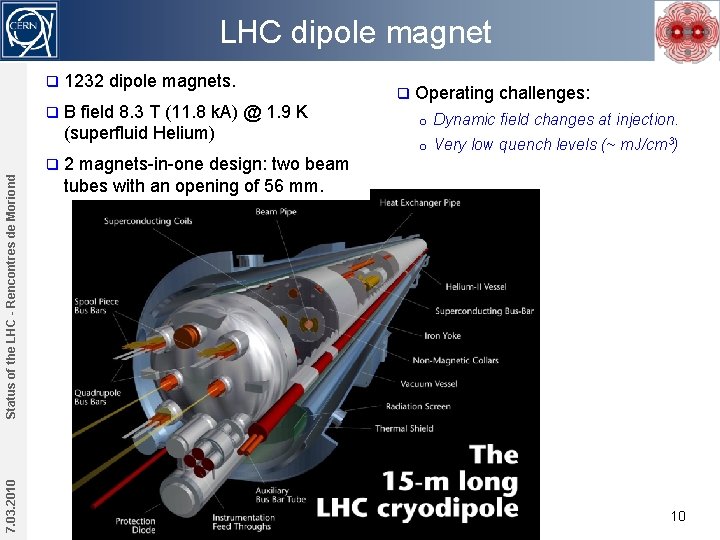
LHC dipole magnet q 1232 dipole magnets. q B field 8. 3 T (11. 8 k. A) @ 1. 9 K (superfluid Helium) 7. 03. 2010 Status of the LHC - Rencontres de Moriond q 2 magnets-in-one design: two beam tubes with an opening of 56 mm. q Operating challenges: o Dynamic field changes at injection. o Very low quench levels (~ m. J/cm 3) 10
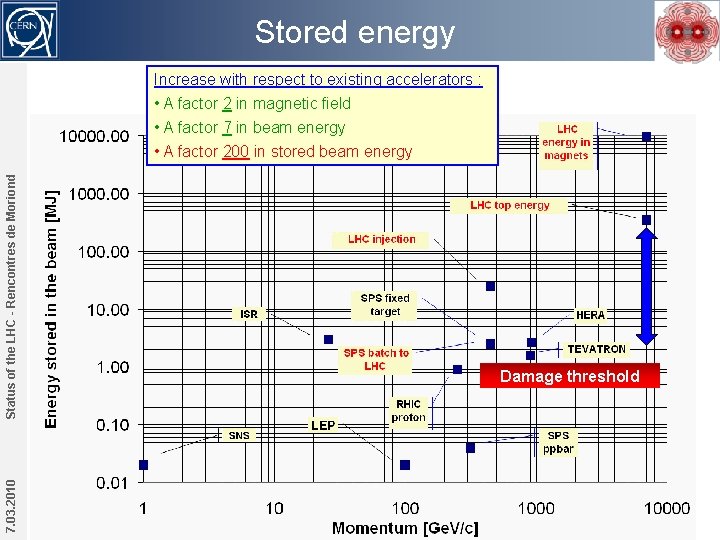
Stored energy Increase with respect to existing accelerators : • A factor 2 in magnetic field • A factor 7 in beam energy 7. 03. 2010 Status of the LHC - Rencontres de Moriond • A factor 200 in stored beam energy Damage threshold 11
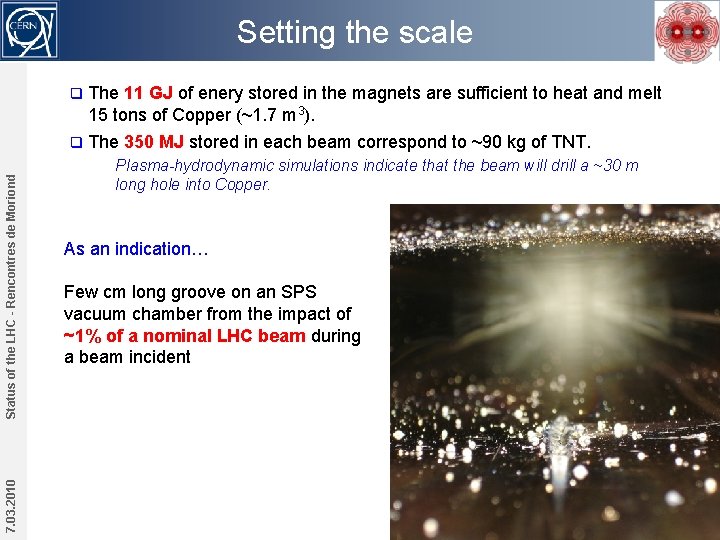
7. 03. 2010 Status of the LHC - Rencontres de Moriond Setting the scale q The 11 GJ of enery stored in the magnets are sufficient to heat and melt 15 tons of Copper (~1. 7 m 3). q The 350 MJ stored in each beam correspond to ~90 kg of TNT. Plasma-hydrodynamic simulations indicate that the beam will drill a ~30 m long hole into Copper. As an indication… Few cm long groove on an SPS vacuum chamber from the impact of ~1% of a nominal LHC beam during a beam incident 12
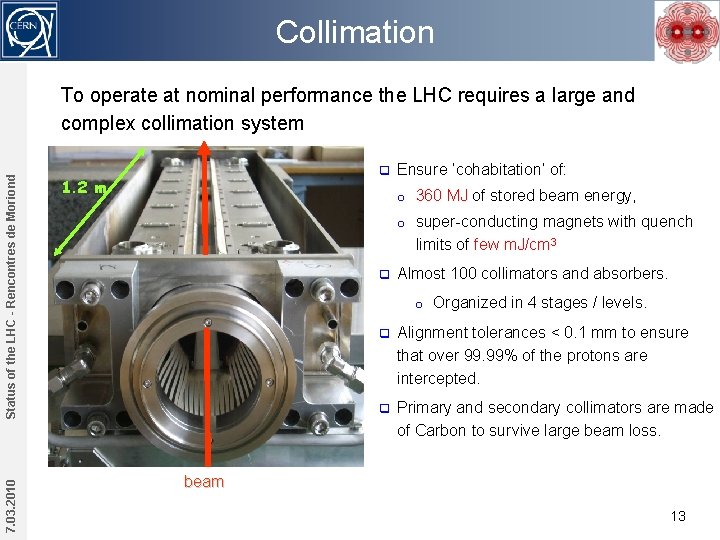
Collimation 7. 03. 2010 Status of the LHC - Rencontres de Moriond To operate at nominal performance the LHC requires a large and complex collimation system q 1. 2 m q Ensure ‘cohabitation’ of: o 360 MJ of stored beam energy, o super-conducting magnets with quench limits of few m. J/cm 3 Almost 100 collimators and absorbers. o Organized in 4 stages / levels. q Alignment tolerances < 0. 1 mm to ensure that over 99. 99% of the protons are intercepted. q Primary and secondary collimators are made of Carbon to survive large beam loss. beam 13
Outline 7. 03. 2010 Status of the LHC - Rencontres de Moriond Introduction Installation and preparation for beam Incident in sector 34 and repair LHC beam operation Conclusions 14
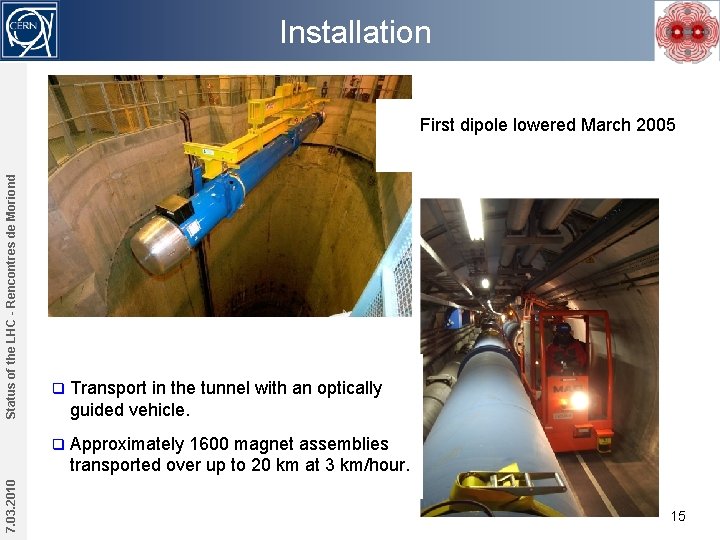
Installation 7. 03. 2010 Status of the LHC - Rencontres de Moriond First dipole lowered March 2005 q Transport in the tunnel with an optically guided vehicle. q Approximately 1600 magnet assemblies transported over up to 20 km at 3 km/hour. 15
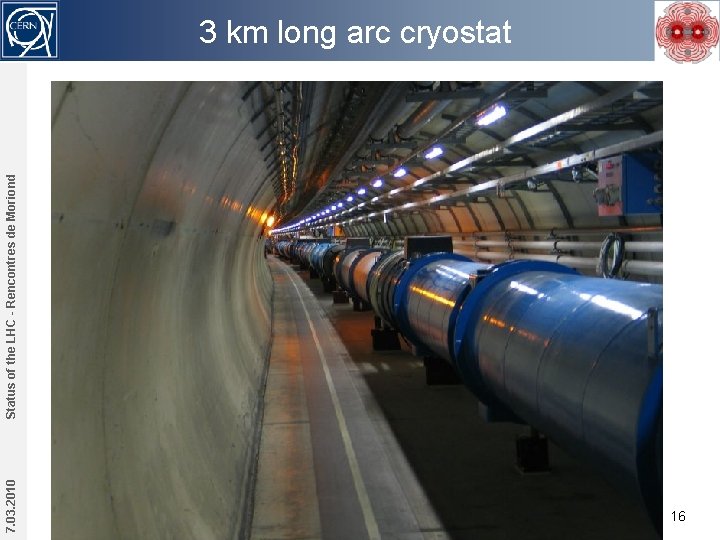
7. 03. 2010 Status of the LHC - Rencontres de Moriond 3 km long arc cryostat 16
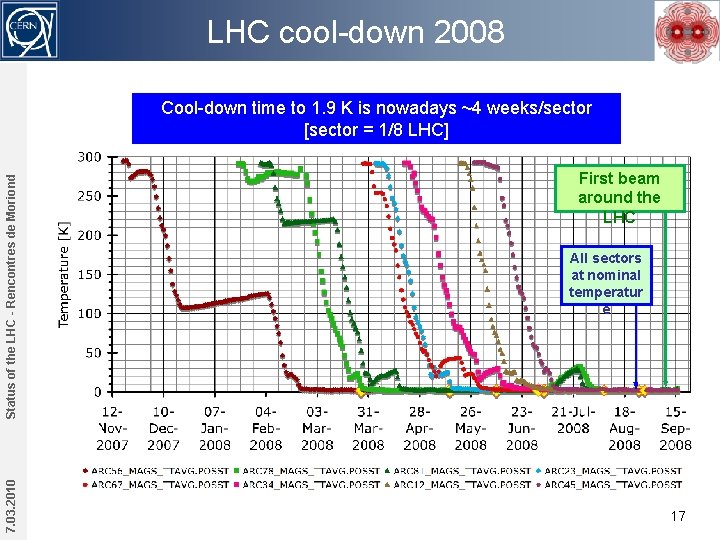
LHC cool-down 2008 7. 03. 2010 Status of the LHC - Rencontres de Moriond Cool-down time to 1. 9 K is nowadays ~4 weeks/sector [sector = 1/8 LHC] First beam around the LHC All sectors at nominal temperatur e 17
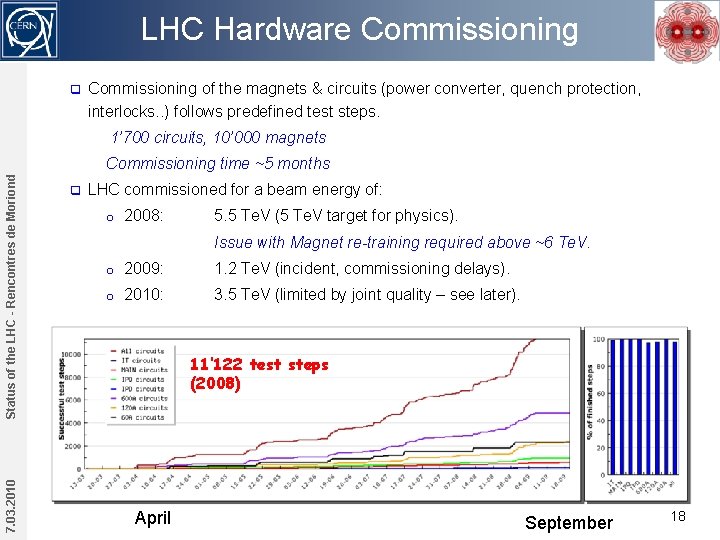
LHC Hardware Commissioning q Commissioning of the magnets & circuits (power converter, quench protection, interlocks. . ) follows predefined test steps. 1’ 700 circuits, 10’ 000 magnets 7. 03. 2010 Status of the LHC - Rencontres de Moriond Commissioning time ~5 months q LHC commissioned for a beam energy of: o 2008: 5. 5 Te. V (5 Te. V target for physics). Issue with Magnet re-training required above ~6 Te. V. o 2009: 1. 2 Te. V (incident, commissioning delays). o 2010: 3. 5 Te. V (limited by joint quality – see later). 11’ 122 test steps (2008) April September 18
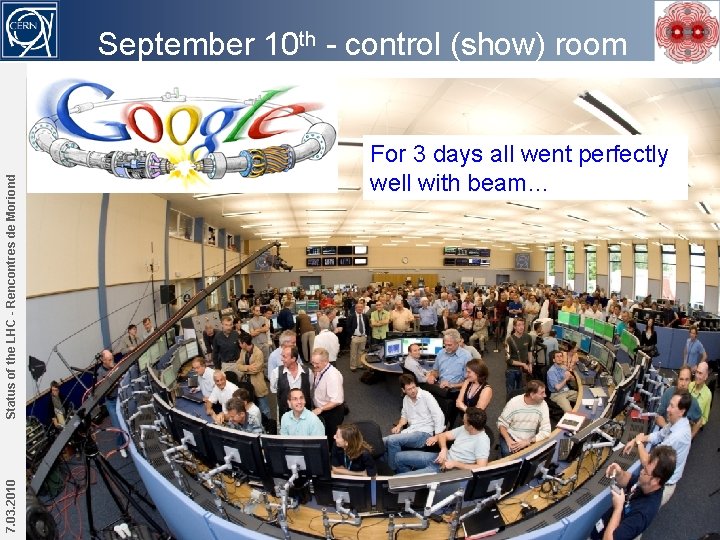
7. 03. 2010 Status of the LHC - Rencontres de Moriond September 10 th - control (show) room For 3 days all went perfectly well with beam… 19
Outline 7. 03. 2010 Status of the LHC - Rencontres de Moriond Introduction Installation and preparation for beam Incident in sector 34 and repair LHC beam operation Conclusions 20
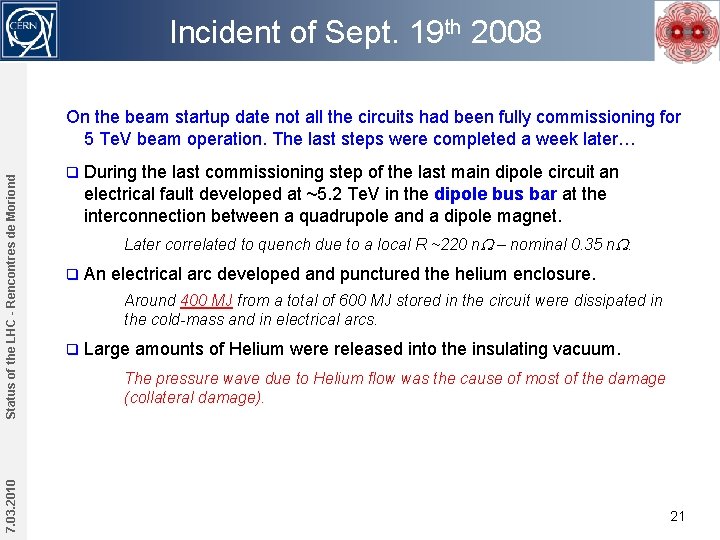
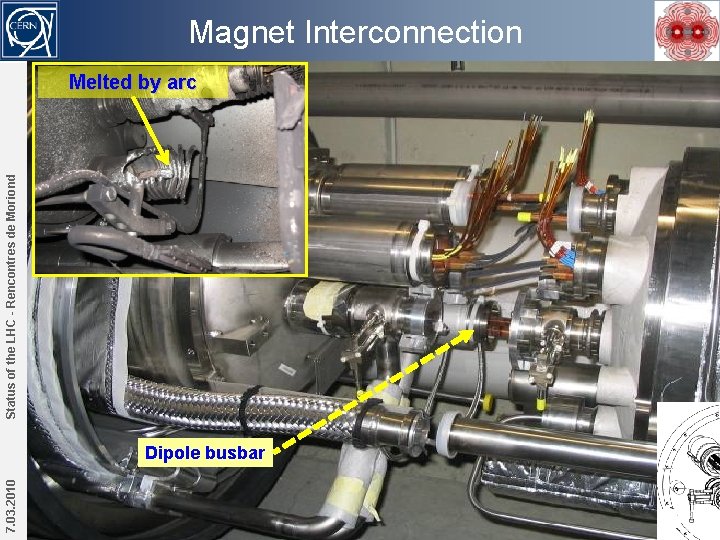
Incident of Sept. 19 th 2008 7. 03. 2010 Status of the LHC - Rencontres de Moriond On the beam startup date not all the circuits had been fully commissioning for 5 Te. V beam operation. The last steps were completed a week later… q During the last commissioning step of the last main dipole circuit an electrical fault developed at ~5. 2 Te. V in the dipole bus bar at the interconnection between a quadrupole and a dipole magnet. Later correlated to quench due to a local R ~220 n. W – nominal 0. 35 n. W. q An electrical arc developed and punctured the helium enclosure. Around 400 MJ from a total of 600 MJ stored in the circuit were dissipated in the cold-mass and in electrical arcs. q Large amounts of Helium were released into the insulating vacuum. The pressure wave due to Helium flow was the cause of most of the damage (collateral damage). 21
Magnet Interconnection Status of the LHC - Rencontres de Moriond Melted by arc 7. 03. 2010 Dipole busbar 22
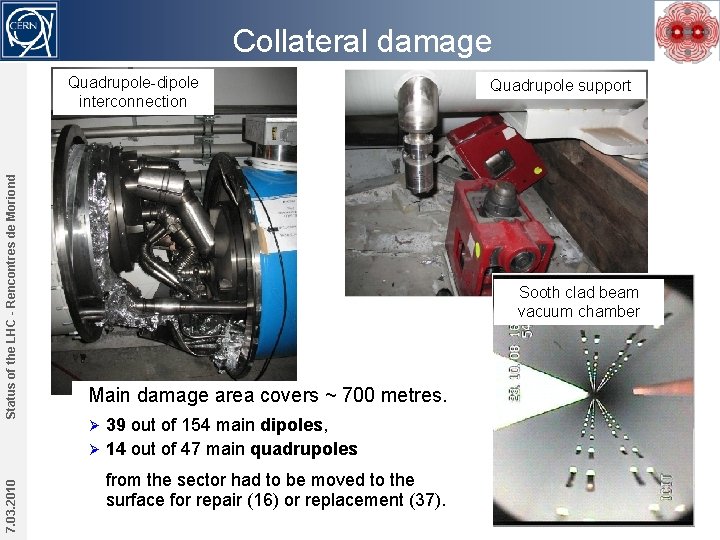
Collateral damage 7. 03. 2010 Status of the LHC - Rencontres de Moriond Quadrupole-dipole interconnection Quadrupole support Sooth clad beam vacuum chamber Main damage area covers ~ 700 metres. 39 out of 154 main dipoles, Ø 14 out of 47 main quadrupoles Ø from the sector had to be moved to the surface for repair (16) or replacement (37). 23
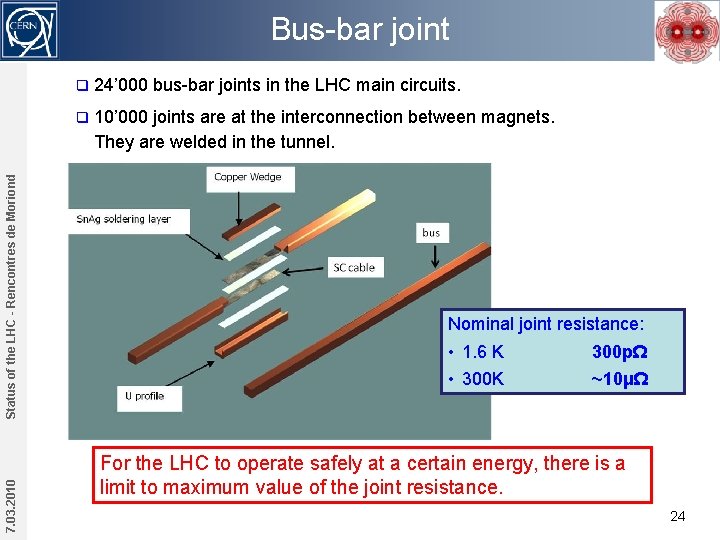
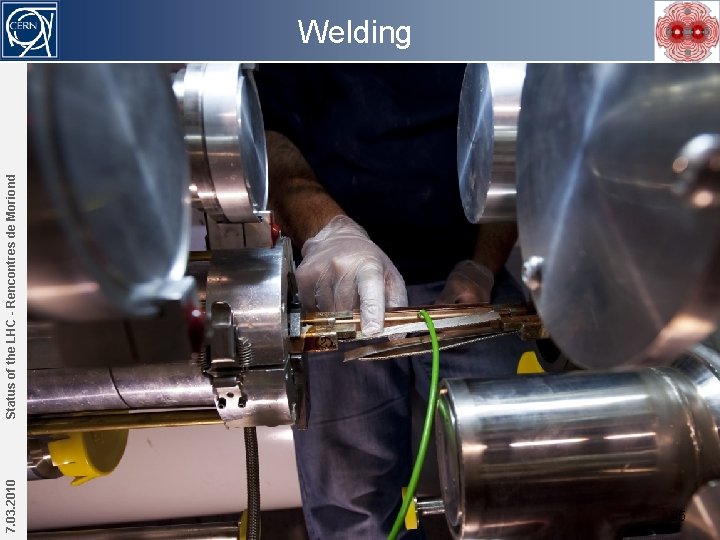
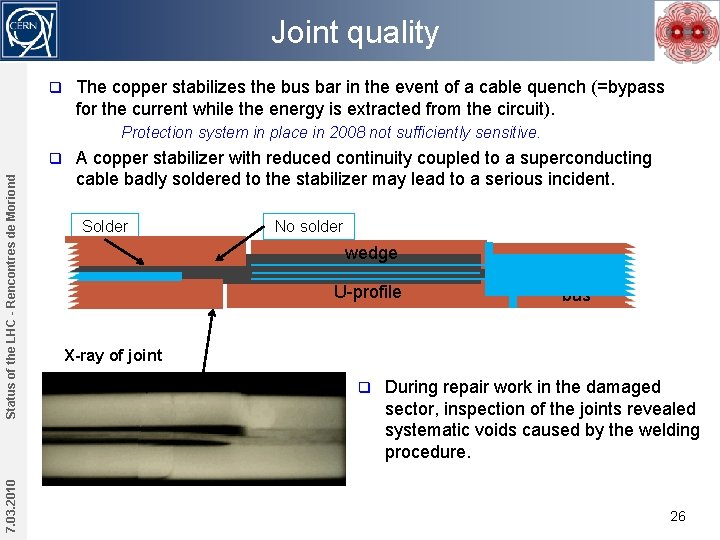
7. 03. 2010 Status of the LHC - Rencontres de Moriond Bus-bar joint q 24’ 000 bus-bar joints in the LHC main circuits. q 10’ 000 joints are at the interconnection between magnets. They are welded in the tunnel. Nominal joint resistance: • 1. 6 K • 300 K 300 pΩ ~10μΩ For the LHC to operate safely at a certain energy, there is a limit to maximum value of the joint resistance. 24
7. 03. 2010 Status of the LHC - Rencontres de Moriond Welding 25
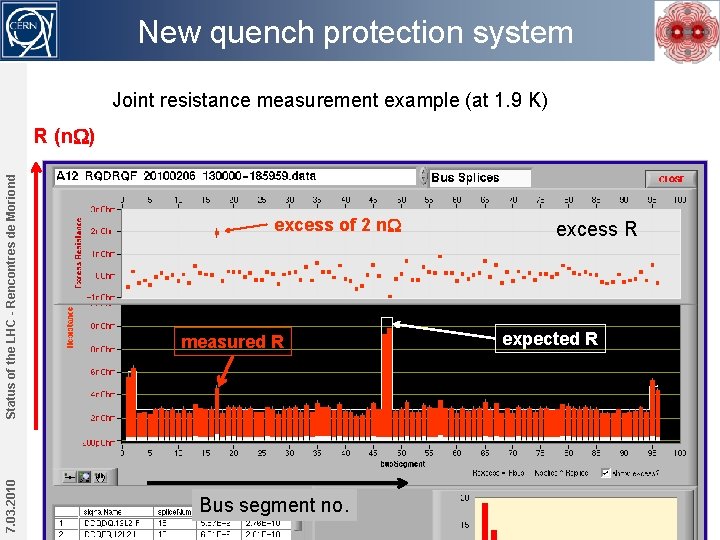
Joint quality q The copper stabilizes the bus bar in the event of a cable quench (=bypass for the current while the energy is extracted from the circuit). Protection system in place in 2008 not sufficiently sensitive. 7. 03. 2010 Status of the LHC - Rencontres de Moriond q A copper stabilizer with reduced continuity coupled to a superconducting cable badly soldered to the stabilizer may lead to a serious incident. Solder No solder wedge bus U-profile bus X-ray of joint q During repair work in the damaged sector, inspection of the joints revealed systematic voids caused by the welding procedure. 26
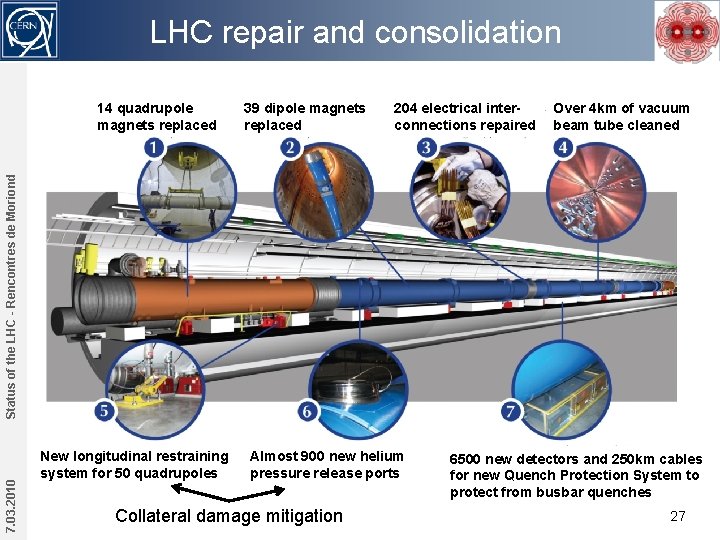
LHC repair and consolidation 39 dipole magnets replaced 204 electrical interconnections repaired Over 4 km of vacuum beam tube cleaned 7. 03. 2010 Status of the LHC - Rencontres de Moriond 14 quadrupole magnets replaced New longitudinal restraining system for 50 quadrupoles Almost 900 new helium pressure release ports Collateral damage mitigation 6500 new detectors and 250 km cables for new Quench Protection System to protect from busbar quenches 27
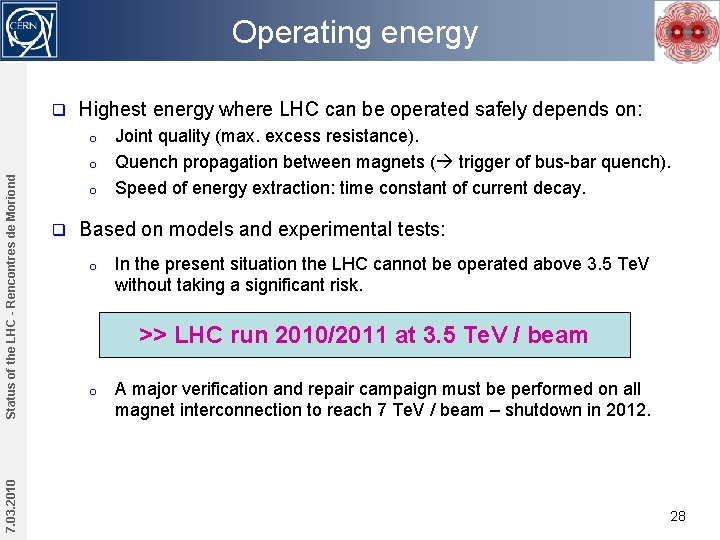
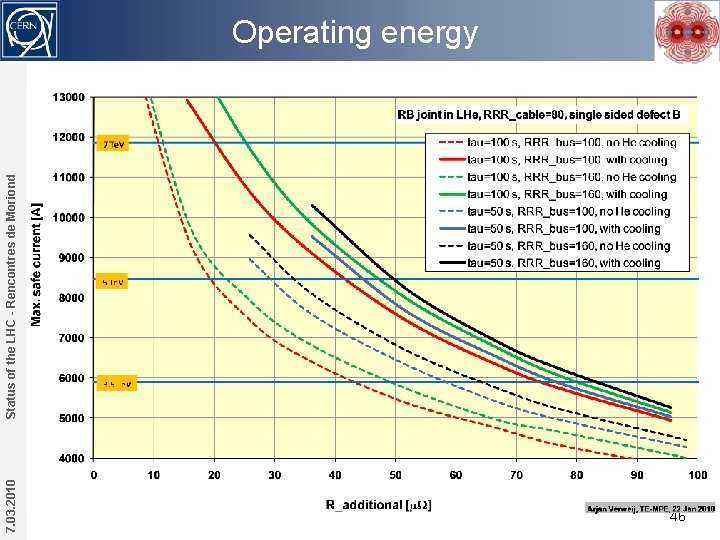
Operating energy q Highest energy where LHC can be operated safely depends on: o 7. 03. 2010 Status of the LHC - Rencontres de Moriond o o q Joint quality (max. excess resistance). Quench propagation between magnets ( trigger of bus-bar quench). Speed of energy extraction: time constant of current decay. Based on models and experimental tests: o In the present situation the LHC cannot be operated above 3. 5 Te. V without taking a significant risk. >> LHC run 2010/2011 at 3. 5 Te. V / beam o A major verification and repair campaign must be performed on all magnet interconnection to reach 7 Te. V / beam – shutdown in 2012. 28
Outline 7. 03. 2010 Status of the LHC - Rencontres de Moriond Introduction Installation and preparation for beam Incident in sector 34 and repair LHC beam operation Conclusions 29
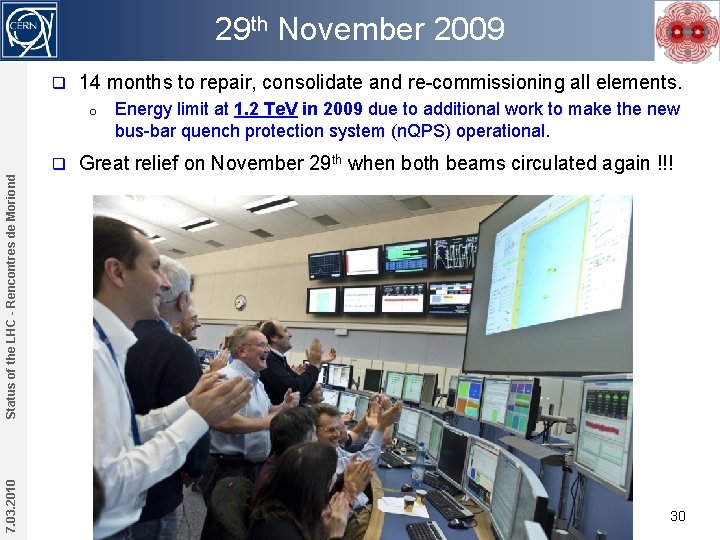
29 th November 2009 q 14 months to repair, consolidate and re-commissioning all elements. o 7. 03. 2010 Status of the LHC - Rencontres de Moriond q Energy limit at 1. 2 Te. V in 2009 due to additional work to make the new bus-bar quench protection system (n. QPS) operational. Great relief on November 29 th when both beams circulated again !!! Reserve slides 30
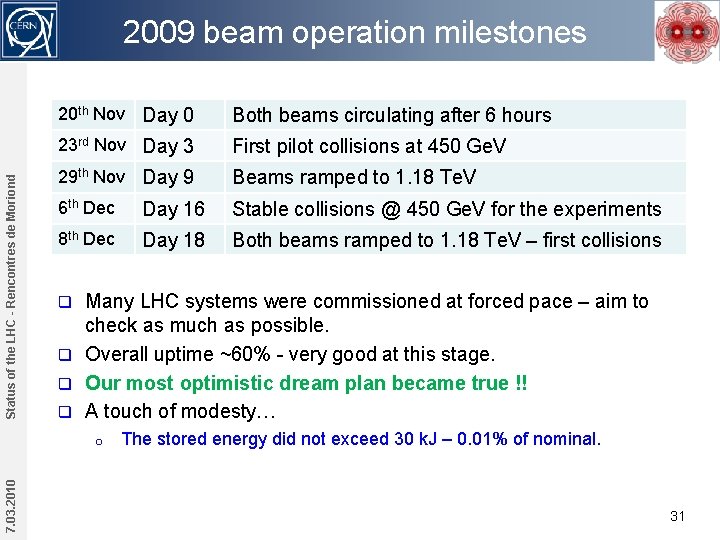
Status of the LHC - Rencontres de Moriond 2009 beam operation milestones 20 th Nov Day 0 Both beams circulating after 6 hours 23 rd Nov Day 3 First pilot collisions at 450 Ge. V 29 th Nov Day 9 Beams ramped to 1. 18 Te. V 6 th Dec Day 16 Stable collisions @ 450 Ge. V for the experiments 8 th Dec Day 18 Both beams ramped to 1. 18 Te. V – first collisions Many LHC systems were commissioned at forced pace – aim to check as much as possible. q Overall uptime ~60% - very good at this stage. q Our most optimistic dream plan became true !! q A touch of modesty… q 7. 03. 2010 o The stored energy did not exceed 30 k. J – 0. 01% of nominal. 31
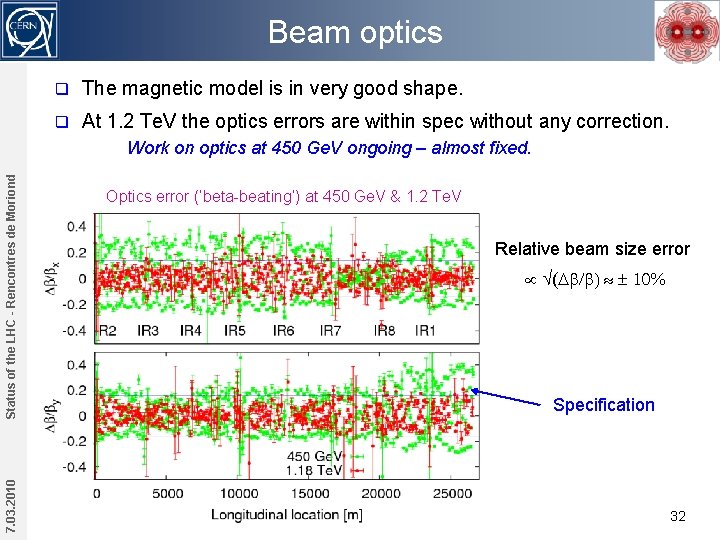
Beam optics q The magnetic model is in very good shape. q At 1. 2 Te. V the optics errors are within spec without any correction. 7. 03. 2010 Status of the LHC - Rencontres de Moriond Work on optics at 450 Ge. V ongoing – almost fixed. Optics error (‘beta-beating’) at 450 Ge. V & 1. 2 Te. V Relative beam size error (Db/b) 10% Specification 32
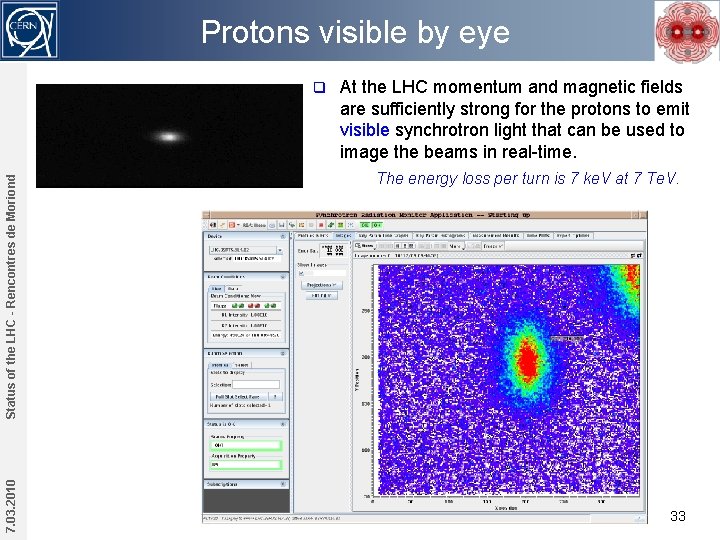
Protons visible by eye 7. 03. 2010 Status of the LHC - Rencontres de Moriond q At the LHC momentum and magnetic fields are sufficiently strong for the protons to emit visible synchrotron light that can be used to image the beams in real-time. The energy loss per turn is 7 ke. V at 7 Te. V. 33
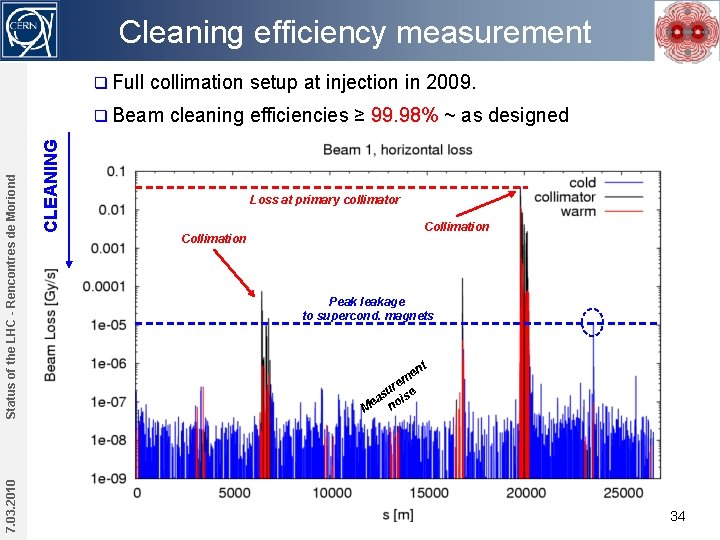
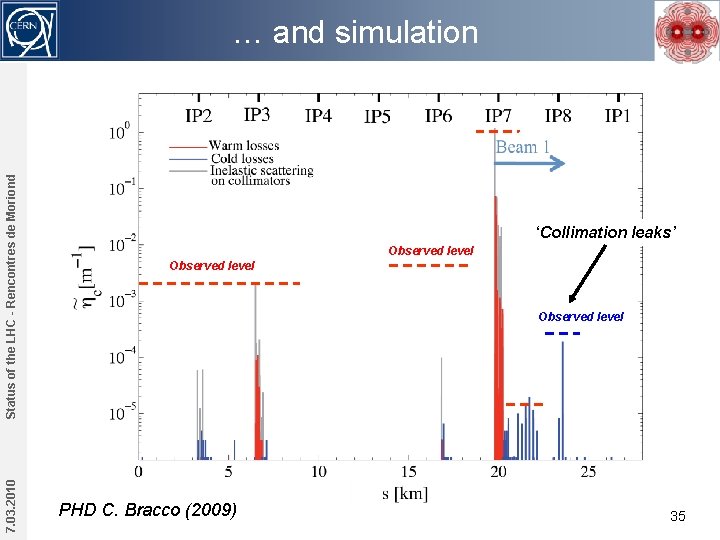
Cleaning efficiency measurement q Full collimation setup at injection in 2009. 7. 03. 2010 CLEANING Status of the LHC - Rencontres de Moriond q Beam cleaning efficiencies ≥ 99. 98% ~ as designed Loss at primary collimator Collimation Peak leakage to supercond. magnets t en em ur se s i a Me no 34
7. 03. 2010 Status of the LHC - Rencontres de Moriond … and simulation ‘Collimation leaks’ Observed level PHD C. Bracco (2009) 35
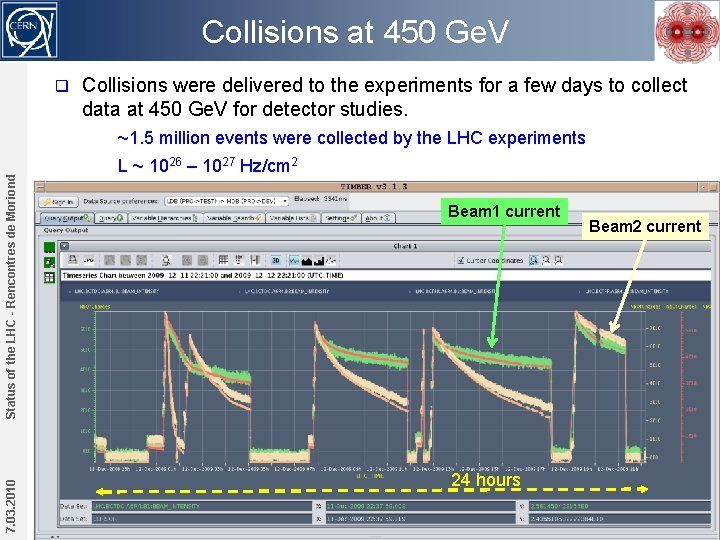
Collisions at 450 Ge. V q Collisions were delivered to the experiments for a few days to collect data at 450 Ge. V for detector studies. 7. 03. 2010 Status of the LHC - Rencontres de Moriond ~1. 5 million events were collected by the LHC experiments L ~ 1026 – 1027 Hz/cm 2 Beam 1 current Beam 2 current 24 hours 36
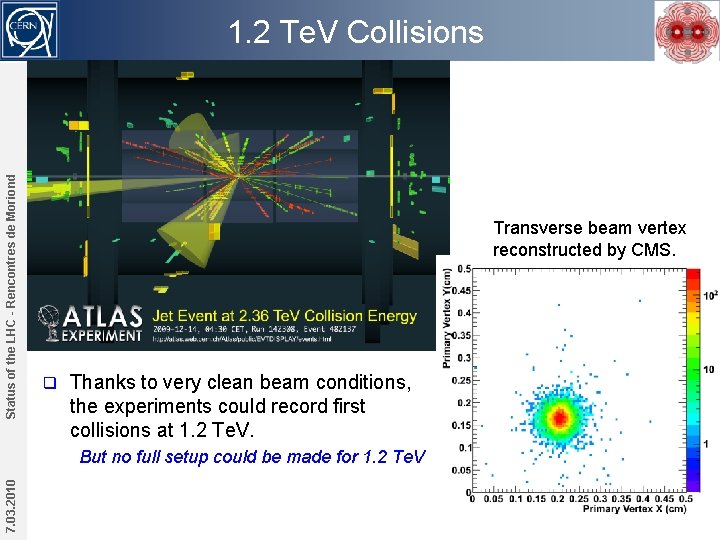
Status of the LHC - Rencontres de Moriond 1. 2 Te. V Collisions Transverse beam vertex reconstructed by CMS. q Thanks to very clean beam conditions, the experiments could record first collisions at 1. 2 Te. V. 7. 03. 2010 But no full setup could be made for 1. 2 Te. V 37
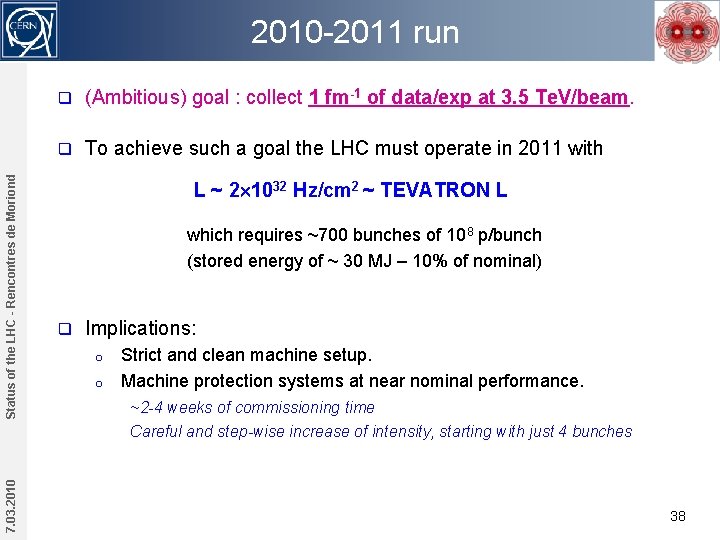
7. 03. 2010 Status of the LHC - Rencontres de Moriond 2010 -2011 run q (Ambitious) goal : collect 1 fm-1 of data/exp at 3. 5 Te. V/beam. q To achieve such a goal the LHC must operate in 2011 with L ~ 2 1032 Hz/cm 2 ~ TEVATRON L which requires ~700 bunches of 108 p/bunch (stored energy of ~ 30 MJ – 10% of nominal) q Implications: o o Strict and clean machine setup. Machine protection systems at near nominal performance. ~2 -4 weeks of commissioning time Careful and step-wise increase of intensity, starting with just 4 bunches 38
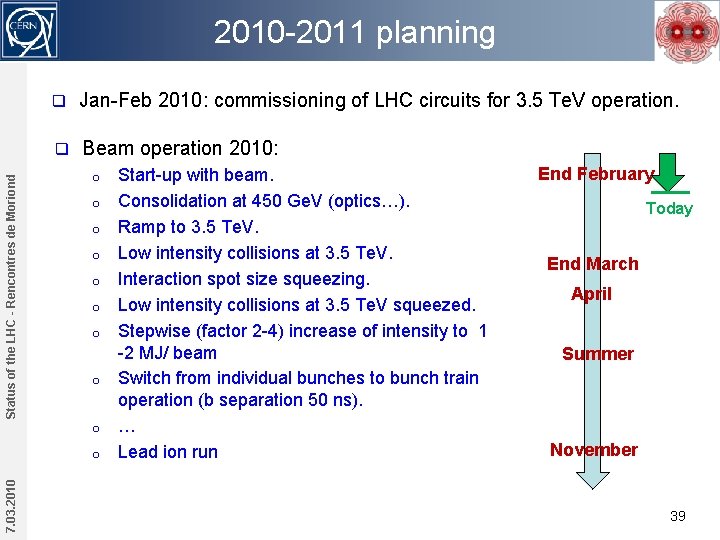
Status of the LHC - Rencontres de Moriond 2010 -2011 planning q Jan-Feb 2010: commissioning of LHC circuits for 3. 5 Te. V operation. q Beam operation 2010: o o o o o 7. 03. 2010 o Start-up with beam. Consolidation at 450 Ge. V (optics…). Ramp to 3. 5 Te. V. Low intensity collisions at 3. 5 Te. V. Interaction spot size squeezing. Low intensity collisions at 3. 5 Te. V squeezed. Stepwise (factor 2 -4) increase of intensity to 1 -2 MJ/ beam Switch from individual bunches to bunch train operation (b separation 50 ns). … Lead ion run End February Today End March April Summer November 39
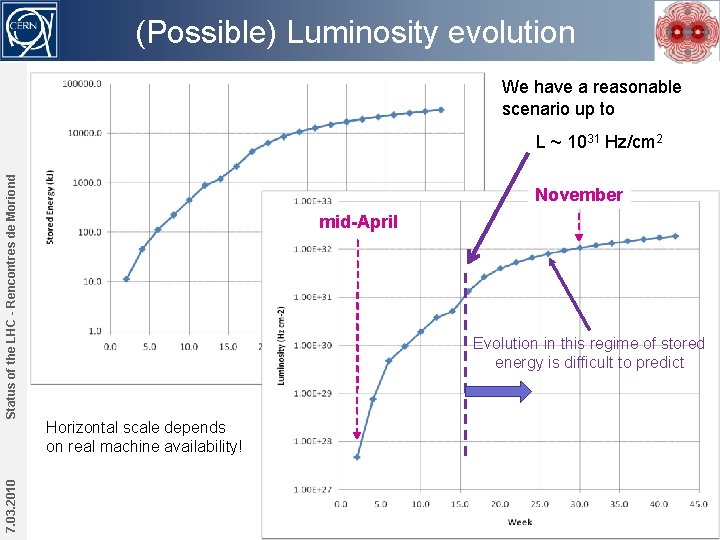
(Possible) Luminosity evolution We have a reasonable scenario up to 7. 03. 2010 Status of the LHC - Rencontres de Moriond L ~ 1031 Hz/cm 2 November mid-April Evolution in this regime of stored energy is difficult to predict Horizontal scale depends on real machine availability! 40
Summary q The electrical incident 9 days after startup in 2008 revealed quality issues of the bus-bar joints. 7. 03. 2010 Status of the LHC - Rencontres de Moriond 14 months of repair and re-commissioning. New diagnostics for online monitoring and protection of all joints. Eradication of joint issues requires a complete warm-up and long shutdown. q The LHC beam energy will be limited to 3. 5 Te. V in 2010/2011. Long shutdown in 2012 to prepare LHC for 7 Te. V / beam. q Very successful beam commissioning in 2009 to 1. 2 Te. V, now preparing for 18 months run at 3. 5 Te. V. Aiming for luminosities up to ~1032 cm-2 s-1 in 2010/11. But the real beam challenges are ahead of us ! 41
7. 03. 2010 Status of the LHC - Rencontres de Moriond Spare slides 42
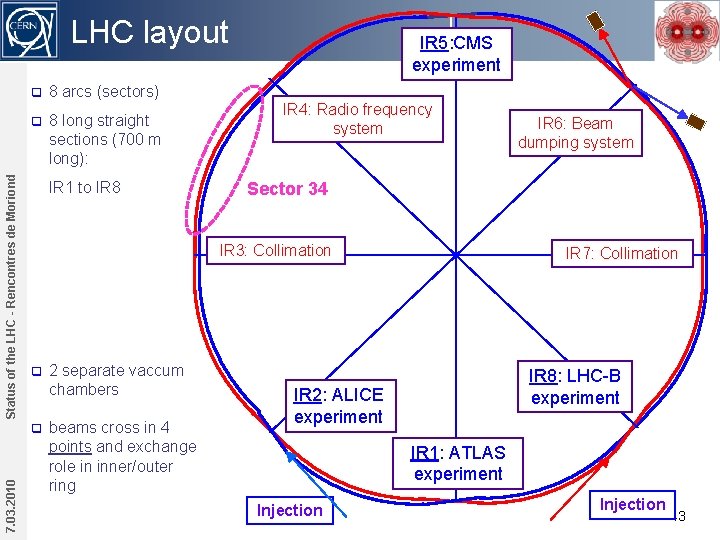
Status of the LHC - Rencontres de Moriond LHC layout q 8 arcs (sectors) q 8 long straight sections (700 m long): IR 1 to IR 8 IR 4: Radio frequency system q 2 separate vaccum chambers beams cross in 4 points and exchange role in inner/outer ring IR 6: Beam dumping system Sector 34 IR 3: Collimation q 7. 03. 2010 IR 5: CMS experiment IR 7: Collimation IR 8: LHC-B experiment IR 2: ALICE experiment IR 1: ATLAS experiment Injection 43
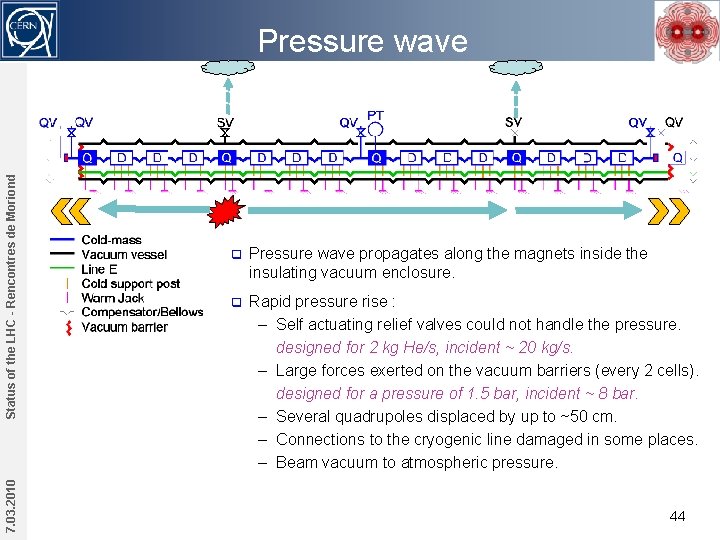
7. 03. 2010 Status of the LHC - Rencontres de Moriond Pressure wave q Pressure wave propagates along the magnets inside the insulating vacuum enclosure. q Rapid pressure rise : – Self actuating relief valves could not handle the pressure. designed for 2 kg He/s, incident ~ 20 kg/s. – Large forces exerted on the vacuum barriers (every 2 cells). designed for a pressure of 1. 5 bar, incident ~ 8 bar. – Several quadrupoles displaced by up to ~50 cm. – Connections to the cryogenic line damaged in some places. – Beam vacuum to atmospheric pressure. 44
New quench protection system Joint resistance measurement example (at 1. 9 K) 7. 03. 2010 Status of the LHC - Rencontres de Moriond R (n. W) excess of 2 n. W measured R Bus segment no. excess R expected R 45
7. 03. 2010 Status of the LHC - Rencontres de Moriond Operating energy 46
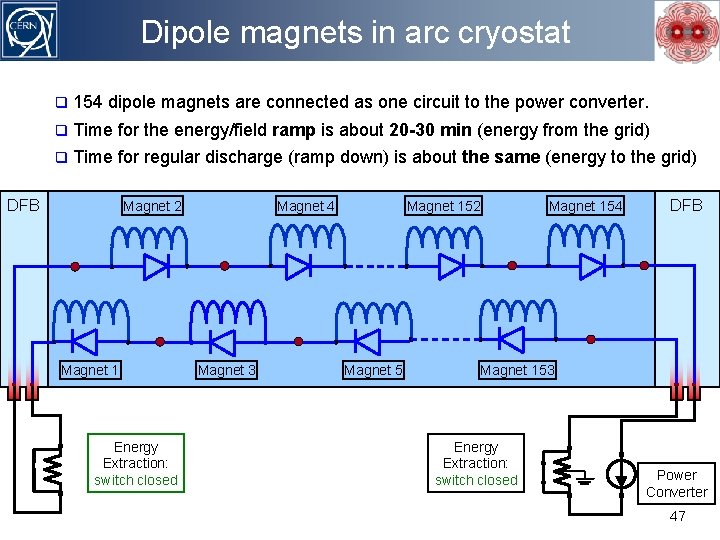
Dipole magnets in arc cryostat q 154 dipole magnets are connected as one circuit to the power converter. q Time for the energy/field ramp is about 20 -30 min (energy from the grid) q Time for regular discharge (ramp down) is about the same (energy to the grid) DFB Magnet 2 Magnet 1 Energy Extraction: switch closed Magnet 4 Magnet 3 Magnet 152 Magnet 5 Magnet 154 DFB Magnet 153 Energy Extraction: switch closed Power Converter 47
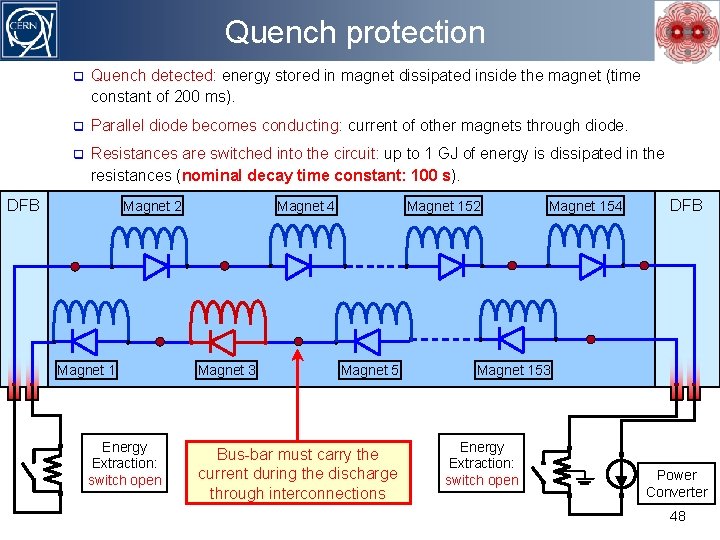
Quench protection q Quench detected: energy stored in magnet dissipated inside the magnet (time constant of 200 ms). q Parallel diode becomes conducting: current of other magnets through diode. q Resistances are switched into the circuit: up to 1 GJ of energy is dissipated in the resistances (nominal decay time constant: 100 s). DFB Magnet 2 Magnet 1 Energy Extraction: switch open Magnet 4 Magnet 3 Magnet 152 Magnet 5 Bus-bar must carry the current during the discharge through interconnections Magnet 154 DFB Magnet 153 Energy Extraction: switch open Power Converter 48