
68402 Structural Design of Buildings II Design of

68402: Structural Design of Buildings II Design of Connections Monther Dwaikat Assistant Professor Department of Building Engineering An-Najah National University 68402/61420 Slide # 1
Bolted Connections l l l Types of Connections Simple Bolted Shear Connections Simple Welded Connections 68402/61420 2

Types of Connections Simple Connections Bolted Connections Common Bolts Eccentric Connections Welded Connections High Strength Bolts Slip Critical Filet Weld Groove Weld Bearing Type 68402/61420 3

Types of Connections Simple Connections Eccentric Connections Bolted Connections Elastic Analysis Ultimate Analysis Welded Connections Moment Resisting Elastic Analysis 68402/61420 Ultimate Analysis Moment Resisting 4
Simple Bolted Connections l There are different types of bolted connections. They can be categorized based on the type of loading. • Tension member connection and splice. It subjects the bolts to forces that tend to shear the shank. • Beam end simple connection. It subjects the bolts to forces that tend to shear the shank. • Hanger connection. The hanger connection puts the bolts in tension 68402/61420 5

Simple Bolted Connections P P Tension member Connection/ splice P P Beam end Simple shear connection 68402/61420 6

Simple Bolted Connections P P P Hanger connection (Tension) Moment resisting connection 68402/61420 7
Simple Bolted Connections The bolts are subjected to shear or tension loading. l • • • In most bolted connection, the bolts are subjected to shear. Bolts can fail in shear or in tension. You can calculate the shear strength or the tensile strength of a bolt l Simple connection: If the line of action of the force acting on the connection passes through the center of gravity of the connection, then each bolt can be assumed to resist an equal share of the load. l The strength of the simple connection will be equal to the sum of the strengths of the individual bolts in the connection. 68402/61420 8
Bolt Types & Materials A 307 - Unfinished (Ordinary or Common) bolts low carbon steel A 36, Fu = 413 MPa, for light structures under static load A 325 - High strength bolts, heat-treated medium carbon steel, Fu = 827 MPa, for structural joints A 490 - High strength bolts, Quenched and Tempered Alloy steel, Fu = 1033 MPa for structural joints A 449 - High strength bolts with diameter > 1 ½”, anchor bolts, lifting hooks, tie-downs 68402/61420 9
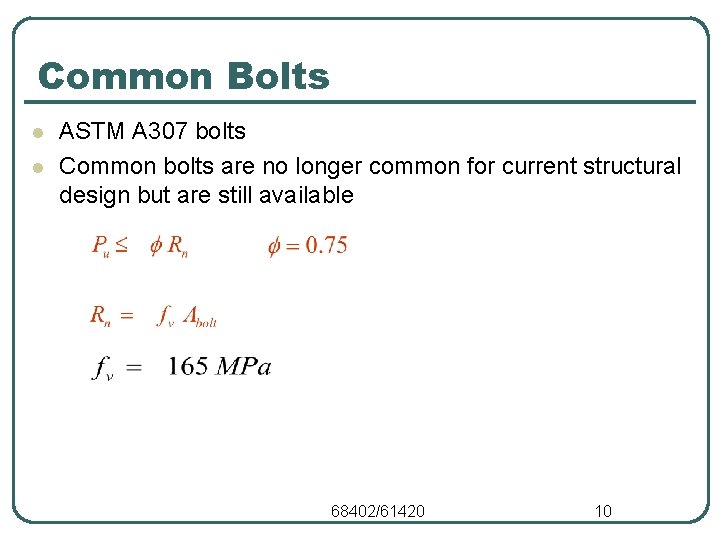
Common Bolts l l ASTM A 307 bolts Common bolts are no longer common for current structural design but are still available 68402/61420 10
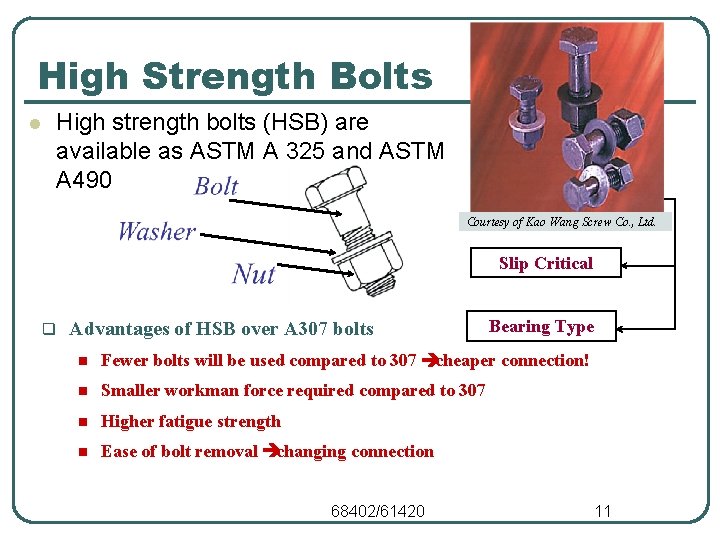
High Strength Bolts l High strength bolts (HSB) are available as ASTM A 325 and ASTM A 490 Courtesy of Kao Wang Screw Co. , Ltd. Slip Critical q Advantages of HSB over A 307 bolts Bearing Type n Fewer bolts will be used compared to 307 ècheaper connection! n Smaller workman force required compared to 307 n Higher fatigue strength n Ease of bolt removal èchanging connection 68402/61420 11
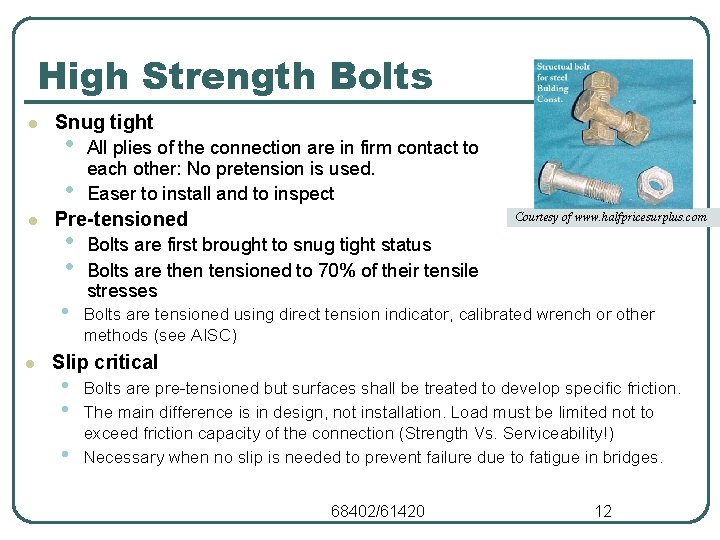
High Strength Bolts l Snug tight • • l Pre-tensioned • • • l All plies of the connection are in firm contact to each other: No pretension is used. Easer to install and to inspect Courtesy of www. halfpricesurplus. com Bolts are first brought to snug tight status Bolts are then tensioned to 70% of their tensile stresses Bolts are tensioned using direct tension indicator, calibrated wrench or other methods (see AISC) Slip critical • • • Bolts are pre-tensioned but surfaces shall be treated to develop specific friction. The main difference is in design, not installation. Load must be limited not to exceed friction capacity of the connection (Strength Vs. Serviceability!) Necessary when no slip is needed to prevent failure due to fatigue in bridges. 68402/61420 12
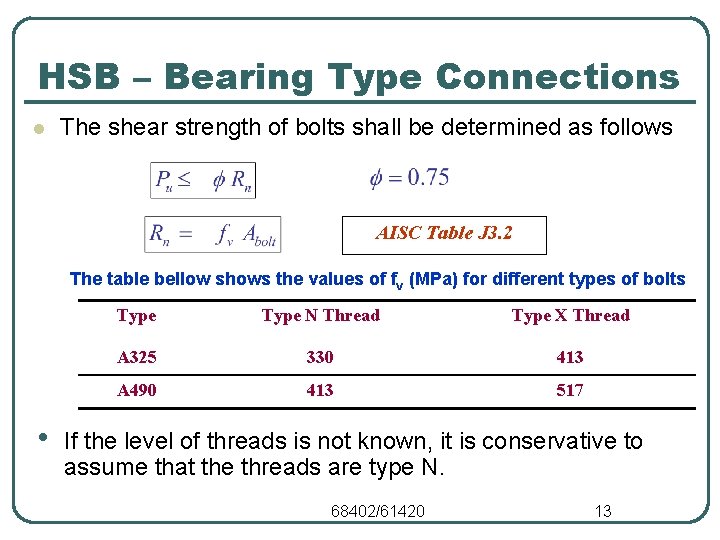
HSB – Bearing Type Connections l The shear strength of bolts shall be determined as follows AISC Table J 3. 2 The table bellow shows the values of fv (MPa) for different types of bolts • Type N Thread Type X Thread A 325 330 413 A 490 413 517 If the level of threads is not known, it is conservative to assume that the threads are type N. 68402/61420 13
Bolted Shear Connections l We want to design the bolted shear connections so that the factored design strength ( Rn) is greater than or equal to the factored load. Rn Pu l So, we need to examine the various possible failure modes and calculate the corresponding design strengths. l Possible failure modes are: • • • Shear failure of the bolts Failure of member being connected due to fracture or yielding or …. Edge tearing or fracture of the connected plate Tearing or fracture of the connected plate between two bolt holes Excessive bearing deformation at the bolt hole 68402/61420 14
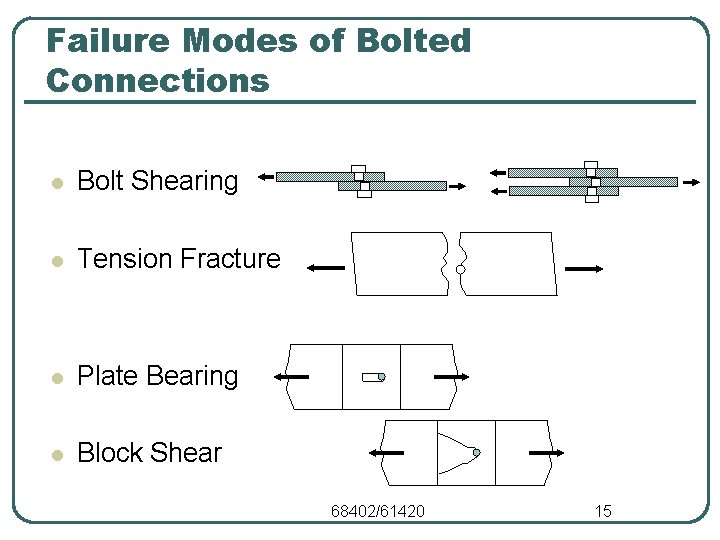
Failure Modes of Bolted Connections l Bolt Shearing l Tension Fracture l Plate Bearing l Block Shear 68402/61420 15
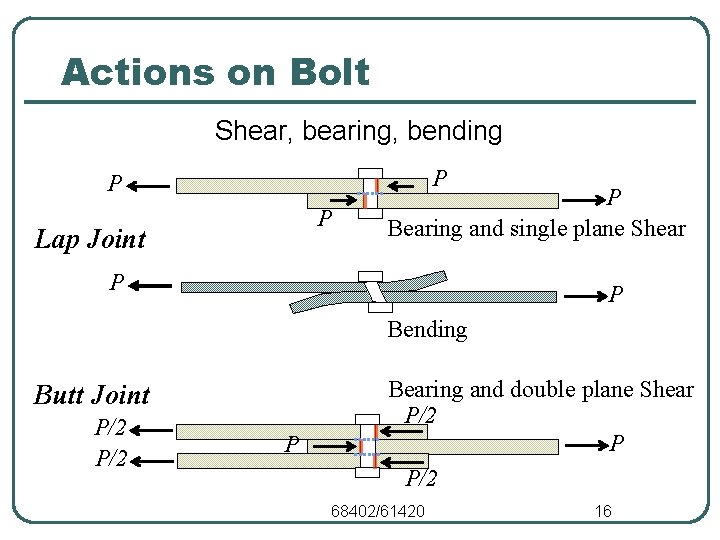
Actions on Bolt Shear, bearing, bending P P P Lap Joint P Bearing and single plane Shear P P Bending Butt Joint P/2 P Bearing and double plane Shear P/2 P P/2 68402/61420 16
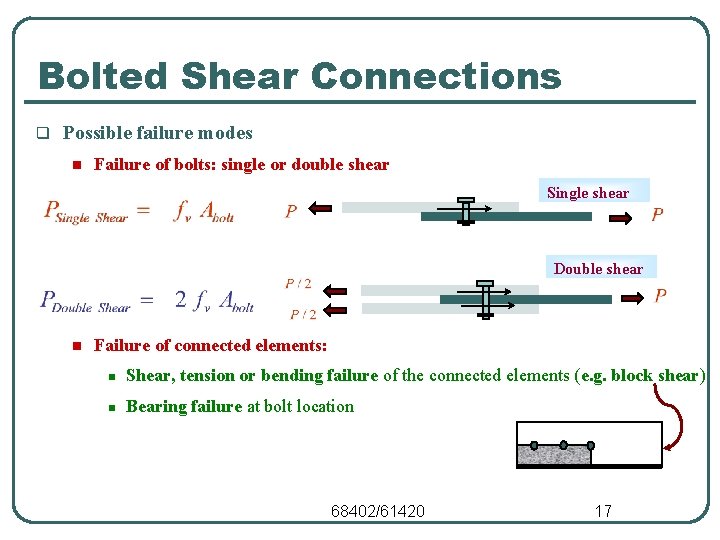
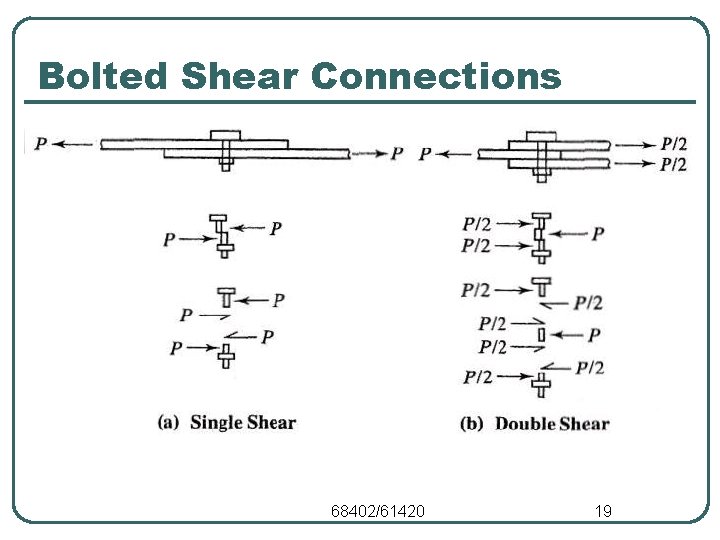
Bolted Shear Connections q Possible failure modes n Failure of bolts: single or double shear Single shear Double shear n Failure of connected elements: n Shear, tension or bending failure of the connected elements (e. g. block shear) n Bearing failure at bolt location 68402/61420 17
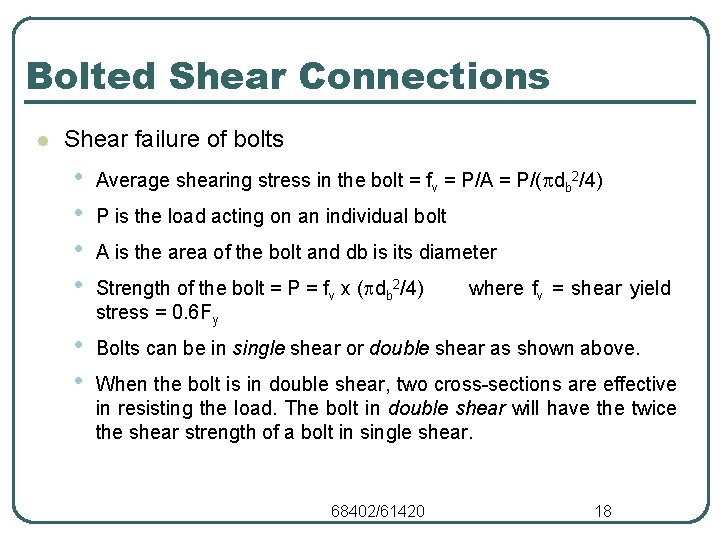
Bolted Shear Connections l Shear failure of bolts • • Average shearing stress in the bolt = fv = P/A = P/( db 2/4) • • Bolts can be in single shear or double shear as shown above. P is the load acting on an individual bolt A is the area of the bolt and db is its diameter Strength of the bolt = P = fv x ( db 2/4) stress = 0. 6 Fy where fv = shear yield When the bolt is in double shear, two cross-sections are effective in resisting the load. The bolt in double shear will have the twice the shear strength of a bolt in single shear. 68402/61420 18
Bolted Shear Connections 68402/61420 19
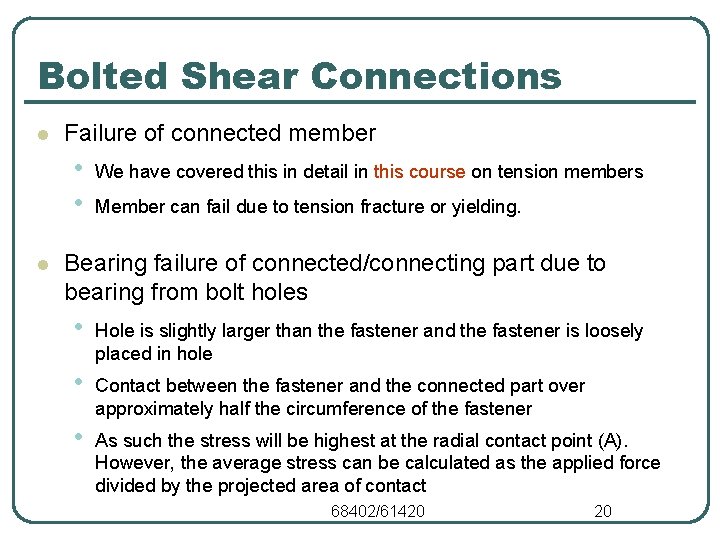
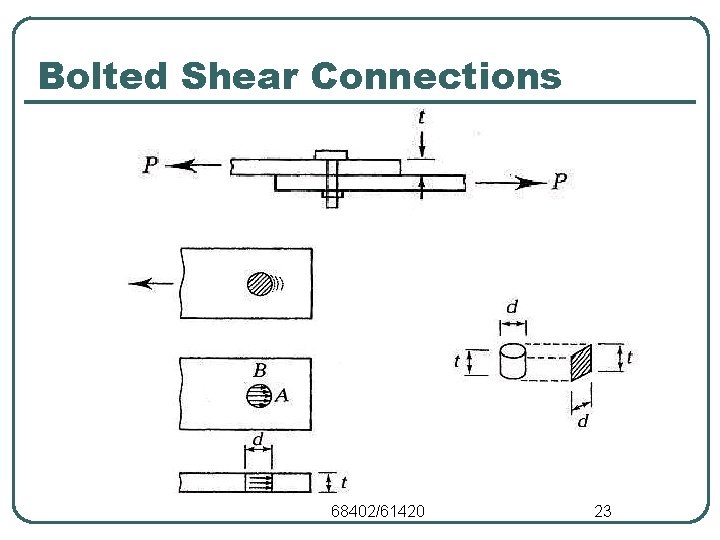
Bolted Shear Connections l Failure of connected member • • l We have covered this in detail in this course on tension members Member can fail due to tension fracture or yielding. Bearing failure of connected/connecting part due to bearing from bolt holes • Hole is slightly larger than the fastener and the fastener is loosely placed in hole • Contact between the fastener and the connected part over approximately half the circumference of the fastener • As such the stress will be highest at the radial contact point (A). However, the average stress can be calculated as the applied force divided by the projected area of contact 68402/61420 20
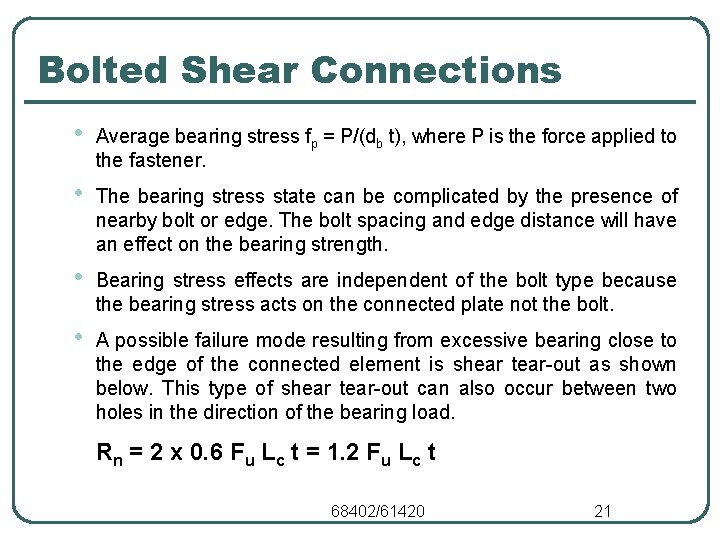
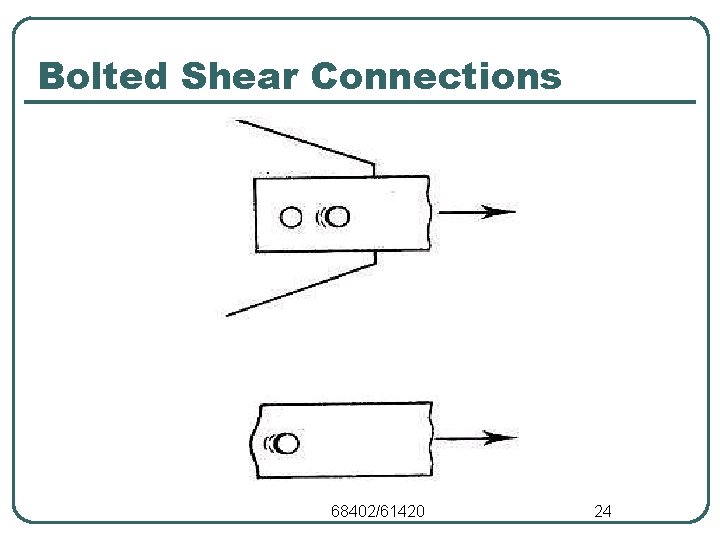
Bolted Shear Connections • Average bearing stress fp = P/(db t), where P is the force applied to the fastener. • The bearing stress state can be complicated by the presence of nearby bolt or edge. The bolt spacing and edge distance will have an effect on the bearing strength. • Bearing stress effects are independent of the bolt type because the bearing stress acts on the connected plate not the bolt. • A possible failure mode resulting from excessive bearing close to the edge of the connected element is shear tear-out as shown below. This type of shear tear-out can also occur between two holes in the direction of the bearing load. Rn = 2 x 0. 6 Fu Lc t = 1. 2 Fu Lc t 68402/61420 21
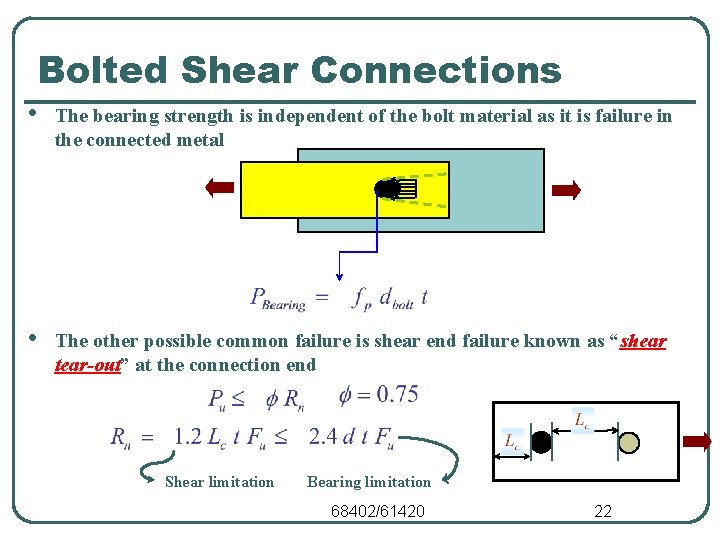
Bolted Shear Connections • The bearing strength is independent of the bolt material as it is failure in the connected metal • The other possible common failure is shear end failure known as “shear tear-out” at the connection end Shear limitation Bearing limitation 68402/61420 22
Bolted Shear Connections 68402/61420 23
Bolted Shear Connections 68402/61420 24
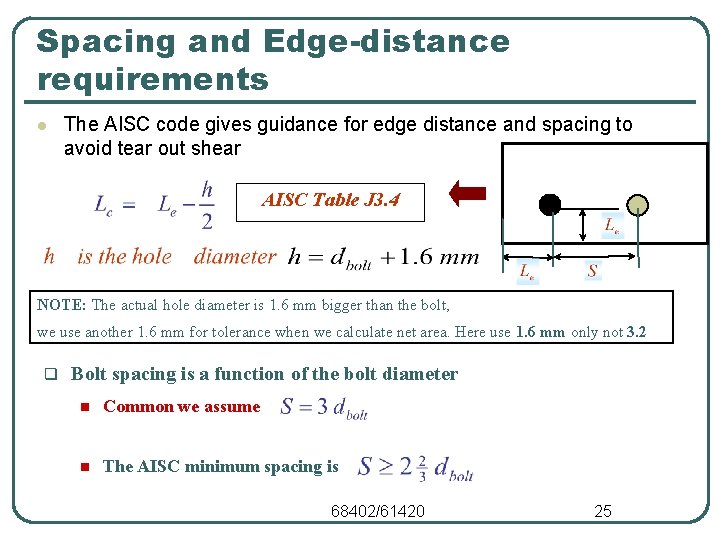
Spacing and Edge-distance requirements l The AISC code gives guidance for edge distance and spacing to avoid tear out shear AISC Table J 3. 4 NOTE: The actual hole diameter is 1. 6 mm bigger than the bolt, we use another 1. 6 mm for tolerance when we calculate net area. Here use 1. 6 mm only not 3. 2 q Bolt spacing is a function of the bolt diameter n Common we assume n The AISC minimum spacing is 68402/61420 25
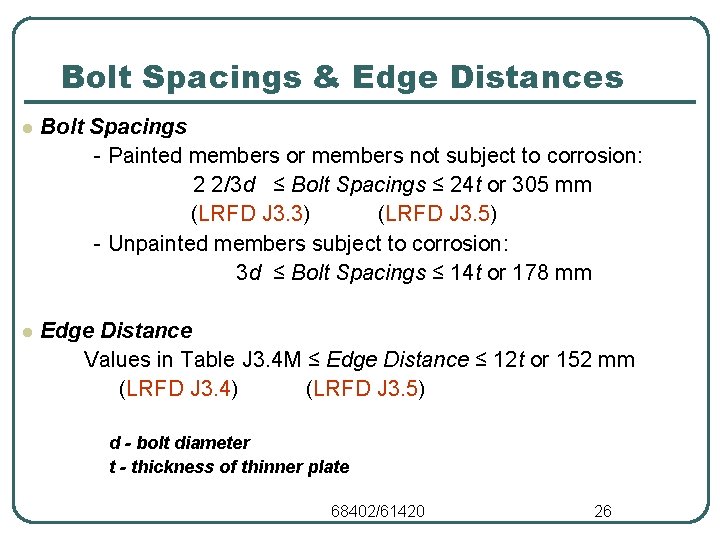
Bolt Spacings & Edge Distances l Bolt Spacings - Painted members or members not subject to corrosion: 2 2/3 d ≤ Bolt Spacings ≤ 24 t or 305 mm (LRFD J 3. 3) (LRFD J 3. 5) - Unpainted members subject to corrosion: 3 d ≤ Bolt Spacings ≤ 14 t or 178 mm l Edge Distance Values in Table J 3. 4 M ≤ Edge Distance ≤ 12 t or 152 mm (LRFD J 3. 4) (LRFD J 3. 5) d - bolt diameter t - thickness of thinner plate 68402/61420 26
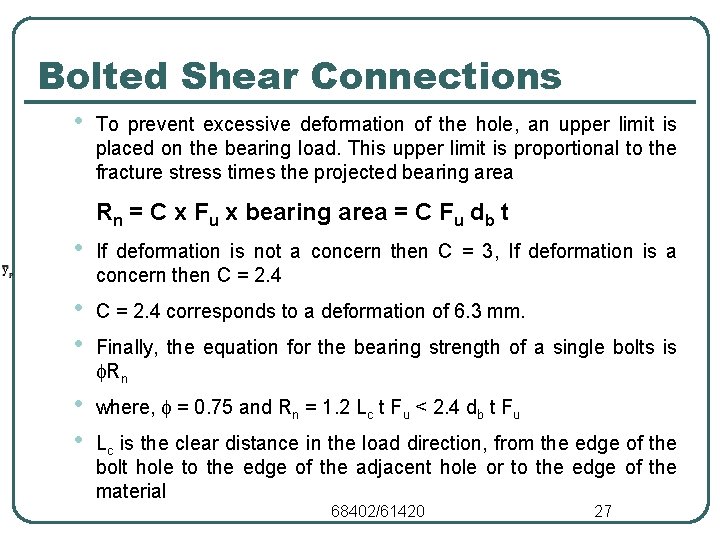
Bolted Shear Connections • To prevent excessive deformation of the hole, an upper limit is placed on the bearing load. This upper limit is proportional to the fracture stress times the projected bearing area Rn = C x Fu x bearing area = C Fu db t • If deformation is not a concern then C = 3, If deformation is a concern then C = 2. 4 • • C = 2. 4 corresponds to a deformation of 6. 3 mm. • • where, = 0. 75 and Rn = 1. 2 Lc t Fu < 2. 4 db t Fu Finally, the equation for the bearing strength of a single bolts is Rn Lc is the clear distance in the load direction, from the edge of the bolt hole to the edge of the adjacent hole or to the edge of the material 68402/61420 27
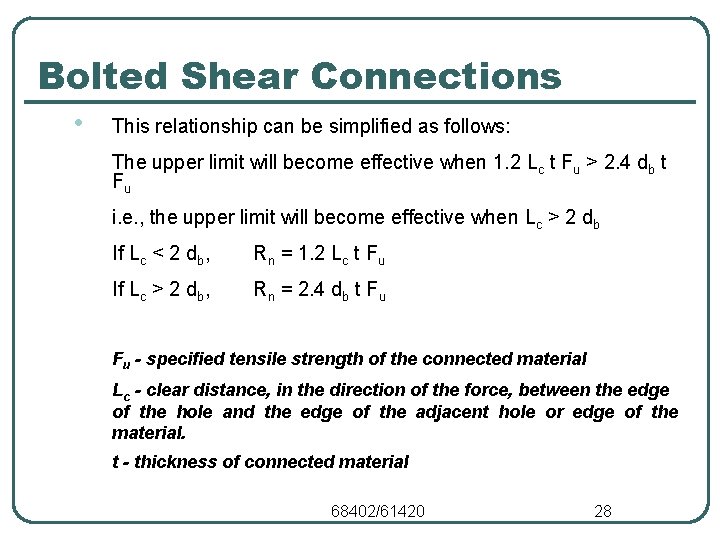
Bolted Shear Connections • This relationship can be simplified as follows: The upper limit will become effective when 1. 2 Lc t Fu > 2. 4 db t Fu i. e. , the upper limit will become effective when Lc > 2 db If Lc < 2 db, Rn = 1. 2 Lc t Fu If Lc > 2 db, Rn = 2. 4 db t Fu Fu - specified tensile strength of the connected material Lc - clear distance, in the direction of the force, between the edge of the hole and the edge of the adjacent hole or edge of the material. t - thickness of connected material 68402/61420 28

Important Notes Lc – Clear distance 68402/61420 29
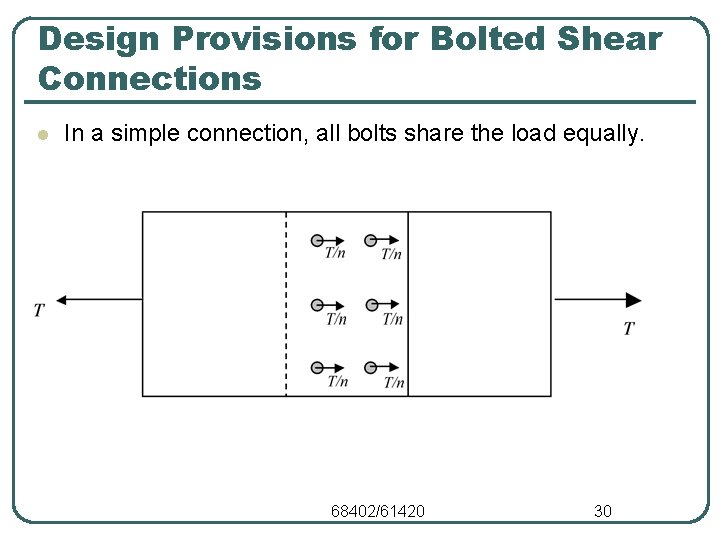
Design Provisions for Bolted Shear Connections l In a simple connection, all bolts share the load equally. 68402/61420 30
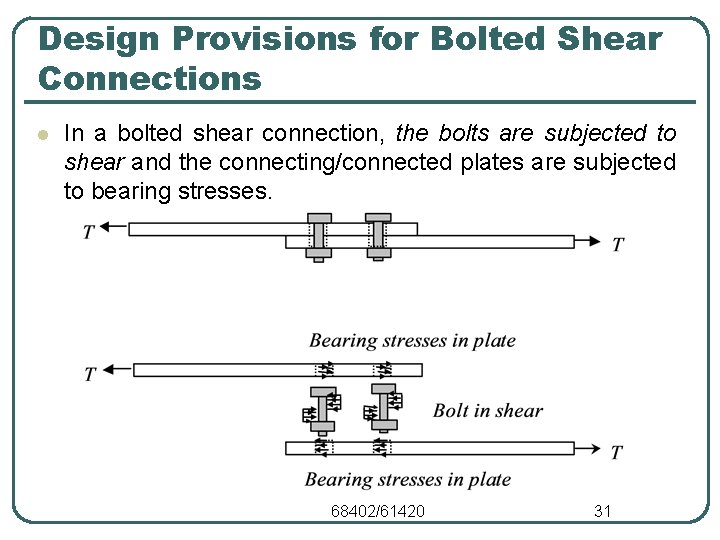
Design Provisions for Bolted Shear Connections l In a bolted shear connection, the bolts are subjected to shear and the connecting/connected plates are subjected to bearing stresses. 68402/61420 31
Design Provisions for Bolted Shear Connections l The shear strength of all bolts = shear strength of one bolt x number of bolts l The bearing strength of the connecting / connected plates can be calculated using equations given by AISC specifications. l The tension strength of the connecting / connected plates can be calculated as discussed in tension members. 68402/61420 32
AISC Design Provisions l Chapter J of the AISC Specifications focuses on connections. l Section J 3 focuses on bolts and threaded parts l AISC Specification J 3. 3 indicates that the minimum distance (s) between the centers of bolt holes is 2. 67. A distance of 3 db is preferred. l AISC Specification J 3. 4 indicates that the minimum edge distance (Le) from the center of the bolt to the edge of the connected part is given in Table J 3. 4 specifies minimum edge distances for sheared edges, edges of rolled shapes, and gas cut edges. 68402/61420 33
AISC Design Provisions l AISC Specification indicates that the maximum edge distance for bolt holes is 12 times the thickness of the connected part (but not more than 152 mm). The maximum spacing for bolt holes is 24 times the thickness of the thinner part (but not more than 305 mm). l Specification J 3. 6 indicates that the design tension or shear strength of bolts is Fn. Ab • • = 0. 75 Table J 3. 2, gives the values of Fn Ab is the unthreaded area of bolt. In Table J 3. 2, there are different types of bolts A 325 and A 490. 68402/61420 34
AISC Design Provisions • The shear strength of the bolts depends on whether threads are included or excluded from the shear planes. If threads are included in the shear planes then the strength is lower. l We will always assume that threads are included in the shear plane, therefore less strength to be conservative. l We will look at specifications J 3. 7 – J 3. 9 later. • AISC Specification J 3. 10 indicates the bearing strength of plates at bolt holes. • • The design bearing strength at bolt holes is Rn Rn = 1. 2 Lc t Fu ≤ 2. 4 db t Fu design consideration - deformation at the bolt holes is a 68402/61420 35
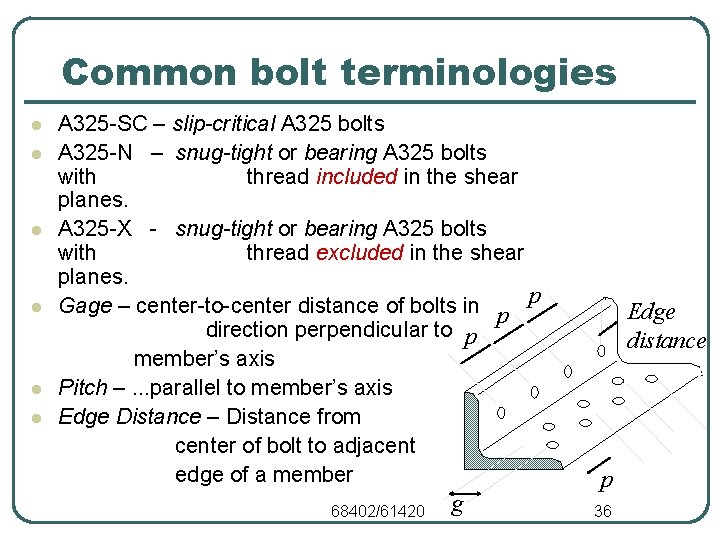
Common bolt terminologies l l l A 325 -SC – slip-critical A 325 bolts A 325 -N – snug-tight or bearing A 325 bolts with thread included in the shear planes. A 325 -X - snug-tight or bearing A 325 bolts with thread excluded in the shear planes. Gage – center-to-center distance of bolts in p p direction perpendicular to p member’s axis Pitch –. . . parallel to member’s axis Edge Distance – Distance from center of bolt to adjacent edge of a member 68402/61420 g Edge distance p 36
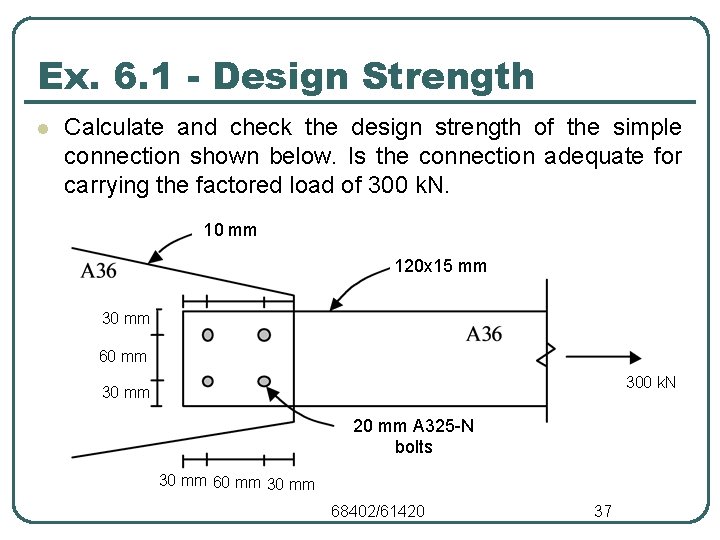
Ex. 6. 1 - Design Strength l Calculate and check the design strength of the simple connection shown below. Is the connection adequate for carrying the factored load of 300 k. N. 10 mm 120 x 15 mm 30 mm 60 mm 300 63 k. N k 30 mm 20 mm A 325 -N bolts 30 mm 60 mm 30 mm 68402/61420 37
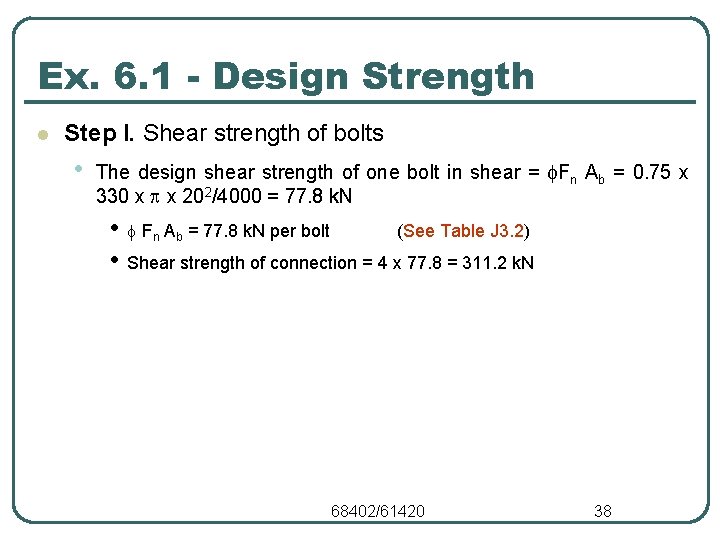
Ex. 6. 1 - Design Strength l Step I. Shear strength of bolts • The design shear strength of one bolt in shear = Fn Ab = 0. 75 x 330 x x 202/4000 = 77. 8 k. N • • Fn Ab = 77. 8 k. N per bolt (See Table J 3. 2) Shear strength of connection = 4 x 77. 8 = 311. 2 k. N 68402/61420 38
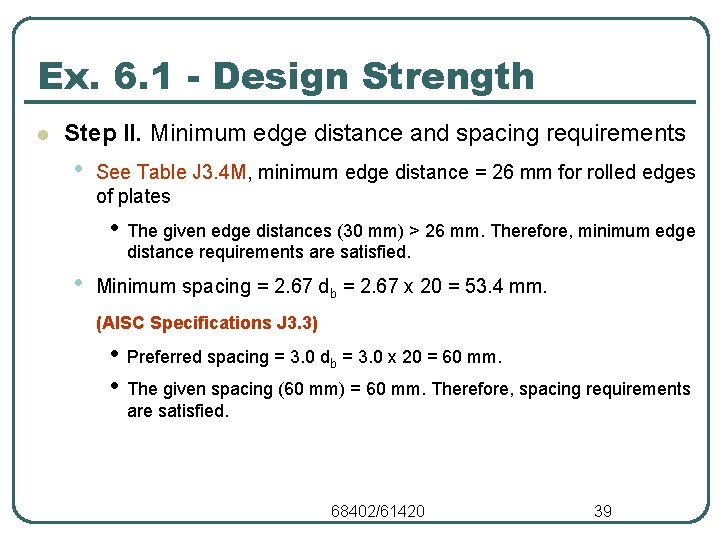
Ex. 6. 1 - Design Strength l Step II. Minimum edge distance and spacing requirements • See Table J 3. 4 M, minimum edge distance = 26 mm for rolled edges of plates • • The given edge distances (30 mm) > 26 mm. Therefore, minimum edge distance requirements are satisfied. Minimum spacing = 2. 67 db = 2. 67 x 20 = 53. 4 mm. (AISC Specifications J 3. 3) • • Preferred spacing = 3. 0 db = 3. 0 x 20 = 60 mm. The given spacing (60 mm) = 60 mm. Therefore, spacing requirements are satisfied. 68402/61420 39
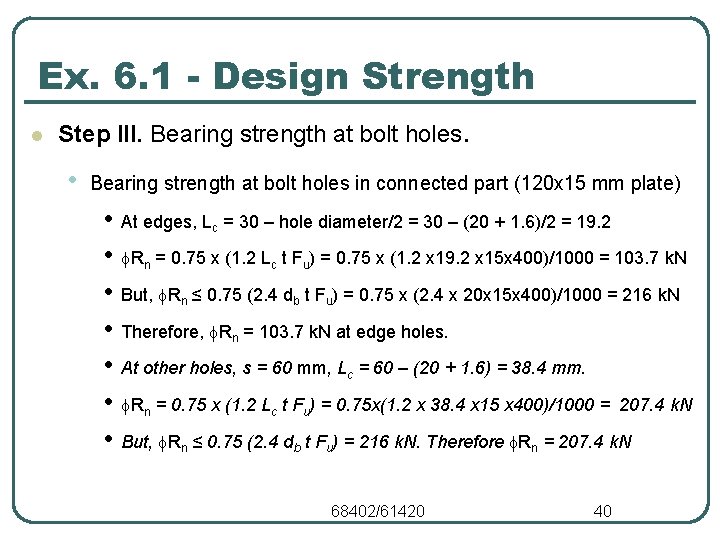
Ex. 6. 1 - Design Strength l Step III. Bearing strength at bolt holes. • Bearing strength at bolt holes in connected part (120 x 15 mm plate) • • At edges, Lc = 30 – hole diameter/2 = 30 – (20 + 1. 6)/2 = 19. 2 Rn = 0. 75 x (1. 2 Lc t Fu) = 0. 75 x (1. 2 x 19. 2 x 15 x 400)/1000 = 103. 7 k. N But, Rn ≤ 0. 75 (2. 4 db t Fu) = 0. 75 x (2. 4 x 20 x 15 x 400)/1000 = 216 k. N Therefore, Rn = 103. 7 k. N at edge holes. At other holes, s = 60 mm, Lc = 60 – (20 + 1. 6) = 38. 4 mm. Rn = 0. 75 x (1. 2 Lc t Fu) = 0. 75 x(1. 2 x 38. 4 x 15 x 400)/1000 = 207. 4 k. N But, Rn ≤ 0. 75 (2. 4 db t Fu) = 216 k. N. Therefore Rn = 207. 4 k. N 68402/61420 40
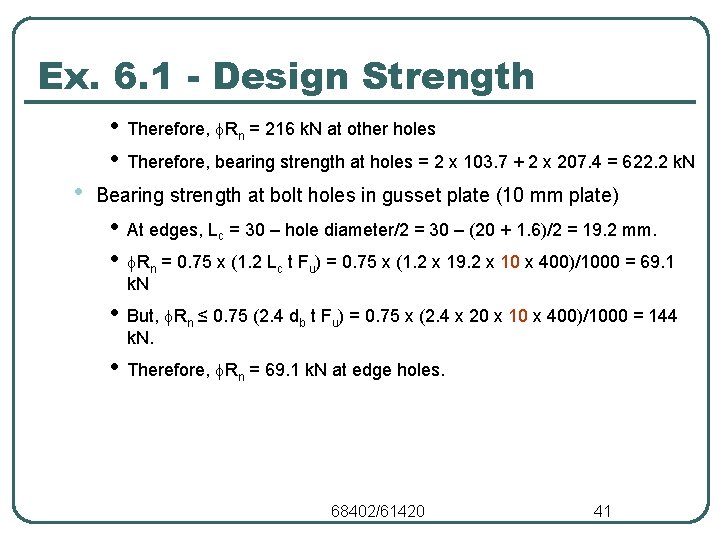
Ex. 6. 1 - Design Strength • • • Therefore, Rn = 216 k. N at other holes Therefore, bearing strength at holes = 2 x 10³. 7 + 2 x 207. 4 = 622. 2 k. N Bearing strength at bolt holes in gusset plate (10 mm plate) • • At edges, Lc = 30 – hole diameter/2 = 30 – (20 + 1. 6)/2 = 19. 2 mm. • But, Rn ≤ 0. 75 (2. 4 db t Fu) = 0. 75 x (2. 4 x 20 x 10 x 400)/1000 = 144 k. N. • Therefore, Rn = 69. 1 k. N at edge holes. Rn = 0. 75 x (1. 2 Lc t Fu) = 0. 75 x (1. 2 x 19. 2 x 10 x 400)/1000 = 69. 1 k. N 68402/61420 41
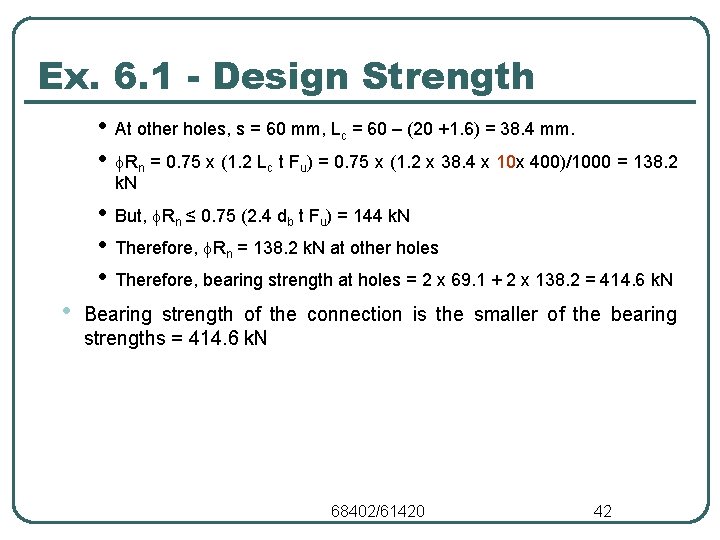
Ex. 6. 1 - Design Strength • • • At other holes, s = 60 mm, Lc = 60 – (20 +1. 6) = 38. 4 mm. • • • But, Rn ≤ 0. 75 (2. 4 db t Fu) = 144 k. N Rn = 0. 75 x (1. 2 Lc t Fu) = 0. 75 x (1. 2 x 38. 4 x 10 x 400)/1000 = 138. 2 k. N Therefore, Rn = 138. 2 k. N at other holes Therefore, bearing strength at holes = 2 x 69. 1 + 2 x 138. 2 = 414. 6 k. N Bearing strength of the connection is the smaller of the bearing strengths = 414. 6 k. N 68402/61420 42
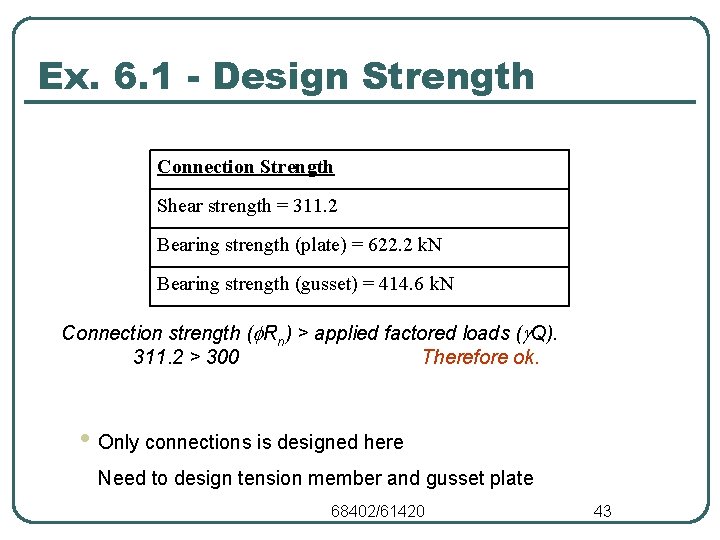
Ex. 6. 1 - Design Strength Connection Strength Shear strength = 311. 2 Bearing strength (plate) = 622. 2 k. N Bearing strength (gusset) = 414. 6 k. N Connection strength (f. Rn) > applied factored loads (g. Q). 311. 2 > 300 Therefore ok. • Only connections is designed here Need to design tension member and gusset plate 68402/61420 43
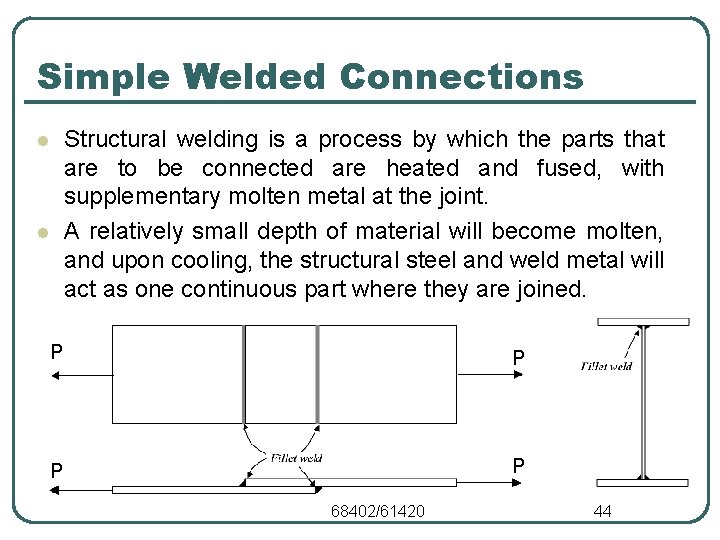
Simple Welded Connections Structural welding is a process by which the parts that are to be connected are heated and fused, with supplementary molten metal at the joint. A relatively small depth of material will become molten, and upon cooling, the structural steel and weld metal will act as one continuous part where they are joined. l l P P 68402/61420 44
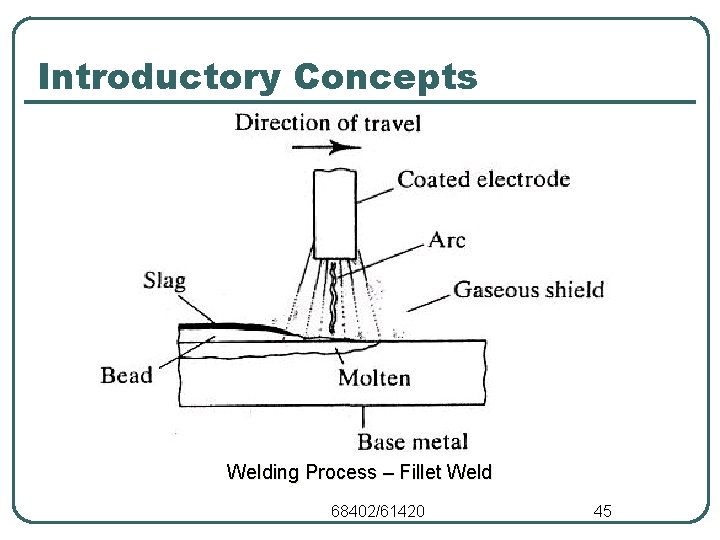
Introductory Concepts Welding Process – Fillet Weld 68402/61420 45
Introductory Concepts l The additional metal is deposited from a special electrode, which is part of the electric circuit that includes the connected part. • In the shielded metal arc welding (SMAW) process, current arcs across a gap between the electrode and the base metal, heating the connected parts and depositing part of the electrode into the molten base metal. • A special coating on the electrode vaporizes and forms a protective gaseous shield, preventing the molten weld metal from oxidizing before it solidifies. • The electrode is moved across the joint, and a weld bead is deposited, its size depending on the rate of travel of the electrode. 68402/61420 46
Introductory Concepts • As the weld cools, impurities rise to the surface, forming a coating called slag that must be removed before the member is painted or another pass is made with the electrode. • Shielded metal arc welding is usually done manually and is the process universally used for field welds. l For shop welding, an automatic or semi automatic process is usually used. Foremost among these is the submerged arc welding (SAW), l In this process, the end of the electrode and the arc are submerged in a granular flux that melts and forms a gaseous shield. There is more penetration into the base metal than with shielded metal arc welding, and higher strength results. 68402/61420 47
Introductory Concepts l Other commonly used processes for shop welding are gas shielded metal arc, flux cored arc, and electro-slag welding. l Quality control of welded connections is particularly difficult, because defects below the surface, or even minor flaws at the surface, will escape visual detection. Welders must be properly certified, and for critical work, special inspection techniques such as radiography or ultrasonic testing must be used. 68402/61420 48
Introductory Concepts l The two most common types of welds are the fillet weld and the groove weld. Fillet weld examples: lap joint – fillet welds placed in the corner formed by two plates Tee joint – fillet welds placed at the intersection of two plates. l Groove welds – deposited in a gap or groove between two parts to be connected e. g. , butt, tee, and corner joints with beveled (prepared) edges l Partial penetration groove welds can be made from one or both sides with or without edge preparation. 68402/61420 49
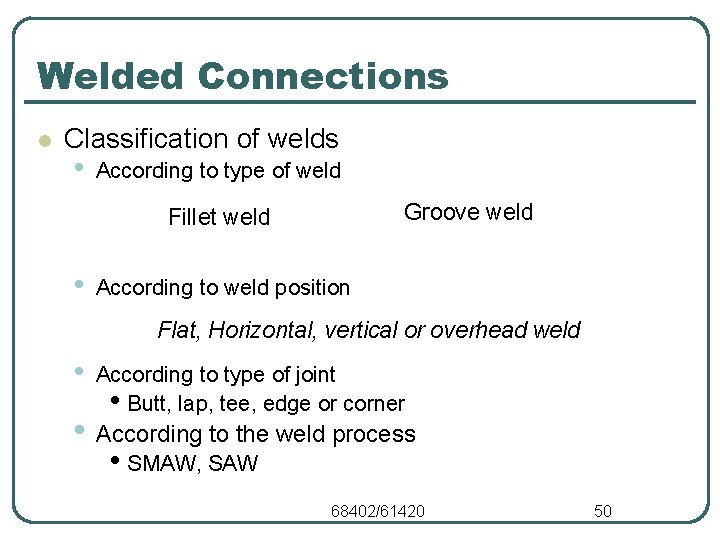
Welded Connections l Classification of welds • According to type of weld Groove weld Fillet weld • According to weld position Flat, Horizontal, vertical or overhead weld • According to type of joint • Butt, lap, tee, edge or corner • According to the weld process • SMAW, SAW 68402/61420 50
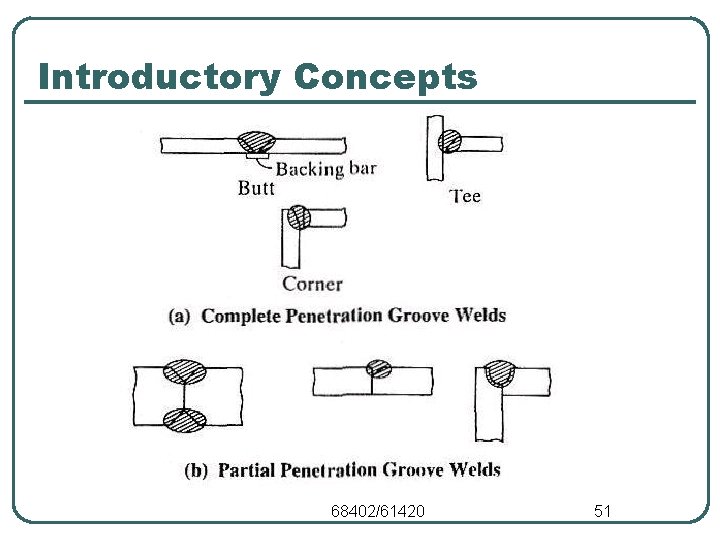
Introductory Concepts 68402/61420 51
Weld Limit States The only limit state of the weld metal in a connection is that of fracture Yielding is not a factor since any deformation that might take place will occur over such a short distance that it will not influence the performance of the structure 68402/61420 52
Design of Welded Connections l Fillet welds are most common and used in all structures. l Weld sizes are specified in 1 mm increments l A fillet weld can be loaded in any direction in shear, compression, or tension. However, it always fails in shear. l The shear failure of the fillet weld occurs along a plane through the throat of the weld, as shown in the Figure below. 68402/61420 53
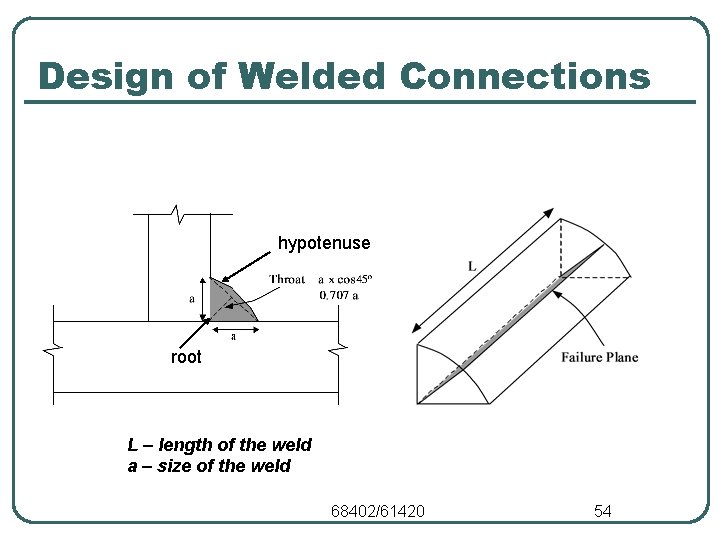
Design of Welded Connections hypotenuse root L – length of the weld a – size of the weld 68402/61420 54
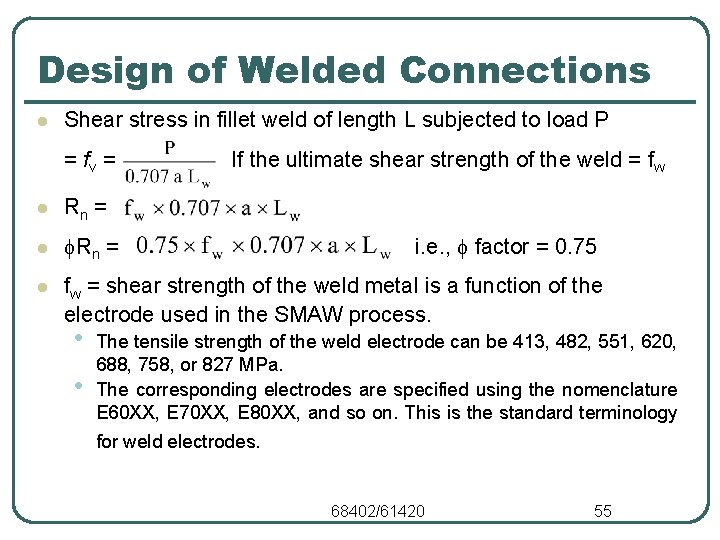
Design of Welded Connections l Shear stress in fillet weld of length L subjected to load P = fv = If the ultimate shear strength of the weld = fw l Rn = l fw = shear strength of the weld metal is a function of the electrode used in the SMAW process. • • i. e. , factor = 0. 75 The tensile strength of the weld electrode can be 413, 482, 551, 620, 688, 758, or 827 MPa. The corresponding electrodes are specified using the nomenclature E 60 XX, E 70 XX, E 80 XX, and so on. This is the standard terminology for weld electrodes. 68402/61420 55
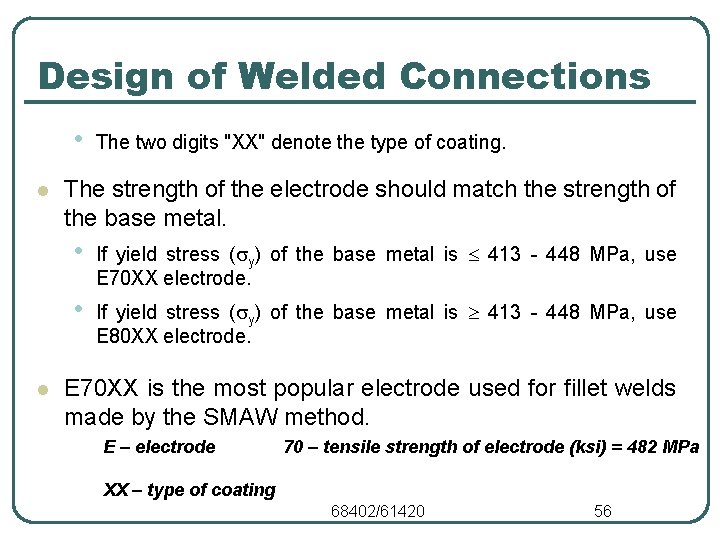
Design of Welded Connections • l l The two digits "XX" denote the type of coating. The strength of the electrode should match the strength of the base metal. • If yield stress ( y) of the base metal is 413 - 448 MPa, use E 70 XX electrode. • If yield stress ( y) of the base metal is 413 - 448 MPa, use E 80 XX electrode. E 70 XX is the most popular electrode used for fillet welds made by the SMAW method. E – electrode 70 – tensile strength of electrode (ksi) = 482 MPa XX – type of coating 68402/61420 56

Fillet Weld l Stronger in tension and compression than in shear Concave Surface Convex Surface Leg Throat l Unequal leg fillet weld Leg Throat Leg Fillet weld designations: 12 mm SMAW E 70 XX: fillet weld with equal leg size of 12 mm, formed using Shielded Metal Arc Welding Process, with filler metal electrodes having a minimum weld tensile strength of 70 ksi. 9 mm-by-12 mm SAW E 110 XX: fillet weld with unequal leg sizes, formed by using Submerged Arc Metal process, with filler metal electrodes having a minimum weld tensile strength of 758 MPa. 68402/61420 57
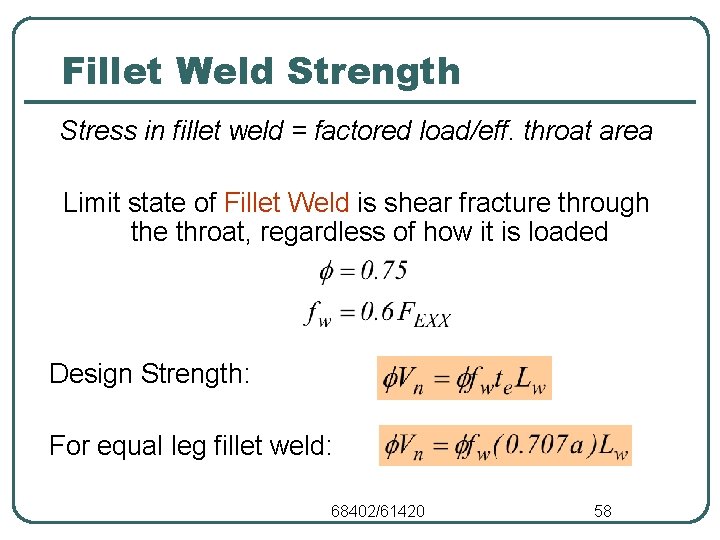
Fillet Weld Strength Stress in fillet weld = factored load/eff. throat area Limit state of Fillet Weld is shear fracture through the throat, regardless of how it is loaded Design Strength: For equal leg fillet weld: 68402/61420 58
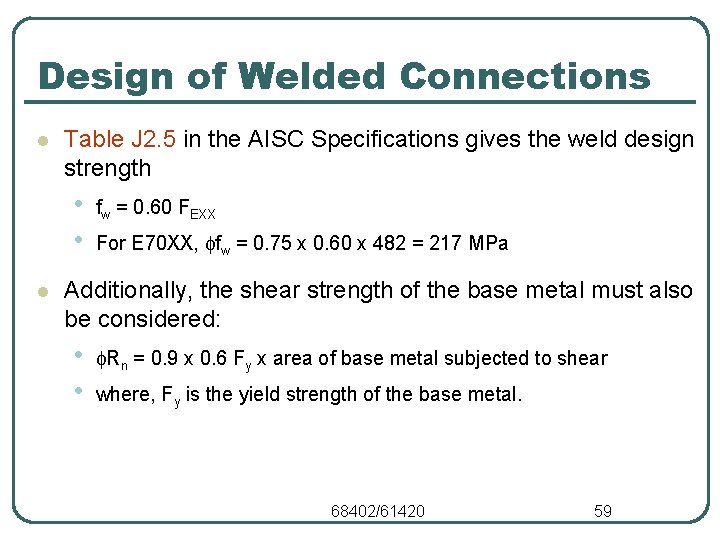
Design of Welded Connections l Table J 2. 5 in the AISC Specifications gives the weld design strength • • l fw = 0. 60 FEXX For E 70 XX, fw = 0. 75 x 0. 60 x 482 = 217 MPa Additionally, the shear strength of the base metal must also be considered: • • Rn = 0. 9 x 0. 6 Fy x area of base metal subjected to shear where, Fy is the yield strength of the base metal. 68402/61420 59
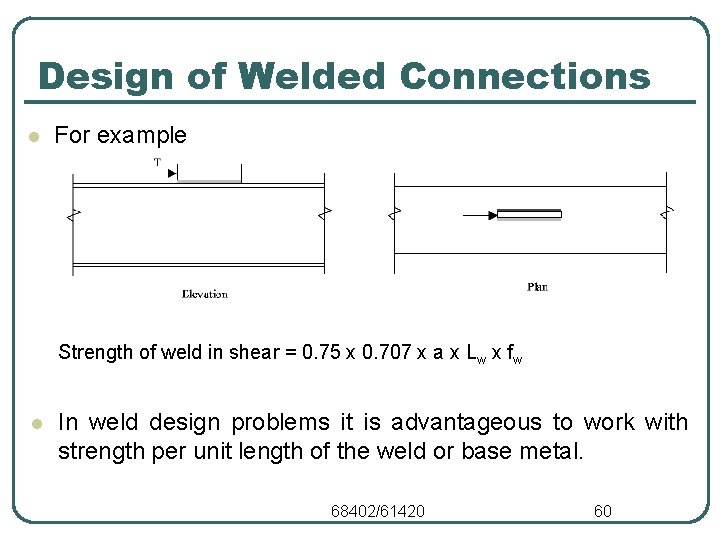
Design of Welded Connections l For example Strength of weld in shear = 0. 75 x 0. 707 x a x Lw x fw l In weld design problems it is advantageous to work with strength per unit length of the weld or base metal. 68402/61420 60
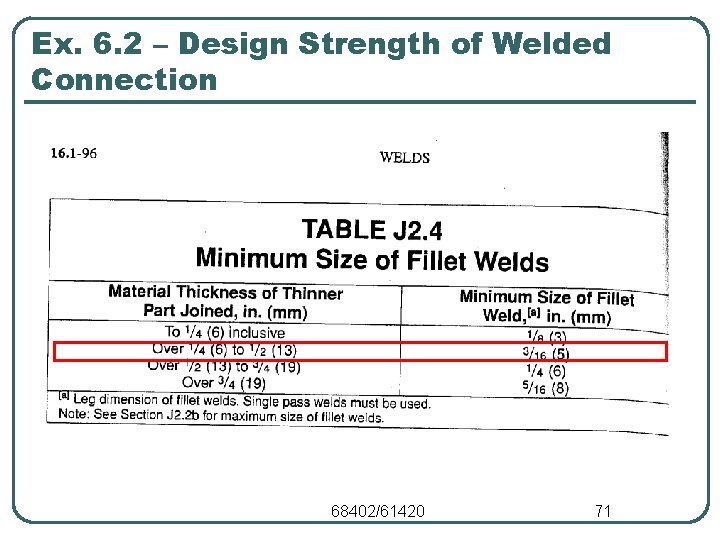
Limitations on Weld Dimensions l l l Minimum size (amin) • • Function of the thickness of the thinnest connected plate Given in Table J 2. 4 in the AISC specifications Maximum size (amax) • • • function of the thickness of the thinnest connected plate: for plates with thickness 6 mm, amax = 6 mm. for plates with thickness 6 mm, amax = t – 2 mm. Minimum length (Lw) • • • Length (Lw) 4 a otherwise, aeff = Lw / 4 a = weld size Read J 2. 2 b page 16. 1 -95 Intermittent fillet welds: Lw-min = 4 a and 38 mm. 68402/61420 61
Limitations on Weld Size – AISC Specifications J 2. 2 b Page 16. 1 -95 l l The minimum length of fillet weld may not be less than 4 x the weld leg size. If it is, the effective weld size must be reduced to ¼ of the weld length The maximum size of a fillet weld along edges of material less than 6 mm thick equals the material thickness. For material thicker than 6 mm, the maximum size may not exceed the material thickness less 2 mm. (to prevent melting of base material) The minimum weld size of fillet welds and minimum effective throat thickness for partial-penetration groove welds are given in LRFD Tables J 2. 4 and J 2. 3 based on the thickness of the base materials (to ensure fusion and minimize distortion) Minimum end return of fillet weld 2 x weld size 68402/61420 62

Limitations on Weld Dimensions l l Maximum effective length - read AISC J 2. 2 b • • • If weld length Lw < 100 a, then effective weld length (Lw-eff) = Lw If Lw < 300 a, then effective weld length (Lw-eff) = Lw (1. 2 – 0. 002 Lw/a) If Lw > 300 a, the effective weld length (Lw-eff) = 0. 6 Lw Weld Terminations - read AISC J 2. 2 b • • Lap joint – fillet welds terminate at a distance > a from edge. Weld returns around corners must be > 2 a 68402/61420 63
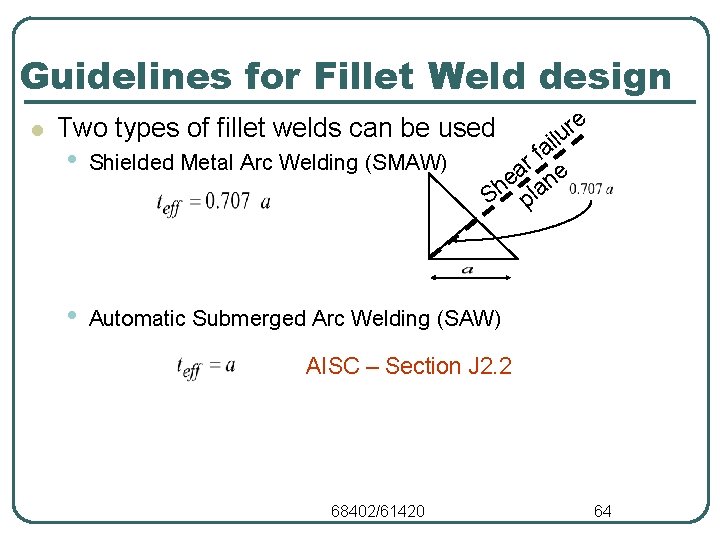
Guidelines for Fillet Weld design l Two types of fillet welds can be used re u il fa r a ne e Sh pla • Shielded Metal Arc Welding (SMAW) • Automatic Submerged Arc Welding (SAW) AISC – Section J 2. 2 68402/61420 64
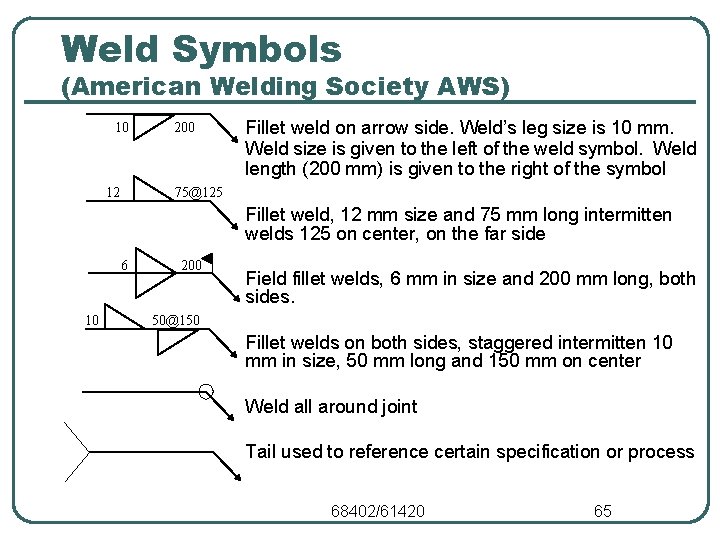
Weld Symbols (American Welding Society AWS) 10 12 200 Fillet weld on arrow side. Weld’s leg size is 10 mm. Weld size is given to the left of the weld symbol. Weld length (200 mm) is given to the right of the symbol 75@125 Fillet weld, 12 mm size and 75 mm long intermitten welds 125 on center, on the far side 6 10 200 Field fillet welds, 6 mm in size and 200 mm long, both sides. 50@150 Fillet welds on both sides, staggered intermitten 10 mm in size, 50 mm long and 150 mm on center Weld all around joint Tail used to reference certain specification or process 68402/61420 65
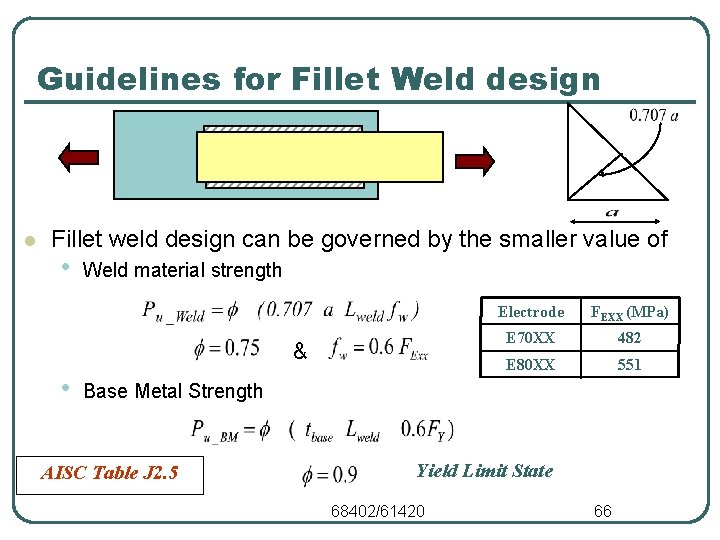
Guidelines for Fillet Weld design l Fillet weld design can be governed by the smaller value of • Weld material strength & • Electrode FEXX (MPa) E 70 XX 482 E 80 XX 551 Base Metal Strength AISC Table J 2. 5 Yield Limit State 68402/61420 66
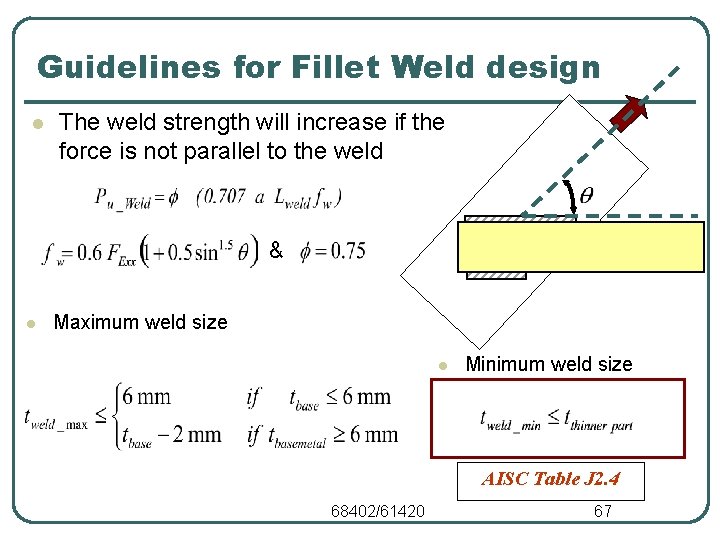
Guidelines for Fillet Weld design l The weld strength will increase if the force is not parallel to the weld & l Maximum weld size l Minimum weld size AISC Table J 2. 4 68402/61420 67
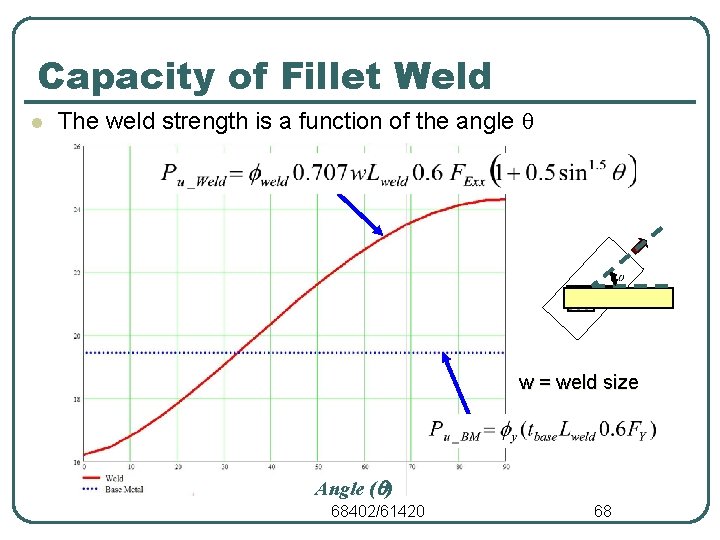
Capacity of Fillet Weld The weld strength is a function of the angle q Strength l Weld governs w = weld size Base metal governs Angle (q) 68402/61420 68
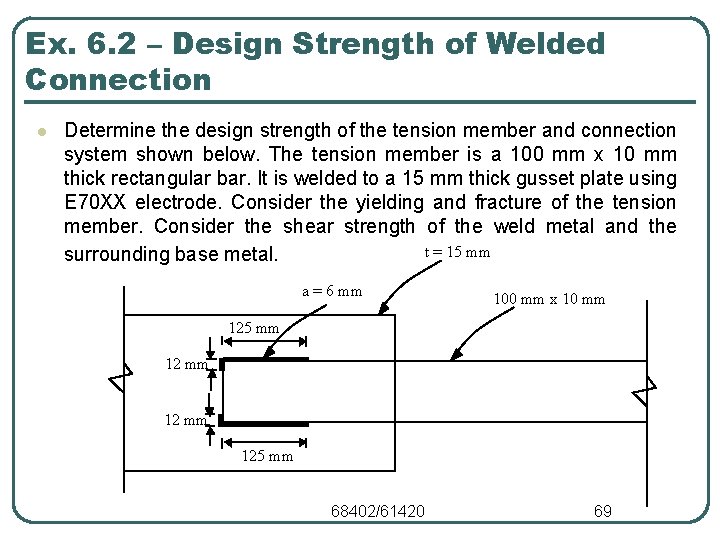
Ex. 6. 2 – Design Strength of Welded Connection l Determine the design strength of the tension member and connection system shown below. The tension member is a 100 mm x 10 mm thick rectangular bar. It is welded to a 15 mm thick gusset plate using E 70 XX electrode. Consider the yielding and fracture of the tension member. Consider the shear strength of the weld metal and the t = 15 mm surrounding base metal. a = 6 mm 100 mm x 10 mm 125 mm 125 mm 68402/61420 69
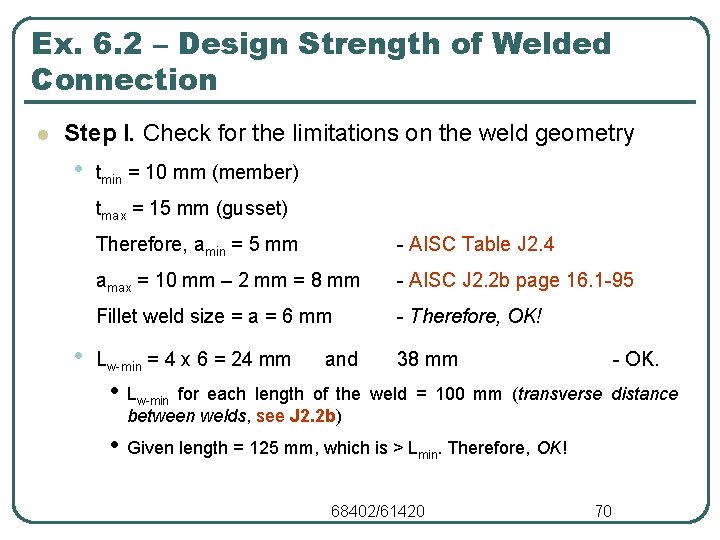
Ex. 6. 2 – Design Strength of Welded Connection l Step I. Check for the limitations on the weld geometry • tmin = 10 mm (member) tmax = 15 mm (gusset) • Therefore, amin = 5 mm - AISC Table J 2. 4 amax = 10 mm – 2 mm = 8 mm - AISC J 2. 2 b page 16. 1 -95 Fillet weld size = a = 6 mm - Therefore, OK! Lw-min = 4 x 6 = 24 mm 38 mm and - OK. • Lw-min for each length of the weld = 100 mm (transverse distance between welds, see J 2. 2 b) • Given length = 125 mm, which is > Lmin. Therefore, OK! 68402/61420 70
Ex. 6. 2 – Design Strength of Welded Connection 68402/61420 71
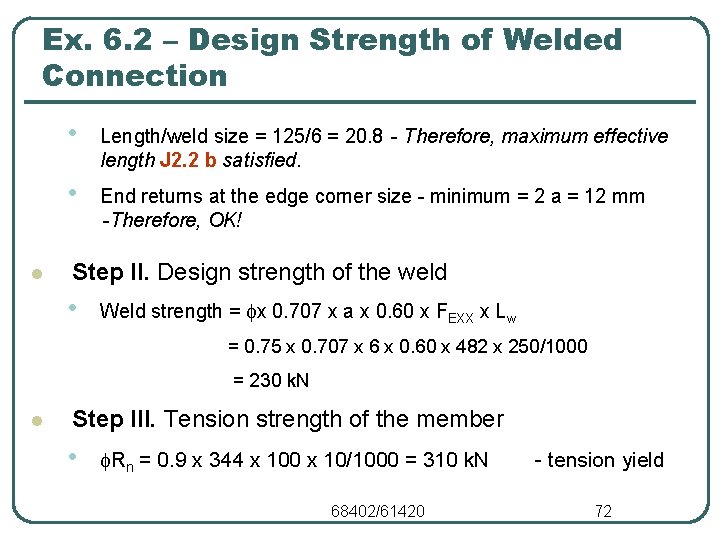
Ex. 6. 2 – Design Strength of Welded Connection l • Length/weld size = 125/6 = 20. 8 - Therefore, maximum effective length J 2. 2 b satisfied. • End returns at the edge corner size - minimum = 2 a = 12 mm -Therefore, OK! Step II. Design strength of the weld • Weld strength = x 0. 707 x a x 0. 60 x FEXX x Lw = 0. 75 x 0. 707 x 6 x 0. 60 x 482 x 250/1000 = 230 k. N l Step III. Tension strength of the member • Rn = 0. 9 x 344 x 100 x 10/1000 = 310 k. N 68402/61420 - tension yield 72
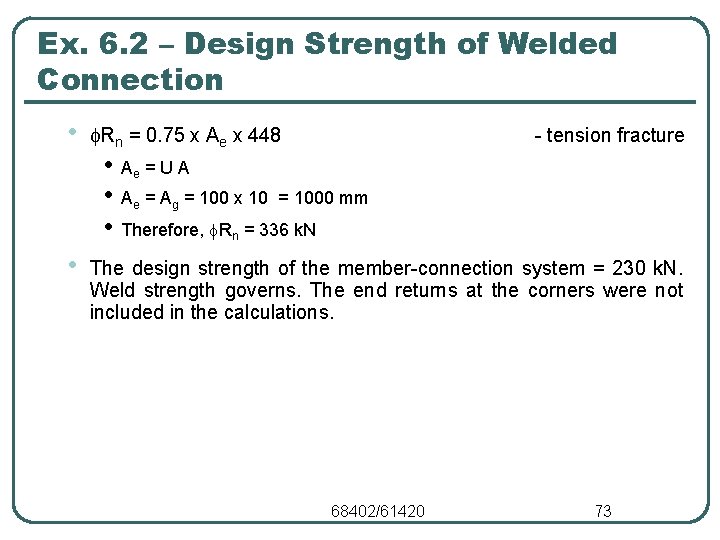
Ex. 6. 2 – Design Strength of Welded Connection • Rn = 0. 75 x Ae x 448 • • - tension fracture Ae = U A Ae = Ag = 100 x 10 = 1000 mm Therefore, Rn = 336 k. N The design strength of the member-connection system = 230 k. N. Weld strength governs. The end returns at the corners were not included in the calculations. 68402/61420 73
- Slides: 73