
682 Meter Calibration Adjustment The method of proving
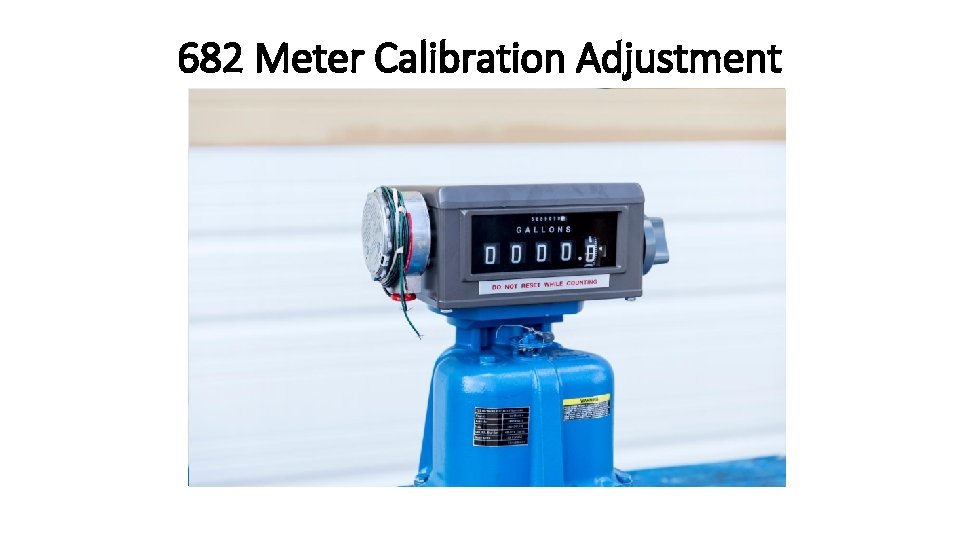
682 Meter Calibration Adjustment
The method of proving should be selected, and necessary provisions made, during the design stage of the installation. Of the most common used systems, portable provers have the advantage of more closely reproducing the condition under which the product is normally delivered. Use Accurate Prover Scientifically designed provers are commercially available for proving meters, and no other kind should be used. Even scientifically designed provers should be checked periodically for accuracy. Weights and Measures officials have been very cooperative in giving assistance to checking privately owned volumetric provers. Recommended size of test measure: The prover capacity should be equal to at least one minute’s flow through the meter at its maximum rate. These provers are not merely truck compartments or drums, but are scientifically designed test measures, having proper drainage means built into them, a calibration gauge glass neck, and protection against deformation (which causes volume changes). A “homemade” prover, whether a drum or a tank is not likely to be satisfactory and may cause expensive errors due to inaccurate meter calibration.
Setting a Prover The prover should be set level, using the levels provided on the prover, or separate ones. This insures consistent results when moving the prover from meter to meter. Where to Test a Meter The best place to test is in its normal operating position, instead of a test stand. In this way, the correctness of the installation and of the operation conditions will be verified by the test. Always test a meter with the same liquid it is to measure, because a difference in viscosity, temperature and system plumbing slightly affects meter accuracy. Discharge Line from Meter Where a portable prover is used, the liquid is generally discharged in to the prover in the same manner, as a normal delivery would be made. Where a special test connection is used, the discharge line must be arranged to drain to the same point on each test. The meter flow rate and off/on is controlled at the end of the discharge line. Wetting the Prover Reset the meter register to zero and fill the prover to the zero or 100% marking of the scale. Disregard the meter reading. Drain the prover and reset the register. The reason for disregarding the first meter reading is that the prover must be wetted, as its calibrated capacity is determined on its wet measure capacity by its manufacturer, and because the prover will be wet for the subsequent tests to be run. After the prover has drained, allow a definitive time of a few minutes for drainage from the sides of the tank. Total drainage time should be the same between all tests to insure uniform results. If a considerable length of time is to elapse between tests, the wetting operation can be eliminated by allowing the prover to remain full until the next test is to be run.
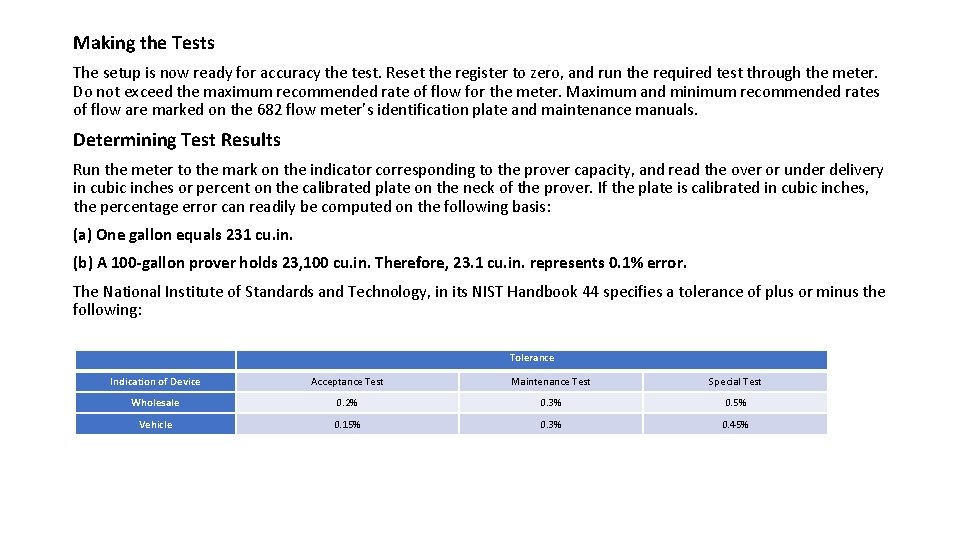
Making the Tests The setup is now ready for accuracy the test. Reset the register to zero, and run the required test through the meter. Do not exceed the maximum recommended rate of flow for the meter. Maximum and minimum recommended rates of flow are marked on the 682 flow meter’s identification plate and maintenance manuals. Determining Test Results Run the meter to the mark on the indicator corresponding to the prover capacity, and read the over or under delivery in cubic inches or percent on the calibrated plate on the neck of the prover. If the plate is calibrated in cubic inches, the percentage error can readily be computed on the following basis: (a) One gallon equals 231 cu. in. (b) A 100 -gallon prover holds 23, 100 cu. in. Therefore, 23. 1 cu. in. represents 0. 1% error. The National Institute of Standards and Technology, in its NIST Handbook 44 specifies a tolerance of plus or minus the following: Tolerance Indication of Device Acceptance Test Maintenance Test Special Test Wholesale 0. 2% 0. 3% 0. 5% Vehicle 0. 15% 0. 3% 0. 45%
METER Tolerance Acceptance tolerances apply to new meters and repaired meters after reconditioning. Repeatability When multiple tests are conducted at approximately the same flow rate and draft size, the range of test results for the flow rate shall not exceed 40% of the absolute value of the maintenance/normal tolerance and the results of each test shall be within the applicable tolerance. Changing Meter Calibration Refer to meter literature for method of changing meter calibration. Any change in the meter calibration adjustment will change the delivery in the same amount for all rates of flow. That is, the calibration curve retains its shape, but is moved up or down. Therefore, if a meter tests satisfactorily at full flow, but drops off too much at low flow, changing the calibration will not remedy this condition; it will bring the low flow test to 100%, but it will also bring the full flow above 100% by the same amount that the low flow was raised. A condition of this kind is caused either by the metering system, need for meter cleaning or repairs, or because of an attempt to retain accuracy below the minimum recommended rate of flow for the meter. Temperature Correction If the conditions of testing are such that there will be a change of more than a few degrees in the temperature of the liquids between the time it passes through the meter and the time the prover is read, it will be advisable to make a temperature correction to the prover readings. To do this, it is necessary to install thermowells; to take readings of the temperature of the liquids in the meter and in the prover; and to take the degrees API of the liquid. Corrections can then be easily made by the use of the National Standard API Tables.
Calibration Adjustment A. It is important to test the repeatability and accuracy of your meter. To test repeatability: • 1) Run a fast (high gallons per minute) test in your prover and record how much the meter is over or under registering. Do NOT change the meter's calibration. • 2) Run a slow (low gallons per minute) test and again record how much the meter is over or under registration. If the results from the fast and the slow test are the same or close to the same, the meter can be successfully calibrated. If the test results differ beyond the rated tolerance of the meter, then repairs are necessary before the meter can be calibrated. B. A valve or nozzle must be at the end of the delivery hose (at the prover). C. Turn on the pump and purge the system of air. Leave the pump on. D. Shut off the valve at the end of the delivery hose and let the system pressurize. E. Wet the prover and empty it, letting it drip for 30 seconds. F. Reset the register on the meter to "0". G. Fill the prover to the line marked "0".
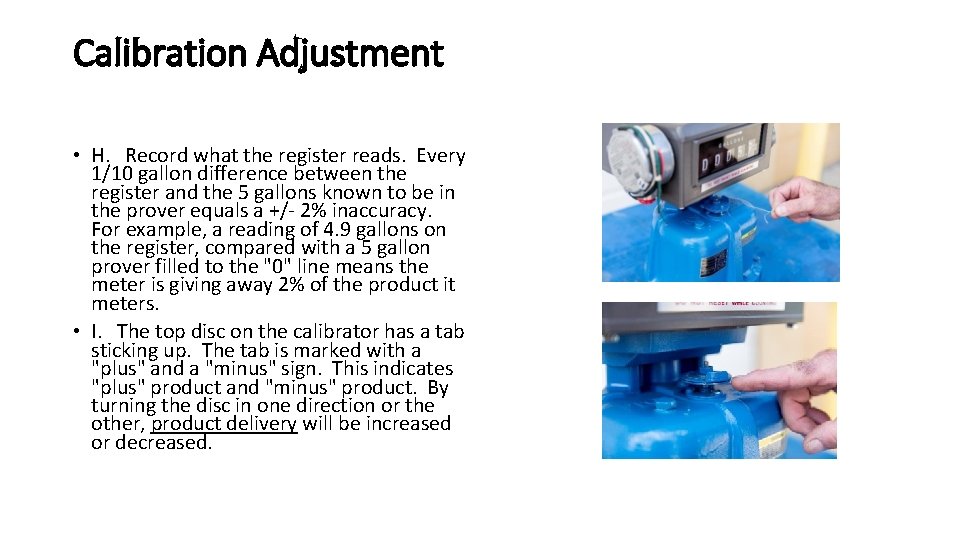
Calibration Adjustment • H. Record what the register reads. Every 1/10 gallon difference between the register and the 5 gallons known to be in the prover equals a +/- 2% inaccuracy. For example, a reading of 4. 9 gallons on the register, compared with a 5 gallon prover filled to the "0" line means the meter is giving away 2% of the product it meters. • I. The top disc on the calibrator has a tab sticking up. The tab is marked with a "plus" and a "minus" sign. This indicates "plus" product and "minus" product. By turning the disc in one direction or the other, product delivery will be increased or decreased.
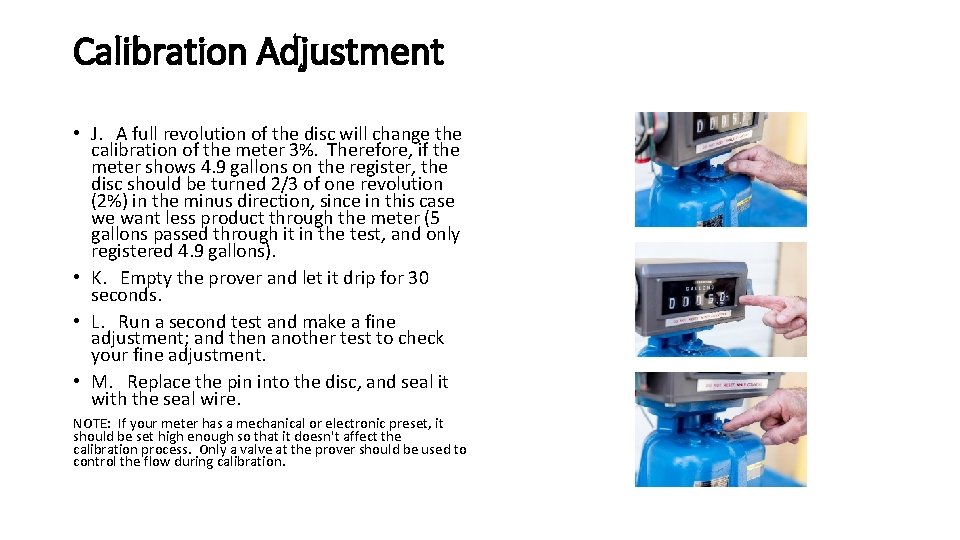
Calibration Adjustment • J. A full revolution of the disc will change the calibration of the meter 3%. Therefore, if the meter shows 4. 9 gallons on the register, the disc should be turned 2/3 of one revolution (2%) in the minus direction, since in this case we want less product through the meter (5 gallons passed through it in the test, and only registered 4. 9 gallons). • K. Empty the prover and let it drip for 30 seconds. • L. Run a second test and make a fine adjustment; and then another test to check your fine adjustment. • M. Replace the pin into the disc, and seal it with the seal wire. NOTE: If your meter has a mechanical or electronic preset, it should be set high enough so that it doesn't affect the calibration process. Only a valve at the prover should be used to control the flow during calibration.
- Slides: 8