
68 th International Symposium on Molecular Spectroscopy Time
![Acknowledgements Temple • Hai-Lung Dai • Matt Nikow, Ph. D. [Agilent] • Jianqiang Ma,](https://slidetodoc.com/presentation_image_h2/fc92f78a0c11dba1bd733cb8e44d51b4/image-27.jpg "Acknowledgements Temple • Hai-Lung Dai • Matt Nikow, Ph. D. [Agilent] • Jianqiang Ma,")
- Slides: 27
68 th International Symposium on Molecular Spectroscopy Time Resolved Infrared Emission from Vibrational Excited Acetylene Following Super Energy Transfer Collisions with Hot Hydrogen Jonathan M. Smith Jianqiang Ma*, Michael J. Wilhelm, Matthew Nikow, and Hai. Lung Dai *University of Pennsylvannia
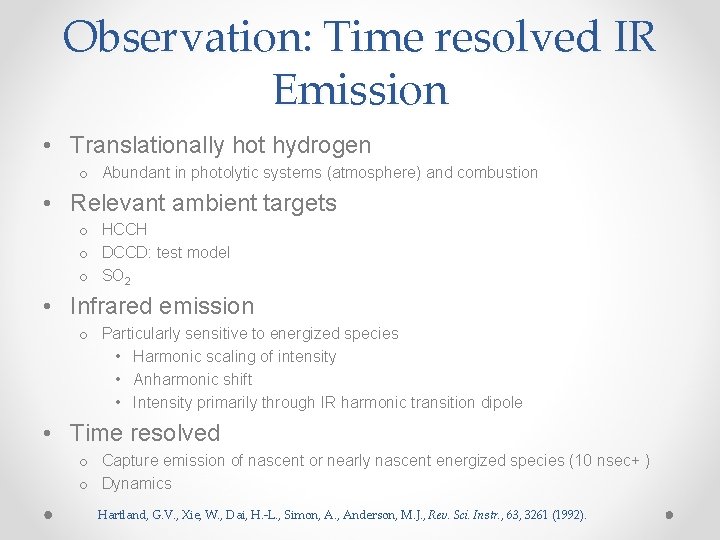
Observation: Time resolved IR Emission • Translationally hot hydrogen o Abundant in photolytic systems (atmosphere) and combustion • Relevant ambient targets o HCCH o DCCD: test model o SO 2 • Infrared emission o Particularly sensitive to energized species • Harmonic scaling of intensity • Anharmonic shift • Intensity primarily through IR harmonic transition dipole • Time resolved o Capture emission of nascent or nearly nascent energized species (10 nsec+ ) o Dynamics Hartland, G. V. , Xie, W. , Dai, H. -L. , Simon, A. , Anderson, M. J. , Rev. Sci. Instr. , 63, 3261 (1992).
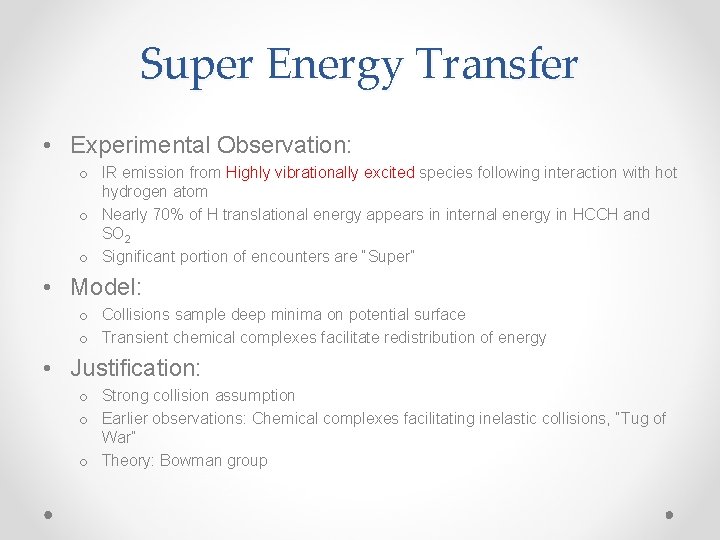
Super Energy Transfer • Experimental Observation: o IR emission from Highly vibrationally excited species following interaction with hot hydrogen atom o Nearly 70% of H translational energy appears in internal energy in HCCH and SO 2 o Significant portion of encounters are “Super” • Model: o Collisions sample deep minima on potential surface o Transient chemical complexes facilitate redistribution of energy • Justification: o Strong collision assumption o Earlier observations: Chemical complexes facilitating inelastic collisions, “Tug of War” o Theory: Bowman group
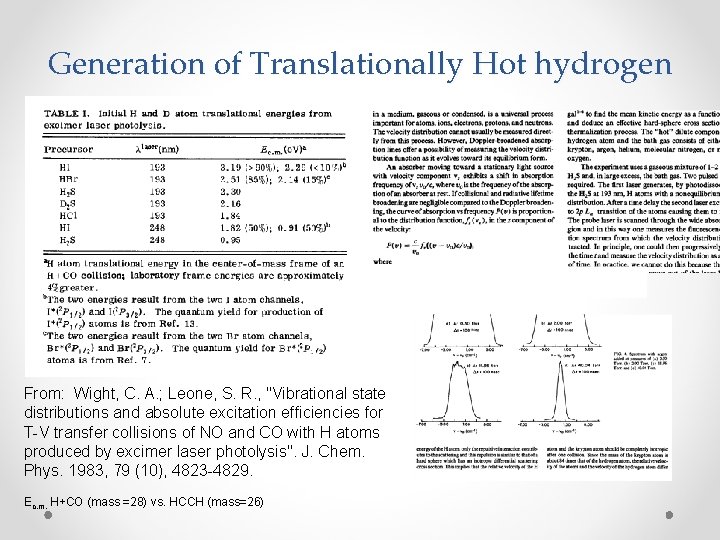
Generation of Translationally Hot hydrogen From: Wight, C. A. ; Leone, S. R. , "Vibrational state distributions and absolute excitation efficiencies for T-V transfer collisions of NO and CO with H atoms produced by excimer laser photolysis". J. Chem. Phys. 1983, 79 (10), 4823 -4829. Ec. m. H+CO (mass =28) vs. HCCH (mass=26)
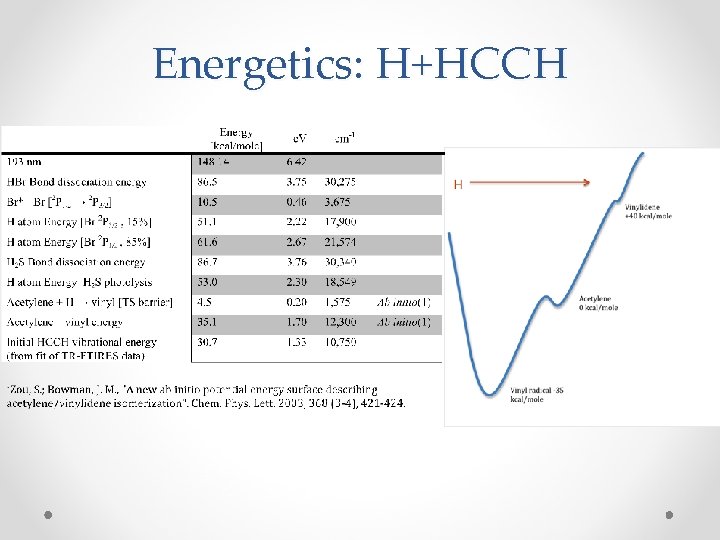
Energetics: H+HCCH
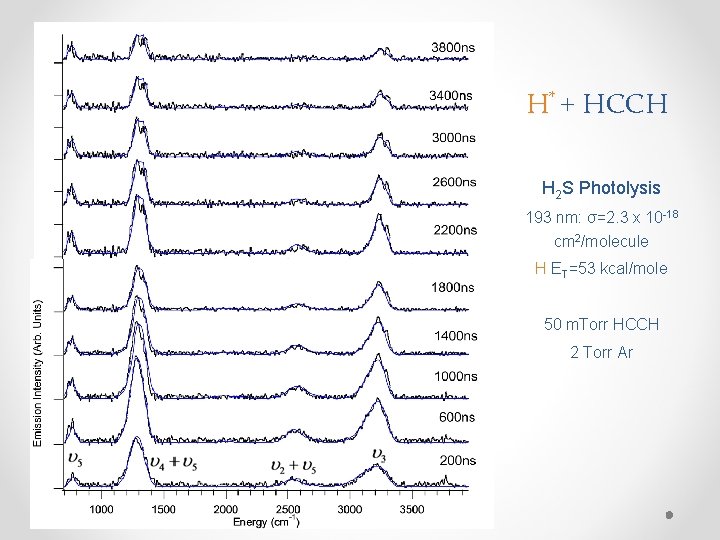
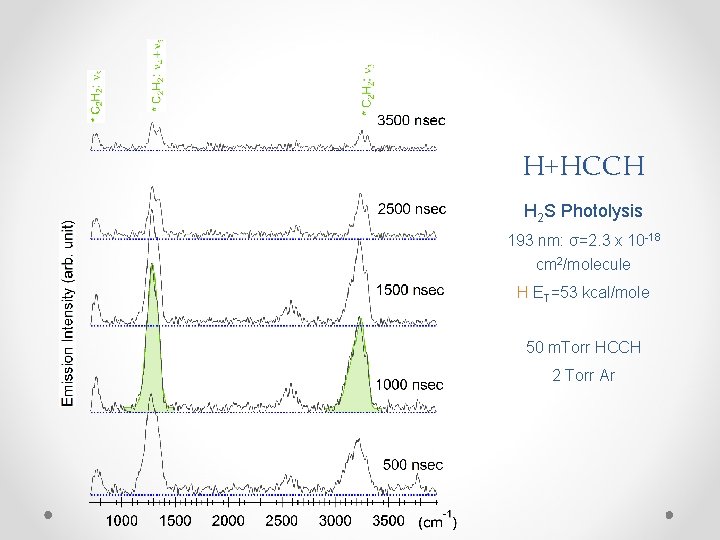
H* + HCCH H 2 S Photolysis 193 nm: σ=2. 3 x 10 -18 cm 2/molecule H ET=53 kcal/mole 50 m. Torr HCCH 2 Torr Ar
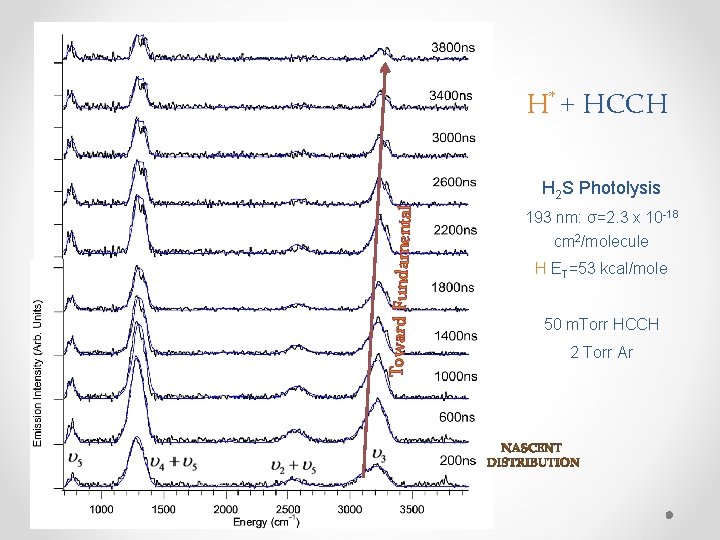
H* + HCCH Toward Fundamental H 2 S Photolysis 193 nm: σ=2. 3 x 10 -18 cm 2/molecule H ET=53 kcal/mole 50 m. Torr HCCH 2 Torr Ar
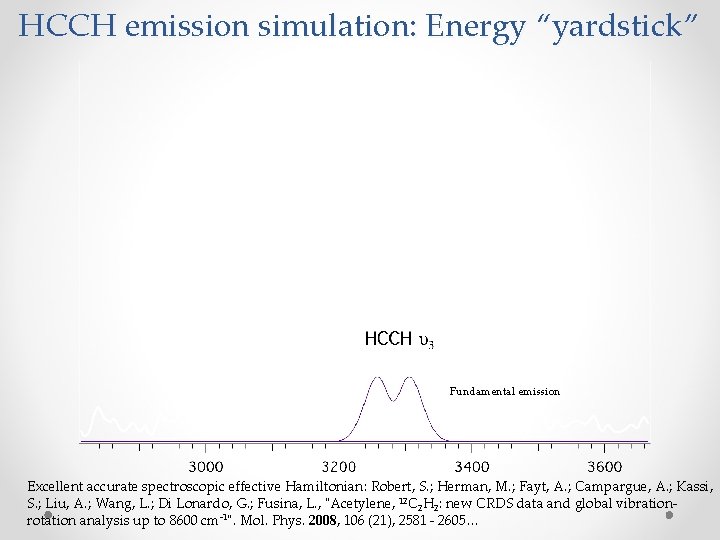
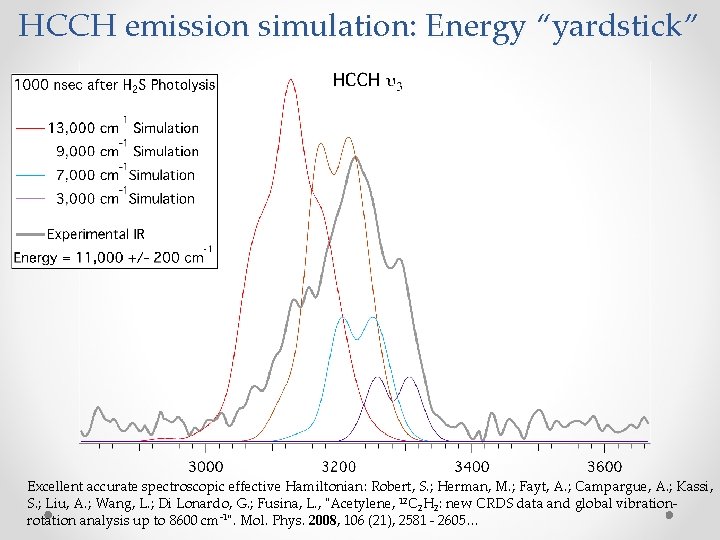
HCCH emission simulation: Energy “yardstick” Fundamental emission Excellent accurate spectroscopic effective Hamiltonian: Robert, S. ; Herman, M. ; Fayt, A. ; Campargue, A. ; Kassi, S. ; Liu, A. ; Wang, L. ; Di Lonardo, G. ; Fusina, L. , "Acetylene, 12 C 2 H 2: new CRDS data and global vibrationrotation analysis up to 8600 cm-1". Mol. Phys. 2008, 106 (21), 2581 - 2605…
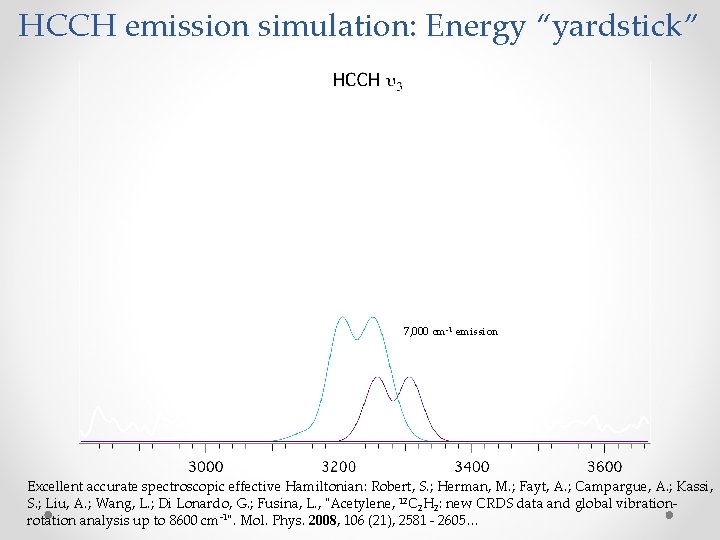
HCCH emission simulation: Energy “yardstick” 7, 000 cm-1 emission Excellent accurate spectroscopic effective Hamiltonian: Robert, S. ; Herman, M. ; Fayt, A. ; Campargue, A. ; Kassi, S. ; Liu, A. ; Wang, L. ; Di Lonardo, G. ; Fusina, L. , "Acetylene, 12 C 2 H 2: new CRDS data and global vibrationrotation analysis up to 8600 cm-1". Mol. Phys. 2008, 106 (21), 2581 - 2605…
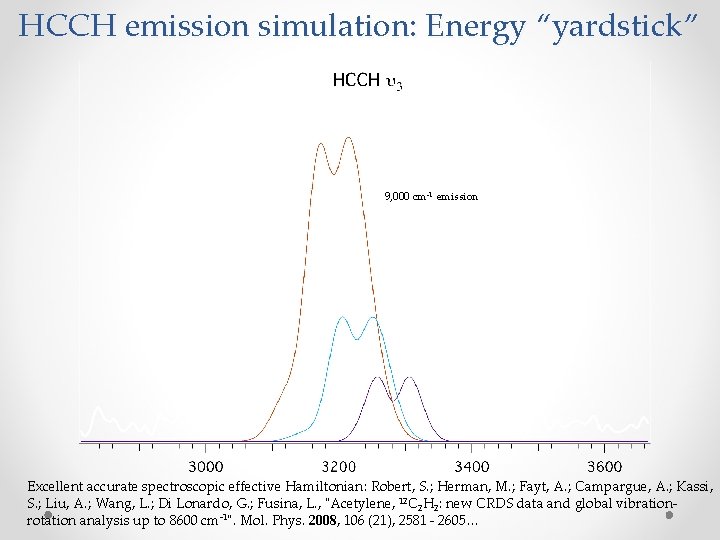
HCCH emission simulation: Energy “yardstick” 9, 000 cm-1 emission Excellent accurate spectroscopic effective Hamiltonian: Robert, S. ; Herman, M. ; Fayt, A. ; Campargue, A. ; Kassi, S. ; Liu, A. ; Wang, L. ; Di Lonardo, G. ; Fusina, L. , "Acetylene, 12 C 2 H 2: new CRDS data and global vibrationrotation analysis up to 8600 cm-1". Mol. Phys. 2008, 106 (21), 2581 - 2605…
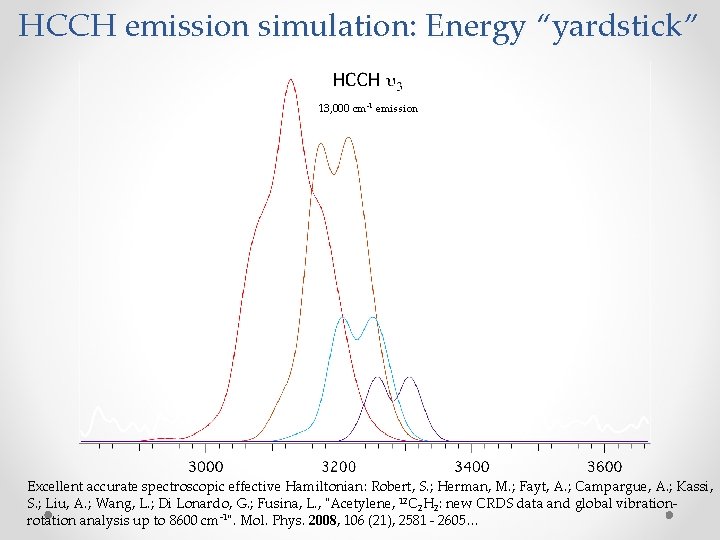
HCCH emission simulation: Energy “yardstick” 13, 000 cm-1 emission Excellent accurate spectroscopic effective Hamiltonian: Robert, S. ; Herman, M. ; Fayt, A. ; Campargue, A. ; Kassi, S. ; Liu, A. ; Wang, L. ; Di Lonardo, G. ; Fusina, L. , "Acetylene, 12 C 2 H 2: new CRDS data and global vibrationrotation analysis up to 8600 cm-1". Mol. Phys. 2008, 106 (21), 2581 - 2605…
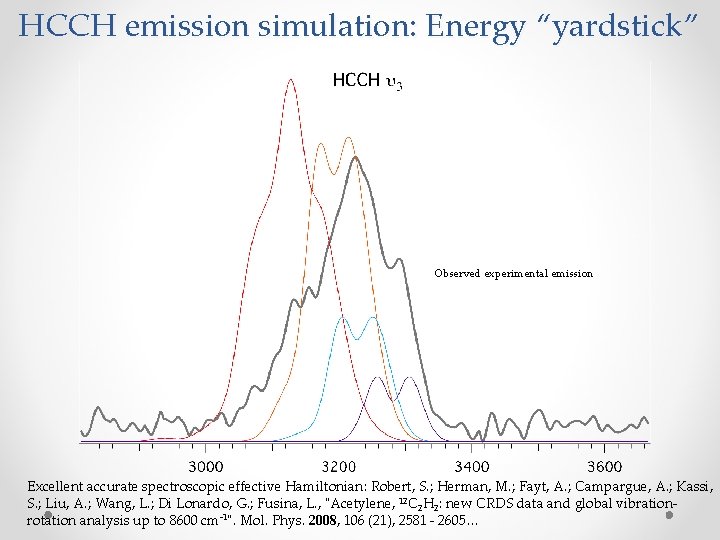
HCCH emission simulation: Energy “yardstick” Observed experimental emission Excellent accurate spectroscopic effective Hamiltonian: Robert, S. ; Herman, M. ; Fayt, A. ; Campargue, A. ; Kassi, S. ; Liu, A. ; Wang, L. ; Di Lonardo, G. ; Fusina, L. , "Acetylene, 12 C 2 H 2: new CRDS data and global vibrationrotation analysis up to 8600 cm-1". Mol. Phys. 2008, 106 (21), 2581 - 2605…
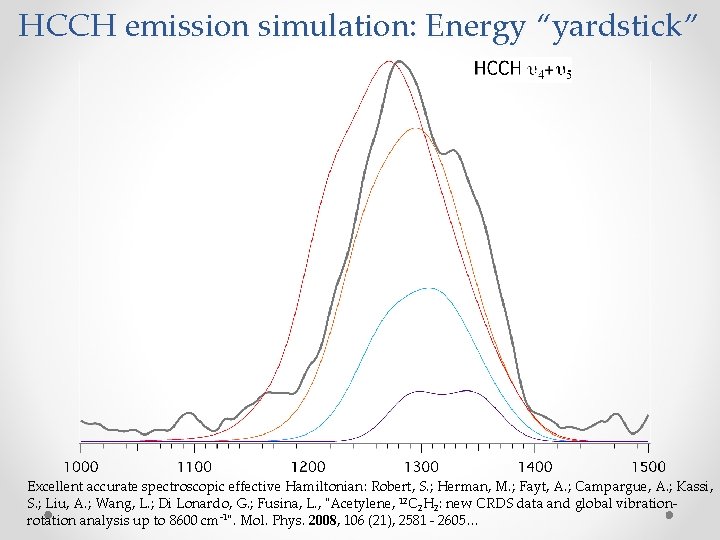
HCCH emission simulation: Energy “yardstick” Excellent accurate spectroscopic effective Hamiltonian: Robert, S. ; Herman, M. ; Fayt, A. ; Campargue, A. ; Kassi, S. ; Liu, A. ; Wang, L. ; Di Lonardo, G. ; Fusina, L. , "Acetylene, 12 C 2 H 2: new CRDS data and global vibrationrotation analysis up to 8600 cm-1". Mol. Phys. 2008, 106 (21), 2581 - 2605…
HCCH emission simulation: Energy “yardstick” Excellent accurate spectroscopic effective Hamiltonian: Robert, S. ; Herman, M. ; Fayt, A. ; Campargue, A. ; Kassi, S. ; Liu, A. ; Wang, L. ; Di Lonardo, G. ; Fusina, L. , "Acetylene, 12 C 2 H 2: new CRDS data and global vibrationrotation analysis up to 8600 cm-1". Mol. Phys. 2008, 106 (21), 2581 - 2605…
H+HCCH H 2 S Photolysis 193 nm: σ=2. 3 x 10 -18 cm 2/molecule H ET=53 kcal/mole 50 m. Torr HCCH 2 Torr Ar
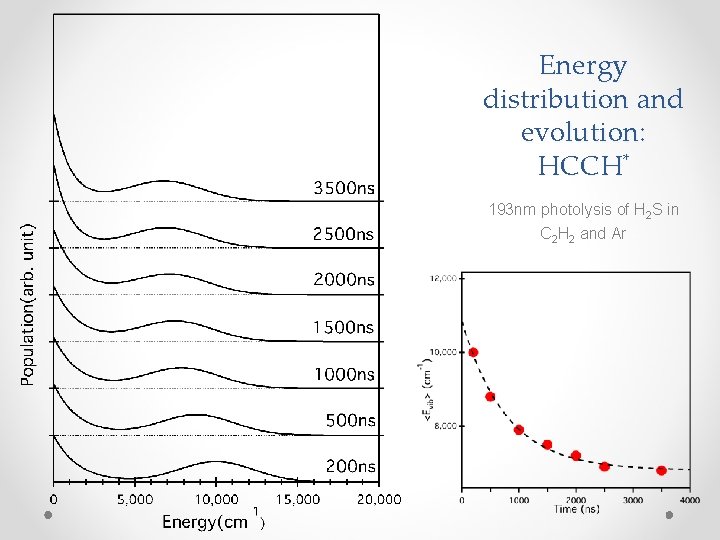
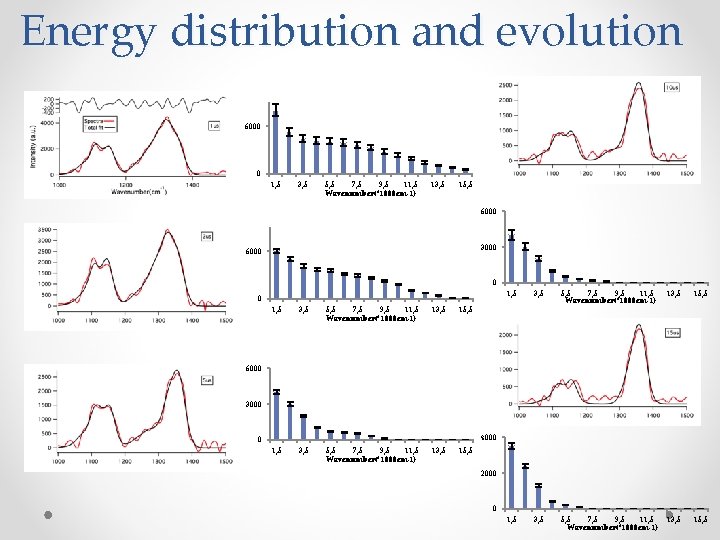
Energy distribution and evolution: HCCH* 193 nm photolysis of H 2 S in C 2 H 2 and Ar
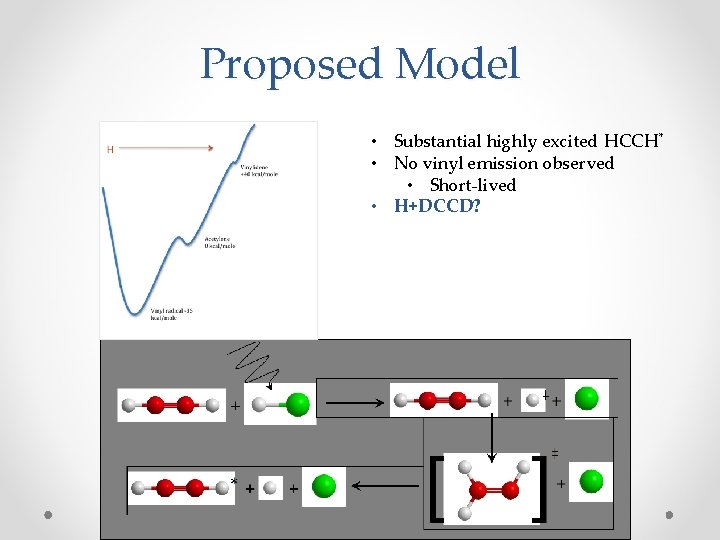
Proposed Model • Substantial highly excited HCCH* • No vinyl emission observed • Short-lived • H+DCCD?
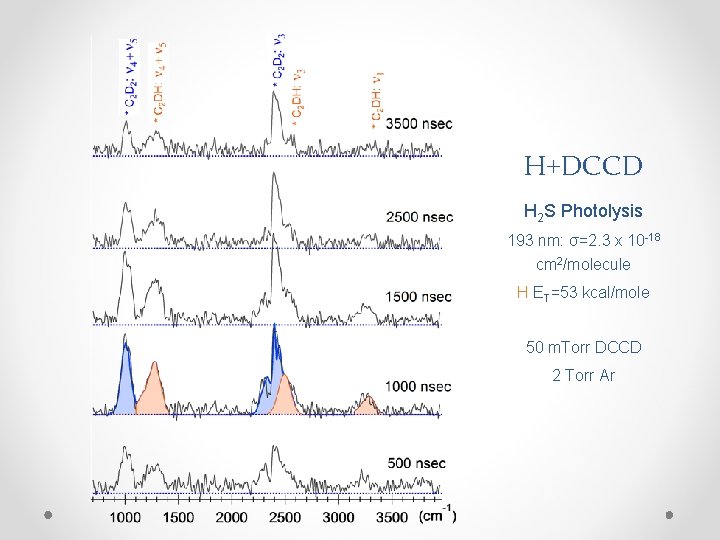
H+DCCD H 2 S Photolysis 193 nm: σ=2. 3 x 10 -18 cm 2/molecule H ET=53 kcal/mole 50 m. Torr DCCD 2 Torr Ar
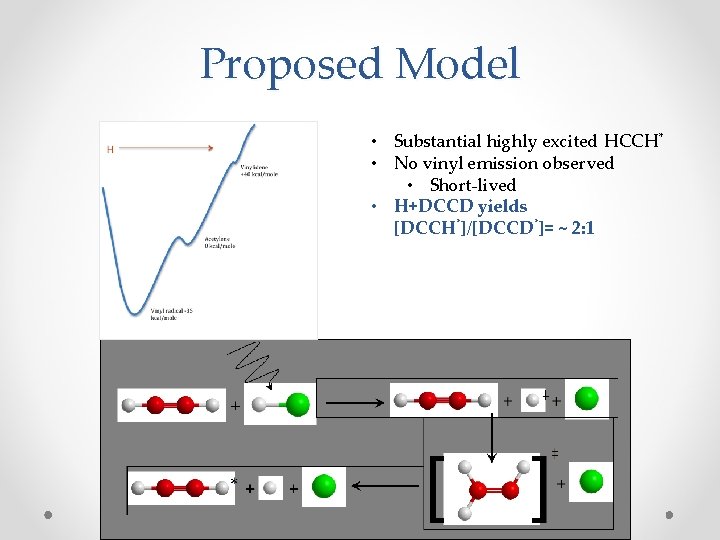
Proposed Model • Substantial highly excited HCCH* • No vinyl emission observed • Short-lived • H+DCCD yields [DCCH*]/[DCCD*]= ~ 2: 1
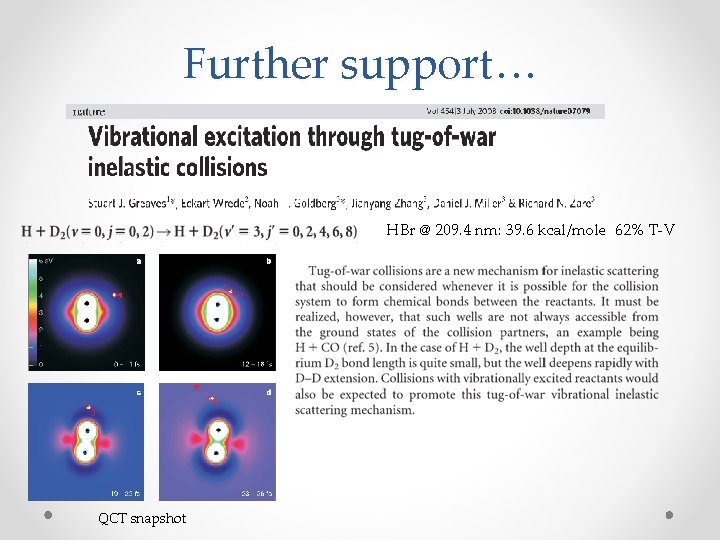
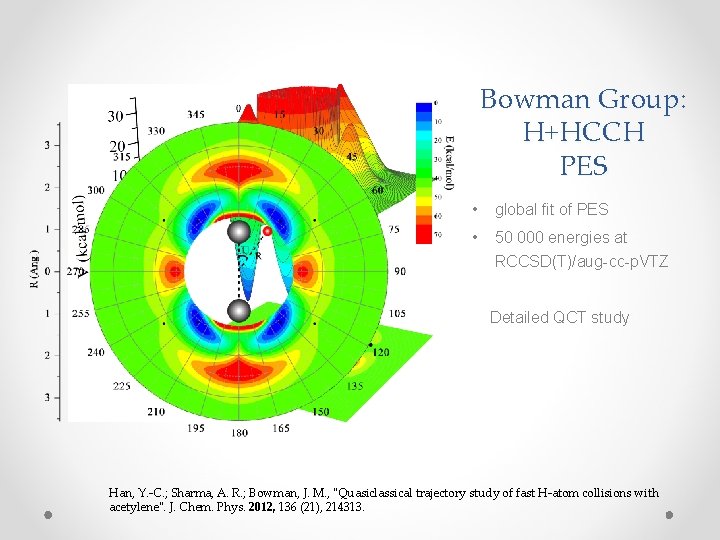
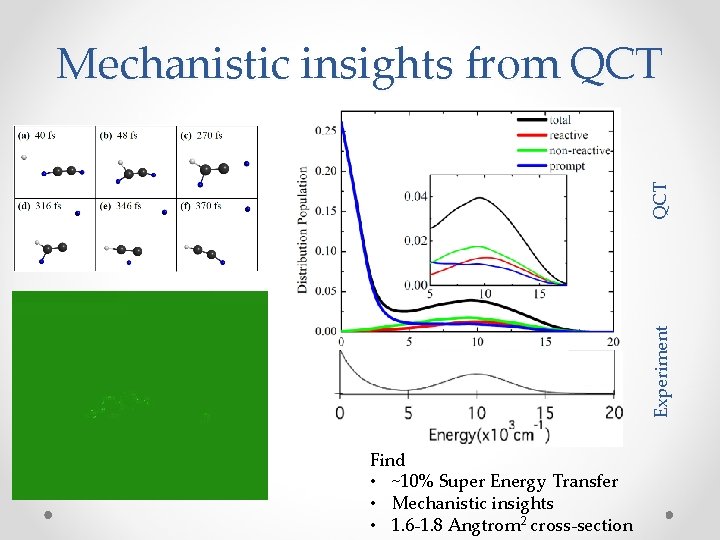
Further support… HBr @ 209. 4 nm: 39. 6 kcal/mole 62% T-V QCT snapshot
Bowman Group: H+HCCH PES • global fit of PES • 50 000 energies at RCCSD(T)/aug-cc-p. VTZ Detailed QCT study Han, Y. -C. ; Sharma, A. R. ; Bowman, J. M. , "Quasiclassical trajectory study of fast H-atom collisions with acetylene". J. Chem. Phys. 2012, 136 (21), 214313.
Experiment QCT Mechanistic insights from QCT Find • ~10% Super Energy Transfer • Mechanistic insights • 1. 6 -1. 8 Angtrom 2 cross-section
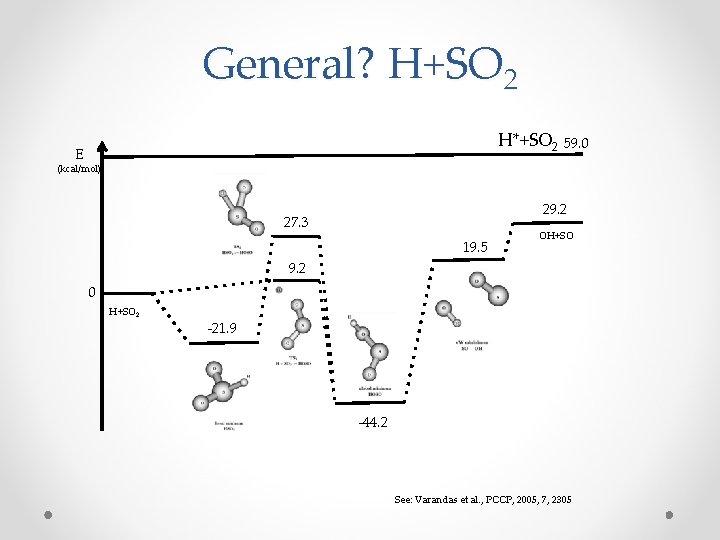
General? H+SO 2 H*+SO 2 E 59. 0 (kcal/mol) 29. 2 27. 3 19. 5 OH+SO 9. 2 0 H+SO 2 -21. 9 -44. 2 See: Varandas et al. , PCCP, 2005, 7, 2305
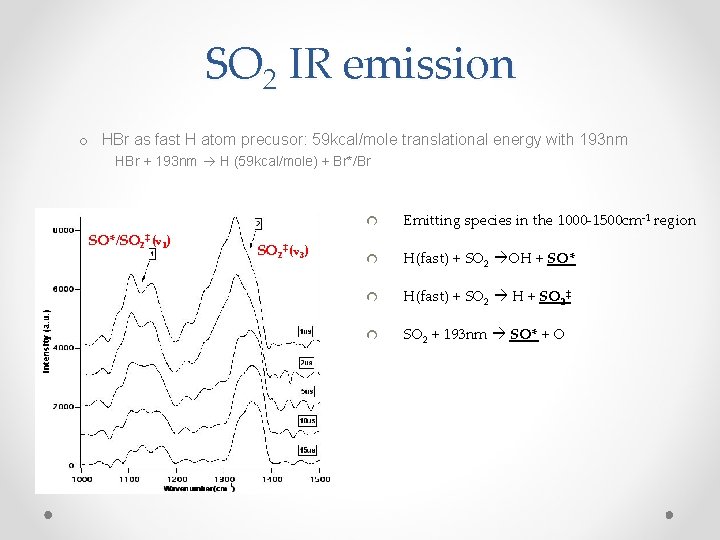
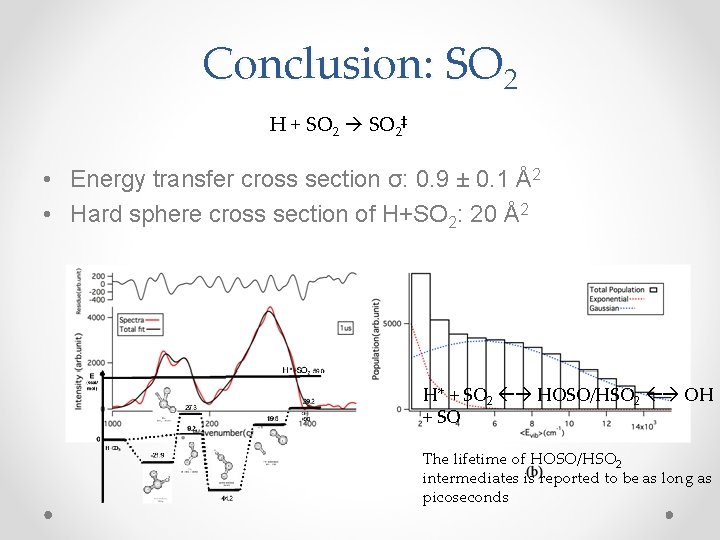
SO 2 IR emission o HBr as fast H atom precusor: 59 kcal/mole translational energy with 193 nm HBr + 193 nm H (59 kcal/mole) + Br*/Br SO*/SO 2‡ (ν 1) Emitting species in the 1000 -1500 cm-1 region SO 2‡ (ν 3) H(fast) + SO 2 OH + SO* H(fast) + SO 2 H + SO 2‡ SO 2 + 193 nm SO* + O
Energy distribution and evolution 6000 0 1, 5 3, 5 5, 5 7, 5 9, 5 11, 5 Wavenumber(*1000 cm-1) 13, 5 15, 5 6000 3000 6000 0 0 1, 5 3, 5 5, 5 7, 5 9, 5 11, 5 Wavenumber(*1000 cm-1) 13, 5 15, 5 6000 3000 0 4000 1, 5 3, 5 5, 5 7, 5 9, 5 11, 5 Wavenumber(*1000 cm-1) 13, 5 15, 5 2000 0
Conclusion: SO 2 H + SO 2‡ • Energy transfer cross section σ: 0. 9 ± 0. 1 Å2 • Hard sphere cross section of H+SO 2: 20 Å2 H* + SO 2 HOSO/HSO 2 OH + SO The lifetime of HOSO/HSO 2 intermediates is reported to be as long as picoseconds
Acknowledgements Temple • Hai-Lung Dai • Matt Nikow, Ph. D. [Agilent] • Jianqiang Ma, Ph. D. [Univ. Penn. ] • • Michael Wilhelm, Ph. D. Ben Datko (ug, ‘ 13) Nader Anz (ug, ‘ 12) Mark Fennimore (ug. ‘ 11) Emory University • Joel Bowman • Amit Sharma [Argonne] • Yong-Chang Halian [Dalian Univ. ] Support • • DE-FG 02 -86 ER 134584 DE-FG 02 -97 ER 14782 (JMB) NSF-MRI 1039925: MU 3 C Temple University