
67 th Cyberspace Wing Instructor Training Course Learning
67 th Cyberspace Wing Instructor Training Course Learning Objectives 1
Objective Describe basic facts surrounding learning objectives. � Using an instructorapproved topic, develop a SMART knowledge and performance objective � 2
Overview Definition � Purpose � Types of Objectives � Formats of Objectives � Steps for Developing Objectives � Elements of Criterion Objectives � 3
Learning Objectives Defined Q: What is a learning objective? A: A precise statement of the learned capability (knowledge, skills, or attitudes) learners are expected to be able to exhibit following instruction. � Examples of learning objectives are found at the beginning of every lesson in this course 4
Purpose of Objectives � For students Directs attention to important content � State standard/expected performance level � Serve as a progress self-check � � For Instructional Developers Serve as the building blocks for training � Serve as a basis for test development � Allow selection of appropriate instructional strategies � 5
Types of Objectives � Two main types Knowledge-based (mental) � Performance-based (task) � � Terminal Learning Objective (TLO) � � An objective that students are expected to attain at the completion of the course of instruction Enabling Learning Objective (ELO) � An objective that students must attain in order to accomplish a terminal objective 6
Formats for Objectives � Some formats are Criterion objectives � Level of learning objectives � Behavioral statements � 7
Formats for Objectives � Criterion Objectives Statements that specify precisely what student behavior is expected � Made up of three parts � Condition – What the student is given or denied � Behavior – What the student will be able to do � Standard – Qualitative/Quantitative criteria � � Example: Given a map, student will identify the location of forty out of fifty states. 8
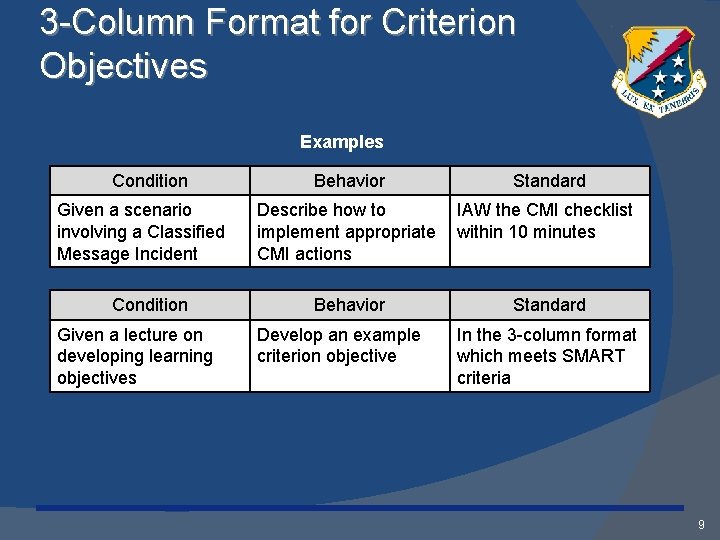
3 -Column Format for Criterion Objectives Examples Condition Given a scenario involving a Classified Message Incident Condition Given a lecture on developing learning objectives Behavior Standard Describe how to implement appropriate CMI actions IAW the CMI checklist within 10 minutes Behavior Standard Develop an example criterion objective In the 3 -column format which meets SMART criteria 9
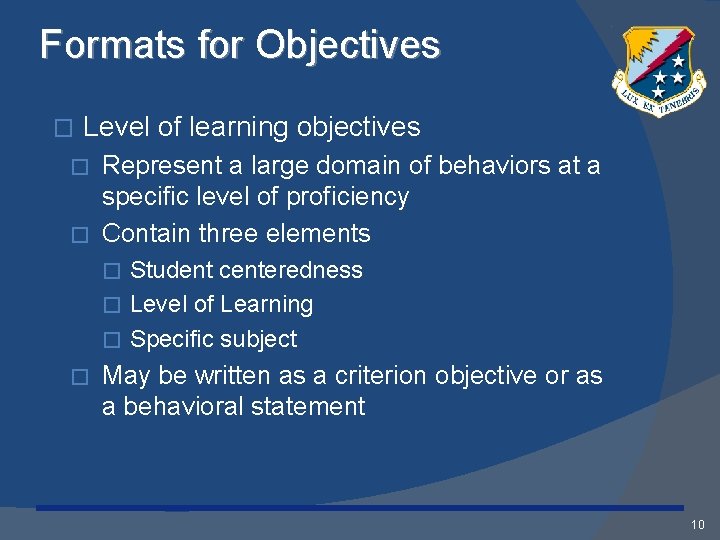
Formats for Objectives � Level of learning objectives Represent a large domain of behaviors at a specific level of proficiency � Contain three elements � Student centeredness � Level of Learning � Specific subject � � May be written as a criterion objective or as a behavioral statement 10
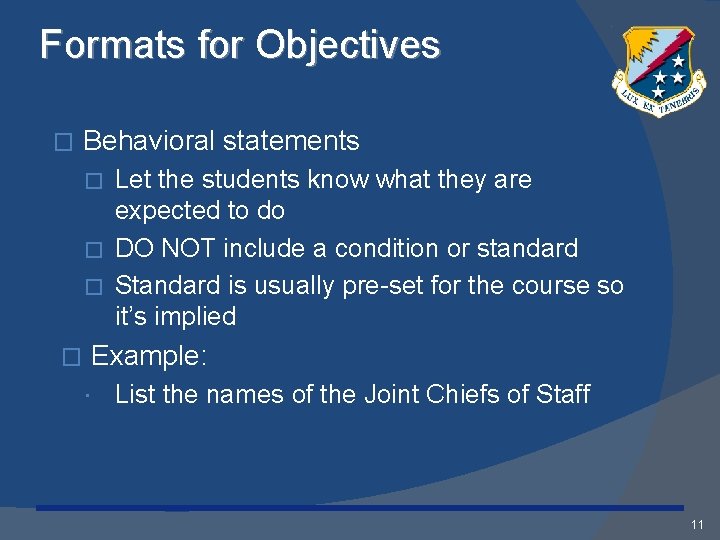
Formats for Objectives � Behavioral statements Let the students know what they are expected to do � DO NOT include a condition or standard � Standard is usually pre-set for the course so it’s implied � Example: � List the names of the Joint Chiefs of Staff 11
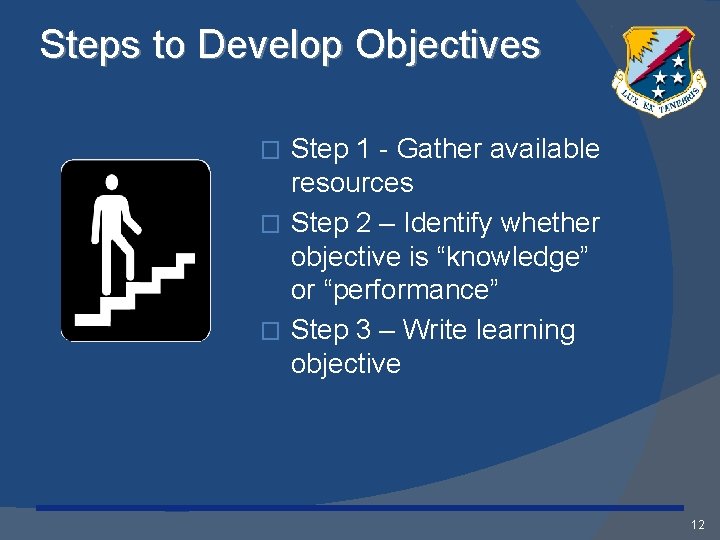
Steps to Develop Objectives Step 1 - Gather available resources � Step 2 – Identify whether objective is “knowledge” or “performance” � Step 3 – Write learning objective � 12
Elements of a Criterion Objective � Three parts: Condition � Behavior � Standard � 13
Elements of a Criterion Objective � Condition � Definition - A description of the testing environment including those problems, materials, and supplies that will be given (included) or specifically excluded from a measurement situation. � Examples Materials given or withheld � Time constraints � Assistance; with or without � 14
Elements of a Criterion Objective � Behavior � Definition - The observable student behavior (or the product of that behavior) acceptable to the instructor as proof that learning has occurred. � Mirror job requirements � Uses action verbs � Examples � Identify, describe, assemble, build 15
Elements of a Criterion Objective � Standard Definition - The qualitative and quantitative criteria against which student performance of the process or product will be measured to determine successful learning � Outlines minimum requirements for achieving objective � Examples � No less than 85% � 10 out of 12 correct � With no errors � 16
Identify CBS Given a map, and without the use of training aids, locate and identify all 10 receiver locations with 100 percent accuracy. � With a given map, compass and coordinates, navigate the terrain and locate all 5 evacuation points with no errors. � Without the use of working aids, define the 10 vocabulary words with 80 percent accuracy. � 17
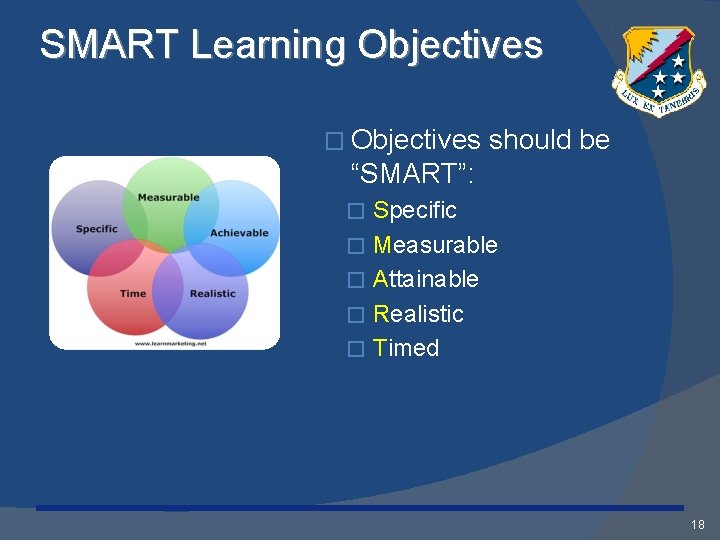
SMART Learning Objectives � Objectives should be “SMART”: � � � Specific Measurable Attainable Realistic Timed 18
Specific Objectives �A specific objective has a much greater chance of being accomplished than a general one. � Specific objectives must answer the six “W” questions: � � � Who: Who is involved? What: What do I want to accomplish? When: Time frame Where: Location Which: Identify requirements & constraints Why: Specific reasons, purpose, benefits for accomplishing goal 19
Measurable Objectives � If a goal is not measurable, it is not possible to know whether a team is making progress toward successful completion. � A measurable goal will usually answer questions such as: How much? � How many? � How will I know when it is accomplished? � 20
Attainable Objectives � While an attainable objective may stretch a student’s knowledge, skills, or attitudes in order to achieve it, the objective should not be not extreme. � Objectives are neither out of reach nor below standard performance, as these may be considered meaningless. 21
Realistic Objectives � Stresses the importance of choosing objectives that matter given the resources you have. � An objective may be specific, measurable, attainable, and timebound, but could lack relevance. 22
Timed Objectives �A commitment to a deadline helps a team focus their efforts on completion of the goal on or before the due date. � A time-bound goal is intended to establish a sense of urgency and priority. 23
SMART or Not? To raise the average daily attendance rate to over 95 percent within the next 3 years � To significantly improve staff satisfaction over the next 12 months. � By the end of the diabetes skills building workshops 60% of the attendees will be able to describe and demonstrate 4 new skills they have learned and will use in managing their child’s diabetes. � 24
Summary Definition � Purpose � Types of Objectives � Formats for Objectives � Steps for Developing Objectives � Elements of Objectives � 25
Questions? 26
Now it’s your turn… � Using an instructor-approved topic, develop a SMART knowledge and performance objective 27
- Slides: 27