
64 QAM Communications System Design and Characterization Project


![MATLAB (1) >> A=[0 1 2; 3 4 5] A = 0 1 2](https://slidetodoc.com/presentation_image/26535cbd8b37398edb712b5adbf27f91/image-22.jpg "MATLAB (1) >> A=[0 1 2; 3 4 5] A = 0 1 2")
- Slides: 27
64 -QAM Communications System Design and Characterization Project #1 EE 283 daeik. kim@duke. edu
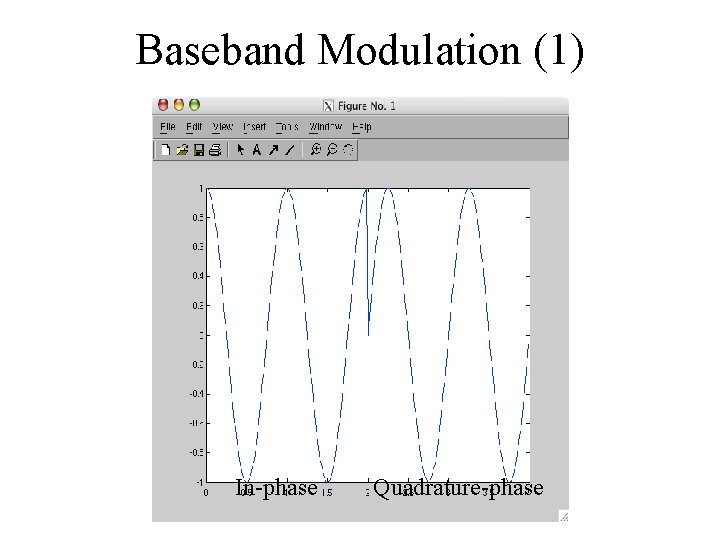
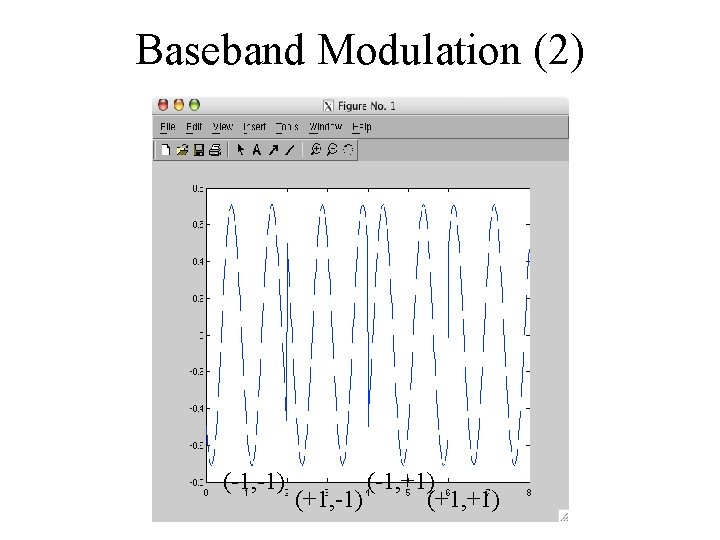
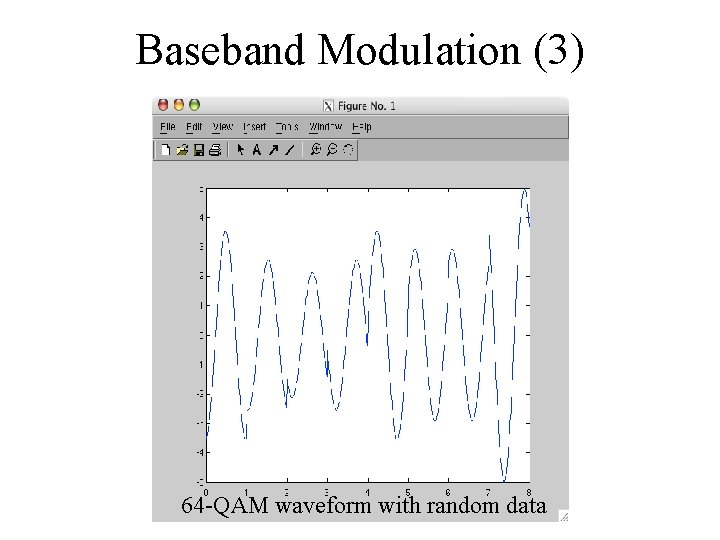
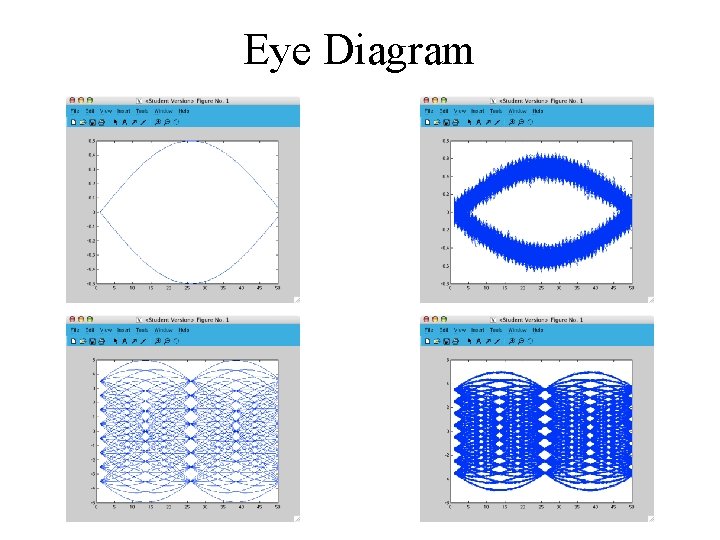
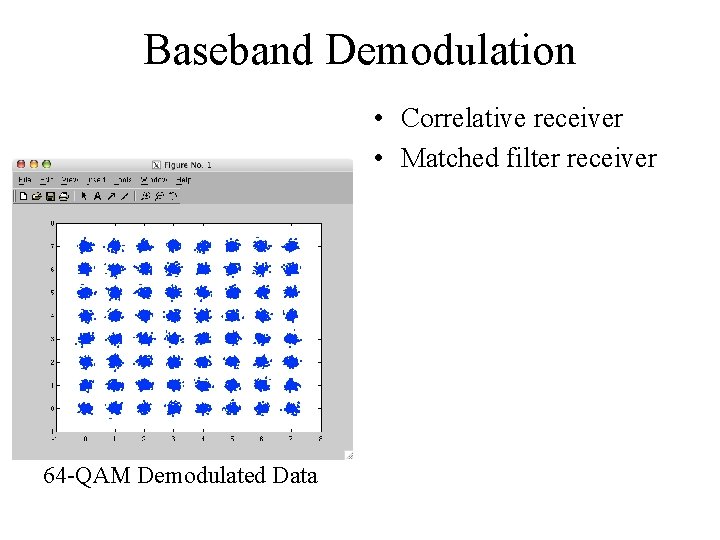
What you need to do (red) • • • • • Assignments: 1. Data Source (0) Propose a data source that you will use for your communication system. Discuss the randomness of data. 2. 64 -QAM Memoryless Channel Coder (25) Design a channel coder with a code rate 1. The designed data source feeds the channel coder. The coder outputs are 64 -QAM in-phase and quadrature-phase data. For example, with 6 -bits taken from data source, an in-phase and a quadrature-phase amplitudes are produced. 3. QAM Base Band Modulation (25) Design a QAM modulator. Modulator inputs are the output of 64 -QAM channel coder and the modulation frequency, etc. The output is a modulated QAM waveform. Show unit in-phase, unit quadrature-phase, and random data waveforms in a fine time resolution (for readability). 4. Channel Modeling (0) Design a channel module that adds Gaussian noise to the modulated data with a given noise intensity. Show a 64 QAM eye diagram. 5. QAM Base Band Demodulation (25) Design a QAM demodulator. Assume that full phase information is given and the phase is locked. The demodulator outputs are in-phase and quadrature-phase amplitudes. Show a demodulated 64 -QAM constellation with noise. 6. 64 -QAM Channel Decoder (25) Design a QAM decoder that performs the inverse of the designed 64 -QAM channel coder. 7. BER Measurements (0) Design a module calculates bit-error-rate with the original data source and the decoded data stream. Discuss how many measurements are required to get 95% or 99% confidence. Make a plot of BER vs SNR. All the numbers, such as signal power and noise power, must be obtained from simulation. 8. Bandwidth Efficiency (0) Calculate the bandwidth efficiency with a given BER. All the numbers, such as bandwidth must be obtained from simulation. Discuss the definition of bandwidth of your baseband waveform.
Outline • 64 -QAM communications system • Testing and measurements • Tools, grading, etc.
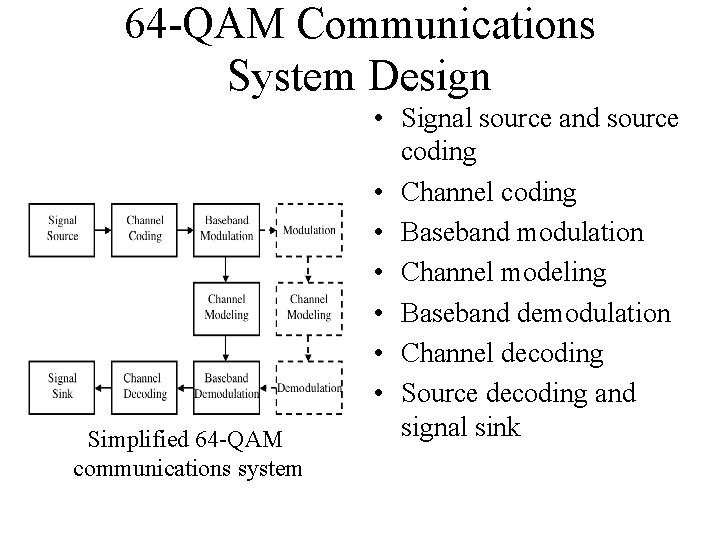
64 -QAM Communications System Design Simplified 64 -QAM communications system • Signal source and source coding • Channel coding • Baseband modulation • Channel modeling • Baseband demodulation • Channel decoding • Source decoding and signal sink
Signal source and source coding • Ideal source coded data – “Random” – Memoryless source – Equiprobable – Spectrum and autocorrelation • A randomly generated data • What if the data is not random?
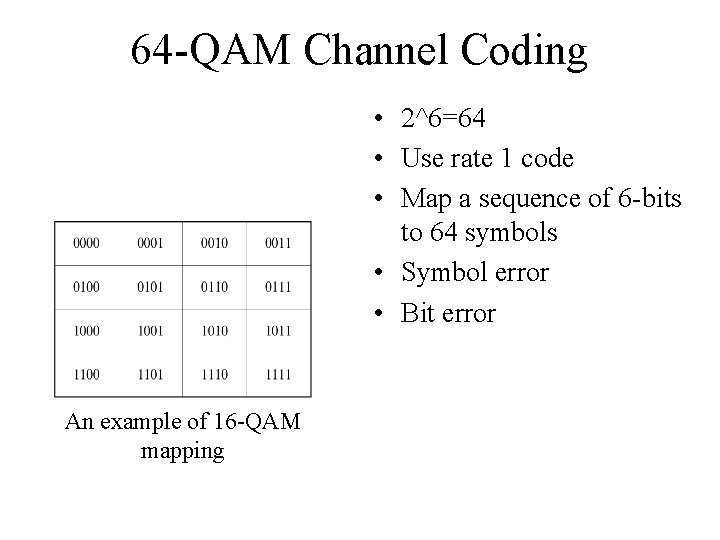
64 -QAM Channel Coding • 2^6=64 • Use rate 1 code • Map a sequence of 6 -bits to 64 symbols • Symbol error • Bit error An example of 16 -QAM mapping
Baseband Modulation (1) In-phase Quadrature-phase
Baseband Modulation (2) (-1, -1) (-1, +1) (+1, -1) (+1, +1)
Baseband Modulation (3) 64 -QAM waveform with random data
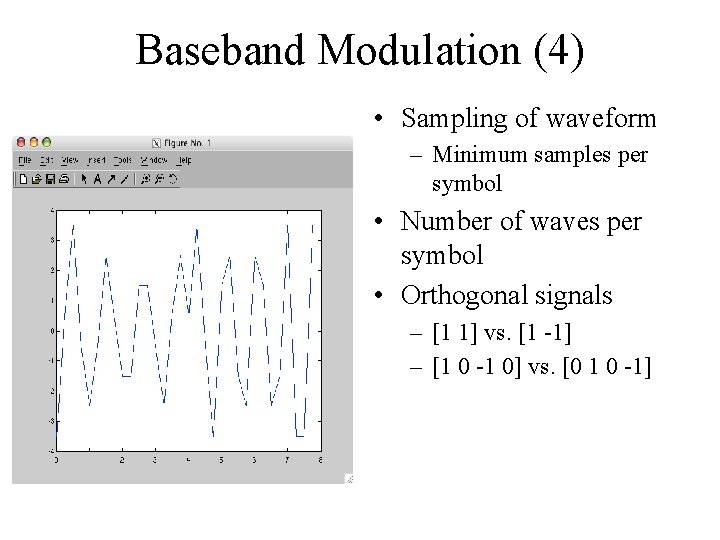
Baseband Modulation (4) • Sampling of waveform – Minimum samples per symbol • Number of waves per symbol • Orthogonal signals – [1 1] vs. [1 -1] – [1 0 -1 0] vs. [0 1 0 -1]
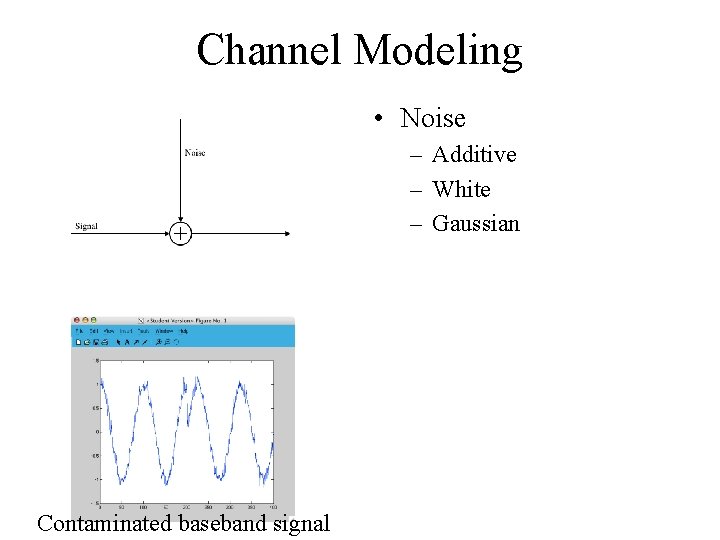
Channel Modeling • Noise – Additive – White – Gaussian Contaminated baseband signal
Eye Diagram
Baseband Demodulation • Correlative receiver • Matched filter receiver 64 -QAM Demodulated Data
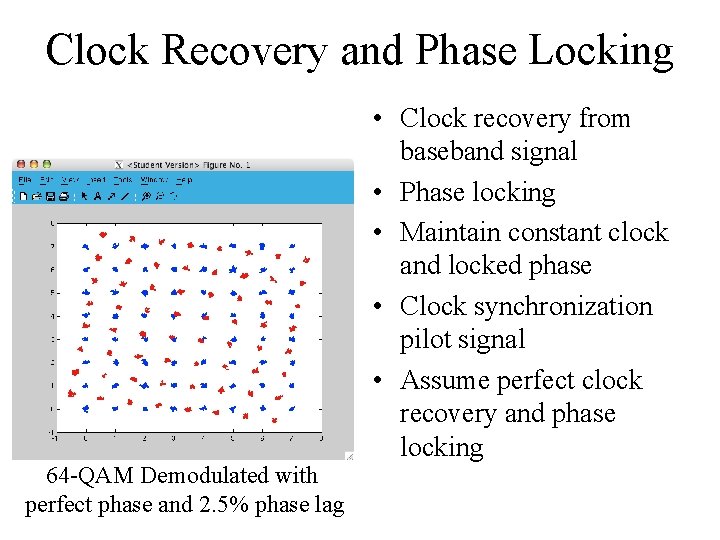
Clock Recovery and Phase Locking 64 -QAM Demodulated with perfect phase and 2. 5% phase lag • Clock recovery from baseband signal • Phase locking • Maintain constant clock and locked phase • Clock synchronization pilot signal • Assume perfect clock recovery and phase locking
Channel Decoding and Signal Sink • Channel Decoding – Inverse of channel coding – Simple hard decision • Signal Sink – Compare received and decoded data with signal source
Testing and Measurements • Obtain – 64 -QAM waveform – Eye diagram – Bit error rate – Bandwidth efficiency
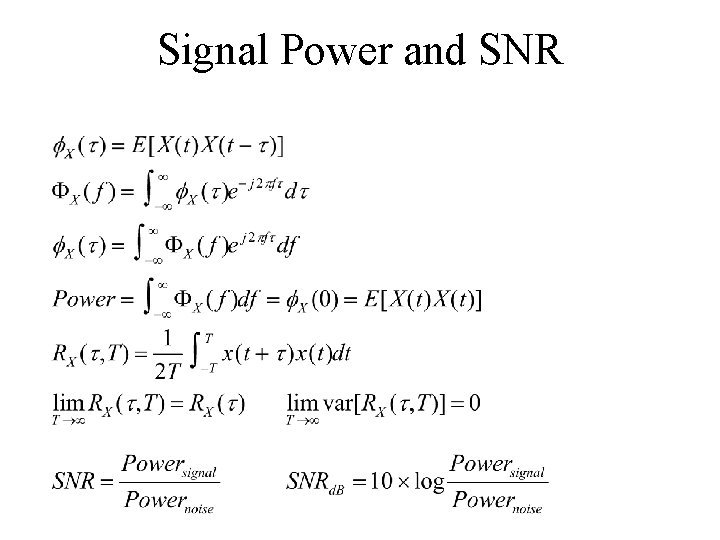
Signal Power and SNR
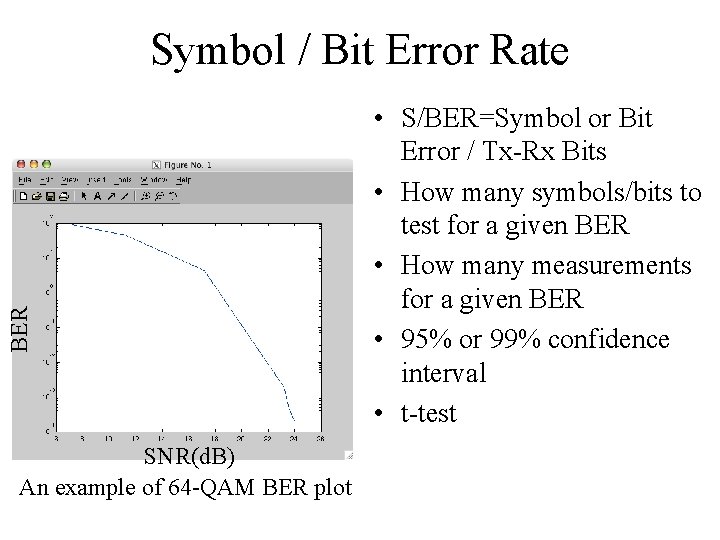
BER Symbol / Bit Error Rate SNR(d. B) An example of 64 -QAM BER plot • S/BER=Symbol or Bit Error / Tx-Rx Bits • How many symbols/bits to test for a given BER • How many measurements for a given BER • 95% or 99% confidence interval • t-test
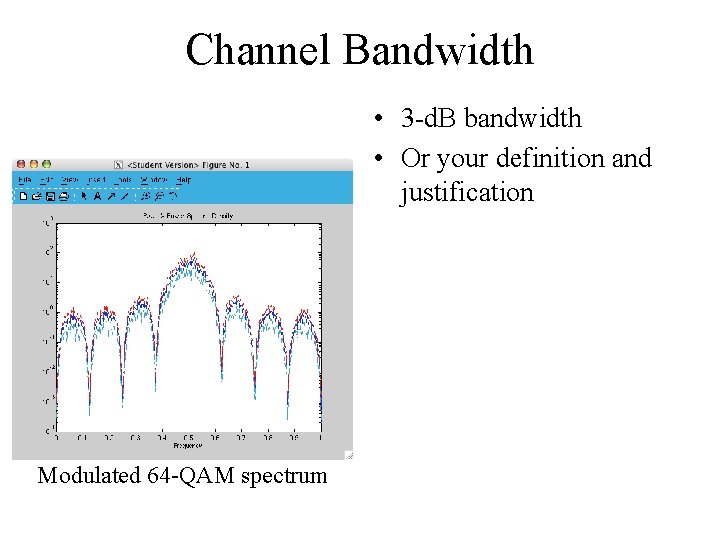
Channel Bandwidth • 3 -d. B bandwidth • Or your definition and justification Modulated 64 -QAM spectrum
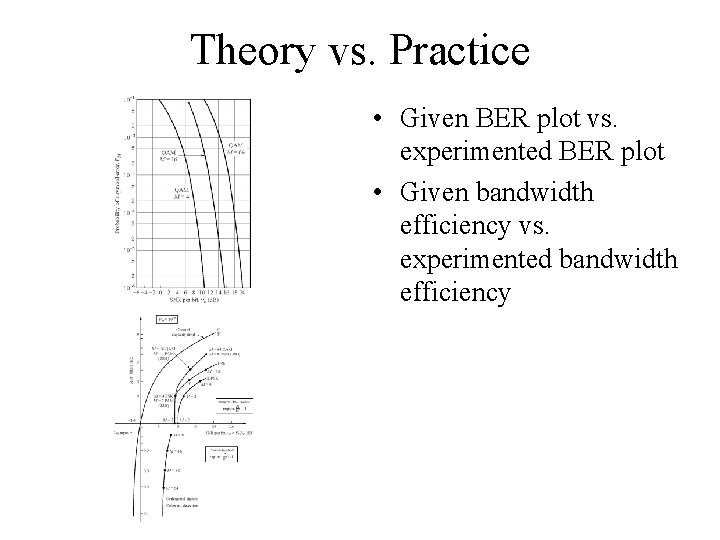
Theory vs. Practice • Given BER plot vs. experimented BER plot • Given bandwidth efficiency vs. experimented bandwidth efficiency
Tools • • Any tools supported by ECE MATLAB recommended C, C++, Java, Visual Basic, Perl, PHP… Simulink ?
MATLAB (1) >> A=[0 1 2; 3 4 5] A = 0 1 2 3 4 5 >> A=(0: 0. 2: 1)' A = 0 0. 2000 0. 4000 0. 6000 0. 8000 1. 0000 >> plot(A, cos(2*pi*A)) >> >> >> ta=1: -0. 01: 0; tb=(0: . 01: 1)'; ta+tb'; ta'. *tb; ta. ^2; ta(1: 10)=tb(11: 20)’; help elfun lookfor signal demo
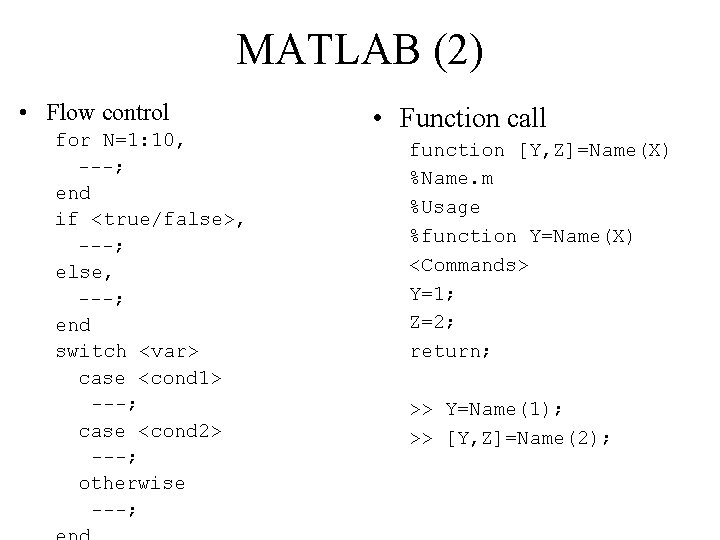
MATLAB (2) • Flow control for N=1: 10, ---; end if <true/false>, ---; else, ---; end switch <var> case <cond 1> ---; case <cond 2> ---; otherwise ---; • Function call function [Y, Z]=Name(X) %Name. m %Usage %function Y=Name(X) <Commands> Y=1; Z=2; return; >> Y=Name(1); >> [Y, Z]=Name(2);
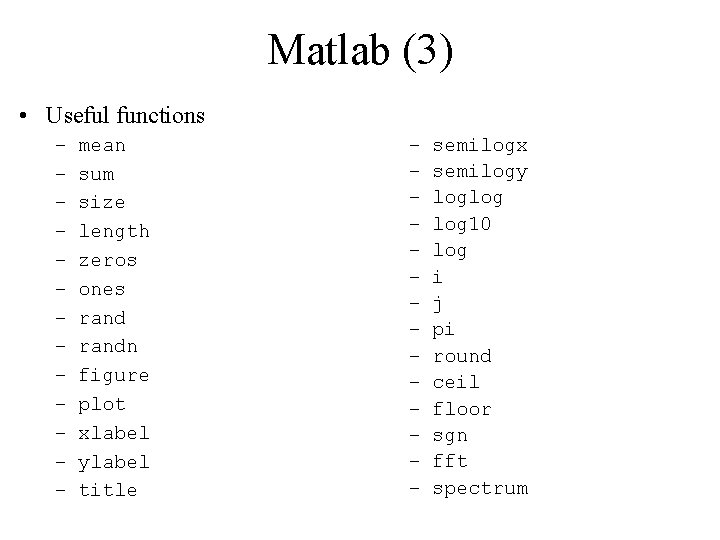
Matlab (3) • Useful functions – – – – mean sum size length zeros ones randn figure plot xlabel ylabel title – – – – semilogx semilogy loglog 10 log i j pi round ceil floor sgn fft spectrum
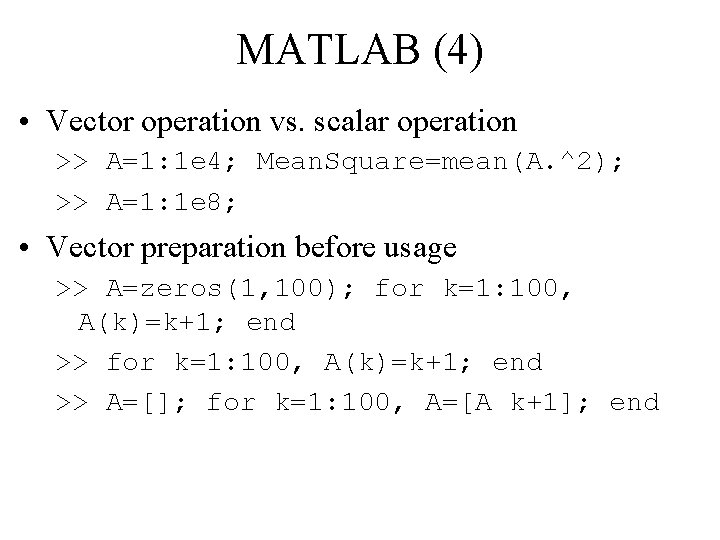
MATLAB (4) • Vector operation vs. scalar operation >> A=1: 1 e 4; Mean. Square=mean(A. ^2); >> A=1: 1 e 8; • Vector preparation before usage >> A=zeros(1, 100); for k=1: 100, A(k)=k+1; end >> A=[]; for k=1: 100, A=[A k+1]; end
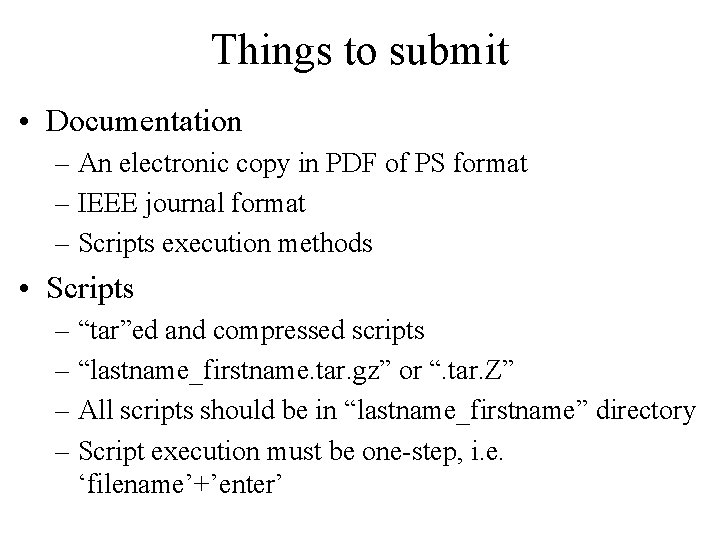
Things to submit • Documentation – An electronic copy in PDF of PS format – IEEE journal format – Scripts execution methods • Scripts – “tar”ed and compressed scripts – “lastname_firstname. tar. gz” or “. tar. Z” – All scripts should be in “lastname_firstname” directory – Script execution must be one-step, i. e. ‘filename’+’enter’
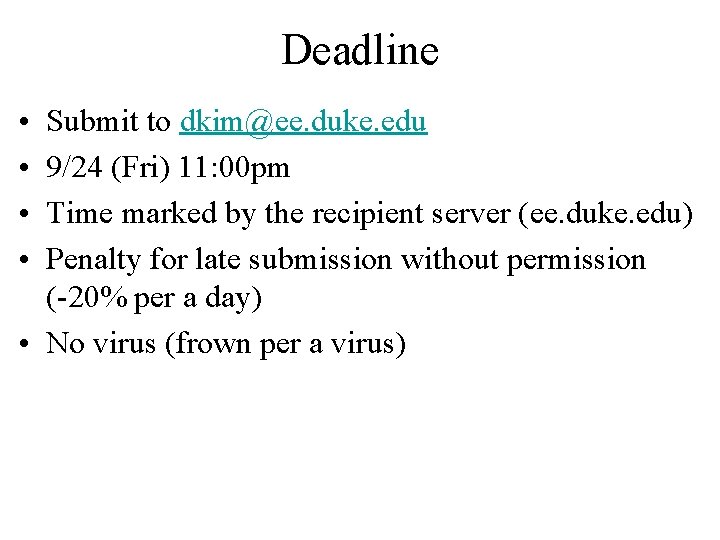
Deadline • • Submit to dkim@ee. duke. edu 9/24 (Fri) 11: 00 pm Time marked by the recipient server (ee. duke. edu) Penalty for late submission without permission (-20% per a day) • No virus (frown per a virus)