
60 YEARS OF PORTFOLIO OPTIMIZATION PRACTICAL CHALLENGES AND


- Slides: 18
60 YEARS OF PORTFOLIO OPTIMIZATION: PRACTICAL CHALLENGES AND CURRENT TRENDS AUTHORS: PETTER N. KOLM (COURANT INSITUTE, NYU) REHA TUTUNCU (GOLDMAN SACHS ASSET MANAGEMENT) FRANK K. FABOZZI (EDHEC BUSINESS SCHOOL) AVAILABLE ONLINE ON NOVEMBER 1 ST 2013
OBJECTIVE 1. Address key aspects related to using portfolio optimization in practice 2. Selectively highlight some of the new trends and developments in portfolio optimization methods
OUTLINE 1. 2. 3. 4. Introduction Mean-Variance Optimization (MVO) Extensions of MVO New Directions in Portfolio Optimization
1. INTRODUCTION Portfolio optimization research essentially attempts to answer a fundamental question for every investor: How should I distribute my funds amongst the various investment choices? This question is entirely unavoidable and must be answered by every investor. Unsurprisingly, this has been a popular research topic in finance for decades.
2. MEAN-VARIANCE OPTIMIZATION (MVO) • Henry Markowitz revolutionized the portfolio optimization conversation in 1952, when he published his theory popularly referred to as Modern Portfolio Theory • Markowitz established the expected return and standard deviation as the methods for quantifying a security's return and risk • He then presented the idea that investing can be seen quantitatively as a trade-off between risk and return • While these things seem intuitive, This paper provided a solid framework for quantitatively measuring risk and return.
2. MEAN-VARIANCE OPTIMIZATION (MVO) • He was able to show the power of considering covariances when evaluating the risk of an entire portfolio • This theory established portfolio construction as an optimization problem, where the goal is minimize risk for a given expected return or maximize return for a given risk level. • According to this paper, over 19, 000 articles on Google Scholar cite Markowitz’s original paper • We all know the math so I will skip it
PROBLEMS WITH MVO • MVO is far from perfect • Forecast estimation errors and optimization errors can result in poorly diversified portfolios • Equally weighted portfolios often outperform MVO portfolios in practical applications • This does not necessarily imply that MVO is flawed. • It does mean that is must be modified when used in practice to achieve reliable, stable, and robust results with respect to both optimization and model errors
3. EXTENSIONS OF MVO Extensions include: 1. 2. the inclusion of transaction costs and tax effects 3. Modeling and quantifying the impact of estimation errors in risk and return forecasts on the portfolios via Bayesian techniques and stochastic optimization, or other robust optimization approaches The inclusion of various types of constraints that take specific investment guidelines and institutional features into account
3. 1 INCORPORATING TRANSACTION COSTS INTO MVO • Transaction costs consist of: • • Direct costs such as commissions, taxes, bid-ask spread Indirect costs such as slippage • Traditionally, portfolio allocation decisions are independently of trading cost considerations, which are considered the trading desk’s problem. • This often damages the realized risk-adjusted returns because of the trading costs were larger than expected • Including transaction cost forecasting, particularly slippage, in the optimization equation leads to superior realized risk-adjusted performance
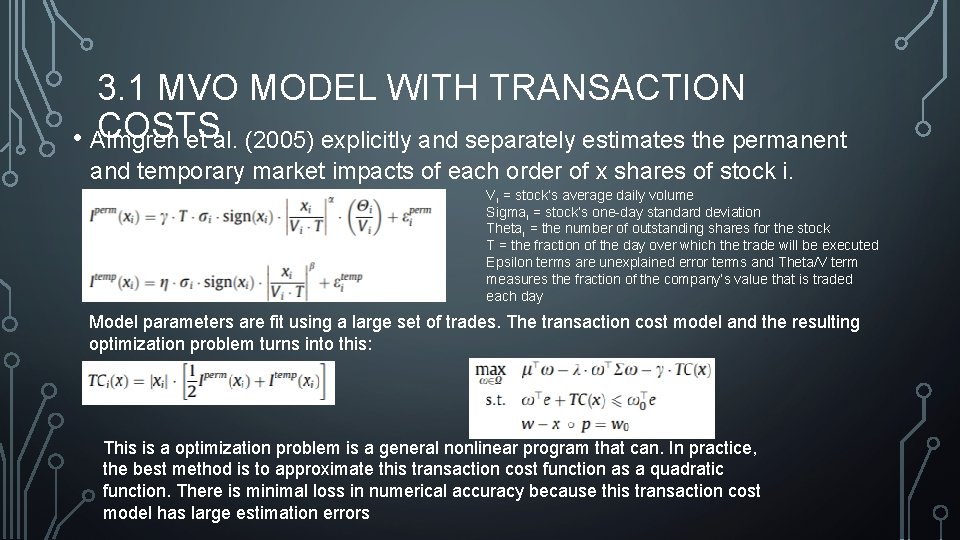
3. 1 MVO MODEL WITH TRANSACTION COSTS • Almgren et al. (2005) explicitly and separately estimates the permanent and temporary market impacts of each order of x shares of stock i. Vi = stock’s average daily volume Sigmai = stock’s one-day standard deviation Thetai = the number of outstanding shares for the stock T = the fraction of the day over which the trade will be executed Epsilon terms are unexplained error terms and Theta/V term measures the fraction of the company’s value that is traded each day Model parameters are fit using a large set of trades. The transaction cost model and the resulting optimization problem turns into this: This is a optimization problem is a general nonlinear program that can. In practice, the best method is to approximate this transaction cost function as a quadratic function. There is minimal loss in numerical accuracy because this transaction cost model has large estimation errors
3. 2 CONSTRAINTS ON PORTFOLIO OPTIMIZATION Adding constraints cannot improve ex-ante results, but in practice, intelligent constraints can lead to better out-of-sample performance. Common constraints are: • Regulatory Constraints: these constraints reflect restrictions imposed by market regulators that must be respected at all times e. g. short selling constraints • • Guideline Constraints: client-specified guidelines such as not investing in certain industries • Trading Constraints: Similar to including transaction costs in the optimization, a manager can limit the exposure to securities with high trading costs with constraints as well Discretionary Exposure Constraints: the manager’s desire to limit exposure to certain securities or groups of securities e. g. specific factor exposures, or specific sectors or countries. This is referred to as model insurance, because the MVO model should theoretically do these things optimally, but the manager can mitigate mistakes personally with these constraints.
3. 2 CONSTRAINTS ON PORTFOLIO OPTIMIZATION • Constraints can distort the optimization in unexpected and hard to quantify ways • Transfer Coefficients can be used to find the cost of constraints on the underlying alphas. This was introduced by Clarke, De Silva, and Thorley in 2002. • This method can only find the impact of constraints in aggregate, so if there are multiple used, we cannot determine the contributions of each constraint. • Another problem is misaligned alpha and risk in the model. • When binding constraints are used in portfolio construction, the realized active risk of these portfolios can be 20 -30% above the levels indicated by the model
3. 3 ESTIMATION ERROR ISSUES • Classical MVO framework requires the investor input forecasts for returns, variances, and covariances • Also treats them as deterministic rather than stochastic • The impact of small estimation errors can be significant (error maximizers) • Many general Bayesian and shrinkage approaches have been used to estimate the inputs to MVO • The basic idea is Bias-Variance tradeoff • More bias in the estimator, but it is less sensitive to changes in the data
3. 3 ESTIMATION ERROR ISSUES • The Black Litterman uses a “market-based” shrinkage approach • The estimate of expected returns is calculated as a weighted average of the CAPM equilibrium and the investor’s views • The weight depends on the volatility of each asset and its corrections with other assets, and the degree of confidence in each forecast • The ability to incorporate exogenous insight is very important in practice • Markowitz has even said “The rational investor is a Bayesian” • The main assumption is that a security should be consistent with the market equilibrium unless the investor has a specific view of the security. Otherwise, the investor is better off holding the market
4. NEW DIRECTIONS IN PORTFOLIO OPTIMIZATION They address the following developments: 1. 2. Multi-period portfolio optimization in practice Risk-parity portfolios
4. 1 MULTI-PERIOD OPTIMIZATION • This turns the quadratic optimization problem into a Linear-Quadratic. Gaussian (LQG) control problem. • The goal is to find the dynamic target portfolio of a given time • In practice, multi-period models are seldom used for the following practical reasons: • • Difficult to estimate risk and return over multiple periods • Most current multi-period models do not handle real-world constraints These models are computationally expensive, particularly when the asset universe being considered is large
4. 2 RISK-PARITY • Design the portfolio according to a risk model without considering returns. • The risk-parity approach (Asness, Frazinni, and Peterson, 2012) aims to build portfolios where the overall risk is diversified equally across different investment strategies or securities • These portfolios are easy to interpret and explain, but can be much harder to construct • You must minimize the “deviation from risk” parity which can be formulated a few different ways, none that are convex with respect to portfolio weights
MY OPINION • Very good conceptual overview of the 60 years of progress that followed the Modern Portfolio Theory’s publishing • Really showed me how difficult it is to answer the portfolio allocation questions and how much incredible research has been conducted in this field since 1952 • Never avoided the negatives associated with a given approach • I wish it had spent more time on recent developments and forward looking opinions