
60 GHz ECR Ion Source for RIB production
60 GHz ECR Ion Source for RIB production T. Lamy, L. Latrasse, T. Thuillier, C. Fourel, J. Giraud Laboratoire de Physique Subatomique et de Cosmologie CNRS/IN 2 P 3, U. Joseph Fourier, INP Grenoble, France F. Debray, C. Trophime, P. Sala, J. Dumas Laboratoire National des Champs Magnétiques Intenses CNRS, INSA Toulouse, U. Paul Sabatier - Toulouse, U. Joseph Fourier, Grenoble, France 1. I. Izotov, A. V. Sidorov, V. A. Skalyga, V. G. Zorin 2. 3. 4. Institute of Applied Physics Russian Academy of Science Nizhny Novgorod, Russia T. Lamy, EUROnu Annual Town meeting CERN 23 -27 March 2009
Summary The initial idea : A dream ? Towards reality The reality A possible future ? T. Lamy, EUROnu Annual Town meeting CERN 23 -27 March 2009
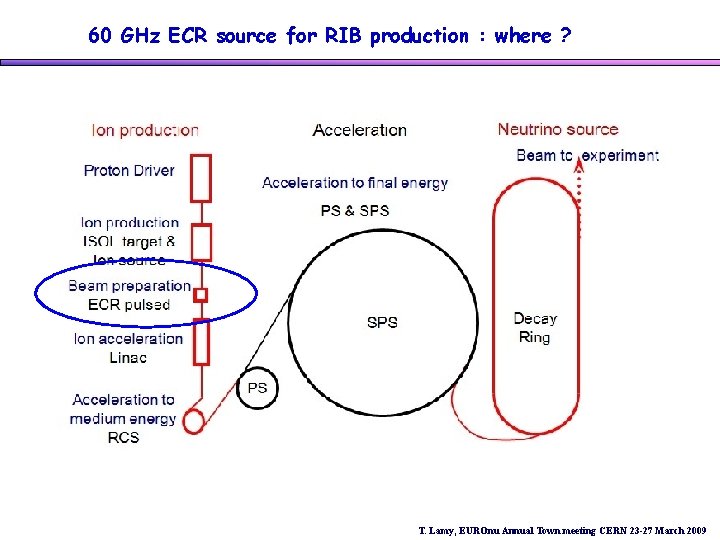
60 GHz ECR source for RIB production : where ? T. Lamy, EUROnu Annual Town meeting CERN 23 -27 March 2009
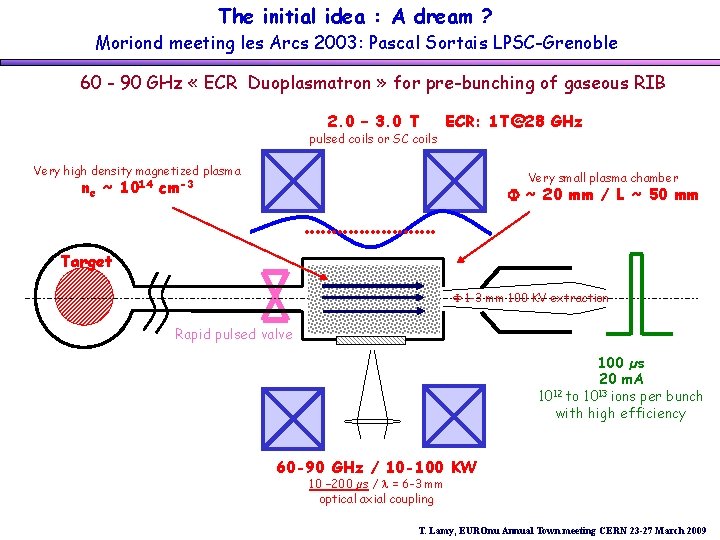
The initial idea : A dream ? Moriond meeting les Arcs 2003: Pascal Sortais LPSC-Grenoble 60 - 90 GHz « ECR Duoplasmatron » for pre-bunching of gaseous RIB 2. 0 – 3. 0 T pulsed coils or SC coils ECR: 1 T@28 GHz Very high density magnetized plasma Very small plasma chamber ne ~ 1014 cm-3 F ~ 20 mm / L ~ 50 mm Target F 1 -3 mm 100 KV extraction Rapid pulsed valve 100 µs 20 m. A 12 13 10 to 10 ions per bunch with high efficiency 60 -90 GHz / 10 -100 KW 10 – 200 µs / = 6 -3 mm optical axial coupling T. Lamy, EUROnu Annual Town meeting CERN 23 -27 March 2009
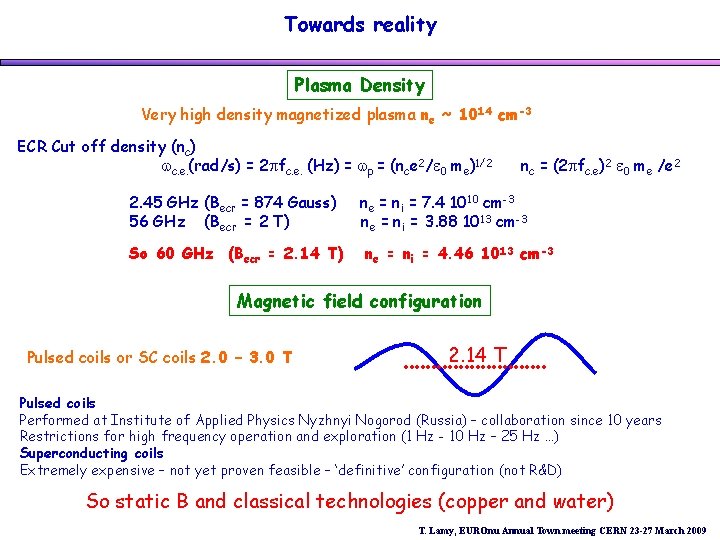
Towards reality Plasma Density Very high density magnetized plasma ne ~ 1014 cm-3 ECR Cut off density (nc) c. e. (rad/s) = 2 fc. e. (Hz) = p = (nce 2/ 0 me)1/2 nc = (2 fc. e)2 0 me /e 2 2. 45 GHz (Becr = 874 Gauss) 56 GHz (Becr = 2 T) ne = ni = 7. 4 1010 cm-3 ne = ni = 3. 88 1013 cm-3 So 60 GHz (Becr = 2. 14 T) ne = ni = 4. 46 1013 cm-3 Magnetic field configuration Pulsed coils or SC coils 2. 0 – 3. 0 T 2. 14 T Pulsed coils Performed at Institute of Applied Physics Nyzhnyi Nogorod (Russia) – collaboration since 10 years Restrictions for high frequency operation and exploration (1 Hz - 10 Hz – 25 Hz …) Superconducting coils Extremely expensive – not yet proven feasible – ‘definitive’ configuration (not R&D) So static B and classical technologies (copper and water) T. Lamy, EUROnu Annual Town meeting CERN 23 -27 March 2009
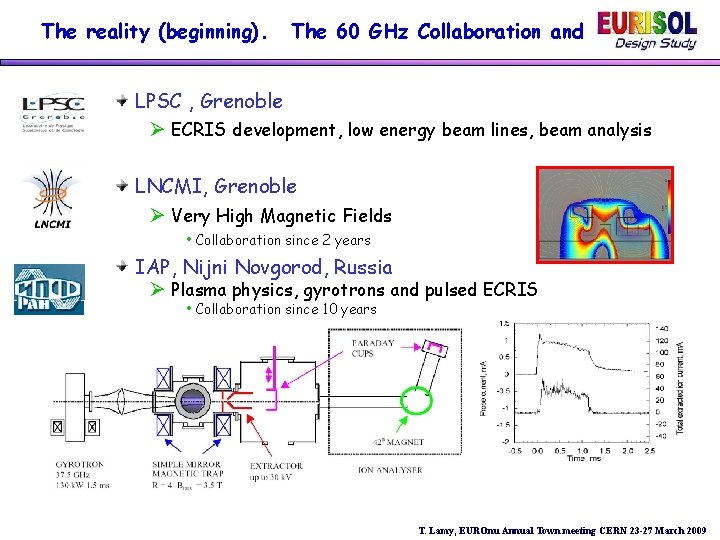
The reality (beginning). The 60 GHz Collaboration and LPSC , Grenoble Ø ECRIS development, low energy beam lines, beam analysis LNCMI, Grenoble Ø Very High Magnetic Fields • Collaboration since 2 years IAP, Nijni Novgorod, Russia Ø Plasma physics, gyrotrons and pulsed ECRIS • Collaboration since 10 years T. Lamy, EUROnu Annual Town meeting CERN 23 -27 March 2009
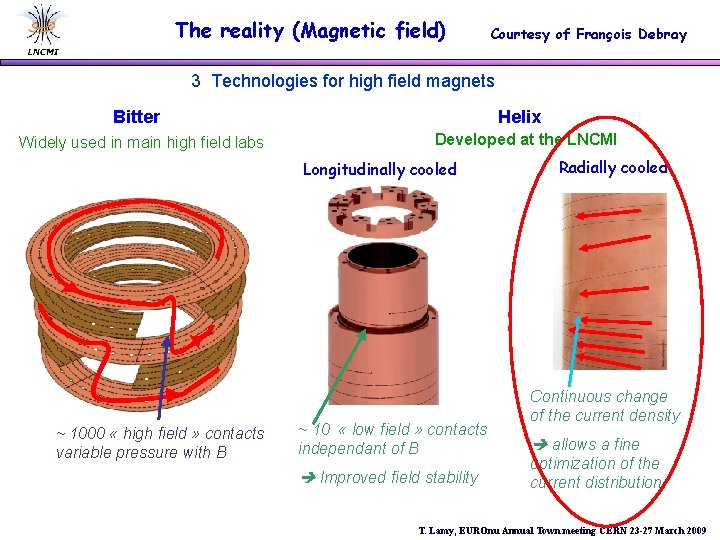
The reality (Magnetic field) Courtesy of François Debray 3 Technologies for high field magnets Bitter Widely used in main high field labs Helix Developed at the LNCMI Longitudinally cooled ~ 1000 « high field » contacts variable pressure with B ~ 10 « low field » contacts independant of B Improved field stability Radially cooled Continuous change of the current density allows a fine optimization of the current distribution T. Lamy, EUROnu Annual Town meeting CERN 23 -27 March 2009
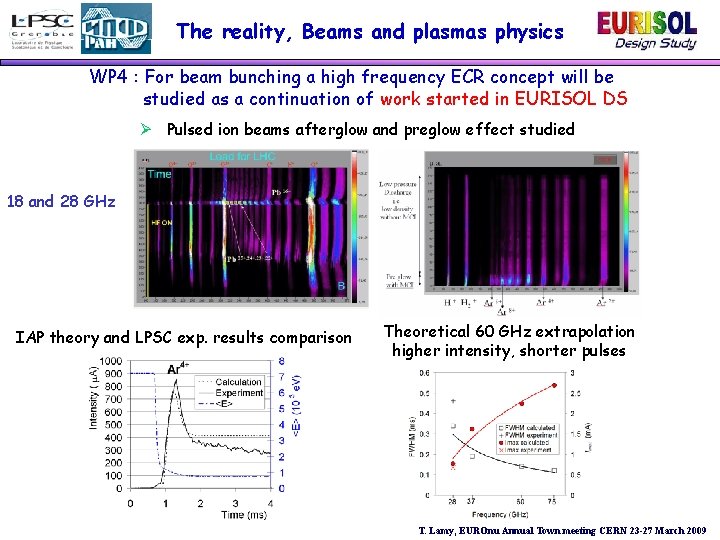
The reality, Beams and plasmas physics WP 4 : For beam bunching a high frequency ECR concept will be studied as a continuation of work started in EURISOL DS Ø Pulsed ion beams afterglow and preglow effect studied 18 and 28 GHz IAP theory and LPSC exp. results comparison Theoretical 60 GHz extrapolation higher intensity, shorter pulses T. Lamy, EUROnu Annual Town meeting CERN 23 -27 March 2009
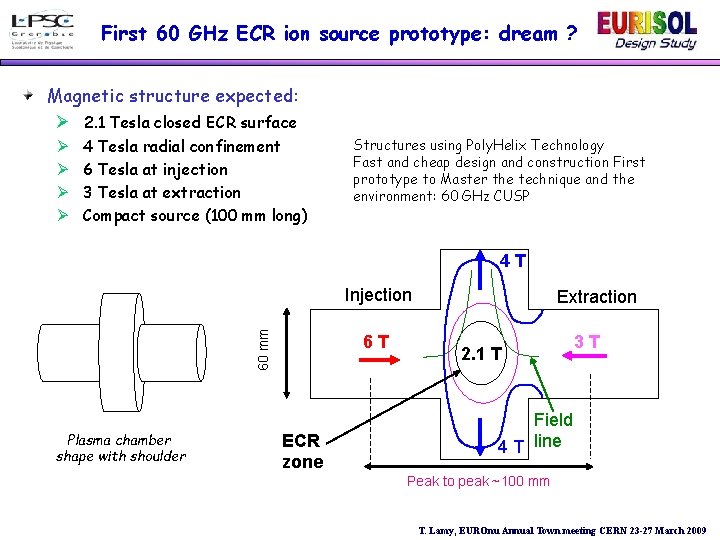
First 60 GHz ECR ion source prototype: dream ? Magnetic structure expected: Ø 2. 1 Tesla closed ECR surface Ø Ø 4 Tesla radial confinement 6 Tesla at injection 3 Tesla at extraction Compact source (100 mm long) Structures using Poly. Helix Technology Fast and cheap design and construction First prototype to Master the technique and the environment: 60 GHz CUSP 4 T 60 mm Injection Plasma chamber shape with shoulder 6 T ECR zone Extraction 2. 1 T 3 T Field 4 T line Peak to peak ~100 mm T. Lamy, EUROnu Annual Town meeting CERN 23 -27 March 2009
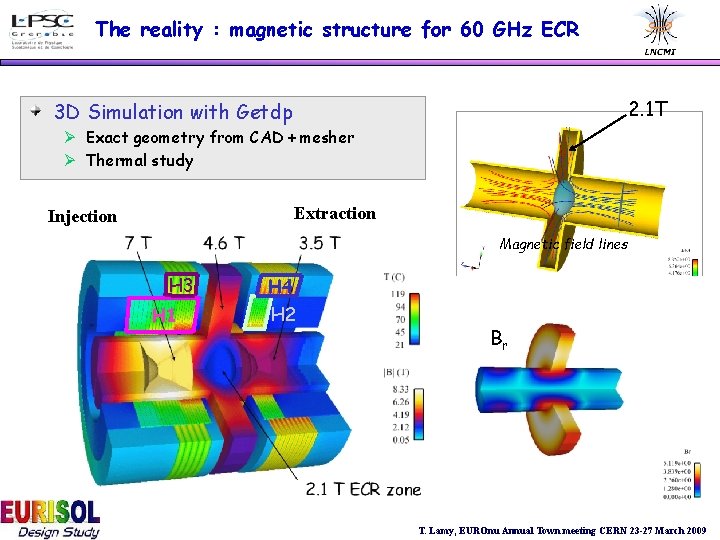
The reality : magnetic structure for 60 GHz ECR 2. 1 T 3 D Simulation with Getdp Ø Exact geometry from CAD + mesher Ø Thermal study Extraction Injection Magnetic field lines H 3 H 1 H 4 H 2 Br T. Lamy, EUROnu Annual Town meeting CERN 23 -27 March 2009
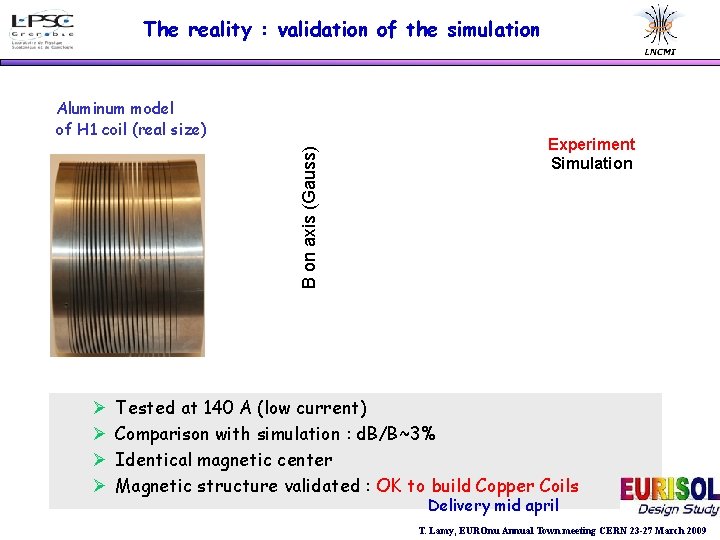
The reality : validation of the simulation B on axis (Gauss) Aluminum model of H 1 coil (real size) Ø Ø Experiment Simulation Tested at 140 A (low current) Comparison with simulation : d. B/B~3% Identical magnetic center Magnetic structure validated : OK to build Copper Coils Delivery mid april T. Lamy, EUROnu Annual Town meeting CERN 23 -27 March 2009
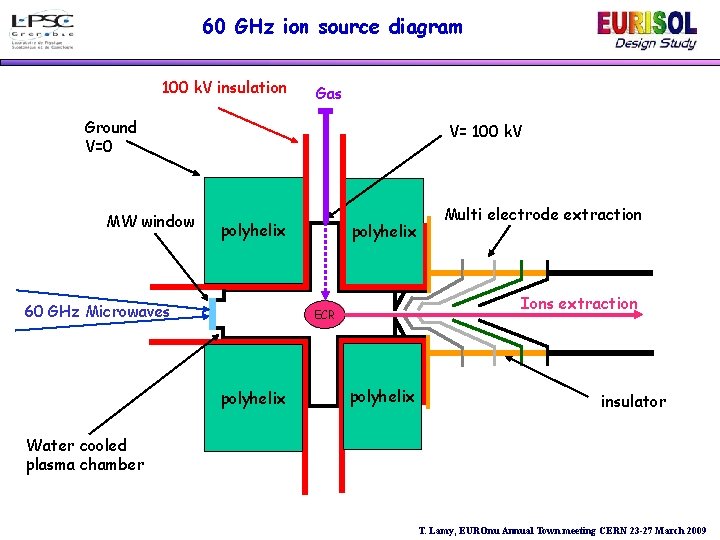
60 GHz ion source diagram 100 k. V insulation Gas Ground V=0 MW window V= 100 k. V polyhelix 60 GHz Microwaves polyhelix Ions extraction ECR polyhelix Multi electrode extraction polyhelix insulator Water cooled plasma chamber T. Lamy, EUROnu Annual Town meeting CERN 23 -27 March 2009
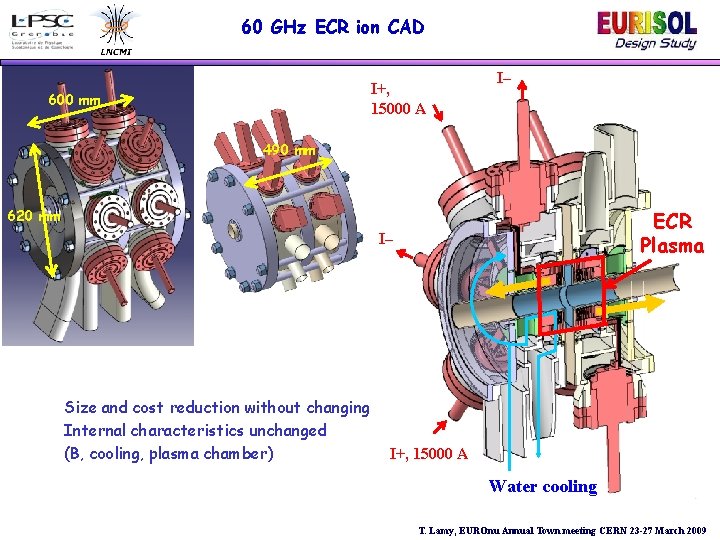
60 GHz ECR ion CAD I+, 15000 A 600 mm I– 490 mm 620 mm ECR Plasma I– Size and cost reduction without changing Internal characteristics unchanged (B, cooling, plasma chamber) I+, 15000 A Water cooling T. Lamy, EUROnu Annual Town meeting CERN 23 -27 March 2009
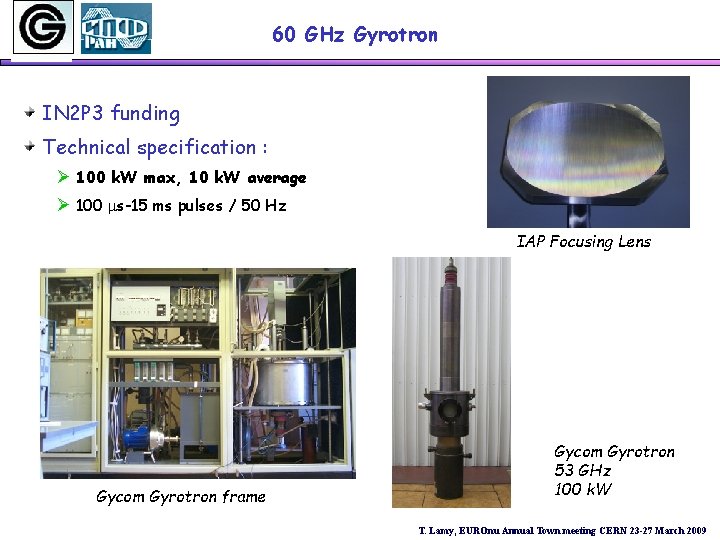
60 GHz Gyrotron IN 2 P 3 funding Technical specification : Ø 100 k. W max, 10 k. W average Ø 100 ms-15 ms pulses / 50 Hz IAP Focusing Lens Gycom Gyrotron frame Gycom Gyrotron 53 GHz 100 k. W T. Lamy, EUROnu Annual Town meeting CERN 23 -27 March 2009
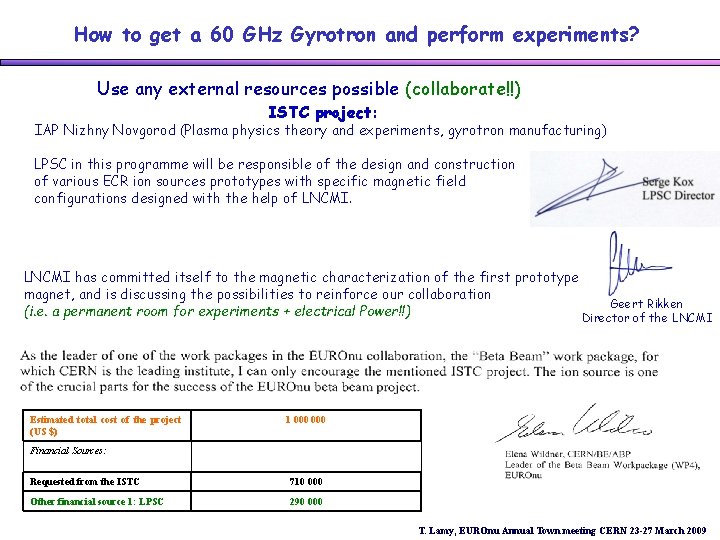
How to get a 60 GHz Gyrotron and perform experiments? Use any external resources possible (collaborate!!) ISTC project: IAP Nizhny Novgorod (Plasma physics theory and experiments, gyrotron manufacturing) LPSC in this programme will be responsible of the design and construction of various ECR ion sources prototypes with specific magnetic field configurations designed with the help of LNCMI has committed itself to the magnetic characterization of the first prototype magnet, and is discussing the possibilities to reinforce our collaboration Geert Rikken (i. e. a permanent room for experiments + electrical Power!!) Director of the LNCMI Estimated total cost of the project (US $) 1 000 Financial Sources: Requested from the ISTC 710 000 Other financial source 1: LPSC 290 000 T. Lamy, EUROnu Annual Town meeting CERN 23 -27 March 2009
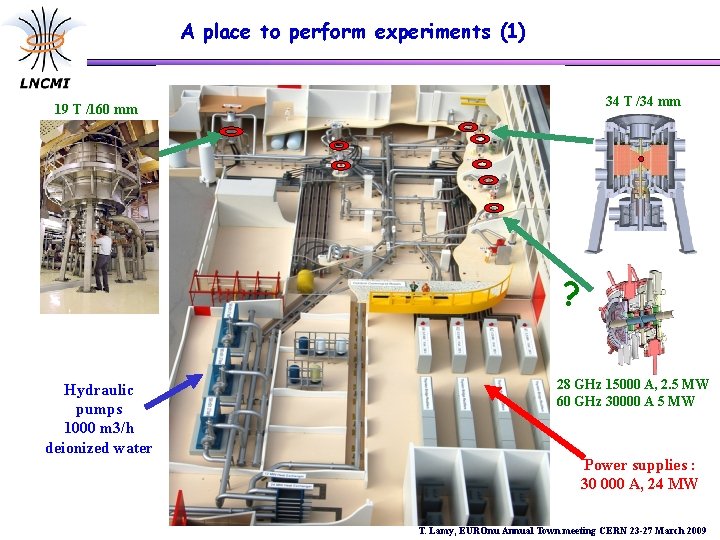
A place to perform experiments (1) 34 T /34 mm 19 T /160 mm ? Hydraulic pumps 1000 m 3/h deionized water 28 GHz 15000 A, 2. 5 MW 60 GHz 30000 A 5 MW Power supplies : 30 000 A, 24 MW T. Lamy, EUROnu Annual Town meeting CERN 23 -27 March 2009
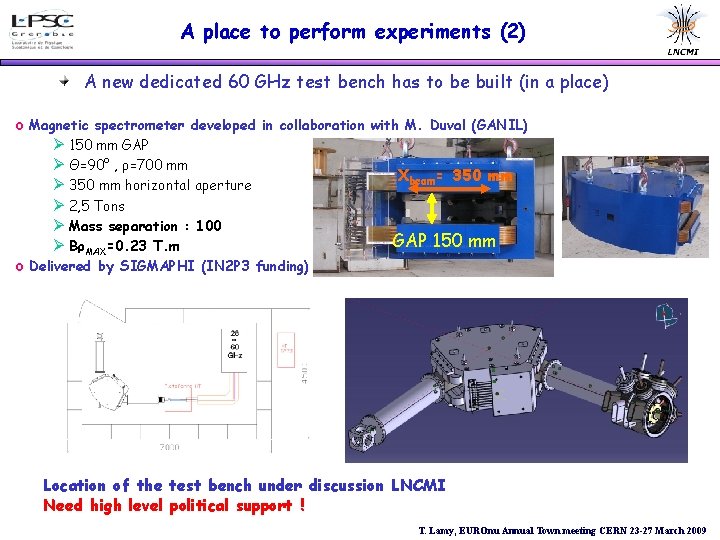
A place to perform experiments (2) A new dedicated 60 GHz test bench has to be built (in a place) o Magnetic spectrometer developed in collaboration with M. Duval (GANIL) Ø 150 mm GAP Ø Θ=90° , ρ=700 mm Xbeam= 350 mm Ø 350 mm horizontal aperture Ø 2, 5 Tons Ø Mass separation : 100 GAP 150 mm Ø BρMAX=0. 23 T. m o Delivered by SIGMAPHI (IN 2 P 3 funding) Location of the test bench under discussion LNCMI Need high level political support ! T. Lamy, EUROnu Annual Town meeting CERN 23 -27 March 2009
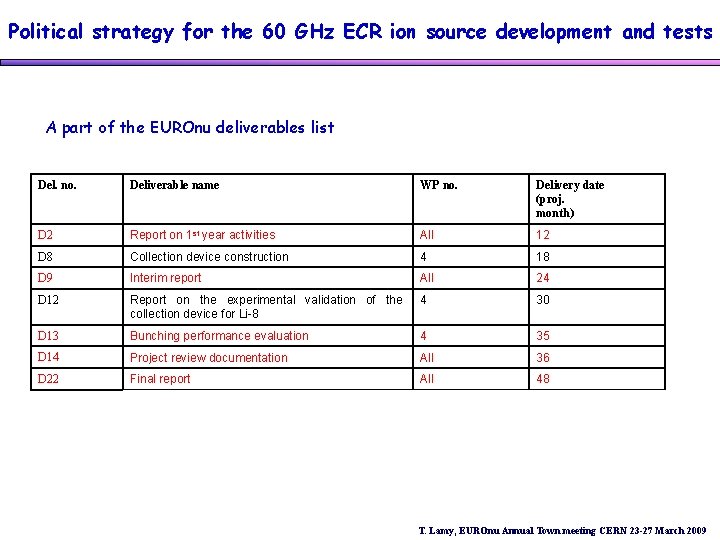
Political strategy for the 60 GHz ECR ion source development and tests A part of the EUROnu deliverables list Del. no. Deliverable name WP no. Delivery date (proj. month) D 2 Report on 1 st year activities All 12 D 8 Collection device construction 4 18 D 9 Interim report All 24 D 12 Report on the experimental validation of the collection device for Li-8 4 30 D 13 Bunching performance evaluation 4 35 D 14 Project review documentation All 36 D 22 Final report All 48 T. Lamy, EUROnu Annual Town meeting CERN 23 -27 March 2009
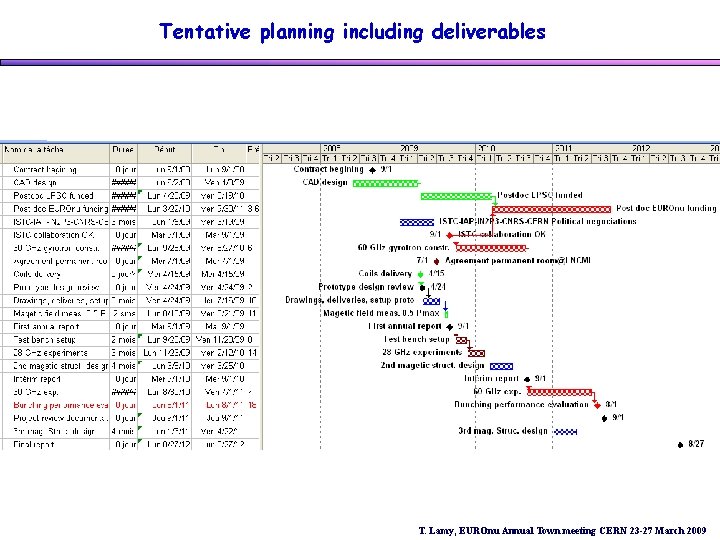
Tentative planning including deliverables T. Lamy, EUROnu Annual Town meeting CERN 23 -27 March 2009
Conclusion If we believe in a dream, we may succeed… If dream gets into reality… There is a possible future: Beyond EURISOL and EURO-nu, We may have 15 years to work on cw (not pulsed) high frequency ECR Ion Sources ! Thank you for your attention ! T. Lamy, EUROnu Annual Town meeting CERN 23 -27 March 2009
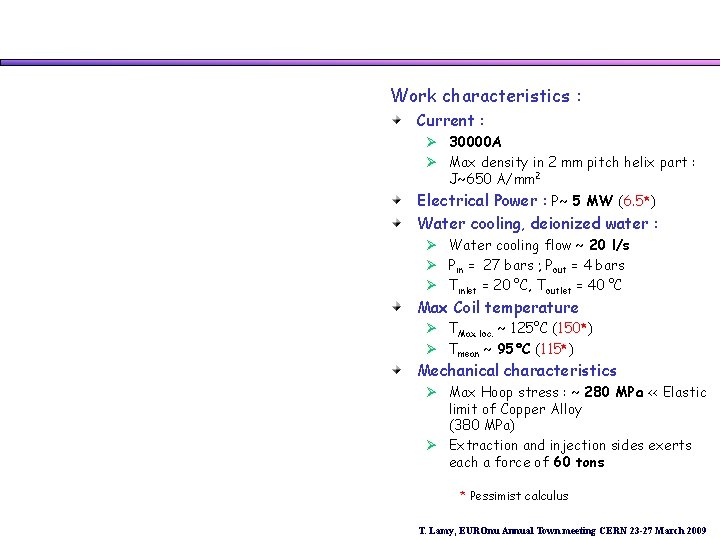
Work characteristics : Current : Ø 30000 A Ø Max density in 2 mm pitch helix part : J~650 A/mm 2 Electrical Power : P~ 5 MW (6. 5*) Water cooling, deionized water : Ø Water cooling flow ~ 20 l/s Ø Pin = 27 bars ; Pout = 4 bars Ø Tinlet = 20 °C, Toutlet = 40 °C Max Coil temperature Ø TMax loc. ~ 125°C (150*) Ø Tmean ~ 95°C (115*) Mechanical characteristics Ø Max Hoop stress : ~ 280 MPa << Elastic limit of Copper Alloy (380 MPa) Ø Extraction and injection sides exerts each a force of 60 tons * Pessimist calculus T. Lamy, EUROnu Annual Town meeting CERN 23 -27 March 2009
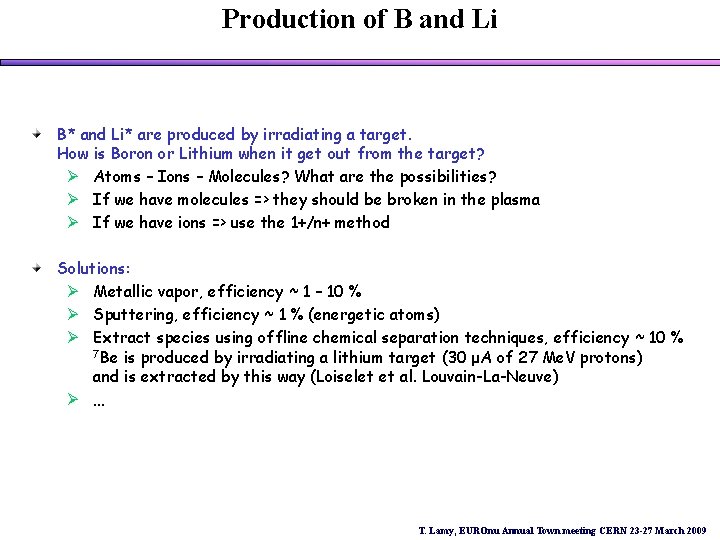
Production of B and Li B* and Li* are produced by irradiating a target. How is Boron or Lithium when it get out from the target? Ø Atoms – Ions – Molecules? What are the possibilities? Ø If we have molecules => they should be broken in the plasma Ø If we have ions => use the 1+/n+ method Solutions: Ø Metallic vapor, efficiency ~ 1 – 10 % Ø Sputtering, efficiency ~ 1 % (energetic atoms) Ø Extract species using offline chemical separation techniques, efficiency ~ 10 % 7 Be is produced by irradiating a lithium target (30 μA of 27 Me. V protons) and is extracted by this way (Loiselet et al. Louvain-La-Neuve) Ø … T. Lamy, EUROnu Annual Town meeting CERN 23 -27 March 2009
- Slides: 22