
6 WOOD LIGHT FRAME CONSTRUCTION 1 2 LIGHT
















- Slides: 42
6. WOOD LIGHT FRAME CONSTRUCTION 1
2
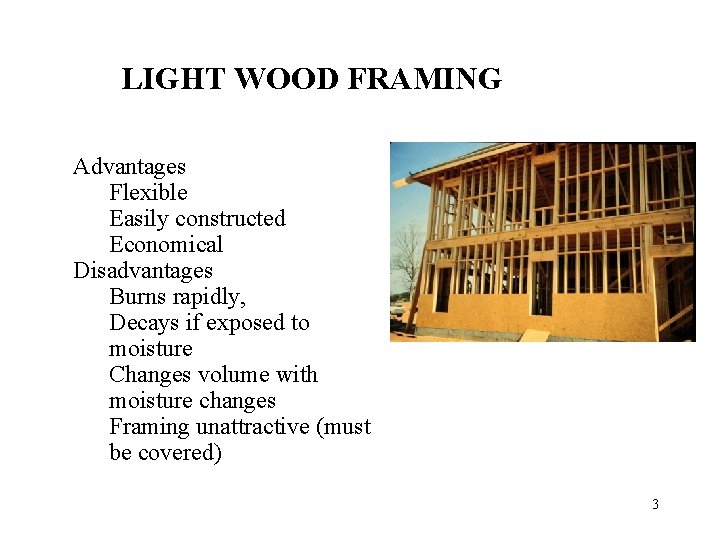
LIGHT WOOD FRAMING Advantages Flexible Easily constructed Economical Disadvantages Burns rapidly, Decays if exposed to moisture Changes volume with moisture changes Framing unattractive (must be covered) 3
6. 1 WOOD LIGHT FRAME CONSTRUCTION - AN OVERVIEW n n n 6. 1 WOOD LIGHT FRAME CONSTRUCTION - AN OVERVIEW 6. 2 INTRODUCTION TO BALLOON FRAME AND PLATFORM FRAME 6. 3 BALLOON FRAME 6. 4 PLATFORM FRAME - ADVANTAGES AND DISADVANTAGES 6. 5 EIGHT STEPS FOR BUILDING A LIGHT WOOD FRAME STRUCTURE 4
6. 2 INTRODUCTION TO BALLOON FRAME AND PLATFORM FRAME n Advantages: Flexible - Any shape can be constructed - Has evolved over 150 years - Easily and swiftly constructed by hands, with a minimum amount of tools n Deficiencies: Rapid burning during fire - Decays fast exposed to dampness - Expands and contacts significantly, causing cracking of plaster, sticking of doors, buckling of floors, etc. - Can be controlled n Two types: Balloon frame and Platform frame - Advantages and disadvantages n Conventional Platform Frame - Built with 2” (nominal size) members - connected with nails - Lumber aligned horizontally and vertically and covered with sheathing - Floors and walls constructed - Sloping roof built with header at lower edge and ridge boards at the top 5
6. 3 BALLOON FRAME n n n In 1865, G. E. Woodward wrote ”A man and a boy can now attain the same results, with the ease, that twenty men could on an old-fashioned frame… the balloon frame can be put up forty percent less money than the mortise and tenon frame” Framed solely with slender, closely spaced wooden members - Joist for floors, studs for walls, and rafters for sloping roofs - Heavy beams were eliminated The full length studs ran continuously for two stories from foundation to roof; hence not efficient for erection - The tall hollow spaces, in between the studs, acted as multiple chimneys, spreading the fire very rapidly to upper floors 6
6. 3 Balloon Framing (Cont’d) n “All” Light Wood Framing n Full Length Studs Cost - Less than Timber n Disadvantages n – Full length studs difficult to handle – Hang 2 nd floor platform – No firestop 7
6. 4 PLATFORM FRAME WITH ADVANTAGES AND DISADVANTAGES n n n Evolved from balloon frame after many modifications Accepted now as the universal standard for wood light frame construction Complex in details, but simple in concept A floor platform is built, made up of either of a concrete slab on-ground or with masonry/concrete footings - Wood load-bearing walls are erected upon this floor/footings - A second floor wood platform is built on these walls Then a second set of walls is built on this platform - The attic and roof are then built upon the second set of walls - Many variations are possible; one or two stories tall, several types of roof (with or without attic) can be built Advantages: Uses short, easily handled lengths of lumber for the vertical framing - Vertical hollow spaces are automatically fire-stopped at each floor level 8
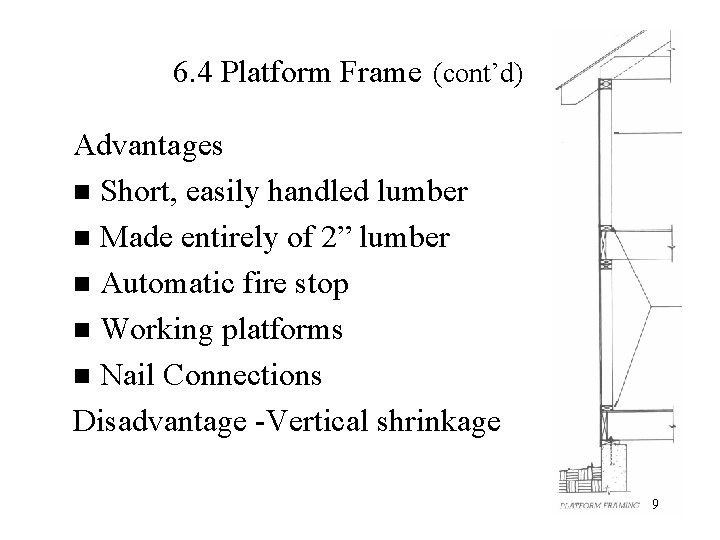
6. 4 Platform Frame (cont’d) Advantages n Short, easily handled lumber n Made entirely of 2” lumber n Automatic fire stop n Working platforms n Nail Connections Disadvantage -Vertical shrinkage 9
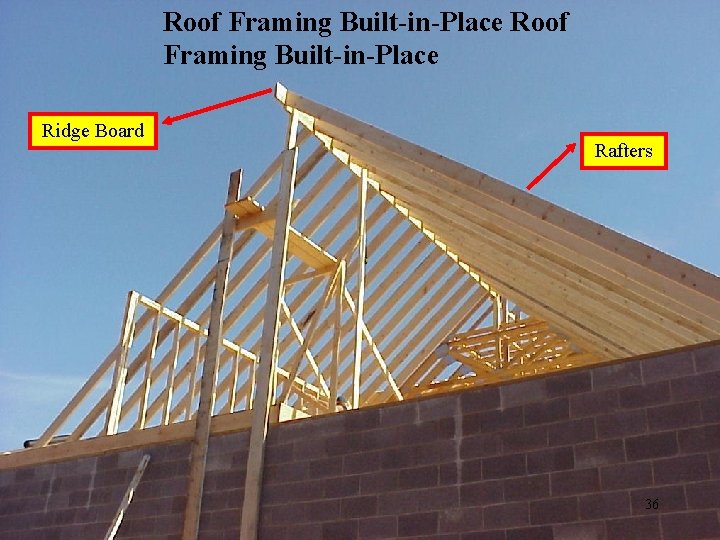
6. 4 PLATFORM FRAME …. . (Cont’d) n n n Disadvantages: Each floor constitutes of a thick layer of wood, whose grain runs horizontally - Leads to relatively large amount of vertical shrinkage in the frame, as moisture dries from the wood - Can lead to distress in exterior/interior finish surfaces A conventional frame built entirely of 2” members (11/2 ” actual), with all connections made with nails Number of framing lumber are aligned parallel to one another, and nailed to cross pieces; then covered with a sheathing (made up of a facing layer of boards, or panels) that join and stabilize the pieces into a single structural unit - In a wall structure, the vertical parallel pieces are called the studs, the cross pieces at the bottom are the sole plates, and the cross pieces on top are called the top plates In a floor, the parallel pieces are floor joists, and the cross pieces at the ends are called headers, rim joists, or band joists. Sheathing on floor is called sub-floor In a sloping roof, the rafters are headed off by the top plates at the lower edges of the roof and by the ridge board at the peak 10
6. 5 Building Sequence n Plan / Design the Facility – Establish Use, Owner Preference, Budget – Consider Codes, Zoning & other Legal Requirements – Graphically Communicate Building Design » » » Foundations Design Framing plans (identifies & locates framing members) Architectural Floor Plans (locations, dimensions, walls, etc) Exterior Elevations (details, openings, heights, finishes, etc. ) Interior Elevations & Sections (construction details, finishes, etc. ) Heating & AC, Plumbing, Electrical 11
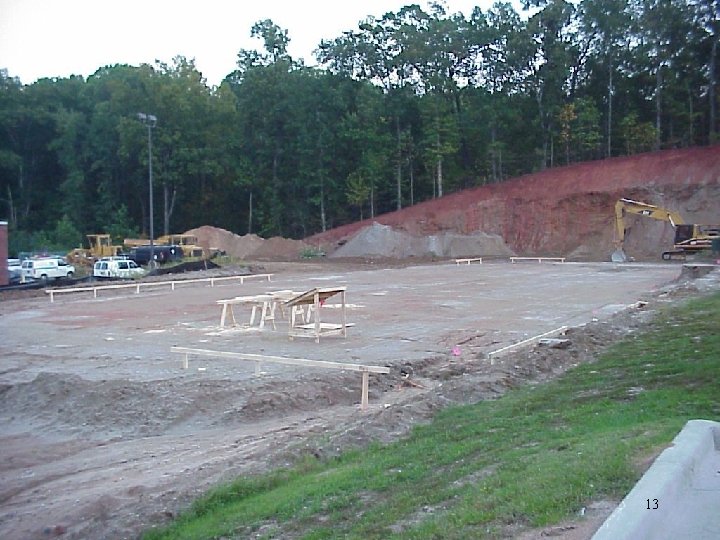
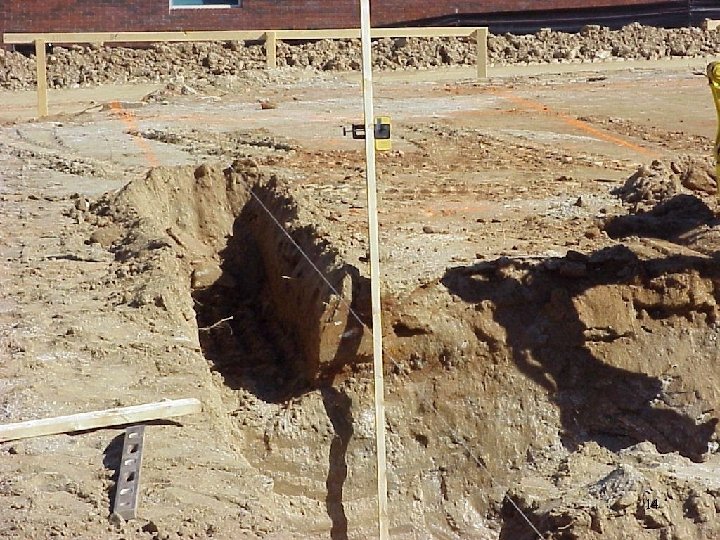
6. 5 EIGHT STEPS FOR BUILDING A WOOD LIGHT FRAME STRUCTURE (Cont’d) n Step 1: Establishing the position, shape, and size of the building on site - Erecting the batter boards, beyond the area to be excavated - Corner stakes located with a plumb bob n Step 2: Excavation and construction of the foundation and substructure walls - Excavating the foundations - Form work built for walls - Site-cast concrete foundation - Slab-on-grade or other - 4” layer of crushed stone, 3” to 4” thick concrete - drainage for foundation - Wall keyed to the floor slab - Independent spread footings 12
13
14
15
Foundation Wall Systems Sill Anchor Dampproofing Stone for Drainage Perforated Drainage Pipe Concrete or CMU Wall Drainage Stone under SOG often w/ Vapor Barrier Concrete Strip Footing 16
Thickened Slab-on-Grade Load Stone Base Thickened SOG 17
Damp-proofing, Protection Board, & Drainage 18
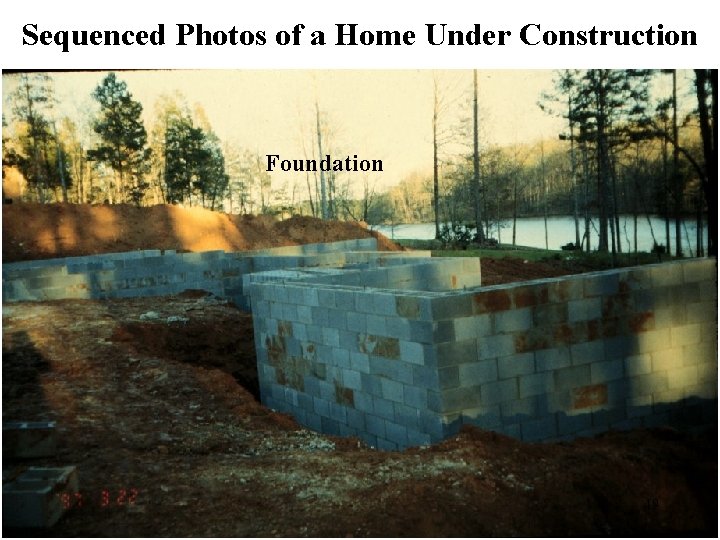
Sequenced Photos of a Home Under Construction Foundation 19
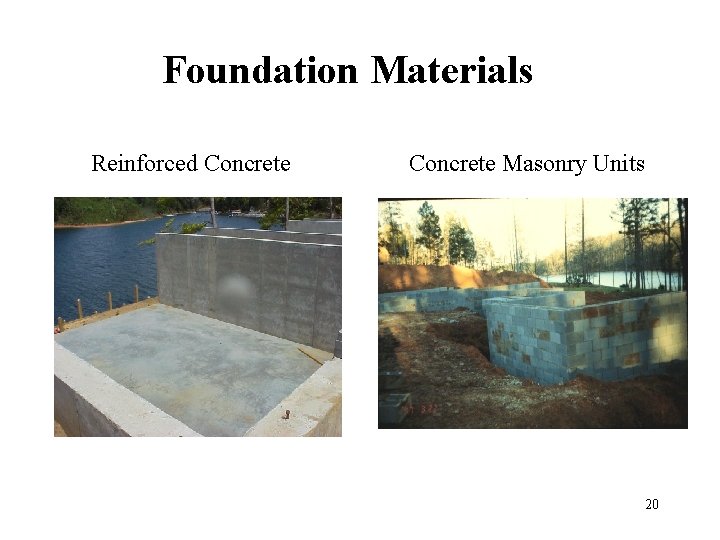
Foundation Materials Reinforced Concrete Masonry Units 20
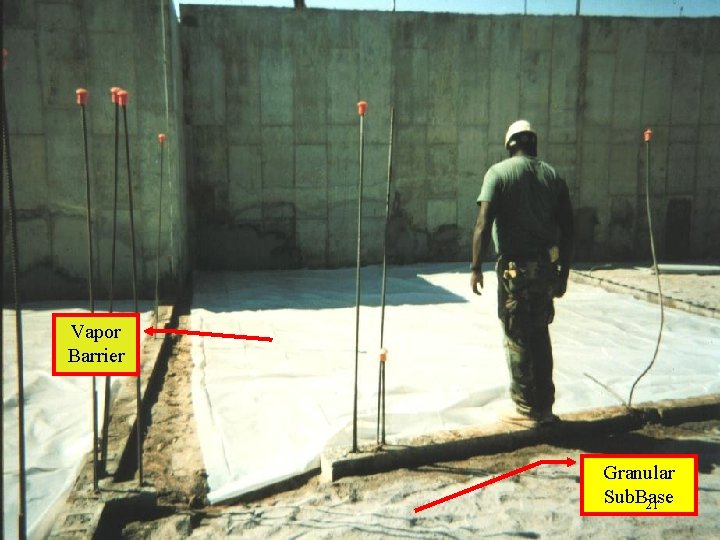
Vapor Barrier Granular Sub. Base 21
Foundation Insulation n Insulate the Crawl Space – Attach to Platform or on Ground – Vapor Barrier n Insulate the Exterior of the Wall – Insulation exposed to the elements n Insulate the Interior of the Wall – Space & condensation considerations n Insulation within the Wall (CMU) 22
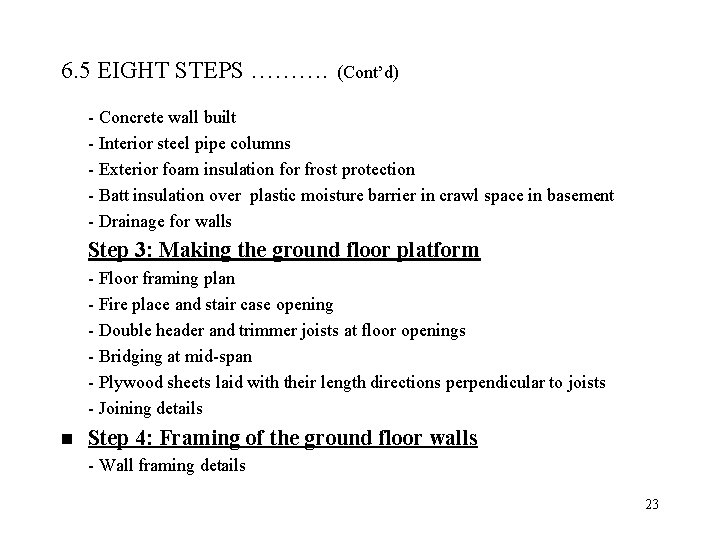
6. 5 EIGHT STEPS ………. (Cont’d) - Concrete wall built - Interior steel pipe columns - Exterior foam insulation for frost protection - Batt insulation over plastic moisture barrier in crawl space in basement - Drainage for walls Step 3: Making the ground floor platform - Floor framing plan - Fire place and stair case opening - Double header and trimmer joists at floor openings - Bridging at mid-span - Plywood sheets laid with their length directions perpendicular to joists - Joining details n Step 4: Framing of the ground floor walls - Wall framing details 23
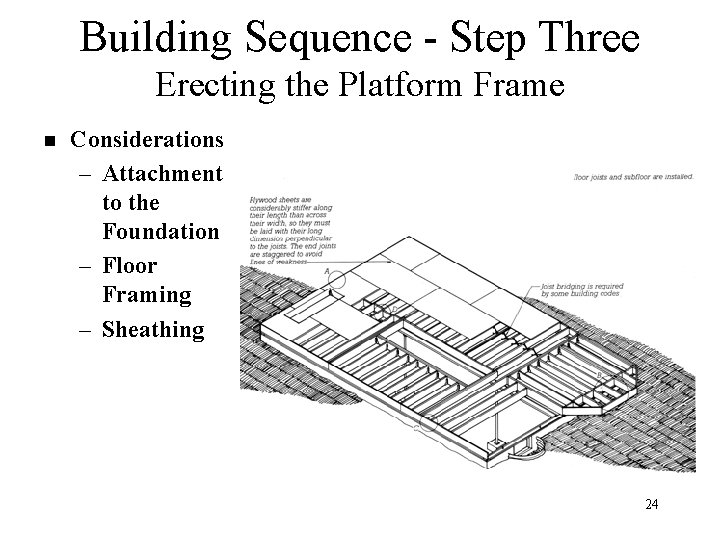
Building Sequence - Step Three Erecting the Platform Frame n Considerations – Attachment to the Foundation – Floor Framing – Sheathing 24
Attachment to the Foundation n Sill Material – Decay Resistant Termite Shield n Sill Attachment n – Anchor Bolts – Expansion Bolts – Add’l for Wind / Quake n Set to Line & Elevation 25
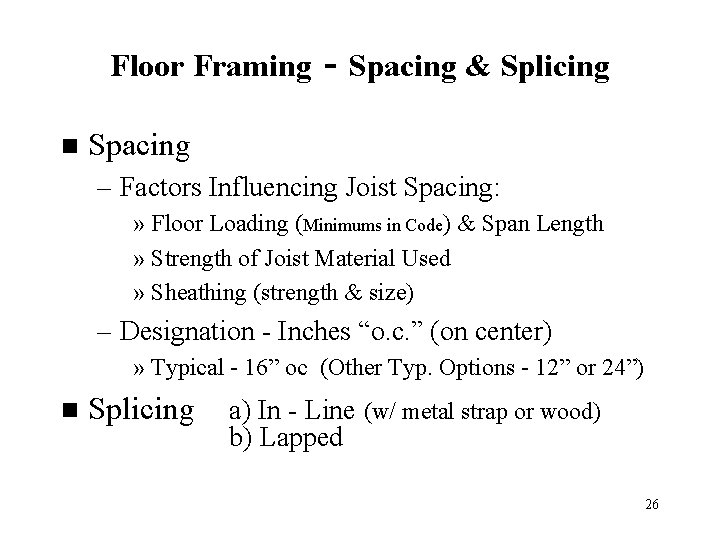
Floor Framing n - Spacing & Splicing Spacing – Factors Influencing Joist Spacing: » Floor Loading (Minimums in Code) & Span Length » Strength of Joist Material Used » Sheathing (strength & size) – Designation - Inches “o. c. ” (on center) » Typical - 16” oc (Other Typ. Options - 12” or 24”) n Splicing a) In - Line (w/ metal strap or wood) b) Lapped 26
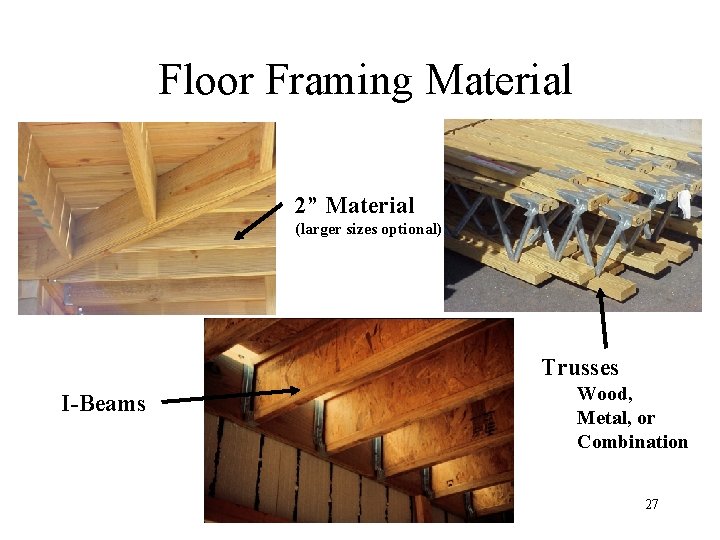
Floor Framing Material 2” Material (larger sizes optional) Trusses I-Beams Wood, Metal, or Combination 27
Floor Framing Bridging & Anchorage Joist Hanger • Metal - Sized to Joist • Purpose Anchorage & Support Bridging • Material - Wood or Metal • Purpose: Improve Rigidity Hold Joist Straight & Distribute Loads • Code requires for joists > 2 x 12 28
Wall Framing Layout Framing Member Size & Spacing n Loads - Vertical & Lateral – Floor Loads, # of Stories, Roof Loads, Wind, Quake – Minimum - Code Requirements n Attachment of: – Exterior and – Interior Finishes Opening Locations - Doors & Windows n Insulation Requirements (may elect to use ‘deeper n framing to accommodate thicker insulation) 29
Framing Terminology Top Plate Often Doubled Stud Header Sheathing Sole Plate 30
Constructing the Wall Framing Build on the Platform & Tilt-up or n Build in Place n 31
Wall Framing 32
6. 5 EIGHT STEPS ………. (Cont’d) n Step 5: Building the upper-floor platform - Details of second floor platform - Interior stairways n Step 6: Framing of the second-story walls - Reinforcing against uplift n Step 7: Framing of the attic floor and roof - Roof framing and details - Chimney details - Dormer - Hip rafter - Roof framing n Step 8: Completing the overall building frame 33
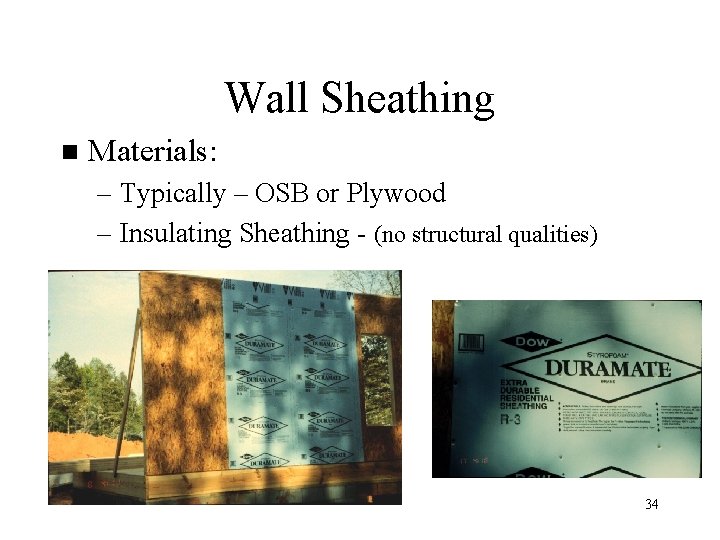
Wall Sheathing n Materials: – Typically – OSB or Plywood – Insulating Sheathing - (no structural qualities) 34
Sheathing Purposes: n n Joins & stabilizes the structure Resists uplift Resists wracking- Resists lateral forces Provides surface for finish material 35
Roof Framing Built-in-Place Ridge Board Rafters 36
Collar Ties 37
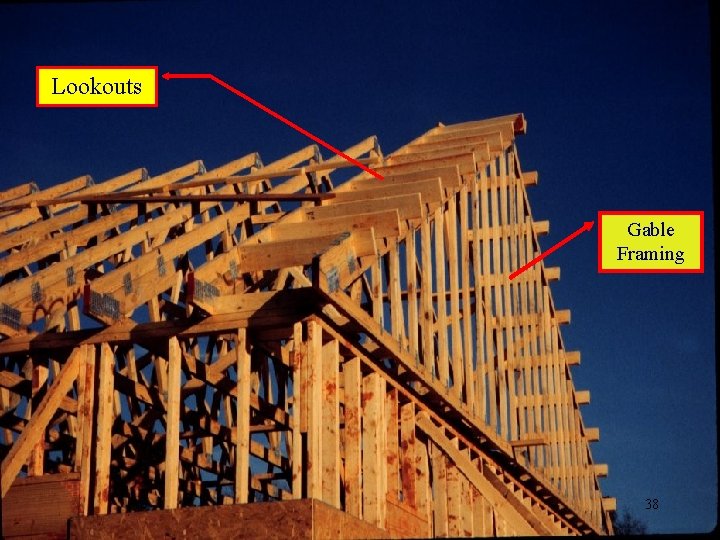
Lookouts Gable Framing 38
Note Strand Orientation Hurricane Clip 39
Roof Profiles n Flat Roof n Single Pitch 40
Roof Profiles n Gable Roof Hip n Hip Roof Ridge 41
Siding 42