
6 VHDL NUMBERS STRINGS AND EXPRESSIONS pierremail isu
第 6章 VHDL NUMBERS, STRINGS, AND EXPRESSIONS 義守大學電機 程學系 陳慶瀚 pierre@mail. isu. edu. tw 10/29/2021 義守大學電機系陳慶瀚 1
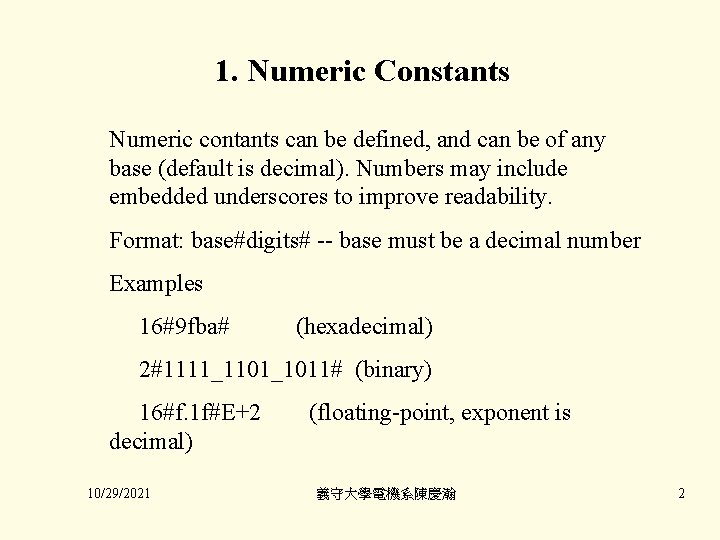
1. Numeric Constants Numeric contants can be defined, and can be of any base (default is decimal). Numbers may include embedded underscores to improve readability. Format: base#digits# -- base must be a decimal number Examples 16#9 fba# (hexadecimal) 2#1111_1101_1011# (binary) 16#f. 1 f#E+2 decimal) 10/29/2021 (floating-point, exponent is 義守大學電機系陳慶瀚 2
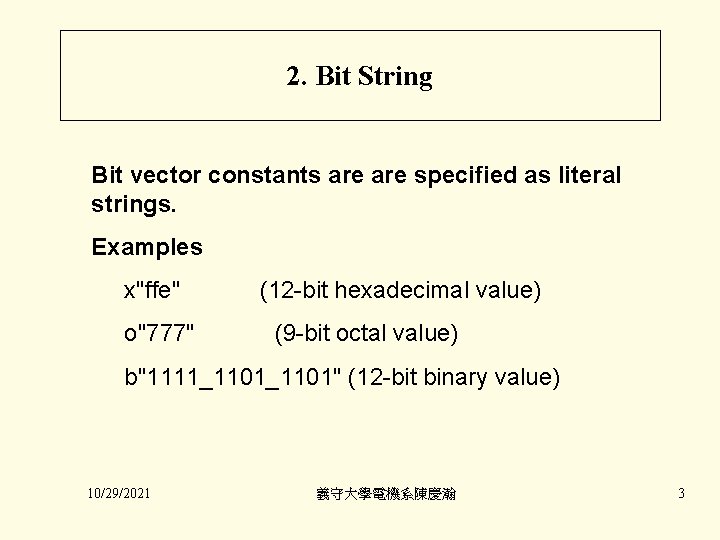
2. Bit String Bit vector constants are specified as literal strings. Examples x"ffe" o"777" (12 -bit hexadecimal value) (9 -bit octal value) b"1111_1101" (12 -bit binary value) 10/29/2021 義守大學電機系陳慶瀚 3
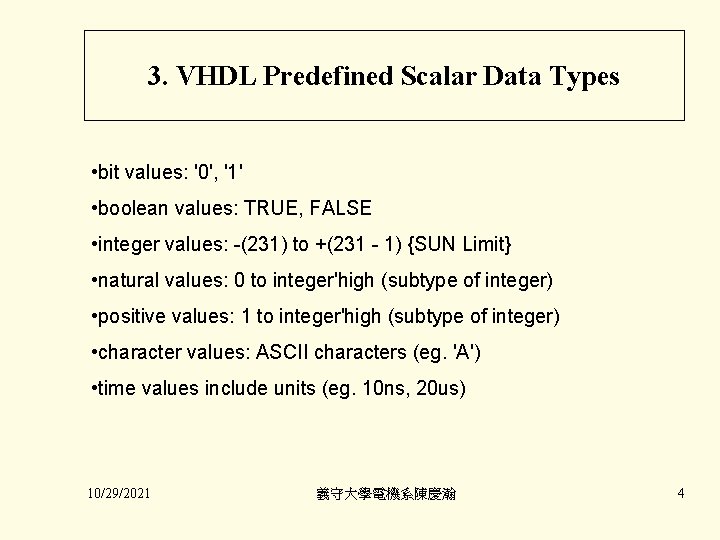
3. VHDL Predefined Scalar Data Types • bit values: '0', '1' • boolean values: TRUE, FALSE • integer values: -(231) to +(231 - 1) {SUN Limit} • natural values: 0 to integer'high (subtype of integer) • positive values: 1 to integer'high (subtype of integer) • character values: ASCII characters (eg. 'A') • time values include units (eg. 10 ns, 20 us) 10/29/2021 義守大學電機系陳慶瀚 4
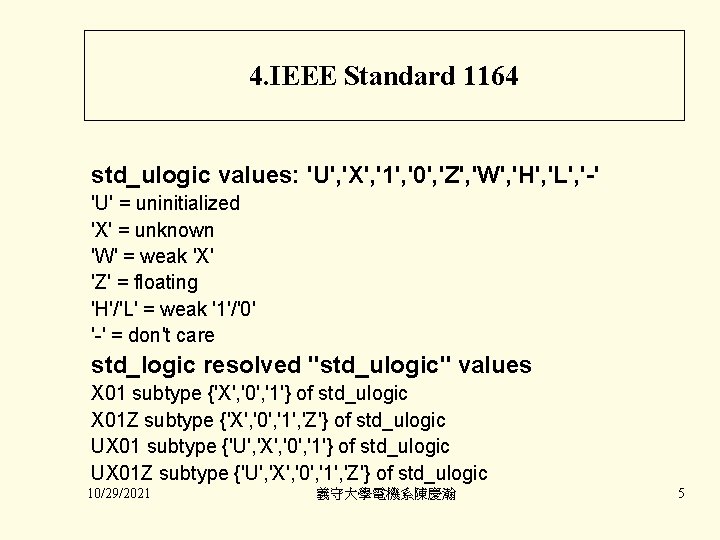
4. IEEE Standard 1164 std_ulogic values: 'U', 'X', '1', '0', 'Z', 'W', 'H', 'L', '-' 'U' = uninitialized 'X' = unknown 'W' = weak 'X' 'Z' = floating 'H'/'L' = weak '1'/'0' '-' = don't care std_logic resolved "std_ulogic" values X 01 subtype {'X', '0', '1'} of std_ulogic X 01 Z subtype {'X', '0', '1', 'Z'} of std_ulogic UX 01 subtype {'U', 'X', '0', '1'} of std_ulogic UX 01 Z subtype {'U', 'X', '0', '1', 'Z'} of std_ulogic 10/29/2021 義守大學電機系陳慶瀚 5

5. VHDL Aggregate Data Types Predefined Aggregate Data Types: bit_vector array (natural range <>) of bit string array (natural range <>) of char text file of "string" IEEE Standard 1164 Aggregate Data Types: std_ulogic_vector array (natural range <>) of std_ulogic std_logic_vector array (natural range <>) of std_logic Examples 10/29/2021 signal dbus: bit_vector(15 downto 0); dbus (7 downto 4) <= "0000"; (4 -bit slice of dbus) signal cnt: std_ulogic_vector(1 to 3); variable message: string(0 to 20); 義守大學電機系陳慶瀚 6
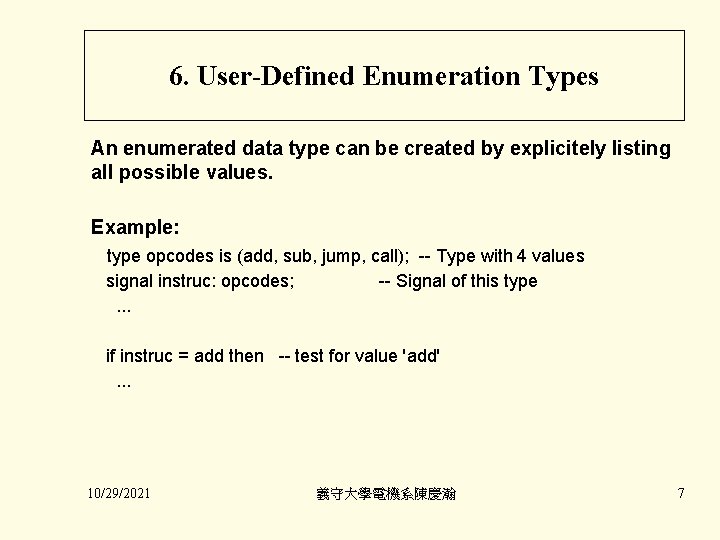
6. User-Defined Enumeration Types An enumerated data type can be created by explicitely listing all possible values. Example: type opcodes is (add, sub, jump, call); -- Type with 4 values signal instruc: opcodes; -- Signal of this type. . . if instruc = add then -- test for value 'add'. . . 10/29/2021 義守大學電機系陳慶瀚 7
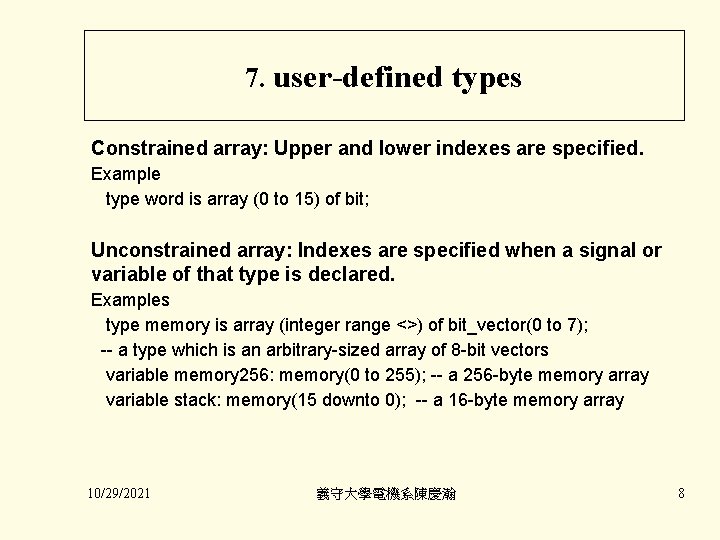
7. user-defined types Constrained array: Upper and lower indexes are specified. Example type word is array (0 to 15) of bit; Unconstrained array: Indexes are specified when a signal or variable of that type is declared. Examples type memory is array (integer range <>) of bit_vector(0 to 7); -- a type which is an arbitrary-sized array of 8 -bit vectors variable memory 256: memory(0 to 255); -- a 256 -byte memory array variable stack: memory(15 downto 0); -- a 16 -byte memory array 10/29/2021 義守大學電機系陳慶瀚 8
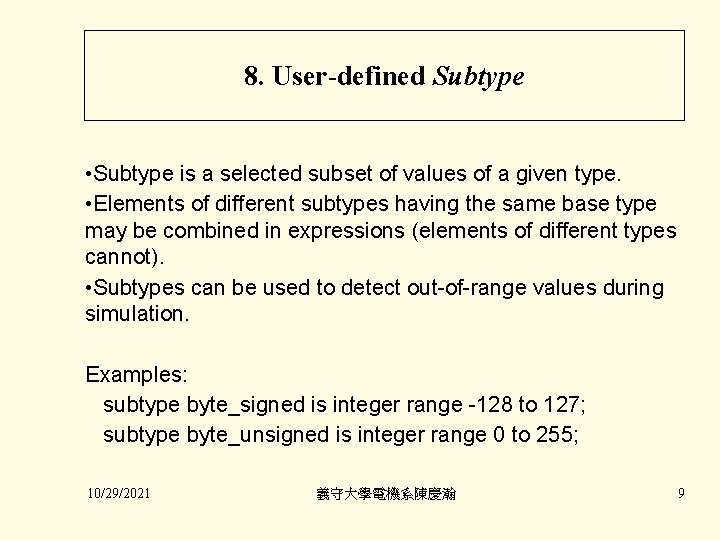
8. User-defined Subtype • Subtype is a selected subset of values of a given type. • Elements of different subtypes having the same base type may be combined in expressions (elements of different types cannot). • Subtypes can be used to detect out-of-range values during simulation. Examples: subtype byte_signed is integer range -128 to 127; subtype byte_unsigned is integer range 0 to 255; 10/29/2021 義守大學電機系陳慶瀚 9
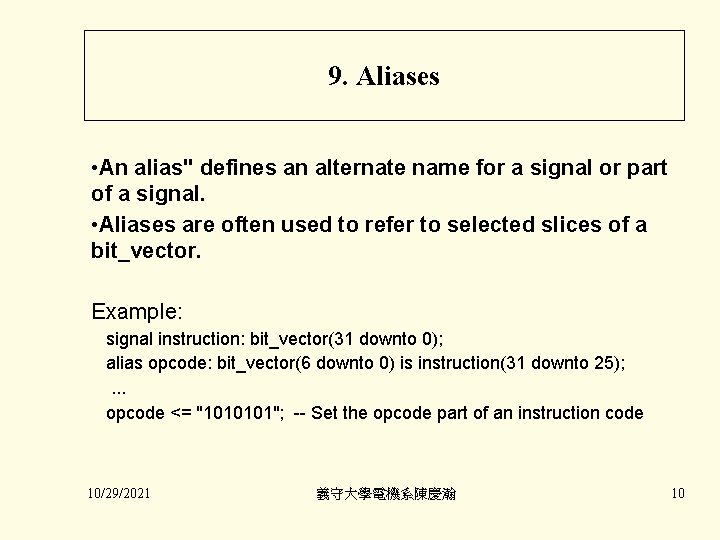
9. Aliases • An alias" defines an alternate name for a signal or part of a signal. • Aliases are often used to refer to selected slices of a bit_vector. Example: signal instruction: bit_vector(31 downto 0); alias opcode: bit_vector(6 downto 0) is instruction(31 downto 25); . . . opcode <= "1010101"; -- Set the opcode part of an instruction code 10/29/2021 義守大學電機系陳慶瀚 10
- Slides: 10