
6 Understanding the Management Process Copyright 2017 Cengage

- Slides: 26
6 Understanding the Management Process Copyright © 2017 Cengage Learning. All Rights Reserved. May not be copied, scanned, or duplicated, in whole or in part, except for use as permitted in a license distributed with a certain product or service or otherwise on a password-protected website for classroom use.
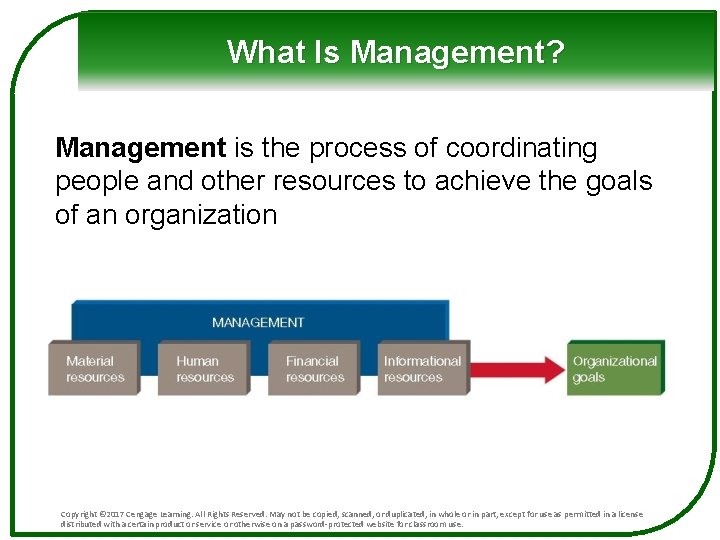
What Is Management? Management is the process of coordinating people and other resources to achieve the goals of an organization Copyright © 2017 Cengage Learning. All Rights Reserved. May not be copied, scanned, or duplicated, in whole or in part, except for use as permitted in a license distributed with a certain product or service or otherwise on a password-protected website for classroom use.
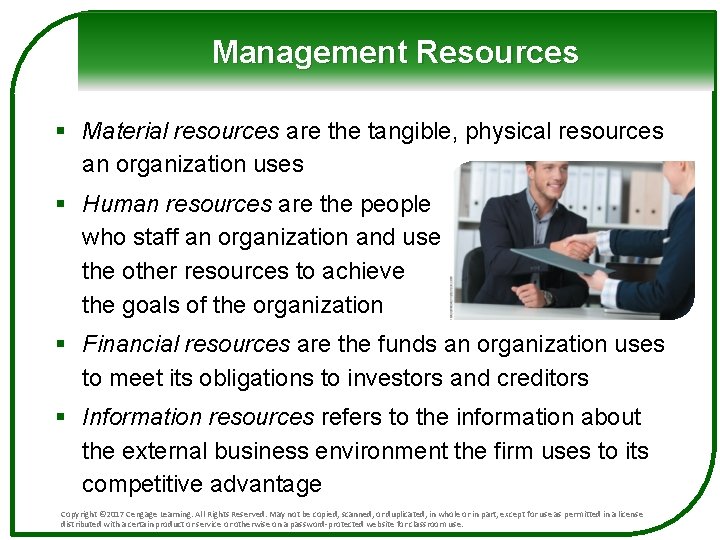
Management Resources § Material resources are the tangible, physical resources an organization uses § Human resources are the people who staff an organization and use the other resources to achieve the goals of the organization § Financial resources are the funds an organization uses to meet its obligations to investors and creditors § Information resources refers to the information about the external business environment the firm uses to its competitive advantage Copyright © 2017 Cengage Learning. All Rights Reserved. May not be copied, scanned, or duplicated, in whole or in part, except for use as permitted in a license distributed with a certain product or service or otherwise on a password-protected website for classroom use.
Today’s Managers • Younger and more progressive. - Growing numbers of women. - Fewer from elite universities. • Emphasis is on teams and team building. • Managers need to be skilled communicators and team players. Copyright © 2017 Cengage Learning. All Rights Reserved. May not be copied, scanned, or duplicated, in whole or in part, except for use as permitted in a license distributed with a certain product or service or otherwise on a password-protected website for classroom use.
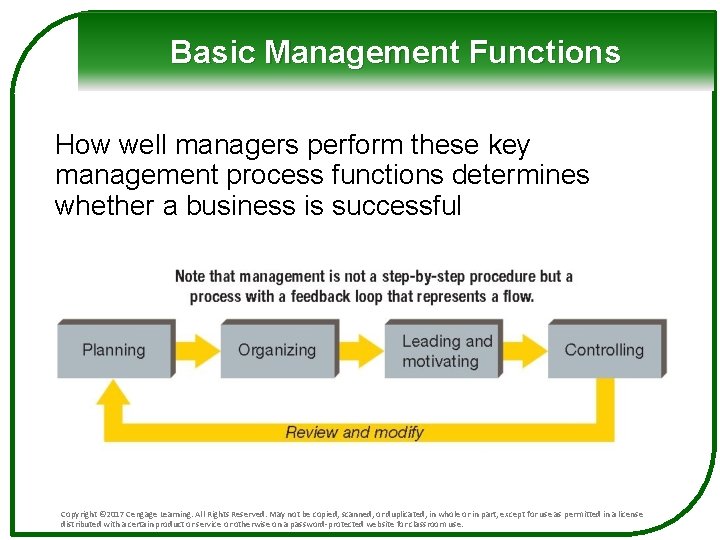
Basic Management Functions How well managers perform these key management process functions determines whether a business is successful Copyright © 2017 Cengage Learning. All Rights Reserved. May not be copied, scanned, or duplicated, in whole or in part, except for use as permitted in a license distributed with a certain product or service or otherwise on a password-protected website for classroom use.
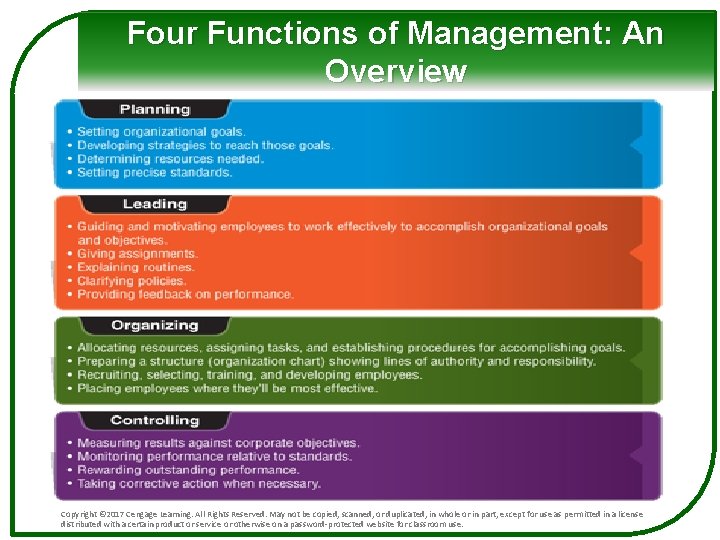
Four Functions of Management: An Overview Copyright © 2017 Cengage Learning. All Rights Reserved. May not be copied, scanned, or duplicated, in whole or in part, except for use as permitted in a license distributed with a certain product or service or otherwise on a password-protected website for classroom use.
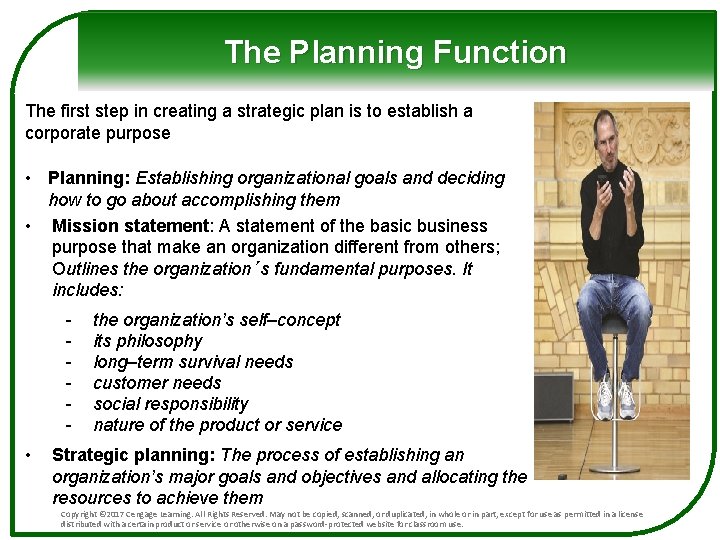
The Planning Function The first step in creating a strategic plan is to establish a corporate purpose • Planning: Establishing organizational goals and deciding how to go about accomplishing them • Mission statement: A statement of the basic business purpose that make an organization different from others; Outlines the organization’s fundamental purposes. It includes: • the organization’s self–concept its philosophy long–term survival needs customer needs social responsibility nature of the product or service Strategic planning: The process of establishing an organization’s major goals and objectives and allocating the resources to achieve them Copyright © 2017 Cengage Learning. All Rights Reserved. May not be copied, scanned, or duplicated, in whole or in part, except for use as permitted in a license distributed with a certain product or service or otherwise on a password-protected website for classroom use.
Planning: Strategic Planning Process § Without knowing “what” you want to be, how can you properly set your goals and objectives? § Establishing goals and objectives • Goal § An end result that an organization is expected to achieve over a one- to ten-year period • Objective § A specific statement detailing what an organization intends to accomplish over a shorter period of time § Properly set goals are: • Set at every level in the organization • Consistent (supportive) with each other • Optimized (balanced) to reduce conflicts between goals Copyright © 2017 Cengage Learning. All Rights Reserved. May not be copied, scanned, or duplicated, in whole or in part, except for use as permitted in a license distributed with a certain product or service or otherwise on a password-protected website for classroom use.
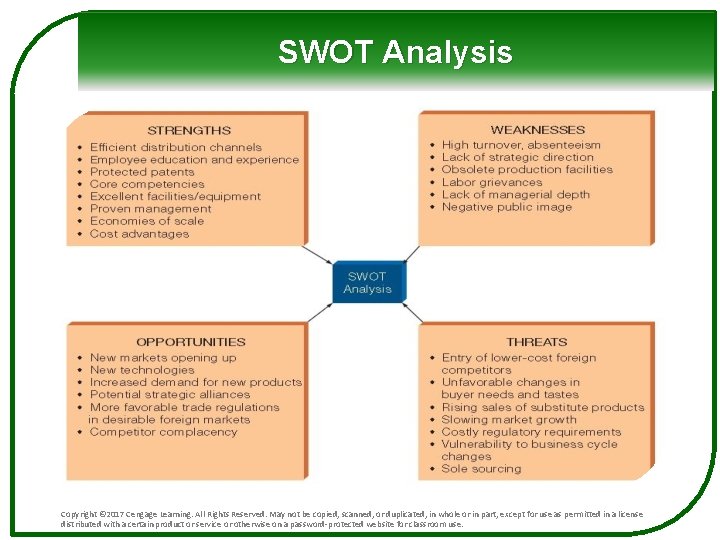
SWOT Analysis Components § SWOT analysis is the identification and evaluation of a firm’s: • • Strengths Weaknesses Opportunities Threats § Core competencies • Approaches and processes that a company performs well and may give it an advantage over its competitors Copyright © 2017 Cengage Learning. All Rights Reserved. May not be copied, scanned, or duplicated, in whole or in part, except for use as permitted in a license distributed with a certain product or service or otherwise on a password-protected website for classroom use.
SWOT Analysis Copyright © 2017 Cengage Learning. All Rights Reserved. May not be copied, scanned, or duplicated, in whole or in part, except for use as permitted in a license distributed with a certain product or service or otherwise on a password-protected website for classroom use.
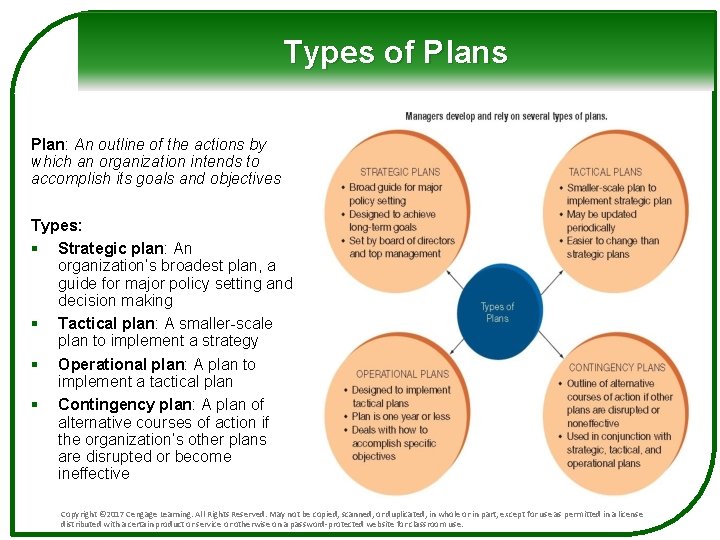
Types of Plans Plan: An outline of the actions by which an organization intends to accomplish its goals and objectives Types: § Strategic plan: An organization’s broadest plan, a guide for major policy setting and decision making § Tactical plan: A smaller-scale plan to implement a strategy § Operational plan: A plan to implement a tactical plan § Contingency plan: A plan of alternative courses of action if the organization’s other plans are disrupted or become ineffective Copyright © 2017 Cengage Learning. All Rights Reserved. May not be copied, scanned, or duplicated, in whole or in part, except for use as permitted in a license distributed with a certain product or service or otherwise on a password-protected website for classroom use.
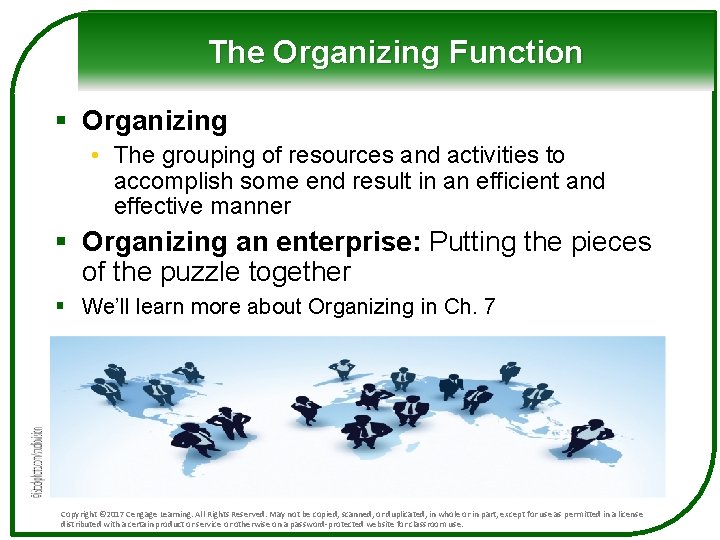
The Organizing Function § Organizing • The grouping of resources and activities to accomplish some end result in an efficient and effective manner § Organizing an enterprise: Putting the pieces of the puzzle together § We’ll learn more about Organizing in Ch. 7 Copyright © 2017 Cengage Learning. All Rights Reserved. May not be copied, scanned, or duplicated, in whole or in part, except for use as permitted in a license distributed with a certain product or service or otherwise on a password-protected website for classroom use.
The Leading and Motivating Function § Leading and motivating • • • § Leading § Influencing people to work toward a common goal Motivating § Providing reasons for people to work in the best interests of an organization Directing § The combined processes of leading and motivating Leaders must: • Communicate a vision and rally others around that vision. • Establish corporate values. • Promote corporate ethics. • Embrace change. • Stress accountability and responsibility Copyright © 2017 Cengage Learning. All Rights Reserved. May not be copied, scanned, or duplicated, in whole or in part, except for use as permitted in a license distributed with a certain product or service or otherwise on a password-protected website for classroom use.
Leadership § Leadership is the ability to influence others § Manager vs. Leader: • A manager may have to depend on coercion • A leader strives for voluntary cooperation § Formal leadership • Legitimate power of position is the basis for authority § Informal leadership • Not recognized formally by the organization authority Copyright © 2017 Cengage Learning. All Rights Reserved. May not be copied, scanned, or duplicated, in whole or in part, except for use as permitted in a license distributed with a certain product or service or otherwise on a password-protected website for classroom use.
Styles of Leadership § § § Autocratic • Task-oriented style; workers are told what to do and how to do it, they have no say in the decision making process Participative (Democratic) • All members of a team are involved in identifying essential goals and developing strategies to reach those goals Entrepreneurial (Free-Rein) • Personality-based, the manager seeks to inspire workers with a vision of what can be accomplished to benefit all stakeholders…Managers set objectives and employees are free to do whatever is appropriate to accomplish those objectives Copyright © 2017 Cengage Learning. All Rights Reserved. May not be copied, scanned, or duplicated, in whole or in part, except for use as permitted in a license distributed with a certain product or service or otherwise on a password-protected website for classroom use.
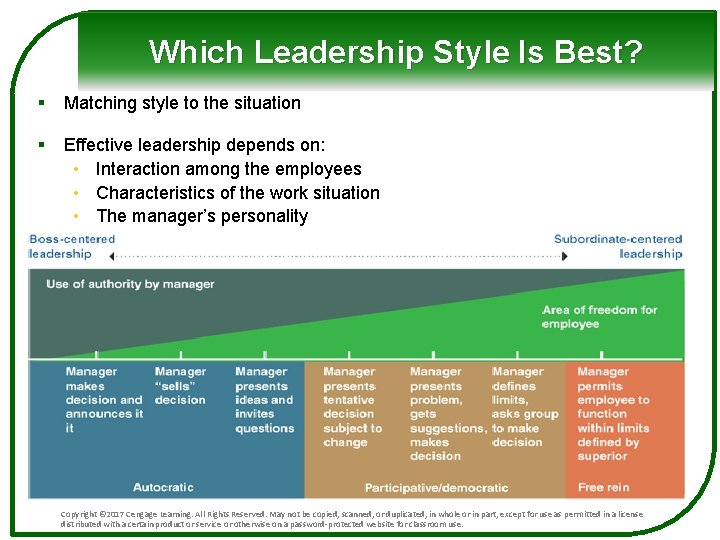
Which Leadership Style Is Best? § Matching style to the situation § Effective leadership depends on: • Interaction among the employees • Characteristics of the work situation • The manager’s personality Copyright © 2017 Cengage Learning. All Rights Reserved. May not be copied, scanned, or duplicated, in whole or in part, except for use as permitted in a license distributed with a certain product or service or otherwise on a password-protected website for classroom use.
The Controlling Function § Controlling is the process of evaluating and regulating ongoing activities to ensure that goals are achieved § Requires constant monitoring and adjusting § Control function • Set standards • Measure performance • Take corrective action Copyright © 2017 Cengage Learning. All Rights Reserved. May not be copied, scanned, or duplicated, in whole or in part, except for use as permitted in a license distributed with a certain product or service or otherwise on a password-protected website for classroom use.
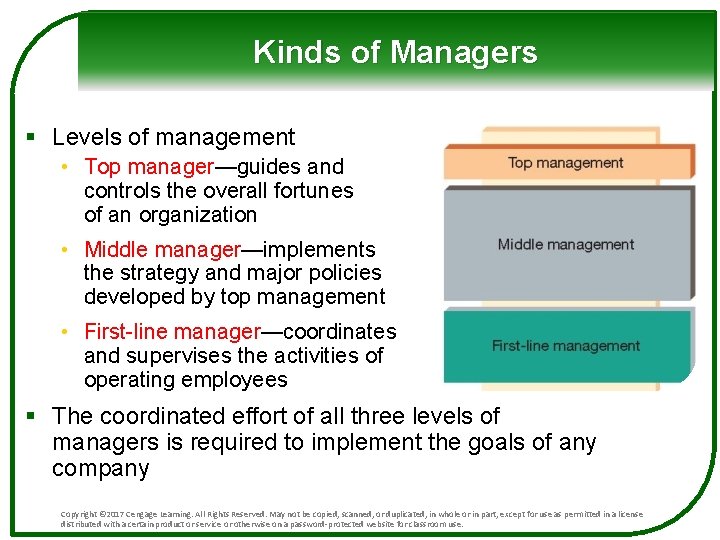
Kinds of Managers § Levels of management • Top manager—guides and controls the overall fortunes of an organization • Middle manager—implements the strategy and major policies developed by top management • First-line manager—coordinates and supervises the activities of operating employees § The coordinated effort of all three levels of managers is required to implement the goals of any company Copyright © 2017 Cengage Learning. All Rights Reserved. May not be copied, scanned, or duplicated, in whole or in part, except for use as permitted in a license distributed with a certain product or service or otherwise on a password-protected website for classroom use.
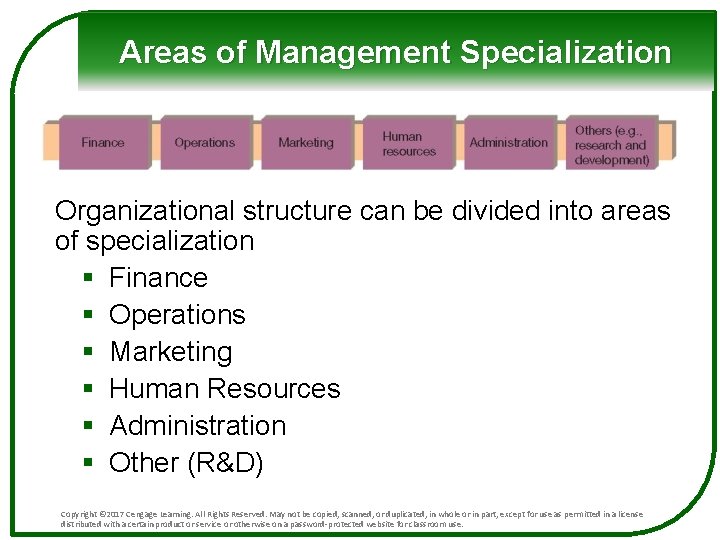
Areas of Management Specialization Organizational structure can be divided into areas of specialization § Finance § Operations § Marketing § Human Resources § Administration § Other (R&D) Copyright © 2017 Cengage Learning. All Rights Reserved. May not be copied, scanned, or duplicated, in whole or in part, except for use as permitted in a license distributed with a certain product or service or otherwise on a password-protected website for classroom use.
Areas of Management Specialization Defined § Financial managers • Responsible for an organization’s financial resources § Operations managers • Manage the systems that convert resources into goods and services § Marketing managers • Responsible for facilitating the exchange of products between an organization and its customers or clients § Human resources managers • Manage an organization’s human resources programs § Administrative managers (general managers) • Not associated with any specific functional area; provide overall administrative guidance and leadership Copyright © 2017 Cengage Learning. All Rights Reserved. May not be copied, scanned, or duplicated, in whole or in part, except for use as permitted in a license distributed with a certain product or service or otherwise on a password-protected website for classroom use.
Key Skills of Successful Managers § Conceptual skills • Ability to think in abstract terms § Analytic skills • Ability to identify problems, generate alternative solutions, and select the best solution § Interpersonal skills • Ability to deal effectively with other people § Technical skills • Needed to accomplish a specialized activity Copyright © 2017 Cengage Learning. All Rights Reserved. May not be copied, scanned, or duplicated, in whole or in part, except for use as permitted in a license distributed with a certain product or service or otherwise on a password-protected website for classroom use.
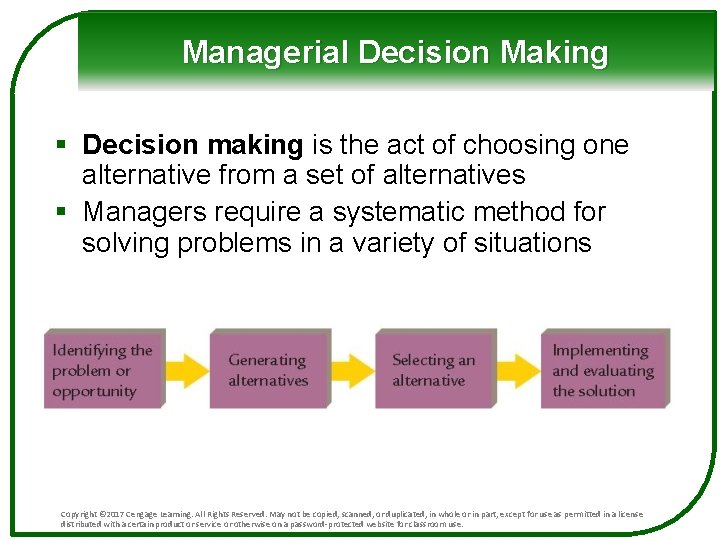
Managerial Decision Making § Decision making is the act of choosing one alternative from a set of alternatives § Managers require a systematic method for solving problems in a variety of situations Copyright © 2017 Cengage Learning. All Rights Reserved. May not be copied, scanned, or duplicated, in whole or in part, except for use as permitted in a license distributed with a certain product or service or otherwise on a password-protected website for classroom use.
Managerial Decision-Making Process: Identifying the Problem of Opportunity § Problem • The discrepancy between an actual condition and a desired condition § Opportunity • A “positive” problem § Problem-solving impediments • Preconceptions about the problem • Focusing on unimportant matters while overlooking significant issues • Analyzing symptoms rather than causes • Failing to look ahead Copyright © 2017 Cengage Learning. All Rights Reserved. May not be copied, scanned, or duplicated, in whole or in part, except for use as permitted in a license distributed with a certain product or service or otherwise on a password-protected website for classroom use.
Managerial Decision-Making Process: Generating and Selecting Alternatives § Techniques • Brainstorming § Encouraging participants to come up with new ideas • “Blast! Then refine. ” § Reevaluating objectives, modifying them if necessary, and devising a new solution to a recurring problem • Trial and error § Selecting an alternative • Satisfice § Choosing an alternative that is not the best possible solution, but one that adequately solves the problem Copyright © 2017 Cengage Learning. All Rights Reserved. May not be copied, scanned, or duplicated, in whole or in part, except for use as permitted in a license distributed with a certain product or service or otherwise on a password-protected website for classroom use.
Managerial Decision-Making Process: Implementation and Evaluation § Requires time, planning, preparation of personnel, and evaluation of the results § An effective decision removes the difference between the actual condition and the desired condition § If a problem still exists, managers may: • Decide to give the chosen alternative more time • Adopt a different alternative • Start the process all over again Copyright © 2017 Cengage Learning. All Rights Reserved. May not be copied, scanned, or duplicated, in whole or in part, except for use as permitted in a license distributed with a certain product or service or otherwise on a password-protected website for classroom use.
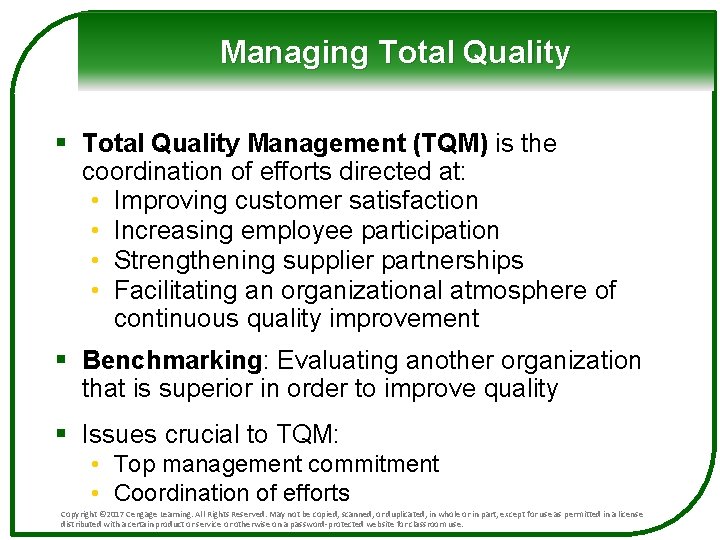
Managing Total Quality § Total Quality Management (TQM) is the coordination of efforts directed at: • Improving customer satisfaction • Increasing employee participation • Strengthening supplier partnerships • Facilitating an organizational atmosphere of continuous quality improvement § Benchmarking: Evaluating another organization that is superior in order to improve quality § Issues crucial to TQM: • Top management commitment • Coordination of efforts Copyright © 2017 Cengage Learning. All Rights Reserved. May not be copied, scanned, or duplicated, in whole or in part, except for use as permitted in a license distributed with a certain product or service or otherwise on a password-protected website for classroom use.