
6 THE PANCREATIC HORMONES AND BLOOD GLUCOSE REGULATION
6. THE PANCREATIC HORMONES AND BLOOD GLUCOSE REGULATION. Prof. Sherif W. Mansour Physiology dpt. , Mutah School of medicine 2020 -2021

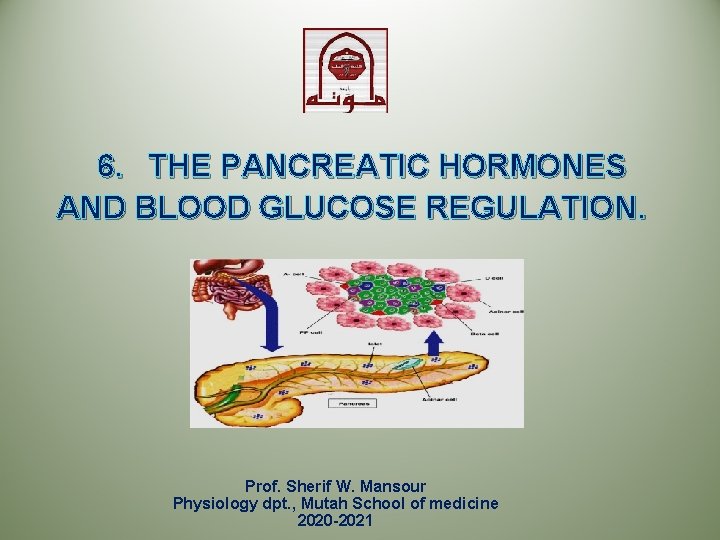
ENDOCRINE FUNCTION OF THE PANCREAS The pancreas has exocrine and endocrine functions. The endocrine functions are limited to the Islets of Langerhans ( 1 to 2 million in humans). The Islets form less than 2 % of the pancreatic tissue but their endocrine secretions are very important to body function and homeostasis. The islets contain 4 types of cells: Alpha , Beta , Delta and Pc. P cells - α cells → secrete Glucagon hormone , a hyperglycemic agent , it represent about 25 % of the islets cells. - β cells → secrete Insulin hormone , a hypoglycemic agent , it represent about 60 % of the islets cells. - δ cells → secrete Somatostatin hormone and Gastrin hormone , it represent about 10 % of the islets cells. - Pc. P cells → secrete pancreatic po 1 ypeptide (a hormone of uncertain function) , it represent about 5 % of the Islets cells.

I. Glucagon Hormone • It is a polypeptide hormone with a mol. weight of 3485 and is composed of a chain of 29 amino acids • Actions : 1 -This hormone increases the blood glucose level by two mechanisms : a- Promotes glycogenolysis (glycogen → blood glucose). It is immediate action and of short duration. b- Stimulates gluconeogenesis (formation of glucose from non-CHO sources) delayed response , long acting (in the liver). 2 - Calorigenic action: due to increase in hepatic deamination of amino acids which requires the presence of thyroxine and cortisol. 3 - It has no action on muscle glycogen or on peripheral utilization of glucose. 4 - It stimulates lipolysis and ketogenesis via activation of adipose cell lipase → increases the quantities of fatty acids available for energy system. The hormone inhibits also triglycerides storage in the liver. 5 - In high concentration , glucagon enhances cardiac contractility (+ve inotropic action due to increased myocardial cyclic AMP) , increases bile secretion , and inhibits gastric acid secretion. 6 - It stimulates the release of Insulin , growth hormone and somatostatin hormone. • Control Of Secretion : 1. Fall in blood glucose stimulates the alpha cells to secrete glucagon while rise in blood glucose inhibits secretion. 2. High concentration of amino acids e. g. alanine and arginine after a protein meal stimulates glucagon secretion (the same as it does with insulin secretion) i. e. amino acids are used in the process of gluconeogenesis. 3. G. I. T. hormones : CCK-PZ and Gastrin increases glucagon secretion while Secretin inhibits it. Thus , a protein meal elicits a greater glucagon response than the increase in amino acids blood level that can be accounted by i. v. injection of amino acids.

4. Exhaustive exercise increases glucagon secretion to prevent the fall of blood glucose. 5. Somatostatin and Insulin depresses glucagon secretion. 6. Sympathetic stimulation : Stimulation of β-adrenoceptors increases glucagon secretion while adrenoceptors inhibits secretion with a predominant β -receptors effect. 7. Vagal stimulation and acetylcholine increase glucagon secretion. α - II. Insulin Hormone Insulin is a polypeptide hormone with a mol. weight of 5808 , composed of two chains of 51 amino acids connected to each other by a disulfide linkages. • Insulin Receptors : Insulin receptor is a glycoprotein with a M. W. of about 300, 000 found in the cell membrane of most of the body cells. It is composed of 4 subunits ; 2 alpha (lie outside the cell membrane) and 2 beta (penetrate through the cell membrane and protruding to the cell cytoplasm). Binding of insulin to the 2 alpha subunits causes auto- phosphorylation of the 2 beta subunits protruding in the cytoplasm to act as a local protein kinase , which in turn activate other cytosol enzymes. • Actions : 1 - Insulin stimulates glycogen formation (glycogenesis). 2 - It increases the utilization of glucose in the liver and muscles by helping phosphorylation to glucose-6 phosphate by glucokinase (in the liver) , also it stimulates glycolysis. 3 - It inhibits the process of gluconeogenesis. 4 - Insulin Inhibits lipolysis and stimulates lipogenesis. 5 - Increases the uptake of amino acids (arginine , valine, leucine , isoleucine, tyrosine) and formation of muscle protein via increase in cellular enzymatic activity (protein synthesis).

6 - Increases cellular Mg++ , K+ and phosphate ions uptake by the muscles. 7 - Increases the cell membrane (of muscle cells, fat cells and others) permeability to glucose that allows rapid entery of glucose into the cells. • Control of Secretion : 1 - Blood glucose : Rise in blood glucose concentration causes increase in insulin secretion , while the drop in blood glucose level inhibits insulin secretion. The rise in blood glucose 2 to 3 times the normal fasting level (90 mg%) causes marked increase in insulin secretion in two steps: a- Within 3 to 5 minutes the insulin output increases 10 times the resting value (first peak-initial rapid surge) due to immediate release of preformed insulin from the beta cells followed by a sudden drop in 5 to 10 Minutes. b- Delayed but higher and continuing increase in insulin production after 15 to 20 minutes that reach a plateau for 2 to 3 hours as a result of new insulin formation by activation of the enzyme system. 2 - During glucose absorption the wall of the upper gastro-intestinal tract releases Enteroglucagon which stimulates Insulin secretion. 3 - Glucagon hormone passes directly into the β -cells , it is a potent insulin stimulator. 4 - Vagal stimulation stimulate insulin release , while sympathetic stimulation inhibits Insulin release. The sympathetic stimulation is mediated by alpha receptors 5 - G. I. T. hormones; gastrin , secretin , CCK-PZ, and gastric inhibitory peptide stimulate insulin release. 6 - Certain amino acids e. g. arginine and lysine are potent stimulators. 7 - Somatostatin hormone is inhibitory to β -cells. • Clinical results of insulin deficiency ( Diabetes Mellitus): - Rise in blood glucose (Hyperglycaemia). - glucosuria (presence of glucose In urine). - Osmotic diuresis (polyuria) →Dehydration - Wasting of fats and muscles → Ketosis

Blood Glucose Regulation • The normal morning fasting level of blood glucose is 60 to 90 mg/dl. After the ingestion of carbohydrate meal the level rises temporarily to 120 to 150 mg/dl or even higher. In normal subject these glucose levels soon decline from the peak values , so that after 1 hour and 30 minutes to 2 hours the fasting levels are once again attained. • The blood glucose is derived from three sources : 1. The absorbed glucose from the G. I. T. 2. The conversion of noncarbohydrate precursors into glucose; i. e. amino acids , intermediates in the breakdown of glucose (lactic , pyruvic , and succinic acids) and glycerol derived from hydrolysis of neutral fat. 3. Glycogenolysis (hydrolysis of liver glycogen). • The constancy of blood glucose concentration between meals is achieved through a balance between glucose utilization by tissues and production (glycogenolysis). A portion of blood glucose is converted by the liver to glycogen (glycogenesis). Some glucose is utilized directly for energy , but most of the glucose derived from digestion of dietary carbohydrate is converted to fat. • The homeostatic processes keeping blood glucose level constant comprise numerous factors : -The Liver as glucostat : • The liver serves as a receiving , manufacturing , storage , and distributing center for glucose which is then carried by the systemic blood stream to all parts of the body. The hepatic cells are freely permeable to glucose. The liver responds sensitively and speedily to changes in blood glucose concentration i. e. when the blood glucose is high the liver takes up glucose and stores it as glycogen, and when the blood glucose is low there is a net loss of glucose from the liver to the blood stream.


The reactions in the liver cells are : 1 - Partly controlled by cellular processes independent of hormones. 2 - Controlled by many hormones superimposed on the previous primitive cellular control mechanisms : Adrenaline , Glucagon , Insulin. -Adrenaline hormone: Promotes glycogenolysis in muscle , but due to lack of glucose-6 -phosphatase in muscles, glycolysis occurs and leads to the formation of lactate → liver (adrenaline enhances gluconeogenesis indirectly via inhibiting insulin secretion). -Glucagon : It does not cause glycogenolysis in muscles. Also , besides promoting glycogenolysis , enhances gluconeogenesis. -Cortisol : 1 - Promotes gluconeogenesis by : - favoring the release of amino acids from proteins in muscle and bone + Synthesis of gluconeogenic enzymes in liver. 2 - Reduces uptake of glucose by tissues. 3 - Promotes lipolysis → release of FFA. which reduce glucose uptake and provides an alternative fuel to glucose in muscles.

Thank You
- Slides: 9