
6 The Muscular System PART A Power Point

- Slides: 28
6 The Muscular System PART A Power. Point® Lecture Slide Presentation by Jerry L. Cook, Sam Houston University ESSENTIALS OF HUMAN ANATOMY & PHYSIOLOGY EIGHTH EDITION ELAINE N. MARIEB Copyright © 2006 Pearson Education, Inc. , publishing as Benjamin Cummings
The Muscular System § Muscles make up 40 -50% of total body weight. § Muscles are responsible for all types of body movement § Three basic muscle types are found in the body § Skeletal muscle § Cardiac muscle § Smooth muscle Copyright © 2006 Pearson Education, Inc. , publishing as Benjamin Cummings
Characteristics of Muscles § Muscle cells are elongated (muscle cell = muscle fiber) § Contraction of muscles is due to the movement of myofilaments § All muscles share some terminology § Prefix myo refers to muscle § Prefix mys refers to muscle § Prefix sarco refers to flesh Copyright © 2006 Pearson Education, Inc. , publishing as Benjamin Cummings
Skeletal Muscle Characteristics § Most are attached by tendons to bones § Cells are multinucleate § Striated – have visible banding § Largest of the muscle fiber types (up to 30 cm) § Voluntary – subject to conscious control § Cells are surrounded and bundled by connective tissue Copyright © 2006 Pearson Education, Inc. , publishing as Benjamin Cummings
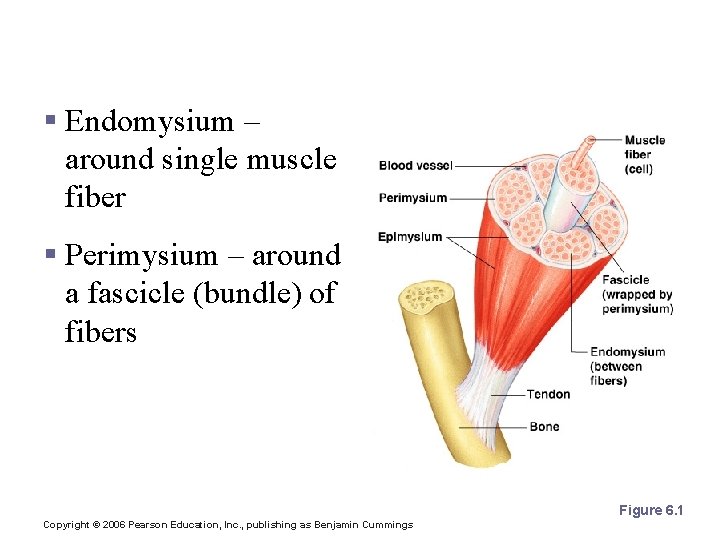
Connective Tissue Wrappings of Skeletal Muscle § Endomysium – around single muscle fiber § Perimysium – around a fascicle (bundle) of fibers Figure 6. 1 Copyright © 2006 Pearson Education, Inc. , publishing as Benjamin Cummings
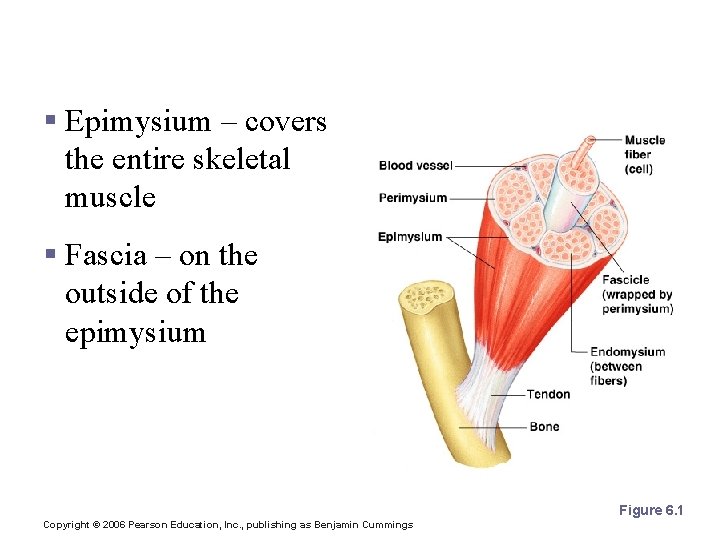
Connective Tissue Wrappings of Skeletal Muscle § Epimysium – covers the entire skeletal muscle § Fascia – on the outside of the epimysium Figure 6. 1 Copyright © 2006 Pearson Education, Inc. , publishing as Benjamin Cummings
Skeletal Muscle Attachments § Epimysium blends into a connective tissue attachment § Tendon (cord-like structure) & aponeuroses (sheet-like structure) § Provide durability & conserve space. § Can cross rough bony projections that could tear muscle tissue. § More tendons can cross over a joint because of their small size. Copyright © 2006 Pearson Education, Inc. , publishing as Benjamin Cummings
Skeletal Muscle Attachments § Sites of muscle attachment § Bones § Cartilages § Connective tissue coverings Copyright © 2006 Pearson Education, Inc. , publishing as Benjamin Cummings
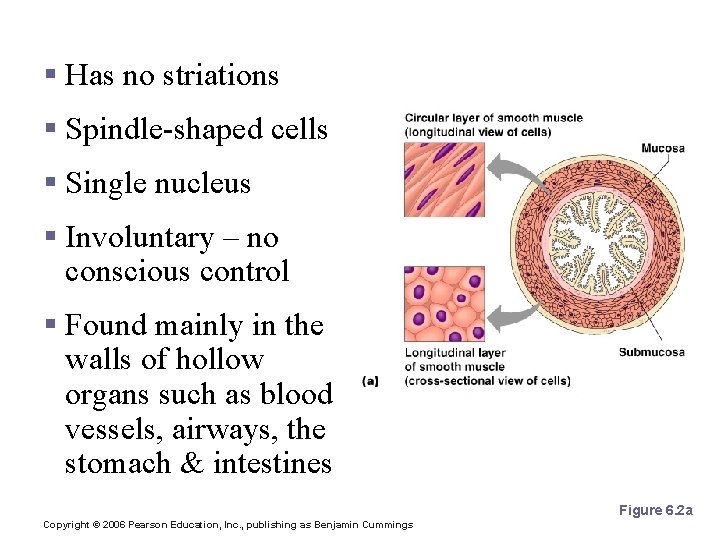
Smooth Muscle Characteristics § Has no striations § Spindle-shaped cells § Single nucleus § Involuntary – no conscious control § Found mainly in the walls of hollow organs such as blood vessels, airways, the stomach & intestines Figure 6. 2 a Copyright © 2006 Pearson Education, Inc. , publishing as Benjamin Cummings
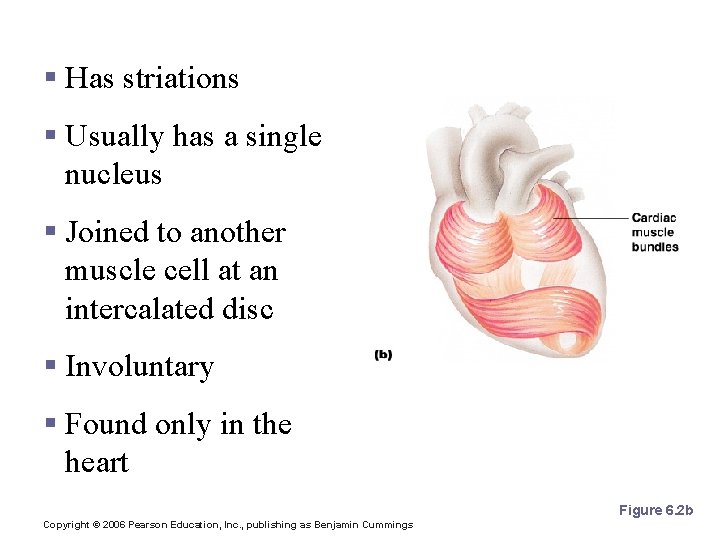
Cardiac Muscle Characteristics § Has striations § Usually has a single nucleus § Joined to another muscle cell at an intercalated disc § Involuntary § Found only in the heart Figure 6. 2 b Copyright © 2006 Pearson Education, Inc. , publishing as Benjamin Cummings
Function of Muscles § Produce movement § Maintain posture § Stabilize joints § Regulating organ volume (sphincters). § Moving substances within the body. § Blood flow § Movement of food through digestive tract. Copyright © 2006 Pearson Education, Inc. , publishing as Benjamin Cummings
Function of Muscles § Generate heat § Used to maintain normal body temperature (3/4 of energy of ATP is released as heat) § Shivering can help warm body. Copyright © 2006 Pearson Education, Inc. , publishing as Benjamin Cummings
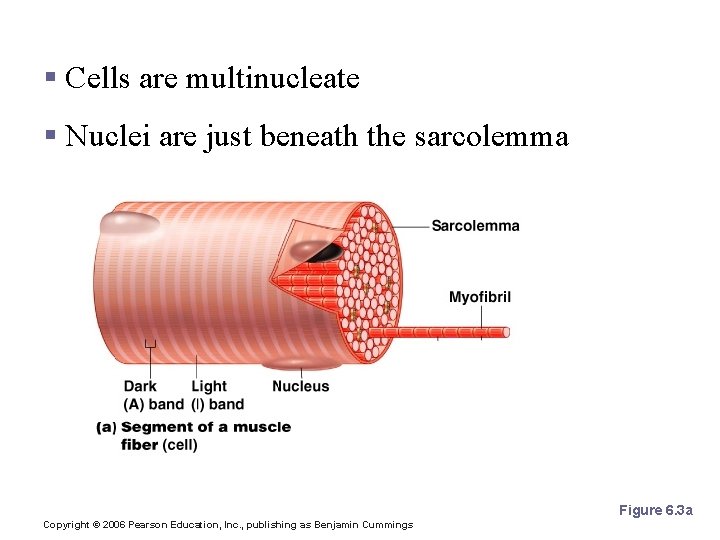
Microscopic Anatomy of Skeletal Muscle § Cells are multinucleate § Nuclei are just beneath the sarcolemma Figure 6. 3 a Copyright © 2006 Pearson Education, Inc. , publishing as Benjamin Cummings
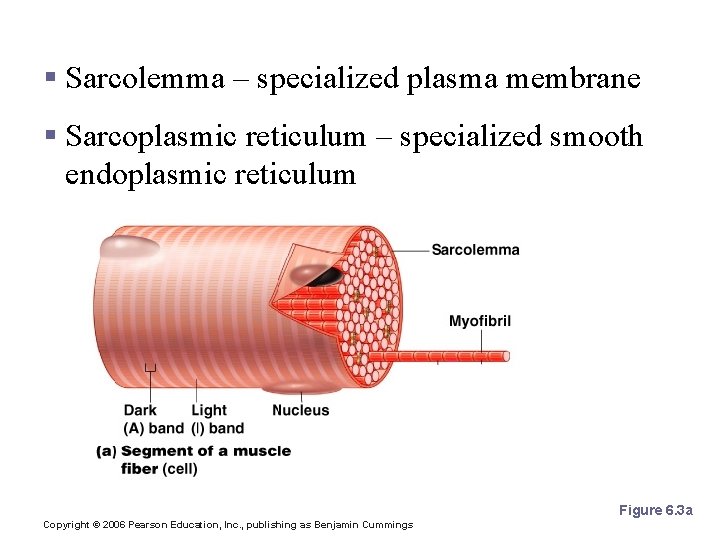
Microscopic Anatomy of Skeletal Muscle § Sarcolemma – specialized plasma membrane § Sarcoplasmic reticulum – specialized smooth endoplasmic reticulum Figure 6. 3 a Copyright © 2006 Pearson Education, Inc. , publishing as Benjamin Cummings
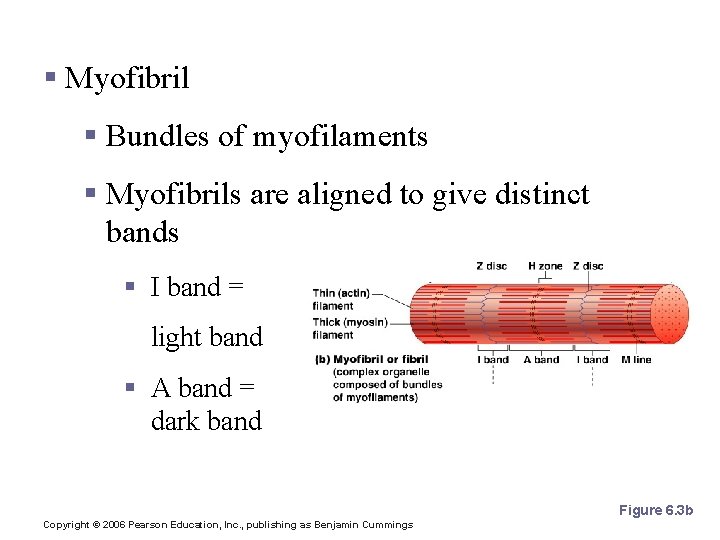
Microscopic Anatomy of Skeletal Muscle § Myofibril § Bundles of myofilaments § Myofibrils are aligned to give distinct bands § I band = light band § A band = dark band Figure 6. 3 b Copyright © 2006 Pearson Education, Inc. , publishing as Benjamin Cummings
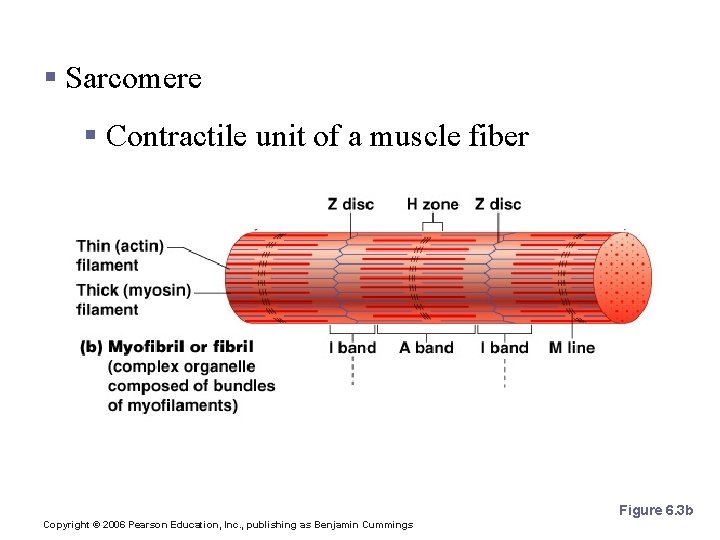
Microscopic Anatomy of Skeletal Muscle § Sarcomere § Contractile unit of a muscle fiber Figure 6. 3 b Copyright © 2006 Pearson Education, Inc. , publishing as Benjamin Cummings
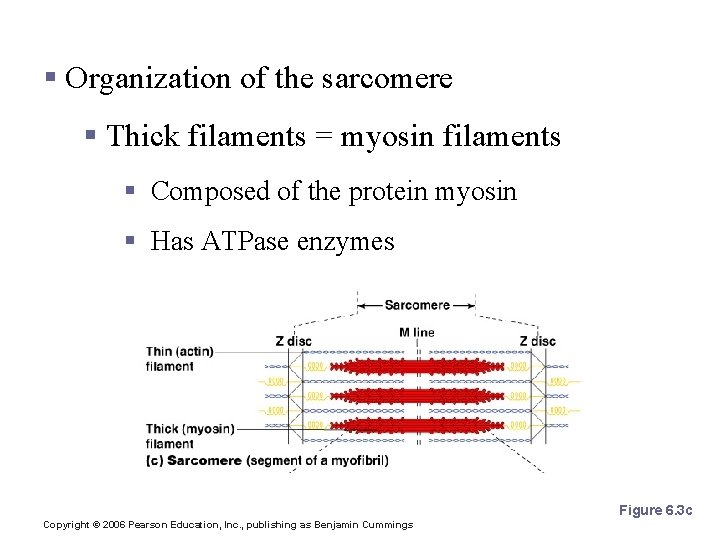
Microscopic Anatomy of Skeletal Muscle § Organization of the sarcomere § Thick filaments = myosin filaments § Composed of the protein myosin § Has ATPase enzymes Figure 6. 3 c Copyright © 2006 Pearson Education, Inc. , publishing as Benjamin Cummings
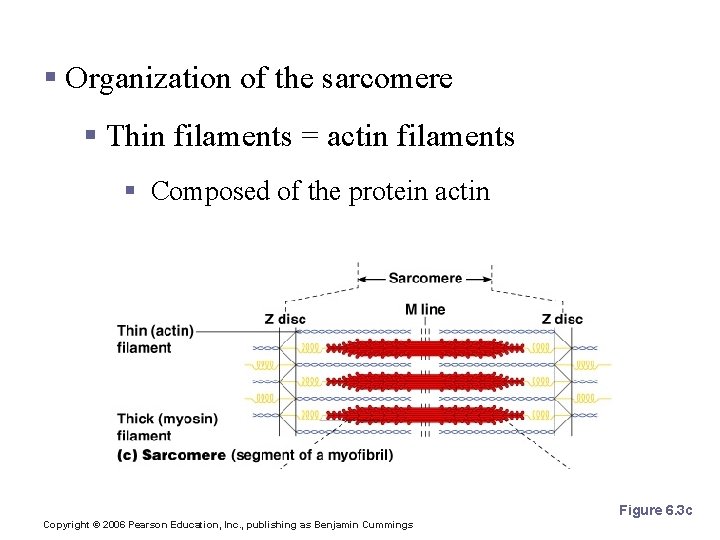
Microscopic Anatomy of Skeletal Muscle § Organization of the sarcomere § Thin filaments = actin filaments § Composed of the protein actin Figure 6. 3 c Copyright © 2006 Pearson Education, Inc. , publishing as Benjamin Cummings
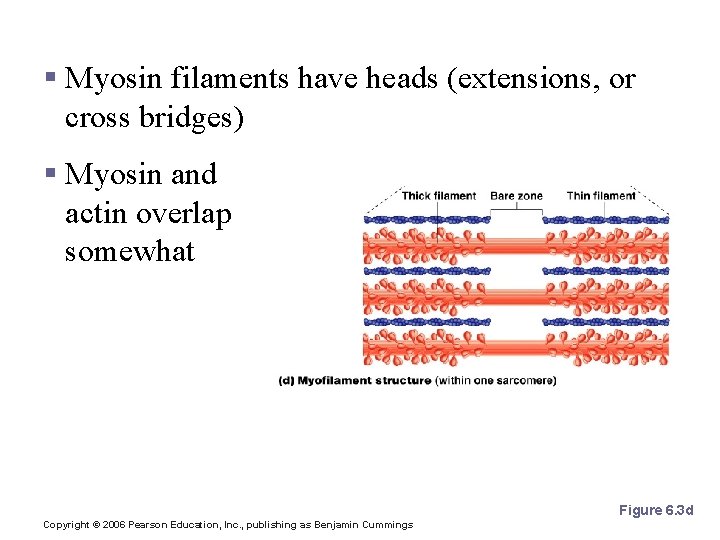
Microscopic Anatomy of Skeletal Muscle § Myosin filaments have heads (extensions, or cross bridges) § Myosin and actin overlap somewhat Figure 6. 3 d Copyright © 2006 Pearson Education, Inc. , publishing as Benjamin Cummings
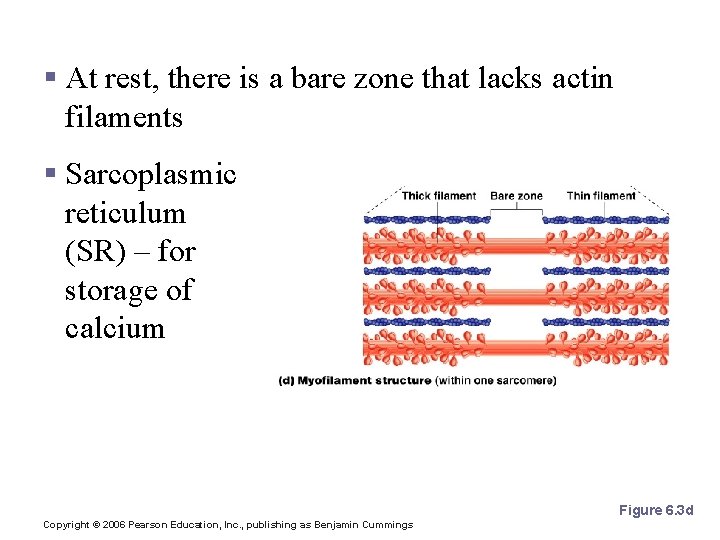
Microscopic Anatomy of Skeletal Muscle § At rest, there is a bare zone that lacks actin filaments § Sarcoplasmic reticulum (SR) – for storage of calcium Figure 6. 3 d Copyright © 2006 Pearson Education, Inc. , publishing as Benjamin Cummings
Properties of Skeletal Muscle Activity § Irritability – ability to receive and respond to a stimulus § Contractility – ability to shorten when an adequate stimulus is received Copyright © 2006 Pearson Education, Inc. , publishing as Benjamin Cummings
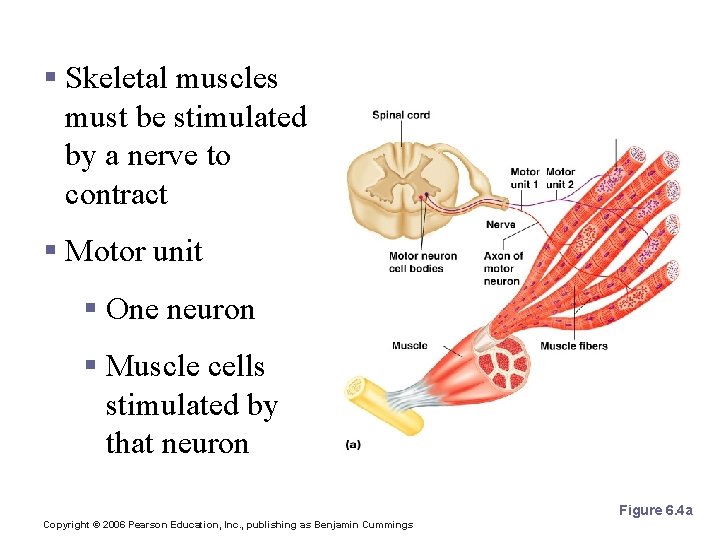
Nerve Stimulus to Muscles § Skeletal muscles must be stimulated by a nerve to contract § Motor unit § One neuron § Muscle cells stimulated by that neuron Figure 6. 4 a Copyright © 2006 Pearson Education, Inc. , publishing as Benjamin Cummings
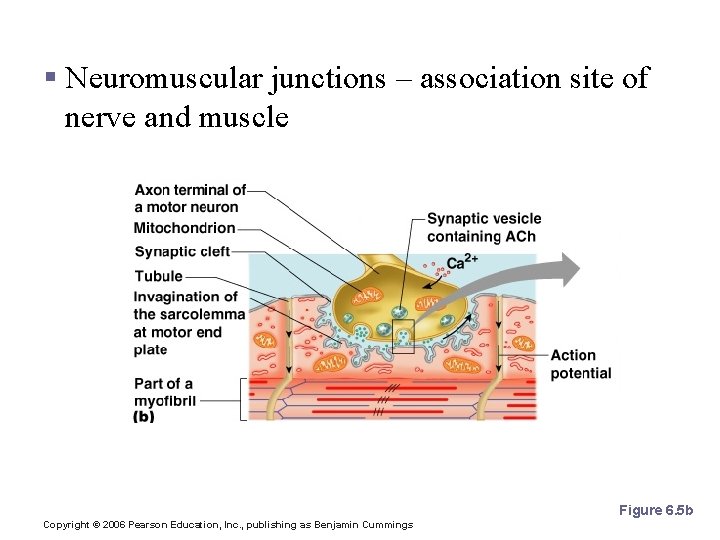
Nerve Stimulus to Muscles § Neuromuscular junctions – association site of nerve and muscle Figure 6. 5 b Copyright © 2006 Pearson Education, Inc. , publishing as Benjamin Cummings
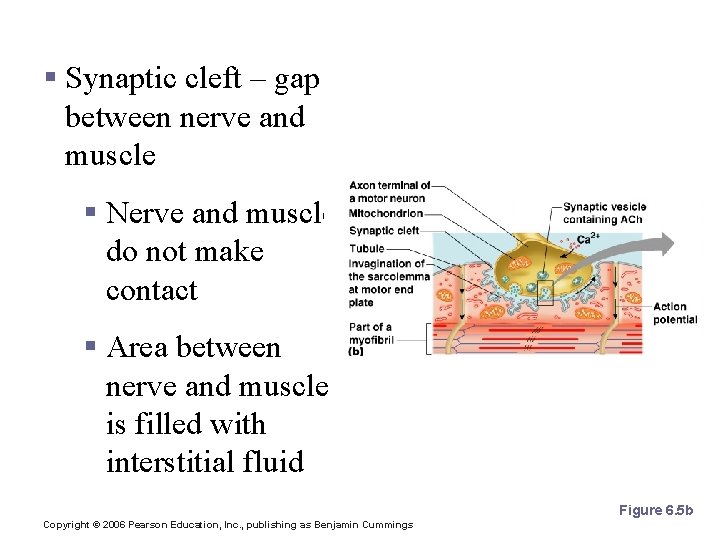
Nerve Stimulus to Muscles § Synaptic cleft – gap between nerve and muscle § Nerve and muscle do not make contact § Area between nerve and muscle is filled with interstitial fluid Figure 6. 5 b Copyright © 2006 Pearson Education, Inc. , publishing as Benjamin Cummings
Transmission of Nerve Impulse to Muscle § Neurotransmitter – chemical released by nerve upon arrival of nerve impulse § The neurotransmitter for skeletal muscle is acetylcholine § Neurotransmitter attaches to receptors on the sarcolemma § Sarcolemma becomes permeable to sodium (Na+) Copyright © 2006 Pearson Education, Inc. , publishing as Benjamin Cummings
Transmission of Nerve Impulse to Muscle § Sodium rushing into the cell generates an action potential § Once started, muscle contraction cannot be stopped Copyright © 2006 Pearson Education, Inc. , publishing as Benjamin Cummings
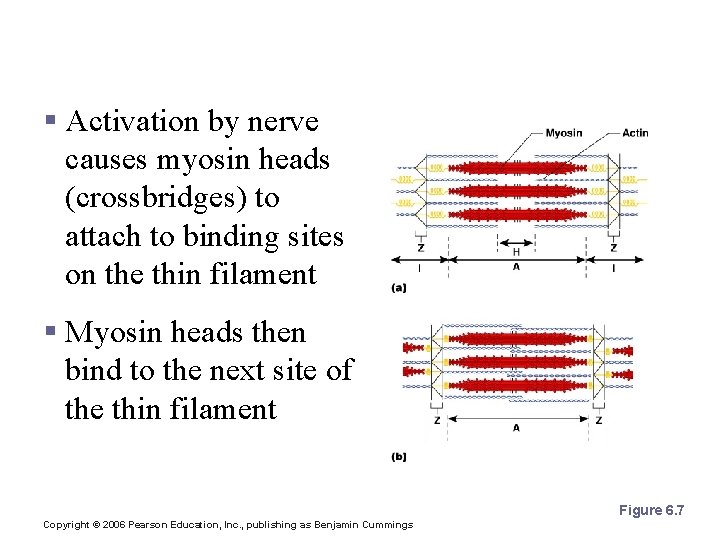
The Sliding Filament Theory of Muscle Contraction § Activation by nerve causes myosin heads (crossbridges) to attach to binding sites on the thin filament § Myosin heads then bind to the next site of the thin filament Figure 6. 7 Copyright © 2006 Pearson Education, Inc. , publishing as Benjamin Cummings
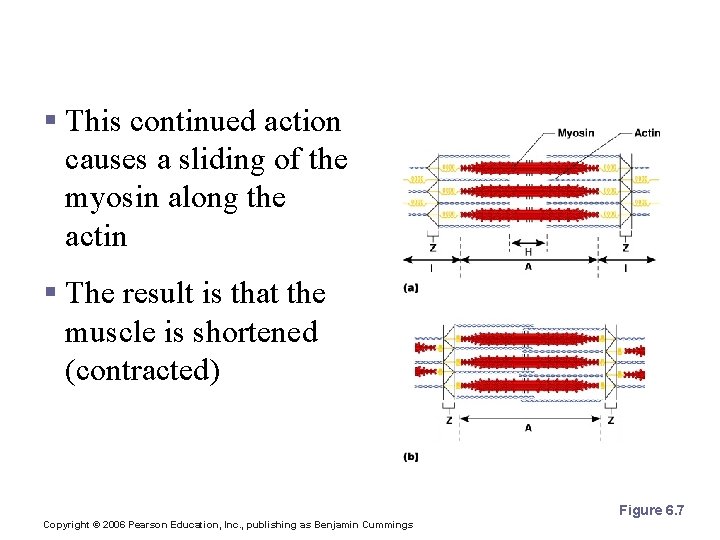
The Sliding Filament Theory of Muscle Contraction § This continued action causes a sliding of the myosin along the actin § The result is that the muscle is shortened (contracted) Figure 6. 7 Copyright © 2006 Pearson Education, Inc. , publishing as Benjamin Cummings