
6 The Cell membrane Describe the structure and
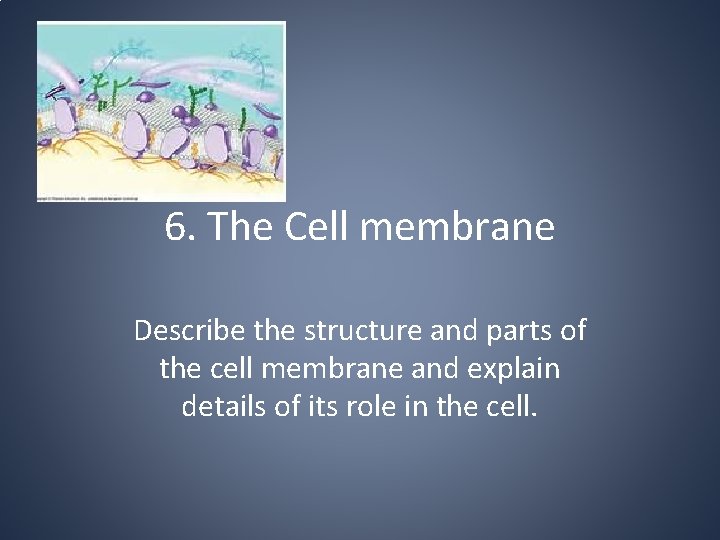
6. The Cell membrane Describe the structure and parts of the cell membrane and explain details of its role in the cell.
Starter. • Name one type of lipid • What is the name given to bonds between amino acids • What main elements make up carbohydrates? • What is the difference between a monomer and a polymer • What is an essential amino acid? • What has to happen to lipids, carbohydrates and proteins once they are eaten by us?
The Cell Membrane • Is the barrier between a living cell and the outside world. • The structure is often called the fluid mosaic model discovered 1972 • Fluid because it is made of two layers (a bilayer) of phospholipids molecules and other components which can move sideways throughout the layer. • Mosaic because the proteins, carbohydrates and cholesterol dotted throughout the membrane look like a mosaic pattern • http: //www. susanahalpine. com/anim/Life/memb. htm

Key components - Lipids • Phospholipids – have two ends. The hydrophilic (water soluble) phosphate end and the hydrophobic (insoluble in w_______) fatty acid end. Form a bilayer with the f______ acids tails on the inside and the hydrop______ groups on the outside in the watery environment. The two layers stop m______ of large molecules into the cell. The fluid environment allows small molecules such as o______ and water to diffuse through. • Cholesterol helps stiffen the membrane. Not found in p____ cells.
• S_____ proteins help to give the cell support and shape. • Cell membrane r____ proteins help cells communicate with their external environment • T________ proteins, such as globular proteins, transport molecules across cell membranes. • C_______ are involved in cell recognition.
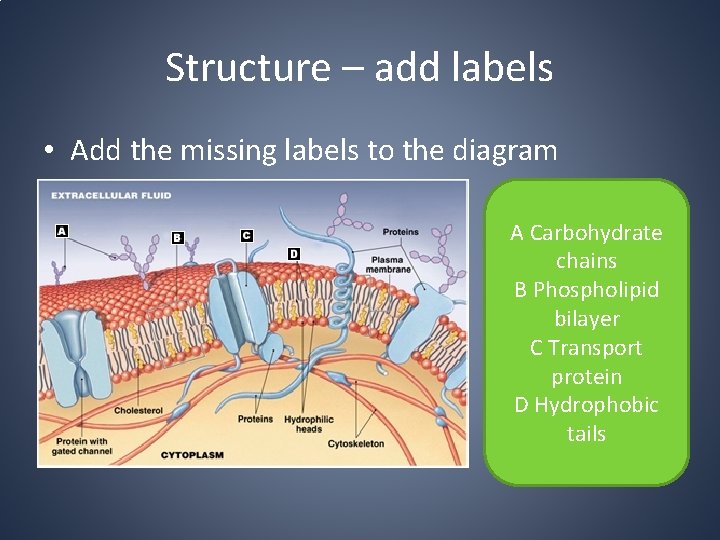
Structure – add labels • Add the missing labels to the diagram A Carbohydrate chains B Phospholipid bilayer C Transport protein D Hydrophobic tails

Lipid bilayer animation • http: //www. youtube. com/watch? v=Qqsf_UJcf Bc
Group task – cell membrane model • Use half toothpicks and plasticene to create phospholipids. • Make proteins, carbohydrates and cholesterol from 3 other colours and create a cell membrane model with toothpick tails turned inwards.

Role of Membrane in Cells • Isolate enzymes from rest of cell. • Smooth ER is a network of membranes involved in lipid synthesis • Surround nucleus and contain DNA • Rough ER – protein synthesis • Entry and Export of substances from cell by vesicles • Cell communication and recognition • Packaging and secretion in the Golgi Apparatus • Selective transport by channel proteins. • Energy Transfer in mitochondria and choroplasts
- Slides: 9