
6 th June 2019 How to Set Up
- Slides: 51
6 th June 2019 How to Set Up Your Data Sharing Policy OASPA Open Scholarship Webinar Series Unless otherwise specified these slides are made available by OASPA under a CC BY 4. 0 License
How to set up your data sharing policy With thanks to Copyright Clearance Center for hosting today’s webinar Unless otherwise specified these slides are made available by OASPA under a CC BY 4. 0 License
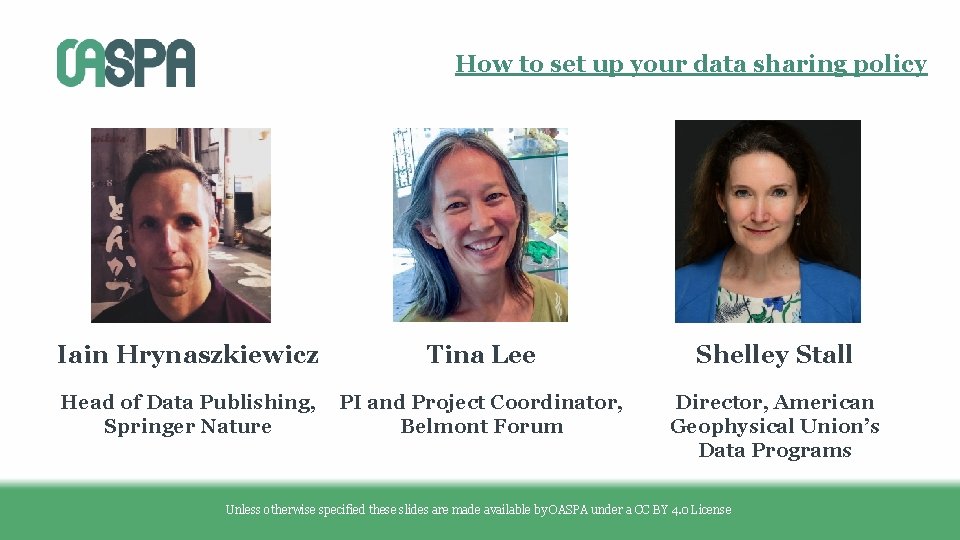
How to set up your data sharing policy Iain Hrynaszkiewicz Tina Lee Shelley Stall Head of Data Publishing, Springer Nature PI and Project Coordinator, Belmont Forum Director, American Geophysical Union’s Data Programs Unless otherwise specified these slides are made available by OASPA under a CC BY 4. 0 License
Journal research data policy: Succession for success OASPA webinar Iain Hrynaszkiewicz, Head of Data Publishing, Springer Nature
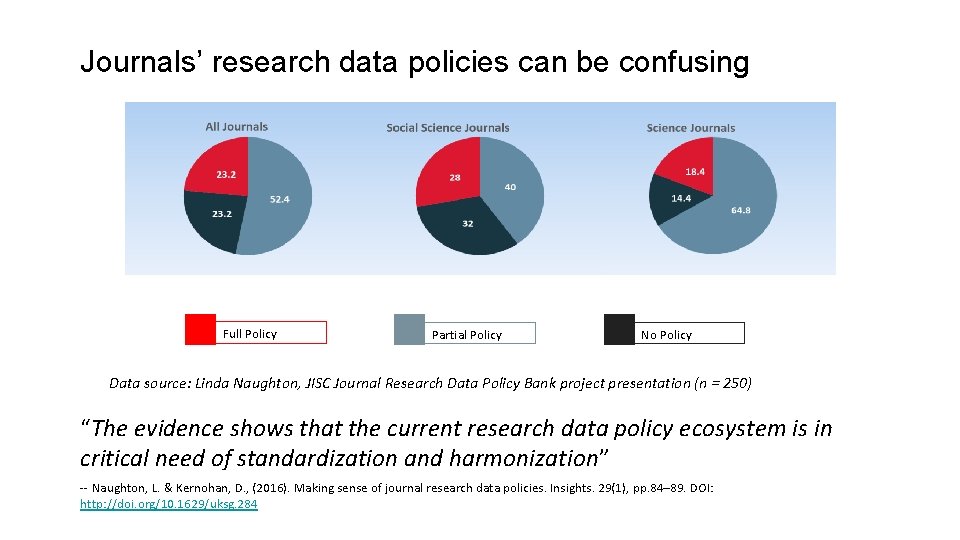
Journals’ research data policies can be confusing Full Policy Partial Policy No Policy Data source: Linda Naughton, JISC Journal Research Data Policy Bank project presentation (n = 250) “The evidence shows that the current research data policy ecosystem is in critical need of standardization and harmonization” -- Naughton, L. & Kernohan, D. , (2016). Making sense of journal research data policies. Insights. 29(1), pp. 84– 89. DOI: http: //doi. org/10. 1629/uksg. 284
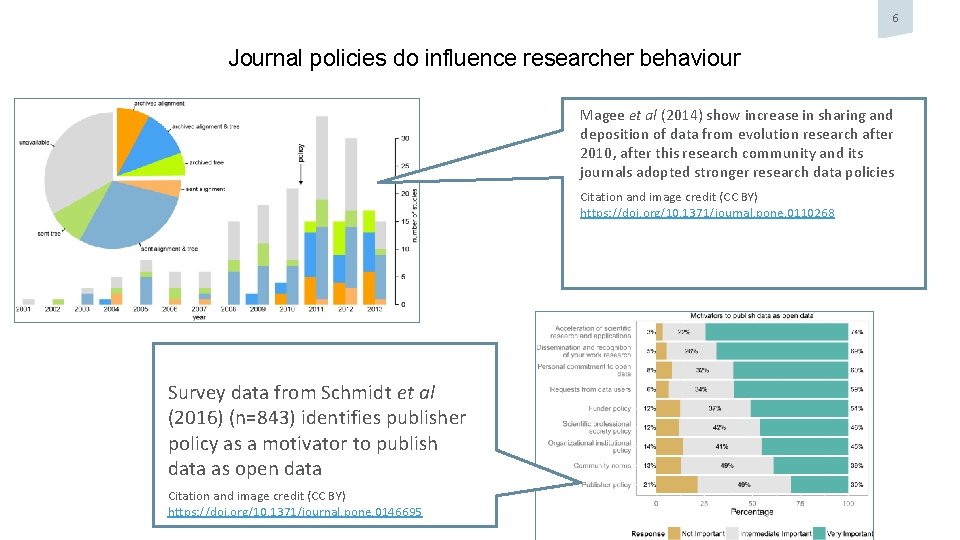
6 Journal policies do influence researcher behaviour Magee et al (2014) show increase in sharing and deposition of data from evolution research after 2010, after this research community and its journals adopted stronger research data policies Citation and image credit (CC BY) https: //doi. org/10. 1371/journal. pone. 0110268 Survey data from Schmidt et al (2016) (n=843) identifies publisher policy as a motivator to publish data as open data Citation and image credit (CC BY) https: //doi. org/10. 1371/journal. pone. 0146695
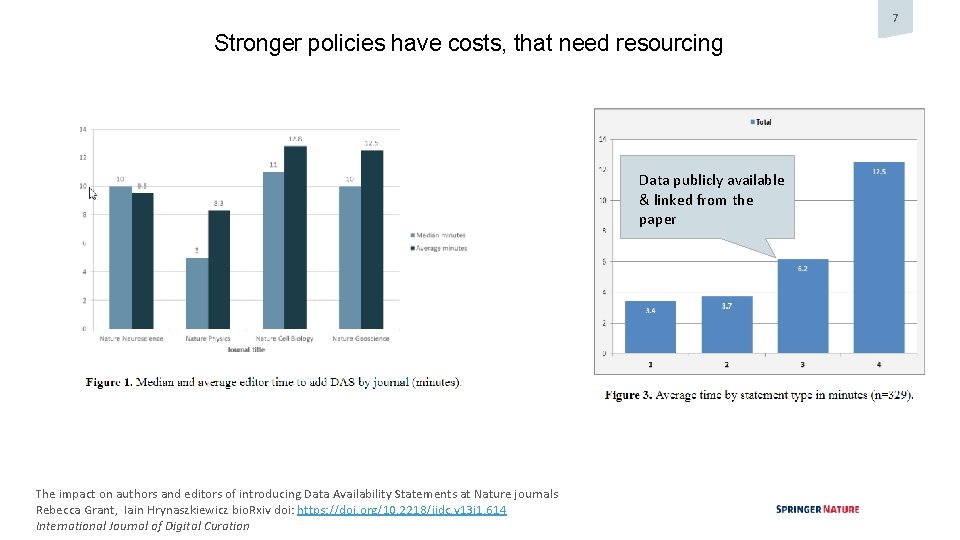
7 Stronger policies have costs, that need resourcing Data publicly available & linked from the paper The impact on authors and editors of introducing Data Availability Statements at Nature journals Rebecca Grant, Iain Hrynaszkiewicz bio. Rxiv doi: https: //doi. org/10. 2218/ijdc. v 13 i 1. 614 International Journal of Digital Curation
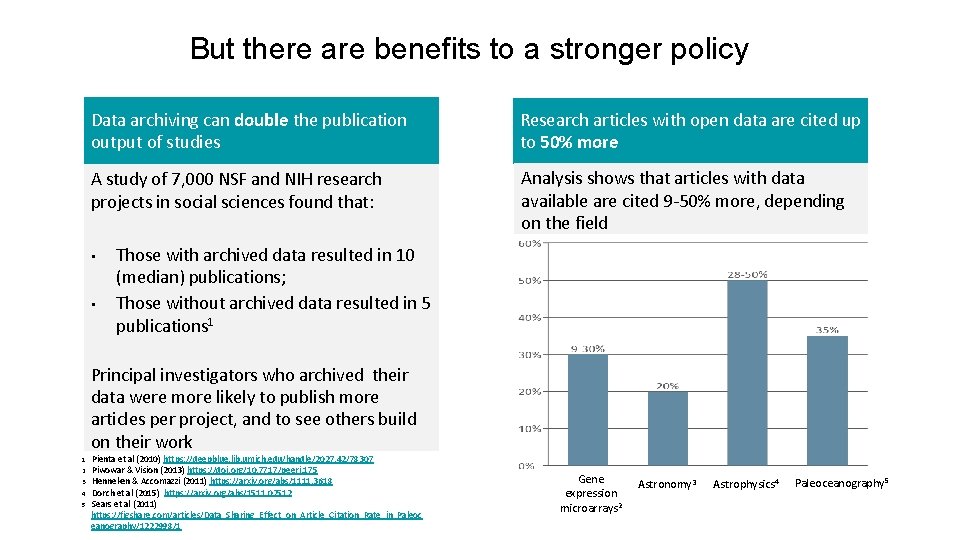
But there are benefits to a stronger policy Data archiving can double the publication output of studies Research articles with open data are cited up to 50% more A study of 7, 000 NSF and NIH research projects in social sciences found that: Analysis shows that articles with data available are cited 9 -50% more, depending on the field • • Those with archived data resulted in 10 (median) publications; Those without archived data resulted in 5 publications 1 Principal investigators who archived their data were more likely to publish more articles per project, and to see others build on their work 1. 2. 3. 4. 5. Pienta et al (2010) https: //deepblue. lib. umich. edu/handle/2027. 42/78307 Piwowar & Vision (2013) https: //doi. org/10. 7717/peerj. 175 Henneken & Accomazzi (2011) https: //arxiv. org/abs/1111. 3618 Dorch et al (2015) https: //arxiv. org/abs/1511. 02512 Sears et al (2011) https: //figshare. com/articles/Data_Sharing_Effect_on_Article_Citation_Rate_in_Paleoc eanography/1222998/1 Gene expression microarrays 2 Astronomy 3 Astrophysics 4 Paleoceanography 5
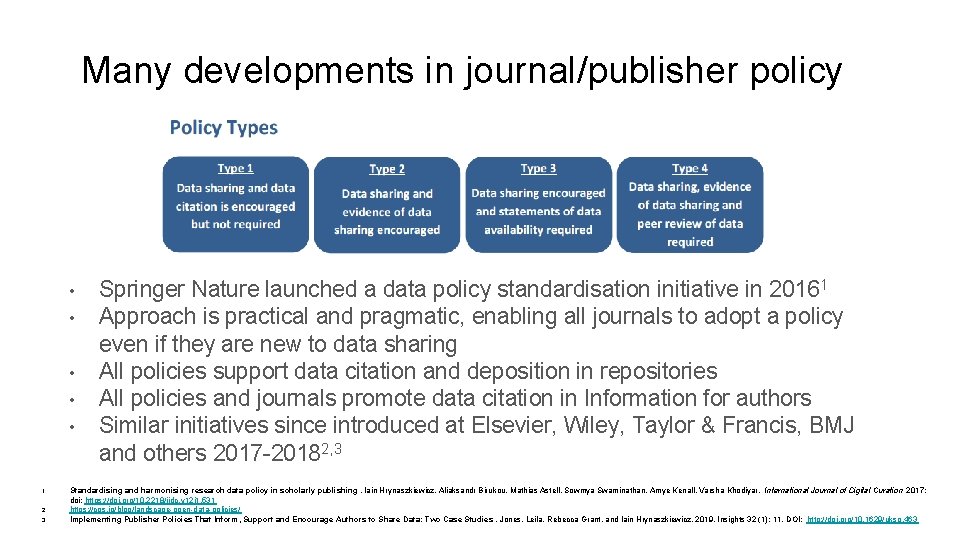
Many developments in journal/publisher policy • • • 1. 2. 3. Springer Nature launched a data policy standardisation initiative in 20161 Approach is practical and pragmatic, enabling all journals to adopt a policy even if they are new to data sharing All policies support data citation and deposition in repositories All policies and journals promote data citation in Information for authors Similar initiatives since introduced at Elsevier, Wiley, Taylor & Francis, BMJ and others 2017 -20182, 3 Standardising and harmonising research data policy in scholarly publishing. Iain Hrynaszkiewicz, Aliaksandr Birukou, Mathias Astell, Sowmya Swaminathan, Amye Kenall, Varsha Khodiyar. International Journal of Digital Curation 2017; doi: https: //doi. org/10. 2218/ijdc. v 12 i 1. 531 https: //cos. io/blog/landscape-open-data-policies/ Implementing Publisher Policies That Inform, Support and Encourage Authors to Share Data: Two Case Studies. Jones, Leila, Rebecca Grant, and Iain Hrynaszkiewicz. 2019. Insights 32 (1): 11. DOI: http: //doi. org/10. 1629/uksg. 463
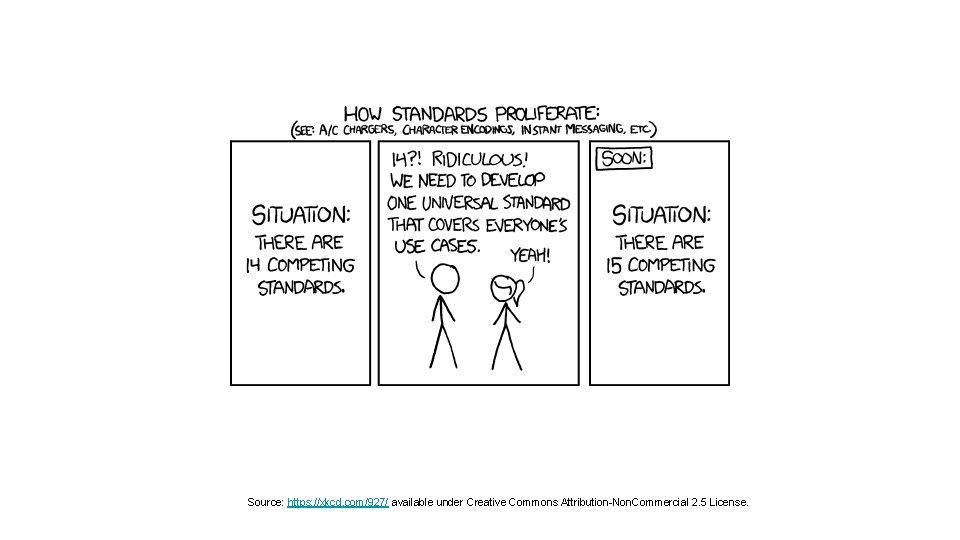
Source: https: //xkcd. com/927/ available under Creative Commons Attribution-Non. Commercial 2. 5 License.
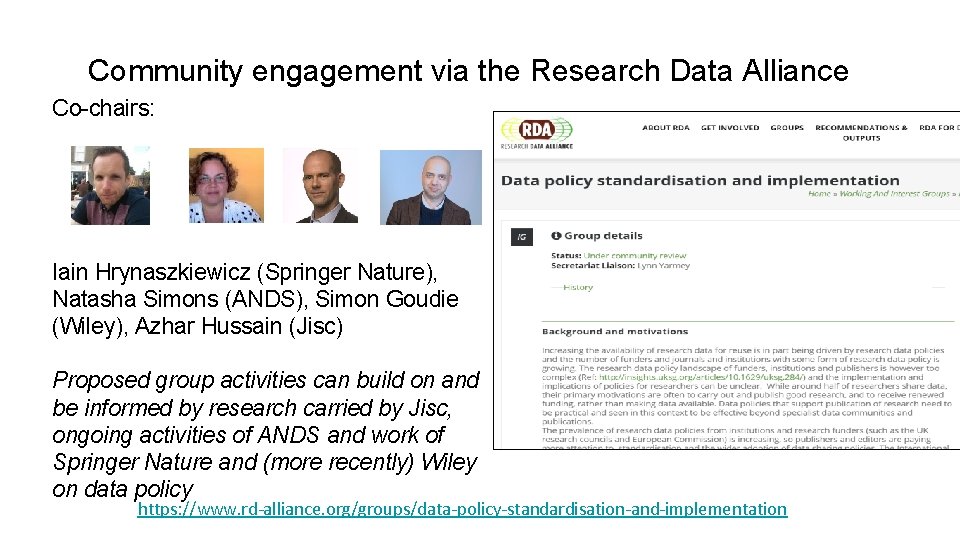
Community engagement via the Research Data Alliance Co-chairs: Iain Hrynaszkiewicz (Springer Nature), Natasha Simons (ANDS), Simon Goudie (Wiley), Azhar Hussain (Jisc) Proposed group activities can build on and be informed by research carried by Jisc, ongoing activities of ANDS and work of Springer Nature and (more recently) Wiley on data policy https: //www. rd-alliance. org/groups/data-policy-standardisation-and-implementation
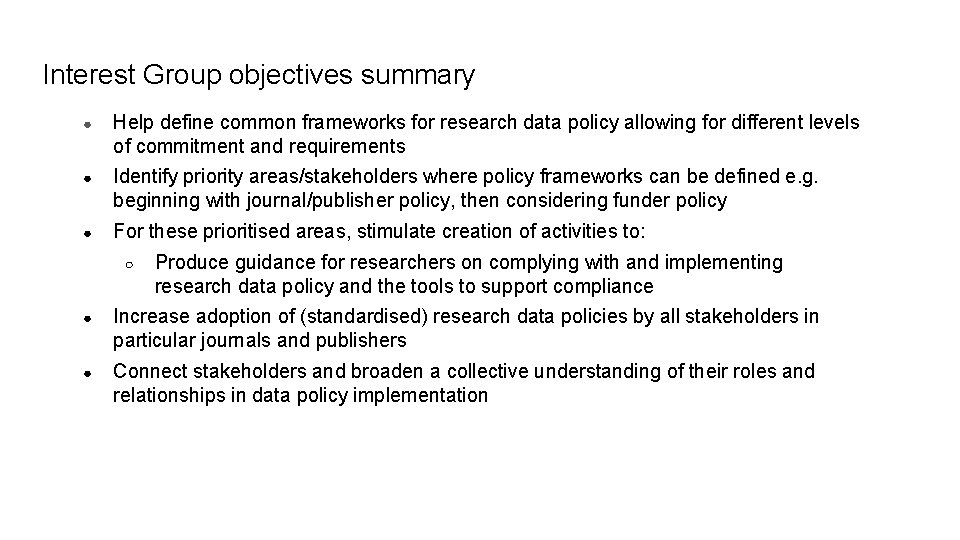
Interest Group objectives summary ● Help define common frameworks for research data policy allowing for different levels of commitment and requirements ● Identify priority areas/stakeholders where policy frameworks can be defined e. g. beginning with journal/publisher policy, then considering funder policy ● For these prioritised areas, stimulate creation of activities to: ○ Produce guidance for researchers on complying with and implementing research data policy and the tools to support compliance ● Increase adoption of (standardised) research data policies by all stakeholders in particular journals and publishers ● Connect stakeholders and broaden a collective understanding of their roles and relationships in data policy implementation
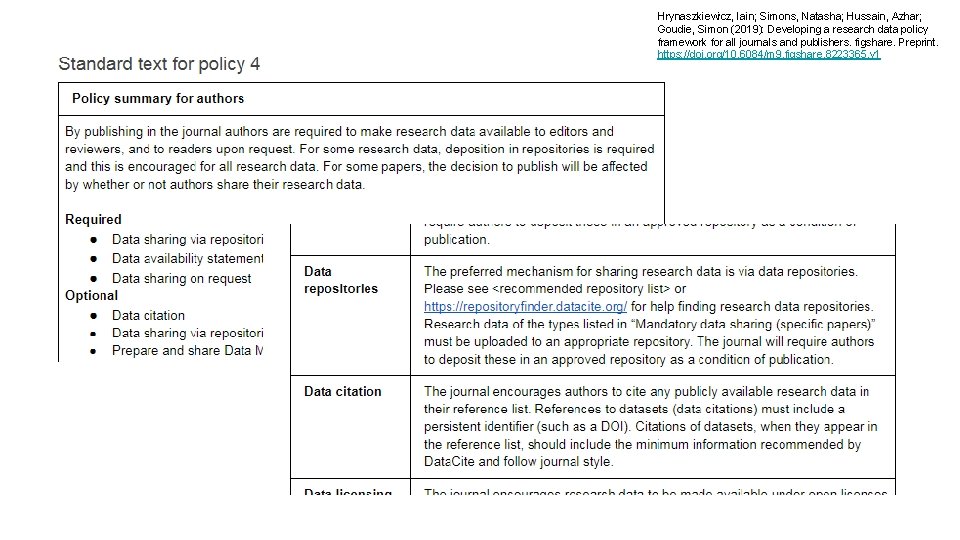
Developing a research data policy framework for all journals and publishers Iain Hrynaszkiewicz, Natasha Simons, Azhar Hussain, Simon Goudie figshare. Preprint. https: //doi. org/10. 6084/m 9. figshare. 8223365. v 1
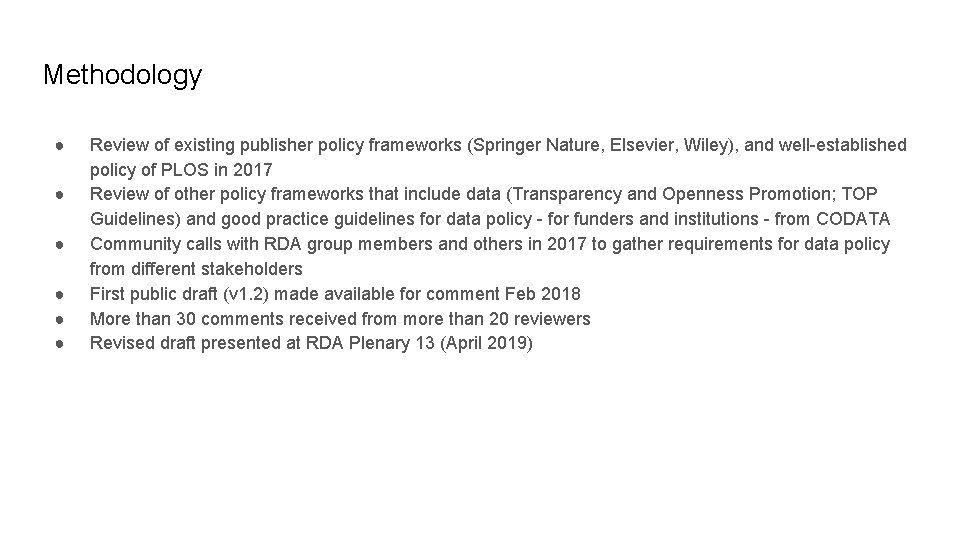
Methodology ● ● ● Review of existing publisher policy frameworks (Springer Nature, Elsevier, Wiley), and well-established policy of PLOS in 2017 Review of other policy frameworks that include data (Transparency and Openness Promotion; TOP Guidelines) and good practice guidelines for data policy - for funders and institutions - from CODATA Community calls with RDA group members and others in 2017 to gather requirements for data policy from different stakeholders First public draft (v 1. 2) made available for comment Feb 2018 More than 30 comments received from more than 20 reviewers Revised draft presented at RDA Plenary 13 (April 2019)
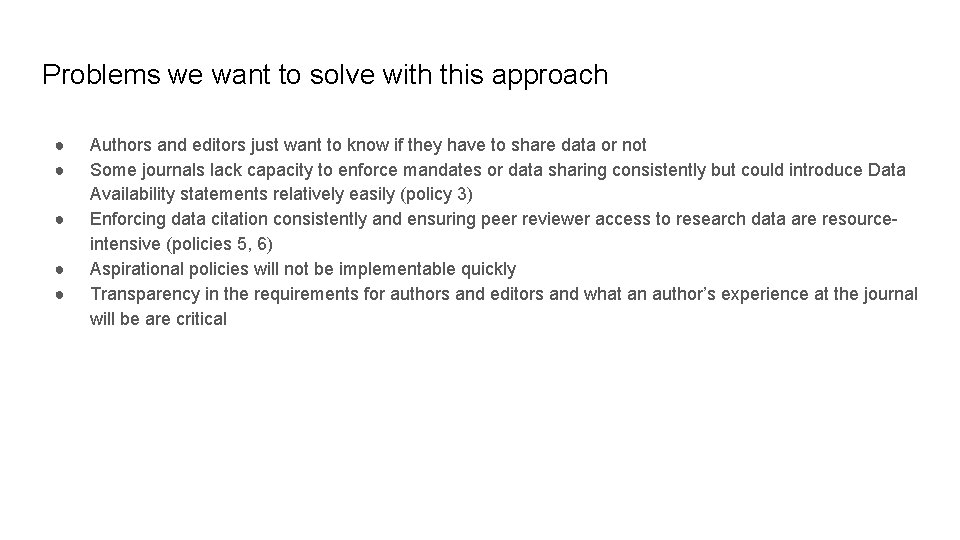
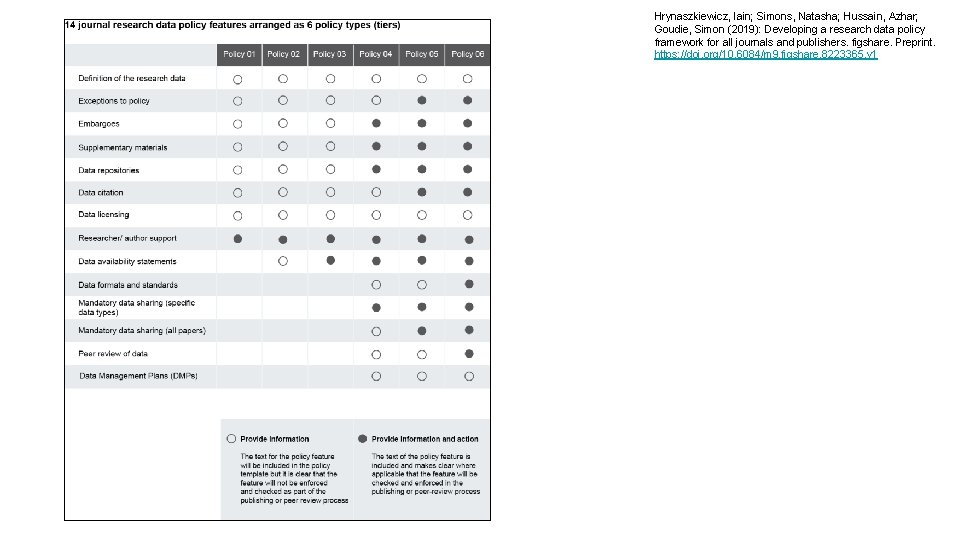
Problems we want to solve with this approach ● ● ● Authors and editors just want to know if they have to share data or not Some journals lack capacity to enforce mandates or data sharing consistently but could introduce Data Availability statements relatively easily (policy 3) Enforcing data citation consistently and ensuring peer reviewer access to research data are resourceintensive (policies 5, 6) Aspirational policies will not be implementable quickly Transparency in the requirements for authors and editors and what an author’s experience at the journal will be are critical
Hrynaszkiewicz, Iain; Simons, Natasha; Hussain, Azhar; Goudie, Simon (2019): Developing a research data policy framework for all journals and publishers. figshare. Preprint. https: //doi. org/10. 6084/m 9. figshare. 8223365. v 1
Hrynaszkiewicz, Iain; Simons, Natasha; Hussain, Azhar; Goudie, Simon (2019): Developing a research data policy framework for all journals and publishers. figshare. Preprint. https: //doi. org/10. 6084/m 9. figshare. 8223365. v 1
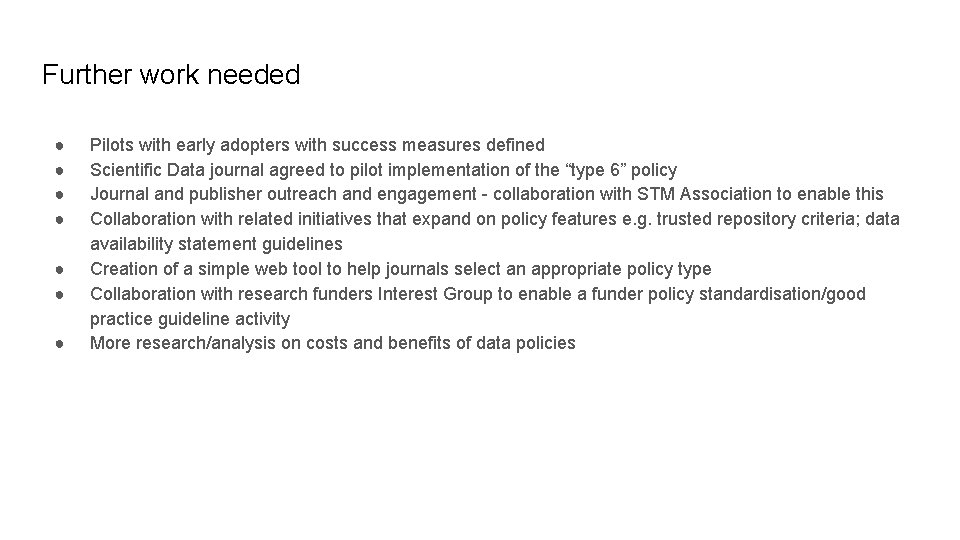
Further work needed ● ● ● ● Pilots with early adopters with success measures defined Scientific Data journal agreed to pilot implementation of the “type 6” policy Journal and publisher outreach and engagement - collaboration with STM Association to enable this Collaboration with related initiatives that expand on policy features e. g. trusted repository criteria; data availability statement guidelines Creation of a simple web tool to help journals select an appropriate policy type Collaboration with research funders Interest Group to enable a funder policy standardisation/good practice guideline activity More research/analysis on costs and benefits of data policies
uth Belmont Forum e-Infrastructures & Data Management: Data Accessibility Statement as a Value-Added Element to Transdisciplinary Global Change Research Tina Lee & Rowena Davis, Project Coordinators Belmont Forum e-I&DM Project
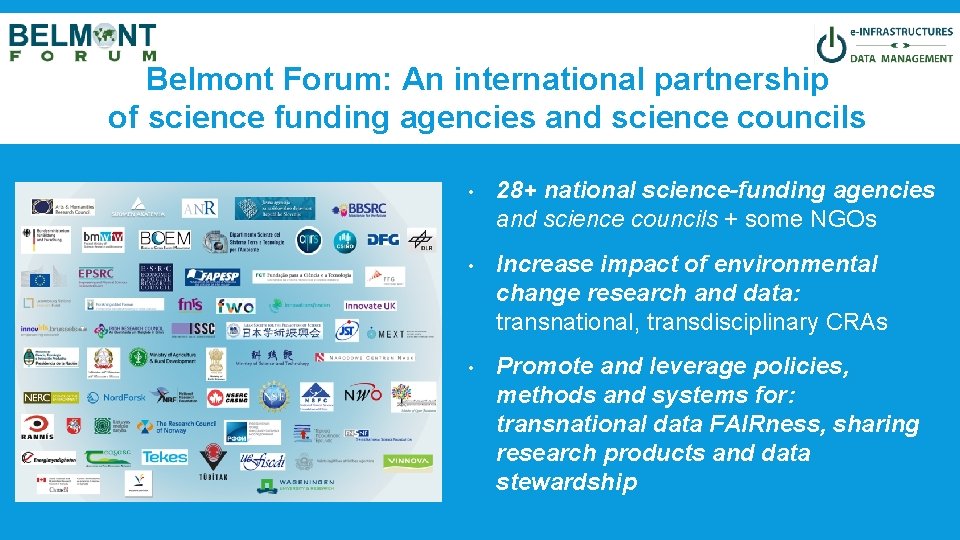
Belmont Forum: An international partnership of science funding agencies and science councils • 28+ national science-funding agencies and science councils + some NGOs • Increase impact of environmental change research and data: transnational, transdisciplinary CRAs • Promote and leverage policies, methods and systems for: transnational data FAIRness, sharing research products and data stewardship
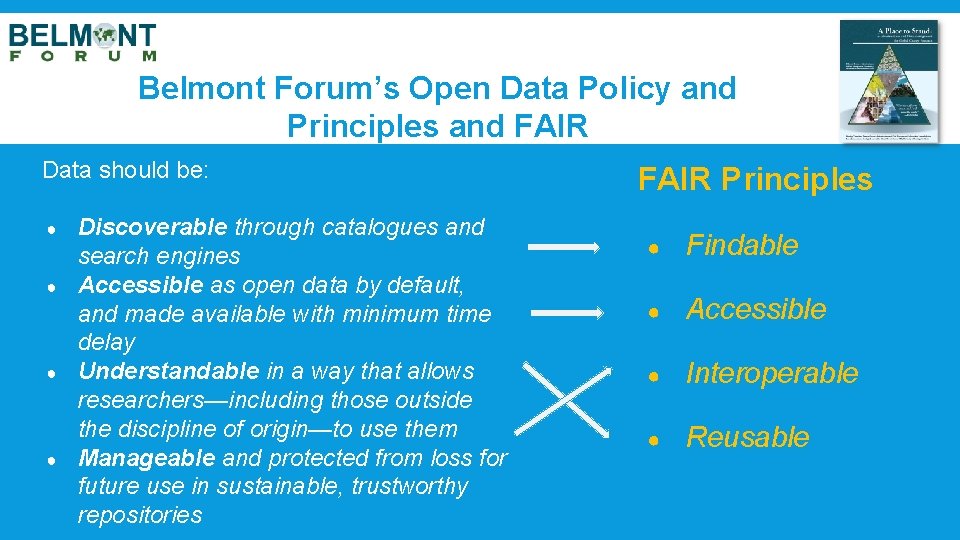
Belmont Forum’s Open Data Policy and Principles and FAIR Data should be: ● ● Discoverable through catalogues and search engines Accessible as open data by default, and made available with minimum time delay Understandable in a way that allows researchers—including those outside the discipline of origin—to use them Manageable and protected from loss for future use in sustainable, trustworthy repositories FAIR Principles ● Findable ● Accessible ● Interoperable ● Reusable
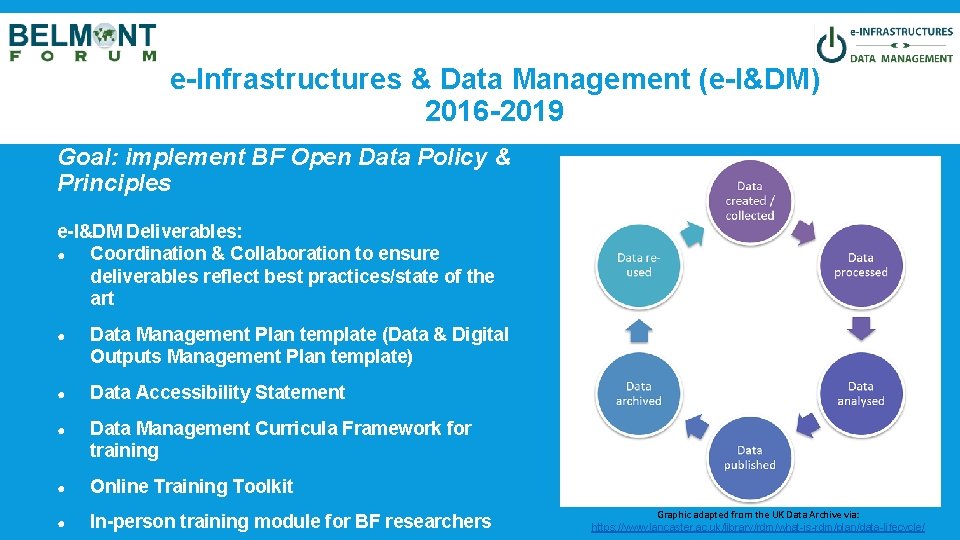
e-Infrastructures & Data Management (e-I&DM) 2016 -2019 Goal: implement BF Open Data Policy & Principles e-I&DM Deliverables: ● Coordination & Collaboration to ensure deliverables reflect best practices/state of the art ● Data Management Plan template (Data & Digital Outputs Management Plan template) ● Data Accessibility Statement ● Data Management Curricula Framework for training ● Online Training Toolkit ● In-person training module for BF researchers Graphic adapted from the UK Data Archive via: https: //www. lancaster. ac. uk/library/rdm/what-is-rdm/plan/data-lifecycle/
Added Value of Open Data in Global Change Research This presentation is focused on BF’s approach to data accessibility and developing a DAS ● Turn the onus of data management into a bonus of a sharable dataset as a project deliverable linked to published work ● Promotes reproducibility (and therefore robusticity of results) ● Deters fraud ● Builds trust and validity in research outcomes
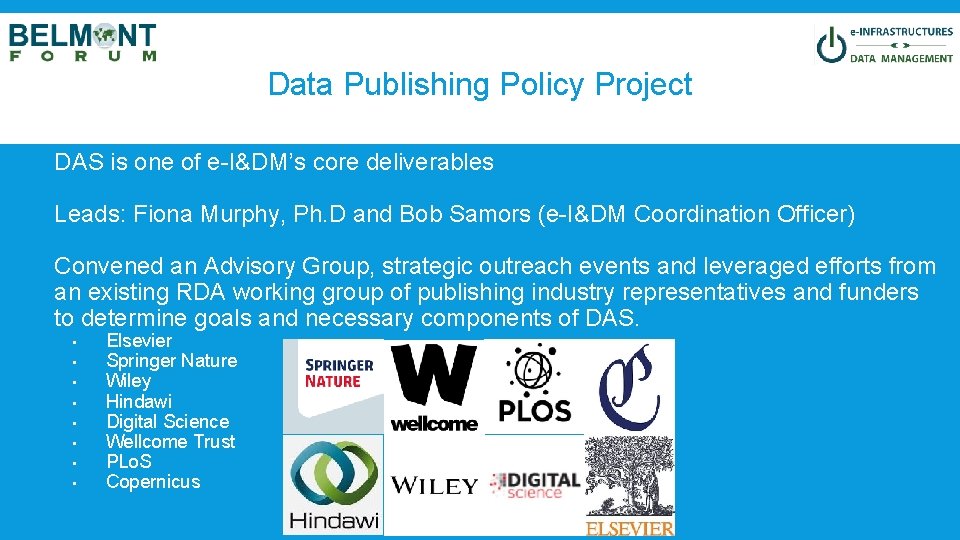
Data Publishing Policy Project DAS is one of e-I&DM’s core deliverables Leads: Fiona Murphy, Ph. D and Bob Samors (e-I&DM Coordination Officer) Convened an Advisory Group, strategic outreach events and leveraged efforts from an existing RDA working group of publishing industry representatives and funders to determine goals and necessary components of DAS. ▪ ▪ ▪ ▪ Elsevier Springer Nature Wiley Hindawi Digital Science Wellcome Trust PLo. S Copernicus
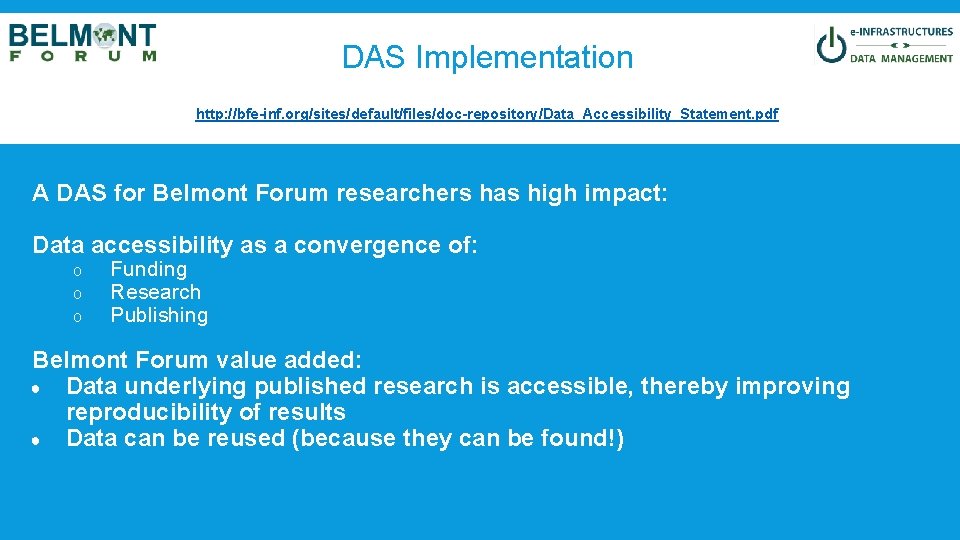
DAS Implementation http: //bfe-inf. org/sites/default/files/doc-repository/Data_Accessibility_Statement. pdf A DAS for Belmont Forum researchers has high impact: Data accessibility as a convergence of: o o o Funding Research Publishing Belmont Forum value added: ● Data underlying published research is accessible, thereby improving reproducibility of results ● Data can be reused (because they can be found!)
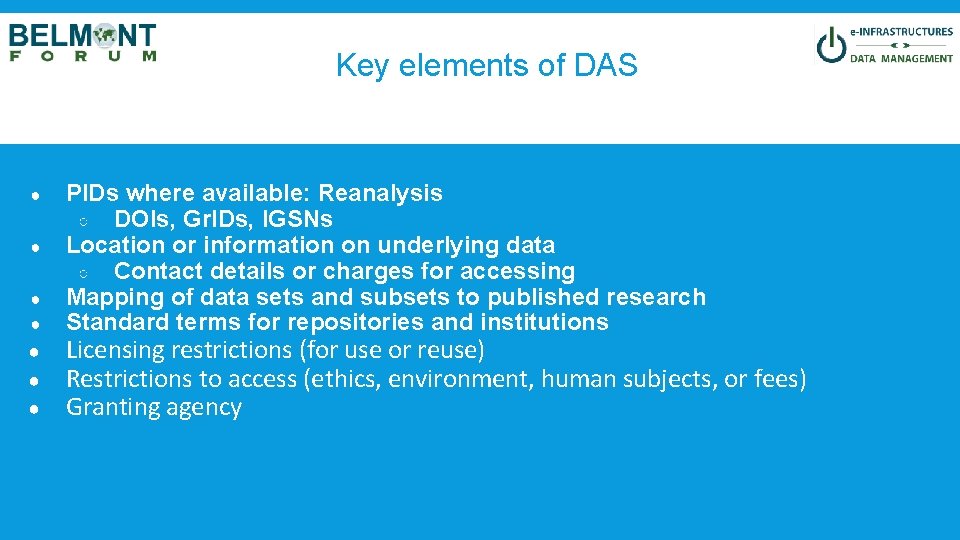
Key elements of DAS ● ● ● ● PIDs where available: Reanalysis ○ DOIs, Gr. IDs, IGSNs Location or information on underlying data ○ Contact details or charges for accessing Mapping of data sets and subsets to published research Standard terms for repositories and institutions Licensing restrictions (for use or reuse) Restrictions to access (ethics, environment, human subjects, or fees) Granting agency
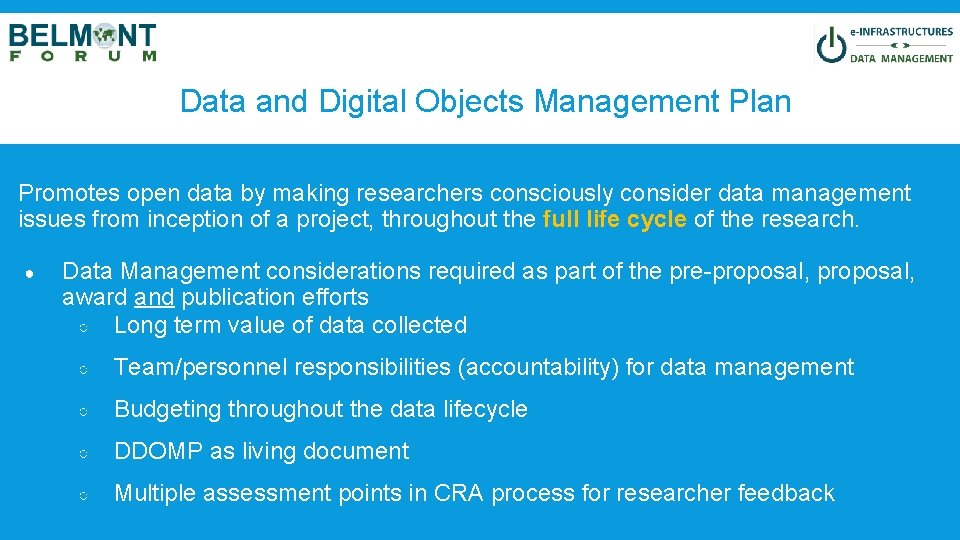
Data and Digital Objects Management Plan Promotes open data by making researchers consciously consider data management issues from inception of a project, throughout the full life cycle of the research. ● Data Management considerations required as part of the pre-proposal, award and publication efforts ○ Long term value of data collected ○ Team/personnel responsibilities (accountability) for data management ○ Budgeting throughout the data lifecycle ○ DDOMP as living document ○ Multiple assessment points in CRA process for researcher feedback
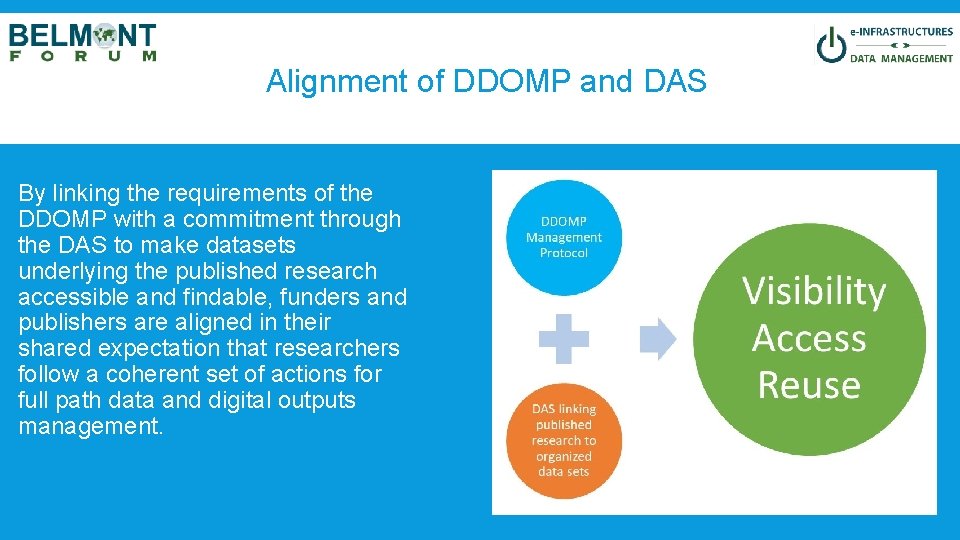
Alignment of DDOMP and DAS By linking the requirements of the DDOMP with a commitment through the DAS to make datasets underlying the published research accessible and findable, funders and publishers are aligned in their shared expectation that researchers follow a coherent set of actions for full path data and digital outputs management.
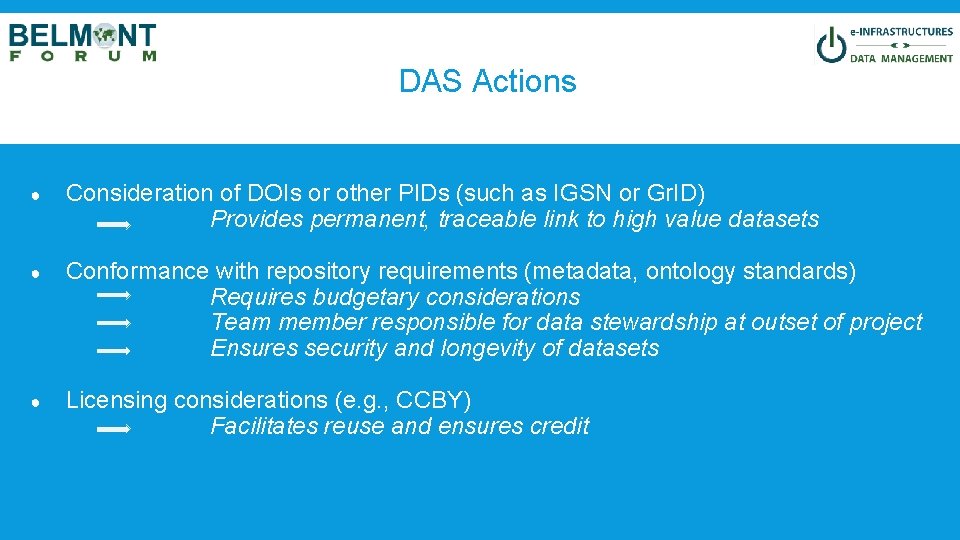
DAS Actions ● Consideration of DOIs or other PIDs (such as IGSN or Gr. ID) Provides permanent, traceable link to high value datasets ● Conformance with repository requirements (metadata, ontology standards) Requires budgetary considerations Team member responsible for data stewardship at outset of project Ensures security and longevity of datasets ● Licensing considerations (e. g. , CCBY) Facilitates reuse and ensures credit
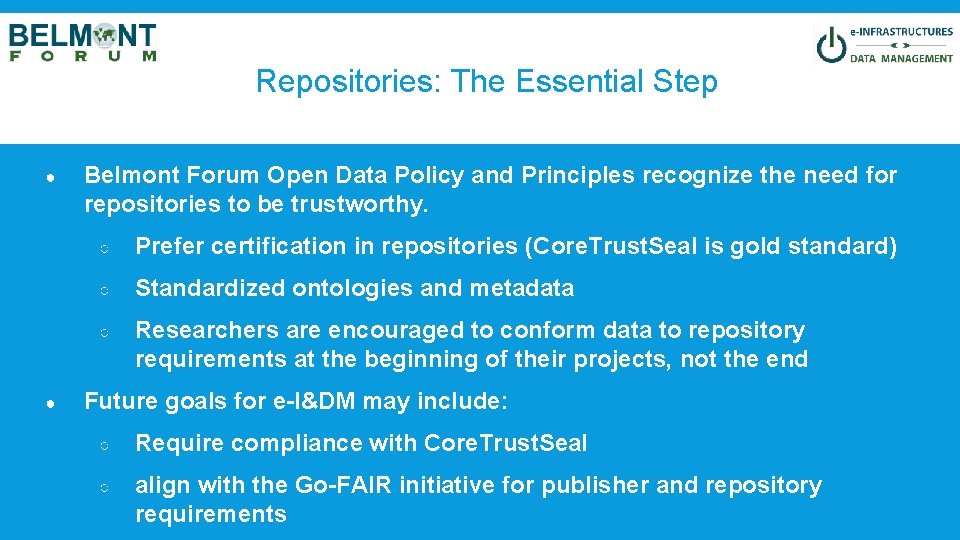
Repositories: The Essential Step ● ● Belmont Forum Open Data Policy and Principles recognize the need for repositories to be trustworthy. ○ Prefer certification in repositories (Core. Trust. Seal is gold standard) ○ Standardized ontologies and metadata ○ Researchers are encouraged to conform data to repository requirements at the beginning of their projects, not the end Future goals for e-I&DM may include: ○ Require compliance with Core. Trust. Seal ○ align with the Go-FAIR initiative for publisher and repository requirements
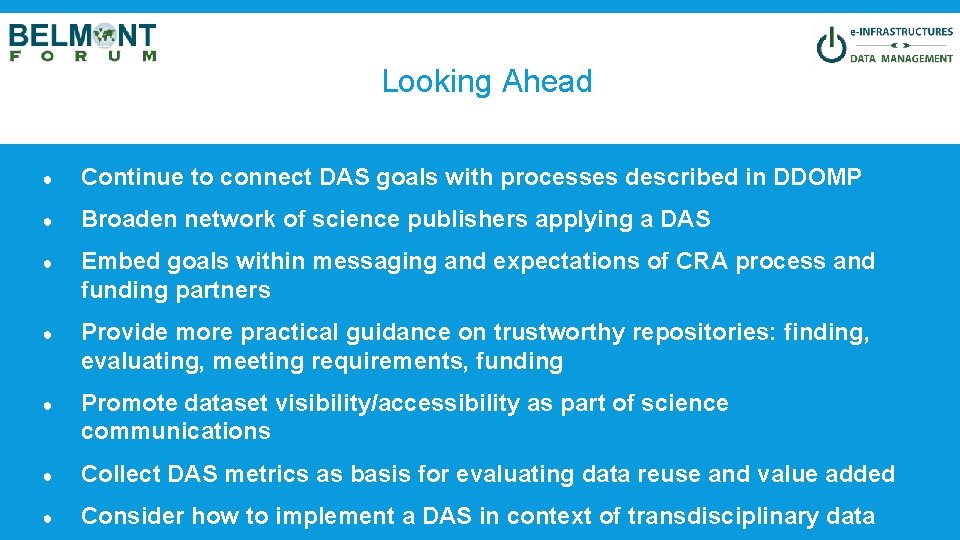
Looking Ahead ● Continue to connect DAS goals with processes described in DDOMP ● Broaden network of science publishers applying a DAS ● Embed goals within messaging and expectations of CRA process and funding partners ● Provide more practical guidance on trustworthy repositories: finding, evaluating, meeting requirements, funding ● Promote dataset visibility/accessibility as part of science communications ● Collect DAS metrics as basis for evaluating data reuse and value added ● Consider how to implement a DAS in context of transdisciplinary data
Acknowledgements Rowena Davis, e-I&DM Coordination Office, AZGS Fiona Murphy, Mitchell Murphy Consulting, UK Robert J. Samors, e-I&DM Coordination Officer Robert Gurney, e-I&DM Co-Lead, NERC/UK Belmont Forum e-I&DM Coordination Office is funded by the U. S. National Science Foundation Award Nos. 1358990 and 1650924
Enabling FAIR Data in the Earth, Space, and Environmental Sciences 6 June 2019 Shelley Stall, AGU Sr. Director, Data Leadership sstall@agu. org @Shelley. Stall https: //orcid. org/0000 -0003 -2926 -8353
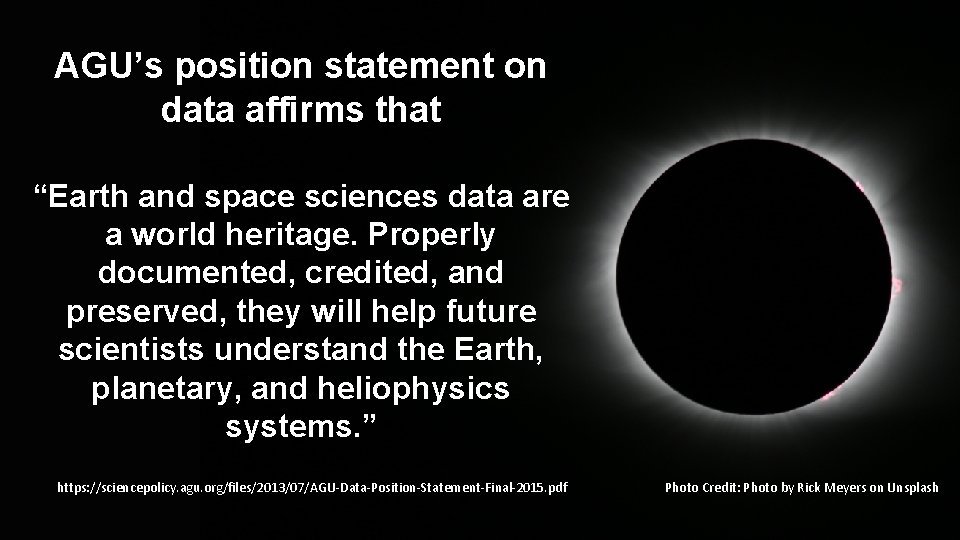
AGU’s position statement on data affirms that “Earth and space sciences data are a world heritage. Properly documented, credited, and preserved, they will help future scientists understand the Earth, planetary, and heliophysics systems. ” https: //sciencepolicy. agu. org/files/2013/07/AGU-Data-Position-Statement-Final-2015. pdf Photo Credit: Photo by Rick Meyers on Unsplash 34
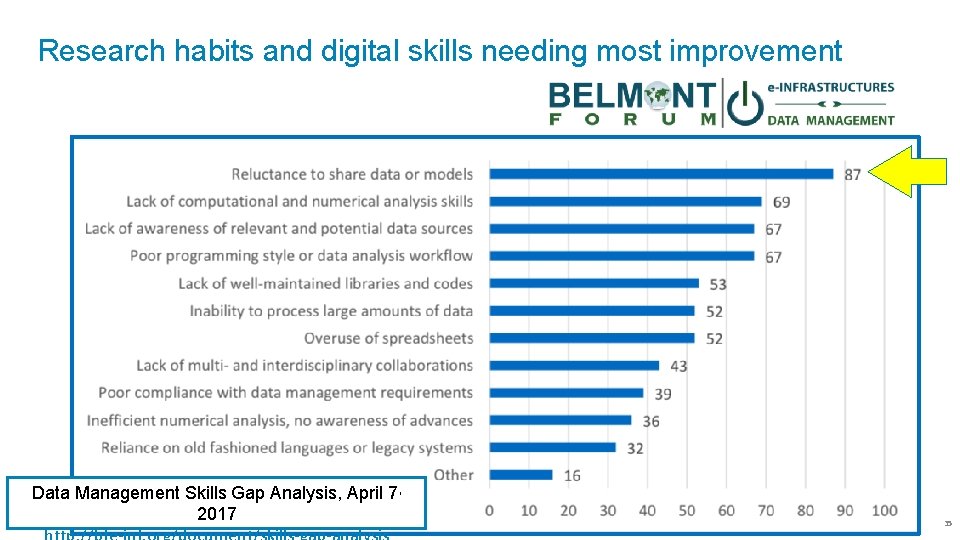
Research habits and digital skills needing most improvement Data Management Skills Gap Analysis, April 7, 2017 35
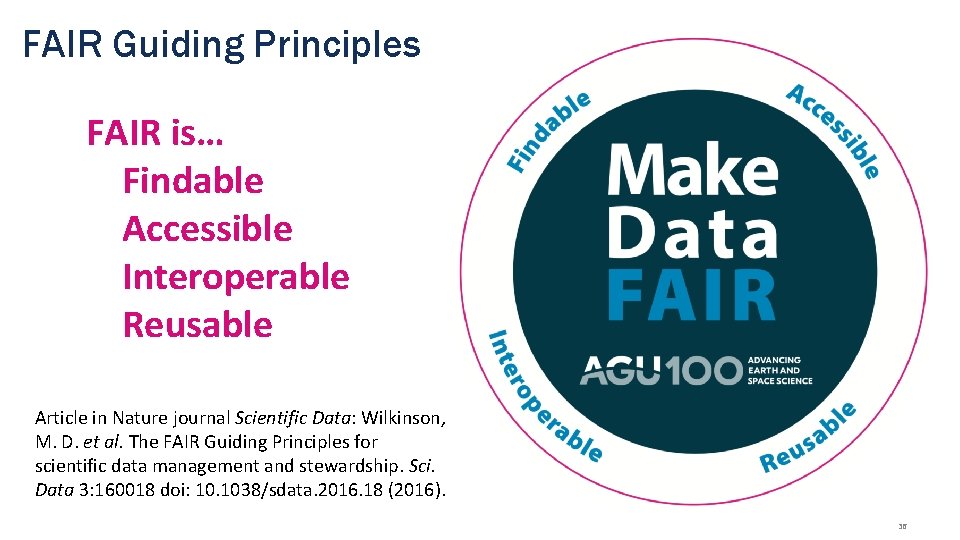
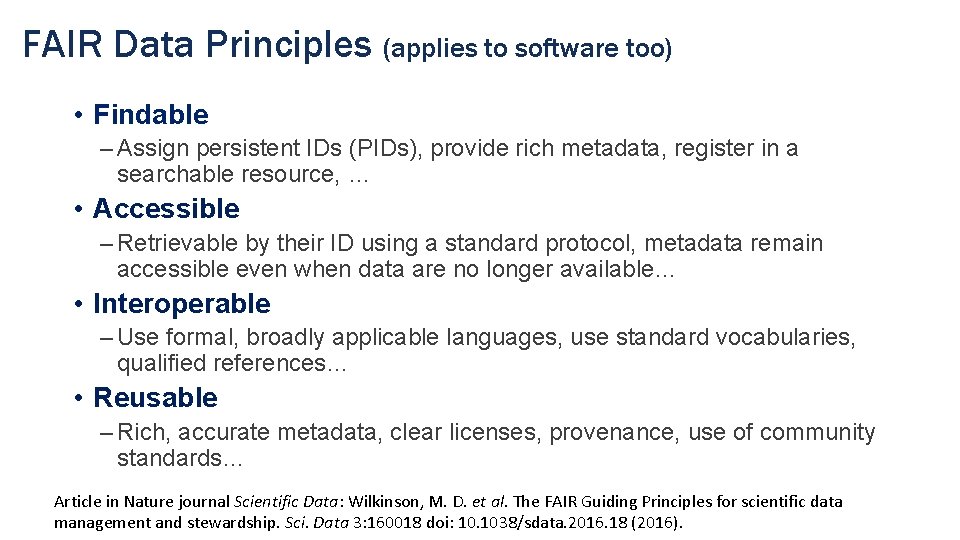
FAIR Guiding Principles FAIR is… Findable Accessible Interoperable Reusable Article in Nature journal Scientific Data: Wilkinson, M. D. et al. The FAIR Guiding Principles for scientific data management and stewardship. Sci. Data 3: 160018 doi: 10. 1038/sdata. 2016. 18 (2016). 36
FAIR Data Principles (applies to software too) • Findable – Assign persistent IDs (PIDs), provide rich metadata, register in a searchable resource, … • Accessible – Retrievable by their ID using a standard protocol, metadata remain accessible even when data are no longer available… • Interoperable – Use formal, broadly applicable languages, use standard vocabularies, qualified references… • Reusable – Rich, accurate metadata, clear licenses, provenance, use of community standards… Article in Nature journal Scientific Data: Wilkinson, M. D. et al. The FAIR Guiding Principles for scientific data management and stewardship. Sci. Data 3: 160018 doi: 10. 1038/sdata. 2016. 18 (2016).
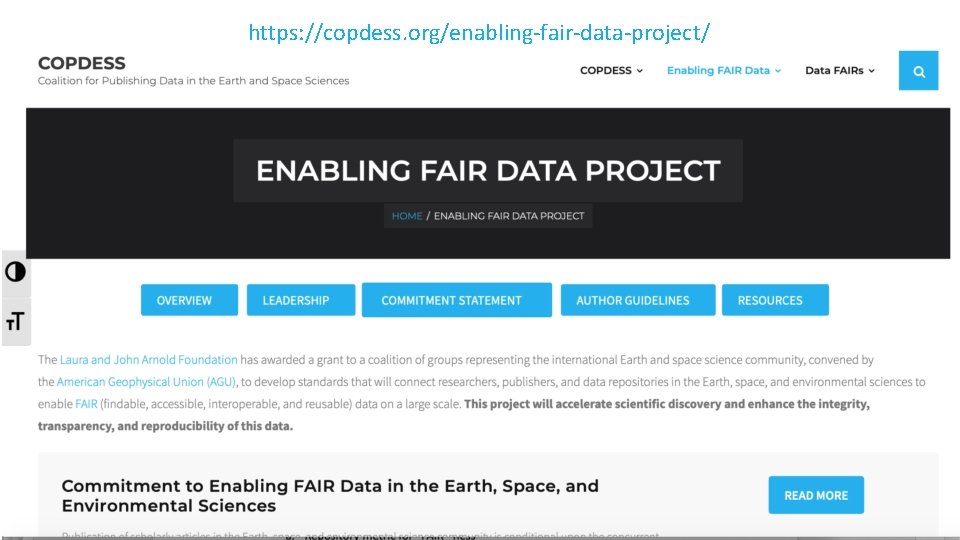
https: //copdess. org/enabling-fair-data-project/ Funded by the Laura and John Arnold Foundation 38
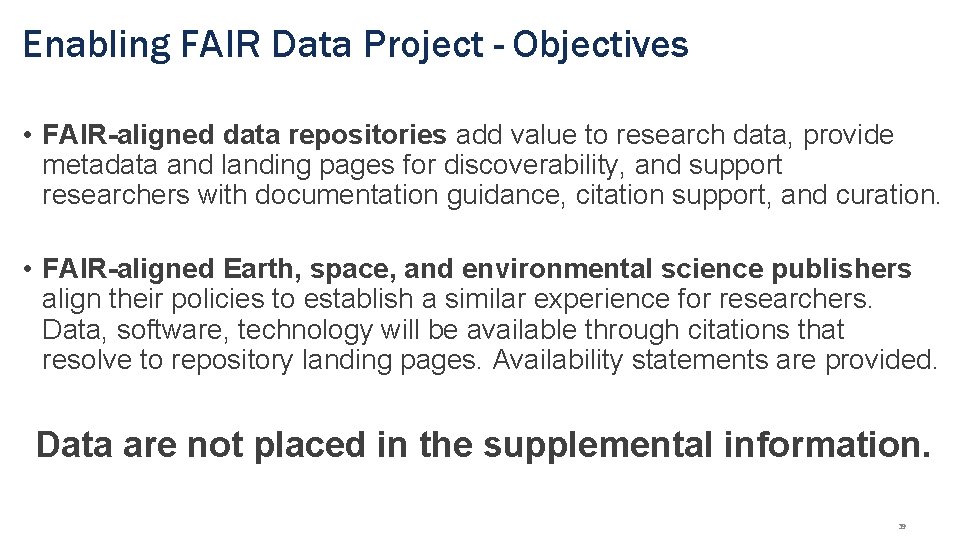
Enabling FAIR Data Project - Objectives • FAIR-aligned data repositories add value to research data, provide metadata and landing pages for discoverability, and support researchers with documentation guidance, citation support, and curation. • FAIR-aligned Earth, space, and environmental science publishers align their policies to establish a similar experience for researchers. Data, software, technology will be available through citations that resolve to repository landing pages. Availability statements are provided. Data are not placed in the supplemental information. 39
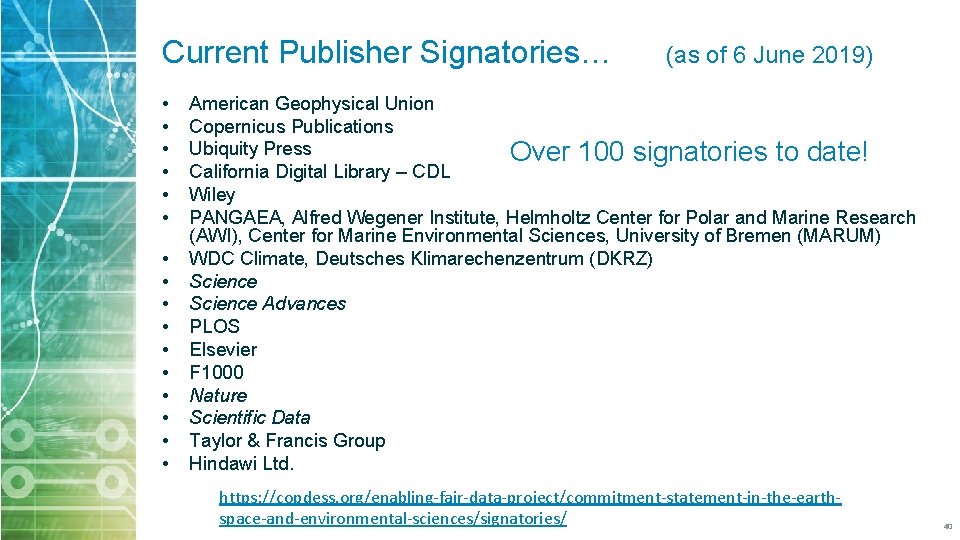
Current Publisher Signatories… • • • • (as of 6 June 2019) American Geophysical Union Copernicus Publications Ubiquity Press Over 100 signatories to date! California Digital Library – CDL Wiley PANGAEA, Alfred Wegener Institute, Helmholtz Center for Polar and Marine Research (AWI), Center for Marine Environmental Sciences, University of Bremen (MARUM) WDC Climate, Deutsches Klimarechenzentrum (DKRZ) Science Advances PLOS Elsevier F 1000 Nature Scientific Data Taylor & Francis Group Hindawi Ltd. https: //copdess. org/enabling-fair-data-project/commitment-statement-in-the-earthspace-and-environmental-sciences/signatories/ 40
FAIR-Aligned: Researcher Commitment • Locating trustworthy, community-accepted, FAIR-aligned repositories that support: – Documenting data and software (and other research outputs as is possible) to agreed community standards that describe provenance and enable discovery, assessment of reliability, and reuse – Persistent identifiers for data and software (and other research outputs as is possible) – Licenses for data and software (and other research outputs as is possible) that is as open as possible to enable the widest potential reuse. • Citing data, software, physical samples, and other research products • Developing data availability statements • Preparing and managing data management plans. Make them living documents. 41
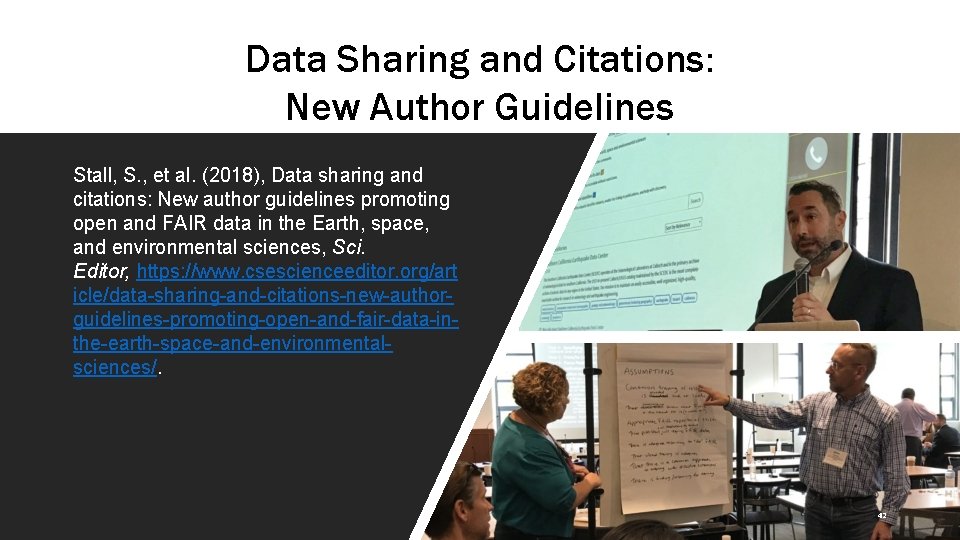
Data Sharing and Citations: New Author Guidelines Stall, S. , et al. (2018), Data sharing and citations: New author guidelines promoting open and FAIR data in the Earth, space, and environmental sciences, Sci. Editor, https: //www. csescienceeditor. org/art icle/data-sharing-and-citations-new-authorguidelines-promoting-open-and-fair-data-inthe-earth-space-and-environmentalsciences/. 42
FAIR-Aligned Publishers - Author Guidelines for Data (1 of 2) • Deposit research data in a FAIR-aligned repository, with a preference for those that explicitly follow the FAIR Data Principles and demonstrate compliance with international standards for data repositories, (e. g. Core. Trust. Seal). • Cite and link to the data in the article, following the Joint Declaration of Data Citation Principles and ESIP Guidelines, using the unique, resolvable, and persistent identifiers provided by the repository in which the data are archived. • Include a Data Availability Statement describing how the data underlying the findings of their article can be accessed and reused. 43
FAIR-Aligned Publishers - Author Guidelines for Data (2 of 2) • Provide unrestricted access to all data and materials underlying reported findings for which ethical or legal constraints do not apply. • A tool to assist in identifying FAIR-aligned repositories is available from Data. Cite and can be found at https: //repositoryfinder. datacite. org. • There may be a need to restrict some access to data because of fragile environments, endangered species, geopolitical tensions or cultural sensitivities (e. g. indigenous land rights). 44
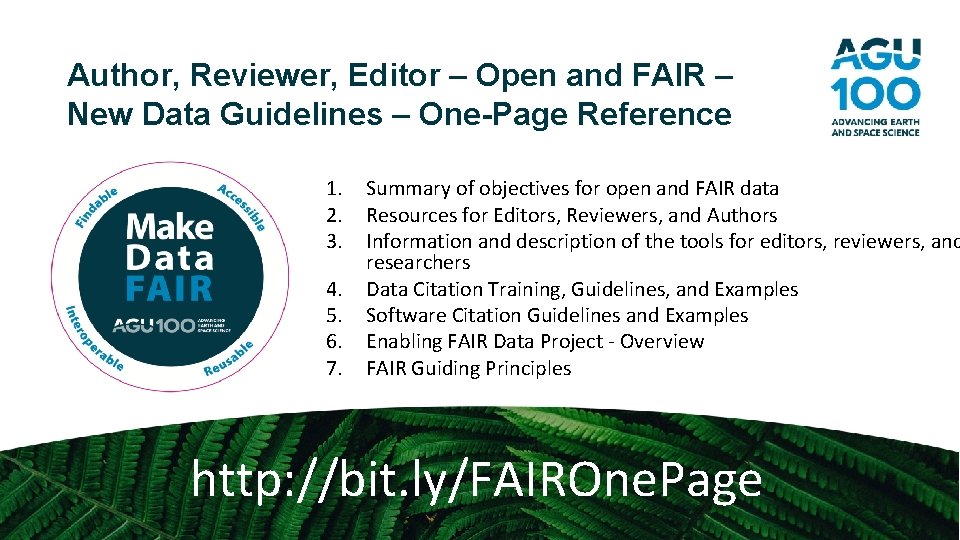
Author, Reviewer, Editor – Open and FAIR – New Data Guidelines – One-Page Reference 1. 2. 3. 4. 5. 6. 7. Summary of objectives for open and FAIR data Resources for Editors, Reviewers, and Authors Information and description of the tools for editors, reviewers, and researchers Data Citation Training, Guidelines, and Examples Software Citation Guidelines and Examples Enabling FAIR Data Project - Overview FAIR Guiding Principles http: //bit. ly/FAIROne. Page
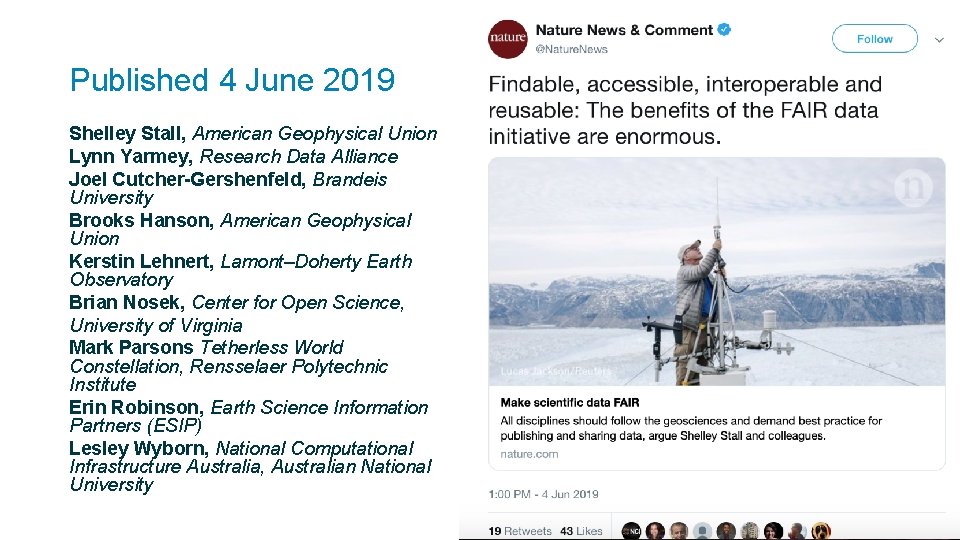
Published 4 June 2019 Shelley Stall, American Geophysical Union Lynn Yarmey, Research Data Alliance Joel Cutcher-Gershenfeld, Brandeis University Brooks Hanson, American Geophysical Union Kerstin Lehnert, Lamont–Doherty Earth Observatory Brian Nosek, Center for Open Science, University of Virginia Mark Parsons Tetherless World Constellation, Rensselaer Polytechnic Institute Erin Robinson, Earth Science Information Partners (ESIP) Lesley Wyborn, National Computational Infrastructure Australia, Australian National University
Things to do: Want information on the author guidelines for data? https: //www. csescienceeditor. org/article/data-sharing-and-citations-new-authorguidelines-promoting-open-and-fair-data-in-the-earth-space-and-environmentalsciences/. Want to be on the email list for updates on Enabling FAIR Data and/or COPDESS? Email sstall@agu. org. [at the moment it is a manual process – keeps costs low] Want to be a signatory of the Enabling FAIR Data Commitment Statement? https: //copdess. org/enabling-fair-data-project/commitment-statement-in-the-earthspace-and-environmental-sciences/. Want to learn more about data citation, Cross. Ref schemas, and making sure they are coded correctly? https: //scholarlykitchen. sspnet. org/2018/12/12/making-magic-happenimplementing-and-contributing-data-citations-in-support-of-todays-scholarship/.
References Stall, S, et al. (2019), Making scientific data FAIR, Nature 570, 27 -29 (2019) doi: 10. 1038/d 41586 -019 -01720 -7 Stall, S. , et al. (2018), Data sharing and citations: New author guidelines promoting open and FAIR data in the Earth, space, and environmental sciences, Sci. Editor, https: //www. csescienceeditor. org/article/data-sharing-and-citations-new-authorguidelines-promoting-open-and-fair-data-in-the-earth-space-and-environmental-sciences/. Hanson, Brooks, et al. (2018), Making Magic Happen: Implementing and Contributing Data Citations in Support of Today’s Scholarship, Scholarly Kitchen, https: //scholarlykitchen. sspnet. org/2018/12/12/making-magic-happen-implementing-andcontributing-data-citations-in-support-of-todays-scholarship/. Published 12 December 2018. Stall, S. , et al. (2018), Advancing FAIR data in Earth, space, and environmental science, Eos, 99, https: //doi. org/10. 1029/2018 EO 109301. Published on 05 November 2018.
Thank you! Shelley Stall AGU Senior Director, Data Leadership sstall@agu. org @Shelley. Stall https: //orcid. org/0000 -0003 -2926 -8353 49
Questions? Unless otherwise specified these slides are made available by OASPA under a CC BY 4. 0 License
Thank you! Thank you for joining us today Contact us at Info@oaspa. org or view our website at www. oaspa. org Unless otherwise specified these slides are made available by OASPA under a CC BY 4. 0 License