
6 th International Particle Accelerator Conference May 3
- Slides: 1
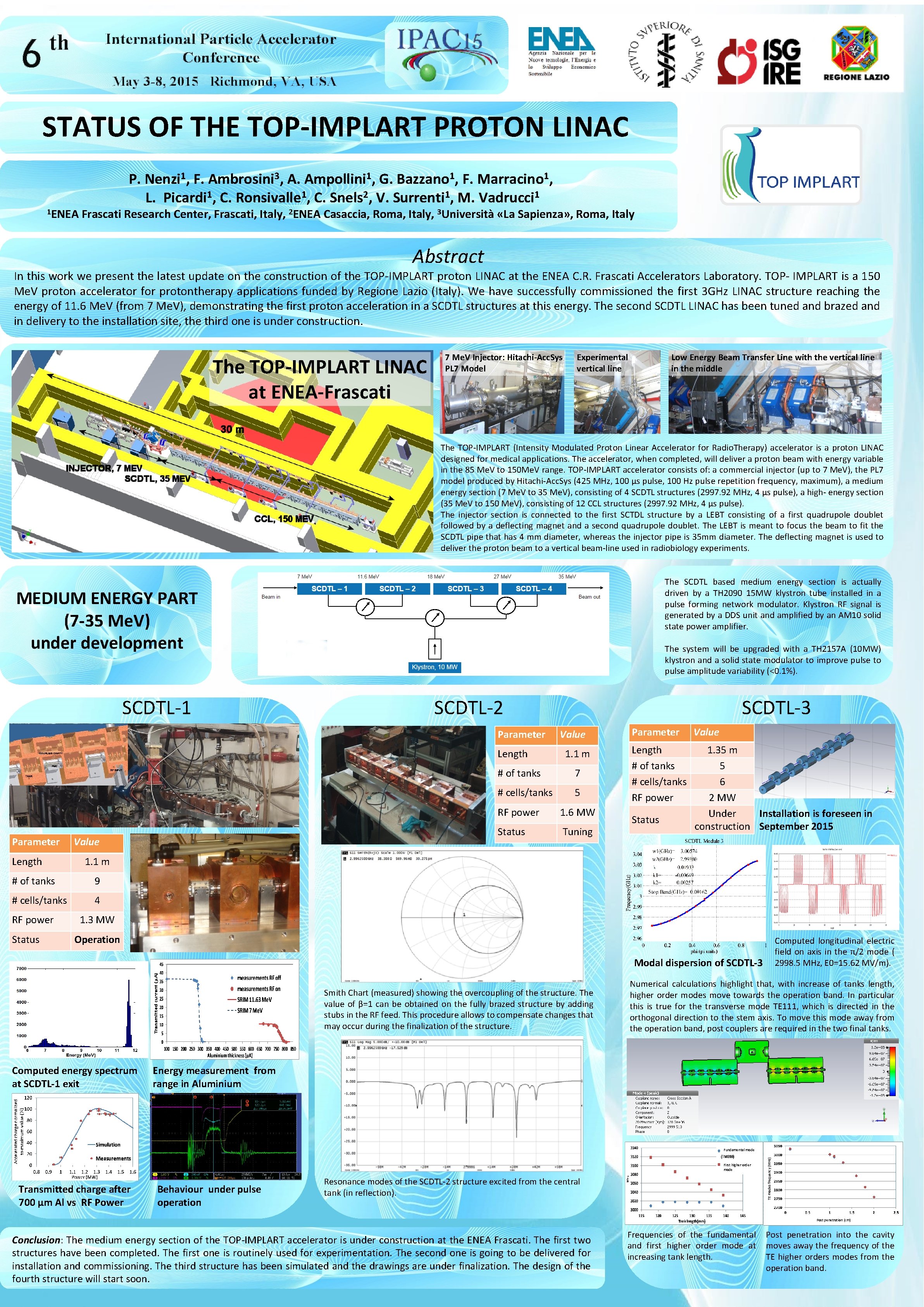
6 th International Particle Accelerator Conference May 3 -8, 2015 Richmond, VA, USA STATUS OF THE TOP-IMPLART PROTON LINAC 1 ENEA P. Nenzi 1, F. Ambrosini 3, A. Ampollini 1, G. Bazzano 1, F. Marracino 1, L. Picardi 1, C. Ronsivalle 1, C. Snels 2, V. Surrenti 1, M. Vadrucci 1 Frascati Research Center, Frascati, Italy, 2 ENEA Casaccia, Roma, Italy, 3 Università «La Sapienza» , Roma, Italy Abstract In this work we present the latest update on the construction of the TOP-IMPLART proton LINAC at the ENEA C. R. Frascati Accelerators Laboratory. TOP- IMPLART is a 150 Me. V proton accelerator for protontherapy applications funded by Regione Lazio (Italy). We have successfully commissioned the first 3 GHz LINAC structure reaching the energy of 11. 6 Me. V (from 7 Me. V), demonstrating the first proton acceleration in a SCDTL structures at this energy. The second SCDTL LINAC has been tuned and brazed and in delivery to the installation site, the third one is under construction. The TOP-IMPLART LINAC at ENEA-Frascati 7 Me. V Injector: Hitachi-Acc. Sys PL 7 Model Experimental vertical line Low Energy Beam Transfer Line with the vertical line in the middle The TOP-IMPLART (Intensity Modulated Proton Linear Accelerator for Radio. Therapy) accelerator is a proton LINAC designed for medical applications. The accelerator, when completed, will deliver a proton beam with energy variable in the 85 Me. V to 150 Me. V range. TOP-IMPLART accelerator consists of: a commercial injector (up to 7 Me. V), the PL 7 model produced by Hitachi-Acc. Sys (425 MHz, 100 μs pulse, 100 Hz pulse repetition frequency, maximum), a medium energy section (7 Me. V to 35 Me. V), consisting of 4 SCDTL structures (2997. 92 MHz, 4 μs pulse), a high- energy section (35 Me. V to 150 Me. V), consisting of 12 CCL structures (2997. 92 MHz, 4 μs pulse). The injector section is connected to the first SCTDL structure by a LEBT consisting of a first quadrupole doublet followed by a deflecting magnet and a second quadrupole doublet. The LEBT is meant to focus the beam to fit the SCDTL pipe that has 4 mm diameter, whereas the injector pipe is 35 mm diameter. The deflecting magnet is used to deliver the proton beam to a vertical beam-line used in radiobiology experiments. The SCDTL based medium energy section is actually driven by a TH 2090 15 MW klystron tube installed in a pulse forming network modulator. Klystron RF signal is generated by a DDS unit and amplified by an AM 10 solid state power amplifier. MEDIUM ENERGY PART (7 -35 Me. V) under development SCDTL-1 The system will be upgraded with a TH 2157 A (10 MW) klystron and a solid state modulator to improve pulse to pulse amplitude variability (<0. 1%). SCDTL-2 Parameter Length Value 9 # cells/tanks 4 Status Value 1. 1 m # of tanks 7 # cells/tanks 5 RF power 1. 6 MW Status Tuning Parameter Value Length # of tanks # cells/tanks RF power 1. 35 m 5 6 2 MW Under Installation is foreseen in construction September 2015 Status 1. 1 m # of tanks RF power SCDTL-3 1. 3 MW Operation Computed longitudinal electric field on axis in the π/2 mode ( 2998. 5 MHz, E 0=15. 62 MV/m). Modal dispersion of SCDTL-3 Smith Chart (measured) showing the overcoupling of the structure. The value of β=1 can be obtained on the fully brazed structure by adding stubs in the RF feed. This procedure allows to compensate changes that may occur during the finalization of the structure. Computed energy spectrum at SCDTL-1 exit Numerical calculations highlight that, with increase of tanks length, higher order modes move towards the operation band. In particular this is true for the transverse mode TE 111, which is directed in the orthogonal direction to the stem axis. To move this mode away from the operation band, post couplers are required in the two final tanks. Energy measurement from range in Aluminium First higher order mode Transmitted charge after 700 µm Al vs RF Power Behaviour under pulse operation Resonance modes of the SCDTL-2 structure excited from the central tank (in reflection). TE modes frequency (MHz) Fundamental mode Post penetration (cm) Conclusion: The medium energy section of the TOP-IMPLART accelerator is under construction at the ENEA Frascati. The first two structures have been completed. The first one is routinely used for experimentation. The second one is going to be delivered for installation and commissioning. The third structure has been simulated and the drawings are under finalization. The design of the fourth structure will start soon. Frequencies of the fundamental and first higher order mode at increasing tank length. Post penetration into the cavity moves away the frequency of the TE higher orders modes from the operation band.