
6 th Grade Using Properties to Generate Equivalent




- Slides: 52
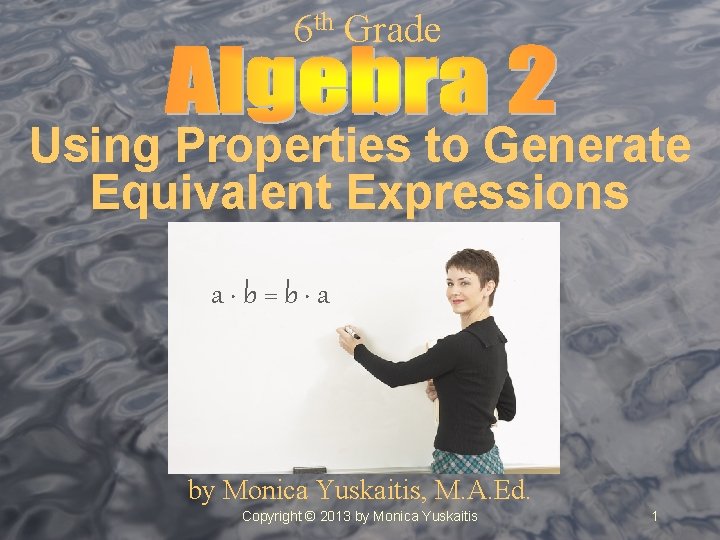
6 th Grade Using Properties to Generate Equivalent Expressions a·b=b·a by Monica Yuskaitis, M. A. Ed. Copyright © 2013 by Monica Yuskaitis 1
Objective • To be able to apply the properties of operations to generate equivalent expressions using: – Zero Property – Identity Property – Commutative Property – Associative Property – Distributive Property Copyright © 2013 by Monica Yuskaitis 2
Essential Question • How can I use properties to generate equivalent expressions? Copyright © 2013 by Monica Yuskaitis 3
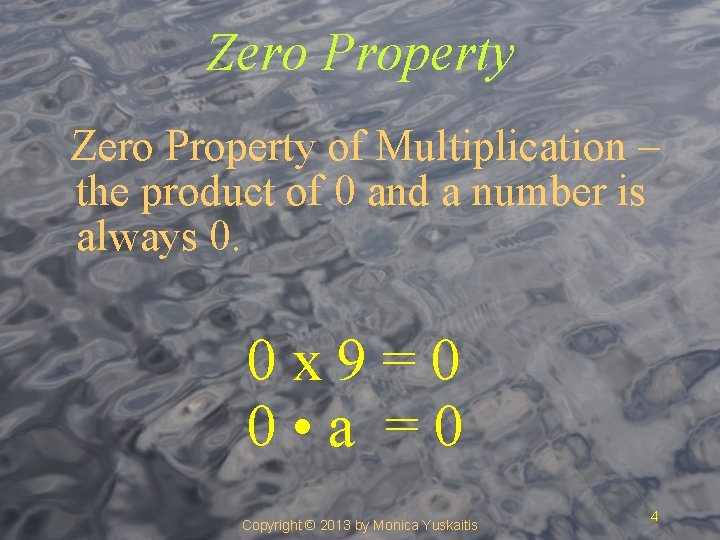
Zero Property of Multiplication – the product of 0 and a number is always 0. 0 x 9=0 0 • a =0 Copyright © 2013 by Monica Yuskaitis 4
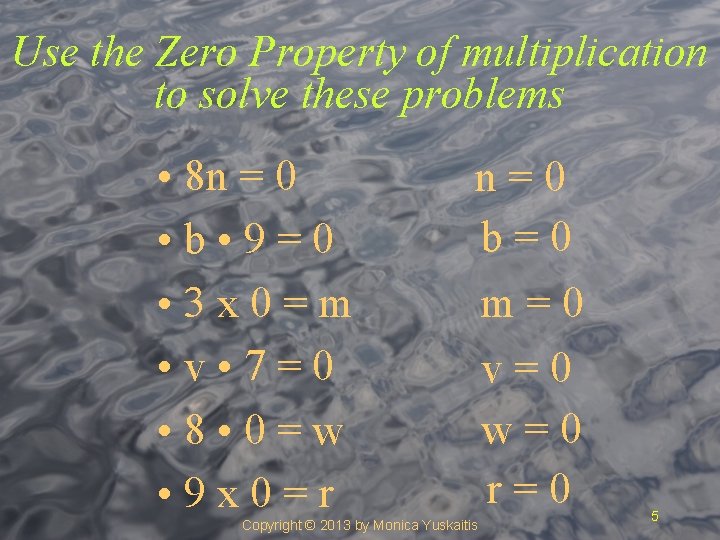
Use the Zero Property of multiplication to solve these problems • 8 n = 0 • b • 9=0 • 3 x 0=m • v • 7=0 • 8 • 0=w • 9 x 0=r n=0 b=0 Copyright © 2013 by Monica Yuskaitis m=0 v=0 w=0 r=0 5
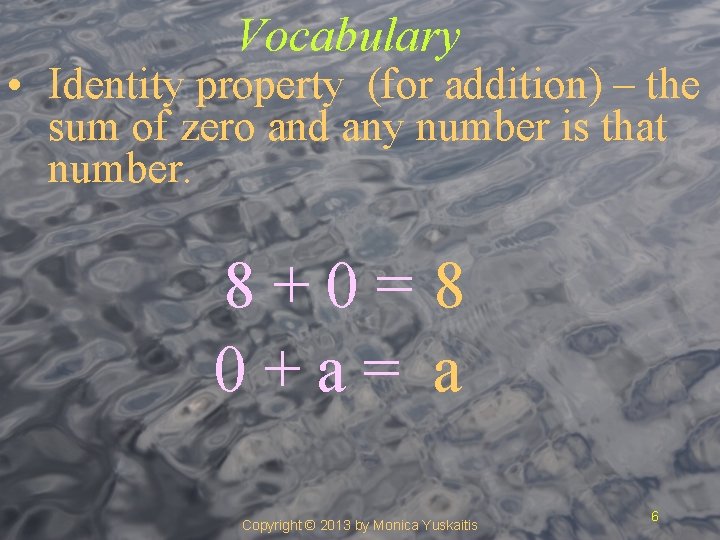
Vocabulary • Identity property (for addition) – the sum of zero and any number is that number. 8+0=8 0+a= a Copyright © 2013 by Monica Yuskaitis 6
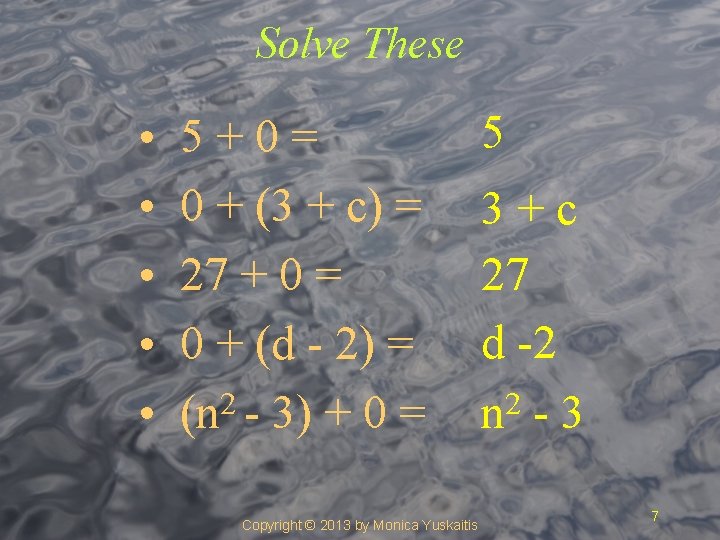
Solve These • • • 5+0= 0 + (3 + c) = 27 + 0 = 0 + (d - 2) = 2 (n - 3) + 0 = Copyright © 2013 by Monica Yuskaitis 5 3+c 27 d -2 n 2 - 3 7
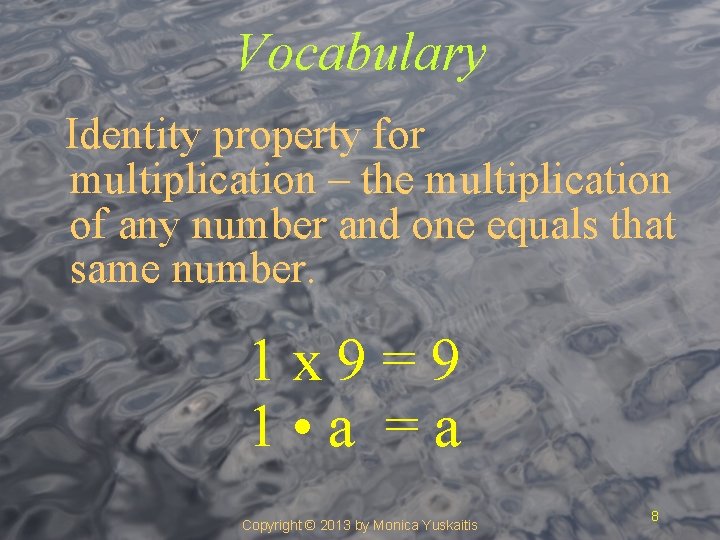
Vocabulary Identity property for multiplication – the multiplication of any number and one equals that same number. 1 x 9=9 1 • a =a Copyright © 2013 by Monica Yuskaitis 8
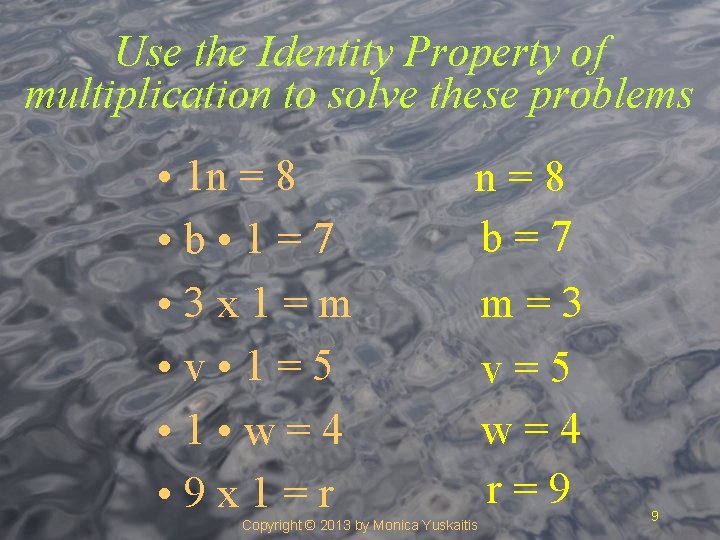
Use the Identity Property of multiplication to solve these problems • 1 n = 8 • b • 1=7 • 3 x 1=m • v • 1=5 • 1 • w=4 • 9 x 1=r n=8 b=7 Copyright © 2013 by Monica Yuskaitis m=3 v=5 w=4 r=9 9
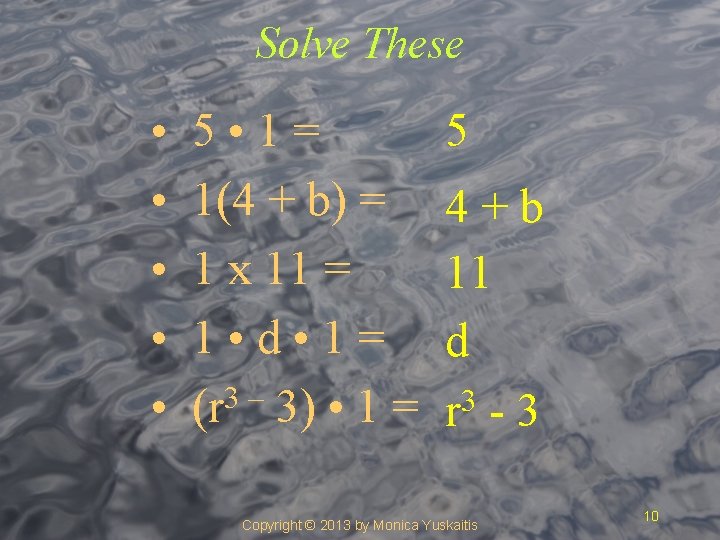
Solve These • • • 5 • 1= 1(4 + b) = 1 x 11 = 1 • d • 1= (r 3 – 3) • 1 = 5 4+b 11 d 3 r -3 Copyright © 2013 by Monica Yuskaitis 10
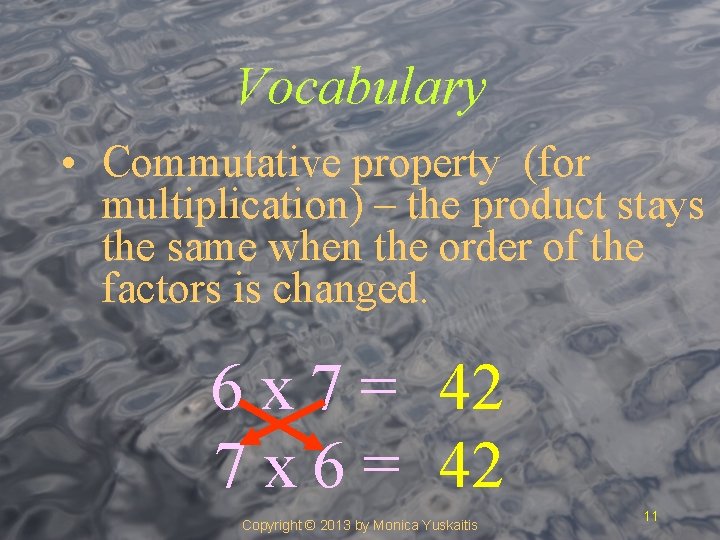
Vocabulary • Commutative property (for multiplication) – the product stays the same when the order of the factors is changed. 6 x 7 = 42 7 x 6 = 42 Copyright © 2013 by Monica Yuskaitis 11
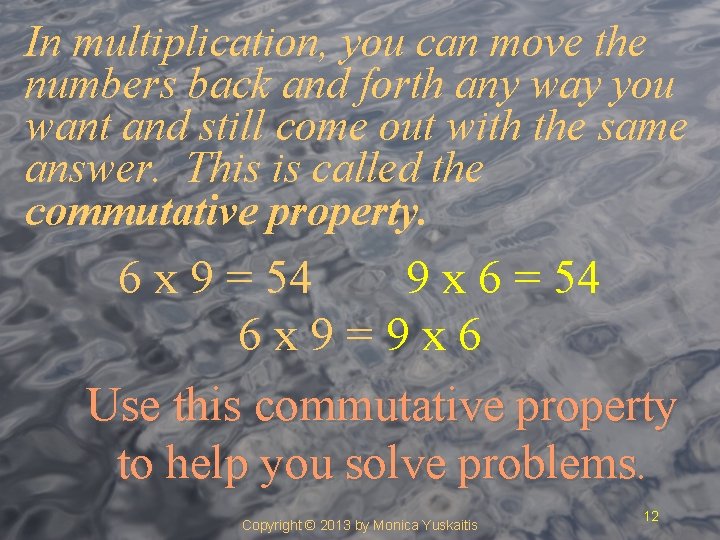
In multiplication, you can move the numbers back and forth any way you want and still come out with the same answer. This is called the commutative property. 6 x 9 = 54 9 x 6 = 54 6 x 9=9 x 6 Use this commutative property to help you solve problems. Copyright © 2013 by Monica Yuskaitis 12
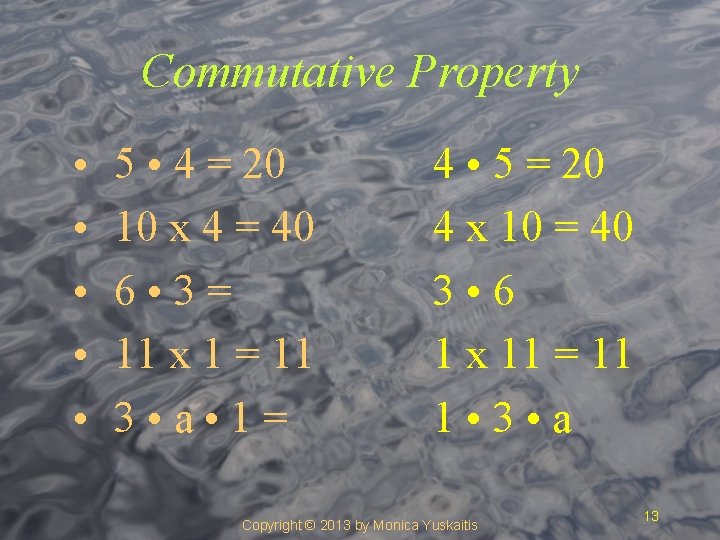
Commutative Property • • • 5 • 4 = 20 10 x 4 = 40 6 • 3= 11 x 1 = 11 3 • a • 1= 4 • 5 = 20 4 x 10 = 40 3 • 6 1 x 11 = 11 1 • 3 • a Copyright © 2013 by Monica Yuskaitis 13
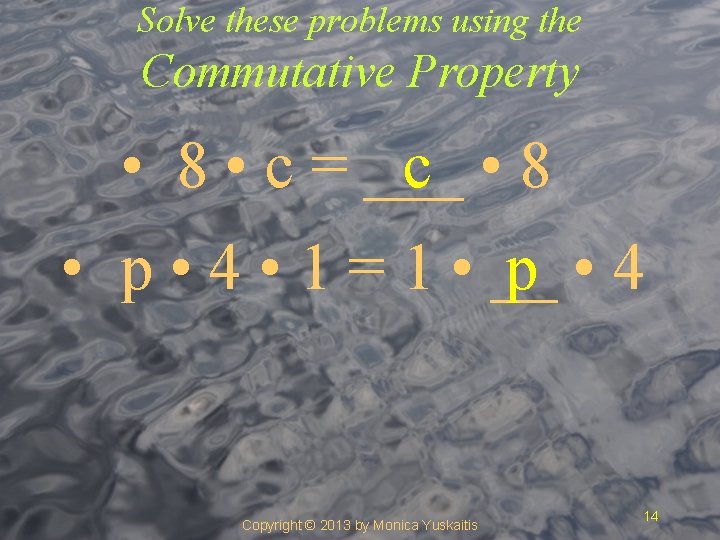
Solve these problems using the Commutative Property c • 8 • c = ___ p • 4 • 1 = 1 • __ Copyright © 2013 by Monica Yuskaitis 14
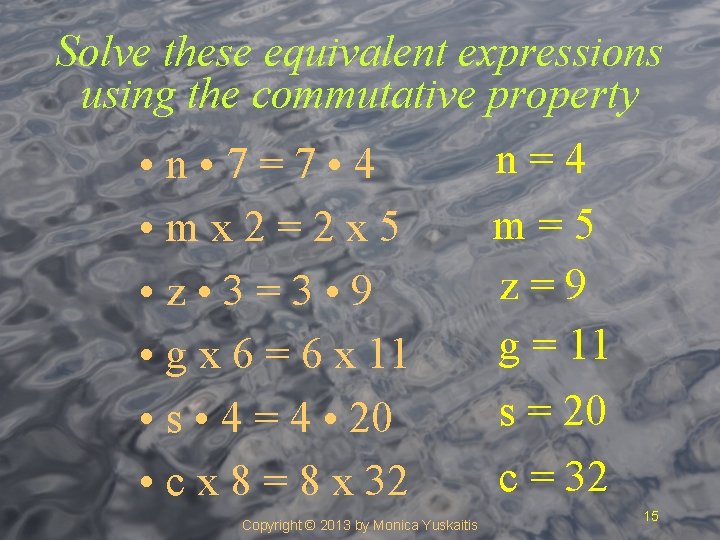
Solve these equivalent expressions using the commutative property n=4 • n • 7=7 • 4 m=5 • mx 2=2 x 5 z=9 • z • 3=3 • 9 g = 11 • g x 6 = 6 x 11 s = 20 • s • 4 = 4 • 20 c = 32 • c x 8 = 8 x 32 Copyright © 2013 by Monica Yuskaitis 15
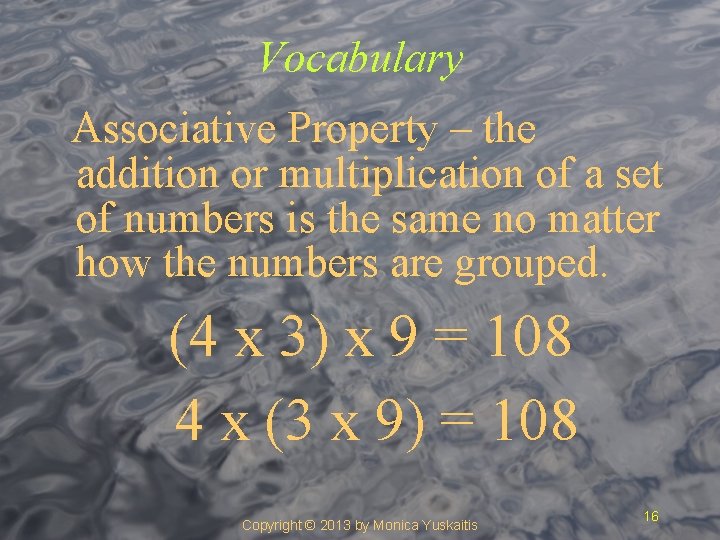
Vocabulary Associative Property – the addition or multiplication of a set of numbers is the same no matter how the numbers are grouped. (4 x 3) x 9 = 108 4 x (3 x 9) = 108 Copyright © 2013 by Monica Yuskaitis 16
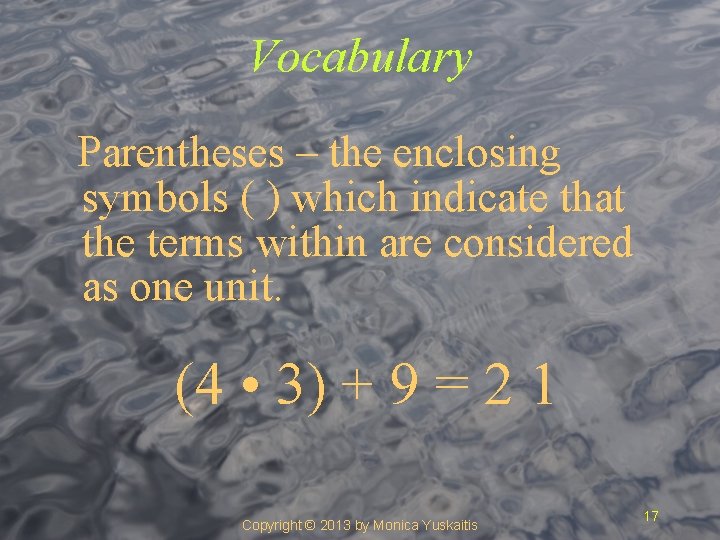
Vocabulary Parentheses – the enclosing symbols ( ) which indicate that the terms within are considered as one unit. (4 • 3) + 9 = 2 1 Copyright © 2013 by Monica Yuskaitis 17
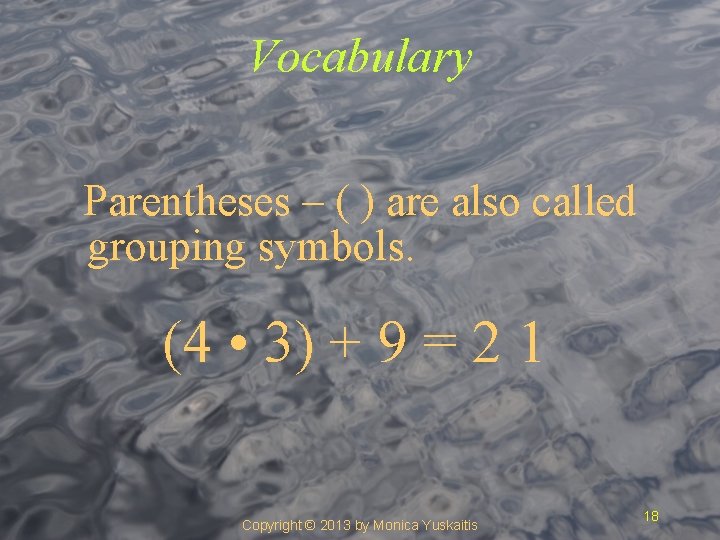
Vocabulary Parentheses – ( ) are also called grouping symbols. (4 • 3) + 9 = 2 1 Copyright © 2013 by Monica Yuskaitis 18
Associative Property The Associative Property is like a man and woman getting married. First, they are each counted separately, then after they are married they are counted as one, even though they are still separate people. Copyright © 2013 by Monica Yuskaitis 19
Before marriage they are counted separately. After the marriage they are considered as one. Copyright © 2013 by Monica Yuskaitis 20
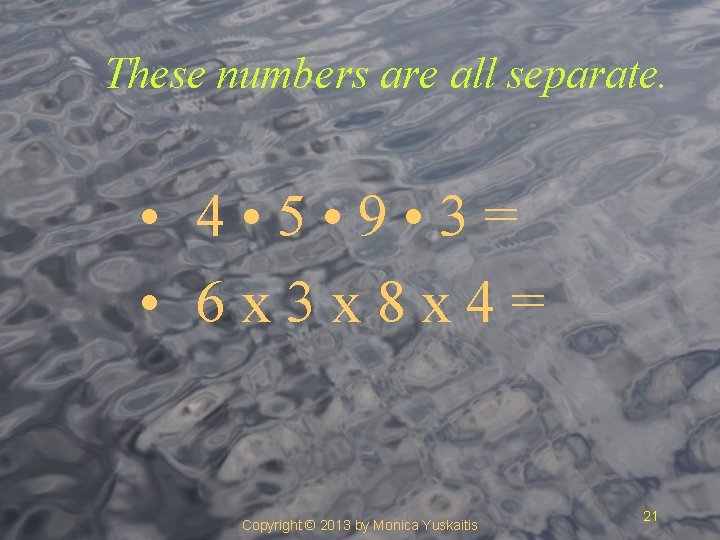
These numbers are all separate. • 4 • 5 • 9 • 3= • 6 x 3 x 8 x 4= Copyright © 2013 by Monica Yuskaitis 21
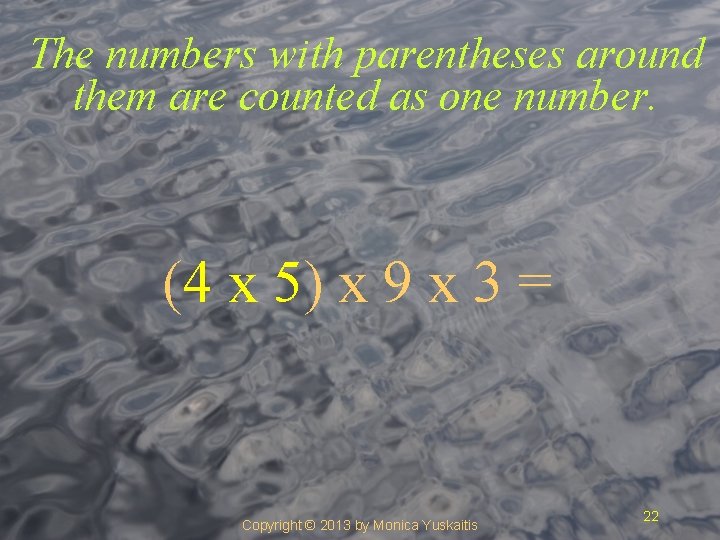
The numbers with parentheses around them are counted as one number. (4 x 5) x 9 x 3 = Copyright © 2013 by Monica Yuskaitis 22
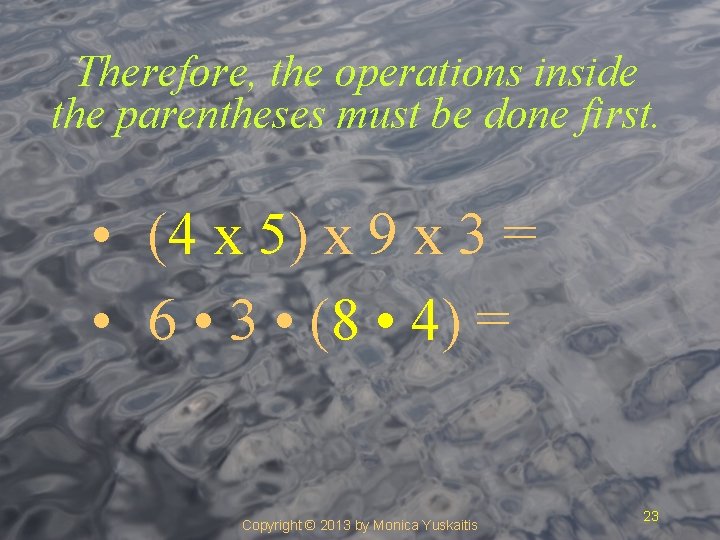
Therefore, the operations inside the parentheses must be done first. • (4 x 5) x 9 x 3 = • 6 • 3 • (8 • 4) = Copyright © 2013 by Monica Yuskaitis 23
The numbers are associated together. Copyright © 2013 by Monica Yuskaitis 24
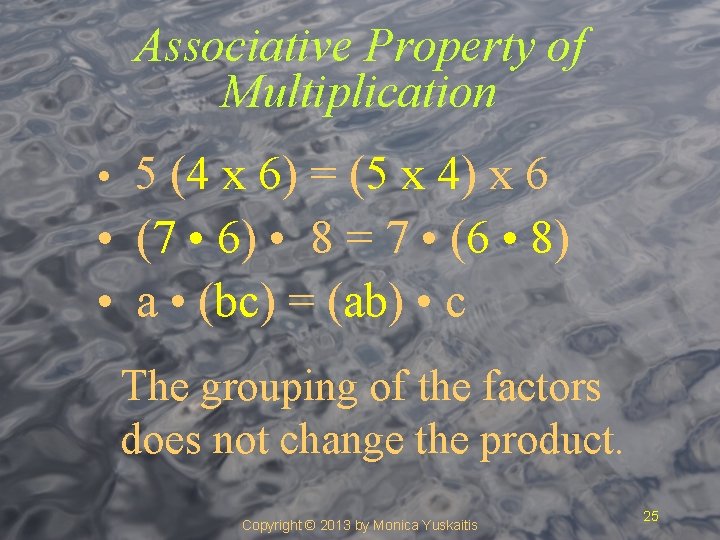
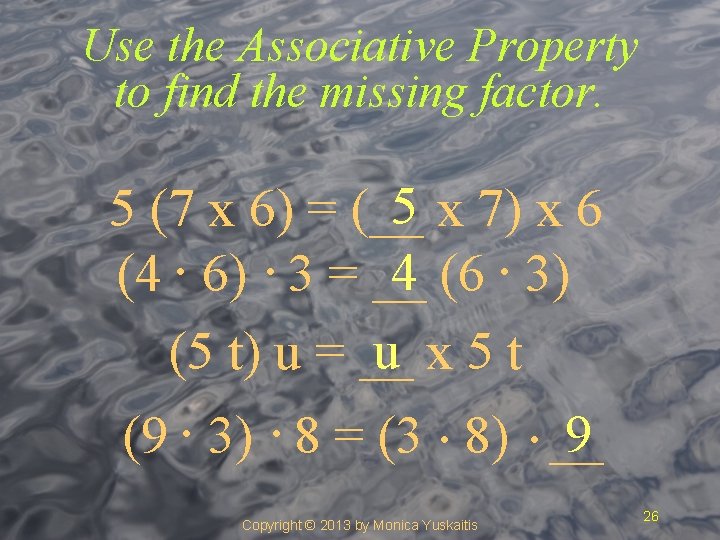
Associative Property of Multiplication • 5 (4 x 6) = (5 x 4) x 6 • (7 • 6) • 8 = 7 • (6 • 8) • a • (bc) = (ab) • c The grouping of the factors does not change the product. Copyright © 2013 by Monica Yuskaitis 25
Use the Associative Property to find the missing factor. 5 x 7) x 6 5 (7 x 6) = (__ 4 (6 · 3) (4 · 6) · 3 = __ u x 5 t (5 t) u = __ 9 (9 · 3) · 8 = (3 · 8) · __ Copyright © 2013 by Monica Yuskaitis 26
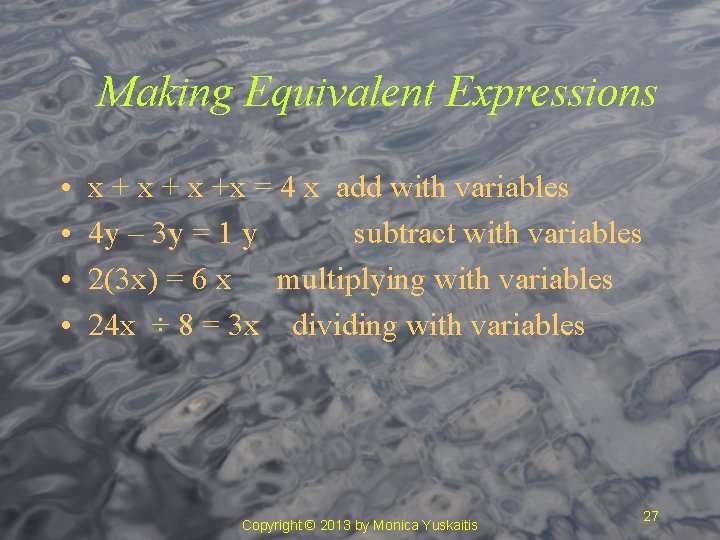
Making Equivalent Expressions • • x + x +x = 4 x add with variables 4 y – 3 y = 1 y subtract with variables 2(3 x) = 6 x multiplying with variables 24 x ÷ 8 = 3 x dividing with variables Copyright © 2013 by Monica Yuskaitis 27
Review and copy notes for 1. 3 Copyright © 2013 by Monica Yuskaitis 28
The Distributive Property Copyright © 2013 by Monica Yuskaitis 1. 4 29
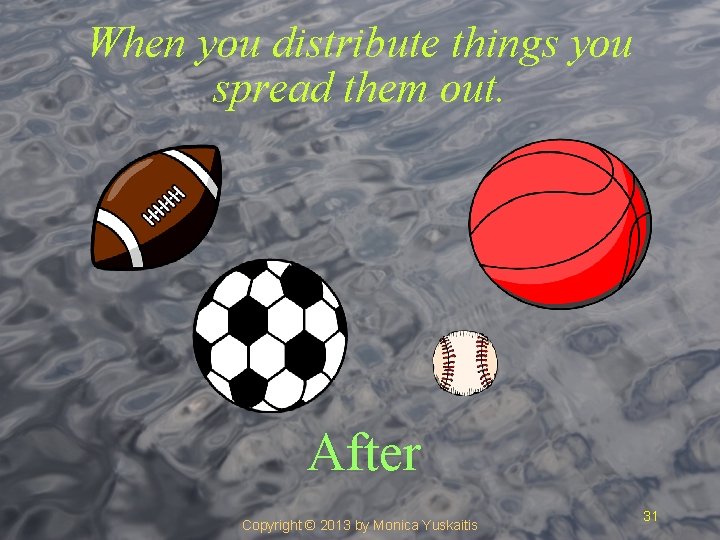
When you distribute things you spread them out. Before Copyright © 2013 by Monica Yuskaitis 30
When you distribute things you spread them out. After Copyright © 2013 by Monica Yuskaitis 31
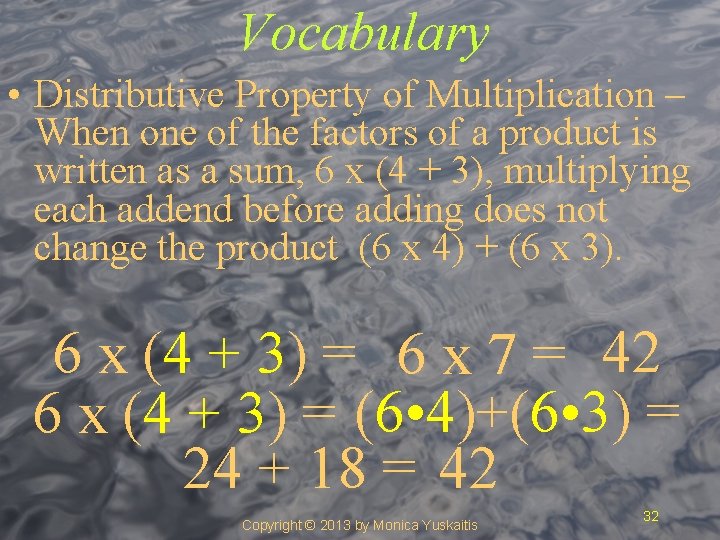
Vocabulary • Distributive Property of Multiplication – When one of the factors of a product is written as a sum, 6 x (4 + 3), multiplying each addend before adding does not change the product (6 x 4) + (6 x 3). 6 x (4 + 3) = 6 x 7 = 42 6 x (4 + 3) = (6 • 4)+(6 • 3) = 24 + 18 = 42 Copyright © 2013 by Monica Yuskaitis 32
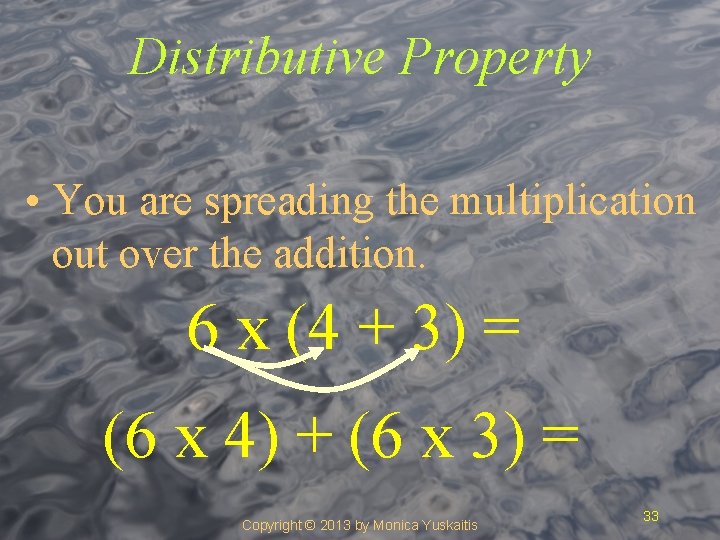
Distributive Property • You are spreading the multiplication out over the addition. 6 x (4 + 3) = (6 x 4) + (6 x 3) = Copyright © 2013 by Monica Yuskaitis 33
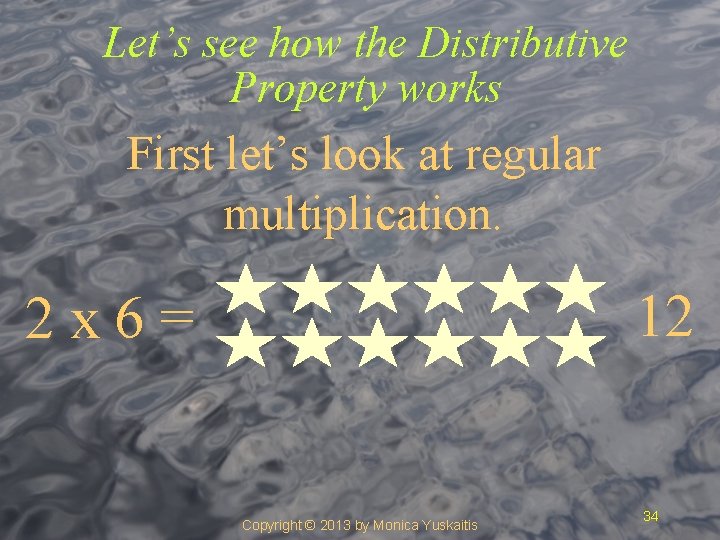
Let’s see how the Distributive Property works First let’s look at regular multiplication. 12 2 x 6= Copyright © 2013 by Monica Yuskaitis 34
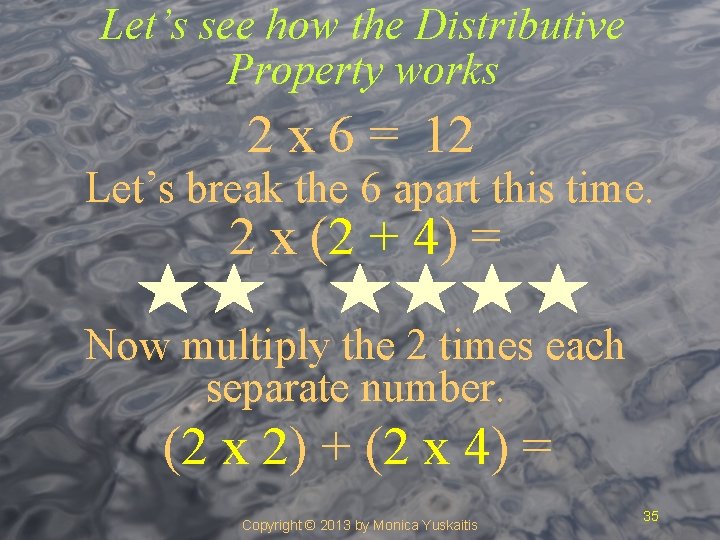
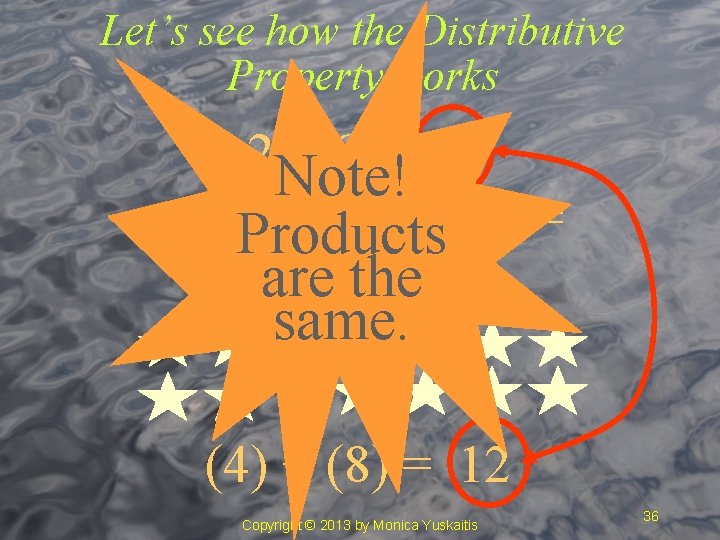
Let’s see how the Distributive Property works 2 x 6 = 12 Let’s break the 6 apart this time. 2 x (2 + 4) = Now multiply the 2 times each separate number. (2 x 2) + (2 x 4) = Copyright © 2013 by Monica Yuskaitis 35
Let’s see how the Distributive Property works 2 Note! x 6 = 12 (2 x. Products 2) + (2 x 4) = Now aremultiply. the same. (4) + (8) = 12 Copyright © 2013 by Monica Yuskaitis 36
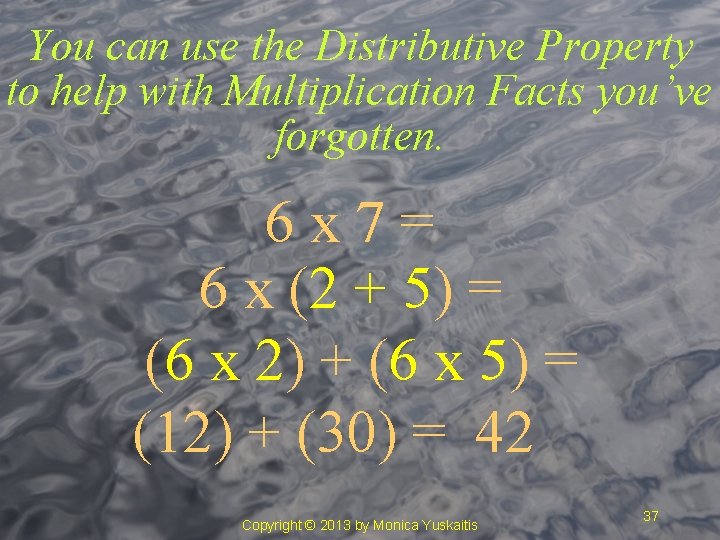
You can use the Distributive Property to help with Multiplication Facts you’ve forgotten. 6 x 7= 6 x (2 + 5) = (6 x 2) + (6 x 5) = (12) + (30) = 42 Copyright © 2013 by Monica Yuskaitis 37
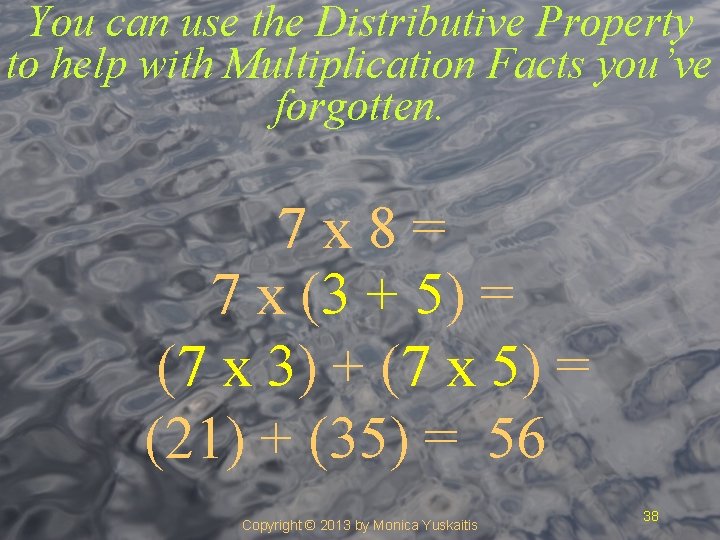
You can use the Distributive Property to help with Multiplication Facts you’ve forgotten. 7 x 8= 7 x (3 + 5) = (7 x 3) + (7 x 5) = (21) + (35) = 56 Copyright © 2013 by Monica Yuskaitis 38
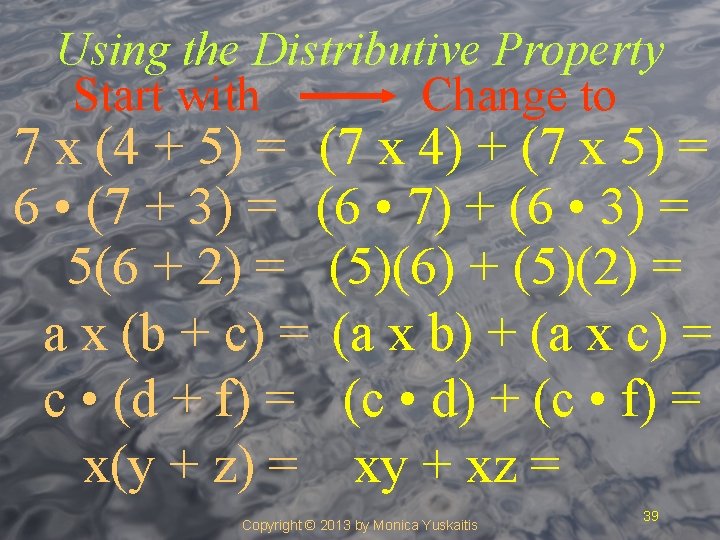
Using the Distributive Property Start with Change to 7 x (4 + 5) = (7 x 4) + (7 x 5) = 6 • (7 + 3) = (6 • 7) + (6 • 3) = 5(6 + 2) = (5)(6) + (5)(2) = a x (b + c) = (a x b) + (a x c) = c • (d + f) = (c • d) + (c • f) = x(y + z) = xy + xz = Copyright © 2013 by Monica Yuskaitis 39
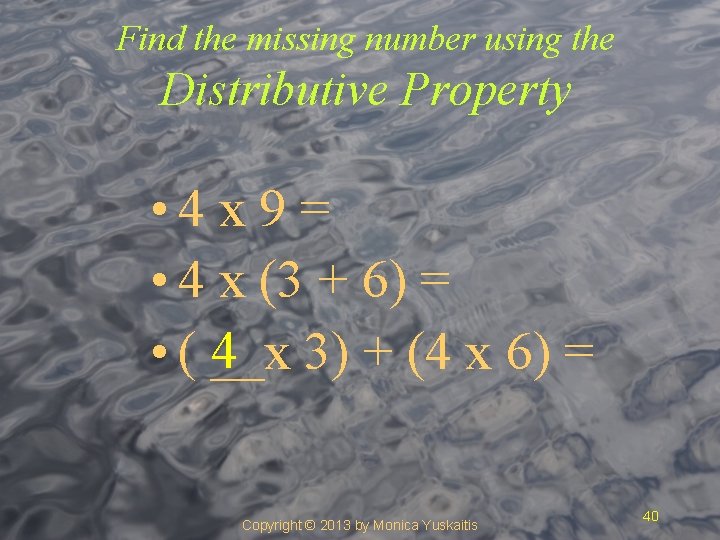
Find the missing number using the Distributive Property • 4 x 9 = • 4 x (3 + 6) = 4 3) + (4 x 6) = • ( __x Copyright © 2013 by Monica Yuskaitis 40
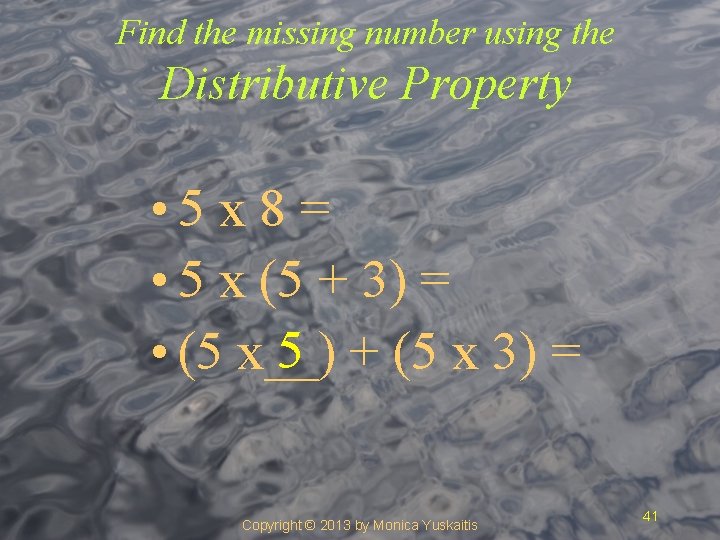
Find the missing number using the Distributive Property • 5 x 8 = • 5 x (5 + 3) = 5 + (5 x 3) = • (5 x__) Copyright © 2013 by Monica Yuskaitis 41
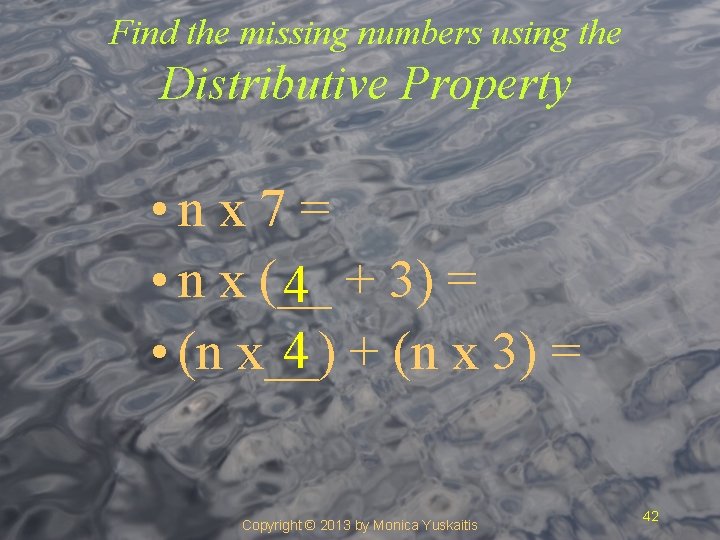
Find the missing numbers using the Distributive Property • n x 7 = • n x (__ 4 + 3) = 4 + (n x 3) = • (n x__) Copyright © 2013 by Monica Yuskaitis 42
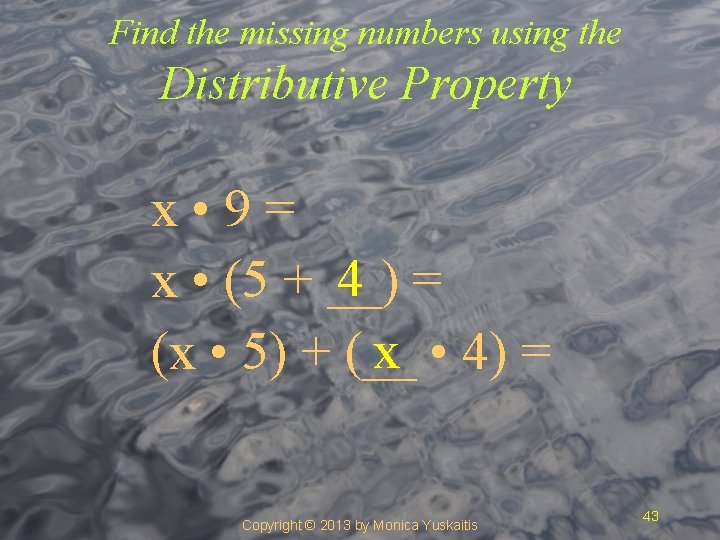
Find the missing numbers using the Distributive Property x • 9= 4 = x • (5 + __) x • 4) = (x • 5) + (__ Copyright © 2013 by Monica Yuskaitis 43
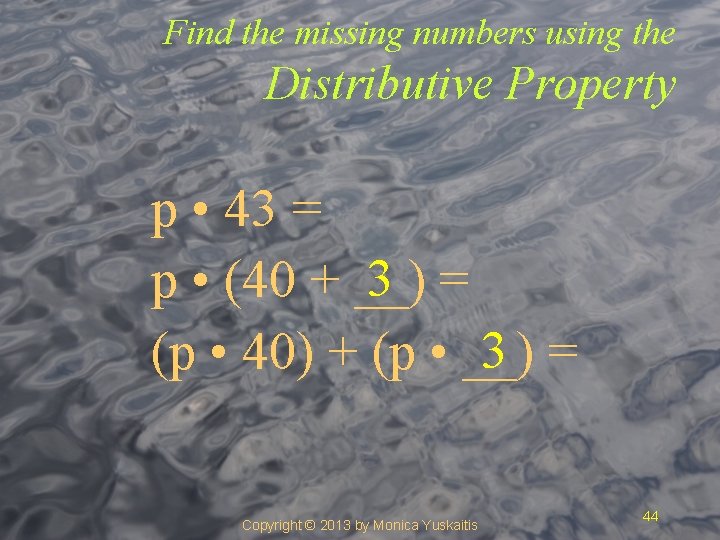
Find the missing numbers using the Distributive Property p • 43 = p • (40 + __) 3 = (p • 40) + (p • __) Copyright © 2013 by Monica Yuskaitis 44
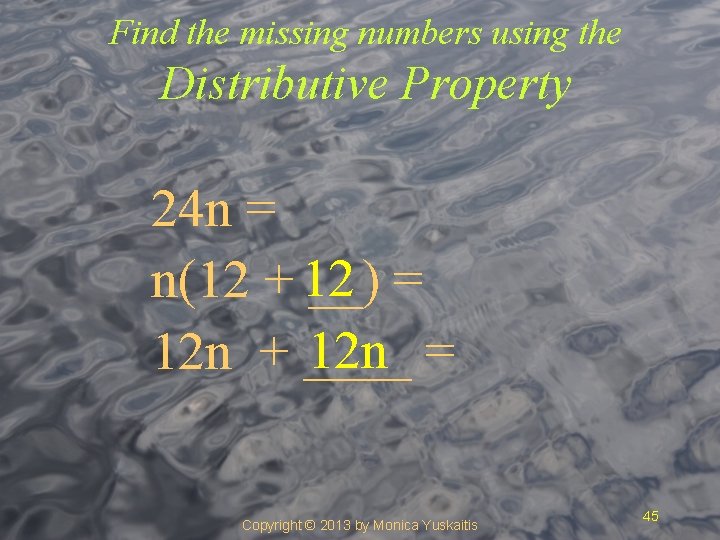
Find the missing numbers using the Distributive Property 24 n = n(12 + 12 __) = 12 n + ____ Copyright © 2013 by Monica Yuskaitis 45
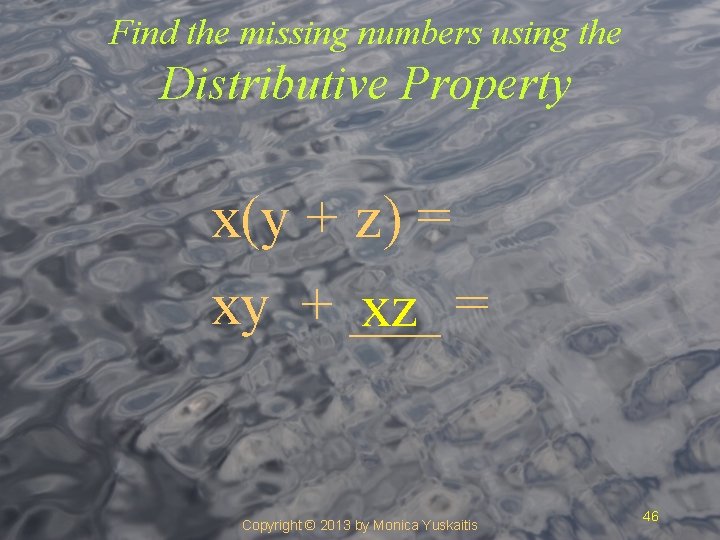
Find the missing numbers using the Distributive Property x(y + z) = xy + ___ xz = Copyright © 2013 by Monica Yuskaitis 46
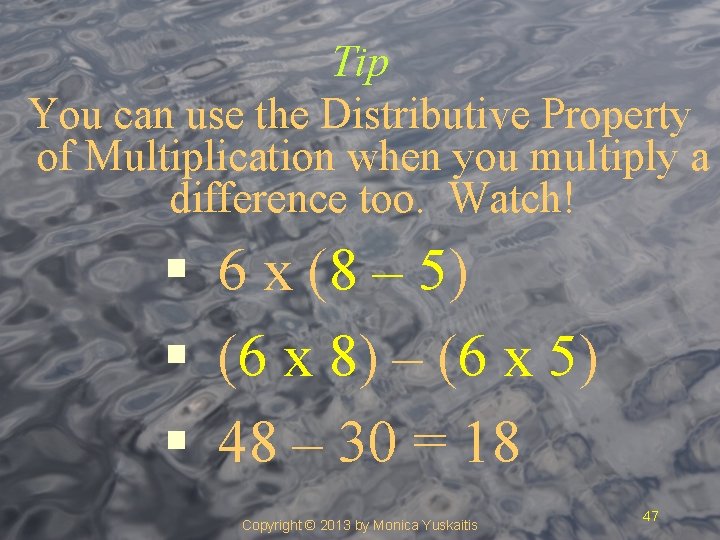
Tip You can use the Distributive Property of Multiplication when you multiply a difference too. Watch! § 6 x (8 – 5) § (6 x 8) – (6 x 5) § 48 – 30 = 18 Copyright © 2013 by Monica Yuskaitis 47
Problem Solving Copyright © 2013 by Monica Yuskaitis 48 48
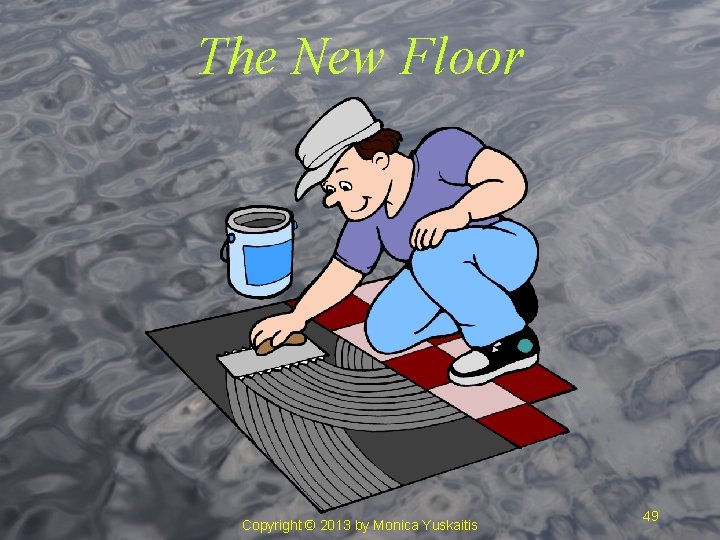
The New Floor Copyright © 2013 by Monica Yuskaitis 49
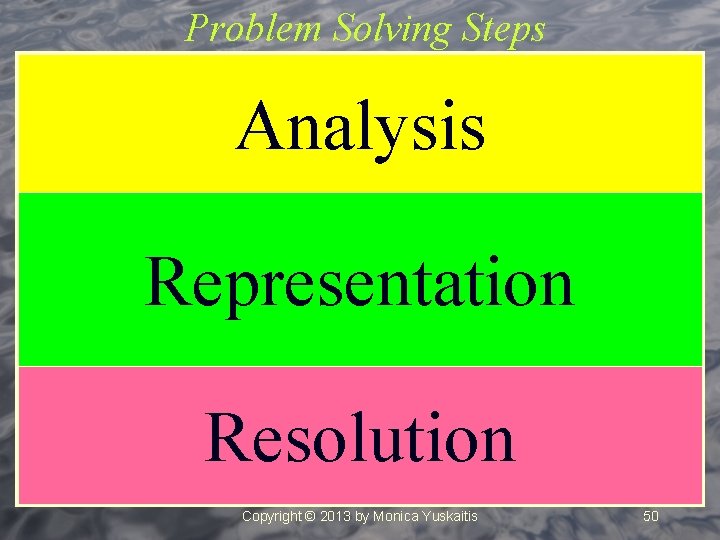
Problem Solving Steps What information do you need? What is the problem asking you to find out? Is the answer going to be larger or smaller? What strategies will you use? What operations will you use? How many steps are there and in what order must you do them? Analysis Representation How will you solve the problem? Did you check your answer? Does your answer make sense? Resolution Copyright © 2013 by Monica Yuskaitis 50
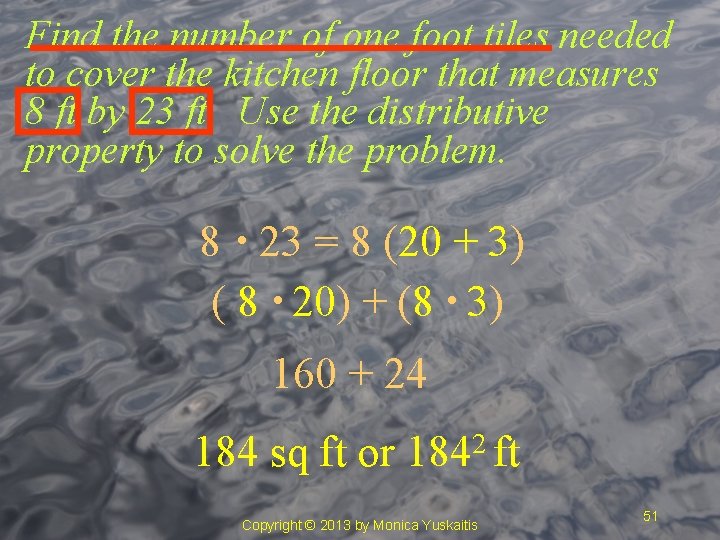
Find the number of one foot tiles needed to cover the kitchen floor that measures 8 ft by 23 ft. Use the distributive property to solve the problem. · 8 23 = 8 (20 + 3) ( 8 20) + (8 3) · · 160 + 24 184 sq ft or 1842 ft Copyright © 2013 by Monica Yuskaitis 51
Let me present you with this bouquet! Copyright © 2013 by Monica Yuskaitis 52