
6 th Grade Sound and Light Module J


- Slides: 25
6 th Grade: Sound and Light (Module J) Unit 1: Introduction to Waves Lesson 1: Waves Lesson 2: Properties of Waves
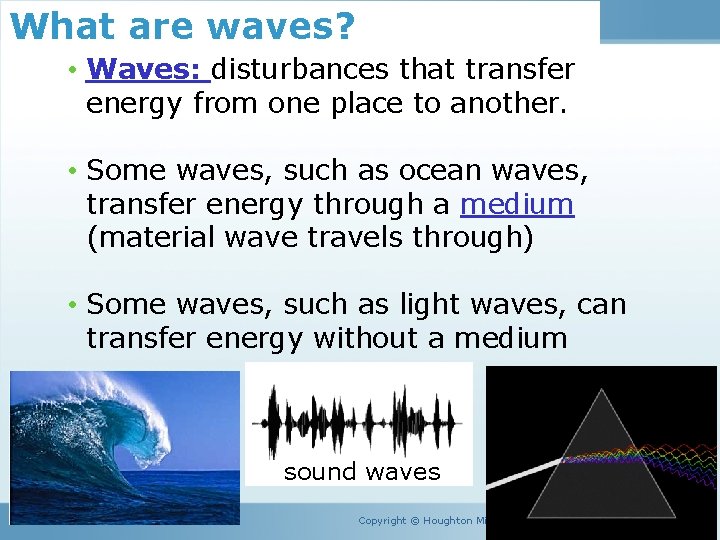
Unit 1 Lesson 1 Waves What are waves? • Waves: disturbances that transfer energy from one place to another. • Some waves, such as ocean waves, transfer energy through a medium (material wave travels through) • Some waves, such as light waves, can transfer energy without a medium sound waves Ex: water Copyright © Houghton Mifflin Harcourt Publishing Company
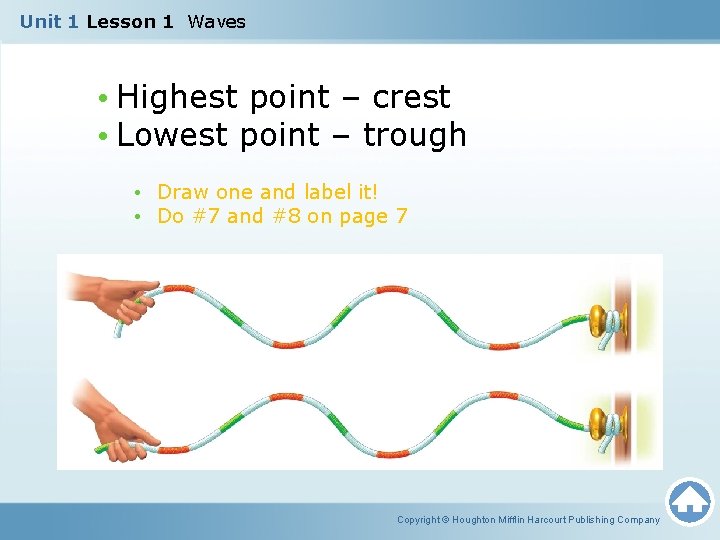
Unit 1 Lesson 1 Waves • Highest point – crest • Lowest point – trough • Draw one and label it! • Do #7 and #8 on page 7 Copyright © Houghton Mifflin Harcourt Publishing Company
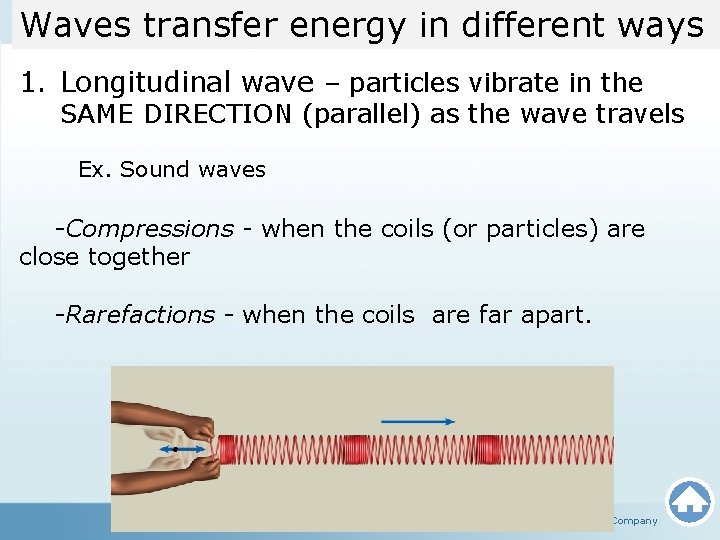
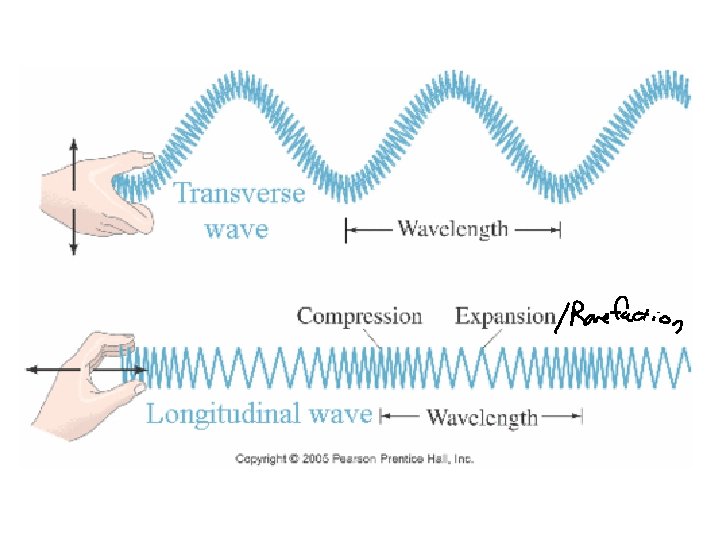
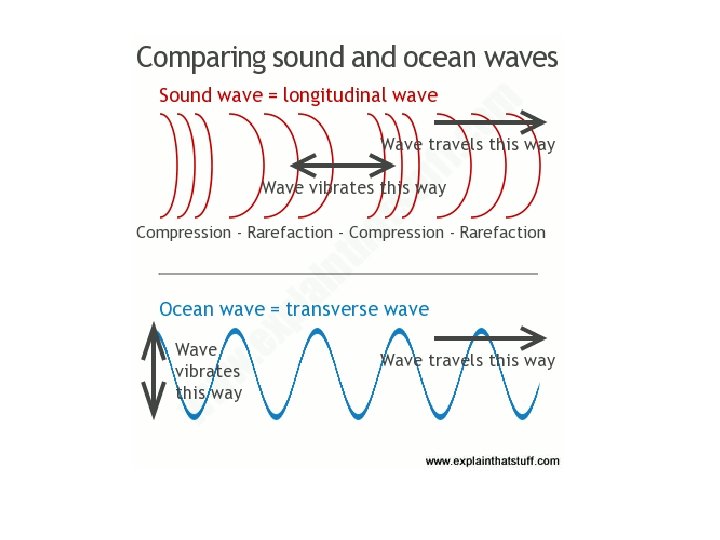
Waves transfer energy in different ways Unit 1 Lesson 1 Waves 1. Longitudinal wave – particles vibrate in the SAME DIRECTION (parallel) as the wave travels Ex. Sound waves -Compressions - when the coils (or particles) are close together -Rarefactions - when the coils are far apart. Copyright © Houghton Mifflin Harcourt Publishing Company
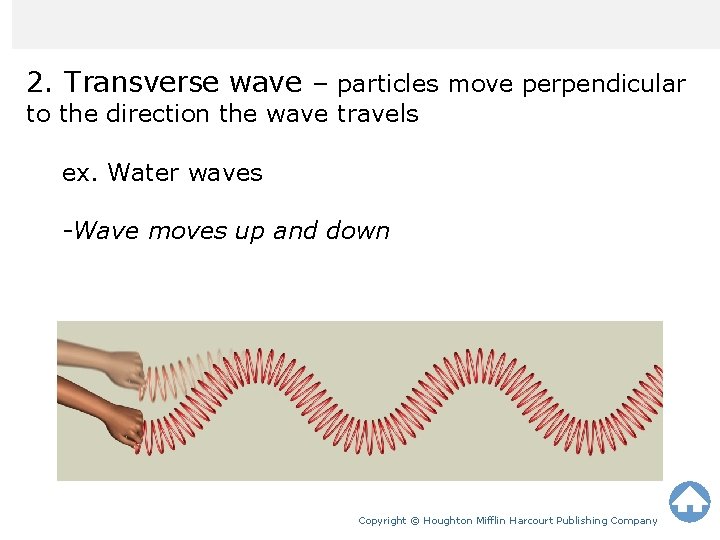
Unit 1 Lesson 1 Waves 2. Transverse wave – particles move perpendicular to the direction the wave travels ex. Water waves -Wave moves up and down Copyright © Houghton Mifflin Harcourt Publishing Company
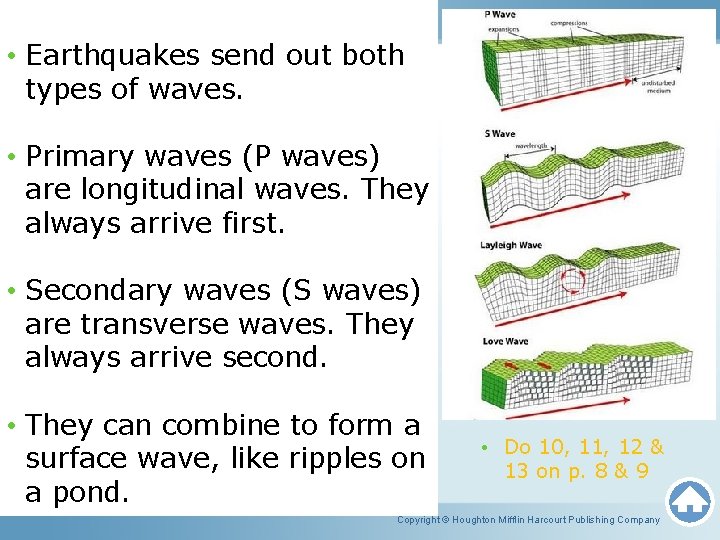
Unit 1 Lesson 1 Waves • Earthquakes send out both types of waves. • Primary waves (P waves) are longitudinal waves. They always arrive first. • Secondary waves (S waves) are transverse waves. They always arrive second. • They can combine to form a surface wave, like ripples on a pond. • Do 10, 11, 12 & 13 on p. 8 & 9 Copyright © Houghton Mifflin Harcourt Publishing Company
Types of Waves Unit 1 Lesson 1 Waves • Mechanical waves - Waves that require a medium (like water waves) • Can be longitudinal or transverse • Some can travel through more than one medium • ex: sound waves can move through air, water, and a solid wall. • Mechanical waves can’t travel without a medium. Copyright © Houghton Mifflin Harcourt Publishing Company
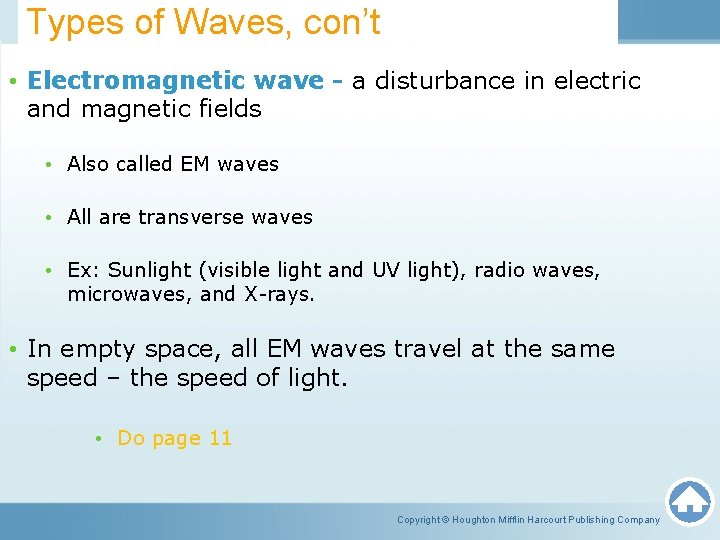
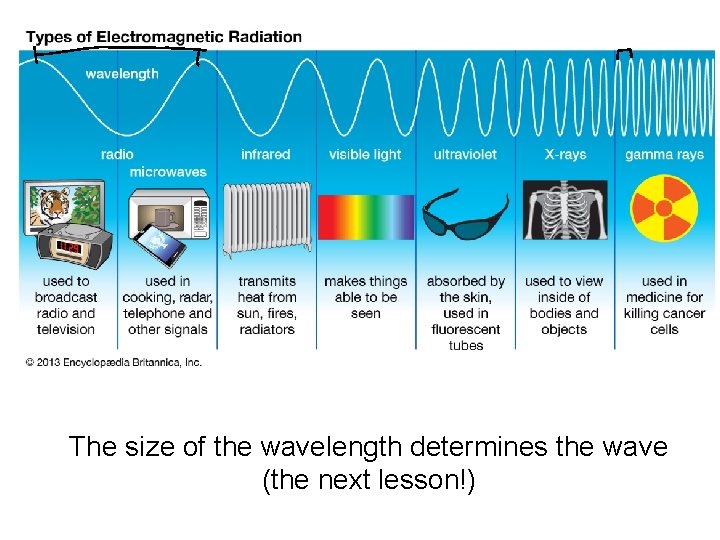
Types of Waves, con’t Unit 1 Lesson 1 Waves • Electromagnetic wave - a disturbance in electric and magnetic fields • Also called EM waves • All are transverse waves • Ex: Sunlight (visible light and UV light), radio waves, microwaves, and X-rays. • In empty space, all EM waves travel at the same speed – the speed of light. • Do page 11 Copyright © Houghton Mifflin Harcourt Publishing Company
The size of the wavelength determines the wave (the next lesson!)
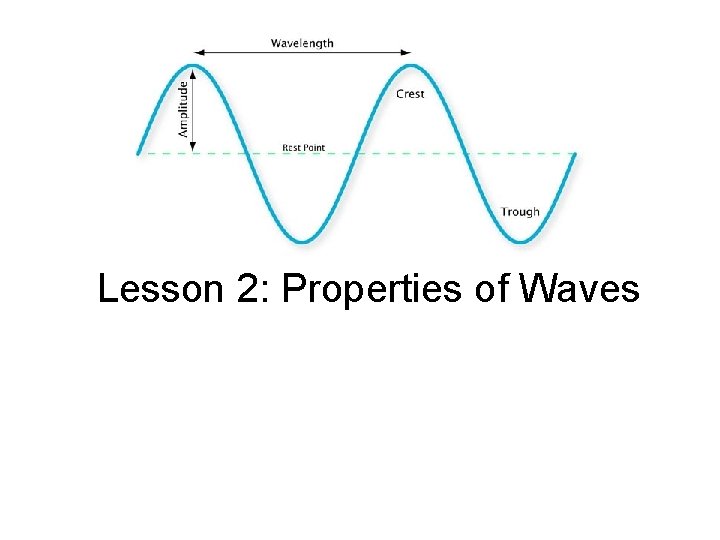
Lesson 2: Properties of Waves
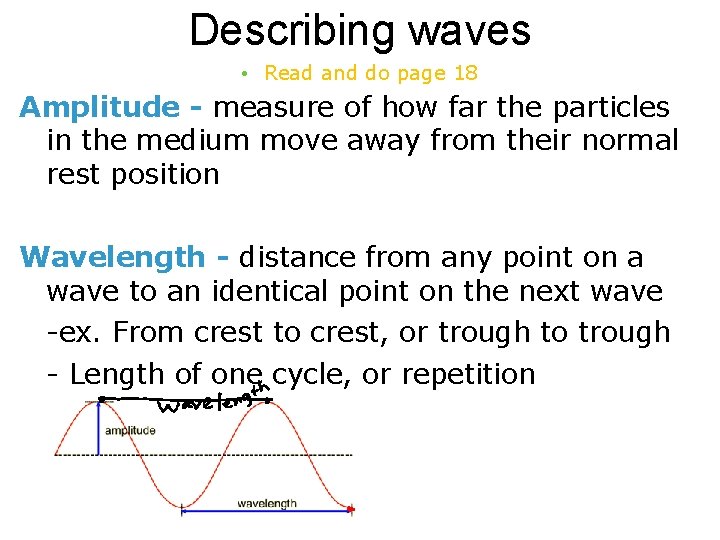
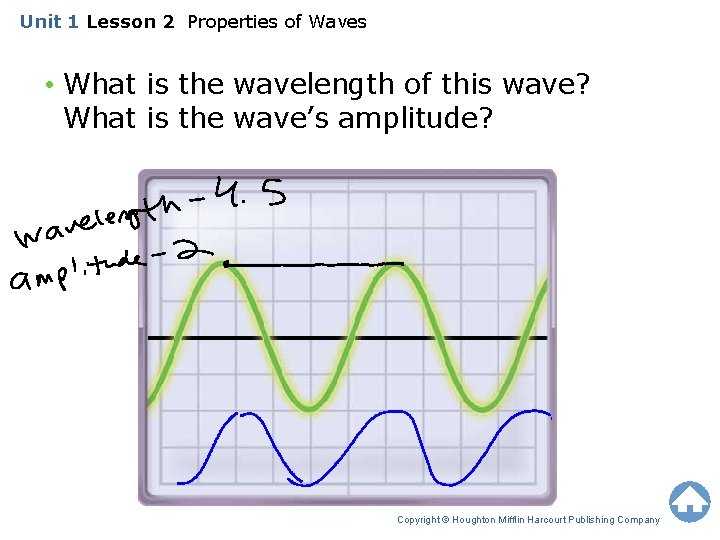
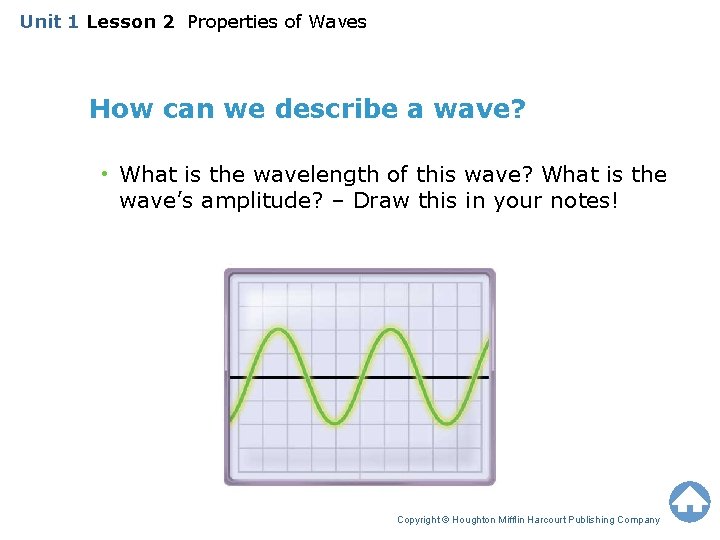
Describing waves • Read and do page 18 Amplitude - measure of how far the particles in the medium move away from their normal rest position Wavelength - distance from any point on a wave to an identical point on the next wave -ex. From crest to crest, or trough to trough - Length of one cycle, or repetition
Unit 1 Lesson 2 Properties of Waves • What is the wavelength of this wave? What is the wave’s amplitude? Copyright © Houghton Mifflin Harcourt Publishing Company
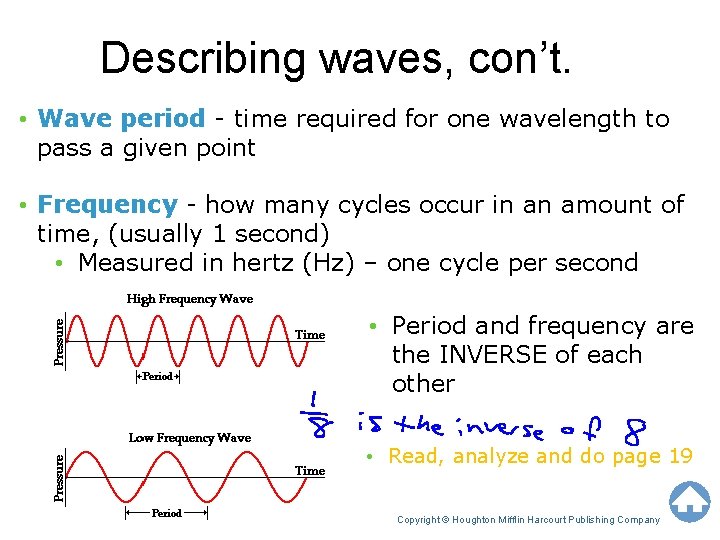
Describing waves, con’t. • Wave period - time required for one wavelength to pass a given point • Frequency - how many cycles occur in an amount of time, (usually 1 second) • Measured in hertz (Hz) – one cycle per second • Period and frequency are the INVERSE of each other • Read, analyze and do page 19 Copyright © Houghton Mifflin Harcourt Publishing Company
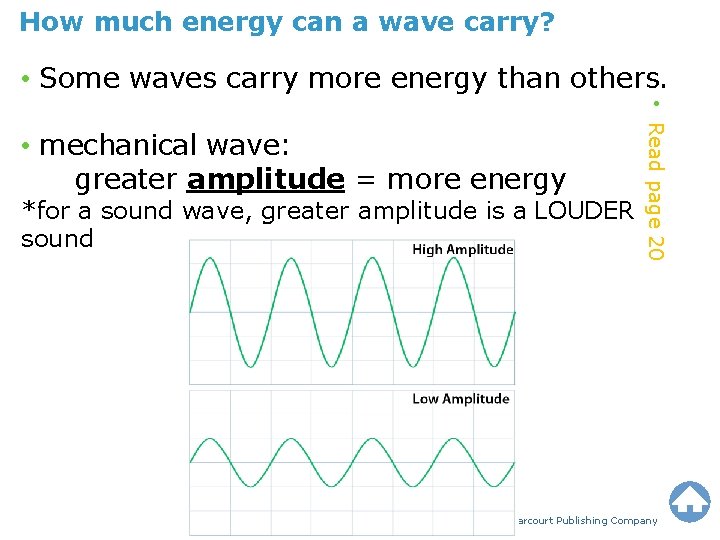
Unit 1 Lesson Properties of Waves How much 2 energy can a wave carry? • Some waves carry more energy than others. *for a sound wave, greater amplitude is a LOUDER sound • Read page 20 • mechanical wave: greater amplitude = more energy Copyright © Houghton Mifflin Harcourt Publishing Company
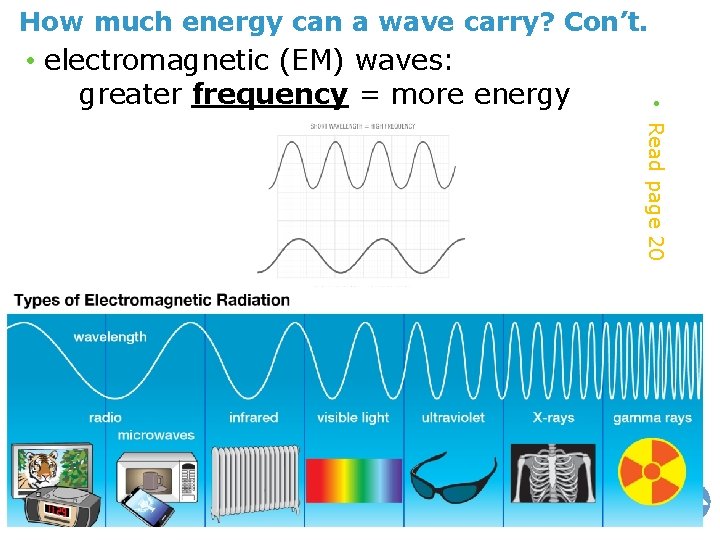
Unit 1 Lesson Properties of Waves How much 2 energy can a wave carry? Con’t. • Read page 20 • electromagnetic (EM) waves: greater frequency = more energy Copyright © Houghton Mifflin Harcourt Publishing Company
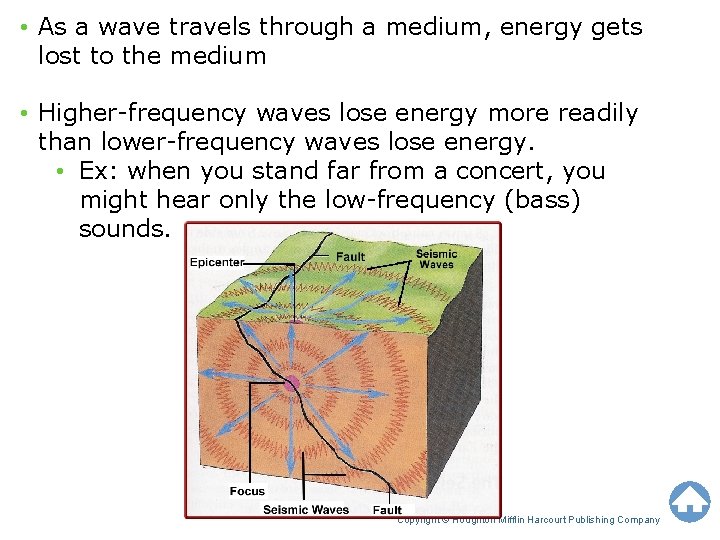
Unit Properties of Wavesa • As 1 a. Lesson wave 2 travels through lost to the medium, energy gets • Higher-frequency waves lose energy more readily than lower-frequency waves lose energy. • Ex: when you stand far from a concert, you might hear only the low-frequency (bass) sounds. Copyright © Houghton Mifflin Harcourt Publishing Company
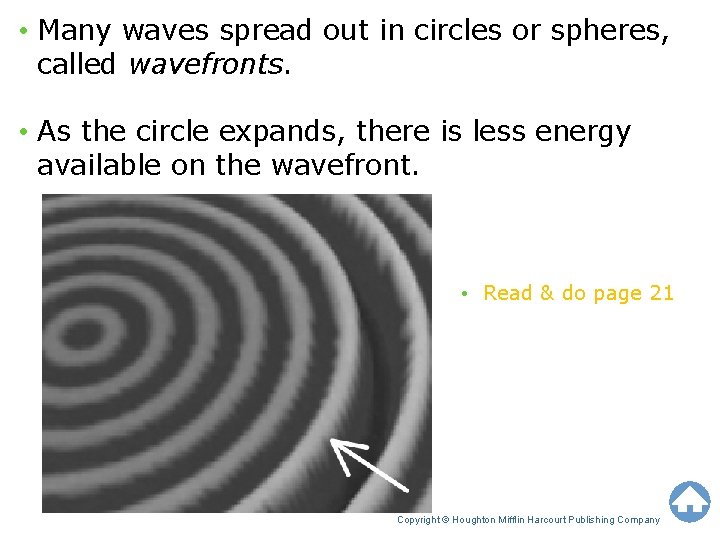
Unit 1 Lesson 2 Properties of Waves • Many waves spread out in circles or spheres, called wavefronts. • As the circle expands, there is less energy available on the wavefront. • Read & do page 21 Copyright © Houghton Mifflin Harcourt Publishing Company
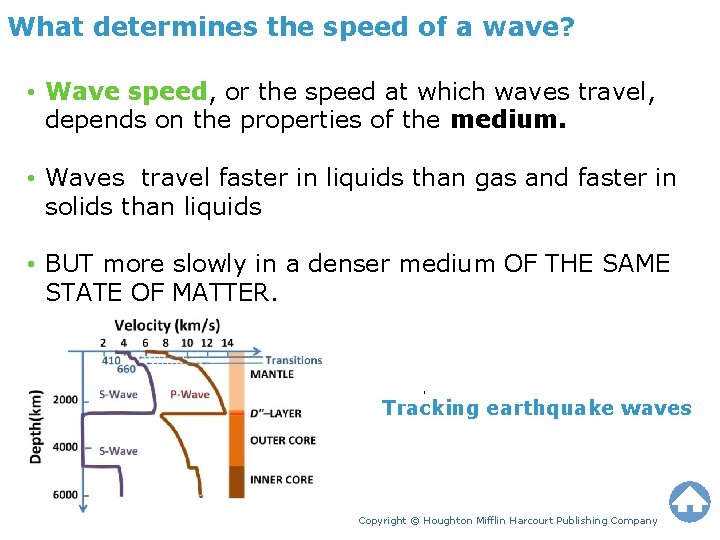
Unit 1 Lesson 2 Properties of Waves What determines the speed of a wave? • Wave speed, or the speed at which waves travel, depends on the properties of the medium. • Waves travel faster in liquids than gas and faster in solids than liquids • BUT more slowly in a denser medium OF THE SAME STATE OF MATTER. Tracking earthquake waves Copyright © Houghton Mifflin Harcourt Publishing Company
Q: Would a wave travel faster in air or water? A: Water Q: would a wave travel faster through a table or through water? A: a table Q: would a wave travel faster through a more dense solid (like metal) or a less dense solid (like wood)? A: A less dense solid (wood) Q: Would a wave travel faster through a more dense liquid like oil, or a less dense liquid like water? A: a less dense liquid like water
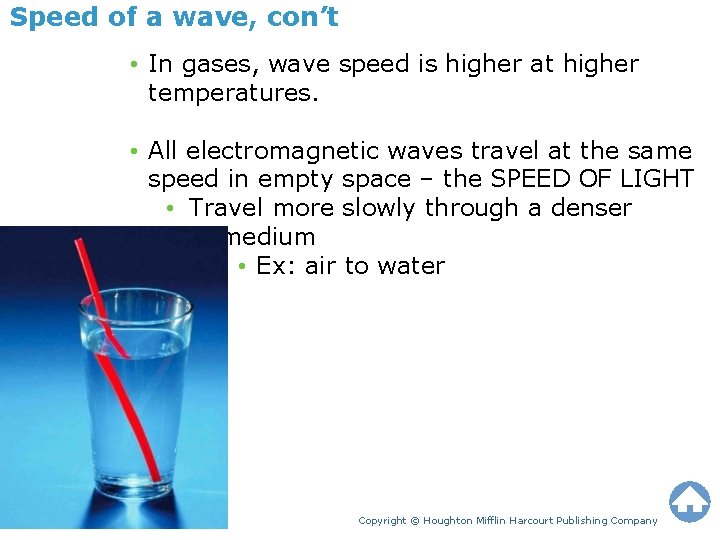
Speed of a 2 wave, con’t Unit 1 Lesson Properties of Waves • In gases, wave speed is higher at higher temperatures. • All electromagnetic waves travel at the same speed in empty space – the SPEED OF LIGHT • Travel more slowly through a denser medium • Ex: air to water Copyright © Houghton Mifflin Harcourt Publishing Company
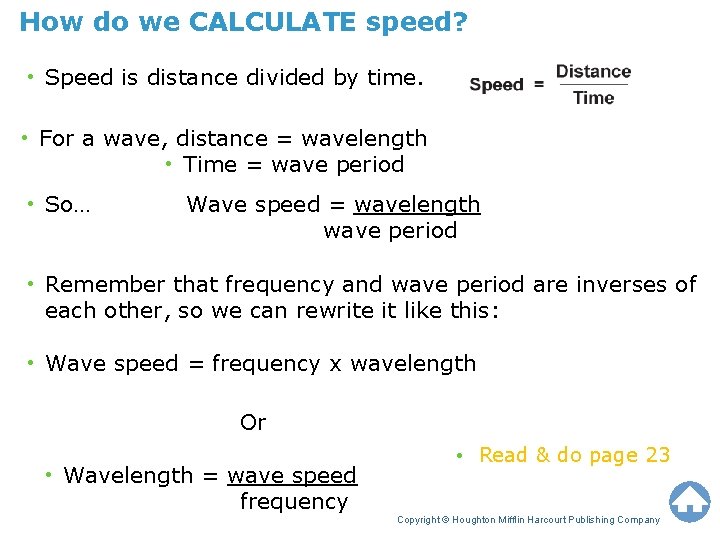
Unit 1 Lesson 2 Properties of Wavesspeed? How do we CALCULATE • Speed is distance divided by time. • For a wave, distance = wavelength • Time = wave period • So… Wave speed = wavelength wave period • Remember that frequency and wave period are inverses of each other, so we can rewrite it like this: • Wave speed = frequency x wavelength Or • Wavelength = wave speed frequency • Read & do page 23 Copyright © Houghton Mifflin Harcourt Publishing Company
Unit 1 Lesson 2 Properties of Waves How can we describe a wave? • What is the wavelength of this wave? What is the wave’s amplitude? – Draw this in your notes! Copyright © Houghton Mifflin Harcourt Publishing Company