
6 th Grade Curriculum Night Presentation A Day
- Slides: 20
6 th Grade Curriculum Night Presentation A Day in the Life of a Sixth Grader
6 th Grade Curriculum Night Presentation Mrs. Lisa Burke, Reading & Writing (LA) Mrs. Dawn Michaelson, Social Studies Mrs. Sophia Patterson, Science Mr. Mick Massicotte, Math Mrs. Tami Phelps, Math
Science Camp: Feb 22 nd -24 th SCIENCE CAMP PREVIEW MEETING (coming soon!!) Location: Prescott Pines (www. prescottpines. org) Reminder notice will be sent home with students • Chaperones must have Tier III clearance which includes fingerprints and background check. • Fundraisers to defray expenses. • Use tax credit to pay camp expenses.
P. A. C. 15 The Principals’ Student Advisory Council (PAC-15) consists of 15 students from grades 4, 5, and 6 who meet with Mr. Cover monthly to talk about school improvement. This leadership experience allows the students to have a direct voice with the Principal in making Cortina a better school. Among the areas the PAC-15 advises in are: • security • school events • recognizing teachers • school web page • facilities • school discipline • and other areas related to the mission, vision and core values of the school.
Principal’s Award To recognize excellence in 5 th – 6 th grade students at Cortina Elementary School in the areas of academics, citizenship, service and extra -curricular activities. In May there will be a recognition night for the award recipients and their parents. More information will be sent home with specific requirements.
TIGER PRIDE STUDENT AMBASSADORS Program encourages students to: • Help other students • Keep Cortina safe • Help problem solve issues • Assist in welcoming new students and visitors to school to our campus • Volunteer to give back to community Applications accepted to Mrs. Papke
Interactive Notebook • Purpose: To help students organize learning, become creative, and independent thinkers and writers. • Grading – A scoring rubric will be used to grade the notebooks periodically. • How Parents can help? Review it with your child one or two times a week to make sure they are staying on track. • Benefits - Allows students to have everything they need in one place, and easily attainable. Student always have material to study from. • Allows students to interact with the materials, activities, and class examples.
A Day in Language Arts • • • Bell work- start the day with short reading passages and questions that target on skills to support our new standards. Review with class when finished. These readings and questions align with the ACCRS and spiral all year. Bell work also include mini grammar lesson which is incorporated in their writing. DEAR /Independent Reading – students have 10 minutes of uninterrupted reading time for their independent book. Not intended to work on other classwork, etc. , including reflections in journal (HOT responses) Vocabulary – work with the root word of the week. (Games, review) Test on Friday Lecture – standard/concept taught or reviewed using interactive notebook. Encourages students to reflect their understanding of lesson in their own way Whole Group Reading – Whole group reading on anchor text and other text, including non-fiction, poetry, short stories to connect and compare with anchor text. Students will participate in Socratic Seminars Writing- Imbedded daily, and through Writers Workshop
LA and Changes with Common Core • Increased emphasis on more challenging text which requires students to re-read and do “close” reading - a deep analysis of text • Read to Compare/Contrast various pieces of text and respond with a comparative writing piece • Citing textual evidence in reading and writing, prove your response • Writing will occur across the curriculum, DBQ in SS and writing in Science. • Use the writing process incorporating the Six Traits of Writing
LA Overview of the Year Quarter 1 Reading and Writing Focus: Literary Elements Anchor Text- Fiction –True Confessions of Charlotte Doyle Writing Narratives (Incidental Narrative) and Responses to Literature Quarter 2 Reading and Writing Focus: Non-fiction (Informational Text) and Text Structure Write informative/ explanatory texts using strategies such as definition, classification, comparison/ contrast, and cause and effect. Anchor Text -NF (Harriet Tubman- Conductor of an Underground Railroad) Quarter 3 Reading and Writing Focus: Persuasive Text, Vocabulary and Persuasive Writing including Formal Business Letter (Persuasive) and/or Persuasive/Argumentative Essay Anchor Text- Non Fiction – Chasing Lincoln’s Killer Quarter 4 Reading and Writing Focus: Anchor Text –Undecided (Possible Literature Circles) Writing Response to Literature ***Each quarter students will read from a wide variety of genre, in addition to the focus and anchor text***** In addition to class novels, students will read from an independent reading book. Encouraging students to read 3 books per Quarter
Social Studies~ Mrs. Michaelson Quarter 1 & 2 Stone Age Mesopotamia Egypt China India Greece Quarter 3 & 4 Rome Middle Ages Renaissance Americas World Religion Grading – Semester Exam, Tests, Quizzes, Homework, Interactive Student Notebooks, Social Studies Writing, and DBQs
Social Studies Warm-up: This is done each morning upon coming into class. Students have a warm-up that is a review of concepts or an intro to the daily lesson. Lesson: Students are introduced to new material (IAN). Activities: Students will be involved in various activities to enhance the curriculum. These activities may include hands-on activities, group activities, discussions, and short films. Homework: There is not homework each night. The homework and daily concepts are listed on the 6 th grade calendar.
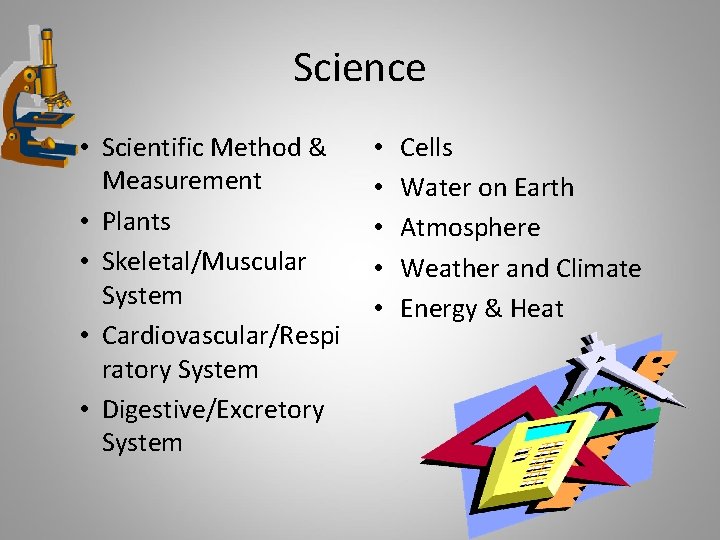
Science • Scientific Method & Measurement • Plants • Skeletal/Muscular System • Cardiovascular/Respi ratory System • Digestive/Excretory System • • • Cells Water on Earth Atmosphere Weather and Climate Energy & Heat
A Day in Science • Agenda/Warm-Up: Students come in and fill-in their agenda; then complete the morning’s warm-up. • Notes: Students will be given outlines of the notes that we will be completing in class. They are to glue the notes into their interactive notebooks. The notebooks will be checked and graded for completion. • Experiments: We will do different experiments throughout the school year that go along with the units being studied. The students will be given a Lab Form that needs to be turned in for every lab. • Tests/Quizzes: A test is given at the end of each unit. It will cover everything from the notes, experiments, and activities in that unit. Quizzes may be given throughout each unit depending on its length.
A Day in Math Ø Enter class and write in agenda Ø Bellwork done in notebook (a quick review of the previous day) Ø Partner or Group Share Homework o Discuss answers to homework questions with partner/group o Students present select homework under the document camera while the rest of the class critiques. Ø Lesson o All students are expected to take complete notes when prompted. o Team/partner work: math problems using equations or models, posters, white board activities, etc. *Student-centered* Ø Homework o A few times a week (not every night) – meant to tie up a day’s lesson in a concise format, sometimes only 1 problem.
Math Overview of the Year QUARTER 1 & 2 • Unit 1 - Arithmetic Operations Including Dividing by a Fraction • Unit 2 – Rational Numbers • Unit 3 – Expressions and Equations QUARTER 3 & 4 • Unit 4 - Ratios and Unit Rates • Unit 5 – Geometry • Unit 6 – Statistics
Moby Max (www. mobymax. com) Ø Online practice for all subjects – CAN be accessed from home! Ø Students took a placement test in Math. Ø Tied directly to our standards. Ø Can earn fun things like badges and game time. Ø We’ll have contests during the year too.
A Day in Math Strategies • Agenda/Warm-up • Hands on/ inquiry based lesson of concepts learned in Massicotte’s room. • I Spy Math Notebook (interactive notebook) • Math Vocabulary • i. Pads
Gifted Services • Services to gifted students will be provided by grade level teachers who will differentiate instructional strategies to meet the specific needs of verbally, quantitatively, and nonverbally gifted students. • Students will remain in their classrooms as recent research in elementary education shows that children’s academic needs are best met by highly qualified classroom teachers with the support of a gifted specialist. • Mrs. Kazzy will be working closely with teachers to ensure that they are making the necessary modifications in the curriculum to keep students engaged and challenged • Gifted teacher will be coming into Math to challenge and enrich curriculum being taught in math
WEB SITES Check Grade Level Calendar The following information is available on each teacher’s web site. Homework Important Date (tests, deadlines, holidays) Synergy for Grades and missing assignments.