
6 Telecommunications and Networking 1 Compare and contrast
![[ Opening Case The Neutrality Ware ] • • The Problem A Possible Solution](https://slidetodoc.com/presentation_image/e59daaa81afa8dcabca12e53eb3f3ba2/image-4.jpg "[ Opening Case The Neutrality Ware ] • • The Problem A Possible Solution")
![[about business] 6. 1 Studio G](https://slidetodoc.com/presentation_image/e59daaa81afa8dcabca12e53eb3f3ba2/image-5.jpg "[about business] 6. 1 Studio G")
![[about business] 6. 2 A New Search Engine](https://slidetodoc.com/presentation_image/e59daaa81afa8dcabca12e53eb3f3ba2/image-19.jpg "[about business] 6. 2 A New Search Engine")
![[about business] 6. 3 Marriot’s Corporate Portal](https://slidetodoc.com/presentation_image/e59daaa81afa8dcabca12e53eb3f3ba2/image-20.jpg "[about business] 6. 3 Marriot’s Corporate Portal")
![[about business] 6. 4 Massive Open Online Courses](https://slidetodoc.com/presentation_image/e59daaa81afa8dcabca12e53eb3f3ba2/image-25.jpg "[about business] 6. 4 Massive Open Online Courses")
![[about business] 6. 5 Yahoo! CEO Marissa Mayer Bands Telecommuting](https://slidetodoc.com/presentation_image/e59daaa81afa8dcabca12e53eb3f3ba2/image-28.jpg "[about business] 6. 5 Yahoo! CEO Marissa Mayer Bands Telecommuting")
![[ Closing Case Fiber to All of Us? ] • The Problem • Possible](https://slidetodoc.com/presentation_image/e59daaa81afa8dcabca12e53eb3f3ba2/image-29.jpg "[ Closing Case Fiber to All of Us? ] • The Problem • Possible")
- Slides: 29
6 Telecommunications and Networking
1. Compare and contrast the two major types of networks. 2. Describe the wireline communications media and transmission technologies. 3. Describe the most common methods for accessing the Internet. 4. Explain the impact that networks have had on business and everyday life for each of the six major categories of network applications.
1. What Is a Computer Network? 2. Network Fundamentals 3. The Internet and the World Wide Web 4. Network Applications
[ Opening Case The Neutrality Ware ] • • The Problem A Possible Solution The Results What We Learned from This Case
[about business] 6. 1 Studio G
6. 1 What Is a Computer Network? • Local Area Networks • Wide Area Networks • Enterprise Networks
6. 2 Network Fundamentals • • Analog and Digital Signals Communications Media and Channels Network Protocols Types of Network Processing
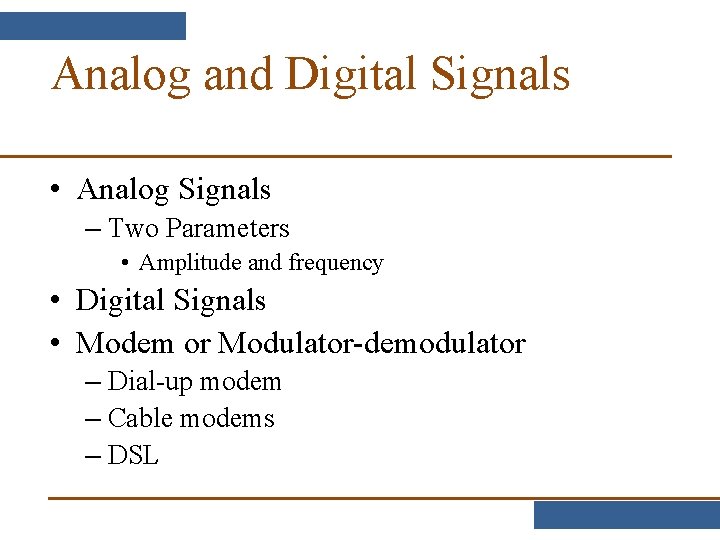
Analog and Digital Signals • Analog Signals – Two Parameters • Amplitude and frequency • Digital Signals • Modem or Modulator-demodulator – Dial-up modem – Cable modems – DSL
Communications Media and Channels • Twisted-pair Wire • Coaxial Cable • Fiber Optics
Network Protocols • Ethernet • Transmission Control Protocol/Internet Protocol (TCP/IP) – Four Layers – Packet Switching
Types of Network Processing • Client/server computing • Peer-to-peer Processing (P 2 P)
6. 3 The Internet and the World Wide Web • Accessing the Internet • The Future of the Internet • The World Wide Web
Accessing the Internet • Connecting via an Online Service • Connecting via Other Means • Addresses on the Internet
The Future of the Internet • Three Factors Could Cause Internet Brownout – Increasing number of people who work online – Soaring popularity of Web sites such as You. Tube requiring large amounts of bandwidth – Tremendous demand for high-definition television delivered over the Internet • Internet 2
World Wide Web (WWW) • A system of universally accepted standards for storing, retrieving, formatting, and displaying information via a client/server architecture – Web site – Webmaster – Uniform Resource Locator (URL) – Browsers
6. 4 Network Applications • • • Discovery Communication Collaboration E-Learning and Distance Learning Virtual Universities Telecommuting
Discovery • Search Engines and Metasearch Engines • Publication of Material in Foreign Languages • Portals
Portals • • Commercial Portal Affinity Portal Corporate Portal Industrywide Portal
[about business] 6. 2 A New Search Engine
[about business] 6. 3 Marriot’s Corporate Portal
Communication • • Electronic Mail (E-mail) Web-Based Call Centers Electronic Chat Rooms Voice Communication – Internet Telephony (Vo. IP) • Unified Communications (UC)
Collaboration • • • Work group Workflow Virtual Team Virtual Collaboration Crowdsourcing Synchronous versus asynchronous
Collaboration • • • Microsoft Share. Point Google Docs IBM Lotus Quickr Jive Electronic Teleconferencing
E-Learning and Distance Learning • E-Learning – Learning supported by the Web • Distance Learning – Any learning situation in which teachers and students do not meet face-to-face.
[about business] 6. 4 Massive Open Online Courses
Virtual Universities • Online universities in which students take classes via the Internet at home or an off-site location.
Telecommuting • A process in which highly prized workers are able to work anywhere anytime. • Knowledge workers • Advantages versus disadvantages
[about business] 6. 5 Yahoo! CEO Marissa Mayer Bands Telecommuting
[ Closing Case Fiber to All of Us? ] • The Problem • Possible Solutions • The Results