
6 Supply Demand and Government Policies 1 Economists
- Slides: 37
6 Supply, Demand, and Government Policies 1
Economists have two roles ▪ As scientists ▪ As policy advisers 2
• We have seen how supply and demand determine the price of a good and the quantity of the good sold. • We have also seen how various events shift supply and demand thereby change the equilibrium price and quantity. • And we have developed the concept of elasticity to gauge the size of these changes 3
Now we analyze various types of government policy using only the tools of supply and demand 4
Recall the ice cream market. Suppose, that consumers complain that price $3 per cone of ice cream is very high. And producers of ice cream complain that $3 per cone of ice cream is very low. Consumers and producers have their lobby in government. 5
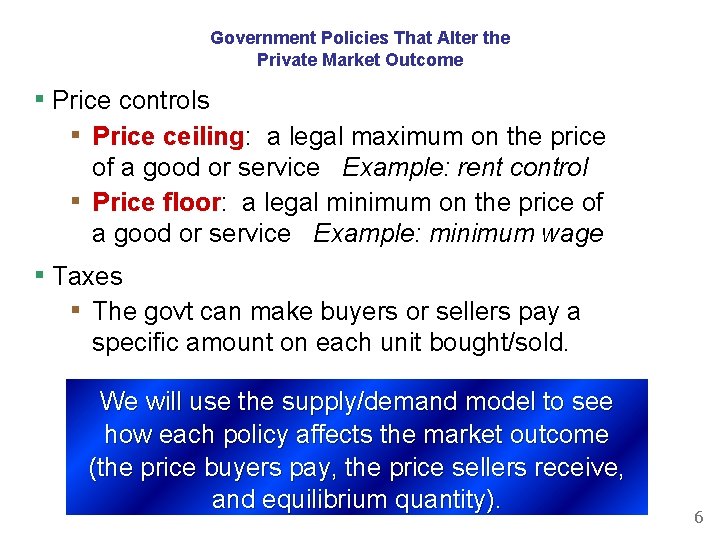
Government Policies That Alter the Private Market Outcome ▪ Price controls ▪ Price ceiling: a legal maximum on the price ▪ of a good or service Example: rent control Price floor: a legal minimum on the price of a good or service Example: minimum wage ▪ Taxes ▪ The govt can make buyers or sellers pay a specific amount on each unit bought/sold. We will use the supply/demand model to see how each policy affects the market outcome (the price buyers pay, the price sellers receive, and equilibrium quantity). 6
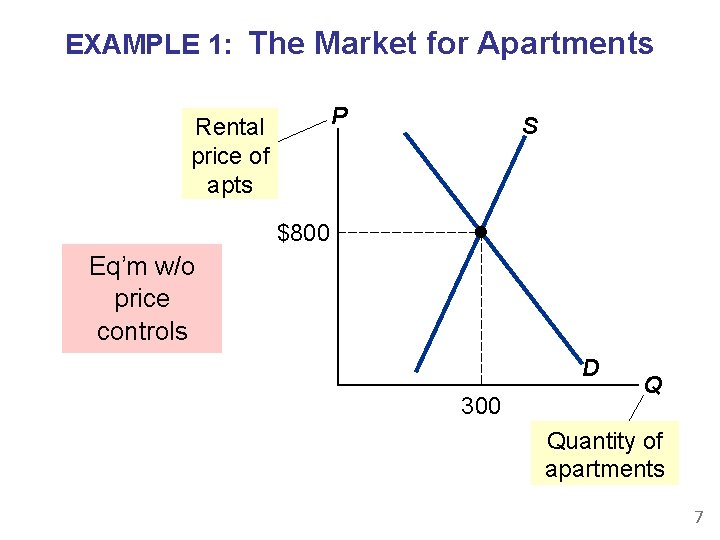
EXAMPLE 1: The Market for Apartments P Rental price of apts S $800 Eq’m w/o price controls D 300 Q Quantity of apartments 7
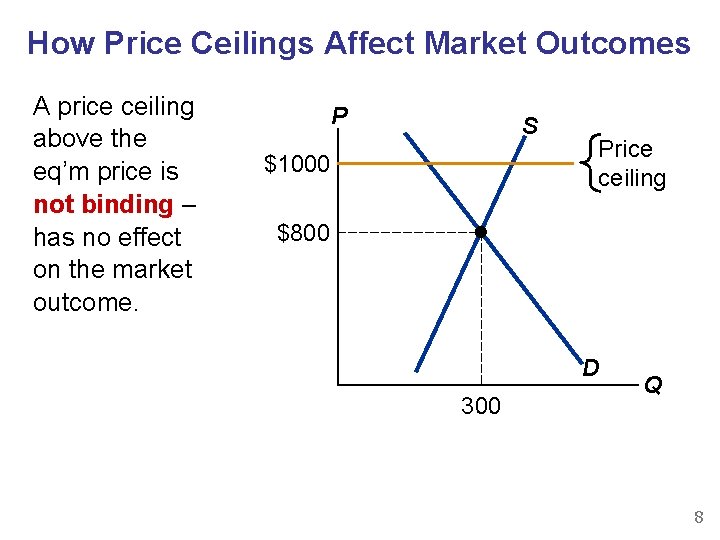
How Price Ceilings Affect Market Outcomes A price ceiling above the eq’m price is not binding – has no effect on the market outcome. P S $1000 Price ceiling $800 D 300 Q 8
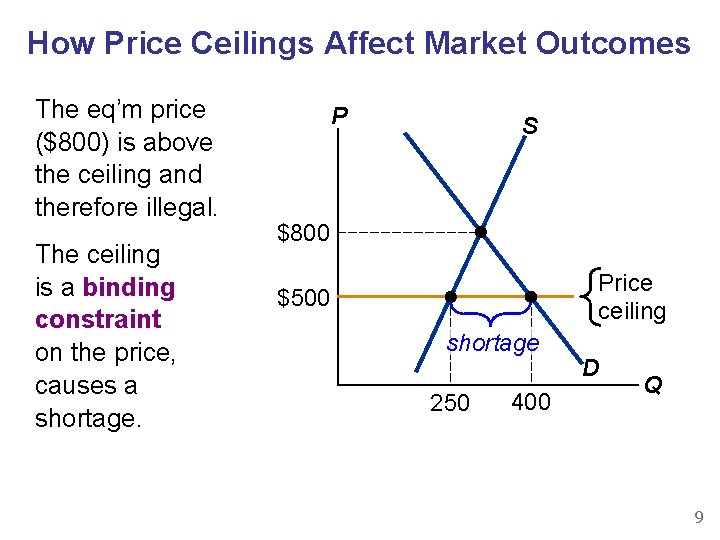
How Price Ceilings Affect Market Outcomes The eq’m price ($800) is above the ceiling and therefore illegal. The ceiling is a binding constraint on the price, causes a shortage. P S $800 Price ceiling $500 shortage 250 400 D Q 9
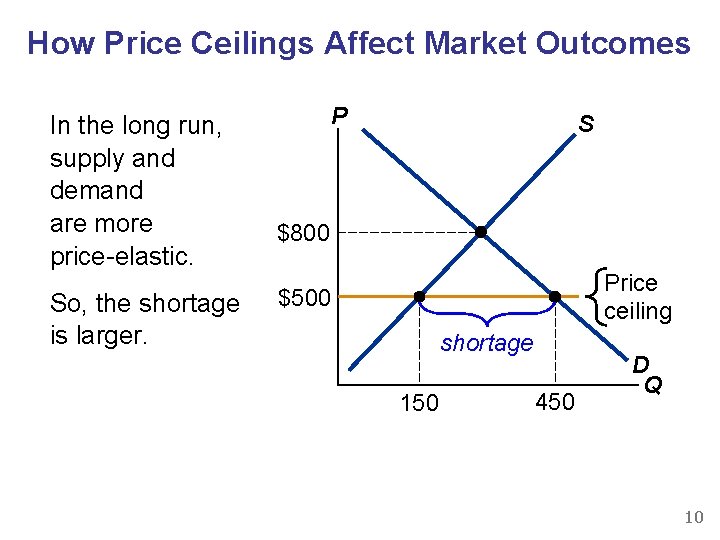
How Price Ceilings Affect Market Outcomes In the long run, supply and demand are more price-elastic. So, the shortage is larger. P S $800 Price ceiling $500 shortage 150 450 D Q 10
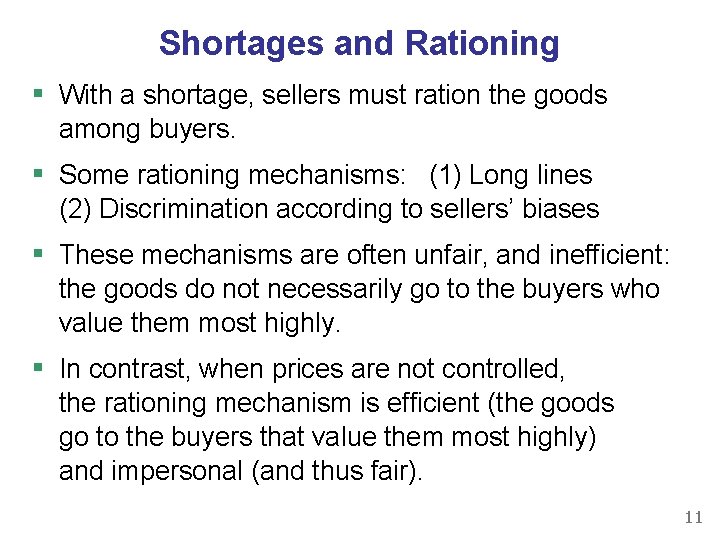
Shortages and Rationing ▪ With a shortage, sellers must ration the goods among buyers. ▪ Some rationing mechanisms: (1) Long lines (2) Discrimination according to sellers’ biases ▪ These mechanisms are often unfair, and inefficient: the goods do not necessarily go to the buyers who value them most highly. ▪ In contrast, when prices are not controlled, the rationing mechanism is efficient (the goods go to the buyers that value them most highly) and impersonal (and thus fair). 11
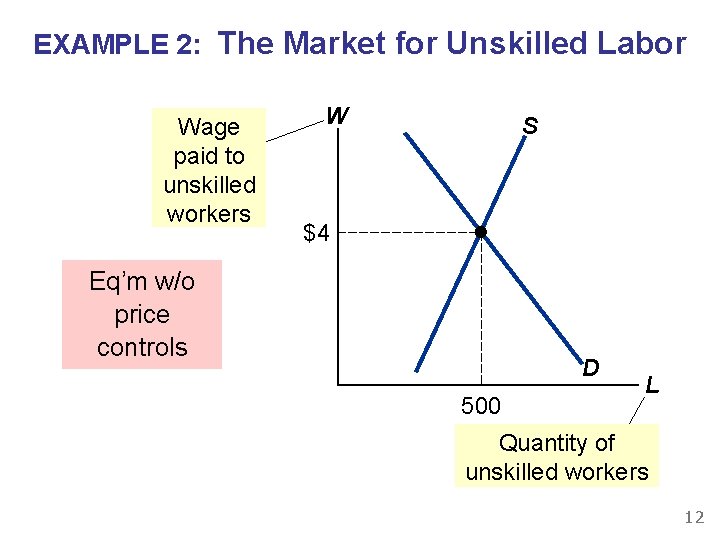
EXAMPLE 2: The Market for Unskilled Labor Wage paid to unskilled workers W S $4 Eq’m w/o price controls D 500 L Quantity of unskilled workers 12
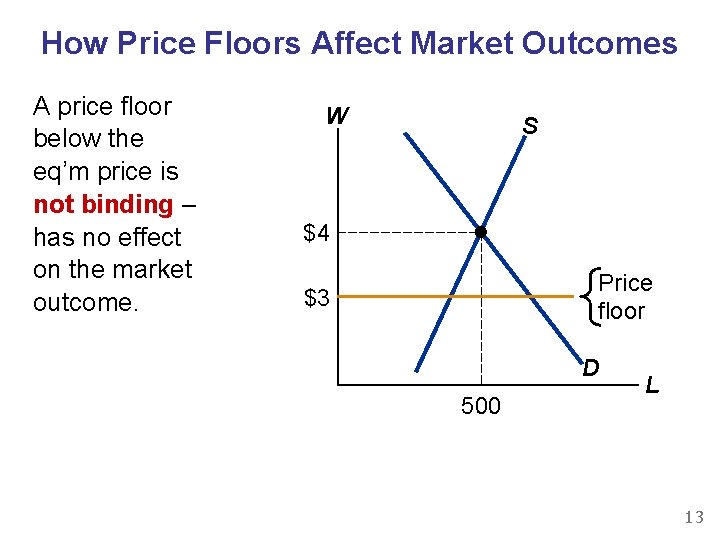
How Price Floors Affect Market Outcomes A price floor below the eq’m price is not binding – has no effect on the market outcome. W S $4 Price floor $3 D 500 L 13
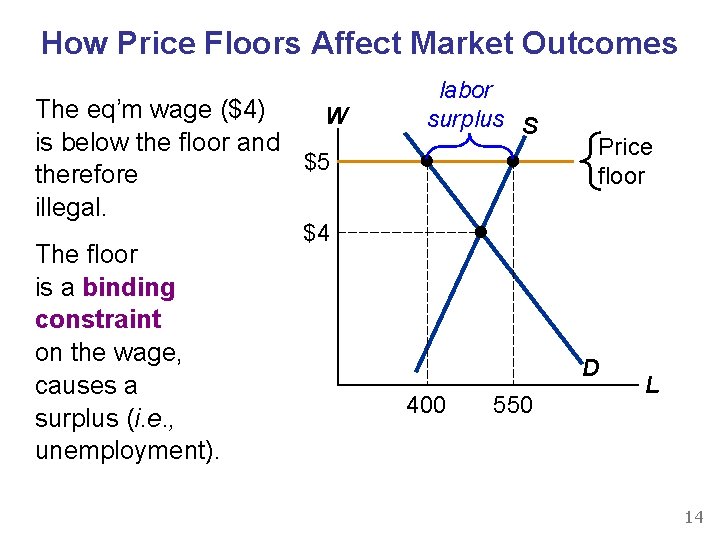
How Price Floors Affect Market Outcomes The eq’m wage ($4) W is below the floor and $5 therefore illegal. The floor is a binding constraint on the wage, causes a surplus (i. e. , unemployment). labor surplus S Price floor $4 D 400 550 L 14
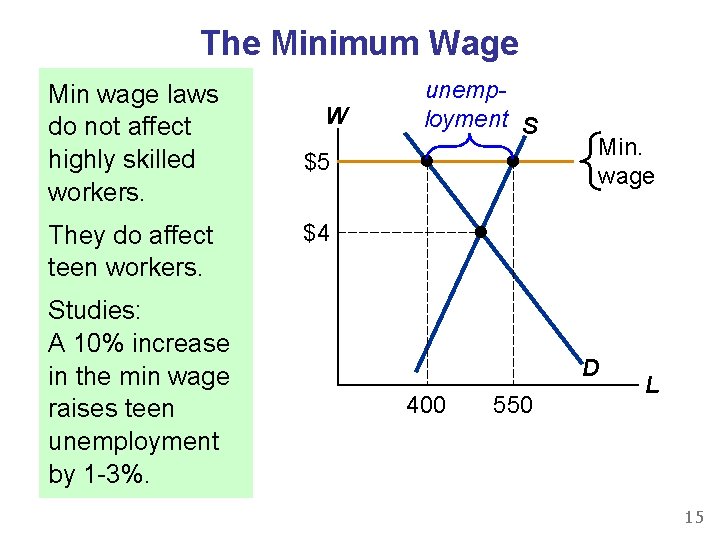
The Minimum Wage Min wage laws do not affect highly skilled workers. They do affect teen workers. Studies: A 10% increase in the min wage raises teen unemployment by 1 -3%. W unemployment S $5 Min. wage $4 D 400 550 L 15
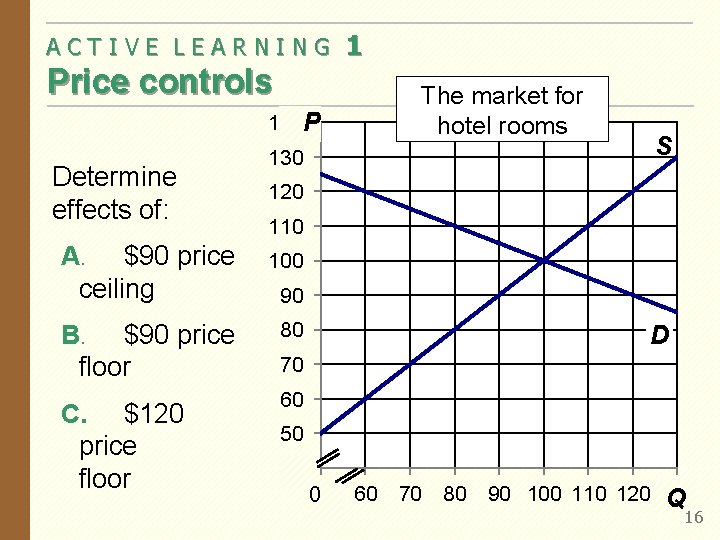
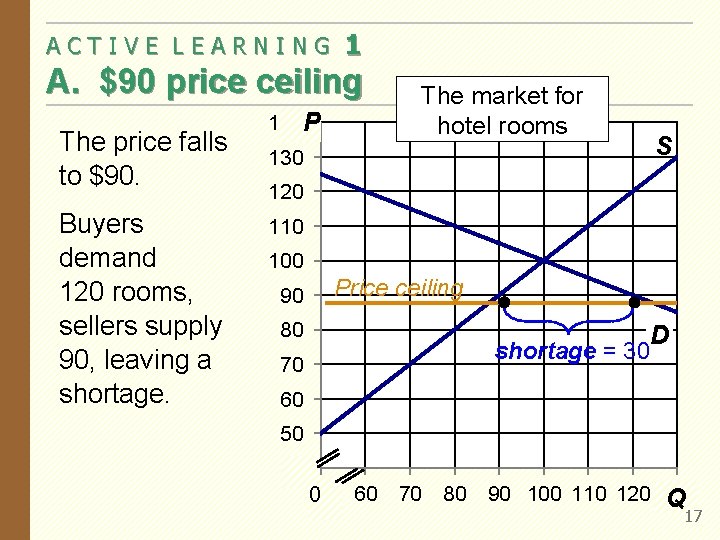
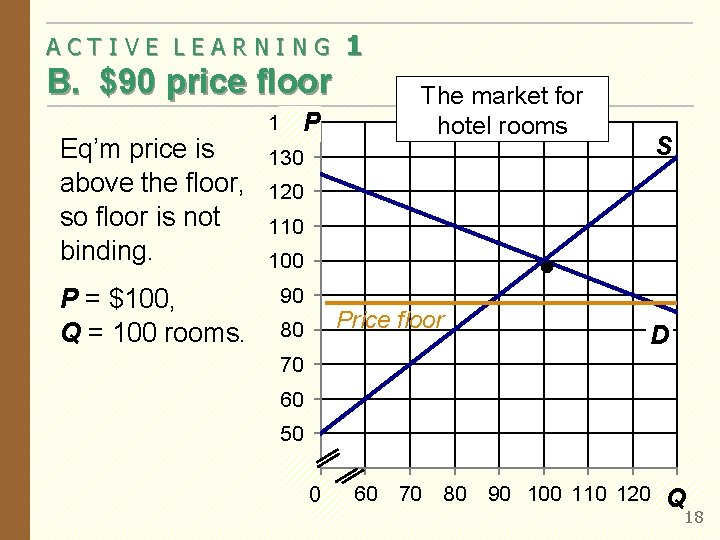
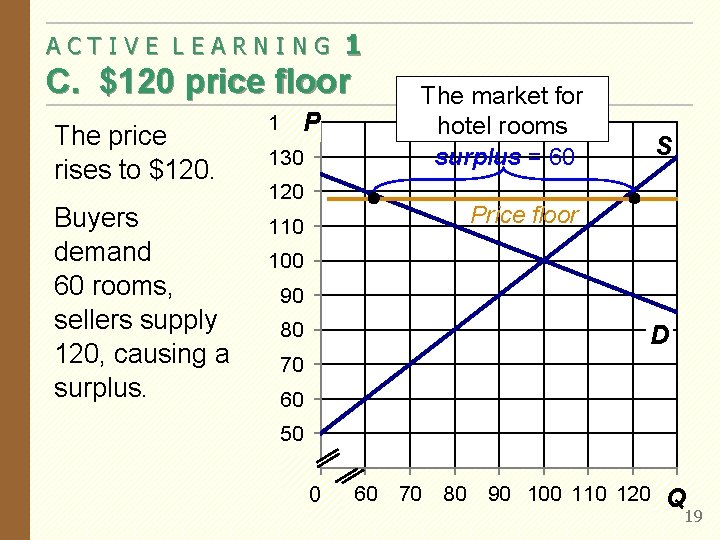
ACTIVE LEARNING 1 Price controls 140 P Determine effects of: 130 S 120 110 A. $90 price ceiling 100 B. $90 price floor 80 C. $120 price floor The market for hotel rooms 90 D 70 60 50 40 50 60 70 80 90 100 110 120 130 0 Q 16
ACTIVE LEARNING 1 A. $90 price ceiling The price falls to $90. Buyers demand 120 rooms, sellers supply 90, leaving a shortage. 140 P The market for hotel rooms S 130 120 110 100 90 80 70 Price ceiling D shortage = 30 60 50 40 50 60 70 80 90 100 110 120 130 0 Q 17
ACTIVE LEARNING 1 B. $90 price floor Eq’m price is above the floor, so floor is not binding. P = $100, Q = 100 rooms. 140 P The market for hotel rooms 130 S 120 110 100 90 80 Price floor D 70 60 50 40 50 60 70 80 90 100 110 120 130 0 Q 18
ACTIVE LEARNING 1 C. $120 price floor The price rises to $120. Buyers demand 60 rooms, sellers supply 120, causing a surplus. 140 P 130 120 110 The market for hotel rooms surplus = 60 S Price floor 100 90 80 D 70 60 50 40 50 60 70 80 90 100 110 120 130 0 Q 19
Evaluating Price Controls ▪ Recall one of the Ten Principles from Chapter 1: Markets are usually a good way to organize economic activity. ▪ Prices are the signals that guide the allocation of society’s resources. This allocation is altered when policymakers restrict prices. ▪ Price controls often intended to help the poor, but often hurt more than help. 20
Taxes ▪ The govt levies taxes on many goods & services to raise revenue to pay for national defense, public schools, etc. ▪ The govt can make buyers or sellers pay the tax. ▪ The tax can be a % of the good’s price, or a specific amount for each unit sold. ▪ For simplicity, we analyze per-unit taxes only. 21
▪ Imagine that a local government decides to hold an annual ice-cream celebration—with a parade, fireworks, and speeches by town officials. To raise revenue to pay for the event, the town decides to place a $0. 50 tax on the sale of icecream cones ▪ But we have a lobby of producers and consumers of ice cream. Nobody want to pay tax 22
The town mayor, hoping to reach a compromise, suggests that half the tax be paid by the buyers and half be paid by the sellers. To analyze these proposals, we need to address a simple but subtle question: ▪ When the government levies a tax on a good, who actually bears the burden of the tax? ▪ The people buying the good? ▪ The people selling the good? ▪ Or if buyers and sellers share the tax burden, what determines how the burden is divided? The term tax incidence refers to how the burden of a tax is distributed among the various people who make up the economy. 23
How Taxes on Sellers Affect Market Outcomes Suppose the local government passes a law requiring sellers of ice-cream cones to send $0. 50 to the government for each cone they sell. How does this law affect the buyers and sellers of ice cream? 1) We decide whether the law affects the supply curve or demand curve. 2) We decide which way the curve shifts. 3) We examine how the shift affects the equilibrium price and quantity. 24
How Taxes on Sellers Affect Market Outcomes Step One The immediate impact of the tax is on the sellers of ice cream. Because the tax is not levied on buyers, the quantity of ice cream demanded at any given price is the same; thus, the demand curve does not change. By contrast, the tax on sellers makes the ice-cream business less profitable at any given price, so it shifts the supply curve. 25
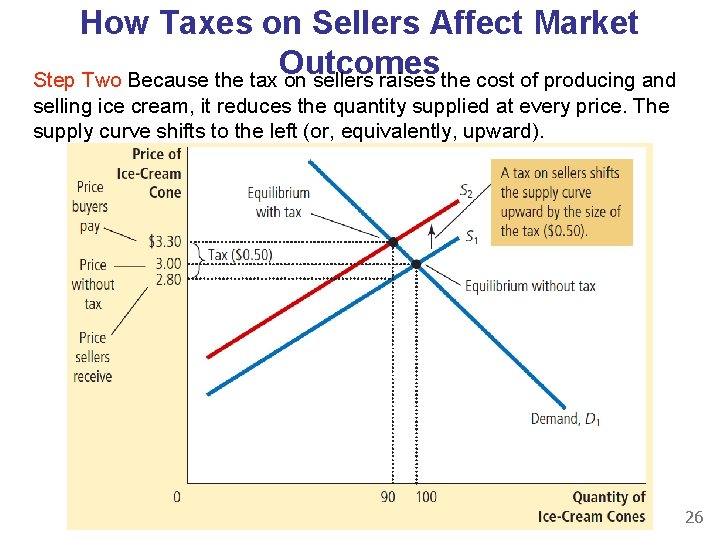
How Taxes on Sellers Affect Market Outcomes Step Two Because the tax on sellers raises the cost of producing and selling ice cream, it reduces the quantity supplied at every price. The supply curve shifts to the left (or, equivalently, upward). 26
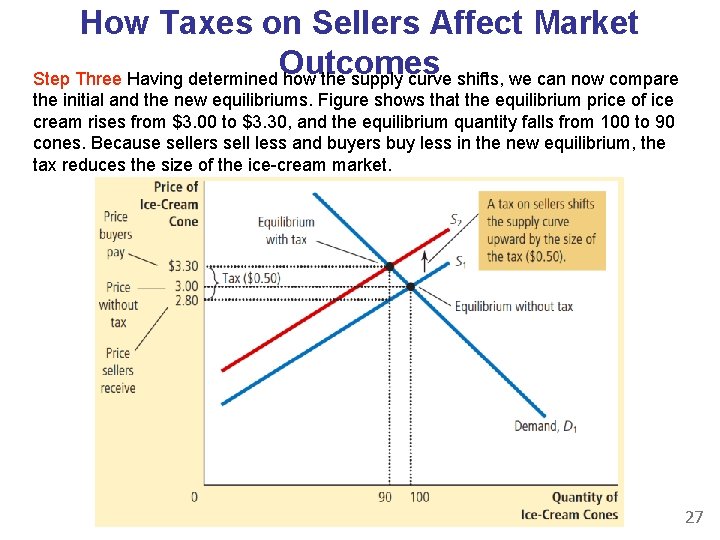
How Taxes on Sellers Affect Market Outcomes Step Three Having determined how the supply curve shifts, we can now compare the initial and the new equilibriums. Figure shows that the equilibrium price of ice cream rises from $3. 00 to $3. 30, and the equilibrium quantity falls from 100 to 90 cones. Because sellers sell less and buyers buy less in the new equilibrium, the tax reduces the size of the ice-cream market. 27
How Taxes on Sellers Affect Market Outcomes Implications We can now return to the question of tax incidence: Who pays the tax? Although sellers send the entire tax to the government, buyers and sellers share the burden. Because the market price rises from $3. 00 to $3. 30 when the tax is introduced, buyers pay $0. 30 more for each ice-cream cone than they did without the tax. Thus, the tax makes buyers worse off. Sellers get a higher price ($3. 30) from buyers than they did previously, but what they get to keep after paying the tax is only $2. 80 ($3. 30 − $0. 50 = $2. 80), compared with $3. 00 before the tax was implemented. Thus, the tax also makes sellers worse off. 28
How Taxes on Sellers Affect Market Outcomes To sum up, this analysis yields two lessons: • Taxes discourage market activity. When a good is taxed, the quantity of the good sold is smaller in the new equilibrium. • Buyers and sellers share the burden of taxes. In the new equilibrium, buyers pay more for the good, and sellers receive less. 29
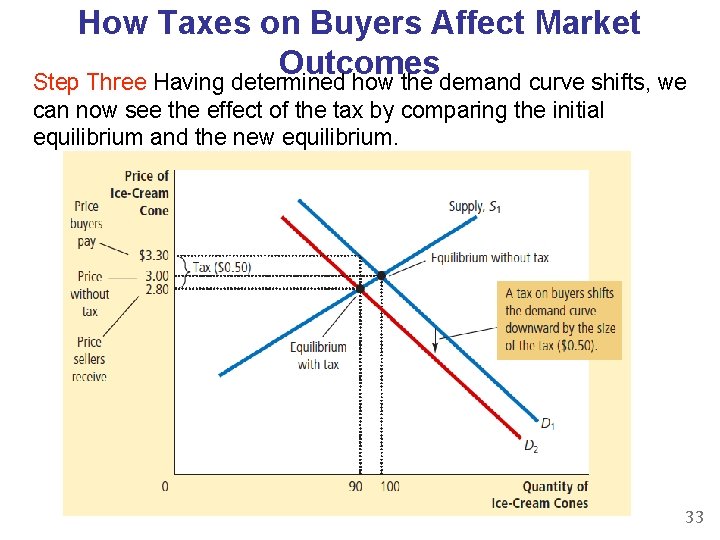
How Taxes on Buyers Affect Market Outcomes Now consider a tax levied on buyers of a good. Suppose that our local government passes a law requiring buyers of ice-cream cones to send $0. 50 to the government for each ice-cream cone they buy. What are the effects of this law? Again, we apply our three steps 30
How Taxes on Buyers Affect Market Outcomes Step One The initial impact of the tax is on the demand for ice cream. The supply curve is not affected because, for any given price of ice cream, sellers have the same incentive to provide ice cream to the market. By contrast, buyers now have to pay a tax to the government (as well as the price to the sellers) whenever they buy ice cream. Thus, the tax shifts the demand curve for ice cream. 31
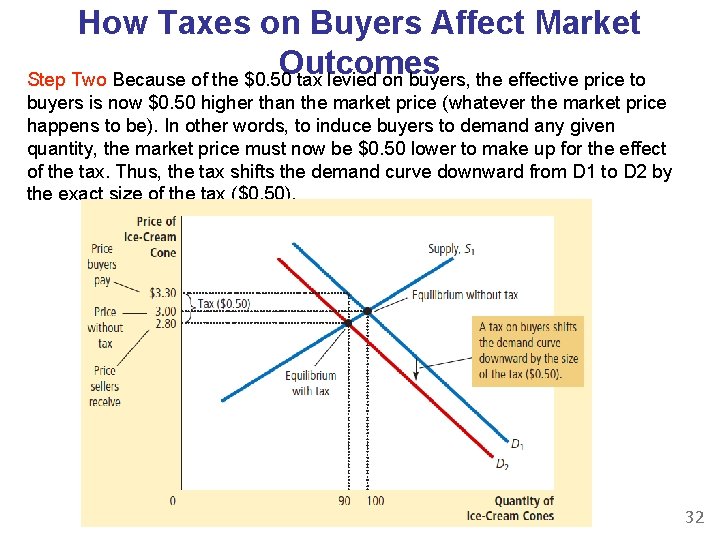
How Taxes on Buyers Affect Market Outcomes Step Two Because of the $0. 50 tax levied on buyers, the effective price to buyers is now $0. 50 higher than the market price (whatever the market price happens to be). In other words, to induce buyers to demand any given quantity, the market price must now be $0. 50 lower to make up for the effect of the tax. Thus, the tax shifts the demand curve downward from D 1 to D 2 by the exact size of the tax ($0. 50). 32
How Taxes on Buyers Affect Market Outcomes Step Three Having determined how the demand curve shifts, we can now see the effect of the tax by comparing the initial equilibrium and the new equilibrium. 33
How Taxes on Buyers Affect Market Outcomes Implications Taxes levied on sellers and taxes levied on buyers are equivalent. In both cases, the tax places a wedge between the price that buyers pay and the price that sellers receive. 34
How Taxes on Buyers Affect Market Outcomes The equivalence of these two taxes is easy to understand if we imagine that the government collects the $0. 50 ice-cream tax in a bowl on the counter of each ice cream store. When the government levies the tax on sellers, the seller is required to place $0. 50 in the bowl after the sale of each cone. When the government levies the tax on buyers, the buyer is required to place $0. 50 in the bowl every time a cone is bought. Whether the $0. 50 goes directly from the buyer’s pocket into the bowl, or indirectly from the buyer’s pocket into the seller’s hand then into the bowl, does not matter. Once the market reaches its new equilibrium, buyers and sellers share the burden, regardless of how the tax is levied. 35
CHAPTER SUMMARY ▪ A price ceiling is a legal maximum on the price of a good. An example is rent control. If the price ceiling is below the eq’m price, it is binding and causes a shortage. ▪ A price floor is a legal minimum on the price of a good. An example is the minimum wage. If the price floor is above the eq’m price, it is binding and causes a surplus. The labor surplus caused by the minimum wage is unemployment. 36
CHAPTER SUMMARY ▪ A tax on a good places a wedge between the price buyers pay and the price sellers receive, and causes the eq’m quantity to fall, whether the tax is imposed on buyers or sellers. ▪ The incidence of a tax is the division of the burden of the tax between buyers and sellers, and does not depend on whether the tax is imposed on buyers or sellers. ▪ The incidence of the tax depends on the price elasticities of supply and demand. 37