
6 Stellar EvolutionI The life history of a




- Slides: 21
6 - Stellar Evolution-I
The life history of a star is determined by its mass…. .
First fuel in stellar cores is hydrogen “burning” via pp or CNO reactions. The rate of energy production is: If the fuel available for before the structure changes is, say, 0. 1 M*, then the lifetime of the star (the time over which this can occur) is: From the mass-luminosity relation for MS stars (of solar mass and somewhat larger):
2 Important Basic Conclusions: We should expect any very massive star to be young, and found near its place of formation.
For a group of stars formed at the same approximate time, the more luminous ones should evolve faster than the lessluminous ones.
Why Do Stars Evolve? Nuclear fusion changes the chemical composition of the core, which in turn changes the mean molecular weight μ, which governs the equation of state. For a star like the sun where the energy generation goes as It can be shown that for a chemically uniform star the surface T and net L go approximately like:
Homogeneouslymixed stars should evolve toward upper left. But real stars are stratified chemically…. .
ZAMS Low-mass Stars: • Radiative cores • Convective envelopes
“to flash, or not to flash…. ” • Lower-mass stars - He-ignition begins in electron degenerate core • Heating does not expand the gas in the core, merely raises T, increasing reaction rates • Explosive reaction ensues - “He (core) Flash” core briefly reaches ~1011 Lsun? ? (NOTE: This is not visible to the outside observer) • Degeneracy is lifted and “normal” He-burning follows.
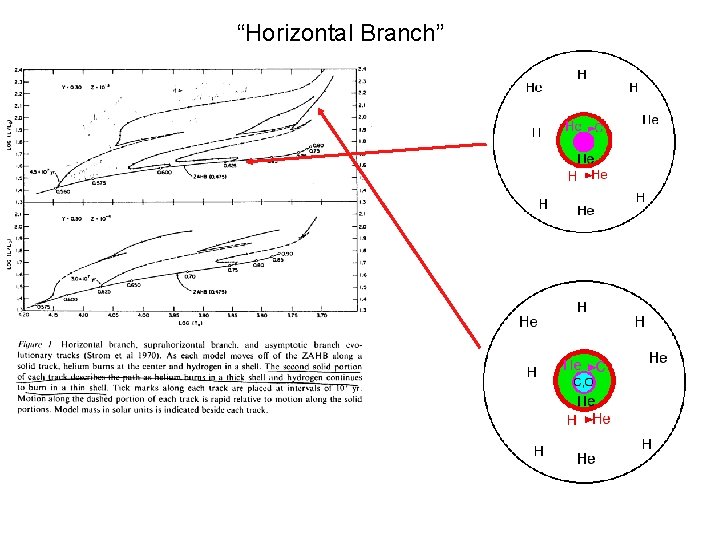
“Horizontal Branch”
Instability Strip (Cepheids & RR Lyrae Stars)
Asymptotic Giant Branch (AGB)
Mass in H-rich envelope
Massive Stars: • Convective cores • Radiative envelopes
convective core
3 rd dredge-up on its way! 1 st dredge-up 2 nd dredge-up Time (units of 107 years)