
6 Solar System observation 6 1 Observing planets
6 Solar System observation: 6. 1 Observing planets 6. 2 The apparent motion of the sun • • Demonstrate an understanding of the retrograde motion of planets on a star chart Describe the apparent motion of the Sun through the sky Starter: 1. Where does the name planet come form? 2. What is the motion of the planets across the sky? 3. Do they follow the same path every time they cross the sky? 4. Why might the path across the sky change?

Starter Find out the meaning of the terms in the boxes below. You may wish to include diagrams Greatest Elongation Conjunction (superior and inferior) Opposition Transit (across solar disc) Occultation
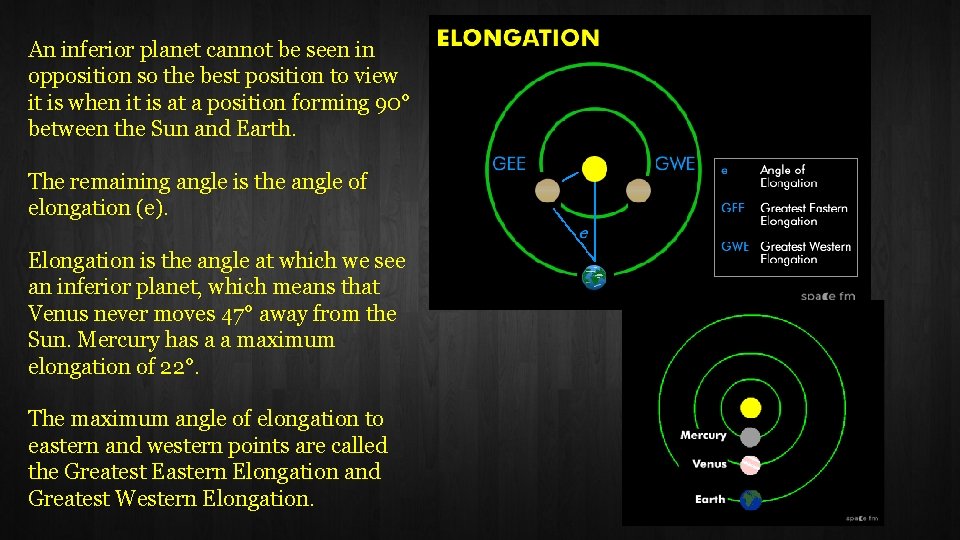
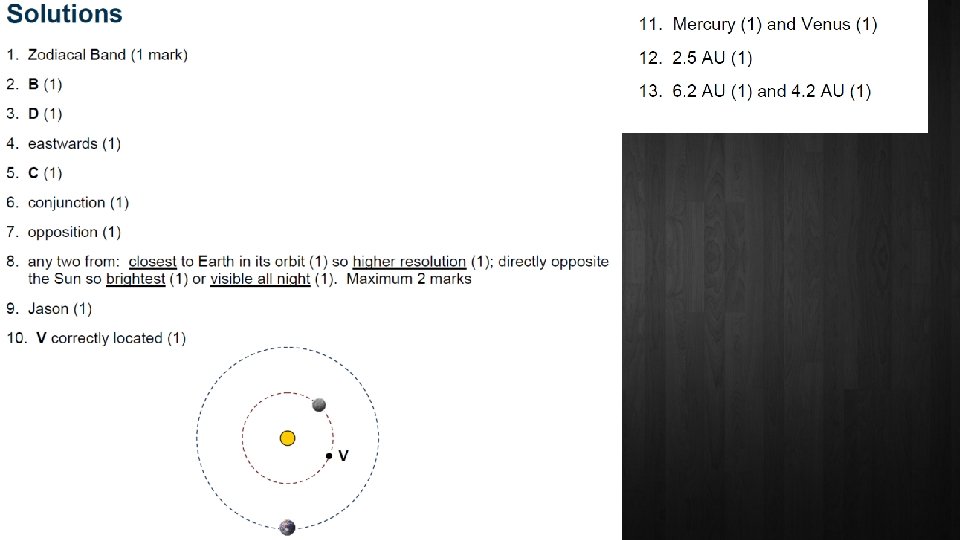
An inferior planet cannot be seen in opposition so the best position to view it is when it is at a position forming 90° between the Sun and Earth. The remaining angle is the angle of elongation (e). Elongation is the angle at which we see an inferior planet, which means that Venus never moves 47° away from the Sun. Mercury has a a maximum elongation of 22°. The maximum angle of elongation to eastern and western points are called the Greatest Eastern Elongation and Greatest Western Elongation.
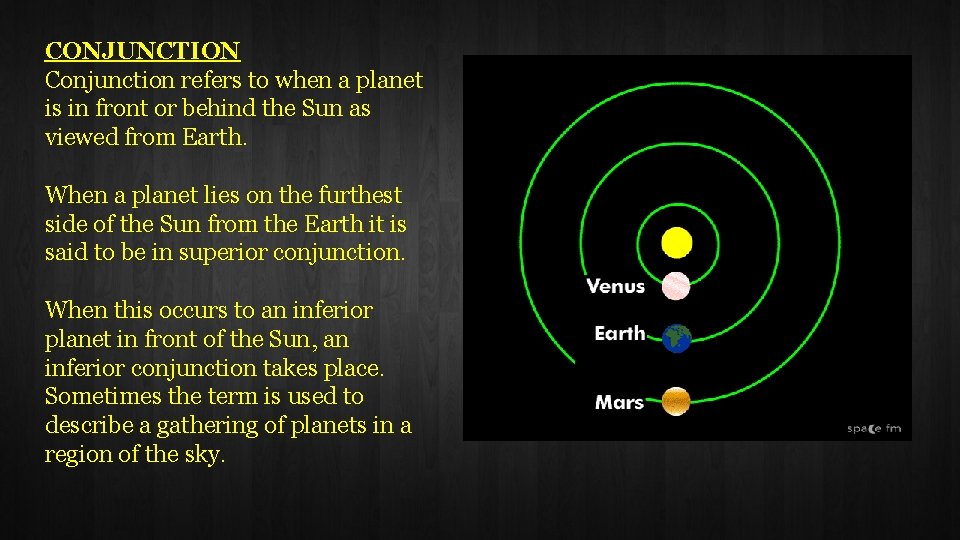
CONJUNCTION Conjunction refers to when a planet is in front or behind the Sun as viewed from Earth. When a planet lies on the furthest side of the Sun from the Earth it is said to be in superior conjunction. When this occurs to an inferior planet in front of the Sun, an inferior conjunction takes place. Sometimes the term is used to describe a gathering of planets in a region of the sky.
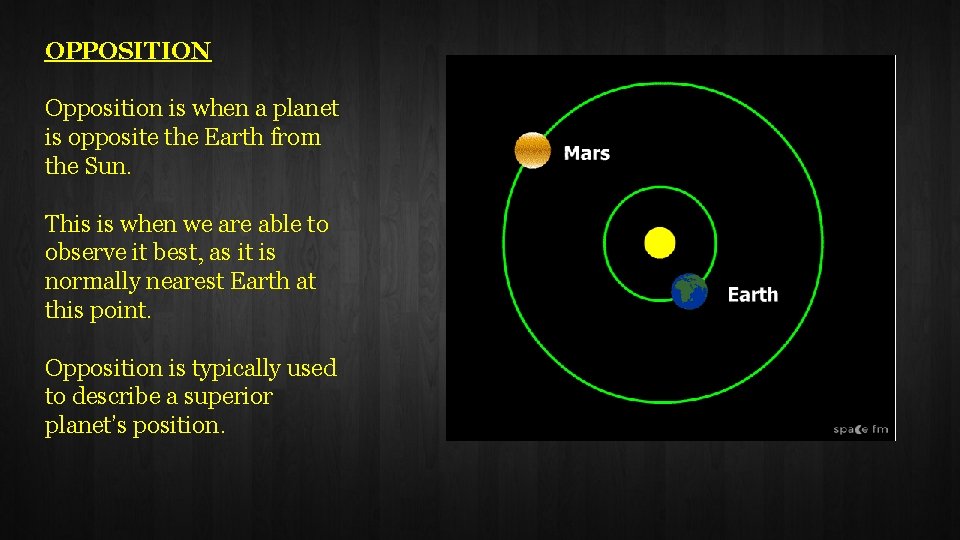
OPPOSITION Opposition is when a planet is opposite the Earth from the Sun. This is when we are able to observe it best, as it is normally nearest Earth at this point. Opposition is typically used to describe a superior planet’s position.
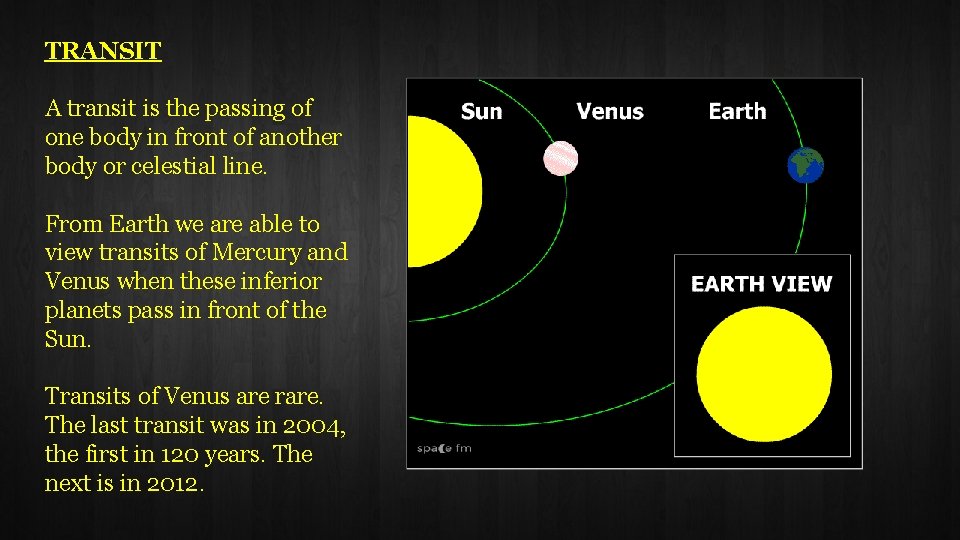
TRANSIT A transit is the passing of one body in front of another body or celestial line. From Earth we are able to view transits of Mercury and Venus when these inferior planets pass in front of the Sun. Transits of Venus are rare. The last transit was in 2004, the first in 120 years. The next is in 2012.
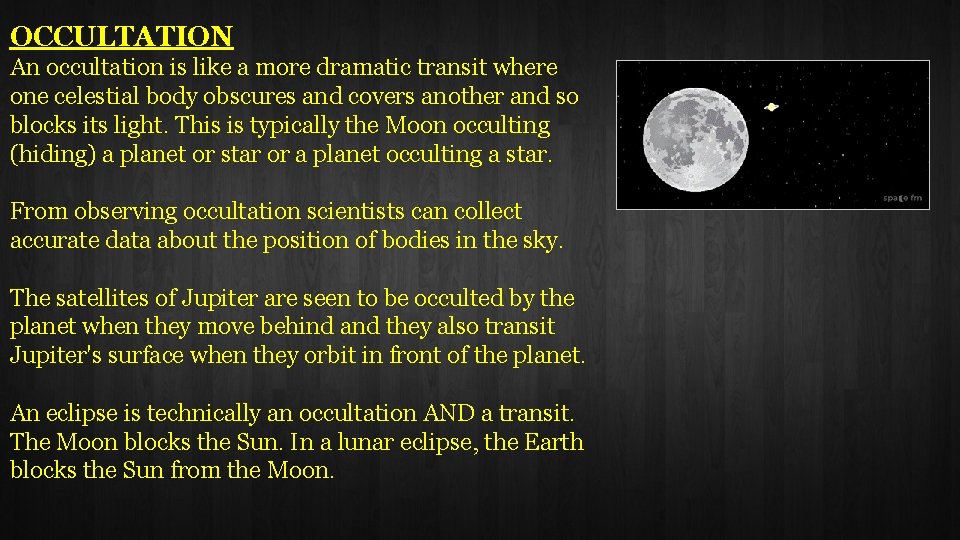
OCCULTATION An occultation is like a more dramatic transit where one celestial body obscures and covers another and so blocks its light. This is typically the Moon occulting (hiding) a planet or star or a planet occulting a star. From observing occultation scientists can collect accurate data about the position of bodies in the sky. The satellites of Jupiter are seen to be occulted by the planet when they move behind and they also transit Jupiter's surface when they orbit in front of the planet. An eclipse is technically an occultation AND a transit. The Moon blocks the Sun. In a lunar eclipse, the Earth blocks the Sun from the Moon.

Planetary motion Find out how the speed of planets orbit vary as they move out from the sun. Animation
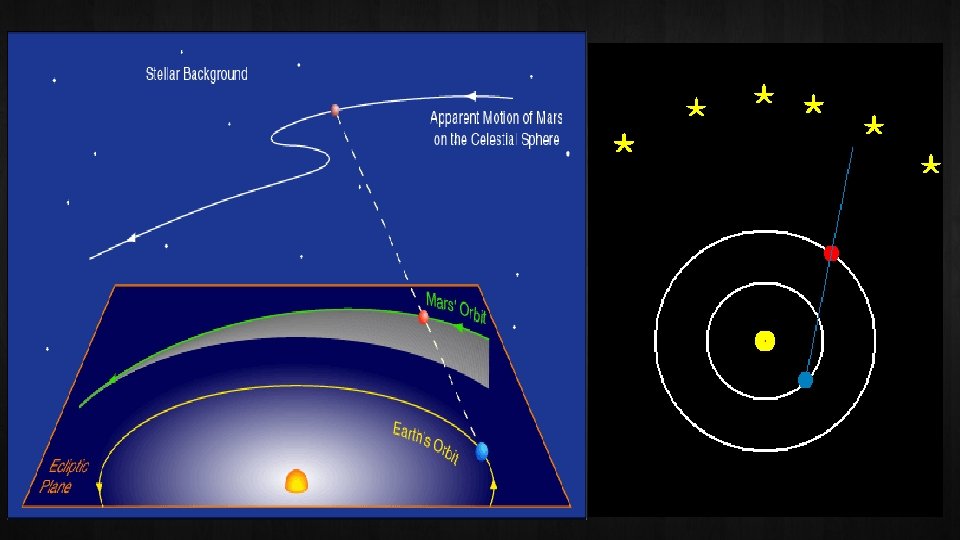
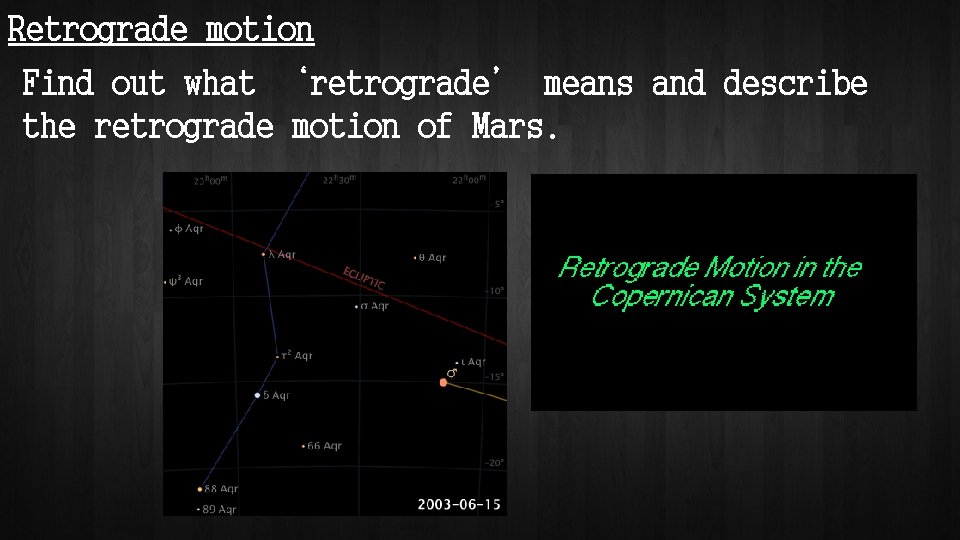
Retrograde motion Find out what ‘retrograde’ means and describe the retrograde motion of Mars. Animation
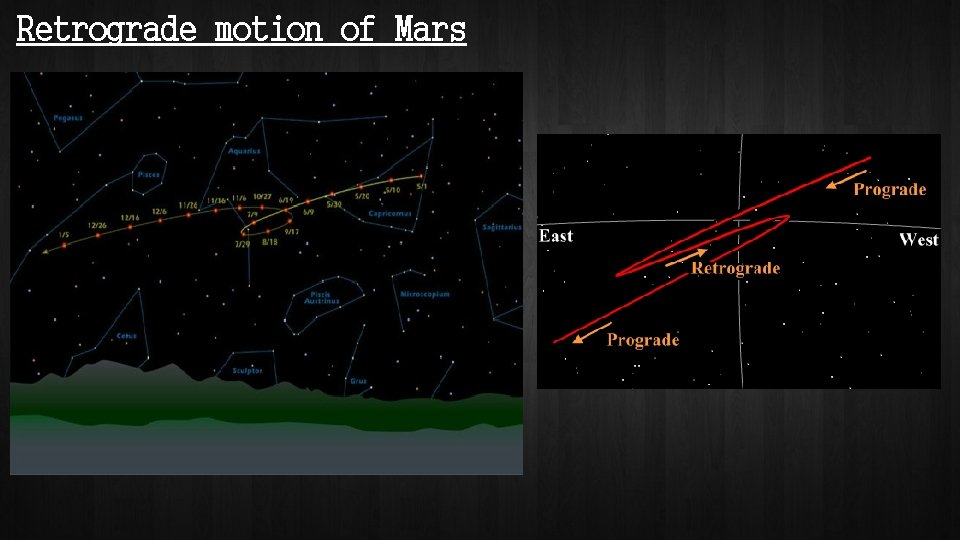
Retrograde motion of Mars
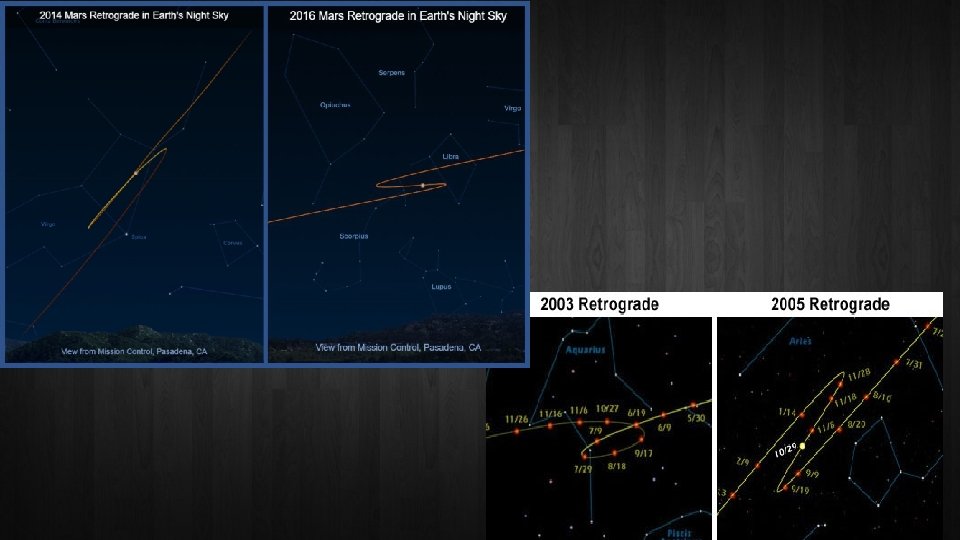

Time to try to plot your own retrograde graph!!!!1111!
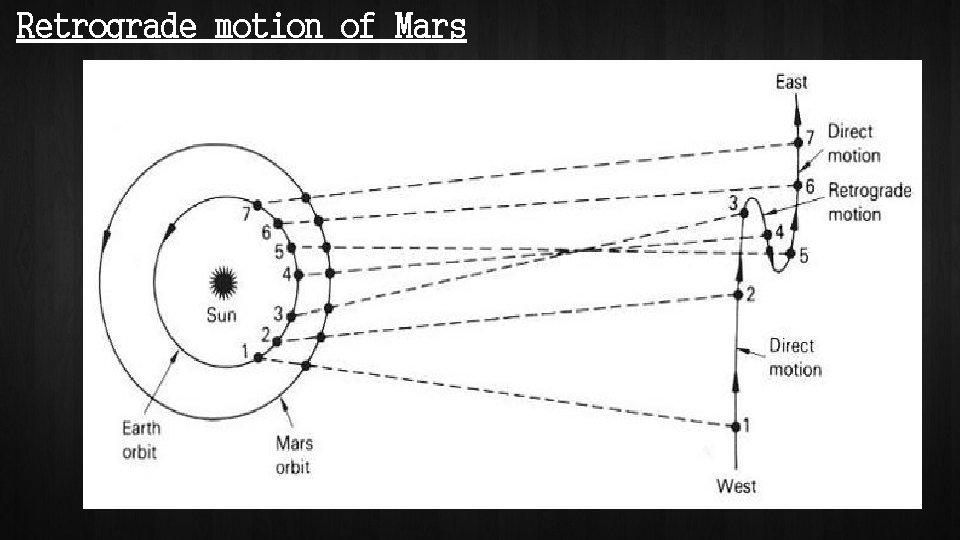
Retrograde motion of Mars

up down up again 7 3 4 6 2 5 1
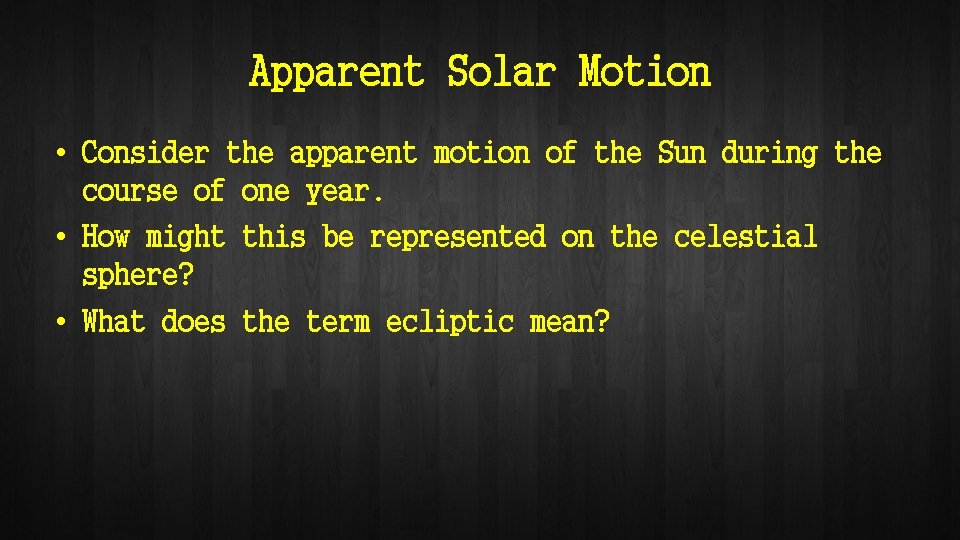
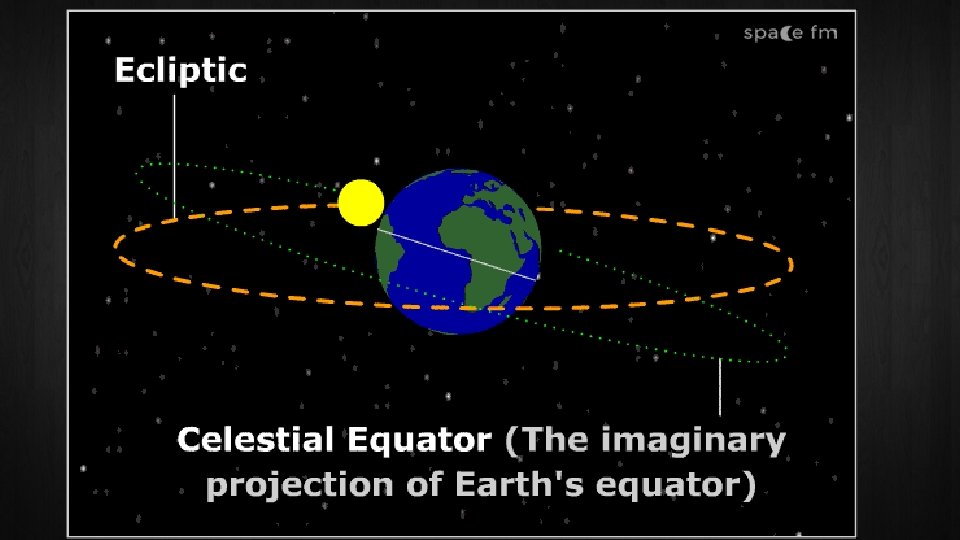
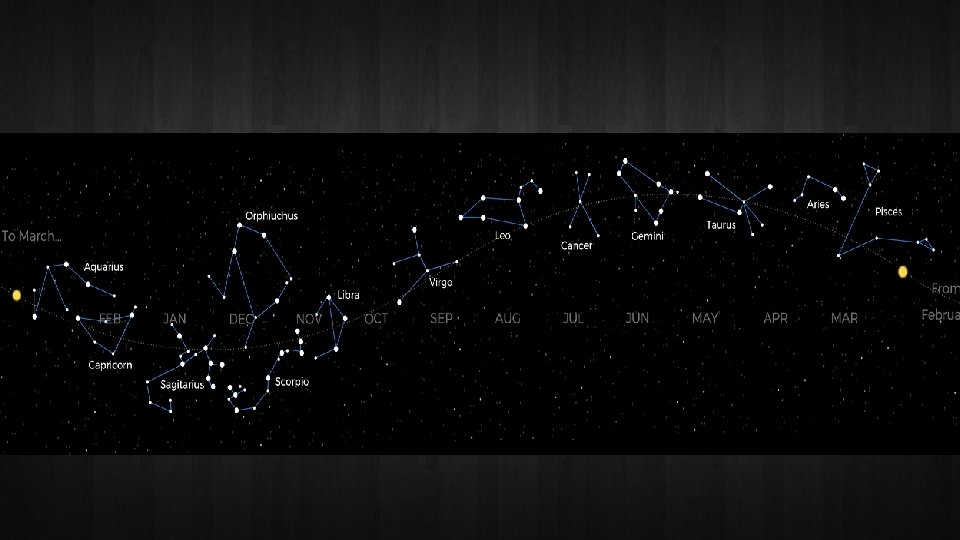
Apparent Solar Motion • Consider the apparent motion of the Sun during the course of one year. • How might this be represented on the celestial sphere? • What does the term ecliptic mean?


Apparent Solar Motion • During the year the earth moves around the sun. As a result, the sun appears to move around the sky once with respect to the stars as seen from Earth. • The plane of the earth's orbit is called the ecliptic. Since the earth orbits the sun, the sun is also on the ecliptic. As a result, the sun appears to us to move around the sky on the ecliptic.

Apparent Solar Motion • Find out what the first point of Aries and Libra are and where they would appear on a RA DEC graph of the motion of the Sun. • What symbols are used to denote these terms? What dates are relevant to these terms and why? • Draw yourself a sketch to explain and label these terms.
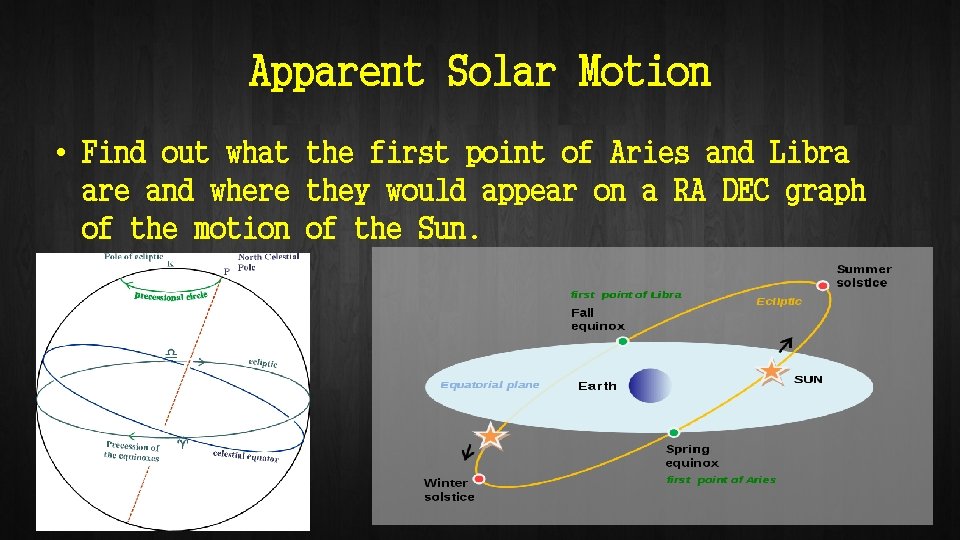
Apparent Solar Motion • Find out what the first point of Aries and Libra are and where they would appear on a RA DEC graph of the motion of the Sun.
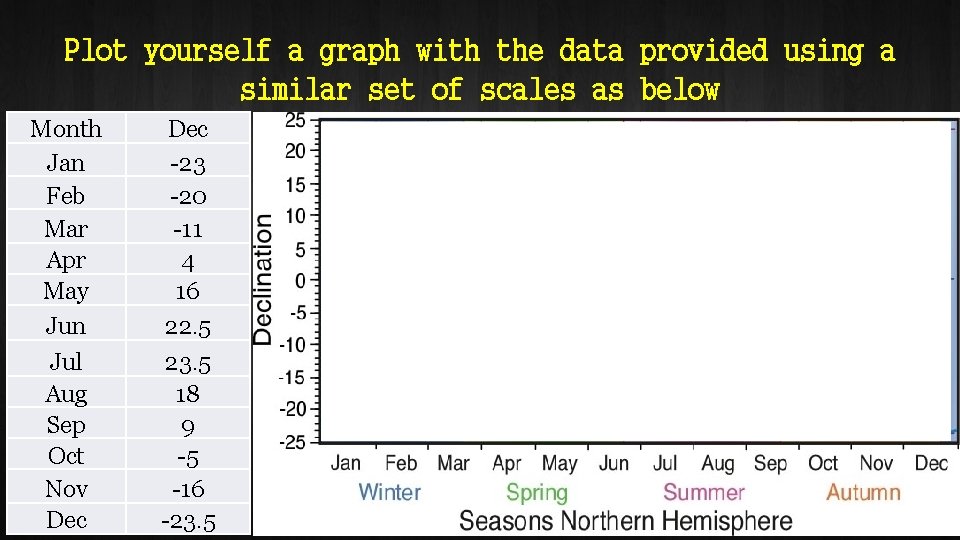
Plot yourself a graph with the data provided using a similar set of scales as below Month Jan Feb Mar Apr May Jun Dec -23 -20 -11 4 16 22. 5 Jul Aug Sep Oct Nov Dec 23. 5 18 9 -5 -16 -23. 5
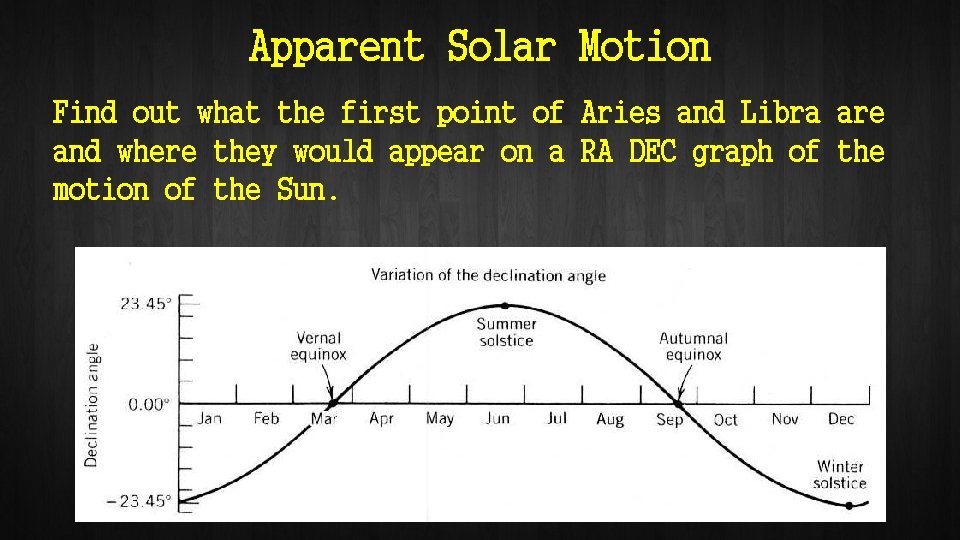
Apparent Solar Motion Find out what the first point of Aries and Libra are and where they would appear on a RA DEC graph of the motion of the Sun.
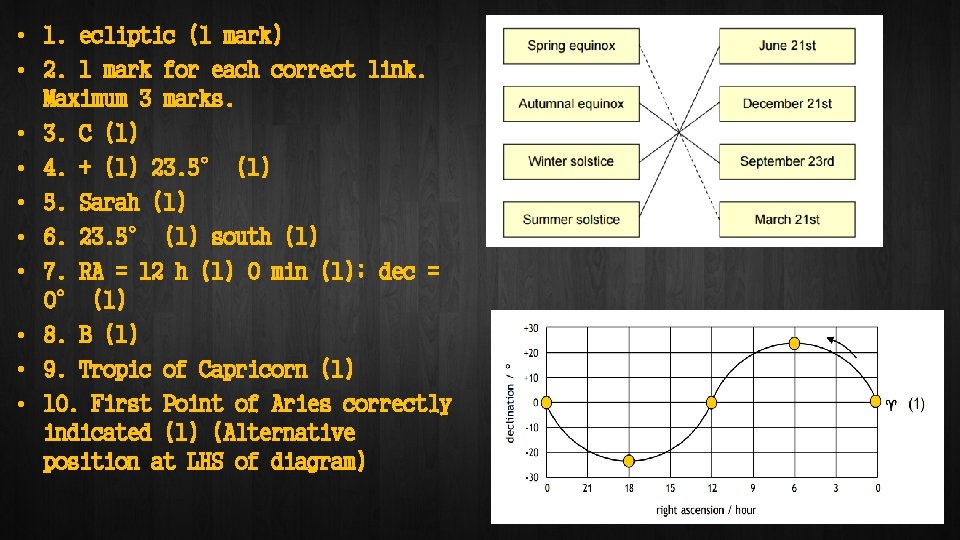
• 1. ecliptic (1 mark) • 2. 1 mark for each correct link. Maximum 3 marks. • 3. C (1) • 4. + (1) 23. 5° (1) • 5. Sarah (1) • 6. 23. 5° (1) south (1) • 7. RA = 12 h (1) 0 min (1); dec = 0° (1) • 8. B (1) • 9. Tropic of Capricorn (1) • 10. First Point of Aries correctly indicated (1) (Alternative position at LHS of diagram)
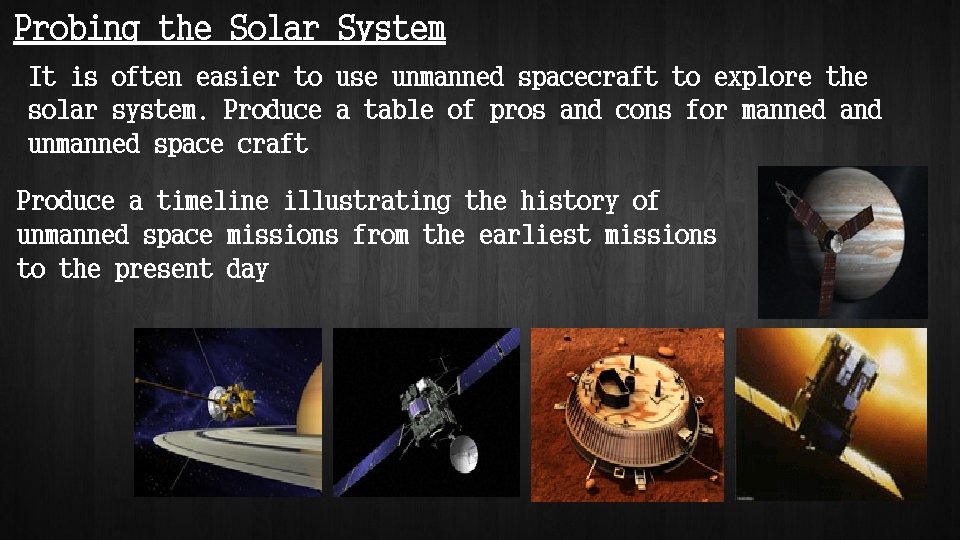
Probing the Solar System It is often easier to use unmanned spacecraft to explore the solar system. Produce a table of pros and cons for manned and unmanned space craft Produce a timeline illustrating the history of unmanned space missions from the earliest missions to the present day
- Slides: 29