
6 Process Selection and Facility Layout Mc GrawHillIrwin
- Slides: 32
6 Process Selection and Facility Layout Mc. Graw-Hill/Irwin
Learning Objectives § § § § Explain the strategic importance of process selection. Describe the basic processing types. List some reasons for redesign of layouts. Describe the basic layout types. List the main advantages and disadvantages of product layouts and process layouts. Solve simple line-balancing problems. Develop simple process layouts. 2
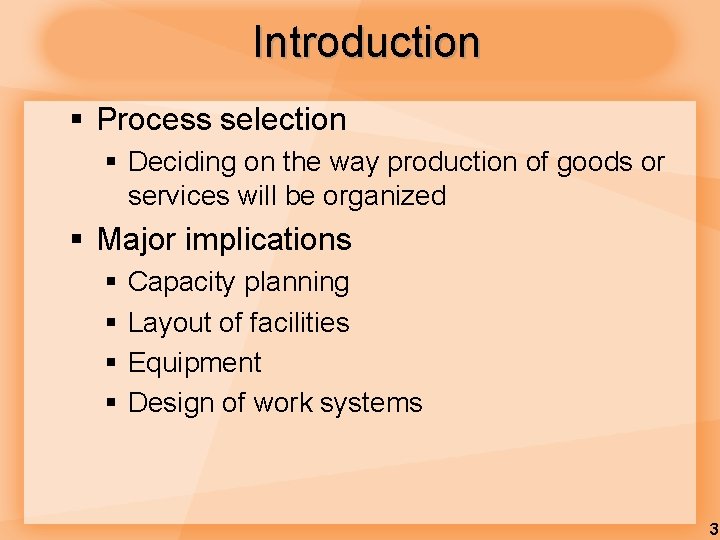
Introduction § Process selection § Deciding on the way production of goods or services will be organized § Major implications § § Capacity planning Layout of facilities Equipment Design of work systems 3
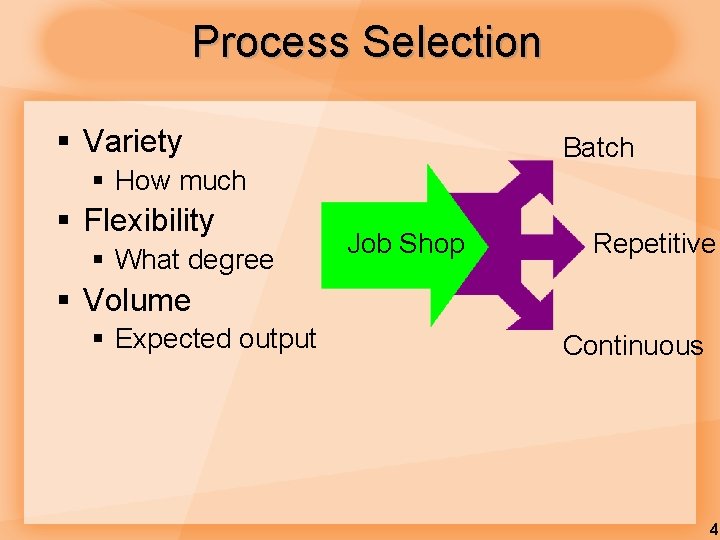
Process Selection § Variety Batch § How much § Flexibility § What degree Job Shop Repetitive § Volume § Expected output Continuous 4
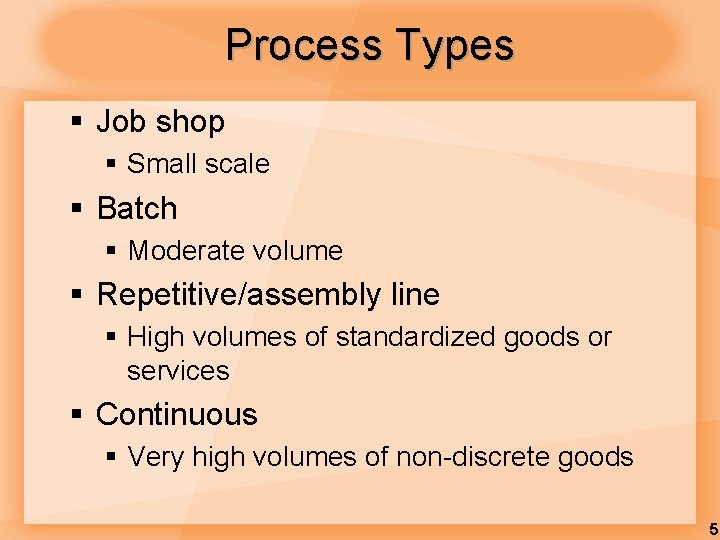
Process Types § Job shop § Small scale § Batch § Moderate volume § Repetitive/assembly line § High volumes of standardized goods or services § Continuous § Very high volumes of non-discrete goods 5
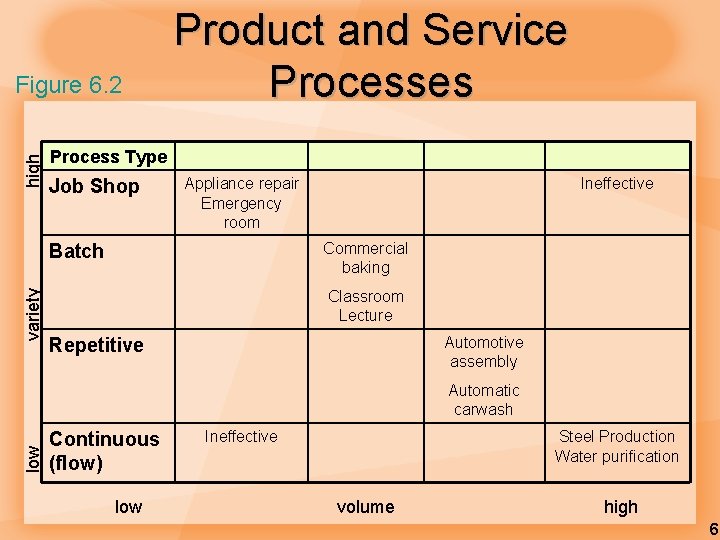
high Figure 6. 2 Product and Service Processes Process Type Job Shop Appliance repair Emergency room Commercial baking Batch variety Ineffective Classroom Lecture Automotive assembly Repetitive low Automatic carwash Continuous (flow) low Ineffective Steel Production Water purification volume high 6
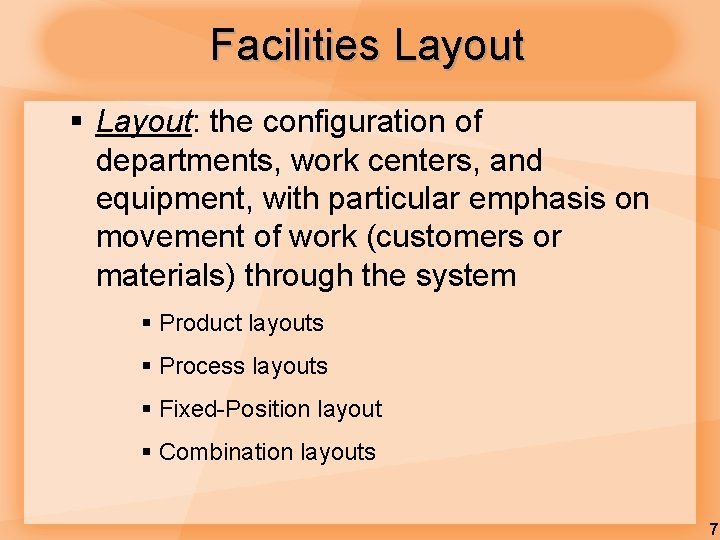
Facilities Layout § Layout: the configuration of departments, work centers, and equipment, with particular emphasis on movement of work (customers or materials) through the system § Product layouts § Process layouts § Fixed-Position layout § Combination layouts 7
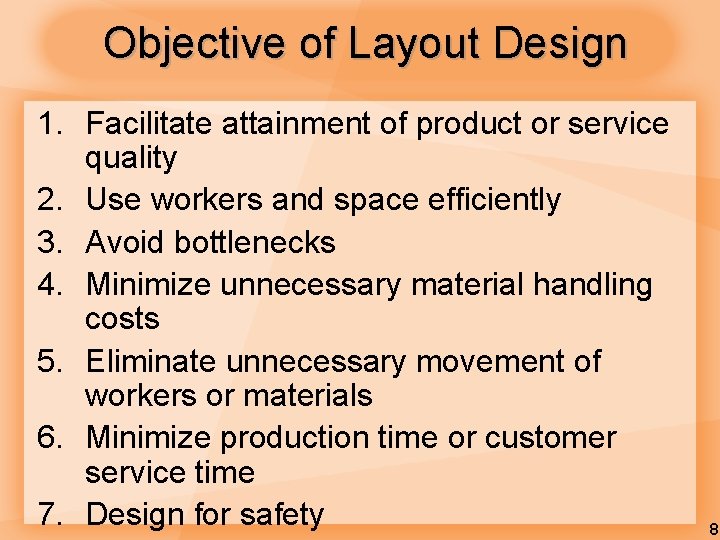
Objective of Layout Design 1. Facilitate attainment of product or service quality 2. Use workers and space efficiently 3. Avoid bottlenecks 4. Minimize unnecessary material handling costs 5. Eliminate unnecessary movement of workers or materials 6. Minimize production time or customer service time 7. Design for safety 8
Importance of Layout Decisions § Requires substantial investments of money and effort § Involves long-term commitments § Has significant impact on cost and efficiency of short-term operations 9
Basic Layout Types § Product layout § Layout that uses standardized processing operations to achieve smooth, rapid, highvolume flow § Process layout § Layout that can handle varied processing requirements § Fixed Position layout § Layout in which the product or project remains stationary, and workers, materials, and equipment are moved as needed 10
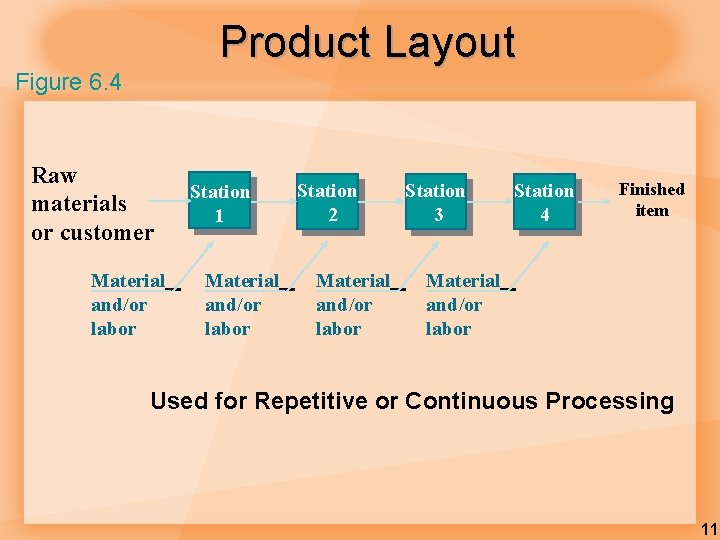
Product Layout Figure 6. 4 Raw materials or customer Material and/or labor Station 1 Material and/or labor Station 2 Material and/or labor Station 3 Station 4 Finished item Material and/or labor Used for Repetitive or Continuous Processing 11
Advantages of Product Layout § § § § High rate of output Low unit cost Labor specialization Low material handling cost High utilization of labor and equipment Established routing and scheduling Routing accounting and purchasing 12
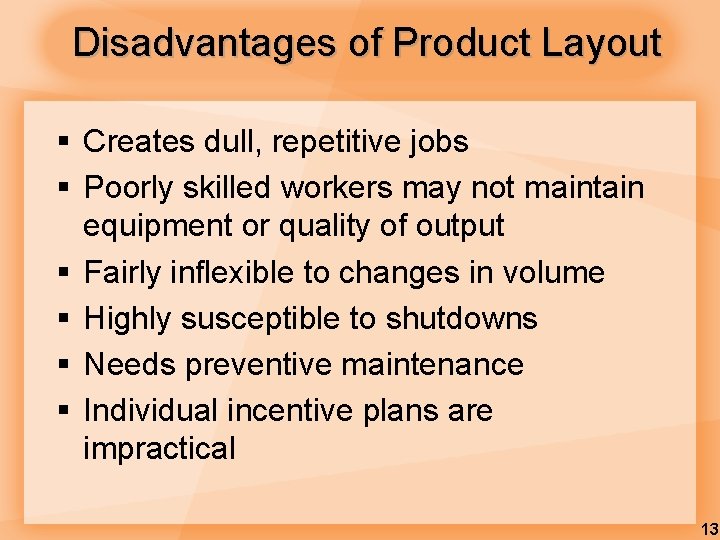
Disadvantages of Product Layout § Creates dull, repetitive jobs § Poorly skilled workers may not maintain equipment or quality of output § Fairly inflexible to changes in volume § Highly susceptible to shutdowns § Needs preventive maintenance § Individual incentive plans are impractical 13
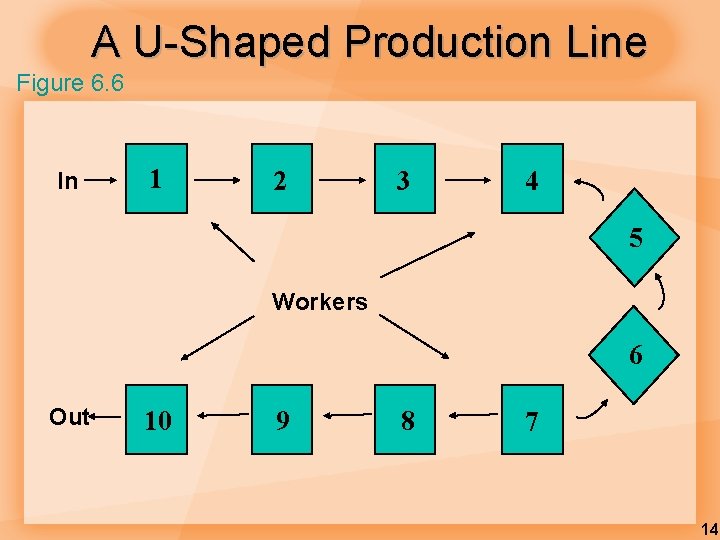
A U-Shaped Production Line Figure 6. 6 In 1 2 3 4 5 Workers 6 Out 10 9 8 7 14
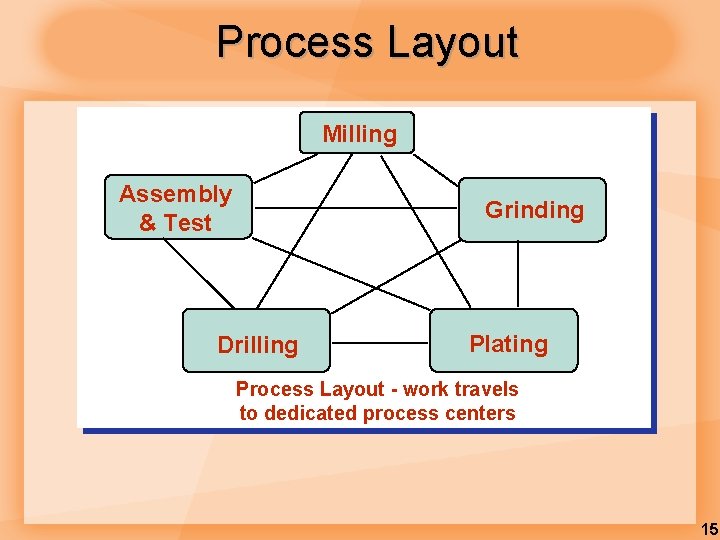
Process Layout Milling Assembly & Test Grinding Drilling Plating Process Layout - work travels to dedicated process centers 15
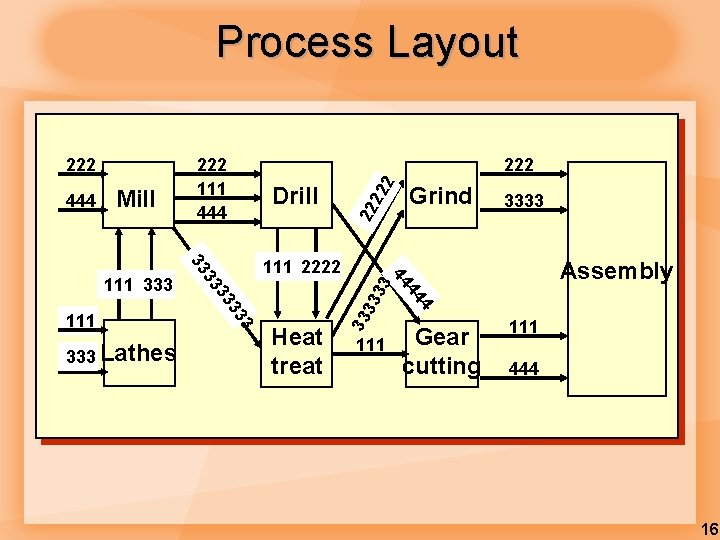
Process Layout 22 2 3 4 44 Heat treat Grind 3333 Assembly 44 3 3 33 333 Lathes 33 11112222 3 33 111 333 Drill 22 Mill 222 33 3 444 222 111 444 111 Gear cutting 33 222 111 444 16
Advantages of Process Layouts § Can handle a variety of processing requirements § Not particularly vulnerable to equipment failures § Equipment used is less costly § Possible to use individual incentive plans 17
Disadvantages of Process Layouts § § § In-process inventory costs can be high Challenging routing and scheduling Equipment utilization rates are low Material handling slow and inefficient Complexities often reduce span of supervision § Special attention for each product or customer § Accounting and purchasing are more 18
Fixed Position Layouts § Fixed Position Layout: Layout in which the product or project remains stationary, and workers, materials, and equipment are moved as needed. § Nature of the product dictates this type of layout § Weight § Size § Bulk § Large construction projects § Ship/Boat production 19
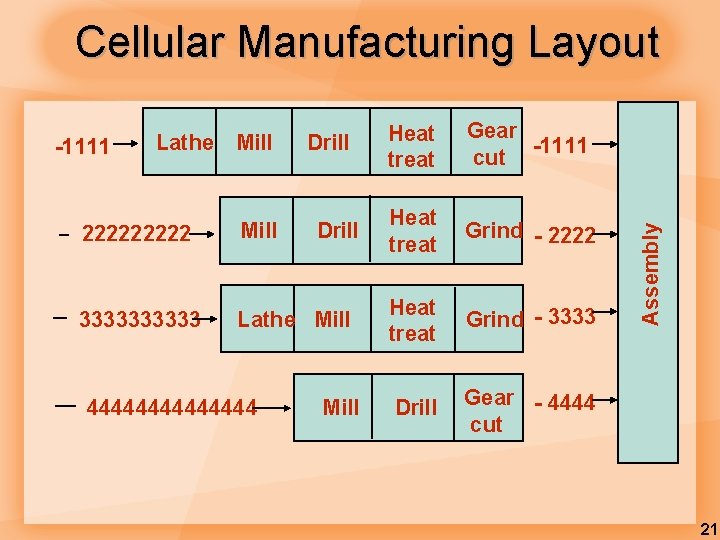
Cellular Layouts § Cellular Production § Layout in which machines are grouped into a cell that can process items that have similar processing requirements § Group Technology § The grouping into part families of items with similar design or manufacturing characteristics 20
-1111 Lathe Mill Drill 22222 Mill 33333 Lathe Mill 4444444 Drill Mill Heat treat Gear -1111 cut Heat treat Grind - 2222 Heat treat Grind - 3333 Drill Gear - 4444 cut Assembly Cellular Manufacturing Layout 21
Service Layouts § § Warehouse and storage layouts Retail layouts Office layouts Service layouts must be aesthetically pleasing as well as functional 22
Design Product Layouts: Line Balancing is the process of assigning tasks to workstations in such a way that the workstations have approximately equal time requirements. 23
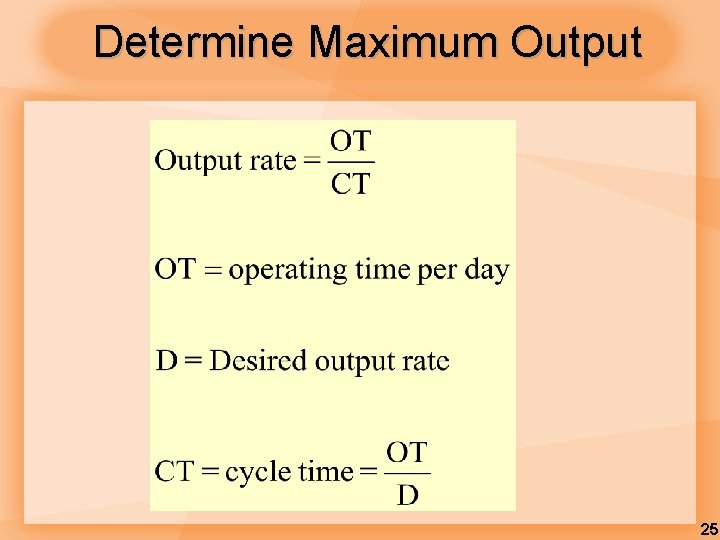
Cycle Time Cycle time is the maximum time allowed at each workstation to complete its set of tasks on a unit. 24
Determine Maximum Output 25
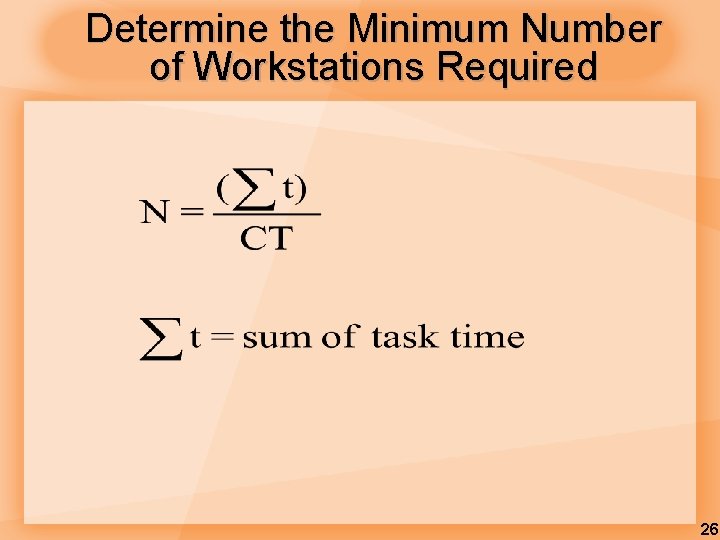
Determine the Minimum Number of Workstations Required 26
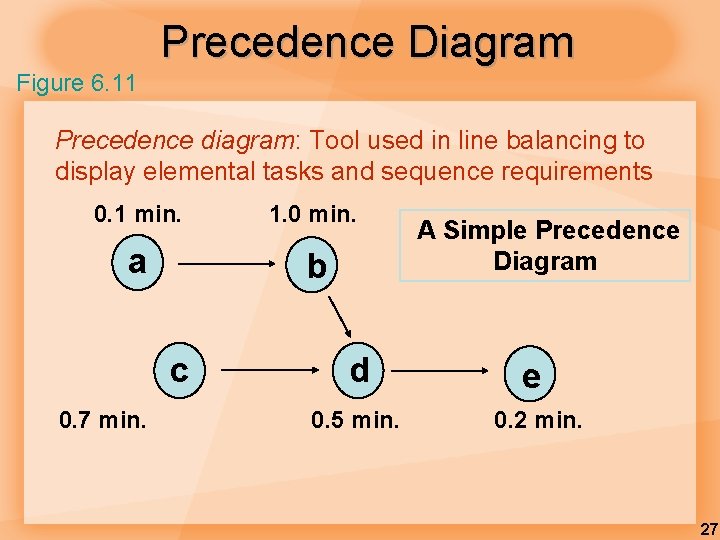
Precedence Diagram Figure 6. 11 Precedence diagram: Tool used in line balancing to display elemental tasks and sequence requirements 0. 1 min. 1. 0 min. a b c 0. 7 min. d 0. 5 min. A Simple Precedence Diagram e 0. 2 min. 27
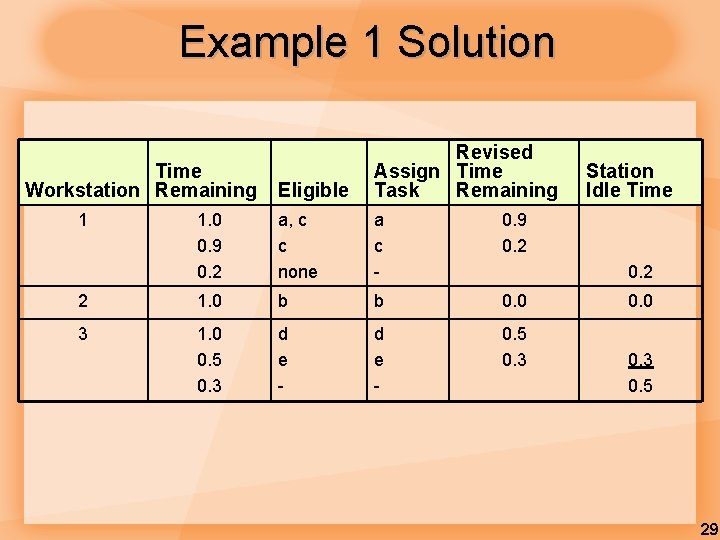
Example 1: Assembly Line Balancing § Arrange tasks shown in Figure 6. 10 into three workstations. § § Use a cycle time of 1. 0 minute Assign tasks in order of the most number of followers 28
Example 1 Solution Eligible Revised Assign Time Task Remaining 1. 0 0. 9 0. 2 a, c c none a c - 0. 9 0. 2 2 1. 0 b b 0. 0 3 1. 0 0. 5 0. 3 d e - 0. 5 0. 3 Time Workstation Remaining 1 Station Idle Time 0. 2 0. 0 0. 3 0. 5 29
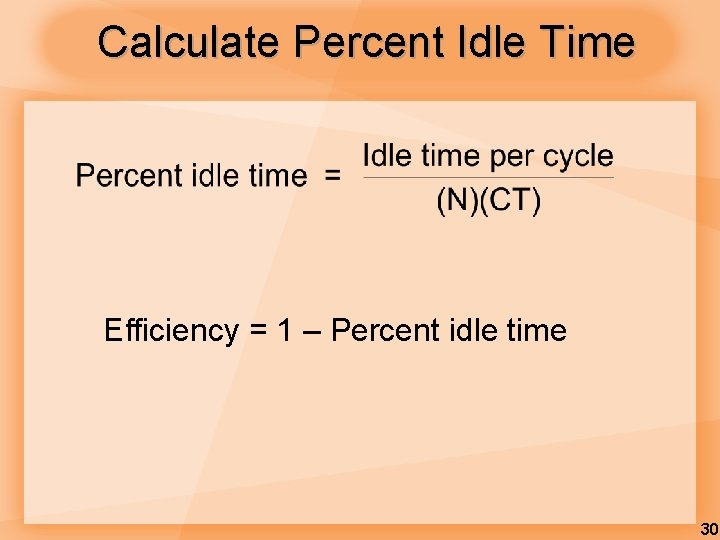
Calculate Percent Idle Time Efficiency = 1 – Percent idle time 30
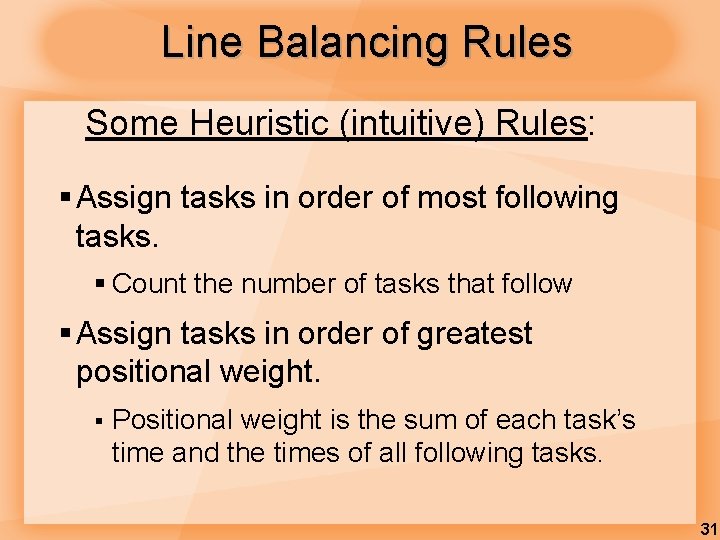
Line Balancing Rules Some Heuristic (intuitive) Rules: § Assign tasks in order of most following tasks. § Count the number of tasks that follow § Assign tasks in order of greatest positional weight. § Positional weight is the sum of each task’s time and the times of all following tasks. 31
Example 2 Try problem 2, pg 269 32