
6 Process Selection and Facility Layout Learning Objectives
6 Process Selection and Facility Layout
Learning Objectives § § Explain the strategic importance of process selection. Describe the basic processing types. Describe the basic layout types. List the main advantages and disadvantages of product layouts and process layouts. 6 -2
Introduction § Process selection § Deciding on the way production of goods or services will be organized § Major implications § § Capacity planning Layout of facilities Equipment Design of work systems 6 -3
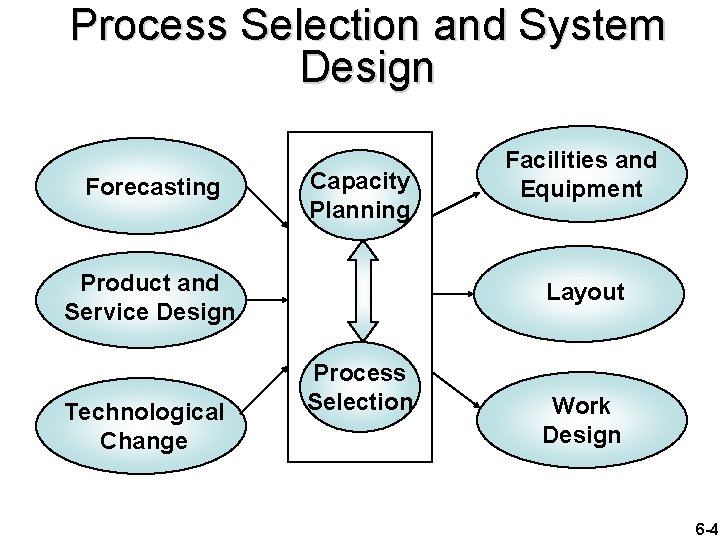
Process Selection and System Design Forecasting Capacity Planning Product and Service Design Technological Change Facilities and Equipment Layout Process Selection Work Design 6 -4
Process Strategy • Key aspects of process strategy – Capital intensive – equipment/labor – Process flexibility/Adjust to changes – Design – Volume – Technology 6 -5
Process Selection § Variety § How much § Flexibility § What degree § Volume § Expected output 6 -6
Process Types § Job shop § Small scale § Batch § Moderate volume § Repetitive/assembly line § High volumes of standardized goods or services § Continuous § Very high volumes of non-discrete goods 6 -7
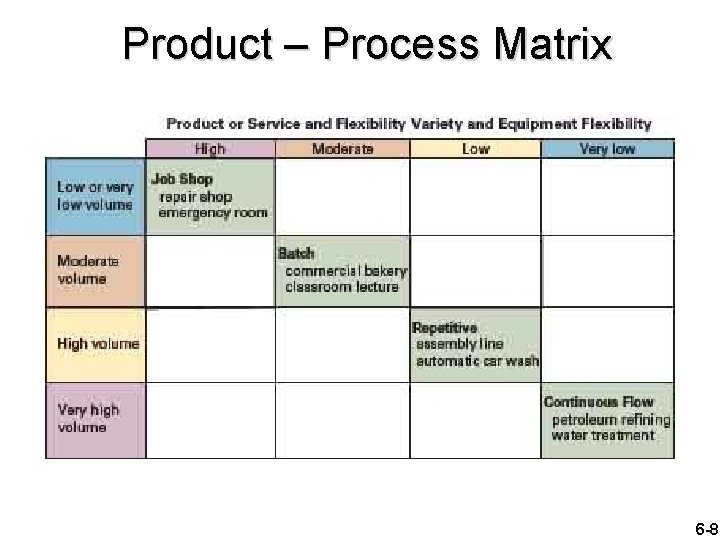
Product – Process Matrix 6 -8
Process Types § Job Shop: It is used when a low volume of highvariety goods or services will be needed. Processing is intermittent; work includes small jobs, each with somewhat different processing requirements. High flexibility using general-purpose equipment and skilled workers are important characteristics of a job shop. A manufacturing example of a job shop is a tool and die shop that is able to produce one-of-a-kind tools. A service example is a Doctor’s office. 6 -9
Process Types § Batch: used when a moderate volume of goods or services is desired, and it can handle a moderate variety in products or services. The equipment need not be as flexible as in a job shop, but processing is still intermittent. § Manufacturing examples: cakes. § Service examples: airline flight, classroom lectures. 6 -10
Process Types § Repetitive: used when higher volumes of more standardized goods or services are needed. The standardized output means only slight flexibility of equipment is needed. Skill of workers is generally low. § Examples of this type of system include production lines and assembly lines. Familiar products made by these systems include automobiles, television sets. § An example of a service system is an automatic carwash. § You are likely to see only minor variations in the product or service being produced using the same process and equipment 6 -11
Process Types § Continuous. Used for a very high volume of non-discrete, highly standardized output. § These systems have almost no variety in output and, hence, no need for equipment flexibility. Workers' skill requirements can range from low to high, depending on the complexity of the system and the expertise workers need. Generally, if equipment is highly specialized, worker skills can be lower. § Examples of non-discrete products made in continuous systems include petroleum products and steel. Continuous services include supplying electricity and water. § Key difference between Repetitive and Continuous is that in Repetitive systems you may experience minor variations in product or service, whereas in Continuous system you will see not almost no variation. 6 -12
Facilities Layout § Layout: the configuration of departments, work centers, and equipment, with particular emphasis on movement of work (customers or materials) through the system § Product layouts § Process layouts § Fixed-Position layout § Combination layouts 6 -13
Objective of Layout Design 1. 2. 3. 4. 5. Facilitate attainment of product or service quality Use workers and space efficiently Avoid bottlenecks Minimize unnecessary material handling costs Eliminate unnecessary movement of workers or materials 6. Minimize production time or customer service time 7. Design for safety 6 -14
Importance of Layout Decisions § Requires substantial investments of money and effort § Involves long-term commitments § Has significant impact on cost and efficiency of short-term operations 6 -15

Basic Layout Types § Product layouts § Process layouts § Fixed-Position layout § Combination layouts 6 -16
Basic Layout Types § Product layout § Layout that uses standardized processing operations to achieve smooth, rapid, highvolume flow § Process layout § Layout that can handle varied processing requirements § Fixed Position layout § Layout in which the product or project remains stationary, and workers, materials, and equipment are moved as needed 6 -17
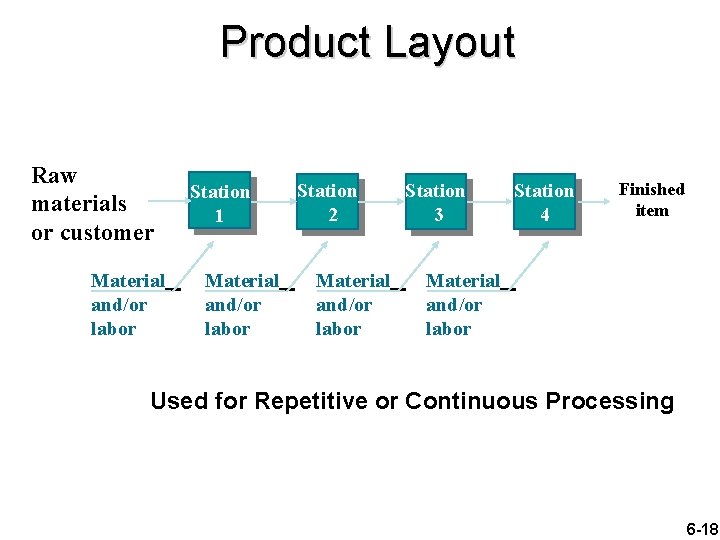
Product Layout Raw materials or customer Material and/or labor Station 1 Material and/or labor Station 2 Material and/or labor Station 3 Station 4 Finished item Material and/or labor Used for Repetitive or Continuous Processing 6 -18
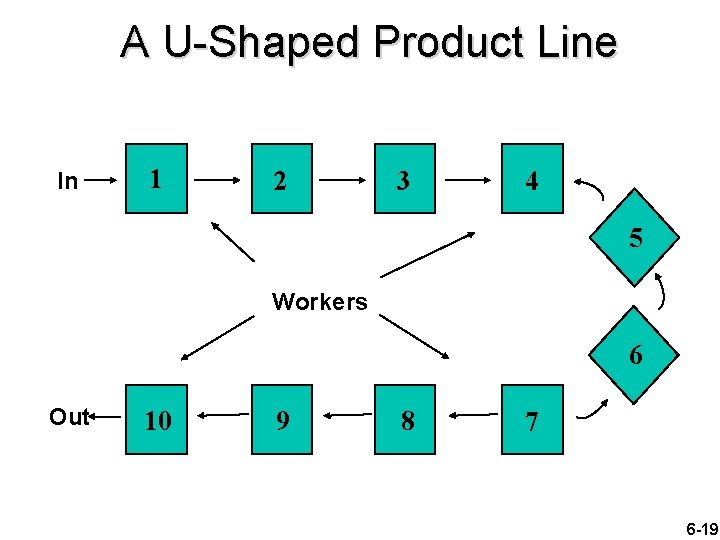
A U-Shaped Product Line In 1 2 3 4 5 Workers 6 Out 10 9 8 7 6 -19
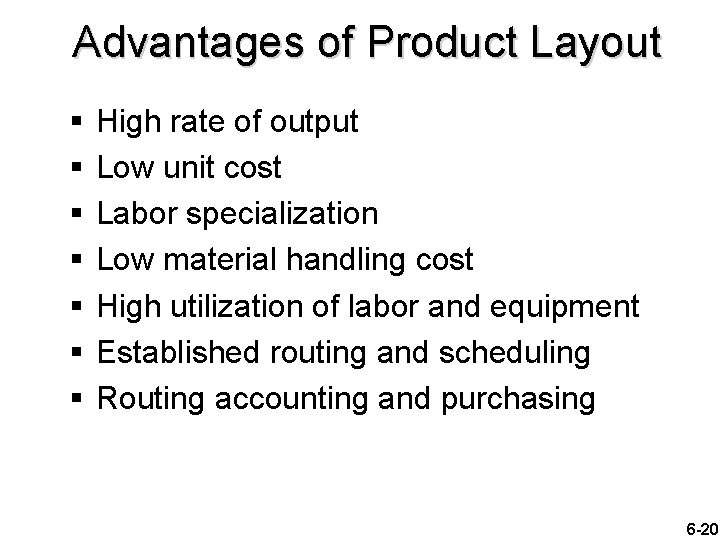
Advantages of Product Layout § § § § High rate of output Low unit cost Labor specialization Low material handling cost High utilization of labor and equipment Established routing and scheduling Routing accounting and purchasing 6 -20
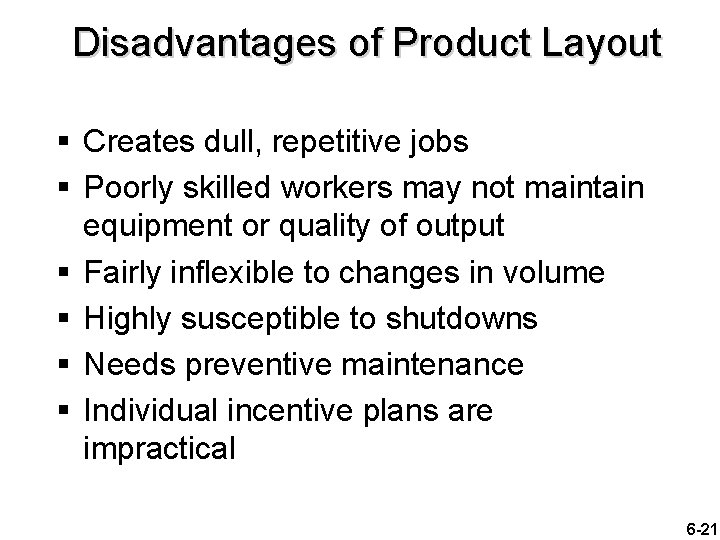
Disadvantages of Product Layout § Creates dull, repetitive jobs § Poorly skilled workers may not maintain equipment or quality of output § Fairly inflexible to changes in volume § Highly susceptible to shutdowns § Needs preventive maintenance § Individual incentive plans are impractical 6 -21
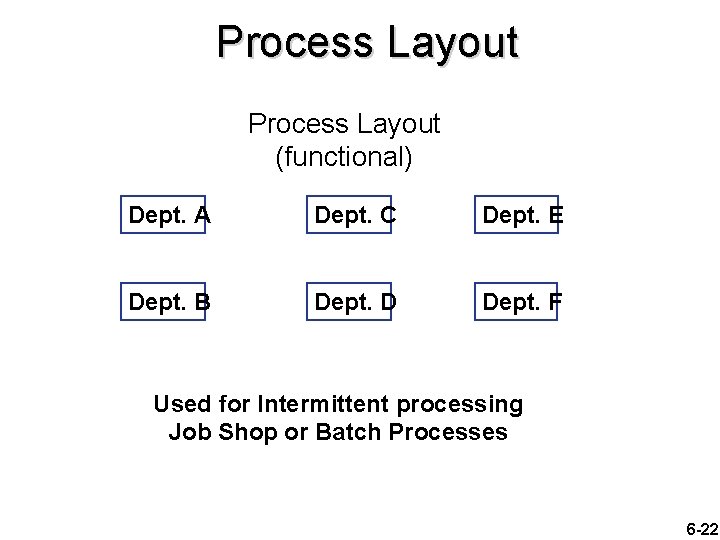
Process Layout (functional) Dept. A Dept. C Dept. E Dept. B Dept. D Dept. F Used for Intermittent processing Job Shop or Batch Processes 6 -22
Advantages of Process Layouts § Can handle a variety of processing requirements § Not particularly vulnerable to equipment failures § Equipment used is less costly § Possible to use individual incentive plans 6 -23
Disadvantages of Process Layouts § § § § In-process inventory costs can be high Challenging routing and scheduling Equipment utilization rates are low Material handling slow and inefficient Complexities often reduce span of supervision Special attention for each product or customer Accounting and purchasing are more involved 6 -24
Fixed Position Layouts § Fixed Position Layout: Layout in which the product or project remains stationary, and workers, materials, and equipment are moved as needed. § Nature of the product dictates this type of layout § Weight § Size § Bulk § Large construction projects 6 -25
Service Layouts § § Warehouse and storage layouts Retail layouts Office layouts Service layouts must be aesthetically pleasing as well as functional 6 -26
Service Layouts § Service layouts can often be categorized as product, process, or fixed-position layouts. § In a fixed-position service layout (e. g. , appliance repair, roofing, home remodeling, copier service), materials, labor, and equipment are brought to the customer's residence or office). 6 -27
Service Layouts § Process layouts are common in services due mainly to the high degree of variety in customer processing requirements. Examples include hospitals, supermarkets and department stores, vehicle repair centers, and banks. § Product layout can be used if the service is organized sequentially, with all customers or work following the same or similar sequence, as it is in a car wash. 6 -28
Service Layout Design § Important factors in service layout design include: § § § Target customer and desired customer experience Customer attitude and image Frequency of orders High level of customer contact The mixture of the physical items, sensual benefits, and psychological benefits. § Interesting point: service layout design is not generally focused on cost minimization and product flow. 6 -29
- Slides: 29