
6 Preequilibrium reactions Prof Dr A J Arjan
6. Pre-equilibrium reactions Prof. Dr. A. J. (Arjan) Koning 1, 2 1 International 2 Division Atomic Energy Agency, Vienna of Applied Nuclear Physics, Department of Physics and Astronomy, Uppsala University, Uppsala, Sweden Email: A. koning@iaea. org EXTEND European School on Experiment, Theory and Evaluation of Nuclear Data, Uppsala University, Sweden, August 29 - September 2, 2016

THE PRE-EQUILIBRIUM MODEL Shape elastic Elastic Reaction OPTICAL MODEL PRE-EQUILIBRIUM NC COMPOUND NUCLEUS Fission Tlj Direct components Inelastic (n, n’), (n, ), etc…
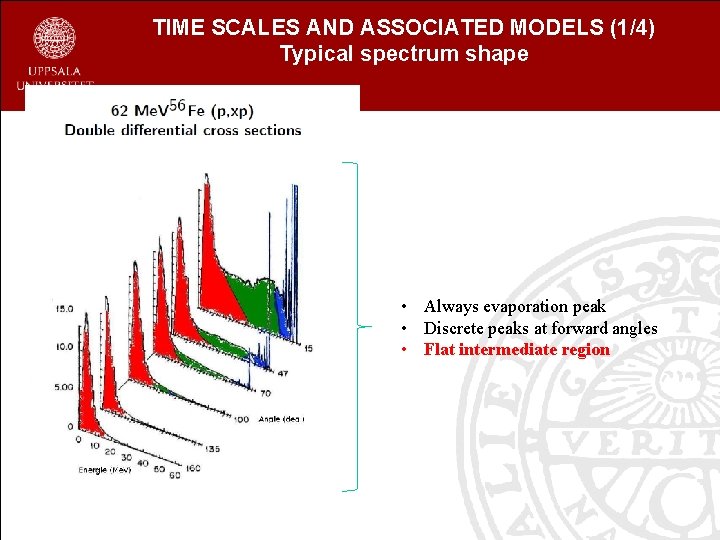
TIME SCALES AND ASSOCIATED MODELS (1/4) Typical spectrum shape • Always evaporation peak • Discrete peaks at forward angles • Flat intermediate region
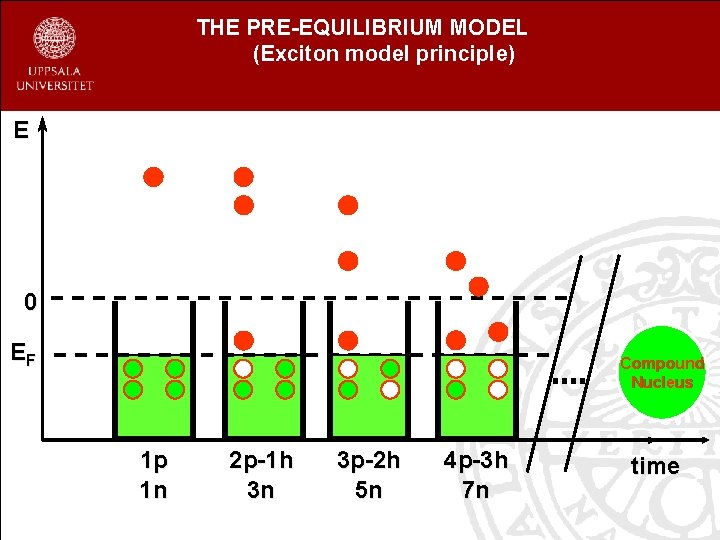
THE PRE-EQUILIBRIUM MODEL (Exciton model principle) E 0 EF Compound Nucleus 1 p 1 n 2 p-1 h 3 n 3 p-2 h 5 n 4 p-3 h 7 n time
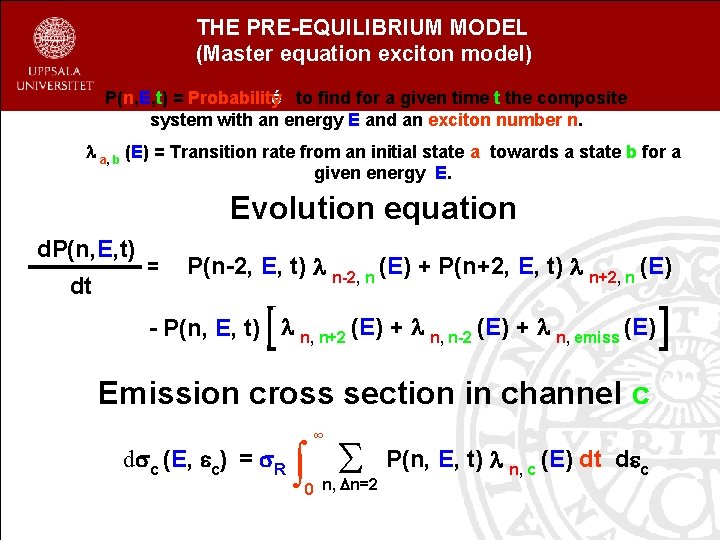
THE PRE-EQUILIBRIUM MODEL (Master equation exciton model) P(n, E, t) = Probability Probabilité to find for a given time t the composite system with an energy E and an exciton number n. l a, b (E) = Transition rate from an initial state a towards a state b for a given energy E. Evolution equation d. P(n, E, t) dt = P(n-2, E, t) l n-2, n (E) + P(n+2, E, t) l n+2, n (E) Apparition [ - P(n, Disparition E, t) l n, n+2 (E) + l n, n-2 (E) + l n, emiss (E) Emission cross section in channel c d c (E, ec) = R ∞ S 0 n, Dn=2 P(n, E, t) l n, c (E) dt dec ]

THE PRE-EQUILIBRIUM MODEL (Initialisation & transition rates) Initialisation P(n, E, 0) = n, n 0 with n 0=3 for nucleon induced reactions Transition rates 2 M 2 ω(p, h, E) with p+h=n-2 l n, n-2 (E) = ℏ 2 M 2 ω(p, h, E) with p+h=n+2 l n, n+2 (E) = ℏ l n, c (E) = 2 sc+1 2 ℏ 3 State densities Original formulation ω(p-pb, h, E- ec- Bc) µc ec c, inv (ec) Qc(n) Fc ω(p, h, E) Corrections for proton-neutron distinguishability ω(p, h, E) = number of ways of distributing p particles and h holes on among accessible single particle levels & complex particle with the available excitation energy E emission
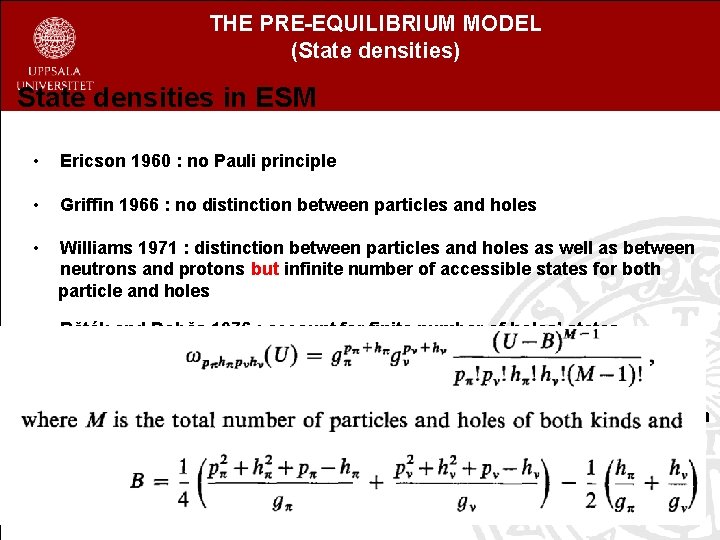
THE PRE-EQUILIBRIUM MODEL (State densities) State densities in ESM • Ericson 1960 : no Pauli principle • Griffin 1966 : no distinction between particles and holes • Williams 1971 : distinction between particles and holes as well as between neutrons and protons but infinite number of accessible states for both particle and holes • Běták and Doběs 1976 : account for finite number of holes’ states • Obložinský 1986 : account for finite number of particles’ states (MSC) • Anzaldo-Meneses 1995 : first order corrections for increasing number of p-h • Hilaire and Koning 1998 : generalized expression in ESM
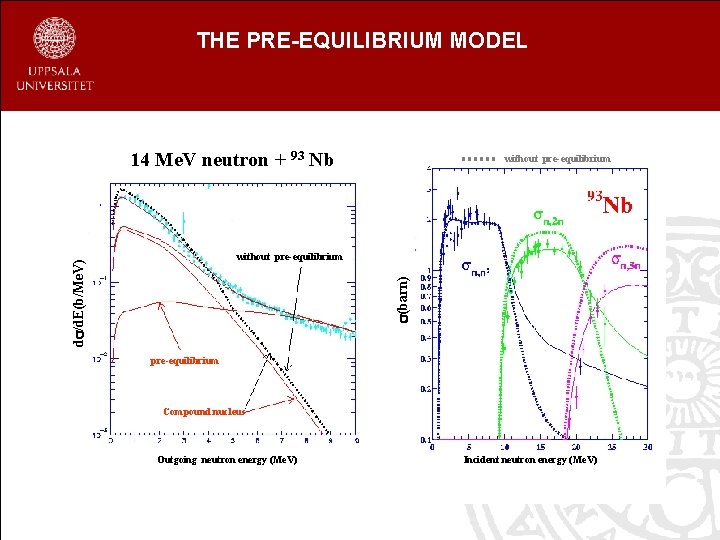
THE PRE-EQUILIBRIUM MODEL 14 Me. V neutron + 93 Nb without pre-equilibrium (barn) d /d. E(b/Me. V) without pre-equilibrium Compound nucleus Outgoing neutron energy (Me. V) Incident neutron energy (Me. V)
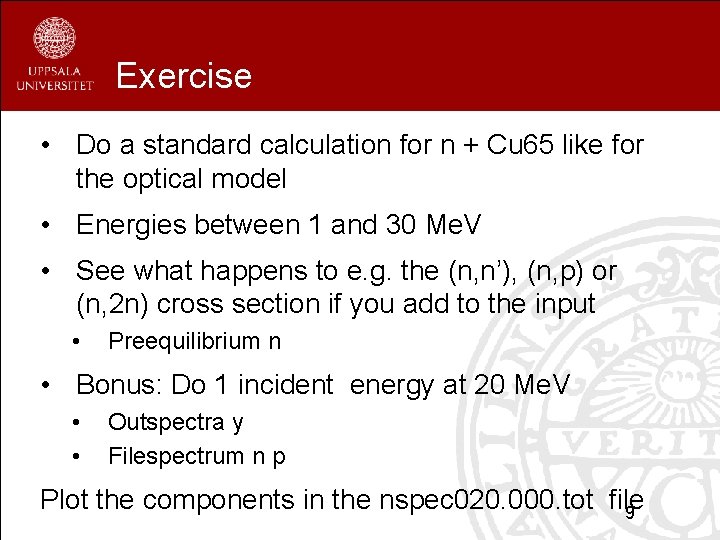
Exercise • Do a standard calculation for n + Cu 65 like for the optical model • Energies between 1 and 30 Me. V • See what happens to e. g. the (n, n’), (n, p) or (n, 2 n) cross section if you add to the input • Preequilibrium n • Bonus: Do 1 incident energy at 20 Me. V • • Outspectra y Filespectrum n p Plot the components in the nspec 020. 000. tot file 9
- Slides: 9