
6 Modelling and analysis Josef Machacek Czech Technical

- Slides: 57
6. Modelling and analysis Josef Machacek Czech Technical University in Prague
Objectives Basic requirements Methods of analysis Influence of deformed geometry Influence of material behaviour Assessment 1 Simple global modelling FE modelling Assessment 2 Examples Conclusions Objectives • This lecture describes principles of modelling and analysis of structures. • Global analyses distinguishing effects of deformed geometry and material non-linearities are presented. • Survey of both simple and FEM analyses and modelling are shown. • Finally some basic examples are presented. Notes Lecture 6, V 001, April 09 2
Objectives Basic requirements Methods of analysis Influence of deformed geometry Influence of material behaviour Assessment 1 Simple global modelling FE modelling Assessment 2 Examples Conclusions Notes Outline of the lecture 1. Basic requirements 2. Methods of analysis 3. Influence of deformed geometry 4. Influence of material behaviour 5. Simple global modelling of frames, trusses and beams 6. FE modelling 7. Examples 8. Conclusions Lecture 6, V 001, April 09 3
Objectives Basic requirements Methods of analysis Influence of deformed geometry Influence of material behaviour Assessment 1 1. Basic requirements • Calculation model should reflect real global and local behaviour of the designed structure (members, cross sections, joints and placement). Simple global modelling FE modelling Assessment 2 Examples Conclusions • Analysis should correspond to limit states under consideration: ULS (ultimate limit states) or SLS (serviceability limit states), i. e. with appropriate loading, criteria and reliability. Notes Lecture 6, V 001, April 09 4
Objectives Basic requirements Methods of analysis Influence of deformed geometry Influence of material behaviour Assessment 1 Simple global modelling FE modelling 1. Basic requirements • Joints are generally modelled (in accordance with EN 1993 -1 -8) as: – simple (transmitting no bending moments), – continuous (with rigidity and resistance providing full continuity of elements), – semi-continues (in which the joint behaviour needs to be considered in the global analysis). Assessment 2 Examples Conclusions Notes • Ground-structure interaction should be considered in case of significant ground support deformation (see EN 1997). Lecture 6, V 001, April 09 5
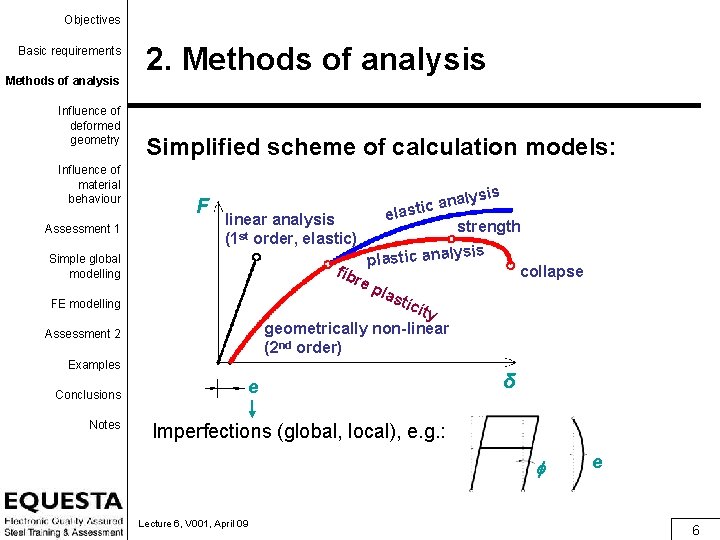
Objectives Basic requirements Methods of analysis Influence of deformed geometry Influence of material behaviour Assessment 1 2. Methods of analysis Simplified scheme of calculation models: F linear analysis (1 st order, elastic) Simple global modelling fib re FE modelling lysis a n a c elasti strength sis plastic analy pla stic ity geometrically non-linear (2 nd order) Assessment 2 Examples Conclusions Notes collapse e δ Imperfections (global, local), e. g. : Lecture 6, V 001, April 09 e 6
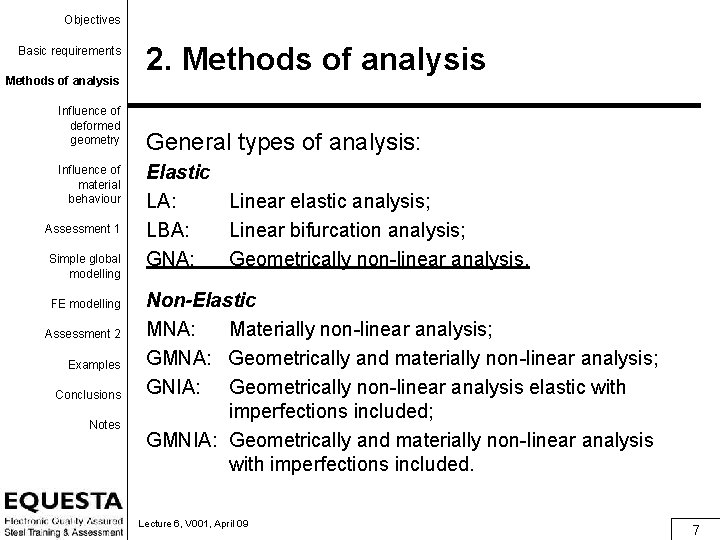
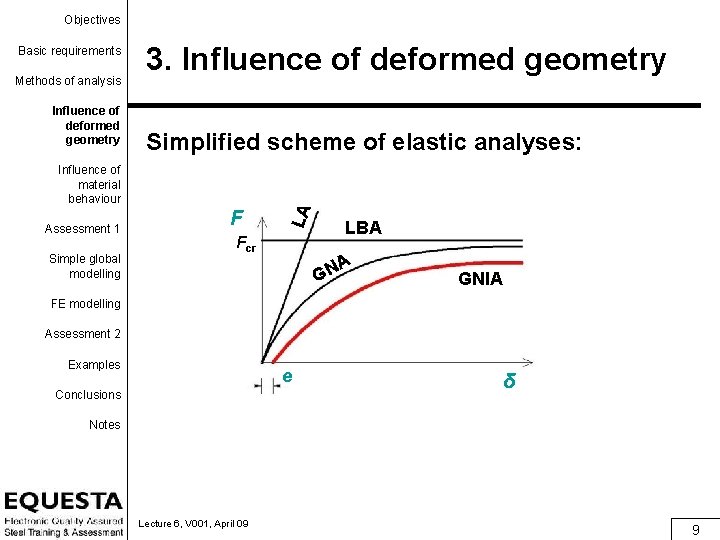
Objectives Basic requirements Methods of analysis Influence of deformed geometry Influence of material behaviour Assessment 1 Simple global modelling FE modelling Assessment 2 Examples Conclusions Notes 2. Methods of analysis General types of analysis: Elastic LA: Linear elastic analysis; LBA: Linear bifurcation analysis; GNA: Geometrically non-linear analysis. Non-Elastic MNA: Materially non-linear analysis; GMNA: Geometrically and materially non-linear analysis; GNIA: Geometrically non-linear analysis elastic with imperfections included; GMNIA: Geometrically and materially non-linear analysis with imperfections included. Lecture 6, V 001, April 09 7
Objectives Basic requirements Methods of analysis Influence of deformed geometry Influence of material behaviour Assessment 1 Simple global modelling 2. Methods of analysis Simplified GNA (using equilibrium equation on deformed structure but the same “small deflections” as in common LA) is called 2 nd order analysis. Such analysis is usually sufficient for investigation of buckling in steel frame structures. FE modelling Assessment 2 Examples Conclusions Notes Lecture 6, V 001, April 09 8
Objectives Basic requirements Methods of analysis Influence of deformed geometry 3. Influence of deformed geometry Simplified scheme of elastic analyses: Assessment 1 Simple global modelling F LA Influence of material behaviour Fcr LBA A GN GNIA FE modelling Assessment 2 Examples e Conclusions δ Notes Lecture 6, V 001, April 09 9
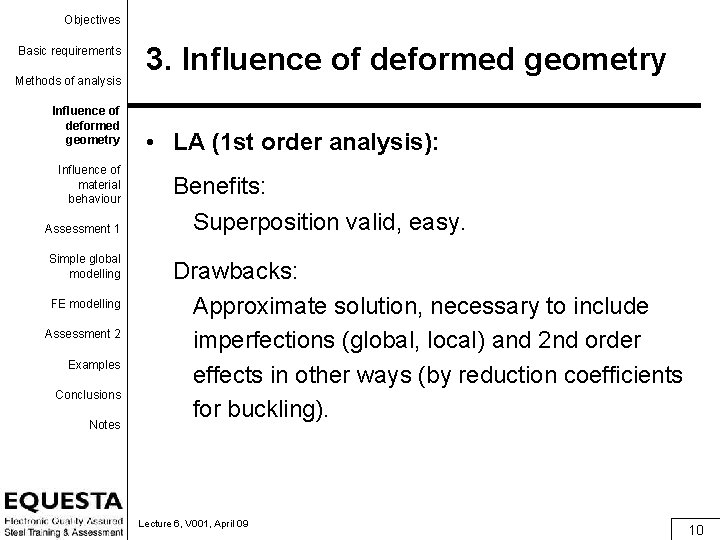
Objectives Basic requirements Methods of analysis Influence of deformed geometry Influence of material behaviour Assessment 1 Simple global modelling FE modelling Assessment 2 Examples Conclusions Notes 3. Influence of deformed geometry • LA (1 st order analysis): Benefits: Superposition valid, easy. Drawbacks: Approximate solution, necessary to include imperfections (global, local) and 2 nd order effects in other ways (by reduction coefficients for buckling). Lecture 6, V 001, April 09 10
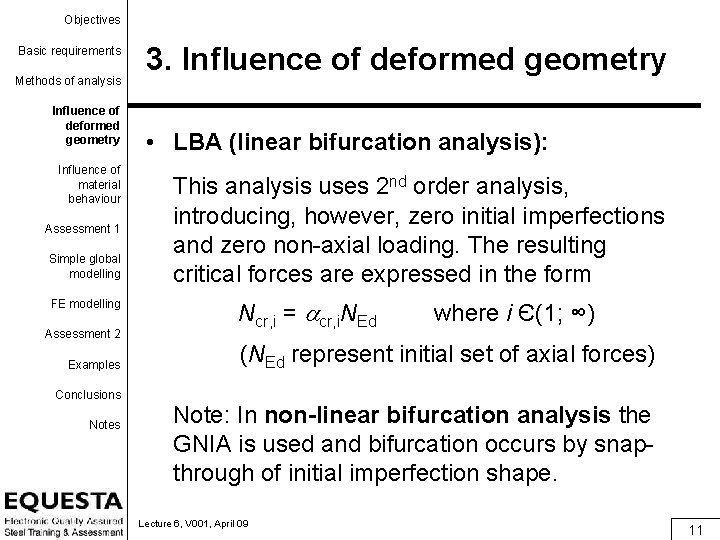
Objectives Basic requirements Methods of analysis Influence of deformed geometry Influence of material behaviour Assessment 1 Simple global modelling FE modelling Assessment 2 Examples 3. Influence of deformed geometry • LBA (linear bifurcation analysis): This analysis uses 2 nd order analysis, introducing, however, zero initial imperfections and zero non-axial loading. The resulting critical forces are expressed in the form Ncr, i = cr, i. NEd where i Є(1; ∞) (NEd represent initial set of axial forces) Conclusions Note: In non-linear bifurcation analysis the GNIA is used and bifurcation occurs by snapthrough of initial imperfection shape. Lecture 6, V 001, April 09 11
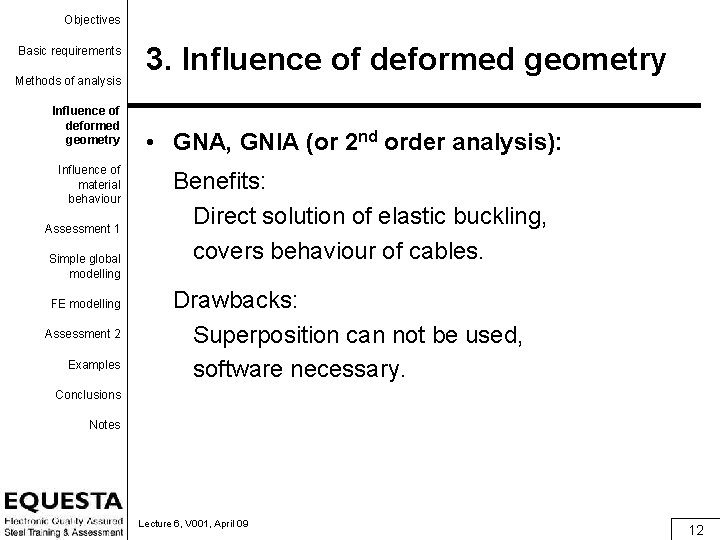
Objectives Basic requirements Methods of analysis Influence of deformed geometry Influence of material behaviour Assessment 1 Simple global modelling FE modelling Assessment 2 Examples 3. Influence of deformed geometry • GNA, GNIA (or 2 nd order analysis): Benefits: Direct solution of elastic buckling, covers behaviour of cables. Drawbacks: Superposition can not be used, software necessary. Conclusions Notes Lecture 6, V 001, April 09 12
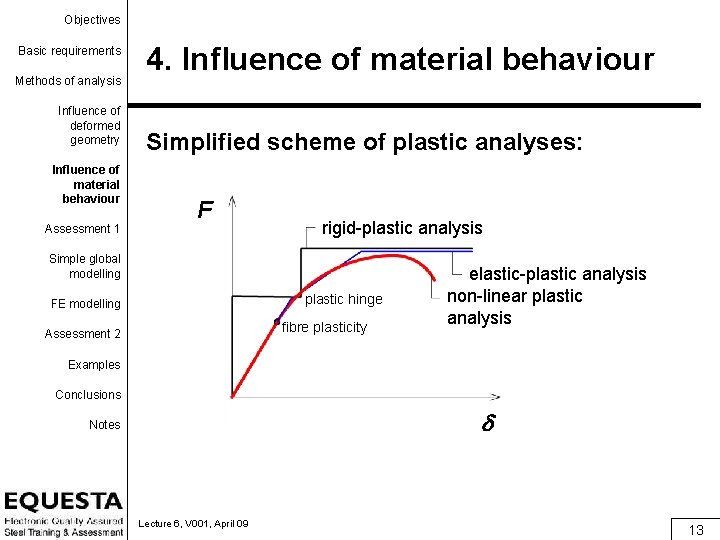
Objectives Basic requirements Methods of analysis Influence of deformed geometry Influence of material behaviour Assessment 1 4. Influence of material behaviour Simplified scheme of plastic analyses: F rigid-plastic analysis Simple global modelling plastic hinge FE modelling fibre plasticity Assessment 2 elastic-plastic analysis non-linear plastic analysis Examples Conclusions Notes Lecture 6, V 001, April 09 13
Objectives Basic requirements Methods of analysis Influence of deformed geometry Influence of material behaviour Assessment 1 Simple global modelling FE modelling Assessment 2 Examples Conclusions Notes 4. Influence of material behaviour • MNA (plastic analysis): Benefits: Higher strength capacity. Drawbacks: May only be used provided that: - steel is sufficiently ductile (fu/fy ≥ 1. 1; ≥ 15 %; εu ≥ 15 εy); - for global analysis the cross sections are of class 1; - in global analysis the stability of members at plastic hinges is assured; - software for plastic global analysis is desirable. Lecture 6, V 001, April 09 14
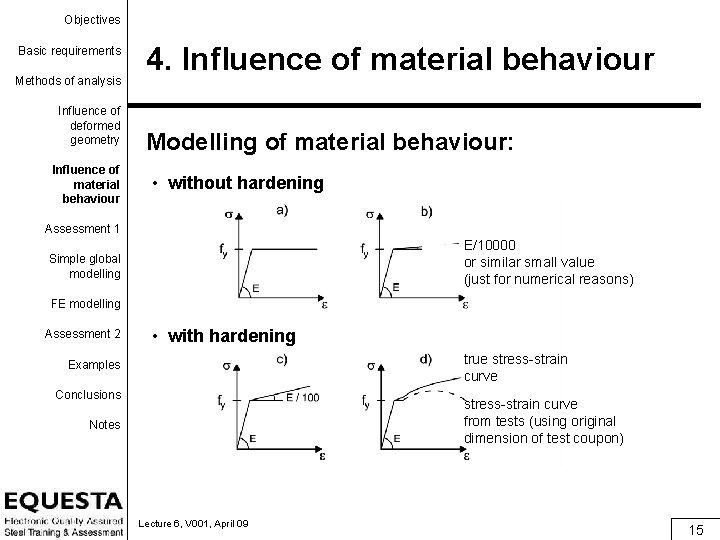
Objectives Basic requirements Methods of analysis Influence of deformed geometry Influence of material behaviour 4. Influence of material behaviour Modelling of material behaviour: • without hardening Assessment 1 E/10000 or similar small value (just for numerical reasons) Simple global modelling FE modelling Assessment 2 • with hardening true stress-strain curve Examples Conclusions stress-strain curve from tests (using original dimension of test coupon) Notes Lecture 6, V 001, April 09 15
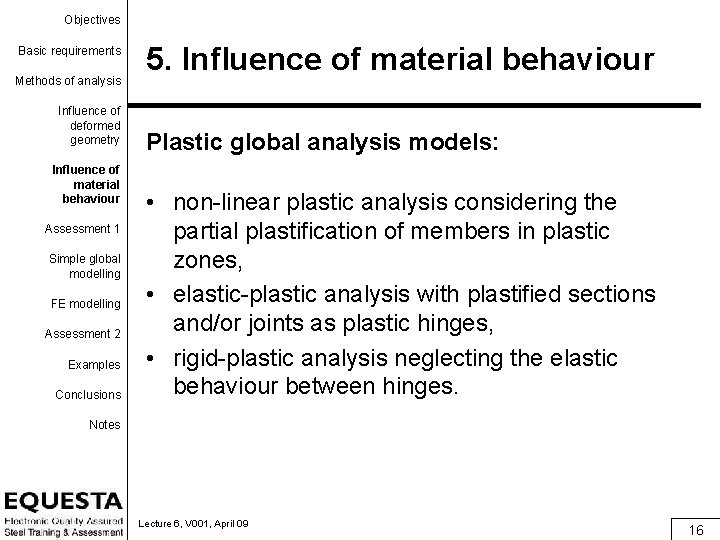
Objectives Basic requirements Methods of analysis Influence of deformed geometry Influence of material behaviour Assessment 1 Simple global modelling FE modelling Assessment 2 Examples Conclusions 5. Influence of material behaviour Plastic global analysis models: • non-linear plastic analysis considering the partial plastification of members in plastic zones, • elastic-plastic analysis with plastified sections and/or joints as plastic hinges, • rigid-plastic analysis neglecting the elastic behaviour between hinges. Notes Lecture 6, V 001, April 09 16
Objectives Basic requirements Formative Assessment Question 1 Methods of analysis Influence of deformed geometry Influence of material behaviour • Describe types of analyses. • How 2 nd order effects in compression members may be covered? • Describe modelling of material properties. • What are the limits for using an elastic analysis? • What are the prerequisites for using a plastic analysis? Assessment 1 Simple global modelling FE modelling Assessment 2 Examples Conclusions Notes Lecture 6, V 001, April 09 17
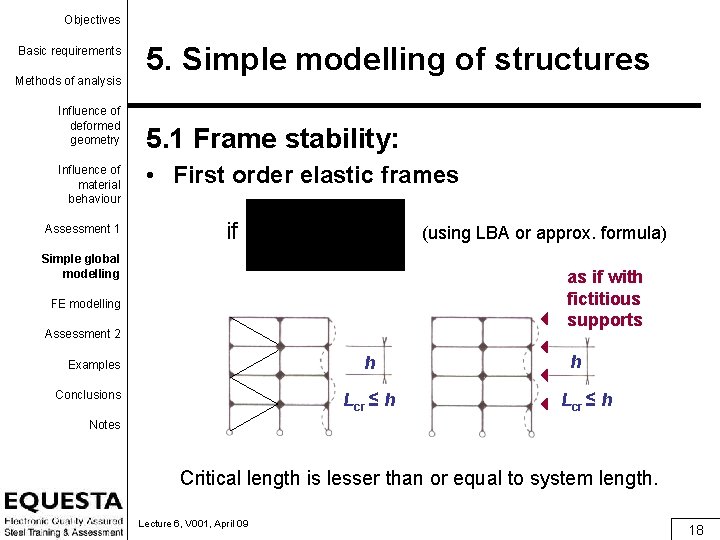
Objectives Basic requirements Methods of analysis Influence of deformed geometry Influence of material behaviour Assessment 1 5. Simple modelling of structures 5. 1 Frame stability: • First order elastic frames if (using LBA or approx. formula) Simple global modelling as if with fictitious supports FE modelling Assessment 2 h Examples Conclusions Lcr ≤ h h Lcr ≤ h Notes Critical length is lesser than or equal to system length. Lecture 6, V 001, April 09 18
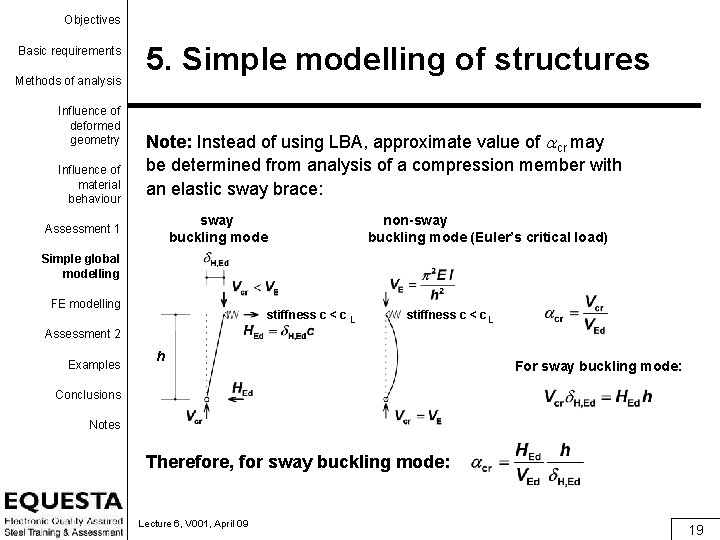
Objectives Basic requirements Methods of analysis Influence of deformed geometry Influence of material behaviour 5. Simple modelling of structures Note: Instead of using LBA, approximate value of cr may be determined from analysis of a compression member with an elastic sway brace: sway buckling mode Assessment 1 non-sway buckling mode (Euler’s critical load) Simple global modelling FE modelling stiffness c < c L Assessment 2 Examples h For sway buckling mode: Conclusions Notes Therefore, for sway buckling mode: Lecture 6, V 001, April 09 19
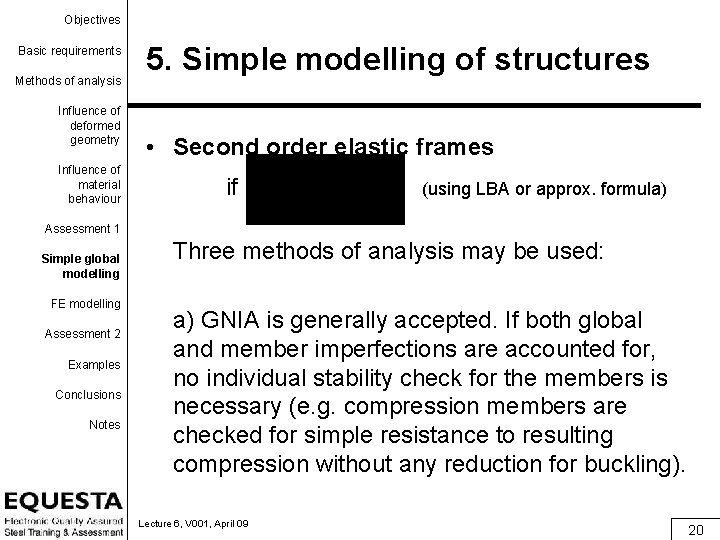
Objectives Basic requirements Methods of analysis Influence of deformed geometry Influence of material behaviour 5. Simple modelling of structures • Second order elastic frames if (using LBA or approx. formula) Assessment 1 Simple global modelling FE modelling Assessment 2 Examples Conclusions Notes Three methods of analysis may be used: a) GNIA is generally accepted. If both global and member imperfections are accounted for, no individual stability check for the members is necessary (e. g. compression members are checked for simple resistance to resulting compression without any reduction for buckling). Lecture 6, V 001, April 09 20
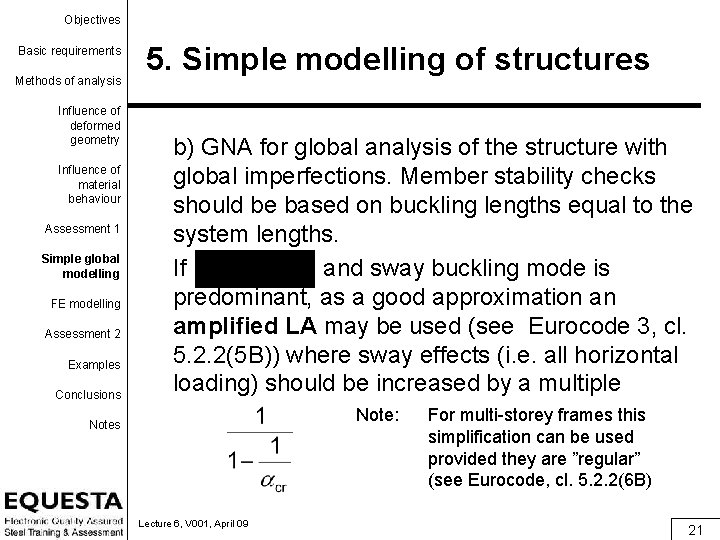
Objectives Basic requirements Methods of analysis Influence of deformed geometry Influence of material behaviour Assessment 1 Simple global modelling FE modelling Assessment 2 Examples Conclusions 5. Simple modelling of structures b) GNA for global analysis of the structure with global imperfections. Member stability checks should be based on buckling lengths equal to the system lengths. If and sway buckling mode is predominant, as a good approximation an amplified LA may be used (see Eurocode 3, cl. 5. 2. 2(5 B)) where sway effects (i. e. all horizontal loading) should be increased by a multiple Note: Notes Lecture 6, V 001, April 09 For multi-storey frames this simplification can be used provided they are ”regular” (see Eurocode, cl. 5. 2. 2(6 B) 21
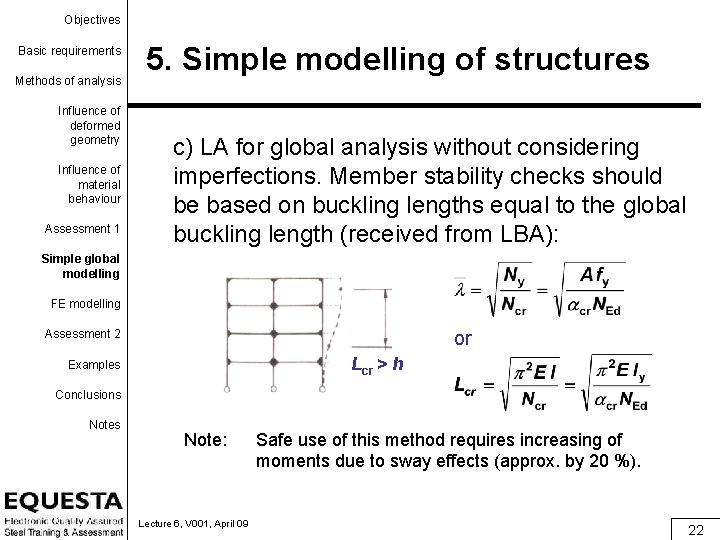
Objectives Basic requirements Methods of analysis Influence of deformed geometry Influence of material behaviour Assessment 1 5. Simple modelling of structures c) LA for global analysis without considering imperfections. Member stability checks should be based on buckling lengths equal to the global buckling length (received from LBA): Simple global modelling FE modelling or Assessment 2 Lcr > h Examples Conclusions Note: Lecture 6, V 001, April 09 Safe use of this method requires increasing of moments due to sway effects (approx. by 20 %). 22
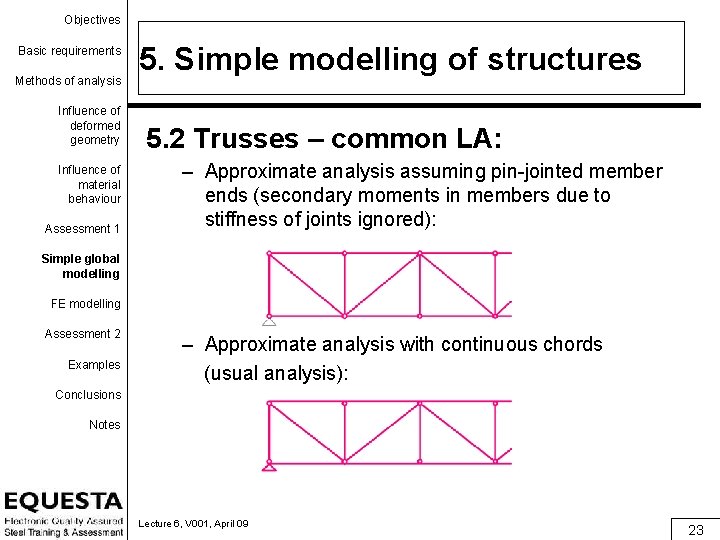
Objectives Basic requirements Methods of analysis Influence of deformed geometry Influence of material behaviour Assessment 1 5. Simple modelling of structures 5. 2 Trusses – common LA: – Approximate analysis assuming pin-jointed member ends (secondary moments in members due to stiffness of joints ignored): Simple global modelling FE modelling Assessment 2 Examples – Approximate analysis with continuous chords (usual analysis): Conclusions Notes Lecture 6, V 001, April 09 23
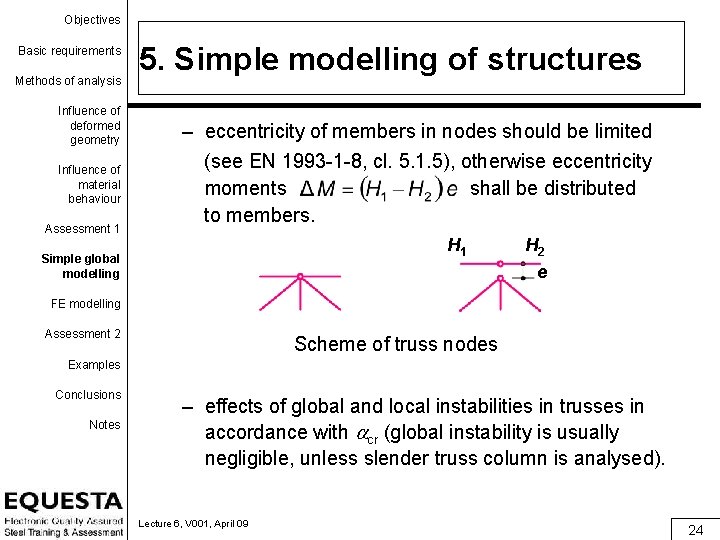
Objectives Basic requirements Methods of analysis Influence of deformed geometry Influence of material behaviour Assessment 1 5. Simple modelling of structures – eccentricity of members in nodes should be limited (see EN 1993 -1 -8, cl. 5. 1. 5), otherwise eccentricity moments shall be distributed to members. H 1 Simple global modelling H 2 e FE modelling Assessment 2 Scheme of truss nodes Examples Conclusions Notes – effects of global and local instabilities in trusses in accordance with cr (global instability is usually negligible, unless slender truss column is analysed). Lecture 6, V 001, April 09 24
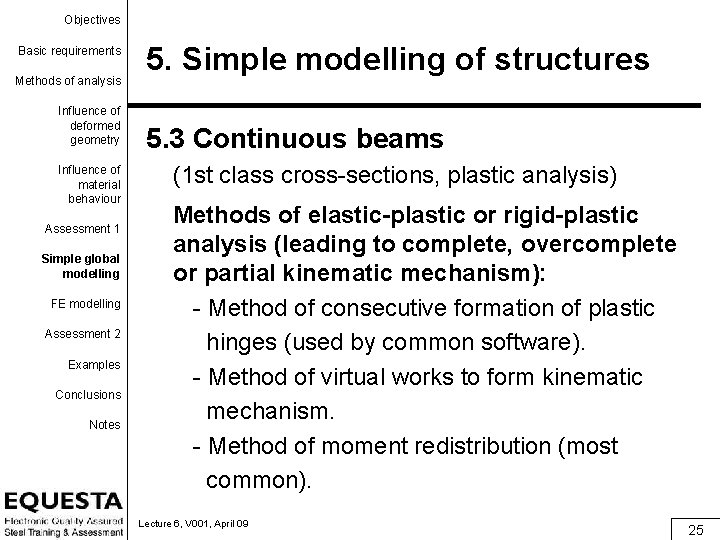
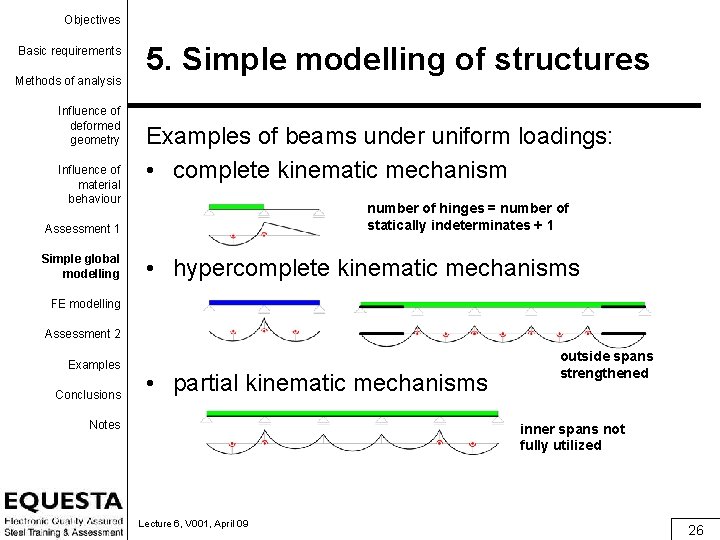
Objectives Basic requirements Methods of analysis Influence of deformed geometry Influence of material behaviour Assessment 1 Simple global modelling FE modelling Assessment 2 Examples Conclusions Notes 5. Simple modelling of structures 5. 3 Continuous beams (1 st class cross-sections, plastic analysis) Methods of elastic-plastic or rigid-plastic analysis (leading to complete, overcomplete or partial kinematic mechanism): - Method of consecutive formation of plastic hinges (used by common software). - Method of virtual works to form kinematic mechanism. - Method of moment redistribution (most common). Lecture 6, V 001, April 09 25
Objectives Basic requirements Methods of analysis Influence of deformed geometry Influence of material behaviour 5. Simple modelling of structures Examples of beams under uniform loadings: • complete kinematic mechanism number of hinges = number of statically indeterminates + 1 Assessment 1 Simple global modelling • hypercomplete kinematic mechanisms FE modelling Assessment 2 Examples Conclusions • partial kinematic mechanisms Notes outside spans strengthened inner spans not fully utilized Lecture 6, V 001, April 09 26
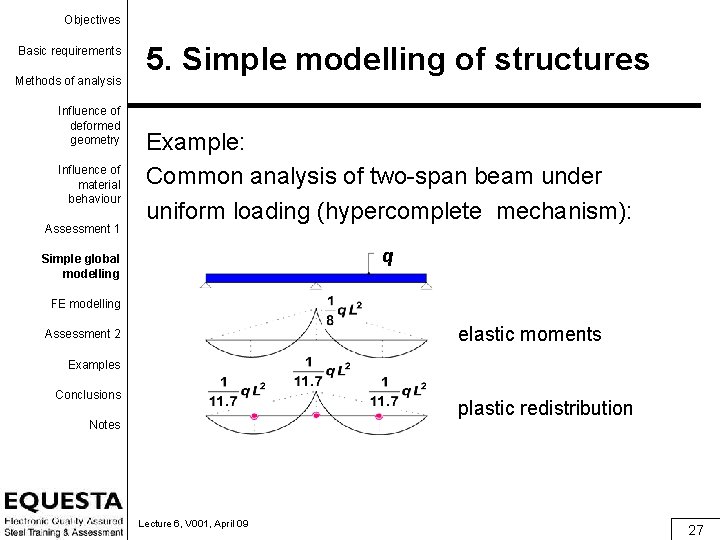
Objectives Basic requirements Methods of analysis Influence of deformed geometry Influence of material behaviour Assessment 1 5. Simple modelling of structures Example: Common analysis of two-span beam under uniform loading (hypercomplete mechanism): q Simple global modelling FE modelling elastic moments Assessment 2 Examples Conclusions plastic redistribution Notes Lecture 6, V 001, April 09 27
Objectives Basic requirements Methods of analysis Influence of deformed geometry Influence of material behaviour Assessment 1 Simple global modelling FE modelling Assessment 2 Examples Conclusions Notes 6. FE modelling Requirements for FEM are given in EN 1993 -1 -5, Annex C. Special care is due to: • the modelling of the structural component and its boundary conditions; • the choice of software and documentation; • the use of imperfections; • the modelling of material properties; • the modelling of loads; • the modelling of limit state criteria; • the partial factors to be applied. Lecture 6, V 001, April 09 28
Objectives Basic requirements Methods of analysis Influence of deformed geometry Influence of material behaviour Assessment 1 Simple global modelling FE modelling Assessment 2 6. FE modelling Limit state criteria: 1. For structures susceptible to buckling: Attainment of the maximum load. 2. For regions subjected to tensile stresses: Attainment of a limiting value of the principal membrane strain (5%). Examples Conclusions Notes Other criteria may be used, e. g. attainment of the yielding criterion or limitation of the yielding zone. Lecture 6, V 001, April 09 29
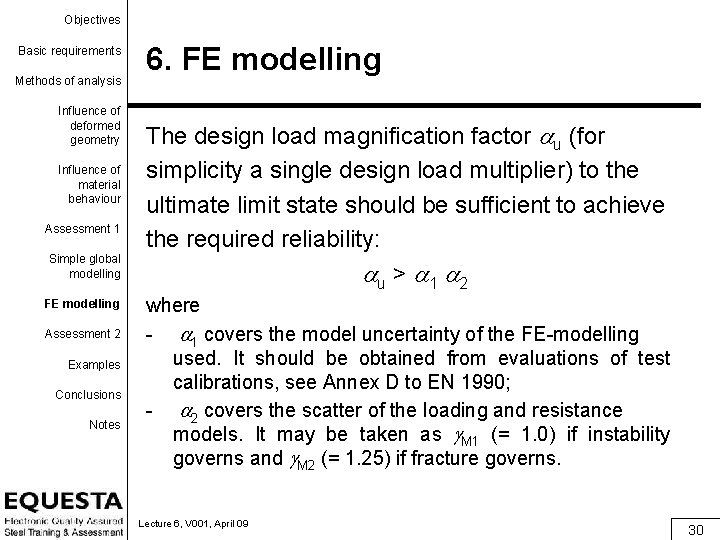
Objectives Basic requirements Methods of analysis Influence of deformed geometry Influence of material behaviour Assessment 1 Simple global modelling FE modelling Assessment 2 Examples Conclusions Notes 6. FE modelling The design load magnification factor u (for simplicity a single design load multiplier) to the ultimate limit state should be sufficient to achieve the required reliability: u > 1 2 where - 1 covers the model uncertainty of the FE-modelling used. It should be obtained from evaluations of test calibrations, see Annex D to EN 1990; - 2 covers the scatter of the loading and resistance models. It may be taken as M 1 (= 1. 0) if instability governs and M 2 (= 1. 25) if fracture governs. Lecture 6, V 001, April 09 30
Objectives Basic requirements Methods of analysis Influence of deformed geometry Influence of material behaviour Assessment 1 Formative Assessment Question 2 • Describe common calculation models for braced building frame. • Describe common calculation models for a truss. • Describe common plastic models for continuous beams under various loadings. • How ULS may be determined when using various FEM models (ranging from LA up to GMNIA)? Simple global modelling FE modelling Assessment 2 Examples Conclusions Notes Lecture 6, V 001, April 09 31
Objectives Basic requirements Methods of analysis Influence of deformed geometry Influence of material behaviour Assessment 1 Simple global modelling 7. Examples Example 1: Two-bay braced frame Example 2: Two-hinged arch Example 3: Plate under uniform loading FE modelling Assessment 2 Examples Conclusions Notes Lecture 6, V 001, April 09 32
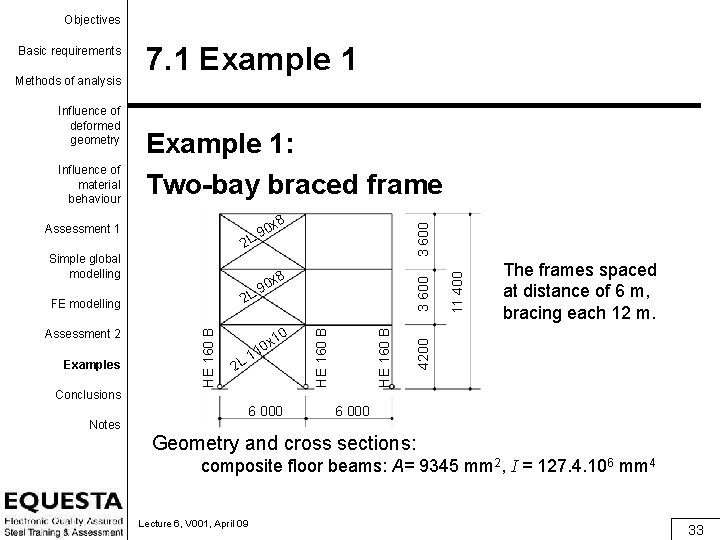
Objectives Influence of material behaviour Example 1: Two-bay braced frame x 8 0 L 9 Assessment 1 2 Simple global modelling 2 L 1 3 600 HE 160 B 10 x 10 HE 160 B Examples 9 2 L FE modelling Assessment 2 8 0 x 11 400 Influence of deformed geometry 3 600 Methods of analysis 7. 1 Example 1 The frames spaced at distance of 6 m, bracing each 12 m. 4200 Basic requirements Conclusions 6 000 Notes 6 000 Geometry and cross sections: composite floor beams: A= 9345 mm 2, I = 127. 4. 106 mm 4 Lecture 6, V 001, April 09 33
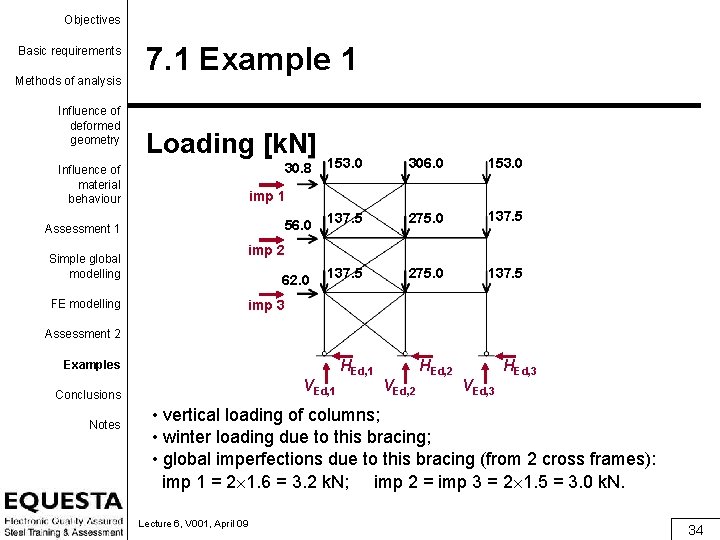
Objectives Basic requirements Methods of analysis Influence of deformed geometry 7. 1 Example 1 Loading [k. N] 153. 0 306. 0 153. 0 56. 0 137. 5 275. 0 137. 5 62. 0 137. 5 275. 0 137. 5 30. 8 Influence of material behaviour imp 1 Assessment 1 Simple global modelling FE modelling imp 2 imp 3 Assessment 2 Examples VEd, 1 Conclusions Notes HEd, 1 VEd, 2 HEd, 2 VEd, 3 HEd, 3 • vertical loading of columns; • winter loading due to this bracing; • global imperfections due to this bracing (from 2 cross frames): imp 1 = 2 1. 6 = 3. 2 k. N; imp 2 = imp 3 = 2 1. 5 = 3. 0 k. N. Lecture 6, V 001, April 09 34
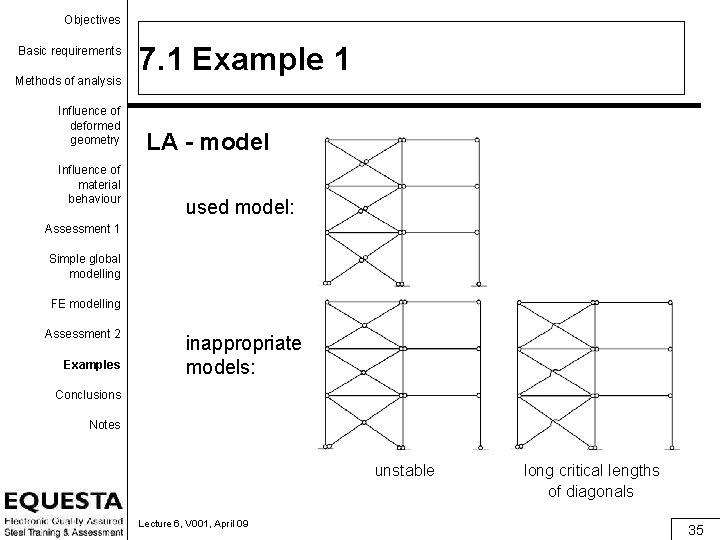
Objectives Basic requirements Methods of analysis Influence of deformed geometry Influence of material behaviour 7. 1 Example 1 LA - model used model: Assessment 1 Simple global modelling FE modelling Assessment 2 Examples inappropriate models: Conclusions Notes unstable Lecture 6, V 001, April 09 long critical lengths of diagonals 35
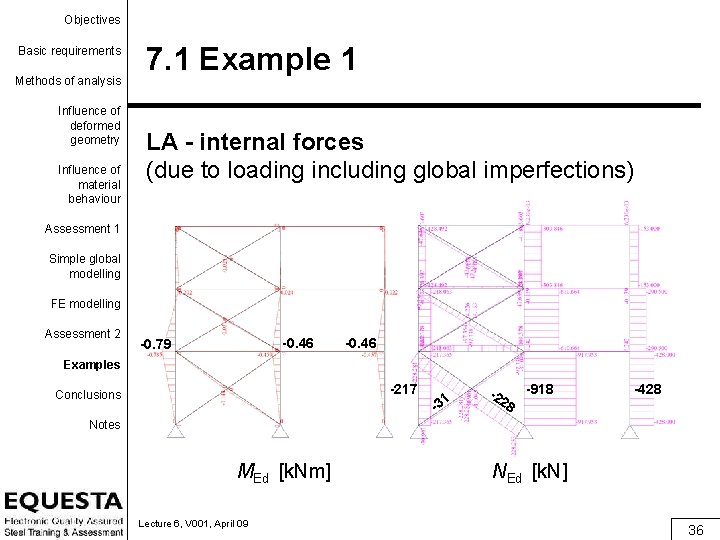
Objectives Basic requirements Methods of analysis Influence of deformed geometry Influence of material behaviour 7. 1 Example 1 LA - internal forces (due to loading including global imperfections) Assessment 1 Simple global modelling FE modelling Assessment 2 -0. 46 -0. 79 -0. 46 Examples -217 Conclusions - 31 -2 28 -918 -428 Notes MEd [k. Nm] Lecture 6, V 001, April 09 NEd [k. N] 36
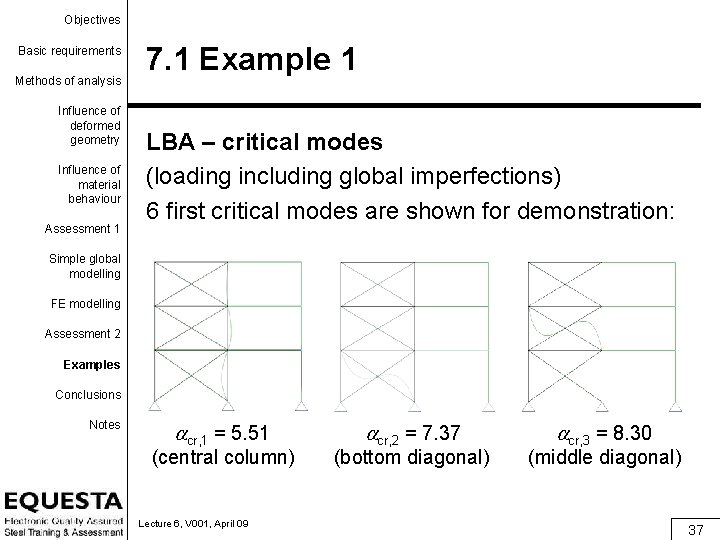
Objectives Basic requirements Methods of analysis Influence of deformed geometry Influence of material behaviour Assessment 1 7. 1 Example 1 LBA – critical modes (loading including global imperfections) 6 first critical modes are shown for demonstration: Simple global modelling FE modelling Assessment 2 Examples Conclusions Notes cr, 1 = 5. 51 (central column) Lecture 6, V 001, April 09 cr, 2 = 7. 37 (bottom diagonal) cr, 3 = 8. 30 (middle diagonal) 37
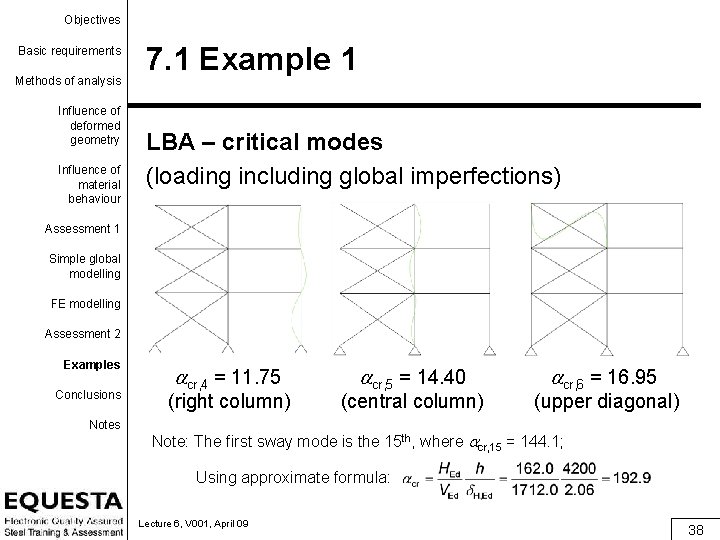
Objectives Basic requirements Methods of analysis Influence of deformed geometry Influence of material behaviour 7. 1 Example 1 LBA – critical modes (loading including global imperfections) Assessment 1 Simple global modelling FE modelling Assessment 2 Examples Conclusions Notes cr, 4 = 11. 75 (right column) cr, 5 = 14. 40 (central column) cr, 6 = 16. 95 (upper diagonal) Note: The first sway mode is the 15 th, where cr, 15 = 144. 1; Using approximate formula: Lecture 6, V 001, April 09 38
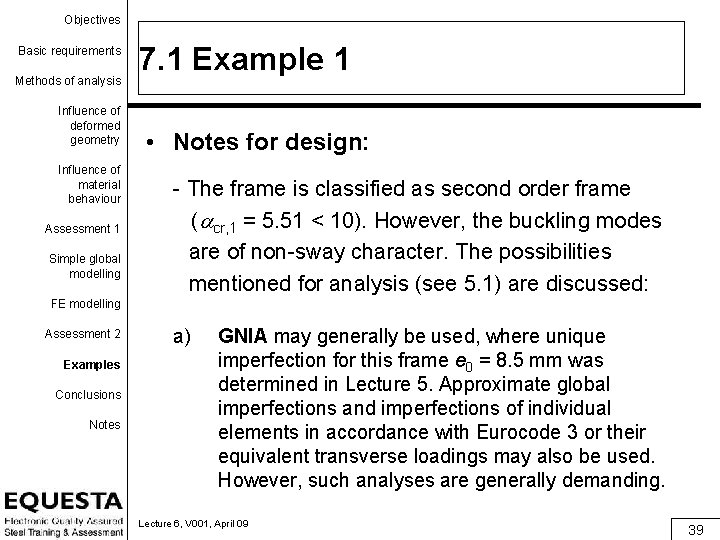
Objectives Basic requirements Methods of analysis Influence of deformed geometry Influence of material behaviour Assessment 1 Simple global modelling 7. 1 Example 1 • Notes for design: - The frame is classified as second order frame ( cr, 1 = 5. 51 < 10). However, the buckling modes are of non-sway character. The possibilities mentioned for analysis (see 5. 1) are discussed: FE modelling Assessment 2 Examples Conclusions Notes a) GNIA may generally be used, where unique imperfection for this frame e 0 = 8. 5 mm was determined in Lecture 5. Approximate global imperfections and imperfections of individual elements in accordance with Eurocode 3 or their equivalent transverse loadings may also be used. However, such analyses are generally demanding. Lecture 6, V 001, April 09 39
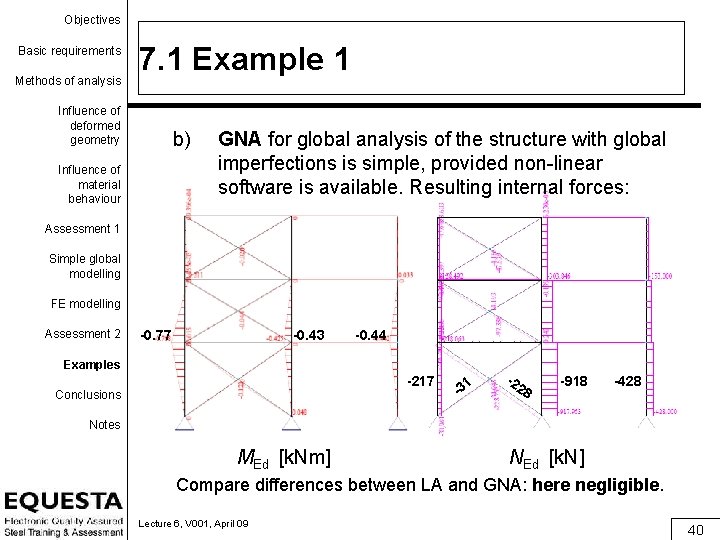
Objectives Basic requirements Methods of analysis 7. 1 Example 1 Influence of deformed geometry b) Influence of material behaviour GNA for global analysis of the structure with global imperfections is simple, provided non-linear software is available. Resulting internal forces: Assessment 1 Simple global modelling FE modelling Assessment 2 -0. 77 -0. 43 -0. 44 Examples -217 Conclusions 1 -3 -2 28 -918 -428 Notes MEd [k. Nm] NEd [k. N] Compare differences between LA and GNA: here negligible. Lecture 6, V 001, April 09 40
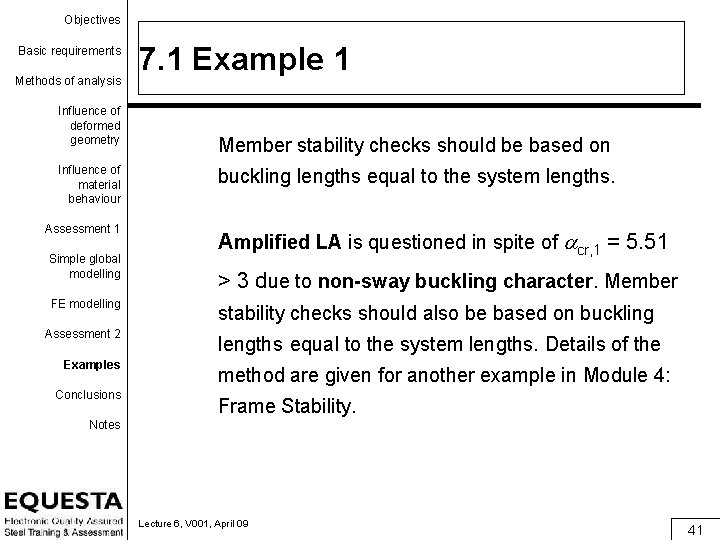
Objectives Basic requirements Methods of analysis Influence of deformed geometry Influence of material behaviour Assessment 1 Simple global modelling FE modelling Assessment 2 Examples Conclusions 7. 1 Example 1 Member stability checks should be based on buckling lengths equal to the system lengths. Amplified LA is questioned in spite of cr, 1 = 5. 51 > 3 due to non-sway buckling character. Member stability checks should also be based on buckling lengths equal to the system lengths. Details of the method are given for another example in Module 4: Frame Stability. Notes Lecture 6, V 001, April 09 41
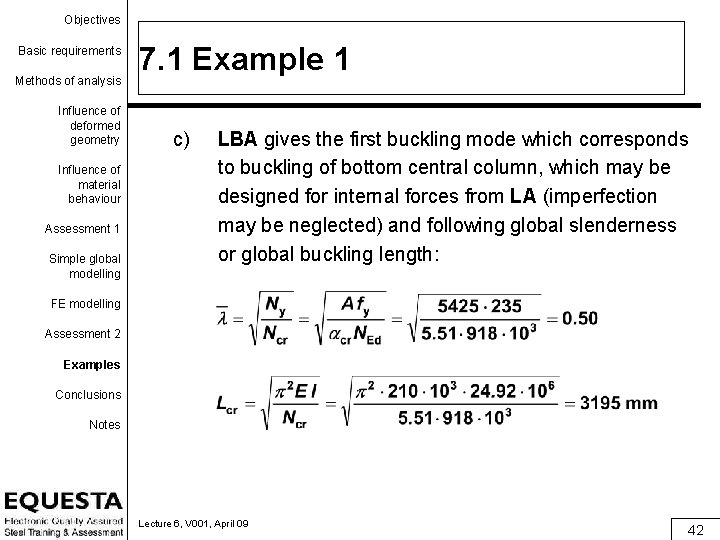
Objectives Basic requirements Methods of analysis Influence of deformed geometry Influence of material behaviour Assessment 1 Simple global modelling 7. 1 Example 1 c) LBA gives the first buckling mode which corresponds to buckling of bottom central column, which may be designed for internal forces from LA (imperfection may be neglected) and following global slenderness or global buckling length: FE modelling Assessment 2 Examples Conclusions Notes Lecture 6, V 001, April 09 42
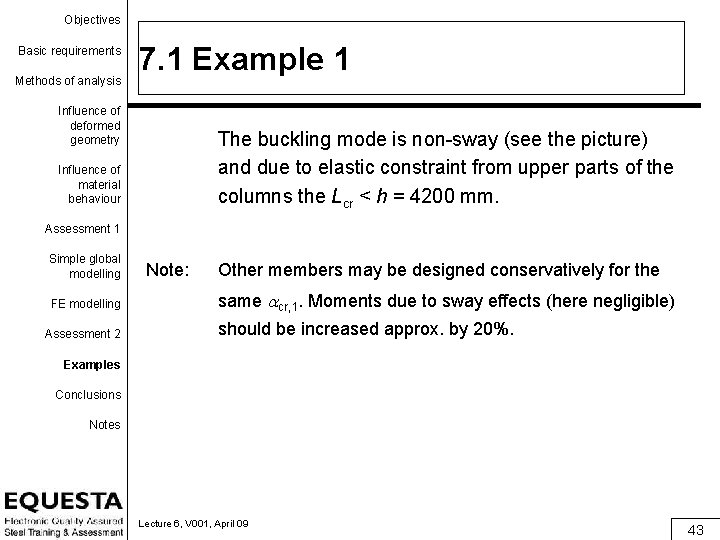
Objectives Basic requirements Methods of analysis 7. 1 Example 1 Influence of deformed geometry The buckling mode is non-sway (see the picture) and due to elastic constraint from upper parts of the columns the Lcr < h = 4200 mm. Influence of material behaviour Assessment 1 Simple global modelling FE modelling Assessment 2 Note: Other members may be designed conservatively for the same cr, 1. Moments due to sway effects (here negligible) should be increased approx. by 20%. Examples Conclusions Notes Lecture 6, V 001, April 09 43
Objectives Basic requirements Methods of analysis 7. 1 Example 1 Influence of deformed geometry Summary concerning the three approaches: Influence of material behaviour • GNIA introducing all kind of imperfections (suitable for all cr) is demanding, usually not employed. Assessment 1 Simple global modelling FE modelling Assessment 2 Examples Conclusions Notes • GNA using global imperfections may be used, followed by member stability checks for system critical lengths. Simplified amplified LA may similarly be used for cr, 1 ≥ 3 but is appropriate for predominantly sway buckling modes. • LA followed by member stability checks using critical lengths from LBA should account for moments due to sway effects. • Braced multi-storey frames are usually non-sway. Lecture 6, V 001, April 09 44
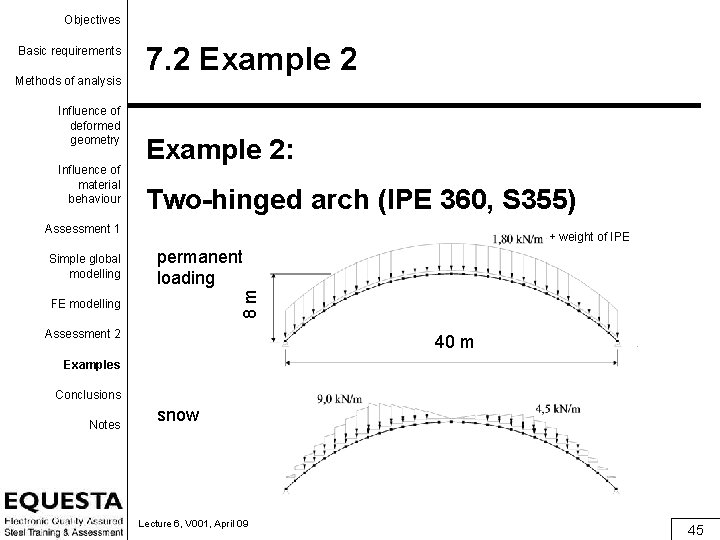
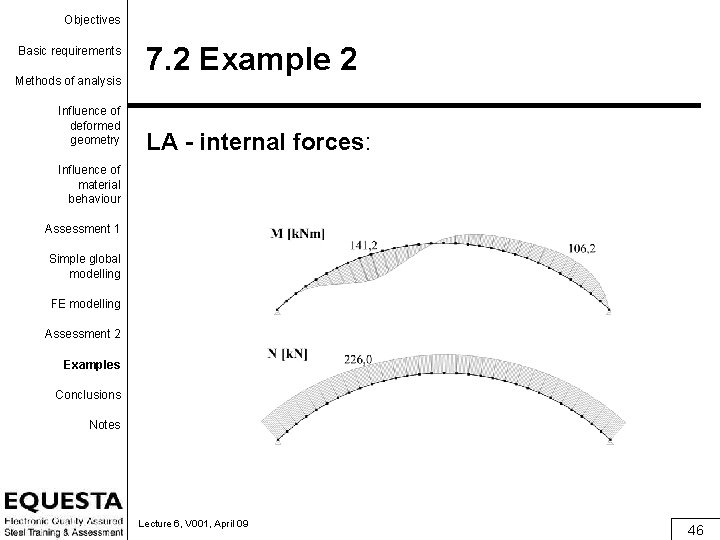
Objectives Basic requirements Methods of analysis Influence of deformed geometry Influence of material behaviour 7. 2 Example 2: Two-hinged arch (IPE 360, S 355) Assessment 1 permanent loading 8 m Simple global modelling + weight of IPE FE modelling Assessment 2 40 m Examples Conclusions Notes snow Lecture 6, V 001, April 09 45
Objectives Basic requirements Methods of analysis Influence of deformed geometry 7. 2 Example 2 LA - internal forces: Influence of material behaviour Assessment 1 Simple global modelling FE modelling Assessment 2 Examples Conclusions Notes Lecture 6, V 001, April 09 46
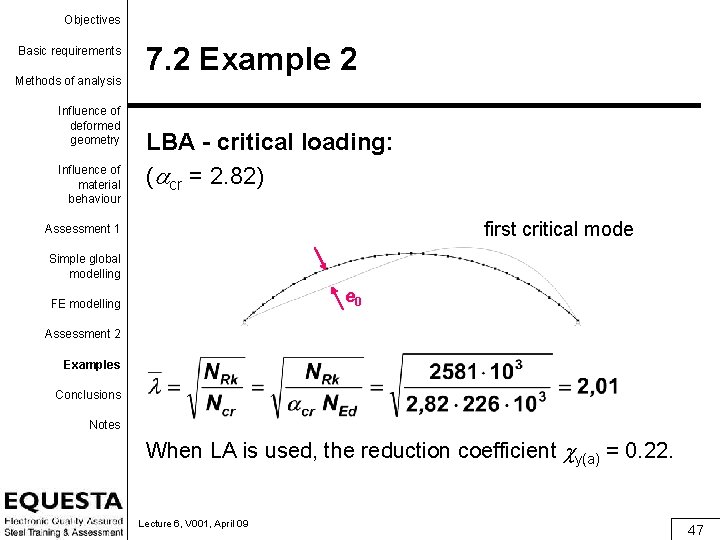
Objectives Basic requirements Methods of analysis Influence of deformed geometry Influence of material behaviour 7. 2 Example 2 LBA - critical loading: ( cr = 2. 82) first critical mode Assessment 1 Simple global modelling e 0 FE modelling Assessment 2 Examples Conclusions Notes When LA is used, the reduction coefficient y(a) = 0. 22. Lecture 6, V 001, April 09 47
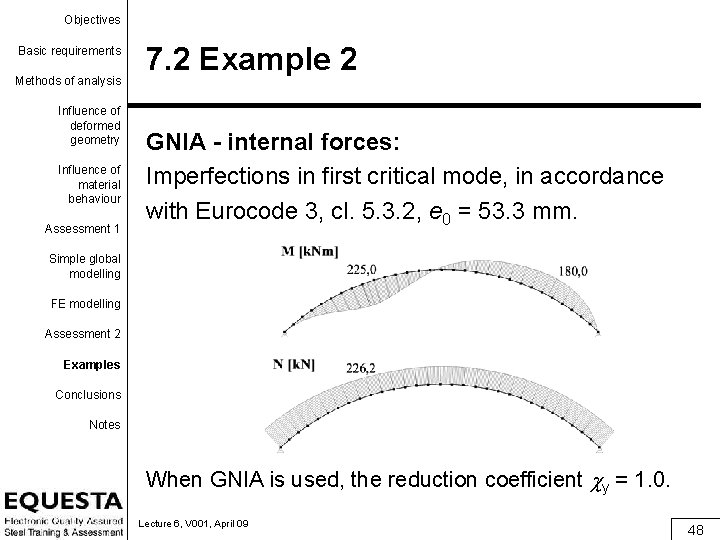
Objectives Basic requirements Methods of analysis Influence of deformed geometry Influence of material behaviour Assessment 1 7. 2 Example 2 GNIA - internal forces: Imperfections in first critical mode, in accordance with Eurocode 3, cl. 5. 3. 2, e 0 = 53. 3 mm. Simple global modelling FE modelling Assessment 2 Examples Conclusions Notes When GNIA is used, the reduction coefficient y = 1. 0. Lecture 6, V 001, April 09 48
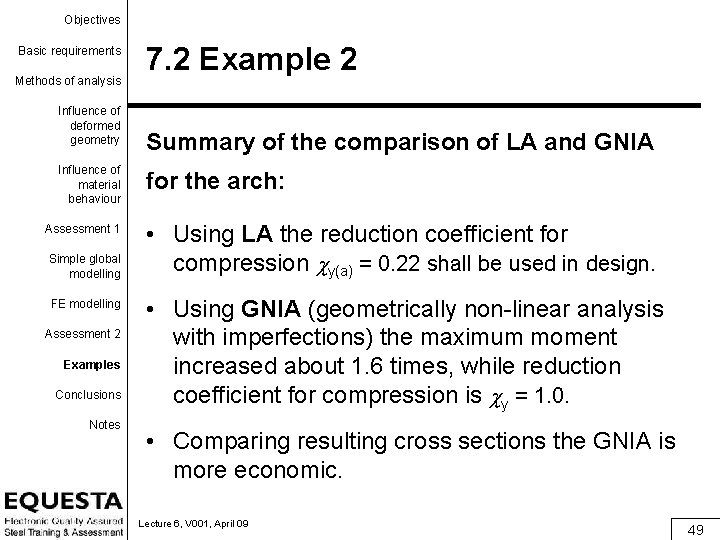
Objectives Basic requirements Methods of analysis Influence of deformed geometry Influence of material behaviour Assessment 1 Simple global modelling FE modelling Assessment 2 Examples Conclusions Notes 7. 2 Example 2 Summary of the comparison of LA and GNIA for the arch: • Using LA the reduction coefficient for compression y(a) = 0. 22 shall be used in design. • Using GNIA (geometrically non-linear analysis with imperfections) the maximum moment increased about 1. 6 times, while reduction coefficient for compression is y = 1. 0. • Comparing resulting cross sections the GNIA is more economic. Lecture 6, V 001, April 09 49
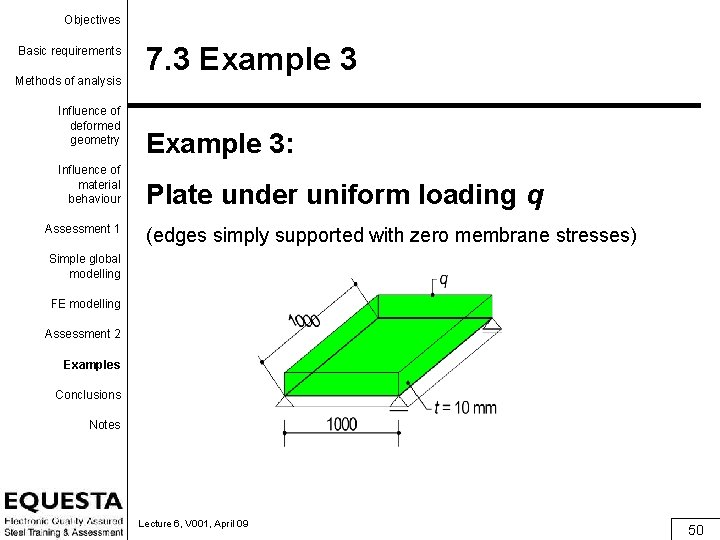
Objectives Basic requirements Methods of analysis Influence of deformed geometry Influence of material behaviour Assessment 1 7. 3 Example 3: Plate under uniform loading q (edges simply supported with zero membrane stresses) Simple global modelling FE modelling Assessment 2 Examples Conclusions Notes Lecture 6, V 001, April 09 50
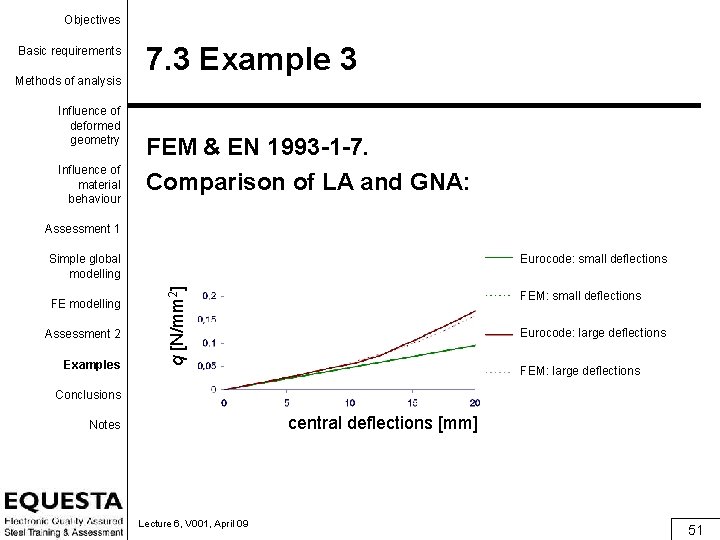
Objectives Basic requirements Methods of analysis Influence of deformed geometry Influence of material behaviour 7. 3 Example 3 FEM & EN 1993 -1 -7. Comparison of LA and GNA: Assessment 1 Eurocode: small deflections FE modelling Assessment 2 Examples q [N/mm 2] Simple global modelling FEM: small deflections Eurocode: large deflections FEM: large deflections Conclusions central deflections [mm] Notes Lecture 6, V 001, April 09 51
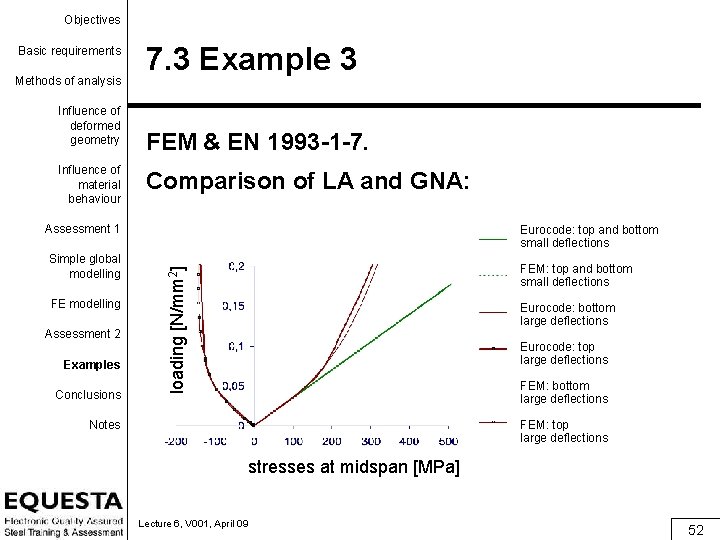
Objectives Basic requirements Methods of analysis Influence of deformed geometry Influence of material behaviour 7. 3 Example 3 FEM & EN 1993 -1 -7. Comparison of LA and GNA: Assessment 1 FE modelling Assessment 2 Examples Conclusions FEM: top and bottom small deflections loading [N/mm 2] Simple global modelling Eurocode: top and bottom small deflections Eurocode: bottom large deflections Eurocode: top large deflections FEM: bottom large deflections FEM: top large deflections Notes stresses at midspan [MPa] Lecture 6, V 001, April 09 52
Objectives Basic requirements Methods of analysis Influence of deformed geometry Influence of material behaviour 7. 3 Example 3 Summary of the comparison of LA and GNA for the thin plate in bending: Assessment 1 Simple global modelling FE modelling Assessment 2 Examples • Using GNA (large deflection theory of plates) the deflections and stresses for the same loading are lower than using LA (small deflection theory of plates). • LA gives uneconomic solution. Conclusions Notes Lecture 6, V 001, April 09 53
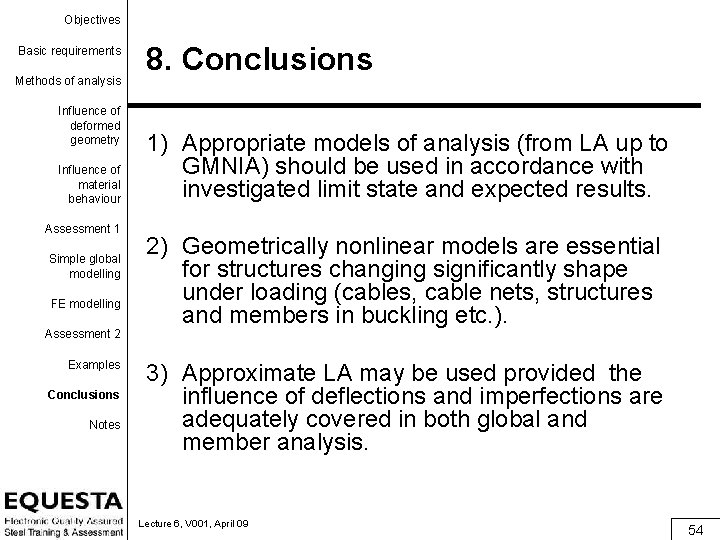
Objectives Basic requirements Methods of analysis Influence of deformed geometry Influence of material behaviour Assessment 1 Simple global modelling FE modelling Assessment 2 Examples Conclusions Notes 8. Conclusions 1) Appropriate models of analysis (from LA up to GMNIA) should be used in accordance with investigated limit state and expected results. 2) Geometrically nonlinear models are essential for structures changing significantly shape under loading (cables, cable nets, structures and members in buckling etc. ). 3) Approximate LA may be used provided the influence of deflections and imperfections are adequately covered in both global and member analysis. Lecture 6, V 001, April 09 54
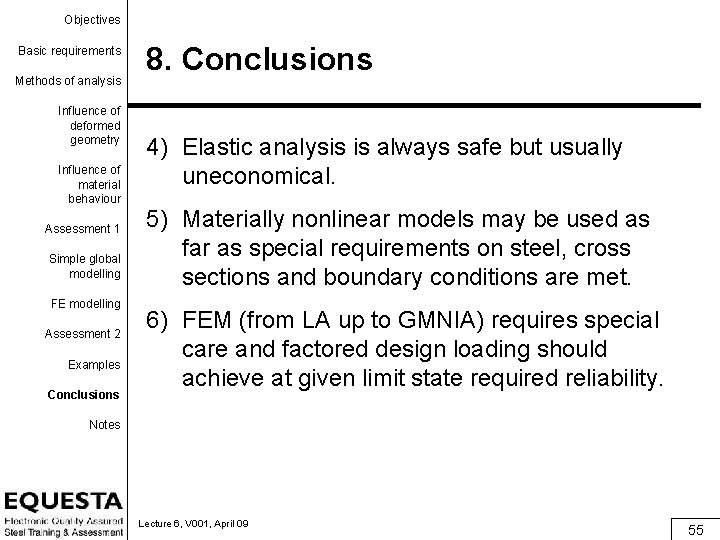
Objectives Basic requirements Methods of analysis Influence of deformed geometry Influence of material behaviour Assessment 1 Simple global modelling FE modelling Assessment 2 Examples Conclusions 8. Conclusions 4) Elastic analysis is always safe but usually uneconomical. 5) Materially nonlinear models may be used as far as special requirements on steel, cross sections and boundary conditions are met. 6) FEM (from LA up to GMNIA) requires special care and factored design loading should achieve at given limit state required reliability. Notes Lecture 6, V 001, April 09 55
Objectives Basic requirements Methods of analysis Influence of deformed geometry Influence of material behaviour Notes to Users of the Lecture • This session is for modelling and analysis of structures and requires about 60 minutes lecturing and 60 minutes tutorial session. • Within the lecturing, calculation models ranging from LA to GMNIA are described. Influence of deformed geometry and of material behaviour is shown with focus on multi-storey frames and floor elements. Analysis using FEM in general form and use of its results for design with harmony of Eurocodes is also presented. • Further readings on the relevant documents from website of www. access-steel. com and relevant standards of national standard institutions are strongly recommended. • Formative questions should be well answered before the summative questions completed within the tutorial session. • Keywords for the lecture: Assessment 1 Simple global modelling FE modelling Assessment 2 Examples Conclusions Notes calculation model, linear analysis, non-linear analysis, elastic analysis, plastic analysis, bifurcation analysis, sway frame, frame stability, FE analysis. Lecture 6, V 001, April 09 56
Objectives Basic requirements Methods of analysis Influence of deformed geometry Notes for lecturers • Subject: Modelling and analysis of structures. • Lecture duration: 60 minutes plus 60 minutes tutorial. • Keywords: calculation model, linear analysis, non-linear analysis, elastic analysis, plastic analysis, bifurcation analysis, sway frame, frame stability, FE analysis. Simple global modelling • Aspects to be discussed: types of analyses, requirements for use of various analyses, modelling of frames, trusses, beams. FE modelling • Within the lecturing, the modelling of multistorey frames incl. stability problems and GNA should be practised. Attention should also be paid to modelling of trusses and beams using LA and MNA. • Further reading: relevant documents www. access-steel. com and relevant standards of national standard institutions are strongly recommended. • Preparation for tutorial exercise: see examples within the lecture. Influence of material behaviour Assessment 1 Assessment 2 Examples Conclusions Notes Lecture 6, V 001, April 09 57